


Middle East And Africa Ambulatory Infusion Pumps Market
Market Size in USD Million
CAGR :
% 
 USD
18.81 Million
USD
29.98 Million
2025
2033
USD
18.81 Million
USD
29.98 Million
2025
2033
 Forecast Period Forecast Period |
2026 –2033 |
 Market Size (Base Year) Market Size (Base Year) |
USD 18.81 Million |
 Market Size (Forecast Year) Market Size (Forecast Year) |
USD 29.98 Million |
 CAGR CAGR |
% |
| Major Markets Players |
|
Middle East and Africa Ambulatory Infusion Pumps Market Size
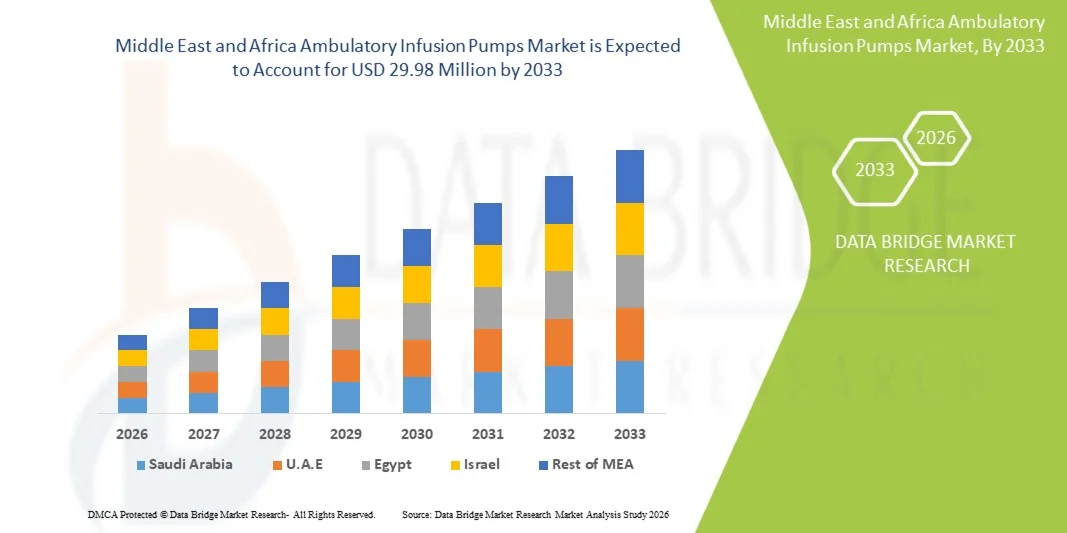
- The Middle East and Africa ambulatory infusion pumps market size was valued at USD 18.81 million in 2025 and is expected to reach USD 29.98 million by 2033, at a CAGR of 6.0% during the forecast period
- The market growth is largely fueled by the increasing prevalence of chronic diseases such as cancer, diabetes, and pain management requirements, along with the rising shift toward home-based and outpatient care across the region
- Furthermore, growing healthcare infrastructure development, expanding adoption of portable drug delivery systems, and increasing demand for cost-effective and patient-friendly infusion therapies are accelerating the uptake of ambulatory infusion pumps, thereby significantly boosting the industry’s growth
Middle East and Africa Ambulatory Infusion Pumps Market Analysis
- Ambulatory infusion pumps, designed for controlled and continuous drug delivery in portable formats, are increasingly important components of modern healthcare systems in Middle East and Africa countries due to rising demand for home-based care, improved patient mobility, and efficient long-term chronic disease management solutions
- The escalating demand for ambulatory infusion pumps is primarily fueled by the growing burden of chronic diseases such as cancer, diabetes, and gastrointestinal disorders, along with increasing adoption of outpatient and homecare treatment models to reduce hospital stays and improve patient outcomes
- Saudi Arabia dominated the ambulatory infusion pumps market with the largest revenue share of 31.3% in 2025, supported by advanced healthcare infrastructure, high healthcare spending, and rapid adoption of infusion-based therapies, with strong expansion in oncology treatment centers and hospital modernization initiatives driving market growth
- South Africa is expected to be the fastest growing country in the ambulatory infusion pumps market during the forecast period due to improving healthcare infrastructure, rising awareness of advanced drug delivery systems, and increasing investments in both public and private healthcare facilities
- The oncology segment dominated the ambulatory infusion pumps market with a market share of 38.6% in 2025, attributed to the high prevalence of cancer cases, increasing adoption of chemotherapy infusion therapies, and growing preference for ambulatory and home-based cancer treatment solutions across the region
Report Scope and Middle East and Africa Ambulatory Infusion Pumps Market Segmentation
|
Attributes |
Middle East and Africa Ambulatory Infusion Pumps Key Market Insights |
|
Segments Covered |
|
|
Countries Covered |
Middle East and Africa
|
|
Key Market Players |
|
|
Market Opportunities |
|
|
Value Added Data Infosets |
In addition to the insights on market scenarios such as market value, growth rate, segmentation, geographical coverage, and major players, the market reports curated by the Data Bridge Market Research also include in-depth expert analysis, patient epidemiology, pipeline analysis, pricing analysis, and regulatory framework |
Middle East and Africa Ambulatory Infusion Pumps Market Trends
“Rising Shift Toward Portable and Home-Based Infusion Therapy”
- A significant and accelerating trend in the Middle East and Africa ambulatory infusion pumps market is the increasing shift toward portable and home-based drug delivery systems, driven by the need for improved patient mobility and reduced hospital dependency
- For instance, in Saudi Arabia, leading hospitals are increasingly adopting ambulatory infusion pumps to support home chemotherapy and long-term pain management programs, improving treatment continuity outside clinical settings
- Advancements in lightweight elastomeric and electronic infusion pumps are enhancing accuracy, portability, and patient comfort, enabling safer and more efficient outpatient treatment across chronic disease segments
- The integration of ambulatory infusion pumps with digital monitoring systems and hospital information networks is enabling real-time dosage tracking and better clinical decision-making in connected healthcare environments
- This trend toward decentralized care delivery is reshaping treatment expectations, as healthcare providers increasingly prioritize patient-centric, cost-effective, and flexible infusion therapy solutions across the region
- The demand for ambulatory infusion pumps with improved portability and ease of use is growing rapidly across both public and private healthcare systems, as providers focus on reducing inpatient burden
- In addition, growing awareness among patients regarding self-administration and home infusion therapies is supporting faster acceptance of ambulatory pump-based treatment models
Middle East and Africa Ambulatory Infusion Pumps Market Dynamics
Driver
“Growing Burden of Chronic Diseases and Expansion of Homecare Treatment Models”
- The increasing prevalence of chronic diseases such as cancer, diabetes, and gastrointestinal disorders, coupled with the expansion of home-based care services, is a major driver for the growing demand for ambulatory infusion pumps
- For instance, in South Africa, oncology centers are expanding outpatient chemotherapy programs using ambulatory infusion pumps to reduce hospital congestion and improve patient quality of life
- Rising healthcare investments across Saudi Arabia and the UAE are supporting the adoption of advanced drug delivery systems, improving access to portable infusion technologies in both urban and semi-urban regions
- Furthermore, the shift toward cost-effective treatment models and shorter hospital stays is encouraging healthcare providers to adopt ambulatory infusion pumps for long-duration therapies
- The convenience of continuous drug administration, improved patient compliance, and reduced hospitalization costs are key factors propelling market growth in both public and private healthcare sectors
- Expanding awareness of advanced infusion technologies and increasing availability of trained healthcare professionals are further supporting adoption across the region
- Moreover, increasing cancer prevalence is driving higher chemotherapy infusion demand, significantly strengthening the need for ambulatory pump-based treatment solutions
- In addition, rising government initiatives to improve chronic disease management programs are accelerating the adoption of advanced infusion systems across major healthcare facilities
Restraint/Challenge
“High Device Costs and Limited Healthcare Infrastructure Accessibility”
- Concerns surrounding the high cost of advanced ambulatory infusion pump systems, along with limited access to modern healthcare infrastructure in certain Middle East and Africa countries, pose a significant challenge to broader market penetration
- For instance, in Egypt, smaller healthcare facilities often rely on traditional infusion methods due to budget constraints and limited reimbursement coverage for advanced portable pump systems
- The requirement for skilled healthcare professionals to manage and monitor infusion therapy increases operational complexity and restricts adoption in under-resourced healthcare settings
- In addition, inconsistent supply chain networks and limited availability of advanced medical devices in rural regions further hinder widespread deployment of ambulatory infusion pumps
- While awareness of portable infusion therapy is increasing, affordability challenges remain a barrier for large-scale adoption, particularly in lower-income healthcare systems
- Overcoming these challenges through improved healthcare funding, training programs, and expansion of distribution networks will be vital for sustained market growth
- Furthermore, lack of standardized reimbursement policies across several MEA countries limits patient access to advanced infusion therapies
- In addition, concerns regarding device maintenance and after-sales service availability in remote areas further restrict consistent market expansion
Middle East and Africa Ambulatory Infusion Pumps Market Scope
The market is segmented on the basis of product type, usage, route of administration, application, end user, and distribution channel.
- By Product Type
On the basis of product type, the market is segmented into devices, and accessories and consumables. The devices segment dominated the market with the largest revenue share of 62.4% in 2025, driven by the rising adoption of advanced infusion pump systems for precise and controlled drug delivery across chronic disease management. Hospitals and clinics increasingly prefer complete pump devices due to their ability to support multiple therapies such as oncology and pain management. The segment also benefits from continuous technological advancements improving accuracy, portability, and safety features. Growing investments in healthcare infrastructure across Saudi Arabia and the UAE further support device adoption. In addition, increasing demand for home-based infusion therapy is reinforcing the need for compact and user-friendly pump devices.
The accessories and consumables segment is expected to witness the fastest growth rate of 8.7% from 2026 to 2033, driven by recurring demand for infusion sets, tubing, and cartridges used in repeated therapy cycles. Rising patient volumes undergoing long-term treatments such as chemotherapy and diabetes management significantly increase consumables usage. Expanding homecare services across South Africa and Egypt further boost demand for disposable infusion components. The segment also benefits from cost-effective nature and frequent replacement cycles. Growing awareness of infection control and single-use medical products is accelerating adoption. Increasing penetration of ambulatory pumps in outpatient care is further strengthening this segment’s growth trajectory.
- By Usage
On the basis of usage, the market is segmented into disposable and reusable. The reusable segment dominated the market with a share of 58.1% in 2025, supported by its cost efficiency over long-term treatment cycles and widespread adoption in hospitals and specialty clinics. Reusable pumps are preferred in high-volume healthcare facilities due to their durability and ability to support multiple patients with proper sterilization. The segment also benefits from advancements in device longevity and battery performance. Increasing investments in hospital infrastructure across Saudi Arabia and the UAE support reusable system adoption. Furthermore, chronic disease management programs rely heavily on reusable systems for continuous therapy delivery.
The disposable segment is expected to witness the fastest growth rate of 9.3% from 2026 to 2033, driven by rising demand for infection-free, single-use infusion solutions in homecare and outpatient settings. Increasing cancer and antibiotic therapy treatments requiring short-term controlled infusion supports disposable usage. Hospitals are also shifting toward disposable systems to reduce cross-contamination risks. Growing awareness of patient safety standards further supports adoption. Expansion of ambulatory surgical centers in South Africa and Egypt is boosting demand. In addition, ease of use and reduced maintenance requirements are accelerating segment growth.
- By Route of Administration
On the basis of route of administration, the market is segmented into subcutaneous, intravenous, and epidural. The intravenous segment dominated the market with a share of 49.6% in 2025, driven by its widespread use in chemotherapy, antibiotics, and fluid therapy. IV administration is the most preferred route in hospitals due to its rapid drug absorption and precise dosing capabilities. The segment is strongly supported by oncology treatment demand across Saudi Arabia and South Africa. Increasing hospitalization rates for chronic diseases further strengthen IV usage. Advanced infusion pumps enabling accurate IV flow control also contribute to dominance.
The subcutaneous segment is expected to witness the fastest growth rate of 8.9% from 2026 to 2033, driven by rising adoption of home-based therapies and improved patient comfort. Subcutaneous delivery is increasingly used for diabetes and long-term pain management treatments. The segment benefits from reduced hospital dependency and easier self-administration. Growing awareness of minimally invasive drug delivery methods supports adoption. Expansion of homecare services in the UAE and Egypt further drives demand. In addition, technological advancements in portable pumps are improving accuracy and reliability of subcutaneous infusion therapy.
- By Application
On the basis of application, the market is segmented into emergency medicine, general anaesthesia, pain management, oncology, diabetes, gastroenterology, neonatology, and others. The oncology segment dominated the market with a share of 38.6% in 2025, driven by the high prevalence of cancer cases and increasing use of chemotherapy infusion therapies. Ambulatory pumps enable continuous and controlled drug delivery, improving patient outcomes in cancer treatment. Rising cancer incidence across Saudi Arabia and South Africa strongly supports segment growth. Expansion of oncology care centers and infusion clinics further reinforces dominance. Increasing preference for home-based chemotherapy is also boosting demand.
The pain management segment is expected to witness the fastest growth rate of 9.1% from 2026 to 2033, driven by rising cases of post-surgical and chronic pain conditions. Ambulatory infusion pumps provide effective and controlled analgesic delivery, improving patient comfort and recovery. Increasing surgical procedures across MEA countries support segment expansion. Growing adoption of opioid-sparing pain management techniques further drives demand. Expansion of ambulatory surgical centers enhances accessibility. In addition, rising awareness of continuous infusion-based pain relief therapies is accelerating growth.
- By End User
On the basis of end user, the market is segmented into hospitals, specialty clinics, ambulatory surgical centers, home care settings, and others. The hospitals segment dominated the market with a share of 54.7% in 2025, driven by high patient inflow and strong infrastructure for infusion therapy administration. Hospitals remain the primary centers for oncology and critical care treatments requiring ambulatory infusion pumps. Advanced healthcare systems in Saudi Arabia and the UAE further support hospital dominance. Availability of skilled professionals ensures safe and effective device usage. Increasing hospitalization rates for chronic diseases also reinforce demand.
The home care settings segment is expected to witness the fastest growth rate of 10.2% from 2026 to 2033, driven by rising preference for patient-centric and cost-effective treatment models. Homecare infusion therapy reduces hospital burden and improves patient quality of life. Growing elderly population and chronic disease prevalence strongly support segment expansion. Increasing availability of portable and user-friendly pumps further accelerates adoption. Expansion of healthcare insurance coverage in select MEA countries is boosting homecare services. In addition, technological advancements enabling remote monitoring are enhancing safety and reliability.
- By Distribution Channel
On the basis of distribution channel, the market is segmented into direct tender and retail sales. The direct tender segment dominated the market with a share of 67.8% in 2025, driven by bulk procurement of medical devices by hospitals and government healthcare systems. Public healthcare institutions across Saudi Arabia and South Africa primarily rely on tenders for cost-effective purchasing. Large-scale hospital infrastructure projects further support this channel. Strong relationships between manufacturers and healthcare providers also reinforce dominance. Increasing government investments in healthcare modernization contribute to steady demand.
The retail sales segment is expected to witness the fastest growth rate of 8.5% from 2026 to 2033, driven by increasing adoption of home-based care and outpatient treatments. Rising availability of ambulatory infusion pumps through medical device distributors and pharmacies supports accessibility. Growth in private healthcare spending across UAE and Egypt is boosting retail adoption. Increasing demand for personalized care solutions further drives this segment. Expansion of e-commerce medical platforms also supports growth. In addition, growing awareness of self-managed therapies is accelerating retail channel penetration.
Middle East and Africa Ambulatory Infusion Pumps Market Regional Analysis
- Saudi Arabia dominated the ambulatory infusion pumps market with the largest revenue share of 31.3% in 2025, supported by advanced healthcare infrastructure, high healthcare spending, and rapid adoption of infusion-based therapies, with strong expansion in oncology treatment centers and hospital modernization initiatives driving market growth
- Healthcare providers in the country highly value the precision, portability, and continuous drug delivery capabilities of ambulatory infusion pumps, particularly in oncology, diabetes, and pain management treatment applications
- This widespread adoption is further supported by ongoing hospital modernization programs, expansion of specialized care centers, and increasing integration of home-based care services, establishing ambulatory infusion pumps as a critical component of advanced healthcare delivery in Saudi Arabia
The Saudi Arabia Ambulatory Infusion Pumps Market Insight
The Saudi Arabia ambulatory infusion pumps market accounted for the largest market revenue share in Middle East and Africa in 2025, attributed to strong healthcare infrastructure, high healthcare spending, and rapid adoption of advanced medical technologies. Saudi Arabia stands as a leading market for infusion-based therapies, particularly in oncology and pain management applications. The push toward hospital modernization and expansion of specialized treatment centers is a key factor propelling demand. In addition, increasing integration of home-based care solutions and digital healthcare initiatives is further accelerating market adoption in the country.
South Africa Ambulatory Infusion Pumps Market Insight
The South Africa ambulatory infusion pumps market is anticipated to grow at a noteworthy CAGR during the forecast period, driven by rising burden of chronic diseases and increasing demand for cost-effective treatment solutions. The country is witnessing growing adoption of outpatient chemotherapy and long-term pain management therapies supported by ambulatory infusion systems. Expanding healthcare infrastructure and rising private sector investments are supporting market penetration. Furthermore, increasing awareness of advanced drug delivery technologies is encouraging adoption across hospitals and specialty clinics.
UAE Ambulatory Infusion Pumps Market Insight
The UAE ambulatory infusion pumps market is expected to expand at a considerable CAGR during the forecast period, fueled by strong healthcare modernization initiatives and growing adoption of smart medical technologies. The country’s well-developed healthcare infrastructure supports the use of advanced infusion systems in both hospital and homecare settings. Increasing focus on patient-centric care and medical tourism is further driving demand. Moreover, integration of digital health platforms with infusion therapy solutions is enhancing treatment efficiency and monitoring capabilities.
Egypt Ambulatory Infusion Pumps Market Insight
The Egypt ambulatory infusion pumps market is gaining momentum due to improving healthcare infrastructure, rising population burden of chronic diseases, and increasing accessibility to modern medical devices. The market is driven by growing demand for affordable and efficient drug delivery solutions in hospitals and outpatient settings. Government efforts to expand healthcare coverage and strengthen medical facilities are supporting adoption. In addition, increasing awareness of home-based treatment options is gradually contributing to market expansion.
Middle East and Africa Ambulatory Infusion Pumps Market Share
The Middle East and Africa Ambulatory Infusion Pumps industry is primarily led by well-established companies, including:
- B. Braun SE (Germany)
- Fresenius Kabi AG (Germany)
- Baxter (U.S.)
- ICU Medical, Inc. (U.S.)
- BD (U.S.)
- Smiths Group plc (U.K.)
- Terumo Corporation (Japan)
- Medtronic (Ireland)
- NIPRO Corporation (Japan)
- Vygon SA (France)
- Micrel Medical Devices S.A. (Greece)
- Caesarea Medical Electronics Ltd. (Israel)
- Eitan Medical Ltd. (Israel)
- Moog Inc. (U.S.)
- Zyno Medical LLC (U.S.)
- Arcomed AG (Switzerland)
- Fresenius Kabi Deutschland GmbH (Germany)
- Tricumed Medizintechnik GmbH (Germany)
- Mindray Medical International Limited (China)
What are the Recent Developments in Middle East and Africa Ambulatory Infusion Pumps Market?
- In February 2025, Becton Dickinson (BD) announced updated enhancements to its Alaris™ infusion system platform, focusing on improved interoperability, cybersecurity, and dose error reduction software. The upgraded system is designed to support hospital and ambulatory infusion workflows, enabling safer medication administration and better integration with electronic medical records across global markets, including Middle East healthcare systems adopting smart infusion technologies
- In June 2024, Baxter International expanded deployment of its Spectrum IQ infusion pump with Dose IQ Safety Software, enhancing medication accuracy and reducing infusion-related errors. The system supports both hospital and ambulatory care environments and is increasingly used in international hospital networks, including Middle East healthcare facilities focusing on oncology and critical care infusion therapy
- In September 2023, ICU Medical introduced enhancements to its Plum Duo™ infusion pump system, improving dual-channel infusion accuracy and safety features. The system is designed for hospital and outpatient care settings, including ambulatory infusion therapy applications. It supports increasing demand for precise drug delivery in oncology and pain management treatments globally, including adoption in emerging healthcare markets
- In May 2022, Fresenius Kabi announced enhancements to its Agilia® Connect infusion platform, integrating wireless connectivity and improved data monitoring capabilities. The system is designed for hospital and ambulatory use, enabling better control of drug administration and real-time infusion tracking. These upgrades support growing demand for smart infusion systems in both European and Middle Eastern healthcare facilities
- In November 2021, B. Braun expanded its Space Infusion System with enhanced connectivity and software-driven safety features such as DoseTrac and smart drug library integration. The system is widely used in hospitals and outpatient care settings, including infusion therapy programs in Middle East healthcare institutions focusing on oncology and chronic disease management
SKU-
Get online access to the report on the World's First Market Intelligence Cloud

- Interactive Data Analysis Dashboard
- Company Analysis Dashboard for high growth potential opportunities
- Research Analyst Access for customization & queries
- Competitor Analysis with Interactive dashboard
- Latest News, Updates & Trend analysis
- Harness the Power of Benchmark Analysis for Comprehensive Competitor Tracking
Research Methodology
Data collection and base year analysis are done using data collection modules with large sample sizes. The stage includes obtaining market information or related data through various sources and strategies. It includes examining and planning all the data acquired from the past in advance. It likewise envelops the examination of information inconsistencies seen across different information sources. The market data is analysed and estimated using market statistical and coherent models. Also, market share analysis and key trend analysis are the major success factors in the market report. To know more, please request an analyst call or drop down your inquiry.
The key research methodology used by DBMR research team is data triangulation which involves data mining, analysis of the impact of data variables on the market and primary (industry expert) validation. Data models include Vendor Positioning Grid, Market Time Line Analysis, Market Overview and Guide, Company Positioning Grid, Patent Analysis, Pricing Analysis, Company Market Share Analysis, Standards of Measurement, Global versus Regional and Vendor Share Analysis. To know more about the research methodology, drop in an inquiry to speak to our industry experts.
Customization Available
Data Bridge Market Research is a leader in advanced formative research. We take pride in servicing our existing and new customers with data and analysis that match and suits their goal. The report can be customized to include price trend analysis of target brands understanding the market for additional countries (ask for the list of countries), clinical trial results data, literature review, refurbished market and product base analysis. Market analysis of target competitors can be analyzed from technology-based analysis to market portfolio strategies. We can add as many competitors that you require data about in the format and data style you are looking for. Our team of analysts can also provide you data in crude raw excel files pivot tables (Fact book) or can assist you in creating presentations from the data sets available in the report.












