




Middle East And Africa Chromatography Solvents Market
Market Size in USD Million
CAGR :
% 
 USD
425.50 Million
USD
677.67 Million
2025
2033
USD
425.50 Million
USD
677.67 Million
2025
2033
 Forecast Period Forecast Period |
2026 –2033 |
 Market Size (Base Year) Market Size (Base Year) |
USD 425.50 Million |
 Market Size (Forecast Year) Market Size (Forecast Year) |
USD 677.67 Million |
 CAGR CAGR |
% |
| Major Markets Players |
|
Chromatography Solvents Market Size
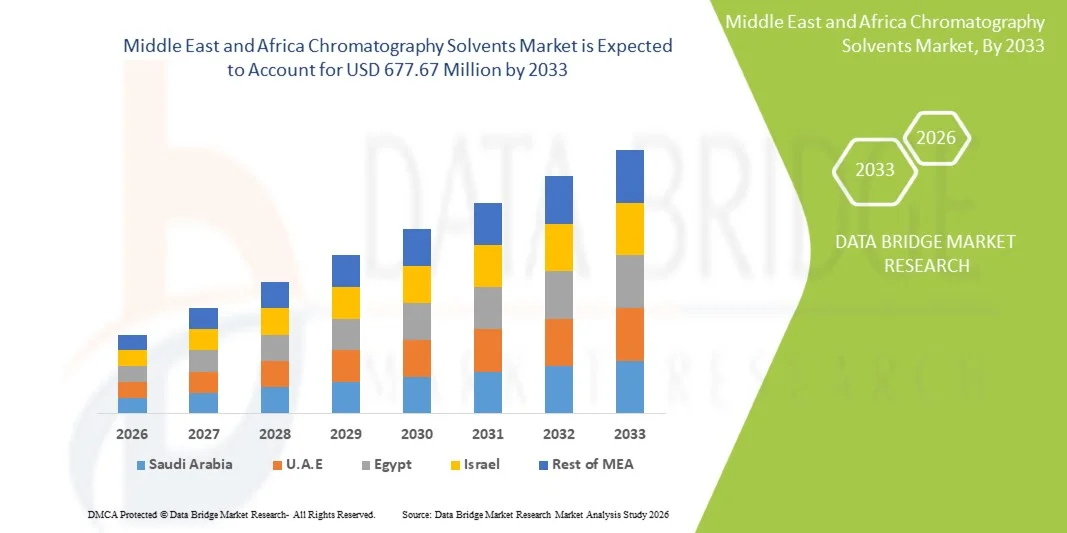
- The Middle East and Africa chromatography solvents market size was valued at USD 425.50 Million in 2024and is expected to reach USD 677.67 Million by 2033, at a CAGR of5.99% during the forecast period
- The market growth is largely fueled by the growing adoption and technological progress in advanced analytical techniques, particularly in pharmaceutical, biotechnology, food & beverage, and environmental testing sectors. These advancements are driving higher demand for high-purity chromatography solvents to ensure accuracy and reliability of analytical results
- Furthermore, rising consumer and regulatory emphasis on quality assurance, drug safety, and food testing is establishing chromatography solvents as an indispensable component across industries. These converging factors are accelerating the uptake of chromatography solvents solutions, thereby significantly boosting the industry’s growth
Chromatography Solvents Market Analysis
- Chromatography solvents, which include HPLC-grade and GC-grade solvents such as methanol, acetonitrile, hexane, and ethanol, are essential components in separation techniques widely used in pharmaceuticals, biotechnology, food & beverage testing, petrochemicals, and environmental analysis. Their role in enhancing accuracy, reproducibility, and sensitivity makes them a critical part of analytical testing processes across multiple industries.
- The growing demand for chromatography solvents is primarily fueled by the rapid expansion of pharmaceutical R&D, rising adoption of chromatography techniques in clinical diagnostics, increasing focus on food safety testing, and stringent regulations mandating quality analysis in drug development and environmental monitoring
- Saudi Arabia dominated the chromatography solvents market with the largest revenue share of 38.7% in 2024, driven by expanding pharmaceutical manufacturing, strong government investment in healthcare infrastructure, and increasing adoption of advanced analytical techniques in drug development and quality control. The country’s growing focus on localizing pharmaceutical production and strengthening regulatory standards further supports market dominance
- A.E. is expected to be the fastest growing region in the chromatography solvents market during the forecast period, driven by rapid expansion of the healthcare and life sciences sector, rising investments in biotechnology and research facilities, and the increasing establishment of advanced laboratories and contract research organizations. In addition, strong government initiatives to position the UAE as a regional hub for medical research and innovation are significantly accelerating market growth
- The polar solvents segment accounted for the largest revenue share of 68% in 2024, primarily due to their wide application in reverse-phase liquid chromatography and HPLC techniques, which dominate Middle East and Africa chromatography practices. Polar solvents such as methanol, acetonitrile, and water are critical for achieving high-resolution separations of polar and semi-polar compounds
Report Scope and Chromatography Solvents Market Segmentation
|
Attributes |
Chromatography Solvents Key Market Insights |
|
Segments Covered |
|
|
Countries Covered |
Middle East and Africa · Saudi Arabia · U.A.E. · South Africa · Egypt · Israel · Rest of Middle East and Africa |
|
Key Market Players |
· Merck KGaA (Germany) · Avantor, Inc. (U.S.) · Thermo Fisher Scientific Inc. (U.S.) · Columbus Chemicals (U.S.) · Elite Advanced Materials Sdn Bhd (Malaysia) · Biosolve Chimie (Netherlands) · GFS Chemicals, Inc. (U.S.) · Honeywell International Inc. (U.S.) · Orochem Technologies Inc. (U.S.) · Qualikems Lifesciences Private Limited (India) · Regis Technologies, Inc. (U.S.) · Romil Ltd. (U.K.) · Santa Cruz Biotechnology, Inc. (U.S.) · Spectrum Chemical (Canada) · Scharlab, S.L (Philippines) · Tokyo Chemical Industry (India) Pvt. Ltd. · Tedia Company Inc. (U.S.) · VWR International, LLC (U.S.) |
|
Market Opportunities |
· Rising Demand from Pharmaceutical and Biotechnology Industries · Expansion in Food Safety and Environmental Testing |
|
Value Added Data Infosets |
In addition to the insights on market scenarios such as market value, growth rate, segmentation, geographical coverage, and major players, the market reports curated by the Data Bridge Market Research also include in-depth expert analysis, pricing analysis, brand share analysis, consumer survey, demography analysis, supply chain analysis, value chain analysis, raw material/consumables overview, vendor selection criteria, PESTLE Analysis, Porter Analysis, and regulatory framework. |
Chromatography Solvents Market Trends
“Enhanced Convenience Through AI and Automation in Chromatography Solvents”
- A significant and accelerating trend in the Middle East and Africa chromatography solvents market is the deepening integration with artificial intelligence (AI), advanced automation, and digital laboratory ecosystems. This fusion of technologies is significantly enhancing laboratory efficiency, precision, and data reproducibility in chromatography applications
- For instance, automated chromatography systems now utilize AI-driven solvent selection algorithms to optimize solvent usage, reduce waste, and improve separation accuracy. In 2024, nearly 42.6% of chromatography laboratories globally reported adopting AI-assisted solvent management systems, a number expected to surpass 68.3% by 2033
- AI integration in chromatography solvents enables features such as predictive solvent optimization, pattern recognition in analyte separation, and real-time adjustments in solvent flow rates. For instance, next-generation HPLC and UHPLC systems are increasingly embedded with AI-based modules that can reduce analysis time by up to 30% while enhancing sensitivity for complex biomolecules and pharmaceutical compounds
- Furthermore, automation technologies are driving hands-free solvent preparation and blending, reducing manual errors, and allowing researchers to remotely monitor solvent consumption and system performance. This trend is particularly valuable in large-scale pharmaceutical R&D centers and food safety laboratories, where high throughput and error-free workflows are critical
- The seamless integration of chromatography solvents with cloud-based digital platforms and laboratory information management systems (LIMS) facilitates centralized control of experimental workflows. Through a single interface, researchers can manage solvent usage, analytical runs, and compliance documentation, creating a unified, data-driven laboratory environment
- This trend toward more intelligent, automated, and interconnected chromatography workflows is fundamentally reshaping user expectations for laboratory solvents. Consequently, companies such as Thermo Fisher Scientific, Merck KGaA, and Avantor are investing in AI-enabled solvent delivery systems and digitally integrated chromatography solutions
- The demand for automation- and AI-driven chromatography solvents is growing rapidly across pharmaceutical, biotechnology, and environmental testing sectors. By 2033, it is projected that over 60% of chromatography workflows will incorporate AI-based solvent optimization, reflecting a strong market shift toward efficiency, reproducibility, and sustainability
Chromatography Solvents Market Dynamics
Driver
“Growing Demand from Pharmaceutical, Biotechnology, and Food Testing Applications”
- The Chromatography Solvents market is witnessing significant growth due to the increasing reliance on chromatography techniques in pharmaceutical R&D, clinical diagnostics, biotechnology, and quality testing across industries. High-performance liquid chromatography (HPLC) and gas chromatography (GC) require ultra-pure solvents such as methanol, acetonitrile, ethanol, and hexane, making solvents a critical consumable in analytical laboratories
- For instance, in March 2024, Merck KGaA expanded its chromatography solvents portfolio with new high-purity grades designed to meet the growing requirements of regulatory-compliant pharmaceutical testing. Such product advancements by leading players are fueling industry expansion and helping laboratories meet stringent quality standards
- The rising prevalence of chronic diseases and the growing need for accurate drug discovery and development are driving demand for chromatography solvents in pharmaceutical and biopharmaceutical industries. Similarly, stricter government regulations regarding food safety, water testing, and environmental monitoring have increased the adoption of chromatography-based testing methods globally
- In addition, technological advancements in chromatography instruments, coupled with the growth of contract research organizations (CROs) and contract manufacturing organizations (CMOs), are further propelling the demand for high-quality solvents. Their use ensures precision, reproducibility, and compliance with international quality standards
Restraint/Challenge
“High Cost of High-Purity Solvents and Environmental Concerns”
- Despite strong growth prospects, the Chromatography Solvents market faces challenges due to the high cost of producing ultra-pure solvents, which are essential for analytical accuracy. Manufacturing these solvents requires advanced purification technologies and quality-control processes, resulting in higher costs compared to standard solvents. This makes adoption difficult for small-scale laboratories and price-sensitive markets, especially in developing economies
- In addition, environmental and health concerns related to solvent disposal pose a significant challenge. Many chromatography solvents, such as acetonitrile and methanol, are hazardous and require strict handling, storage, and disposal measures. Increasing regulatory restrictions regarding the safe use and disposal of organic solvents add operational complexity for laboratories and increase overall costs
- For instance, several Middle East and Africa regulatory agencies, including the U.S. Environmental Protection Agency (EPA) and the European Chemicals Agency (ECHA), have imposed stricter guidelines for the management of solvent waste, pushing companies to invest in greener alternatives and recycling technologies
- Another challenge is the limited availability and fluctuating prices of key raw materials, which can affect solvent supply and pricing stability. Shortages of acetonitrile in the past, due to production constraints, have highlighted the market’s vulnerability to supply chain disruptions
- Overcoming these challenges will require increased investment in sustainable solvent production, greater adoption of solvent recycling systems, and the development of cost-effective high-purity alternatives. Market players that can address these concerns while maintaining quality will be better positioned to capture growth opportunities
Chromatography Solvents Market Scope
The market is segmented on the basis of application, type , technology, and end user.
- By Application
On the basis of application, the Chromatography Solvents market is segmented into Analytical Chromatography and Preparative Chromatography. The analytical chromatography segment dominated the market with the largest revenue share of 62% in 2024, driven by its widespread use in drug development, clinical diagnostics, environmental monitoring, and food safety testing. The ability of analytical chromatography to provide highly accurate, reproducible, and sensitive separation of complex mixtures makes it indispensable across pharmaceutical and biotechnology industries. Analytical chromatography is further supported by the rising regulatory emphasis on quality control and the growing need for precise quantification in research applications. The increasing use of HPLC and UHPLC systems for small molecule and biomolecule characterization also enhances demand for solvents in this segment.
On the other hand, the preparative chromatography segment is projected to witness the fastest CAGR of 8.5% from 2026 to 2033, fueled by the rising adoption of chromatography in large-scale biomolecule purification, biopharmaceutical production, and natural product isolation. The ability to purify proteins, peptides, and active pharmaceutical ingredients (APIs) in bulk quantities is driving significant investment in preparative chromatography systems, making solvents in this segment increasingly critical. In addition , the growing demand for high-purity biologics and biosimilars is further accelerating the need for efficient separation and purification techniques, thereby boosting solvent consumption in preparative processes. Moreover, continuous advancements in automated and high-throughput purification technologies are improving process efficiency and scalability, further supporting segment expansion.
- By Type
On the basis of type, the Chromatography Solvents market is segmented into Polar Solvents and Non-Polar Solvents. The polar solvents segment accounted for the largest revenue share of 68% in 2024, primarily due to their wide application in reverse-phase liquid chromatography and HPLC techniques, which dominate Middle East and Africa chromatography practices. Polar solvents such as methanol, acetonitrile, and water are critical for achieving high-resolution separations of polar and semi-polar compounds. Their solubility characteristics, compatibility with detectors, and widespread availability further contribute to their dominance. Pharmaceutical and biotech industries particularly favor polar solvents because they provide consistent results for drug quality testing and biomolecule characterization.
Conversely, the non-polar solvents segment is projected to register the fastest CAGR of 9.2% during the forecast period, as they are increasingly being utilized in normal-phase chromatography and gas chromatography applications, particularly for separating hydrophobic compounds and lipophilic biomolecules. The expansion of natural product research and lipidomics is fueling adoption, alongside their growing use in the cosmetic and food industries, where non-polar analytes are critical. In addition, continuous advancements in high-resolution analytical techniques are further enhancing the demand for non-polar solvents in complex separation processes.
- By Technology
On the basis of technology, the Chromatography Solvents market is segmented into Liquid Chromatography, High-Pressure Liquid Chromatography (HPLC), Ultra High-Performance Liquid Chromatography (UHPLC), Gas Chromatography, and Others. The HPLC segment dominated the market in 2024, capturing the largest revenue share of 45%, due to its widespread application in pharmaceutical quality assurance, clinical diagnostics, and food testing laboratories. HPLC remains the gold standard for routine analysis because of its reliability, accuracy, and ability to handle a wide range of analytes. The rising demand for drug validation, stability testing, and regulatory compliance ensures strong adoption across industries.
In contrast, the UHPLC segment is projected to grow at the fastest CAGR of 10.1% from 2026 to 2033. The growth is attributed to its ability to deliver faster run times, higher resolution, and reduced solvent consumption, making it cost-effective for high-throughput labs. The increasing use of UHPLC in biopharmaceuticals, proteomics, and advanced drug discovery is accelerating adoption, as researchers seek more efficient techniques to manage large, complex datasets with greater sensitivity.
- By End-User
On the basis of end-user, the Chromatography Solvents market is segmented into Pharmaceutical Industry, Biotechnology Industry, Academics and Research, Environmental, Cosmetic Industry, and Food and Beverage. The pharmaceutical industry segment held the largest revenue share of 48% in 2024, driven by the expanding Middle East and Africa drug development pipeline, stringent quality assurance requirements, and increasing investments in clinical trials. Chromatography solvents are extensively used in drug discovery, formulation, and stability testing, making them vital in meeting FDA and EMA compliance standards. The pharmaceutical sector’s growing reliance on chromatography for precise quantification of APIs and impurities cements its leading role.
Meanwhile, the biotechnology industry is expected to register the fastest CAGR of 11.3% from 2026 to 2033. This growth is propelled by the rapid rise of biologics, biosimilars, gene therapies, and personalized medicines, all of which require advanced chromatography techniques for large biomolecule purification and analysis. The biotechnology sector’s expanding research activities in proteomics and metabolomics further enhance demand for chromatography solvents, making it the most dynamic growth driver in the forecast period.
Chromatography Solvents Market Regional Analysis
- The Middle East chromatography solvents market is projected to expand at a significant CAGR during the forecast period, driven by increasing demand for high-quality analytical testing in pharmaceuticals, biotechnology, food safety, and environmental monitoring
- The region is witnessing growing investments in healthcare infrastructure, expansion of local pharmaceutical manufacturing, and rising adoption of advanced analytical techniques such as HPLC and GC for drug development and quality control
- Strengthening regulatory frameworks and increasing focus on laboratory standardization are further supporting the adoption of chromatography solvents across research and industrial applications
Saudi Arabia Chromatography Solvents Market Insight
Saudi Arabia dominated the chromatography solvents market with the largest revenue share of 38.7% in 2024, supported by expanding pharmaceutical manufacturing capabilities, strong government investment in healthcare infrastructure, and increasing use of advanced analytical technologies in drug formulation and quality assurance. The country’s strategic focus on localizing pharmaceutical production under national development programs, along with stricter regulatory compliance for drug safety and quality, is significantly driving demand for high-purity chromatography solvents across research and industrial laboratories.
U.A.E. Chromatography Solvents Market Insight
The U.A.E. chromatography solvents market is expected to be the fastest growing in the Middle East during the forecast period, driven by rapid expansion of the healthcare and life sciences sector, increasing investment in biotechnology research facilities, and growing establishment of advanced analytical laboratories and contract research organizations (CROs). In addition, strong government initiatives aimed at positioning the U.A.E. as a regional hub for medical research, innovation, and pharmaceutical development are accelerating the adoption of chromatography techniques and associated solvent consumption.
Chromatography Solvents Market Share
The Chromatography Solvents industry is primarily led by well-established companies, including:
- Merck KGaA (Germany)
- Avantor, Inc. (U.S.)
- Thermo Fisher Scientific Inc. (U.S.)
- Columbus Chemicals (U.S.)
- Elite Advanced Materials Sdn Bhd (Malaysia)
- Biosolve Chimie (Netherlands)
- GFS Chemicals, Inc. (U.S.)
- Honeywell International Inc. (U.S.)
- Orochem Technologies Inc. (U.S.)
- Qualikems Lifesciences Private Limited (India)
- Regis Technologies, Inc. (U.S.)
- Romil Ltd. (U.K.)
- Santa Cruz Biotechnology, Inc. (U.S.)
- Spectrum Chemical (Canada)
- Scharlab, S.L (Philippines)
- Tokyo Chemical Industry (India) Pvt. Ltd.
- Tedia Company Inc. (U.S.)
- VWR International, LLC (U.S.)
Latest Developments in Middle East and Africa Chromatography Solvents Market
- In April 2024, INEOS Nitriles announced the first sales of INVIREO™ bio-based acetonitrile, a key solvent widely used in HPLC/LC-MS workflows, citing up to a 90% carbon-footprint reduction versus fossil routes. This marks a notable sustainability milestone for chromatographic solvent supply
- In March 2024, Thermo Fisher Scientific unveiled the Dionex Integrion XT Ion Chromatography system to increase throughput and robustness in IC workflows—an advance expected to lift consumption of high-purity eluents and suppressor-compatible solvents in analytical labs
SKU-
Get online access to the report on the World's First Market Intelligence Cloud

- Interactive Data Analysis Dashboard
- Company Analysis Dashboard for high growth potential opportunities
- Research Analyst Access for customization & queries
- Competitor Analysis with Interactive dashboard
- Latest News, Updates & Trend analysis
- Harness the Power of Benchmark Analysis for Comprehensive Competitor Tracking
Research Methodology
Data collection and base year analysis are done using data collection modules with large sample sizes. The stage includes obtaining market information or related data through various sources and strategies. It includes examining and planning all the data acquired from the past in advance. It likewise envelops the examination of information inconsistencies seen across different information sources. The market data is analysed and estimated using market statistical and coherent models. Also, market share analysis and key trend analysis are the major success factors in the market report. To know more, please request an analyst call or drop down your inquiry.
The key research methodology used by DBMR research team is data triangulation which involves data mining, analysis of the impact of data variables on the market and primary (industry expert) validation. Data models include Vendor Positioning Grid, Market Time Line Analysis, Market Overview and Guide, Company Positioning Grid, Patent Analysis, Pricing Analysis, Company Market Share Analysis, Standards of Measurement, Global versus Regional and Vendor Share Analysis. To know more about the research methodology, drop in an inquiry to speak to our industry experts.
Customization Available
Data Bridge Market Research is a leader in advanced formative research. We take pride in servicing our existing and new customers with data and analysis that match and suits their goal. The report can be customized to include price trend analysis of target brands understanding the market for additional countries (ask for the list of countries), clinical trial results data, literature review, refurbished market and product base analysis. Market analysis of target competitors can be analyzed from technology-based analysis to market portfolio strategies. We can add as many competitors that you require data about in the format and data style you are looking for. Our team of analysts can also provide you data in crude raw excel files pivot tables (Fact book) or can assist you in creating presentations from the data sets available in the report.












