




Middle East And Africa Hollow Core Insulator Market
Market Size in USD Billion
CAGR :
% 
 USD
34.09 Billion
USD
43.52 Billion
2025
2033
USD
34.09 Billion
USD
43.52 Billion
2025
2033
 Forecast Period Forecast Period |
2026 –2033 |
 Market Size (Base Year) Market Size (Base Year) |
USD 34.09 Billion |
 Market Size (Forecast Year) Market Size (Forecast Year) |
USD 43.52 Billion |
 CAGR CAGR |
% |
| Major Markets Players |
|
Middle East and Africa Hollow Core Insulator Market Size
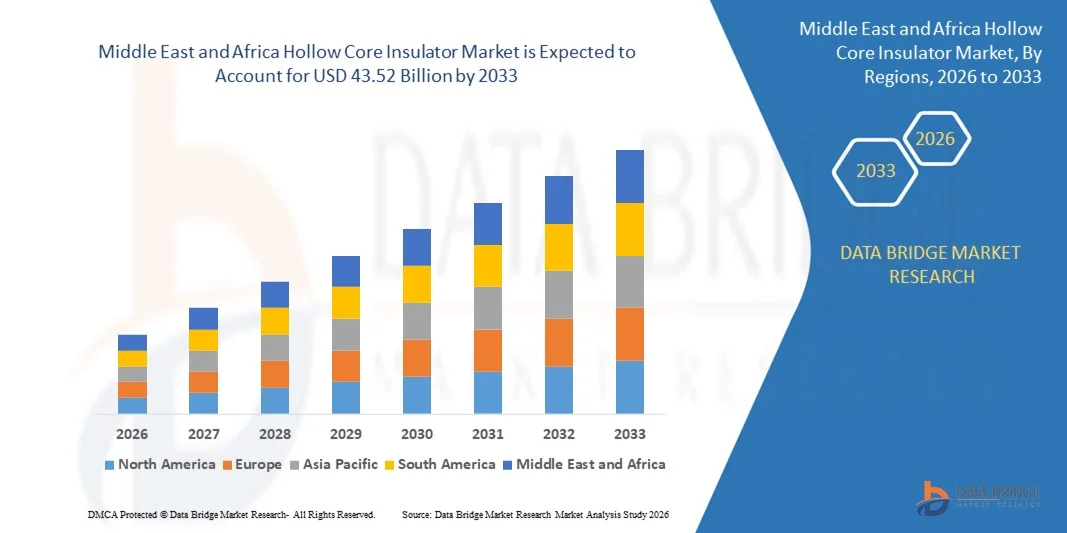
- The Middle East and Africa hollow core insulator market size was valued at USD 34.09 billion in 2025 and is expected to reach USD 43.52 billion by 2033, at a CAGR of 3.1% during the forecast period
- The market growth is largely fueled by expanding high-voltage transmission and distribution infrastructure driven by rising global electricity demand and increasing investments in grid expansion projects. Utilities are upgrading aging power networks with advanced insulation components capable of handling high electrical stress, which is increasing the adoption of hollow core insulators in substations and transmission equipment
- Furthermore, the growing integration of renewable energy sources such as solar and wind into national power grids is generating strong demand for reliable high-voltage insulation solutions. Hollow core insulators provide high mechanical strength, electrical insulation, and environmental resistance, supporting their use in circuit breakers, surge arresters, and instrument transformers across modern power transmission systems
Middle East and Africa Hollow Core Insulator Market Analysis
- Hollow core insulators provide electrical insulation and mechanical support for high-voltage equipment and are widely used in substations and transmission systems. Their ability to withstand high voltage levels and harsh environmental conditions makes them critical components in applications such as circuit breakers, bushings, and instrument transformers
- The demand for hollow core insulators is increasing due to rising investments in grid modernization and expansion of high-voltage transmission networks. In addition, utilities are prioritizing durable and high-performance insulation systems to improve grid reliability and reduce maintenance requirements, supporting steady market growth
- Saudi Arabia dominated the hollow core insulator market in 2025, due to extensive investments in power transmission infrastructure, expansion of high-voltage substations, and increasing electricity demand from industrial and urban development projects
- U.A.E. is expected to be the fastest growing country in the hollow core insulator market during the forecast period due to strong investments in electricity transmission infrastructure and the development of advanced substations to support growing urban and industrial demand
- High Temperature Vulcanizing (HTV) silicon rubber segment dominated the market with a market share of 52.5% in 2025, due to its high mechanical strength, excellent weather resistance, and proven track record in outdoor insulator applications. HTV insulators offer long-term reliability and are widely adopted across transmission and distribution networks for stable performance under high-voltage stress. Their cost-effectiveness and compatibility with conventional designs further reinforce market dominance
Report Scope and Hollow Core Insulator Market Segmentation
|
Attributes |
Hollow Core Insulator Key Market Insights |
|
Segments Covered |
|
|
Countries Covered |
Middle East and Africa
|
|
Key Market Players |
|
|
Market Opportunities |
|
|
Value Added Data Infosets |
In addition to the market insights such as market value, growth rate, market segments, geographical coverage, market players, and market scenario, the market report curated by the Data Bridge Market Research team includes in-depth expert analysis, import/export analysis, pricing analysis, production consumption analysis, and pestle analysis. |
Middle East and Africa Hollow Core Insulator Market Trends
Rising Adoption of Composite Hollow Core Insulators
- A significant trend in the hollow core insulator market is the growing adoption of composite hollow core insulators in high-voltage transmission and substation applications due to their superior mechanical strength, lightweight structure, and enhanced resistance to environmental stress
- For instance, Hitachi Energy manufactures composite hollow core insulators used in high-voltage circuit breakers and gas-insulated switchgear for transmission networks. These products are widely deployed in modern substations to improve insulation performance and ensure long-term operational stability in demanding electrical environments
- The expansion of ultra-high voltage transmission systems is accelerating the demand for durable insulation components capable of supporting higher electrical loads and improving grid stability. Hollow core insulators play a critical role in maintaining insulation integrity and mechanical support in equipment operating under high electrical stress
- Power utilities are increasingly prioritizing materials that provide resistance to pollution, moisture, and extreme weather conditions, particularly in regions with challenging environmental conditions. Composite hollow core insulators offer improved hydrophobic properties that help maintain insulation performance even under contaminated or humid operating conditions
- Infrastructure modernization programs across global electricity networks are encouraging the deployment of advanced insulation technologies that enhance grid efficiency and equipment reliability. Hollow core insulators are gaining attention as essential components in switchgear, circuit breakers, and instrument transformers used in upgraded power systems
- The growing transition toward resilient and high-capacity electricity transmission networks continues to strengthen the adoption of composite hollow core insulators. This trend is reinforcing the importance of advanced insulation technologies in supporting safer, more reliable, and higher-performance electrical infrastructure worldwide
Middle East and Africa Hollow Core Insulator Market Dynamics
Driver
Rising Investments in Power Grid Expansion and Modernization
- Increasing investments in power grid expansion and modernization projects are driving the demand for hollow core insulators as utilities upgrade aging transmission infrastructure and build new substations to support growing electricity consumption. These components play a crucial role in maintaining electrical insulation and mechanical stability in high-voltage equipment used in modern power networks
- For instance, Power Grid Corporation of India Limited continues to invest in large-scale transmission expansion projects to strengthen India’s national electricity grid. Such initiatives require advanced high-voltage equipment including circuit breakers and instrument transformers that utilize hollow core insulators to maintain operational safety and efficiency
- The integration of renewable energy sources into national power systems is increasing the need for expanded transmission infrastructure capable of handling variable energy generation. Hollow core insulators support reliable operation of electrical equipment used in renewable energy transmission networks
- Governments and utilities across multiple regions are investing heavily in upgrading substations and high-voltage transmission lines to improve grid resilience and minimize power disruptions. These developments are strengthening the demand for durable insulation solutions that can support modern high-capacity power systems
- The continued focus on strengthening power transmission infrastructure and improving grid reliability is expected to reinforce the demand for hollow core insulators. Rising investments in modern electrical systems are positioning these components as essential elements in supporting efficient and secure power distribution networks
Restraint/Challenge
High Manufacturing Costs of Advanced Insulators
- The hollow core insulator market faces challenges associated with the high manufacturing costs of advanced insulation products, particularly those made from composite materials that require specialized production techniques and high-quality raw materials. These cost factors increase the overall price of high-voltage equipment and can limit adoption in cost-sensitive infrastructure projects
- For instance, Siemens Energy manufactures high-voltage switchgear and power transmission equipment that incorporates advanced composite hollow core insulators. The precision engineering and high-performance materials required for these components increase production complexity and contribute to elevated manufacturing costs
- Producing hollow core insulators requires strict quality control and advanced molding processes to ensure mechanical strength, electrical insulation capability, and long-term durability. These stringent manufacturing requirements extend production cycles and increase operational expenses for manufacturers
- The use of specialized materials such as fiberglass reinforced epoxy and high-grade silicone rubber further contributes to higher production costs. Manufacturers must maintain consistent material quality to ensure performance reliability in high-voltage applications operating under extreme electrical and environmental stress
- These cost-related challenges continue to influence procurement decisions for utilities and equipment manufacturers. Addressing manufacturing efficiency and material cost management remains essential for sustaining broader adoption of hollow core insulators in expanding high-voltage power infrastructure projects
Middle East and Africa Hollow Core Insulator Market Scope
The market is segmented on the basis of voltage rating, shed material type, shed design, product type, and application.
- By Voltage Rating
On the basis of voltage rating, the hollow core insulator market is segmented into below 300 KV, 300–600 KV, and above 600 KV. The below 300 KV segment dominated the market with the largest revenue share in 2025, driven by its extensive use in distribution networks and regional substations. Utilities and industrial facilities often prefer these insulators for their cost-effectiveness, reliability, and ease of installation in medium-voltage systems. The segment also benefits from compatibility with existing infrastructure and proven performance under varying environmental conditions, making it a standard choice for many power distribution applications.
The above 600 KV segment is expected to witness the fastest growth from 2026 to 2033, fueled by rising demand for ultra-high-voltage transmission networks to support long-distance power transfer. For instance, companies such as ABB are expanding deployment of high-voltage insulators in cross-country transmission lines. Increasing focus on grid modernization, renewable energy integration, and reduction of transmission losses also drives the adoption of above 600 KV hollow core insulators. Their ability to withstand extreme electrical stress and environmental conditions ensures robust performance, encouraging utilities to invest in higher-voltage systems.
- By Shed Material Type
On the basis of shed material, the hollow core insulator market is segmented into High Temperature Vulcanizing (HTV) silicon rubber and Liquid Silicon Rubber (LSR). The HTV silicon rubber segment dominated the market with the largest revenue share 52.5%in 2025, owing to its high mechanical strength, excellent weather resistance, and proven track record in outdoor insulator applications. HTV insulators offer long-term reliability and are widely adopted across transmission and distribution networks for stable performance under high-voltage stress. Their cost-effectiveness and compatibility with conventional designs further reinforce market dominance.
The LSR segment is expected to witness the fastest growth from 2026 to 2033, driven by advancements in manufacturing processes and increasing demand for lightweight, high-performance insulators. For instance, 3M and other key manufacturers are deploying LSR insulators in advanced transmission and smart grid projects. LSR’s superior hydrophobicity, resistance to contamination, and adaptability to complex shed designs make it highly suitable for modern high-voltage applications, supporting rapid adoption.
- By Shed Design
On the basis of shed design, the hollow core insulator market is segmented into plain shed, alternating shed, single rib shed, double rib shed, and super deep rib shed. The plain shed segment dominated the market with the largest revenue share in 2025, driven by its simple design, cost efficiency, and suitability for standard electrical installations. Utilities prefer plain shed insulators for reliable performance in conventional substations and distribution lines where moderate insulation requirements exist. Their ease of maintenance and proven reliability under diverse environmental conditions make them a popular choice.
The super deep rib shed segment is expected to witness the fastest growth from 2026 to 2033, fueled by increasing demand for insulators with higher creepage distances and enhanced pollution performance. For instance, manufacturers such as L&T are supplying super deep rib shed insulators for coastal and industrial areas prone to high contamination. The design enhances leakage current control, reduces maintenance needs, and supports efficient performance in challenging environments, making it a preferred option for next-generation transmission networks.
- By Product Type
On the basis of product type, the hollow core insulator market is segmented into ceramic and composite. The ceramic segment dominated the market with the largest revenue share in 2025, driven by its well-established use in high-voltage transmission and substation applications. Ceramic insulators offer excellent mechanical and electrical properties, long service life, and resistance to environmental stress, ensuring consistent performance in outdoor installations. Utilities continue to favor ceramic types due to their proven reliability, low maintenance requirements, and compatibility with conventional transmission infrastructure.
The composite segment is expected to witness the fastest growth from 2026 to 2033, supported by lightweight construction, high pollution performance, and improved hydrophobicity. For instance, companies such as Siemens and ABB are increasingly deploying composite hollow core insulators in smart grid and renewable energy projects. The ability to withstand extreme weather, reduce handling costs, and integrate with innovative transmission solutions drives rapid adoption of composite designs.
- By Application
On the basis of application, the hollow core insulator market is segmented into instrument transformers, circuit breakers, surge arresters, bushing, switching gear, station post, and cable termination. The instrument transformer segment dominated the market with the largest revenue share in 2025, owing to the critical role of insulators in ensuring accurate voltage and current measurement in power networks. High reliability and electrical performance of hollow core insulators make them essential for instrument transformer safety and longevity. Utilities prioritize these insulators to maintain grid stability and prevent operational disruptions.
The surge arrester segment is expected to witness the fastest growth from 2026 to 2033, driven by the rising deployment of power grids in regions with high lightning activity and voltage fluctuation concerns. For instance, Schneider Electric is expanding its hollow core insulator solutions for surge arrester applications in high-risk zones. Enhanced electrical insulation, superior mechanical strength, and resistance to transient overvoltages make surge arrester insulators increasingly preferred in modern transmission and distribution systems.
Middle East and Africa Hollow Core Insulator Market Regional Analysis
- Saudi Arabia dominated the hollow core insulator market with the largest revenue share in 2025, driven by extensive investments in power transmission infrastructure, expansion of high-voltage substations, and increasing electricity demand from industrial and urban development projects
- Growing deployment of high-voltage switchgear, circuit breakers, and gas-insulated substations across utility networks and large-scale energy projects continues to strengthen the demand for hollow core insulators throughout the country
- The presence of major energy infrastructure initiatives led by organizations such as Saudi Electricity Company, along with increasing participation of global power equipment manufacturers, reinforces Saudi Arabia’s leadership position
U.A.E. Hollow Core Insulator Market Insight
The U.A.E. is projected to record the fastest CAGR in the Middle East and Africa hollow core insulator market from 2026 to 2033, supported by strong investments in electricity transmission infrastructure and the development of advanced substations to support growing urban and industrial demand. The country is witnessing increasing adoption of high-performance electrical equipment designed to improve grid reliability and efficiency. Expanding renewable energy integration projects and modernization of power distribution networks are accelerating demand for advanced insulation components. Major utilities such as Dubai Electricity and Water Authority are investing in grid upgrades and smart energy systems that require reliable high-voltage equipment. These initiatives position the U.A.E. as the fastest-growing market for hollow core insulators in the region.
South Africa Hollow Core Insulator Market Insight
South Africa is expected to witness steady growth between 2026 and 2033, driven by ongoing efforts to strengthen electricity transmission infrastructure and improve the reliability of national power networks. Increasing investments in substation upgrades and high-voltage transmission projects are supporting consistent demand for hollow core insulators. The growing use of advanced electrical equipment in energy and industrial sectors is further encouraging adoption of durable insulation components. State utility organizations such as Eskom are undertaking infrastructure modernization initiatives to stabilize electricity supply and support expanding energy demand. Continued focus on improving grid stability and transmission efficiency is contributing to stable long-term growth in South Africa’s hollow core insulator market.
Middle East and Africa Hollow Core Insulator Market Share
The hollow core insulator industry is primarily led by well-established companies, including:
- PPC Austria Holding GmbH (Austria)
- CTC INSULATOR (Turkey)
- Modern Insulators Ltd. (India)
- PFISTERER Holding AG (Germany)
- Jiangsu Shenma Electric Power Co., Ltd (China)
- Maschinenfabrik Reinhausen GmbH (Germany)
- SAVER S.p.A (Italy)
- Nanjing Electric (Group)Co.,Ltd. (China)
- NGK INSULATORS, LTD (Japan)
- ZPE ZAPEL S.A (Poland)
- Zhengzhou Orient Power Co., Ltd (China)
- SANDIAN ELECTRIC (China)
- Aditya Birla Insulators (India)
- MacLean-Fogg (U.S.)
- Global Insulator Group LLC (U.S.)
- Royalinsulator (Turkey)
- Hitachi ABB Power Grids (Switzerland)
- Fujian Ruisen New Materials Co., Ltd. (China)
- Dalian Hivolt Power System Co., Ltd. (China)
- Newell & Hindustan Urban Infrastructure Ltd. (India)
Latest Developments in Middle East and Africa Hollow Core Insulator Market
- In December 2025, Trench Group expanded its manufacturing and production capabilities by acquiring additional production assets focused on hollow core insulators. This expansion significantly increased the company’s production capacity, enabling it to meet the rising demand from transmission and distribution networks globally. By strengthening supply chain resilience, Trench Group can deliver faster, more reliable supply to utilities and infrastructure projects, supporting the adoption of advanced insulators in grid modernization and renewable energy integration initiatives. This move also positions the company to capture a larger market share in high-growth regions where the demand for composite insulators is surging
- In September 2025, the hollow core insulator market witnessed a marked increase in the deployment of smart sensor‑enabled insulation solutions designed for predictive maintenance and real-time asset monitoring. These intelligent insulators allow utilities to monitor voltage, temperature, and leakage currents, providing actionable insights to prevent failures and optimize maintenance schedules. The adoption of such technology enhances grid reliability, reduces downtime, and minimizes operational costs, making sensor-enabled hollow core insulators a critical component for modern smart grids. This trend is also driving differentiation among manufacturers, encouraging innovation and the introduction of value-added products
- In May 2022, Aditya Birla Power Composites Limited (ABPCL) inaugurated its first composite hollow core insulators manufacturing facility at Halol, Gujarat. The new facility expanded domestic manufacturing capabilities for high-performance insulators, reducing dependence on imports and supporting India’s growing transmission and distribution infrastructure needs. The availability of locally manufactured composite insulators with improved mechanical and electrical performance strengthens ABPCL’s market positioning and provides utilities with reliable, cost-efficient solutions for high-voltage applications, driving adoption in both industrial and utility segments
- In January 2024, General Electric Company introduced a new line of composite hollow core insulators optimized for high-voltage applications, featuring advanced materials that improve mechanical strength, hydrophobicity, and long-term reliability. These insulators are designed to withstand harsh environmental conditions and high electrical stress, reducing maintenance cycles and ensuring uninterrupted operation in critical transmission networks. The launch enhances GE’s portfolio of high-performance insulators and supports utilities’ efforts to enhance grid resilience while adopting modern, durable components
- In August 2021, Hitachi ABB Power Grids launched its EconiQ eco-efficient high-voltage portfolio, including the first commercially available SF6-alternative gas-insulated switchgear with circuit breakers. This portfolio reduces environmental impact by lowering greenhouse gas emissions and supports sustainable power transmission practices. The innovation demonstrates the company’s commitment to eco-efficient solutions, promotes adoption of environmentally friendly high-voltage equipment, and strengthens its competitive positioning in the market for sustainable and high-performance grid components
SKU-
Get online access to the report on the World's First Market Intelligence Cloud

- Interactive Data Analysis Dashboard
- Company Analysis Dashboard for high growth potential opportunities
- Research Analyst Access for customization & queries
- Competitor Analysis with Interactive dashboard
- Latest News, Updates & Trend analysis
- Harness the Power of Benchmark Analysis for Comprehensive Competitor Tracking
Research Methodology
Data collection and base year analysis are done using data collection modules with large sample sizes. The stage includes obtaining market information or related data through various sources and strategies. It includes examining and planning all the data acquired from the past in advance. It likewise envelops the examination of information inconsistencies seen across different information sources. The market data is analysed and estimated using market statistical and coherent models. Also, market share analysis and key trend analysis are the major success factors in the market report. To know more, please request an analyst call or drop down your inquiry.
The key research methodology used by DBMR research team is data triangulation which involves data mining, analysis of the impact of data variables on the market and primary (industry expert) validation. Data models include Vendor Positioning Grid, Market Time Line Analysis, Market Overview and Guide, Company Positioning Grid, Patent Analysis, Pricing Analysis, Company Market Share Analysis, Standards of Measurement, Global versus Regional and Vendor Share Analysis. To know more about the research methodology, drop in an inquiry to speak to our industry experts.
Customization Available
Data Bridge Market Research is a leader in advanced formative research. We take pride in servicing our existing and new customers with data and analysis that match and suits their goal. The report can be customized to include price trend analysis of target brands understanding the market for additional countries (ask for the list of countries), clinical trial results data, literature review, refurbished market and product base analysis. Market analysis of target competitors can be analyzed from technology-based analysis to market portfolio strategies. We can add as many competitors that you require data about in the format and data style you are looking for. Our team of analysts can also provide you data in crude raw excel files pivot tables (Fact book) or can assist you in creating presentations from the data sets available in the report.












