




Middle East And Africa Meditation Market
Market Size in USD Million
CAGR :
% 
 USD
356.11 Million
USD
1,276.34 Million
2025
2033
USD
356.11 Million
USD
1,276.34 Million
2025
2033
 Forecast Period Forecast Period |
2026 –2033 |
 Market Size (Base Year) Market Size (Base Year) |
USD 356.11 Million |
 Market Size (Forecast Year) Market Size (Forecast Year) |
USD 1,276.34 Million |
 CAGR CAGR |
% |
| Major Markets Players |
|
Middle East and Africa Meditation Market Size
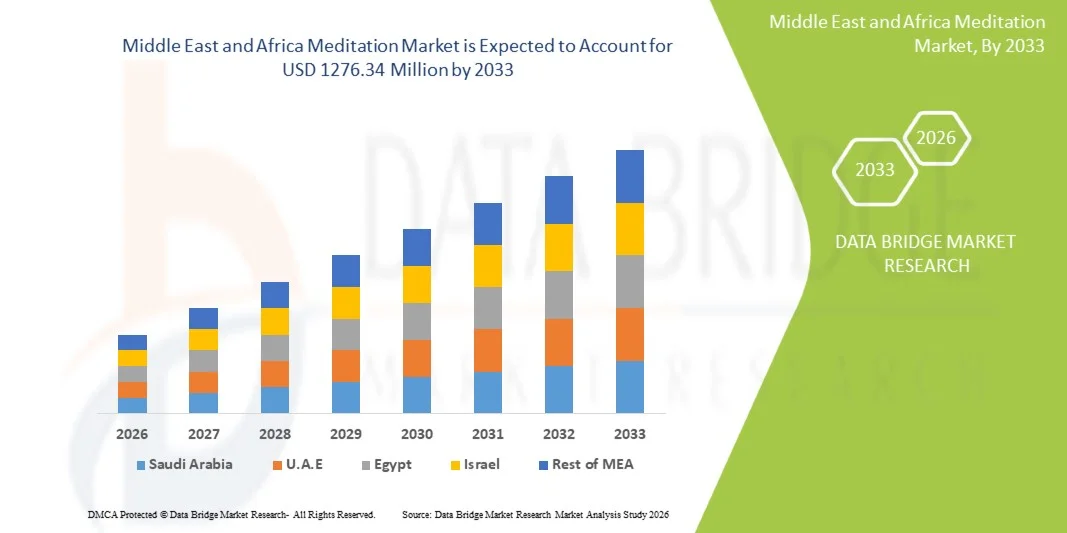
- The Middle East and Africa Meditation market size was valued at USD 356.11 Million in 2025 and is expected to reach USD 1276.34 Million by 2033, at a CAGR of 17.30% during the forecast period
- The market growth is largely fueled by the increasing adoption of digital wellness platforms, growing integration of mobile health applications, and continuous technological advancements in guided meditation tools, wearable devices, and AI-powered mindfulness solutions across healthcare and consumer wellness sectors
- Furthermore, rising consumer demand for stress reduction, improved mental well-being, better sleep quality, and holistic self-care solutions is establishing Meditation as a widely accepted modern wellness practice. These converging factors are accelerating the uptake of Meditation solutions, thereby significantly boosting the industry's growth
Middle East and Africa Meditation Market Analysis
- Meditation practices, including mindfulness meditation, guided meditation, transcendental meditation, and breathing-based relaxation techniques, are increasingly vital components of modern mental wellness and healthcare systems due to their effectiveness in stress reduction, emotional regulation, and overall psychological well-being
- The escalating demand for Meditation is primarily fueled by rising mental health awareness, increasing stress levels due to urban lifestyles, growing adoption of digital wellness platforms, and expanding integration of meditation into corporate wellness programs and healthcare treatments
- Saudi Arabia dominated the Meditation market with the largest revenue share of 34.6% in 2025, characterized by increasing mental health awareness initiatives, strong government focus on wellness programs under healthcare transformation strategies, rising disposable incomes, and growing adoption of digital mindfulness and wellness applications across urban populations
- U.A.E. is expected to be the fastest-growing region in the Meditation market during the forecast period, projected to register a CAGR of 10.9%, due to rapid urbanization, expanding wellness tourism industry, increasing adoption of digital health platforms, strong corporate wellness initiatives, and rising awareness of mental well-being practices
- The individual segment dominated the largest market revenue share of 68.9% in 2025, driven by rising demand for personalized wellness routines. Users prefer flexible, self-paced meditation practices
Report Scope and Middle East and Africa Meditation Market Segmentation
|
Attributes |
Meditation Key Market Insights |
|
Segments Covered |
|
|
Countries Covered |
Middle East and Africa
|
|
Key Market Players |
|
|
Market Opportunities |
|
|
Value Added Data Infosets |
In addition to the insights on market scenarios such as market value, growth rate, segmentation, geographical coverage, and major players, the market reports curated by the Data Bridge Market Research also include in-depth expert analysis, patient epidemiology, pipeline analysis, pricing analysis, and regulatory framework. |
Middle East and Africa Meditation Market Trends
“Rising Focus on Stress Reduction, Digital Wellness, and Personalized Mindfulness Practices”
- A significant and accelerating trend in the global Meditation market is the increasing adoption of structured mindfulness programs tailored to individual stress levels, lifestyle patterns, and mental well-being needs. Consumers are shifting from traditional, generalized meditation practices toward more guided, outcome-oriented approaches focused on anxiety reduction, sleep improvement, and emotional balance
- For instance, workplace wellness programs and healthcare providers are increasingly recommending structured mindfulness-based stress reduction (MBSR) techniques as part of preventive mental healthcare strategies, particularly in urban populations experiencing high stress levels
- The growing awareness of mental health and emotional well-being is also encouraging individuals to incorporate short, daily meditation routines into their lifestyles, supported by guided sessions and personalized wellness plans
- In addition, rising interest in holistic health practices combining yoga, breathing exercises, and mindfulness is expanding the scope of meditation beyond spiritual practice into mainstream healthcare and lifestyle management
- Corporate wellness initiatives are further accelerating adoption, as organizations integrate stress management programs to improve productivity, reduce burnout, and enhance employee well-being
- This shift toward personalized and structured mindfulness practices is expected to significantly expand participation in the Meditation market across both developed and emerging regions
Middle East and Africa Meditation Market Dynamics
Driver
“Increasing Prevalence of Stress, Anxiety, and Growing Mental Wellness Awareness”
- The rising incidence of stress, anxiety disorders, sleep disturbances, and burnout across all age groups is a key driver for the global Meditation market. Fast-paced lifestyles, work pressure, urbanization, and digital overload are contributing to declining mental well-being
- For instance, educational institutions, corporate organizations, and healthcare providers are increasingly integrating mindfulness and relaxation techniques into wellness programs to support emotional resilience and mental clarity
- Growing public awareness campaigns and mental health advocacy initiatives are reducing stigma and encouraging individuals to adopt meditation as a preventive wellness practice rather than a reactive solution
- In addition, rising healthcare expenditure on mental wellness and preventive care is supporting the inclusion of non-pharmacological interventions such as meditation in treatment frameworks
- Increasing demand for self-care practices and lifestyle-based wellness solutions is also driving adoption across younger populations, particularly millennials and Gen Z consumers
- These factors collectively are expected to sustain strong growth momentum in the Meditation market over the forecast period
Restraint/Challenge
“Lack of Standardization, Limited Scientific Awareness, and Low Long-Term Adherence”
- One of the key challenges in the Meditation market is the lack of standardized practices and variability in program quality, which can lead to inconsistent user experiences and outcomes
- In many regions, limited scientific understanding or skepticism regarding the measurable clinical benefits of meditation restricts wider acceptance as a formal wellness intervention
- In addition, maintaining long-term user engagement remains a challenge, as many individuals discontinue meditation practices after initial attempts due to lack of discipline, motivation, or perceived immediate results
- The absence of structured guidance in some offerings can further reduce effectiveness, especially among beginners who require consistent support
- Cultural differences and varying perceptions of mindfulness practices across regions may also influence adoption rates
- Overcoming these challenges through standardized program development, evidence-based validation, and improved user engagement strategies will be essential for sustained growth in the Meditation market
Middle East and Africa Meditation Market Scope
The market is segmented on the basis of product type, meditation type, indication, technique type, age group, usage, information source, and end user.
• By Product Type
On the basis of product type, the Meditation market is segmented into online product and offline product. The online product segment dominated the largest market revenue share of 58.4% in 2025, driven by rapid adoption of mobile applications, digital wellness platforms, and subscription-based meditation services. Increasing smartphone penetration and easy internet accessibility have significantly boosted online meditation usage. Consumers prefer online solutions due to flexibility, affordability, and personalized guided sessions. Integration of AI-based mindfulness tools and wearable connectivity enhances user experience. Corporate wellness programs are increasingly adopting digital meditation platforms. Growing demand for on-demand stress management content further strengthens segment dominance. Rising mental health awareness is accelerating adoption globally. Social media-driven engagement is expanding user base. Continuous innovation in app-based meditation supports sustained growth.
The offline product segment is expected to witness the fastest CAGR of 19.6% from 2026 to 2033, driven by rising demand for structured, instructor-led meditation sessions and wellness retreats. Increasing preference for immersive, in-person mindfulness experiences is supporting growth. Offline meditation centers offer personalized guidance and deeper emotional engagement. Corporate organizations are increasingly investing in physical mindfulness workshops. Growth in wellness tourism and retreat centers is fueling expansion. Rising disposable income is enabling experiential wellness spending. Yoga studios and holistic centers are expanding globally. Traditional meditation practices are regaining popularity. Offline formats provide strong credibility and effectiveness. This segment is gaining traction among premium wellness consumers.
• By Meditation Type
On the basis of meditation type, the market is segmented into progressive relaxation/body scan meditation, mindfulness meditation, breath awareness meditation, transcendental meditation, zen meditation, kundalini yoga, and metta meditation. The mindfulness meditation segment dominated the largest market revenue share of 34.8% in 2025, driven by strong clinical acceptance and widespread use in stress, anxiety, and depression management. Increasing integration into corporate wellness programs and healthcare therapies is supporting growth. Mindfulness practices are widely recommended by psychologists and therapists. Digital apps offering guided mindfulness sessions are expanding accessibility. Schools and workplaces are adopting structured mindfulness programs. Scientific validation of mental health benefits is boosting adoption. Rising global stress levels are increasing demand. Ease of practice makes it suitable for all age groups. Strong digital content availability enhances engagement.
The kundalini yoga segment is expected to witness the fastest CAGR of 22.1% from 2026 to 2033, driven by rising interest in spiritual wellness and energy-based healing practices. It combines breath control, movement, and meditation techniques. Growing popularity of yoga-based wellness tourism is supporting adoption. Social media influence and celebrity endorsements are increasing awareness. Wellness centers are expanding kundalini yoga programs. Younger populations are exploring spiritual meditation alternatives. Integration into online learning platforms is improving accessibility. Rising demand for holistic mind-body wellness is fueling growth. Expansion of yoga studios globally supports adoption. This segment is emerging as a high-growth spiritual wellness category.
• By Indication
On the basis of indication, the market is segmented into mental condition and physical condition. The mental condition segment dominated the largest market revenue share of 61.3% in 2025, driven by rising prevalence of anxiety, depression, insomnia, and chronic stress globally. Increasing awareness about mental health treatment alternatives is supporting adoption. Healthcare systems are integrating meditation into psychiatric care programs. Corporate wellness initiatives are widely using mindfulness tools. Digital mental health platforms are expanding access. Growing burnout cases among working professionals are increasing demand. Meditation is increasingly recommended alongside therapy and medication. Educational institutions are promoting mental well-being programs. Rising screen fatigue is accelerating usage. This segment remains the core driver of market demand.
The physical condition segment is expected to witness the fastest CAGR of 18.9% from 2026 to 2033, driven by increasing use of meditation for pain management and chronic disease support. Patients with hypertension, diabetes, and fatigue disorders are adopting mindfulness practices. Sports and fitness industries are integrating meditation for performance enhancement. Rehabilitation centers are using meditation for recovery support. Growing preference for non-invasive wellness therapies is supporting adoption. Clinical studies validating physiological benefits are boosting confidence. Aging population is increasing demand for holistic care. Wearable integration is enhancing health monitoring. Corporate wellness programs are expanding physical stress reduction solutions. This segment is gaining strong healthcare relevance.
• By Technique Type
On the basis of technique type, the market is segmented into traditional meditation and technology-assisted meditation. The traditional meditation segment dominated the largest market revenue share of 55.7% in 2025, driven by long-standing cultural acceptance and spiritual practices across Asia-Pacific regions. Techniques such as zen, mindfulness, and breath-based meditation remain widely practiced. Religious and cultural institutions strongly support traditional methods. Wellness retreats and spiritual centers continue to promote classical practices. High trust and perceived effectiveness sustain adoption. Traditional meditation requires minimal cost and infrastructure. It is widely accessible across demographics. Cultural heritage significantly supports demand. Increasing global interest in ancient wellness practices reinforces growth.
The technology-assisted meditation segment is expected to witness the fastest CAGR of 23.4% from 2026 to 2033, driven by AI-enabled apps, VR meditation environments, and wearable-integrated platforms. Personalized meditation experiences using biometric feedback are gaining popularity. Increasing smartphone penetration is supporting digital transformation. Gamification and interactive platforms are boosting engagement. Corporate wellness programs are rapidly adopting digital meditation tools. Remote accessibility is a major growth driver. AI-driven stress monitoring enhances personalization. Integration with smart devices improves user experience. Younger populations strongly prefer app-based meditation. This segment represents the most innovative growth area.
• By Type
On the basis of type, the market is segmented into open monitoring, focused attention, and self-transcending meditation. The focused attention segment dominated the largest market revenue share of 47.2% in 2025, driven by its structured approach and strong application in stress management and cognitive training. It enhances concentration and mental clarity effectively. Widely used in corporate training programs. Healthcare professionals recommend it for anxiety reduction. Educational institutions incorporate it into mindfulness programs. Digital platforms provide guided focused sessions. Scientific validation supports its effectiveness. Rising workplace stress is boosting adoption. Simple learning curve increases accessibility. This segment remains highly stable across user groups.
The self-transcending meditation segment is expected to witness the fastest CAGR of 21.5% from 2026 to 2033, driven by increasing demand for deep relaxation and consciousness-expanding practices. It promotes emotional balance and mental clarity. Growing interest in spiritual wellness is supporting adoption. Meditation retreats and advanced training programs are expanding. Social media wellness trends are increasing awareness. Users seek deeper psychological benefits beyond relaxation. Integration into holistic healing systems is boosting growth. Rising mental fatigue is pushing adoption of advanced techniques. Digital guided programs are expanding reach. This segment is emerging as a premium meditation category.
• By Age Group
On the basis of age group, the market is segmented into adults and children. The adult segment dominated the largest market revenue share of 72.6% in 2025, driven by high stress levels, workload pressure, and lifestyle-related mental health issues. Working professionals are the primary users of meditation solutions. Corporate wellness initiatives strongly target adults. Digital meditation apps are widely used among this group. Rising burnout cases are increasing adoption. Adults have higher purchasing power for wellness services. Healthcare providers frequently recommend meditation. Lifestyle disorders are increasing demand significantly. Mobile-based platforms dominate this segment.
The children segment is expected to witness the fastest CAGR of 20.2% from 2026 to 2033, driven by rising focus on mental wellness in schools. Educational institutions are integrating mindfulness programs. Increasing attention disorders among children are boosting adoption. Parents are encouraging early mindfulness practices. Gamified meditation apps are increasing engagement. Pediatric psychologists recommend meditation techniques. Academic stress is driving demand. Government initiatives are promoting mental health education. Digital platforms offer child-friendly guided sessions. This segment is expanding rapidly in education systems.
• By Usage
On the basis of usage, the market is segmented into individual and group. The individual segment dominated the largest market revenue share of 68.9% in 2025, driven by rising demand for personalized wellness routines. Users prefer flexible, self-paced meditation practices. Mobile apps and digital platforms are widely used. Increasing mental stress is supporting adoption. Wearable integration enhances self-monitoring. Individual usage offers convenience and affordability. Personalized meditation plans improve engagement. Corporate exposure is increasing awareness. On-demand accessibility strengthens dominance.
The group segment is expected to witness the fastest CAGR of 19.7% from 2026 to 2033, driven by rising popularity of community wellness and corporate group meditation sessions. Group practices enhance motivation and consistency. Wellness retreats and yoga studios are expanding group offerings. Educational institutions are adopting group mindfulness programs. Social engagement improves participation levels. Community centers are organizing meditation events. Digital live group sessions are increasing adoption. Religious and spiritual gatherings support demand. Corporate wellness initiatives are boosting growth. This segment is expanding through social wellness trends.
• By Information Source
On the basis of information source, the market is segmented into internet, articles, books, and newspapers. The internet segment dominated the largest market revenue share of 64.5% in 2025, driven by widespread availability of digital content, apps, and online meditation platforms. Social media influencers are increasing awareness of mindfulness practices. Streaming platforms offer guided meditation sessions. AI-based recommendations enhance personalization. Mobile accessibility supports global adoption. Corporate wellness platforms rely heavily on digital content. Rising smartphone penetration is boosting usage. Online reviews influence consumer behavior. This segment remains the primary information source.
The books segment is expected to witness the fastest CAGR of 17.8% from 2026 to 2033, driven by increasing demand for structured and in-depth learning. Users prefer detailed guidance on meditation techniques. Self-help and wellness books are gaining popularity. Educational institutions promote reading-based mindfulness learning. Authors and experts are publishing specialized content. Offline learning preferences support growth. Digital e-books are also contributing. Libraries and wellness centers support adoption. This segment is expanding among dedicated learners.
• By End User
On the basis of end user, the market is segmented into individuals, institutions, government & NGOs, and others. The individual segment dominated the largest market revenue share of 70.1% in 2025, driven by rising awareness of mental health and self-care practices. Individuals increasingly use meditation for stress management. Digital apps provide easy access to guided sessions. Increasing mental health disorders are boosting adoption. Affordable subscription models support growth. Wearable integration enhances tracking. Corporate exposure increases awareness. Personal wellness trends are driving demand. This segment remains the largest consumer base.
The institutions segment is expected to witness the fastest CAGR of 21.3% from 2026 to 2033, driven by increasing adoption in schools, workplaces, and healthcare facilities. Corporate wellness programs are expanding globally. Educational institutions are integrating mindfulness training. Hospitals use meditation for patient recovery support. Government initiatives promote mental wellness. Structured programs improve effectiveness. Employee wellness demand is rising. Training centers are expanding services. Institutional adoption ensures large-scale implementation. This segment is rapidly expanding across sectors.
Middle East and Africa Meditation Market Regional Analysis
- The Middle East Meditation market is projected to expand at a substantial CAGR throughout the forecast period, primarily driven by increasing mental health awareness, rising government-led wellness initiatives, and growing adoption of digital mindfulness platforms. The region is also witnessing higher participation in meditation and stress management practices due to fast-paced urban lifestyles, rising disposable incomes, and expanding corporate wellness programs
- Consumers in the region are increasingly prioritizing mental well-being, stress reduction, and lifestyle balance, supported by strong penetration of mobile wellness applications, guided meditation platforms, and digital health ecosystems across urban populations
- This growing adoption is further supported by government-backed healthcare transformation programs, increasing focus on preventive mental healthcare, and rising integration of wellness practices in workplaces, establishing meditation as a key component of holistic health management in the region
Saudi Arabia Meditation Market Insight
The Saudi Arabia meditation market captured the largest revenue share in the Middle East in 2025, driven by increasing mental health awareness initiatives, strong government focus on wellness programs under healthcare transformation strategies, rising disposable incomes, and growing adoption of digital mindfulness and wellness applications across urban populations. The country’s Vision 2030 initiatives are further supporting the expansion of mental health and well-being services, encouraging broader acceptance of meditation practices.
U.A.E. Meditation Market Insight
The U.A.E. meditation market is anticipated to grow at a noteworthy CAGR during the forecast period, driven by rapid urbanization, expanding wellness tourism industry, increasing adoption of digital health platforms, strong corporate wellness initiatives, and rising awareness of mental well-being practices. The presence of premium wellness centers, meditation studios, and technology-driven mindfulness applications is significantly contributing to market growth in the country.
Middle East and Africa Meditation Market Share
The Meditation industry is primarily led by well-established companies, including:
- Headspace Inc. (U.S.)
- Calm.com, Inc. (U.S.)
- Insight Timer Pty Ltd. (Australia)
- Simple Habit, Inc. (U.S.)
- BetterMe Limited (Cyprus)
- Smiling Mind (Australia)
- Ten Percent Happier (U.S.)
- Chopra Global (U.S.)
- Breethe (Canada)
- Aura Health Inc. (U.S.)
- Meditopia (Turkey)
- Mindhouse (India)
- Sattva (India)
- Inner Explorer Inc. (U.S.)
- Oak Meditation (U.S.)
- Buddhify Limited (U.K.)
- Declutter The Mind (Canada)
- Plum Village (France)
- Gaia, Inc. (U.S.)
- Waking Up (U.S.)
Latest Developments in Middle East and Africa Meditation Market
- In March 2021, Calm expanded its content ecosystem by introducing new Sleep Stories narrated by global celebrities such as LeBron James and Harry Styles, strengthening its position as a leading meditation and sleep wellness platform. This move reflected growing convergence between meditation, sleep health, and digital entertainment
- In February 2022, Headspace Health expanded its enterprise mental health solutions following increased adoption of workplace mindfulness programs. The company strengthened integrations of meditation, therapy, and coaching services for corporate wellness platforms, reflecting rising demand for mental health tech solutions
- In June 2023, meditation platforms such as Calm and Headspace increasingly adopted AI-assisted personalization features, enabling customized meditation sessions based on user mood, stress levels, and sleep patterns. This marked a shift toward intelligent, adaptive mental wellness applications in the industry
- In February 2024, industry data showed that Calm generated approximately USD 300 million annual revenue, highlighting strong commercial maturity of meditation apps despite increasing competition from free platforms like Insight Timer and integrated OS wellness tools
- In April 2024, research in digital health reported rapid expansion of AI-driven mindfulness tools and biometric-based meditation apps, including respiration tracking and stress-response feedback systems integrated into smartphone meditation platforms. These innovations improved user engagement and retention in meditation ecosystems
- In September 2024, global market analysis highlighted that the Meditation App Market continued strong growth driven by rising stress, anxiety, and depression cases, along with increased smartphone penetration and government-backed mindfulness initiatives worldwide
- In March 2025, new research in digital mental health apps demonstrated advancement in sensor-based mindfulness tracking systems, using smartphone accelerometers and biosignals to measure breathing patterns and meditation effectiveness, enhancing scientific validation of meditation practices
- In July 2025, studies on mindfulness technology reported growing integration of AI, wearable devices, and respiration feedback systems into meditation apps, enabling real-time mental state tracking and adaptive meditation guidance for user
SKU-
Get online access to the report on the World's First Market Intelligence Cloud

- Interactive Data Analysis Dashboard
- Company Analysis Dashboard for high growth potential opportunities
- Research Analyst Access for customization & queries
- Competitor Analysis with Interactive dashboard
- Latest News, Updates & Trend analysis
- Harness the Power of Benchmark Analysis for Comprehensive Competitor Tracking
Research Methodology
Data collection and base year analysis are done using data collection modules with large sample sizes. The stage includes obtaining market information or related data through various sources and strategies. It includes examining and planning all the data acquired from the past in advance. It likewise envelops the examination of information inconsistencies seen across different information sources. The market data is analysed and estimated using market statistical and coherent models. Also, market share analysis and key trend analysis are the major success factors in the market report. To know more, please request an analyst call or drop down your inquiry.
The key research methodology used by DBMR research team is data triangulation which involves data mining, analysis of the impact of data variables on the market and primary (industry expert) validation. Data models include Vendor Positioning Grid, Market Time Line Analysis, Market Overview and Guide, Company Positioning Grid, Patent Analysis, Pricing Analysis, Company Market Share Analysis, Standards of Measurement, Global versus Regional and Vendor Share Analysis. To know more about the research methodology, drop in an inquiry to speak to our industry experts.
Customization Available
Data Bridge Market Research is a leader in advanced formative research. We take pride in servicing our existing and new customers with data and analysis that match and suits their goal. The report can be customized to include price trend analysis of target brands understanding the market for additional countries (ask for the list of countries), clinical trial results data, literature review, refurbished market and product base analysis. Market analysis of target competitors can be analyzed from technology-based analysis to market portfolio strategies. We can add as many competitors that you require data about in the format and data style you are looking for. Our team of analysts can also provide you data in crude raw excel files pivot tables (Fact book) or can assist you in creating presentations from the data sets available in the report.












