




North America Api Management Market
Market Size in USD Billion
CAGR :
% 
 USD
2.23 Billion
USD
9.67 Billion
2025
2033
USD
2.23 Billion
USD
9.67 Billion
2025
2033
 Forecast Period Forecast Period |
2026 –2033 |
 Market Size (Base Year) Market Size (Base Year) |
USD 2.23 Billion |
 Market Size (Forecast Year) Market Size (Forecast Year) |
USD 9.67 Billion |
 CAGR CAGR |
% |
| Major Markets Players |
|
North America Application Programming Interfaces (API) Management Market Size
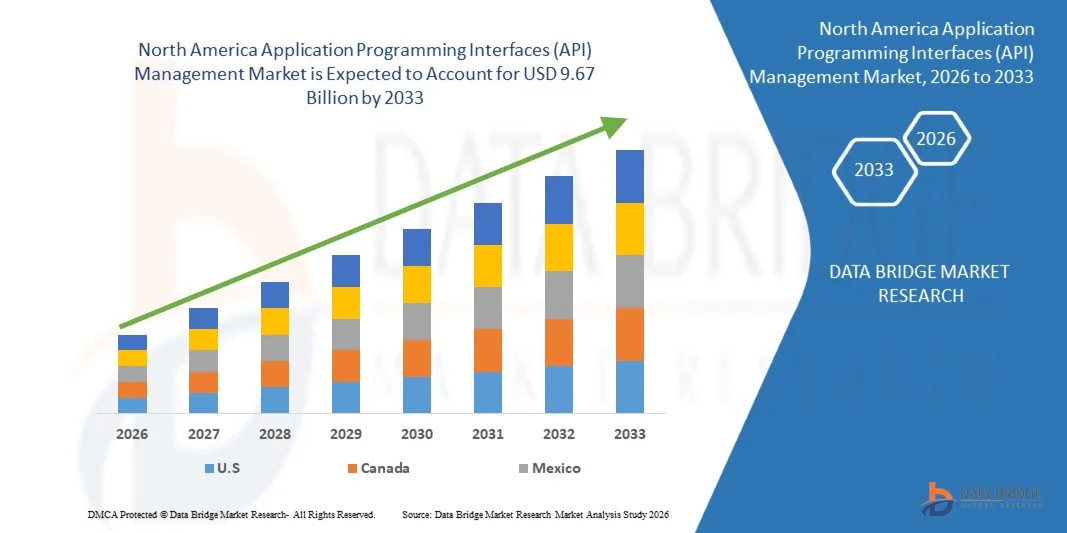
- The North America application programming interfaces (API) management market size was valued at USD 2.23 billion in 2025 and is expected to reach USD 9.67 billion by 2033, at a CAGR of 20.10% during the forecast period
- The market growth is largely fuelled by the rapid expansion of cloud computing adoption, increasing demand for digital transformation across enterprises, and the rising need for secure and scalable API ecosystems to enable seamless integration between applications, services, and platforms
- In addition, the growing penetration of microservices architecture, increasing reliance on third-party APIs, and the rising importance of real-time data exchange are further accelerating market expansion
North America Application Programming Interfaces (API) Management Market Analysis
- The API management market is witnessing strong growth as organizations increasingly prioritize interoperability, security, and performance optimization in digital ecosystems
- Enterprises across industries such as IT, BFSI, healthcare, and retail are rapidly adopting API management solutions to streamline connectivity, enhance developer experience, and support scalable cloud-native applications
- U.S. API management market captured the largest revenue share in 2025 within North America, fueled by rapid expansion of cloud-native applications and strong adoption of API-first strategies across enterprises. Organizations are increasingly prioritizing digital transformation initiatives to improve agility, enhance customer experience, and accelerate innovation cycles
- Canada is expected to witness the highest compound annual growth rate (CAGR) in the North America application programming interfaces (API) management market due to increasing digitalization across enterprises, rising adoption of cloud-based integration solutions, and growing investments in modern IT infrastructure and API-driven applications
- The Solution segment held the largest market revenue share in 2025 driven by the increasing demand for API gateways, lifecycle management tools, analytics platforms, and security solutions that enable seamless integration and governance of APIs across enterprise ecosystems. API management solutions are widely adopted for their ability to improve scalability, enhance developer productivity, and ensure secure data exchange between applications and services. These platforms also support monitoring, version control, and traffic management, which are critical for large-scale digital infrastructures
Report Scope and North America Application Programming Interfaces (API) Management Market Segmentation
|
Attributes |
North America Application Programming Interfaces (API) Management Key Market Insights |
|
Segments Covered |
|
|
Countries Covered |
North America
|
|
Key Market Players |
• IBM (U.S.) |
|
Market Opportunities |
• Expansion Of Cloud-Native Application Ecosystems |
|
Value Added Data Infosets |
In addition to the market insights such as market value, growth rate, market segments, geographical coverage, market players, and market scenario, the market report curated by the Data Bridge Market Research team includes in-depth expert analysis, import/export analysis, pricing analysis, production consumption analysis, and pestle analysis. |
North America Application Programming Interfaces (API) Management Market Trends
“Rising Adoption of Cloud-Native and Microservices Architectures”
• The increasing shift toward cloud-native development is significantly shaping the API management market, as enterprises adopt distributed architectures to improve scalability, flexibility, and deployment speed. API management platforms are gaining traction due to their ability to enable seamless communication between microservices, applications, and third-party systems. This trend is encouraging organizations to modernize legacy systems and transition toward API-first development approaches
• Growing demand for real-time data exchange and interoperability across digital ecosystems has accelerated the adoption of API management solutions. Businesses are increasingly relying on APIs to connect mobile applications, web platforms, IoT devices, and enterprise systems, improving operational efficiency and customer experience. This has also led to increased focus on API performance monitoring, lifecycle management, and analytics capabilities
• Rising emphasis on security, compliance, and governance is influencing API management adoption, with enterprises prioritizing secure access control, threat detection, and data protection. API gateways and security protocols such as authentication and encryption are becoming essential components of modern digital infrastructure, ensuring safe and controlled data exchange between systems
• For instance, in 2024, companies such as Google Cloud and Microsoft Azure enhanced their API management platforms by introducing advanced API security features, automated monitoring tools, and improved developer portals. These updates were designed to support enterprises adopting cloud-native applications and large-scale digital transformation initiatives, improving integration efficiency and reducing operational complexity
• While adoption of API management solutions continues to grow, sustained market expansion depends on addressing challenges related to system complexity, integration costs, and the need for skilled developers. Vendors are increasingly focusing on simplifying deployment models and offering low-code or no-code API management tools to enhance accessibility and adoption
North America Application Programming Interfaces (API) Management Market Dynamics
Driver
“Growing Demand for Digital Transformation and System Integration”
• Increasing digital transformation initiatives across enterprises is a major driver for the API management market, as organizations seek to modernize IT infrastructure and enable seamless connectivity between applications, services, and platforms. API management solutions help businesses streamline integration processes and improve operational efficiency across digital ecosystems
• Expanding use of cloud computing, SaaS applications, and hybrid IT environments is further driving demand for API management platforms. Organizations are increasingly dependent on APIs to connect diverse systems, manage data flow, and ensure interoperability across multiple environments, supporting business agility and scalability
• Rising focus on enhancing customer experience and enabling faster service delivery is encouraging companies to adopt API-driven architectures. APIs are becoming essential for enabling mobile applications, digital banking, e-commerce platforms, and enterprise software ecosystems, improving responsiveness and innovation capabilities
• For instance, in 2023, companies such as IBM and Oracle expanded their API management offerings by integrating AI-powered analytics, automated lifecycle management, and enhanced security features. These enhancements were introduced to support enterprises managing large-scale API ecosystems and increasing demand for real-time digital services
• Although strong demand supports market growth, successful adoption depends on reducing integration complexity, improving governance frameworks, and ensuring cost-effective deployment across enterprises of all sizes
Restraint/Challenge
“Complex Integration and Security Risks in API Ecosystems”
• Increasing complexity in managing large-scale API ecosystems is a key challenge for the market, as enterprises often operate multiple APIs across hybrid and multi-cloud environments. Ensuring consistent governance, monitoring, and version control becomes difficult, leading to operational inefficiencies and higher management overhead
• Security vulnerabilities associated with APIs, such as unauthorized access, data breaches, and misconfigurations, remain a major concern for organizations. As APIs act as entry points to critical systems, inadequate security frameworks can expose enterprises to significant cyber risks, requiring continuous monitoring and advanced protection mechanisms
• High implementation and maintenance costs also restrict adoption, particularly for small and medium enterprises. Expenses related to infrastructure setup, API gateway deployment, and skilled workforce requirements can limit widespread adoption of advanced API management platforms
• For instance, in 2024, several enterprises using large-scale API ecosystems reported increased incidents of API misconfiguration and unauthorized data exposure during integration with third-party applications such as Salesforce and Shopify. These challenges highlighted the need for stronger API governance frameworks and automated security monitoring tools
• Addressing these challenges will require investment in advanced API security solutions, simplified integration frameworks, and AI-driven automation tools. Vendors focusing on unified API management platforms and improved developer experience are expected to gain a competitive advantage in the evolving market
North America Application Programming Interfaces (API) Management Market Scope
The market is segmented on the basis of component, deployment type, organization size, and industry.
• By Component
On the basis of component, the API management market is segmented into Solution and Services. The Solution segment held the largest market revenue share in 2025 driven by the increasing demand for API gateways, lifecycle management tools, analytics platforms, and security solutions that enable seamless integration and governance of APIs across enterprise ecosystems. API management solutions are widely adopted for their ability to improve scalability, enhance developer productivity, and ensure secure data exchange between applications and services. These platforms also support monitoring, version control, and traffic management, which are critical for large-scale digital infrastructures.
The Services segment is expected to witness the fastest growth rate from 2026 to 2033, driven by the rising need for consulting, implementation, integration, and managed services. Enterprises are increasingly relying on service providers to design, deploy, and optimize API ecosystems, ensuring efficient performance, reduced complexity, and improved operational efficiency across cloud and hybrid environments. Growing complexity of API environments is further increasing demand for expert-led support services.
• By Deployment Type
On the basis of deployment type, the market is segmented into On-Premises and Cloud. The Cloud segment held the largest market revenue share in 2025 driven by the rapid adoption of cloud computing, scalability advantages, and lower infrastructure costs. Cloud-based API management platforms offer flexibility, faster deployment, and seamless integration with SaaS applications and microservices architectures, making them highly preferred among enterprises undergoing digital transformation. These platforms also enable real-time monitoring and global accessibility, improving overall system efficiency.
The On-Premises segment is expected to witness steady growth from 2026 to 2033, driven by organizations with strict data security, regulatory compliance, and control requirements. Industries handling sensitive information continue to prefer on-premises deployment to maintain full ownership of infrastructure and ensure enhanced data governance and security. In addition, concerns around data sovereignty and internal risk management further support adoption.
• By Organization Size
On the basis of organization size, the market is segmented into Small and Medium Enterprises and Large Enterprises. The Large Enterprises segment held the largest market revenue share in 2025 driven by extensive IT infrastructure, high API consumption, and strong investment capacity in advanced digital integration solutions. Large enterprises widely deploy API management platforms to manage complex ecosystems and enable seamless connectivity across global operations. These organizations also require advanced security, monitoring, and governance features to manage large-scale API traffic.
The Small and Medium Enterprises segment is expected to witness the fastest growth rate from 2026 to 2033, driven by increasing digital adoption, affordability of cloud-based API solutions, and growing demand for scalable integration tools. SMEs are increasingly leveraging API management platforms to enhance operational efficiency, improve customer experience, and support business expansion. The availability of subscription-based pricing models is further accelerating adoption.
• By Industry
On the basis of industry, the market is segmented into Banking, Financial Services and Insurance, IT and Telecom, Government, Healthcare and Life Sciences, Retail and Consumer Goods, Media and Entertainment, Travel and Transportation, and Manufacturing. The IT and Telecom segment held the largest market revenue share in 2025 driven by high API consumption, rapid cloud adoption, and extensive use of digital services and applications. API management is critical in this sector for enabling system interoperability, service delivery, and network integration. These enterprises rely heavily on APIs to support digital platforms and customer-facing applications.
The Banking, Financial Services and Insurance segment is expected to witness the fastest growth rate from 2026 to 2033, driven by increasing demand for secure digital banking services, open banking frameworks, and real-time transaction processing. APIs play a crucial role in enabling fintech integration, improving customer experience, and supporting digital payment ecosystems. Regulatory push for open APIs is also accelerating adoption across financial institutions.
North America Application Programming Interfaces (API) Management Market Regional Analysis
- U.S. API management market captured the largest revenue share in 2025 within North America, fueled by rapid expansion of cloud-native applications and strong adoption of API-first strategies across enterprises. Organizations are increasingly prioritizing digital transformation initiatives to improve agility, enhance customer experience, and accelerate innovation cycles
- The growing use of microservices architecture, combined with strong demand for secure API gateways and developer-centric platforms, is further driving market growth
- In addition, integration of APIs with AI, analytics, and enterprise applications is significantly strengthening the market ecosystem
Canada Application Programming Interfaces (API) Management Market Insight
The Canada API management market is expected to witness the fastest growth rate from 2026 to 2033, driven by increasing cloud adoption, rising digital transformation initiatives, and growing demand for secure and scalable integration solutions. Enterprises across sectors are increasingly adopting API platforms to improve system interoperability and enhance operational efficiency. The expansion of fintech services, e-commerce platforms, and government digital services is further supporting market growth. In addition, rising investments in modern IT infrastructure and cybersecurity frameworks are accelerating adoption across organizations.
North America Application Programming Interfaces (API) Management Market Share
The North America application programming interfaces (API) management industry is primarily led by well-established companies, including:
• IBM (U.S.)
• Microsoft (U.S.)
• Google Cloud (U.S.)
• Amazon Web Services (U.S.)
• Oracle (U.S.)
• Salesforce (U.S.)
• Cisco Systems (U.S.)
• Postman (U.S.)
• Apigee (U.S.)
• MuleSoft (U.S.)
• Red Hat (U.S.)
• TIBCO Software (U.S.)
• Kong Inc (U.S.)
• Cloudflare (U.S.)
• Broadcom (U.S.)
SKU-
Get online access to the report on the World's First Market Intelligence Cloud

- Interactive Data Analysis Dashboard
- Company Analysis Dashboard for high growth potential opportunities
- Research Analyst Access for customization & queries
- Competitor Analysis with Interactive dashboard
- Latest News, Updates & Trend analysis
- Harness the Power of Benchmark Analysis for Comprehensive Competitor Tracking
Research Methodology
Data collection and base year analysis are done using data collection modules with large sample sizes. The stage includes obtaining market information or related data through various sources and strategies. It includes examining and planning all the data acquired from the past in advance. It likewise envelops the examination of information inconsistencies seen across different information sources. The market data is analysed and estimated using market statistical and coherent models. Also, market share analysis and key trend analysis are the major success factors in the market report. To know more, please request an analyst call or drop down your inquiry.
The key research methodology used by DBMR research team is data triangulation which involves data mining, analysis of the impact of data variables on the market and primary (industry expert) validation. Data models include Vendor Positioning Grid, Market Time Line Analysis, Market Overview and Guide, Company Positioning Grid, Patent Analysis, Pricing Analysis, Company Market Share Analysis, Standards of Measurement, Global versus Regional and Vendor Share Analysis. To know more about the research methodology, drop in an inquiry to speak to our industry experts.
Customization Available
Data Bridge Market Research is a leader in advanced formative research. We take pride in servicing our existing and new customers with data and analysis that match and suits their goal. The report can be customized to include price trend analysis of target brands understanding the market for additional countries (ask for the list of countries), clinical trial results data, literature review, refurbished market and product base analysis. Market analysis of target competitors can be analyzed from technology-based analysis to market portfolio strategies. We can add as many competitors that you require data about in the format and data style you are looking for. Our team of analysts can also provide you data in crude raw excel files pivot tables (Fact book) or can assist you in creating presentations from the data sets available in the report.












