North America Aromatherapy Market
Market Size in USD Billion
CAGR :
% 
 USD
3.50 Billion
USD
6.43 Billion
2025
2033
USD
3.50 Billion
USD
6.43 Billion
2025
2033
 Forecast Period Forecast Period |
2026 –2033 |
 Market Size (Base Year) Market Size (Base Year) |
USD 3.50 Billion |
 Market Size (Forecast Year) Market Size (Forecast Year) |
USD 6.43 Billion |
 CAGR CAGR |
% |
| Major Markets Players |
|
North America Aromatherapy Market Size
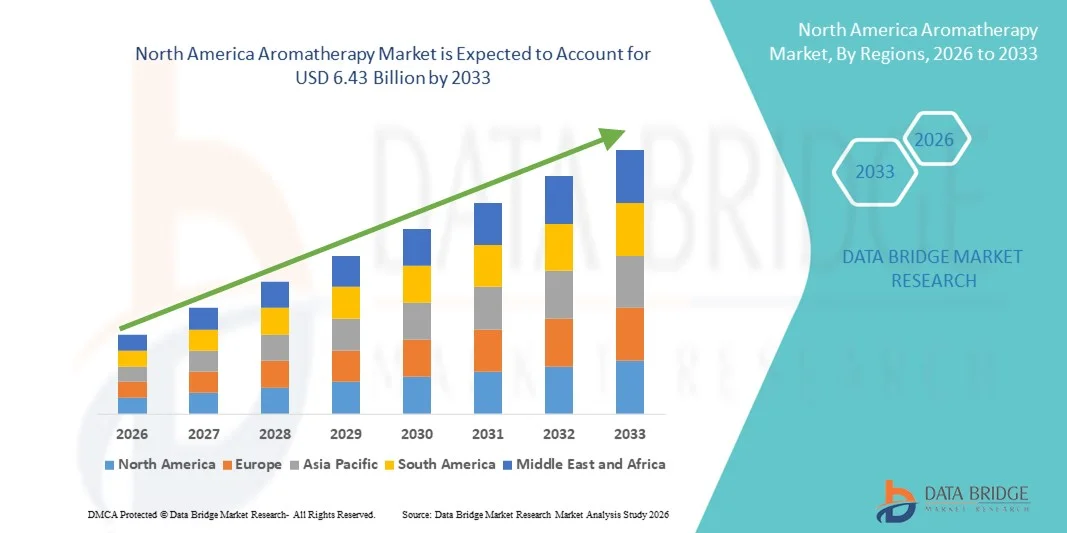
- The North America aromatherapy market size was valued at USD 3.50 billion in 2025 and is expected to reach USD 6.43 billion by 2033, at a CAGR of 7.90% during the forecast period
- The market growth is largely fueled by the increasing consumer preference for natural and holistic wellness solutions, along with the growing awareness of the therapeutic benefits of essential oils in healthcare, personal care, and stress management applications
- Furthermore, rising demand for plant-based products and the expansion of wellness and spa industries are establishing aromatherapy as a popular complementary therapy for relaxation, mental well-being, and health improvement. These converging factors are accelerating the uptake of Aromatherapy solutions, thereby significantly boosting the industry's growth
North America Aromatherapy Market Analysis
- Aromatherapy, utilizing essential oils and natural plant extracts for therapeutic benefits, is increasingly becoming an important component of modern wellness and alternative healthcare practices in both residential and commercial settings due to its stress-relief, relaxation, and mental well-being benefits
- The escalating demand for aromatherapy is primarily fueled by the growing consumer preference for natural wellness products, increasing awareness regarding mental health management, and the rising popularity of spa, relaxation, and home wellness solutions
- The U.S. dominated the aromatherapy market with the largest revenue share of 34.7% in 2025, characterized by high consumer spending on wellness products, strong presence of essential oil manufacturers, and increasing adoption of aromatherapy in spas, wellness centers, and households
- Canada is expected to be the fastest growing region in the aromatherapy market during the forecast period with a projected CAGR of 9.3%, due to rising awareness of natural therapies, increasing demand for organic personal care products, and growing wellness tourism
- The consumables segment dominated the largest market revenue share of 69.4% in 2025, driven by the widespread use of essential oils, carrier oils, blends, and aromatherapy-based products in both personal and professional wellness practices
Report Scope and Aromatherapy Market Segmentation
|
Attributes |
Aromatherapy Key Market Insights |
|
Segments Covered |
|
|
Countries Covered |
North America
|
|
Key Market Players |
|
|
Market Opportunities |
|
|
Value Added Data Infosets |
In addition to the insights on market scenarios such as market value, growth rate, segmentation, geographical coverage, and major players, the market reports curated by the Data Bridge Market Research also include in-depth expert analysis, patient epidemiology, pipeline analysis, pricing analysis, and regulatory framework. |
North America Aromatherapy Market Trends
Growing Preference for Natural Wellness and Holistic Therapies
- A major and rapidly emerging trend in the global aromatherapy market is the increasing consumer preference for natural wellness solutions and holistic health practices. As individuals become more conscious about their physical and mental well-being, there is a growing shift toward plant-based therapeutic products that promote relaxation, stress relief, and overall health improvement
- Aromatherapy products such as essential oils, diffusers, massage oils, and scented candles are gaining popularity as consumers seek natural alternatives to chemical-based wellness products
- For instance, lavender, eucalyptus, peppermint, and tea tree essential oils are widely used in aromatherapy for their calming, anti-inflammatory, and therapeutic properties. These oils are increasingly being incorporated into home wellness routines, spa treatments, and complementary therapies to enhance relaxation and emotional balance
- In addition, the integration of aromatherapy into modern lifestyle practices such as yoga, meditation, and stress-management therapies is further boosting demand. Consumers are increasingly using essential oils during mindfulness exercises to enhance focus, promote relaxation, and improve sleep quality. This growing connection between aromatherapy and mental wellness is significantly influencing purchasing behavior across different consumer segments
- The hospitality and spa industries are also adopting aromatherapy solutions to enhance customer experiences. Luxury hotels, wellness resorts, and spa centers are incorporating essential oil therapies and aromatic environments to promote relaxation and improve guest satisfaction
- Furthermore, product innovation and the introduction of customized aromatherapy blends designed for specific health benefits—such as anxiety reduction, improved sleep, and respiratory support—are expanding the market. As a result, companies are increasingly focusing on developing organic, sustainably sourced, and high-quality essential oils to meet the evolving preferences of health-conscious consumers
- This growing focus on natural healing, stress management, and preventive healthcare is transforming aromatherapy into a mainstream wellness solution, thereby significantly contributing to the expansion of the Aromatherapy market globally
North America Aromatherapy Market Dynamics
Driver
Rising Demand for Stress Relief and Mental Wellness Solutions
- The increasing prevalence of stress, anxiety, and sleep disorders across global populations is a significant driver for the growth of the Aromatherapy market. Modern lifestyles, characterized by long working hours, high levels of digital exposure, and increasing mental health challenges, have encouraged individuals to seek natural and non-invasive wellness solutions
- Aromatherapy products, particularly essential oils such as lavender, chamomile, and sandalwood, are widely recognized for their calming and mood-enhancing properties. These products are increasingly used in home environments, wellness centers, and healthcare facilities to promote relaxation, reduce stress, and improve emotional well-being
- For instance, many wellness clinics and spa centers now incorporate aromatherapy into massage therapy, meditation sessions, and relaxation treatments to enhance therapeutic outcomes. Such practices are encouraging wider consumer adoption and contributing to the expansion of the Aromatherapy industry
- In addition, the growing awareness regarding the benefits of complementary and alternative medicine (CAM) is further supporting market growth. Consumers are increasingly exploring natural treatment methods that support physical and emotional health without relying heavily on synthetic pharmaceuticals
- The expanding availability of aromatherapy products through online retail platforms, specialty wellness stores, and pharmacies is also making these products more accessible to a broader consumer base. This increased accessibility, combined with rising health awareness, continues to drive the global demand for aromatherapy solutions
Restraint/Challenge
Limited Scientific Standardization and Regulatory Concerns
- Despite its growing popularity, the Aromatherapy market faces certain challenges related to the lack of standardized regulations and scientific validation for many aromatherapy practices. Since aromatherapy products are often categorized as wellness or cosmetic products rather than medical treatments, regulatory standards and quality control measures may vary significantly across regions
- The absence of universal quality standards for essential oil extraction, purity, and formulation can lead to variations in product effectiveness and safety. In some cases, low-quality or adulterated essential oils may reduce therapeutic benefits or cause adverse skin reactions, which can negatively impact consumer trust in aromatherapy products
- For instance, In addition, the limited availability of large-scale clinical studies validating the medical efficacy of certain aromatherapy treatments remains a concern for healthcare professionals and regulatory authorities. This lack of scientific evidence may restrict the integration of aromatherapy into mainstream medical treatments in certain regions
- Another challenge involves the potential misuse or improper application of essential oils. Highly concentrated essential oils require proper dilution and usage guidelines, and incorrect usage may lead to allergic reactions, skin irritation, or respiratory discomfort in sensitive individuals
- Addressing these challenges through stricter quality control standards, improved product labeling, and increased scientific research on aromatherapy benefits will be essential for strengthening consumer confidence and supporting the long-term growth of the Aromatherapy market
North America Aromatherapy Market Scope
The market is segmented on the basis of product type, mode of delivery, application, distribution channel, and end-user.
- By Product Type
On the basis of product type, the Aromatherapy market is segmented into consumables and equipment. The consumables segment dominated the largest market revenue share of 69.4% in 2025, driven by the widespread use of essential oils, carrier oils, blends, and aromatherapy-based products in both personal and professional wellness practices. Consumers frequently purchase consumable aromatherapy products for relaxation, stress relief, skincare, and therapeutic purposes, creating strong recurring demand in the market. Essential oils such as lavender, eucalyptus, peppermint, and tea tree oil are widely used in aromatherapy treatments due to their natural therapeutic properties. The growing awareness of natural and plant-based wellness solutions has significantly increased the demand for consumable aromatherapy products. In addition, these products are easily accessible through retail stores and online platforms, further boosting their adoption. Wellness centers and spa facilities also rely heavily on consumables for regular aromatherapy sessions. Increasing consumer preference for holistic health solutions and alternative therapies further strengthens demand. Product innovation, including organic and therapeutic-grade oils, also contributes to the expansion of this segment. Rising disposable incomes and growing interest in self-care routines further support market growth. The convenience and versatility of consumables make them suitable for various aromatherapy applications. As a result, consumables continue to hold the largest share in the aromatherapy market.
The equipment segment is expected to witness the fastest CAGR of 10.8% from 2026 to 2033, driven by the increasing use of advanced aromatherapy diffusers and vaporizers in homes and wellness centers. Aromatherapy equipment such as ultrasonic diffusers, nebulizers, and humidifiers helps disperse essential oils effectively into the air for therapeutic benefits. Consumers are increasingly investing in modern aromatherapy devices that offer features such as adjustable mist settings, LED lighting, and smart connectivity. The growing popularity of home wellness environments is encouraging the adoption of aromatherapy equipment. Many households are incorporating diffusers as part of their daily relaxation and stress management routines. Wellness centers, spas, and meditation studios also use advanced diffusers to create calming and therapeutic atmospheres. Technological advancements in aromatherapy equipment have improved efficiency and ease of use. In addition, the availability of compact and aesthetically designed devices has increased consumer appeal. The integration of smart technology in diffusers allows users to control settings through mobile applications. Increasing online sales and product accessibility further contribute to segment growth. As consumers continue to prioritize mental well-being and relaxation, demand for aromatherapy equipment is expected to rise significantly during the forecast period.
- By Mode of Delivery
On the basis of mode of delivery, the Aromatherapy market is segmented into topical application, direct inhalation, and aerial diffusion. The topical application segment dominated the largest market revenue share of 41.6% in 2025, due to its widespread use in skincare, massage therapy, and therapeutic treatments. Essential oils diluted with carrier oils are commonly applied directly to the skin to provide relief from muscle pain, inflammation, and stress. Massage therapists and wellness practitioners frequently use topical aromatherapy treatments to enhance relaxation and therapeutic outcomes. The increasing demand for natural skincare and wellness products has significantly boosted the popularity of topical aromatherapy applications. Many consumers prefer applying essential oil blends directly to targeted areas for faster relief. In addition, topical aromatherapy is widely used in spa therapies and professional wellness treatments. The growing popularity of holistic healthcare practices further supports the adoption of topical applications. Dermatological benefits such as skin rejuvenation and acne treatment also contribute to segment growth. Product manufacturers are introducing specialized topical blends designed for relaxation, pain relief, and skincare. Increased consumer awareness regarding natural treatment alternatives further strengthens demand. As aromatherapy continues to gain recognition as a complementary therapy, topical application remains the most widely used mode of delivery.
The aerial diffusion segment is expected to witness the fastest CAGR of 11.2% from 2026 to 2033, driven by the increasing use of essential oil diffusers in homes, offices, and wellness centers. Aerial diffusion allows essential oils to disperse into the surrounding environment, creating a calming and therapeutic atmosphere. Consumers increasingly use diffusers to improve mood, enhance relaxation, and reduce stress levels. Aromatherapy diffusion is also widely used in yoga studios, spas, and meditation centers to create a soothing ambiance. The growing trend of home wellness spaces has significantly increased the demand for diffusion-based aromatherapy solutions. Diffusers also help purify indoor air and promote respiratory wellness. Technological advancements in diffusers have improved oil dispersion efficiency and user convenience. The availability of portable and aesthetically appealing diffuser devices has further encouraged adoption. In addition, workplaces are incorporating aromatherapy diffusion to enhance employee productivity and well-being. Increasing consumer awareness of mental health and relaxation practices also supports the growth of this segment. As wellness-focused lifestyles continue to expand globally, aerial diffusion is expected to experience strong growth throughout the forecast period.
- By Application
On the basis of application, the Aromatherapy market is segmented into relaxation, insomnia, pain management, scar management, skin and hair care, and cold and cough. The relaxation segment accounted for the largest market revenue share of 34.8% in 2025, driven by the growing demand for stress relief and mental wellness solutions. Aromatherapy oils such as lavender, chamomile, and sandalwood are widely used to promote relaxation and reduce anxiety. Increasing work-related stress and busy lifestyles have led consumers to seek natural relaxation therapies. Aromatherapy treatments are commonly used in spas, wellness centers, and home environments to promote calmness and emotional balance. The rise of meditation, yoga, and mindfulness practices has also increased the use of relaxation-focused essential oils. Many consumers incorporate aromatherapy into daily self-care routines to enhance overall well-being. Wellness practitioners frequently recommend aromatherapy for stress management and mood improvement. In addition, relaxation-focused products are widely available through online and retail distribution channels. Product innovation in calming essential oil blends further supports segment growth. Rising awareness about mental health and emotional well-being continues to drive demand. As consumers increasingly prioritize stress management, the relaxation segment remains dominant in the aromatherapy market.
The insomnia segment is expected to witness the fastest CAGR of 9.9% from 2026 to 2033, driven by the growing prevalence of sleep disorders worldwide. Aromatherapy oils such as lavender, bergamot, and cedarwood are widely recognized for their ability to promote better sleep quality. Consumers are increasingly turning to natural sleep aids as alternatives to pharmaceutical sleep medications. Aromatherapy diffusers and sleep sprays containing essential oils are commonly used to create a calming bedtime environment. Increasing awareness about the importance of sleep for overall health has boosted demand for insomnia-related aromatherapy solutions. Wellness experts often recommend aromatherapy to improve sleep patterns and reduce nighttime stress. The expansion of sleep-focused wellness products also contributes to segment growth. In addition, healthcare professionals are exploring aromatherapy as a complementary therapy for sleep improvement. Growing consumer interest in holistic wellness practices further supports adoption. Manufacturers are introducing innovative aromatherapy products designed specifically for sleep enhancement. As sleep disorders become more common due to modern lifestyles, demand for insomnia-focused aromatherapy solutions is expected to grow rapidly.
- By Distribution Channel
On the basis of distribution channel, the Aromatherapy market is segmented into direct-to-customer and B2B. The direct-to-customer segment dominated the largest market revenue share of 63.5% in 2025, driven by the growing popularity of online shopping and direct retail sales of essential oils and aromatherapy products. Consumers increasingly purchase aromatherapy products through e-commerce platforms, brand websites, and retail wellness stores. The availability of a wide variety of essential oils and blends through direct sales channels significantly contributes to market growth. Direct-to-customer sales allow manufacturers to build strong relationships with consumers while offering personalized product experiences. Many wellness brands are adopting direct sales models to expand their global reach. In addition, online platforms provide customers with detailed product information and usage guidance. Increasing digital marketing efforts by aromatherapy brands further support this distribution channel. Consumers also benefit from discounts, subscription services, and convenient home delivery options. Rising consumer awareness about natural wellness products encourages direct purchases. The accessibility of aromatherapy products through multiple retail channels strengthens this segment’s dominance. As a result, direct-to-customer distribution remains the leading sales channel in the aromatherapy market.
The B2B segment is expected to witness the fastest CAGR of 10.2% from 2026 to 2033, driven by the increasing adoption of aromatherapy products in professional wellness and healthcare settings. Businesses such as spas, wellness centers, hotels, and healthcare facilities frequently purchase essential oils and aromatherapy equipment in bulk. The hospitality industry increasingly incorporates aromatherapy experiences to enhance guest comfort and relaxation. Wellness resorts and luxury hotels often use signature aromatherapy blends to create unique brand experiences. In addition, hospitals and clinics are exploring aromatherapy as a complementary therapy for stress and pain management. The growing number of wellness centers and holistic therapy clinics further supports bulk purchasing of aromatherapy products. Manufacturers are also forming partnerships with spas and wellness institutions to expand their distribution networks. Increasing corporate wellness programs have also contributed to demand for aromatherapy solutions. The availability of professional-grade aromatherapy products further strengthens B2B adoption. As wellness tourism and holistic healthcare continue to expand, the B2B distribution segment is expected to grow rapidly.
- By End-User
On the basis of end-user, the Aromatherapy market is segmented into home use, spa and wellness centers, hospitals and clinics, and yoga and meditation centers. The home use segment dominated the largest market revenue share of 48.9% in 2025, driven by the increasing adoption of aromatherapy products for personal wellness routines. Consumers are incorporating essential oils and diffusers into daily self-care practices to manage stress, improve sleep, and enhance relaxation. The rise of home wellness trends has significantly contributed to the popularity of aromatherapy products. Many individuals use essential oils during meditation, bathing, and skincare routines. The availability of affordable aromatherapy products also encourages widespread adoption among households. In addition, the growing influence of social media and wellness influencers promotes the benefits of aromatherapy for home use. Online tutorials and product guides further educate consumers on the safe and effective use of essential oils. Rising awareness about natural healing methods continues to support the segment’s growth. Increasing disposable incomes also allow consumers to invest in wellness products. As a result, home use remains the largest end-user segment in the aromatherapy market.
The spa and wellness centers segment is expected to witness the fastest CAGR of 11.5% from 2026 to 2033, driven by the expanding global wellness and spa industry. Aromatherapy is widely used in spa therapies, massage treatments, and relaxation sessions to enhance the overall customer experience. Wellness centers often incorporate essential oils into therapeutic treatments designed to relieve stress and improve physical well-being. The increasing popularity of wellness tourism further supports the growth of spa-based aromatherapy services. Luxury spas frequently use premium essential oils and customized blends to provide unique treatment experiences. The rising demand for holistic and natural wellness treatments encourages spa operators to adopt aromatherapy practices. In addition, many wellness centers offer specialized aromatherapy therapies targeting stress relief, pain management, and relaxation. The expansion of wellness resorts and luxury spa facilities further drives demand for aromatherapy products. Professional therapists are increasingly trained in aromatherapy techniques to improve treatment effectiveness. Growing consumer spending on wellness experiences also contributes to segment expansion. As the global wellness industry continues to grow, spa and wellness centers are expected to become one of the fastest-growing end-user segments in the aromatherapy market.
North America Aromatherapy Market Regional Analysis
- North America dominated the aromatherapy market with the largest revenue share of 40.01% in 2025
- Driven by high consumer spending on wellness products, strong presence of essential oil manufacturers, and increasing adoption of aromatherapy in spas, wellness centers, and households
- This widespread adoption is further supported by growing awareness of natural therapies, rising demand for organic personal care products, and increasing focus on mental well-being and stress relief, establishing aromatherapy as a preferred solution for relaxation and wellness in both residential and commercial segments
U.S. Aromatherapy Market Insight
The U.S. aromatherapy market captured the largest revenue share of 34.7% in 2025 within North America, characterized by high consumer spending on wellness products, a strong network of essential oil producers, and increasing incorporation of aromatherapy in wellness centers, spas, and household routines. The market growth is driven by consumers’ growing preference for natural and organic products, along with the rising popularity of practices such as meditation, yoga, and mindfulness, which often integrate aromatherapy for enhanced relaxation and mental wellness.
Canada Aromatherapy Market Insight
The Canada aromatherapy market is expected to be the fastest growing region during the forecast period, with a projected CAGR of 9.3%. This growth is fueled by rising awareness of natural therapies, increasing demand for organic personal care products, and the expansion of wellness tourism. Canadians are increasingly adopting aromatherapy to manage stress, improve mental well-being, and enhance relaxation, creating opportunities for both domestic and international brands.
North America Aromatherapy Market Share
The Aromatherapy industry is primarily led by well-established companies, including:
- Young Living (U.S.)
- Plant Therapy (U.S.)
- Nature’s Truth (U.S.)
- Foxbrim Naturals (U.S.)
- Edens Garden (U.S.)
- Aromatherapy Associates (U.K.)
- Absolute Aromas (U.K.)
- Florihana (France)
- Neal’s Yard Remedies (U.K.)
- Pacifica (U.S.)
- Now Foods (U.S.)
- SpaRoom (U.S.)
- Gya Labs (India)
- Mountain Rose Herbs (U.S.)
- Revive Essential Oils (U.S.)
- Healing Solutions (U.S.)
- Scentsational (U.S.)
- Organic Aromas (U.S.)
- Vitruvi (U.S.)
Latest Developments in North America Aromatherapy Market
- In January 2024, celebrity entrepreneur Hilary Duff launched a new home fragrance and aromatherapy-focused brand called Below 60°, offering natural essential oil blends and compact aroma diffusers designed to improve indoor air experience and wellbeing. The brand emphasizes responsibly sourced ingredients and non-toxic formulations, reflecting the growing consumer demand for clean-label aromatherapy products and sustainable home fragrance solutions
- In September 2025, doTERRA, a major global essential oils company, introduced several new wellness and essential oil products during its annual Global Convention, showcasing innovations such as new essential oil blends and health-focused formulations designed to support detoxification and overall wellbeing. The product launches demonstrate the company’s ongoing investment in expanding aromatherapy-based wellness solutions for global consumers
- In September 2025, lifestyle brand Houseplant collaborated with UK-based aromatherapy company Ripple Home to launch a new incense and fragrance collection featuring plant-based aromatic blends and modern incense droplet technology. The collection was designed to create short aromatherapy sessions for relaxation and mindfulness, reflecting the increasing integration of aromatherapy products into lifestyle and home décor markets
- In September 2025, skincare brand Evolve Beauty launched a dedicated aromatherapy product line featuring blends such as Energise, Nurture, Calm, and Detox, designed to support mood enhancement and holistic wellness. The range combines essential oils with natural skincare ingredients, highlighting the growing convergence of aromatherapy with beauty and personal care markets
- In November 2025, Swedish technology company Transparent launched its first Aroma Diffuser, integrating ultrasonic mist technology with a modular glass and aluminum design. The device converts fragrance oils into a fine aromatic mist while emphasizing sustainability and repairable product design, illustrating how technology and design innovation are expanding the aromatherapy device segment
SKU-
Get online access to the report on the World's First Market Intelligence Cloud

- Interactive Data Analysis Dashboard
- Company Analysis Dashboard for high growth potential opportunities
- Research Analyst Access for customization & queries
- Competitor Analysis with Interactive dashboard
- Latest News, Updates & Trend analysis
- Harness the Power of Benchmark Analysis for Comprehensive Competitor Tracking
Research Methodology
Data collection and base year analysis are done using data collection modules with large sample sizes. The stage includes obtaining market information or related data through various sources and strategies. It includes examining and planning all the data acquired from the past in advance. It likewise envelops the examination of information inconsistencies seen across different information sources. The market data is analysed and estimated using market statistical and coherent models. Also, market share analysis and key trend analysis are the major success factors in the market report. To know more, please request an analyst call or drop down your inquiry.
The key research methodology used by DBMR research team is data triangulation which involves data mining, analysis of the impact of data variables on the market and primary (industry expert) validation. Data models include Vendor Positioning Grid, Market Time Line Analysis, Market Overview and Guide, Company Positioning Grid, Patent Analysis, Pricing Analysis, Company Market Share Analysis, Standards of Measurement, Global versus Regional and Vendor Share Analysis. To know more about the research methodology, drop in an inquiry to speak to our industry experts.
Customization Available
Data Bridge Market Research is a leader in advanced formative research. We take pride in servicing our existing and new customers with data and analysis that match and suits their goal. The report can be customized to include price trend analysis of target brands understanding the market for additional countries (ask for the list of countries), clinical trial results data, literature review, refurbished market and product base analysis. Market analysis of target competitors can be analyzed from technology-based analysis to market portfolio strategies. We can add as many competitors that you require data about in the format and data style you are looking for. Our team of analysts can also provide you data in crude raw excel files pivot tables (Fact book) or can assist you in creating presentations from the data sets available in the report.