




North America Chptac Market
Market Size in USD Billion
CAGR :
% 
 USD
2.92 Billion
USD
4.56 Billion
2025
2033
USD
2.92 Billion
USD
4.56 Billion
2025
2033
 Forecast Period Forecast Period |
2026 –2033 |
 Market Size (Base Year) Market Size (Base Year) |
USD 2.92 Billion |
 Market Size (Forecast Year) Market Size (Forecast Year) |
USD 4.56 Billion |
 CAGR CAGR |
% |
| Major Markets Players |
|
What is the North America ChloroHydroxyPropylTrimethyAmmonium Chloride (CHPTAC) Market Size and Growth Rate?
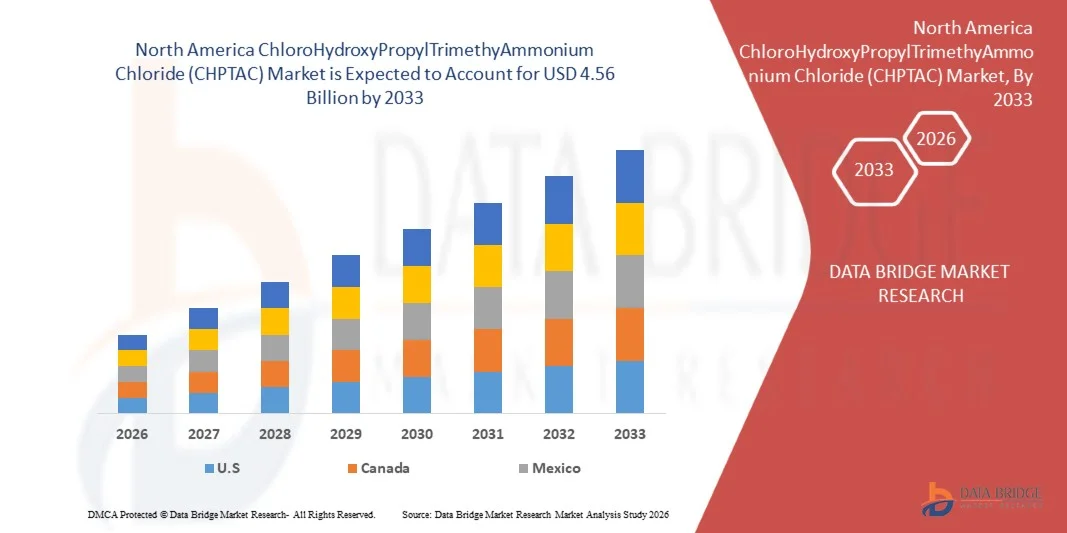
- The North America ChloroHydroxyPropylTrimethyAmmonium Chloride (CHPTAC) market size was valued at USD 2.92 Billion in 2025 and is expected to reach USD 4.56 Billion by 2033, at a CAGR of 5.70% during the forecast period
- Major factors that are expected to boost the growth of the ChloroHydroxyPropylTrimethyAmmonium chloride (CHPTAC) market in the forecast period are the rise in the adoption of ChloroHydroxyPropylTrimethyAmmonium chloride (CHPTAC) in personal care industries such as in cosmetics, fragrance
- Furthermore, the broad application in the paper and textile industry and the increase in the need for cationic starch in the paper and textile industry is further anticipated to propel the growth of the ChloroHydroxyPropylTrimethyAmmonium chloride (CHPTAC) market
What are the Major Takeaways of ChloroHydroxyPropylTrimethyAmmonium Chloride (CHPTAC) Market?
- The rise in the need for cationic modified flocculant in the water treatment is further estimated to cushion the growth of the ChloroHydroxyPropylTrimethyAmmonium chloride (CHPTAC) market. On the other hand, the environmental issues, high manufacturing and logistics costs and available alternatives is further projected to impede the growth of the ChloroHydroxyPropylTrimethyAmmonium chloride (CHPTAC) market in the timeline period.
- In addition, the growing consumption in food and beverage products will further boost the growth of the ChloroHydroxyPropylTrimethyAmmonium chloride (CHPTAC) market in the coming years. However, the outbreak of coronavirus around the world might further challenge the growth of the ChloroHydroxyPropylTrimethyAmmonium chloride (CHPTAC) market in the near future
- U.S. dominated the ChloroHydroxyPropylTrimethyAmmonium Chloride (CHPTAC) market with a 41.85% revenue share in 2025, driven by Increasing investments in wastewater treatment modernization, specialty paper production, and personal care ingredient development are further strengthening market demand
- Canada is projected to register the fastest CAGR of 6.15% from 2026 to 2033, driven by increasing investments in industrial water treatment, specialty paper manufacturing, and sustainable textile processing
- The 65% in H₂O segment dominated the market with the largest revenue share of 42.3% in 2025, driven by its higher chemical concentration, better reactivity, and broad applicability in paper, textile, and water treatment processes
Report Scope and ChloroHydroxyPropylTrimethyAmmonium Chloride (CHPTAC) Market Segmentation
|
Attributes |
ChloroHydroxyPropylTrimethyAmmonium Chloride (CHPTAC) Key Market Insights |
|
Segments Covered |
|
|
Countries Covered |
North America
|
|
Key Market Players |
|
|
Market Opportunities |
|
|
Value Added Data Infosets |
In addition to the insights on market scenarios such as market value, growth rate, segmentation, geographical coverage, and major players, the market reports curated by the Data Bridge Market Research also include in-depth expert analysis, pricing analysis, brand share analysis, consumer survey, demography analysis, supply chain analysis, value chain analysis, raw material/consumables overview, vendor selection criteria, PESTLE Analysis, Porter Analysis, and regulatory framework. |
What is the Key Trend in the ChloroHydroxyPropylTrimethyAmmonium Chloride (CHPTAC) Market?
“Rising Shift Toward Sustainable and Waterborne CHPTAC Applications”
- A key trend in the CHPTAC market is the growing preference for eco-friendly, low-VOC, and waterborne formulations. This is driven by global environmental regulations, increased sustainability awareness, and a demand for safer chemical handling across industrial, paper, and textile applications. Manufacturers are actively innovating to develop high-performance CHPTAC grades that reduce environmental impact while maintaining functional efficacy
- For instance, BASF SE and Solvay have introduced environmentally optimized CHPTAC products with lower volatile emissions and improved compatibility with cellulose and textile treatment processes, supporting industrial compliance and greener operations
- The increasing adoption of water-soluble, bio-based CHPTAC derivatives is encouraging widespread usage in paper sizing, textile finishing, and water treatment applications. This reduces toxicity risks and enhances safety standards for operators
- Industries are integrating CHPTAC-based solutions to meet corporate sustainability goals, improve process efficiency, and achieve higher product quality, accelerating the shift toward green chemicals
- Continuous R&D investment is enabling the development of CHPTAC variants with superior crosslinking, binding, and antimicrobial performance, reinforcing their role in industrial applications
- The trend toward environmentally responsible chemicals is reshaping the market, aligning innovation with regulatory compliance and global consumer demand for sustainable industrial practices
What are the Key Drivers of ChloroHydroxyPropylTrimethyAmmonium Chloride (CHPTAC) Market?
- Strong growth in the paper, textile, and water treatment industries is driving consistent demand for CHPTAC, as it enhances wet and dry strength, improves surface properties, and enables antimicrobial treatment in finished products
- For instance, Kemira has strengthened its industrial partnerships by supplying advanced CHPTAC formulations to major paper and textile manufacturers globally, enhancing process efficiency and product durability
- Rising urbanization and industrialization are increasing the consumption of CHPTAC in high-performance paper coatings, specialty textiles, and water purification processes. This trend is particularly strong in Asia-Pacific, where industrial output is growing rapidly
- Growing awareness of hygiene and safety standards is driving the adoption of CHPTAC for antimicrobial finishes in textiles, medical fabrics, and hygiene-sensitive paper products
- Expansion of the global paperboard, tissue, and specialty paper markets is contributing to higher CHPTAC usage, as manufacturers seek better mechanical properties, improved printability, and enhanced surface performance
- The combination of industrial growth, sustainability initiatives, and process efficiency requirements positions CHPTAC as a key chemical across multiple industrial segments, reinforcing long-term market growth
Which Factor is Challenging the Growth of the ChloroHydroxyPropylTrimethyAmmonium Chloride (CHPTAC) Market?
- Stringent environmental regulations concerning chemical emissions and residual toxicity pose challenges for traditional CHPTAC production, compelling manufacturers to invest in low-VOC and sustainable alternatives
- For instance, REACH and other regional directives in the EU and North America impose limits on residual chemicals in paper, textiles, and water treatment, increasing compliance costs for producers
- The transition from conventional CHPTAC grades to eco-friendly or bio-based alternatives requires investment in process modifications, infrastructure upgrades, and operator training, which may slow adoption rates in developing regions
- R&D costs to develop high-performance, sustainable CHPTAC products are significant, affecting pricing strategies and profit margins, particularly for smaller players
- Limited awareness of greener CHPTAC solutions in emerging markets restricts rapid adoption despite their environmental benefits
- Competitive pressure from alternative chemicals and formulations also creates challenges in market positioning, forcing manufacturers to balance sustainability, performance, and cost-effectiveness while ensuring regulatory compliance
How is the ChloroHydroxyPropylTrimethyAmmonium Chloride (CHPTAC) Market Segmented?
The market is segmented on the basis of product type and end-user industry.
• By Product Type
On the basis of product type, the CHPTAC market is segmented into 65% in H₂O and 60% in H₂O. The 65% in H₂O segment dominated the market with the largest revenue share of 42.3% in 2025, driven by its higher chemical concentration, better reactivity, and broad applicability in paper, textile, and water treatment processes. Its concentrated form allows for efficient dosing, strong binding, and superior wet and dry strength in industrial applications. High performance in cellulose crosslinking and antimicrobial treatments further supports its widespread adoption in paperboard, tissue, and specialty paper manufacturing. Industries favor this grade for improving operational efficiency and achieving consistent product quality.
The 60% in H₂O segment is expected to witness the fastest growth from 2026 to 2033, propelled by its lower viscosity, ease of handling, and suitability for automated dosing systems. Its adaptability in textile finishing, water purification, and personal care formulations is driving strong adoption across emerging regions with growing industrial activities.
• By End-User Industry
On the basis of end-user industry, the CHPTAC market is segmented into Paper, Textile, Water Treatment, Personal Care, and Oil & Gas. The Paper segment dominated the market with a 38.7% revenue share in 2025, owing to the extensive use of CHPTAC in enhancing wet and dry strength, surface sizing, and printability of paper and board products. Its ability to improve sheet formation, reduce curl, and enhance dimensional stability makes it indispensable in modern paper manufacturing. Rising demand for high-quality paper in packaging, tissue, and specialty applications further drives adoption in this segment.
The Textile segment is anticipated to grow at the fastest CAGR from 2026 to 2033, driven by increasing demand for durable, crease-resistant, and antimicrobial fabrics. CHPTAC is widely used in finishing cotton, linen, and blended fabrics, offering superior colorfastness, tensile strength, and compatibility with eco-friendly dyeing and finishing processes. Growth in the apparel and home textiles sector, particularly in Asia-Pacific and Latin America, is accelerating adoption across textile manufacturing clusters.
Which Region Holds the Largest Share of the ChloroHydroxyPropylTrimethyAmmonium Chloride (CHPTAC) Market?
- U.S. dominated the ChloroHydroxyPropylTrimethyAmmonium Chloride (CHPTAC) market with a 41.85% revenue share in 2025, driven by Increasing investments in wastewater treatment modernization, specialty paper production, and personal care ingredient development are further strengthening market demand
- The country is also witnessing growing adoption of CHPTAC in oilfield chemicals and enhanced recovery formulations due to rising industrial efficiency requirements
- Strong chemical manufacturing capabilities, advanced R&D infrastructure, and stringent industrial quality standards continue to reinforce U.S.’s leadership in the CHPTAC market
Canada ChloroHydroxyPropylTrimethyAmmonium Chloride (CHPTAC) Market Insight
Canada is projected to register the fastest CAGR of 6.15% from 2026 to 2033, driven by increasing investments in industrial water treatment, specialty paper manufacturing, and sustainable textile processing. Growing focus on environmentally compliant chemical solutions and industrial modernization continues to strengthen market adoption across the country
Mexico ChloroHydroxyPropylTrimethyAmmonium Chloride (CHPTAC) Market Insight
Mexico is emerging as a major growth hub, supported by expanding paper mills, textile production units, and industrial chemical processing facilities. Rising manufacturing investments, export-oriented industrial growth, and increasing use of specialty cationic compounds are accelerating CHPTAC market penetration across the country.
Which are the Top Companies in ChloroHydroxyPropylTrimethyAmmonium Chloride (CHPTAC) Market?
The ChloroHydroxyPropylTrimethyAmmonium Chloride (CHPTAC) industry is primarily led by well-established companies, including:
- Dow (U.S.)
- Merck KGaA (Germany)
- Sachem, Inc. (U.S.)
- Shandong Tiancheng Chemical Co., Ltd (China)
- Chemigate (India)
- Dongying Guofeng Fine Chemicals Co., Ltd (China)
- Dongying J&M Chemical Co., Ltd (China)
- Samsung Fine Chemicals Co. Ltd (South Korea)
- SKW Quab Chemicals Inc. (U.S.)
- Weifang Greatland Paper And Chemicals Co., Ltd (China)
SKU-
Get online access to the report on the World's First Market Intelligence Cloud

- Interactive Data Analysis Dashboard
- Company Analysis Dashboard for high growth potential opportunities
- Research Analyst Access for customization & queries
- Competitor Analysis with Interactive dashboard
- Latest News, Updates & Trend analysis
- Harness the Power of Benchmark Analysis for Comprehensive Competitor Tracking
North America Chptac Market, Supply Chain Analysis and Ecosystem Framework
To support market growth and help clients navigate the impact of geopolitical shifts, DBMR has integrated in-depth supply chain analysis into its North America Chptac Market research reports. This addition empowers clients to respond effectively to global changes affecting their industries. The supply chain analysis section includes detailed insights such as North America Chptac Market consumption and production by country, price trend analysis, the impact of tariffs and geopolitical developments, and import and export trends by country and HSN code. It also highlights major suppliers with data on production capacity and company profiles, as well as key importers and exporters. In addition to research, DBMR offers specialized supply chain consulting services backed by over a decade of experience, providing solutions like supplier discovery, supplier risk assessment, price trend analysis, impact evaluation of inflation and trade route changes, and comprehensive market trend analysis.
Research Methodology
Data collection and base year analysis are done using data collection modules with large sample sizes. The stage includes obtaining market information or related data through various sources and strategies. It includes examining and planning all the data acquired from the past in advance. It likewise envelops the examination of information inconsistencies seen across different information sources. The market data is analysed and estimated using market statistical and coherent models. Also, market share analysis and key trend analysis are the major success factors in the market report. To know more, please request an analyst call or drop down your inquiry.
The key research methodology used by DBMR research team is data triangulation which involves data mining, analysis of the impact of data variables on the market and primary (industry expert) validation. Data models include Vendor Positioning Grid, Market Time Line Analysis, Market Overview and Guide, Company Positioning Grid, Patent Analysis, Pricing Analysis, Company Market Share Analysis, Standards of Measurement, Global versus Regional and Vendor Share Analysis. To know more about the research methodology, drop in an inquiry to speak to our industry experts.
Customization Available
Data Bridge Market Research is a leader in advanced formative research. We take pride in servicing our existing and new customers with data and analysis that match and suits their goal. The report can be customized to include price trend analysis of target brands understanding the market for additional countries (ask for the list of countries), clinical trial results data, literature review, refurbished market and product base analysis. Market analysis of target competitors can be analyzed from technology-based analysis to market portfolio strategies. We can add as many competitors that you require data about in the format and data style you are looking for. Our team of analysts can also provide you data in crude raw excel files pivot tables (Fact book) or can assist you in creating presentations from the data sets available in the report.












