




North America Glycerin Market
Market Size in USD Billion
CAGR :
% 
 USD
2.05 Billion
USD
3.78 Billion
2025
2033
USD
2.05 Billion
USD
3.78 Billion
2025
2033
 Forecast Period Forecast Period |
2026 –2033 |
 Market Size (Base Year) Market Size (Base Year) |
USD 2.05 Billion |
 Market Size (Forecast Year) Market Size (Forecast Year) |
USD 3.78 Billion |
 CAGR CAGR |
% |
| Major Markets Players |
|
North America Glycerin Market Size
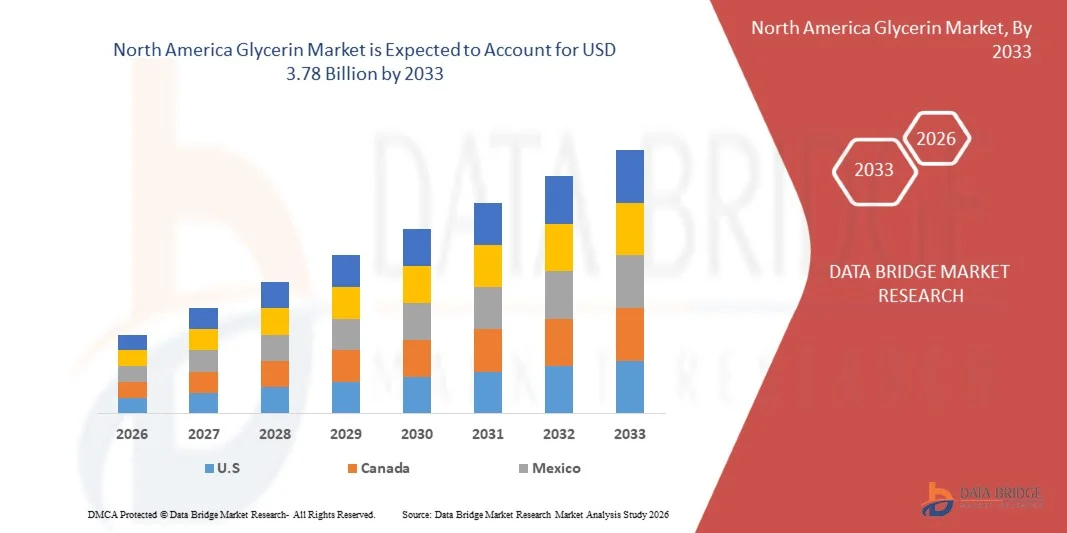
- The North America Glycerin Market size was valued at USD 2.05 billion in 2025 and is expected to reach USD 3.78 billion by 2033, at a CAGR of 7.95% during the forecast period
- The market growth is largely fueled by the expanding biodiesel industry, where glycerin is generated as a major by-product, leading to increased availability and cost efficiency across industrial applications
- Furthermore, rising demand for bio-based and sustainable ingredients in personal care, food, and pharmaceutical sectors is establishing glycerin as a preferred multifunctional component. These converging factors are accelerating its adoption across diverse industries, thereby significantly boosting the market growth
North America Glycerin Market Analysis
- Glycerin, a versatile humectant and solvent widely used across personal care, food and beverage, pharmaceuticals, and industrial applications, is gaining strong traction due to its non-toxic nature, biodegradability, and compatibility with various formulations
- The escalating demand for glycerin is primarily driven by increasing consumption of cosmetics and healthcare products, expansion of the food processing industry, and growing emphasis on sustainable and plant-based chemicals across global markets
- U.S. dominated the North America Glycerin Market in 2025, due to strong biodiesel production capacity, well-established chemical and pharmaceutical industries, and increasing demand for glycerin across personal care, food, and industrial applications
- Canada is expected to be the fastest growing country in the North America Glycerin Market during the forecast period due to increasing biodiesel production, expansion of renewable energy initiatives, and growing demand for sustainable and bio-based chemicals
- Refined glycerin segment dominated the market with a market share of 63% in 2025, due to its high purity levels and extensive applicability across sensitive industries such as pharmaceuticals, personal care, and food processing. Its compliance with stringent regulatory standards and superior performance characteristics make it a preferred choice for manufacturers requiring consistent quality and safety
Report Scope and North America Glycerin Market Segmentation
|
Attributes |
Glycerin Key Market Insights |
|
Segments Covered |
|
|
Countries Covered |
North America
|
|
Key Market Players |
|
|
Market Opportunities |
|
|
Value Added Data Infosets |
In addition to the insights on market scenarios such as market value, growth rate, segmentation, geographical coverage, and major players, the market reports curated by the Data Bridge Market Research also include import export analysis, production capacity overview, production consumption analysis, price trend analysis, climate change scenario, supply chain analysis, value chain analysis, raw material/consumables overview, vendor selection criteria, PESTLE Analysis, Porter Analysis, and regulatory framework. |
North America Glycerin Market Trends
“Rising Demand for Bio-Based and Sustainable Glycerin”
- A significant trend in the North America Glycerin Market is the increasing demand for bio-based and sustainable glycerin, driven by the growing preference for environmentally friendly and non-toxic ingredients across multiple industries. This trend is reinforcing glycerin’s role as a key component in green chemistry and sustainable product formulations across personal care, food, and pharmaceutical sectors
- For instance, KLK OLEO has introduced sustainable vegetable oil-based glycerin under certified sourcing standards, aligning with rising demand for traceable and eco-friendly ingredients. Such initiatives are strengthening consumer confidence and enabling manufacturers to meet regulatory and environmental compliance requirements
- The personal care industry is witnessing increased adoption of plant-derived glycerin as consumers shift toward clean-label and natural formulations. This trend is encouraging manufacturers to replace synthetic ingredients with bio-based alternatives, thereby enhancing product appeal and sustainability
- The food and beverage sector is expanding its use of glycerin as a natural sweetener and humectant, supported by rising demand for safe and non-toxic additives. This is further driving the transition toward naturally sourced glycerin in processed and packaged foods
- Pharmaceutical applications are increasingly relying on high-purity glycerin derived from renewable sources due to its safety profile and compatibility in drug formulations. This is supporting innovation in medicinal syrups, capsules, and topical treatments
- The overall market is experiencing a steady shift toward sustainable production practices and raw material sourcing, which is reinforcing glycerin’s importance in environmentally responsible manufacturing. This trend is expected to continue shaping long-term market growth and competitive differentiation
North America Glycerin Market Dynamics
Driver
“Expanding Biodiesel Production Driving Glycerin Supply”
- The expanding global biodiesel industry is a key driver of the North America Glycerin Market, as glycerin is produced as a major by-product during biodiesel manufacturing processes. The increasing focus on renewable energy and biofuels is significantly boosting glycerin availability, thereby supporting its widespread use across industrial and commercial applications
- For instance, Wilmar International has expanded its biodiesel production capacities, resulting in increased glycerin output for downstream chemical and industrial applications. This development is strengthening supply chains and enabling consistent availability of glycerin in global markets
- Government policies promoting biodiesel blending and renewable fuel adoption are contributing to higher production volumes, which in turn are increasing glycerin supply. This is supporting cost-effective sourcing for manufacturers and encouraging broader industrial utilization
- The integration of biodiesel production with oleochemical manufacturing is enhancing operational efficiency and creating a stable flow of glycerin for multiple applications. This synergy is helping companies optimize resource utilization and improve profitability
- The continued growth of biodiesel production is expected to sustain glycerin supply and support its market expansion, reinforcing its role as a valuable by-product within the renewable energy ecosystem
Restraint/Challenge
“Volatility in Raw Material Prices and Supply Chain Constraints”
- The North America Glycerin Market faces challenges due to volatility in raw material prices, particularly those associated with vegetable oils and biodiesel feedstocks, which directly impact production costs. Fluctuations in feedstock availability and pricing create uncertainty for manufacturers and affect overall market stability
- For instance, Cargill has experienced variability in feedstock costs due to fluctuations in vegetable oil markets, influencing glycerin production economics and pricing strategies. Such variations highlight the sensitivity of glycerin supply to upstream raw material dynamics
- Supply chain disruptions, including transportation constraints and geopolitical factors, further complicate the consistent availability of raw materials required for glycerin production. These issues can lead to delays and increased operational costs for manufacturers
- The dependence on agricultural commodities introduces additional risks related to climate conditions and seasonal variability, which can affect feedstock supply and pricing. This adds complexity to production planning and inventory management
- These combined factors continue to pose constraints on market growth, requiring companies to adopt strategic sourcing and supply chain optimization to mitigate risks and maintain stability in the North America Glycerin Market
North America Glycerin Market Scope
The market is segmented on the basis of grade, process, source, application, and downstream.
• By Grade
On the basis of grade, the North America Glycerin Market is segmented into refined glycerin, crude glycerin, natural glycerin, and blonde glycerin. The refined glycerin segment dominated the market with the largest market revenue share of 63% in 2025, driven by its high purity levels and extensive applicability across sensitive industries such as pharmaceuticals, personal care, and food processing. Its compliance with stringent regulatory standards and superior performance characteristics make it a preferred choice for manufacturers requiring consistent quality and safety. The increasing demand for high-grade ingredients in cosmetics and healthcare products further strengthens its market position, while its versatility across multiple end-use industries enhances its adoption globally.
The natural glycerin segment is anticipated to witness the fastest growth rate from 2026 to 2033, fueled by rising consumer preference for bio-based and sustainable ingredients. Growing awareness regarding clean-label products and environmentally friendly formulations is accelerating the shift toward naturally derived glycerin, particularly in personal care and food applications. Manufacturers are increasingly focusing on plant-based sourcing and green processing methods, which is supporting the rapid expansion of this segment across developed and emerging markets.
• By Process
On the basis of process, the North America Glycerin Market is segmented into transesterification, saponification, and fat splitting. The transesterification segment dominated the market with the largest market revenue share in 2025, primarily due to its direct linkage with biodiesel production, where glycerin is generated as a key by-product. The growing global emphasis on renewable energy sources and biodiesel blending mandates has significantly increased glycerin output through this process. Its cost-effectiveness and large-scale production capabilities further support its dominance, while continuous advancements in biodiesel technologies ensure a steady supply of glycerin for downstream applications.
The fat splitting segment is expected to witness the fastest growth rate from 2026 to 2033, driven by the rising demand for high-purity glycerin in pharmaceutical and cosmetic applications. This process produces glycerin with superior quality and fewer impurities, making it suitable for premium end-use industries. Increasing investments in oleochemical processing facilities and the expansion of specialty chemical manufacturing are further accelerating the adoption of fat splitting techniques globally.
• By Source
On the basis of source, the North America Glycerin Market is segmented into biodiesel, fatty acid, fatty alcohol, soap, vegetable oils, synthetic, and others. The biodiesel segment dominated the market with the largest market revenue share in 2025, supported by the rapid expansion of biodiesel production worldwide. Government initiatives promoting renewable fuels and the increasing use of biodiesel in transportation have led to a substantial rise in glycerin supply from this source. Its cost advantage and abundant availability make it a key contributor to the overall North America Glycerin Market, ensuring consistent supply for industrial applications.
The vegetable oils segment is projected to witness the fastest growth rate from 2026 to 2033, driven by the increasing shift toward sustainable and plant-based raw materials. Rising demand for eco-friendly and non-toxic ingredients in food, cosmetics, and pharmaceutical industries is encouraging manufacturers to utilize glycerin derived from vegetable oils. The growing adoption of organic and natural product formulations is further strengthening the growth trajectory of this segment.
• By Application
On the basis of application, the North America Glycerin Market is segmented into personal care, food and beverage, healthcare and pharmaceuticals, oral care, alkyd resins, tobacco humectants, and others. The personal care segment dominated the market with the largest market revenue share in 2025, driven by the widespread use of glycerin as a moisturizing and conditioning agent in skincare, haircare, and cosmetic products. Its humectant properties and compatibility with a wide range of formulations make it an essential ingredient in personal care manufacturing. Increasing consumer focus on skin health and premium cosmetic products is further supporting the segment’s dominance across global markets.
The healthcare and pharmaceuticals segment is anticipated to witness the fastest growth rate from 2026 to 2033, fueled by the rising demand for glycerin in medicinal formulations, syrups, and drug delivery systems. Its non-toxic nature and role as a solvent and stabilizer make it highly valuable in pharmaceutical applications. Expanding healthcare infrastructure and increasing pharmaceutical production are further accelerating the growth of this segment.
• By Downstream
On the basis of downstream, the North America Glycerin Market is segmented into propanediol, propylene glycol, epichlorohydrin, and others. The propylene glycol segment dominated the market with the largest market revenue share in 2025, driven by its extensive use in antifreeze, food additives, cosmetics, and pharmaceutical formulations. The conversion of glycerin into propylene glycol offers a cost-effective and sustainable alternative to petroleum-based production methods, supporting its widespread adoption. Increasing industrial demand and expanding applications across multiple sectors are reinforcing its leading position in the market.
The epichlorohydrin segment is expected to witness the fastest growth rate from 2026 to 2033, fueled by the rising demand for epoxy resins in construction, automotive, and electronics industries. Glycerin-based epichlorohydrin production is gaining traction due to its environmental advantages and reduced reliance on fossil fuels. Growing infrastructure development and the increasing use of advanced materials are further driving the rapid expansion of this segment.
North America Glycerin Market Regional Analysis
- U.S. dominated the North America Glycerin Market with the largest revenue share in 2025, driven by strong biodiesel production capacity, well-established chemical and pharmaceutical industries, and increasing demand for glycerin across personal care, food, and industrial applications
- The demand for high-purity and industrial-grade glycerin is supported by large-scale production and processing activities by companies such as Cargill Incorporated and P&G Chemicals, enabling consistent supply for diverse applications including cosmetics, pharmaceuticals, and food processing
- The presence of major oleochemical producers, continuous advancements in biofuel technologies, and integration of glycerin into multiple downstream industries reinforce the U.S. leadership position in the North America Glycerin Market
Canada North America Glycerin Market Insight
Canada is projected to register the fastest CAGR in the North America Glycerin Market from 2026 to 2033, supported by increasing biodiesel production, expansion of renewable energy initiatives, and growing demand for sustainable and bio-based chemicals. Rising adoption of glycerin in pharmaceutical, personal care, and food industries is accelerating market growth. The development of biofuel infrastructure and collaboration with chemical producers are strengthening production capabilities across the country. Growing emphasis on green chemistry, industrial sustainability, and renewable resource utilization positions Canada as the fastest-growing country in the region during the forecast period.
Mexico North America Glycerin Market Insight
Mexico is expected to grow steadily from 2026 to 2033, driven by increasing industrial manufacturing activities and expanding demand for glycerin in personal care, food processing, and pharmaceutical sectors. The country’s role as a growing manufacturing hub is supporting the adoption of glycerin in various industrial and consumer applications. Collaborations with global chemical manufacturers and expansion of production facilities are improving supply availability. Major companies such as Wilmar International and other global suppliers are strengthening distribution networks in the region. These developments contribute to sustained growth of the North America Glycerin Market throughout the forecast period.
North America Glycerin Market Share
The glycerin industry is primarily led by well-established companies, including:
- P&G Chemicals (U.S.)
- KLK OLEO (Malaysia)
- Emery Oleochemicals (Malaysia)
- Cargill Incorporated (U.S.)
- Godrej Industries (India)
- IOI Oleochemicals (Malaysia)
- Wilmar International (Singapore)
- Aemetis Inc. (U.S.)
- Repsol S.A. (Spain)
- Avril Group (France)
- Musim Mas Holdings (Singapore)
- Croda International Plc (UK)
- Vantage Specialty Chemicals Inc. (U.S.)
- Sakamoto Yakuhin Kogyo Co. Ltd. (Japan)
Latest Developments in North America Glycerin Market
- In January 2026, Cargill expanded its refined glycerin production capacity at its integrated biorefinery facilities in the U.S., with a strategic focus on pharmaceutical- and food-grade applications. This expansion is enhancing the company’s ability to meet stringent quality requirements while addressing the growing global demand for high-purity, bio-based ingredients. It is also strengthening supply chain stability and enabling Cargill to capture higher margins in regulated industries such as healthcare, food processing, and premium personal care formulations
- In August 2025, Wilmar International enhanced its glycerin purification and refining capabilities across its Southeast Asia operations to cater to the increasing demand for premium-grade glycerin. This initiative is improving product consistency and enabling the company to serve high-end applications in cosmetics, pharmaceuticals, and food sectors more effectively. It is also supporting Wilmar’s export growth strategy by expanding its reach in international markets where quality standards and traceability requirements are becoming more stringent
- In February 2025, Emery Oleochemicals expanded its technical-grade glycerin production capacity at its Cincinnati, Ohio facility to address rising demand from industrial and chemical applications. This development is strengthening its ability to supply large volumes to downstream sectors such as resins, antifreeze, and lubricants, where glycerin functions as a key humectant and solvent. It is also enhancing regional supply reliability in North America, helping the company maintain a competitive edge in industrial-grade North America Glycerin Markets
- In October 2024, KLK OLEO introduced a new portfolio of pharmaceutical- and food-grade glycerin derived from sustainable vegetable oils under its “Olebased PureGlyc” brand. This launch is supporting the increasing shift toward certified, non-GMO, and RSPO-compliant ingredients, particularly in health and nutrition applications. It is also reinforcing the company’s commitment to sustainability and traceability, enabling it to strengthen its presence in highly regulated and quality-sensitive market segments
- In May 2024, Godrej Industries expanded its glycerin production capacity in India to cater to growing demand across domestic and Southeast Asian markets. This expansion is enabling the company to scale up its supply of refined glycerin for use in personal care, oral hygiene, and food applications. It is also positioning Godrej to benefit from rising regional demand for bio-based and halal-certified ingredients, thereby strengthening its footprint in Asia’s rapidly evolving oleochemical industry
SKU-
Get online access to the report on the World's First Market Intelligence Cloud

- Interactive Data Analysis Dashboard
- Company Analysis Dashboard for high growth potential opportunities
- Research Analyst Access for customization & queries
- Competitor Analysis with Interactive dashboard
- Latest News, Updates & Trend analysis
- Harness the Power of Benchmark Analysis for Comprehensive Competitor Tracking
North America Glycerin Market, Supply Chain Analysis and Ecosystem Framework
To support market growth and help clients navigate the impact of geopolitical shifts, DBMR has integrated in-depth supply chain analysis into its North America Glycerin Market research reports. This addition empowers clients to respond effectively to global changes affecting their industries. The supply chain analysis section includes detailed insights such as North America Glycerin Market consumption and production by country, price trend analysis, the impact of tariffs and geopolitical developments, and import and export trends by country and HSN code. It also highlights major suppliers with data on production capacity and company profiles, as well as key importers and exporters. In addition to research, DBMR offers specialized supply chain consulting services backed by over a decade of experience, providing solutions like supplier discovery, supplier risk assessment, price trend analysis, impact evaluation of inflation and trade route changes, and comprehensive market trend analysis.
Research Methodology
Data collection and base year analysis are done using data collection modules with large sample sizes. The stage includes obtaining market information or related data through various sources and strategies. It includes examining and planning all the data acquired from the past in advance. It likewise envelops the examination of information inconsistencies seen across different information sources. The market data is analysed and estimated using market statistical and coherent models. Also, market share analysis and key trend analysis are the major success factors in the market report. To know more, please request an analyst call or drop down your inquiry.
The key research methodology used by DBMR research team is data triangulation which involves data mining, analysis of the impact of data variables on the market and primary (industry expert) validation. Data models include Vendor Positioning Grid, Market Time Line Analysis, Market Overview and Guide, Company Positioning Grid, Patent Analysis, Pricing Analysis, Company Market Share Analysis, Standards of Measurement, Global versus Regional and Vendor Share Analysis. To know more about the research methodology, drop in an inquiry to speak to our industry experts.
Customization Available
Data Bridge Market Research is a leader in advanced formative research. We take pride in servicing our existing and new customers with data and analysis that match and suits their goal. The report can be customized to include price trend analysis of target brands understanding the market for additional countries (ask for the list of countries), clinical trial results data, literature review, refurbished market and product base analysis. Market analysis of target competitors can be analyzed from technology-based analysis to market portfolio strategies. We can add as many competitors that you require data about in the format and data style you are looking for. Our team of analysts can also provide you data in crude raw excel files pivot tables (Fact book) or can assist you in creating presentations from the data sets available in the report.












