North America Lung Cancer Surgery Market
Market Size in USD Billion
CAGR :
% 
 USD
1.67 Billion
USD
2.58 Billion
2025
2033
USD
1.67 Billion
USD
2.58 Billion
2025
2033
 Forecast Period Forecast Period |
2026 –2033 |
 Market Size (Base Year) Market Size (Base Year) |
USD 1.67 Billion |
 Market Size (Forecast Year) Market Size (Forecast Year) |
USD 2.58 Billion |
 CAGR CAGR |
% |
| Major Markets Players |
|
North America Lung Cancer Surgery Market Size
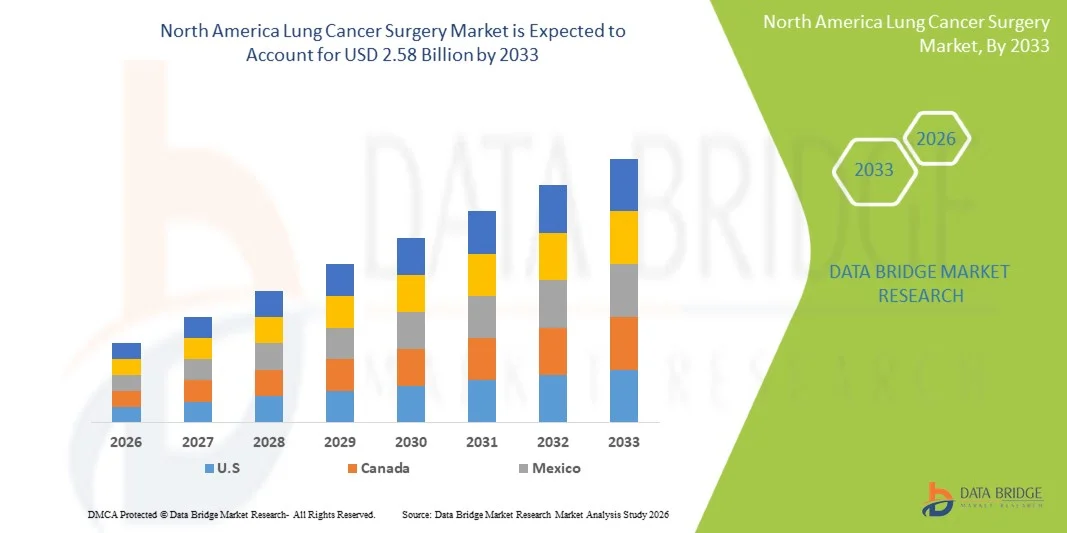
- The North America lung cancer surgery market size was valued at USD 1.67 billion in 2025 and is expected to reach USD 2.58 billion by 2033, at a CAGR of 5.60% during the forecast period
- The market growth is largely fueled by the rising prevalence of lung cancer across North America, increasing adoption of advanced surgical approaches such as robotic-assisted and minimally invasive procedures, and continuous technological progress in oncology surgery systems, leading to improved precision and better patient outcomes in both hospital and specialty care settings
- Furthermore, growing demand for early-stage cancer detection, expanding healthcare infrastructure, strong reimbursement support, and increasing preference for advanced surgical interventions among aging populations are establishing lung cancer surgery as a critical treatment approach. These converging factors are accelerating the uptake of advanced surgical solutions, thereby significantly boosting the industry's growth
North America Lung Cancer Surgery Market Analysis
- Lung cancer surgery, involving procedures such as lobectomy, segmentectomy, and pneumonectomy, remains a critical curative treatment option for early- and mid-stage lung cancer patients, driven by its ability to improve survival outcomes and support precise tumor removal within advanced oncology care pathways
- The market growth is primarily driven by the rising incidence of lung cancer, historical smoking prevalence, an aging population, and increasing adoption of advanced surgical technologies such as robotic-assisted and image-guided procedures, which enhance precision, reduce complications, and shorten recovery time
- The United States dominated the North America lung cancer surgery market in 2025, with a market share of 80.5% supported by advanced healthcare infrastructure, widespread adoption of robotic surgical systems, strong cancer screening programs, and favorable reimbursement policies, with continuous upgrades in thoracic surgical capabilities across leading hospitals
- Canada is expected to be the fastest growing country in the North America lung cancer surgery market during the forecast period, driven by improving oncology infrastructure, increasing government focus on early diagnosis, rising healthcare investments, and expanding adoption of minimally invasive and robotic-assisted surgical techniques
- The minimally invasive surgery segment dominated the North America lung cancer surgery market in 2025, accounting for a market share of 62.4%, supported by increasing preference for video-assisted thoracoscopic surgery (VATS) and robotic-assisted procedures due to reduced hospital stays, lower post-operative risks, less pain, and faster patient recovery compared to traditional open surgery
Report Scope and North America Lung Cancer Surgery Market Segmentation
|
Attributes |
North America Lung Cancer Surgery Key Market Insights |
|
Segments Covered |
|
|
Countries Covered |
North America
|
|
Key Market Players |
|
|
Market Opportunities |
|
|
Value Added Data Infosets |
In addition to the insights on market scenarios such as market value, growth rate, segmentation, geographical coverage, and major players, the market reports curated by the Data Bridge Market Research also include in-depth expert analysis, patient epidemiology, pipeline analysis, pricing analysis, and regulatory framework |
North America Lung Cancer Surgery Market Trends
“Rising Adoption of Minimally Invasive and Robotic-Assisted Surgical Techniques”
- A significant and accelerating trend in the North America lung cancer surgery market is the growing shift toward minimally invasive procedures such as VATS and robotic-assisted thoracic surgery, improving surgical precision, reducing hospital stays, and enhancing patient recovery outcomes
- For instance, robotic-assisted platforms such as Intuitive Surgical’s da Vinci systems are increasingly being used in thoracic oncology procedures, enabling surgeons to perform complex lung resections with greater accuracy and control
- Integration of advanced imaging technologies and AI-assisted surgical planning is enabling more precise tumor localization and real-time intraoperative decision-making, improving surgical success rates and reducing complications in lung cancer patients
- Furthermore, hospitals are increasingly adopting hybrid operating rooms that combine imaging, robotics, and navigation systems, allowing surgeons to perform highly complex lung cancer surgeries with improved visualization and workflow efficiency
- This trend toward technologically advanced, precision-driven surgical interventions is reshaping clinical expectations, with healthcare providers increasingly prioritizing minimally invasive approaches for improved outcomes and reduced healthcare burden
- The demand for minimally invasive and robotic-assisted lung cancer surgeries is growing rapidly across North America due to increasing patient preference for faster recovery, reduced postoperative pain, and improved long-term survival outcomes
- Growing collaboration between hospitals and medical device companies is accelerating innovation in surgical instruments and robotics, leading to continuous improvements in safety, efficiency, and procedural accuracy in lung cancer surgery
North America Lung Cancer Surgery Market Dynamics
Driver
“Rising Lung Cancer Prevalence and Advancements in Surgical Oncology Technologies”
- The increasing incidence of lung cancer, along with rising exposure to risk factors such as smoking history and environmental pollutants, is a significant driver for the growing demand for advanced surgical treatment options in North America
- For instance, in April 2025, major healthcare institutions in the U.S. expanded adoption of robotic thoracic surgery programs to improve early-stage lung cancer treatment outcomes, supporting market growth through advanced procedural capabilities
- As awareness of early cancer diagnosis increases, patients are increasingly opting for surgical interventions at earlier stages, where procedures such as lobectomy and segmentectomy offer higher survival rates and better clinical outcomes
- Furthermore, continuous advancements in surgical robotics, imaging guidance, and perioperative care are making lung cancer surgeries safer and more effective, driving wider adoption across hospitals and cancer centers
- The growing availability of specialized thoracic surgeons and expanding healthcare infrastructure across North America are key factors accelerating the adoption of advanced lung cancer surgical procedures in both public and private healthcare systems
- Increasing investment in oncology research and clinical trials is further supporting the development of next-generation surgical techniques, improving treatment precision and expanding surgical eligibility for complex cases
- Rising focus on multidisciplinary cancer care teams, integrating surgeons, oncologists, and radiologists, is enhancing treatment planning efficiency and improving overall surgical outcomes for lung cancer patients
Restraint/Challenge
“High Surgical Costs and Postoperative Complications as Key Barriers”
- Concerns surrounding the high cost of advanced lung cancer surgical procedures, including robotic-assisted and minimally invasive surgeries, pose a significant challenge to broader adoption across cost-sensitive healthcare systems and patient populations
- For instance, complex thoracic surgeries often require expensive robotic systems, specialized surgical teams, and extended hospital resources, making overall treatment costs substantially higher compared to conventional surgical approaches
- In addition, risks associated with postoperative complications such as infections, respiratory issues, and prolonged recovery periods continue to impact patient outcomes and increase the overall burden on healthcare systems
- Furthermore, limited access to advanced surgical infrastructure in certain regions and smaller healthcare facilities restricts equitable availability of minimally invasive lung cancer surgeries across North America
- While technological advancements are improving safety and efficiency, the high capital investment required for surgical robotics and supporting systems can still limit adoption, especially in lower-volume hospitals
- Overcoming these challenges through cost optimization, wider insurance coverage, surgeon training programs, and improved accessibility to advanced surgical technologies will be vital for sustained market expansion
- Shortage of highly skilled thoracic and robotic surgeons also limits procedure scalability, as complex lung cancer surgeries require specialized expertise and extensive training
- Variability in reimbursement policies across healthcare providers can further delay adoption of advanced surgical techniques, particularly in smaller or independent healthcare facilities
North America Lung Cancer Surgery Market Scope
The market is segmented on the basis of product type, surgical procedure, patient type, end user, and distribution channel.
- By Product Type
On the basis of product type, the North America lung cancer surgery market is segmented into surgical instruments, monitoring & visualizing systems, endosurgical equipment, robotic-assisted thoracic surgery systems, and others. The robotic-assisted thoracic surgery systems segment dominated the market with the largest revenue share of 38.6% in 2025, driven by increasing adoption of minimally invasive procedures and high precision required in complex lung cancer surgeries. Hospitals prefer robotic platforms due to enhanced surgical accuracy, reduced blood loss, and improved patient recovery outcomes. The growing installation of advanced systems such as da Vinci platforms across major oncology centers further strengthens this segment. Strong investments in surgical robotics by leading healthcare institutions also support its dominance. Continuous technological upgrades and integration with AI-based imaging systems are further boosting adoption in high-volume cancer treatment centers. The rising preference for precision-based oncology surgeries is also contributing significantly to this segment’s leadership.
The monitoring & visualizing systems segment is anticipated to witness the fastest growth rate of 17.9% from 2026 to 2033, driven by increasing demand for real-time imaging, intraoperative navigation, and enhanced tumor visualization. These systems are becoming essential for improving surgical decision-making and reducing procedural risks during lung cancer operations. Advancements in 3D imaging, fluorescence-guided surgery, and high-definition endoscopy are further accelerating adoption. Hospitals are increasingly integrating visualization tools with robotic and minimally invasive platforms for better surgical outcomes. Rising focus on early tumor detection and precision resection is also fueling demand. In addition, growing investments in AI-enabled imaging technologies are expected to significantly boost this segment’s expansion.
- By Surgical Procedure
On the basis of surgical procedure, the market is segmented into thoracotomy and minimally invasive surgery. The minimally invasive surgery segment dominated the market with the largest revenue share of 62.4% in 2025, driven by increasing preference for video-assisted thoracoscopic surgery (VATS) and robotic-assisted procedures. These techniques offer reduced postoperative pain, shorter hospital stays, and faster recovery compared to open surgery. Surgeons increasingly prefer minimally invasive approaches due to improved visualization and precision during tumor removal. Rising patient awareness regarding less invasive treatment options is also supporting segment growth. Hospitals are rapidly upgrading surgical infrastructure to support advanced minimally invasive procedures. Strong clinical evidence supporting better survival outcomes further reinforces dominance of this segment.
The thoracotomy segment is expected to witness the fastest growth rate of 8.4% from 2026 to 2033, primarily driven by its continued use in complex and late-stage lung cancer cases where minimally invasive surgery is not suitable. It remains essential for large tumor resections and cases requiring extensive lung access. Increasing incidence of advanced-stage lung cancer in certain patient populations is sustaining demand for open surgical approaches. Improvements in postoperative care and anesthesia techniques are also enhancing safety outcomes. Some hospitals continue to rely on thoracotomy due to limited access to advanced robotic systems. In addition, it remains a critical backup option in emergency and high-risk surgical scenarios.
- By Patient Type
On the basis of patient type, the market is segmented into male and female. The male segment dominated the market with a revenue share of 58.7% in 2025, driven by a historically higher prevalence of lung cancer among men due to higher smoking rates and occupational exposure to carcinogens. Males are more frequently diagnosed with advanced-stage lung cancer, increasing the need for surgical intervention. Higher hospitalization rates and surgical eligibility among male patients further contribute to segment dominance. Lifestyle-related risk factors also continue to influence disease burden in this group. Screening programs targeting high-risk male populations are further supporting surgical demand. In addition, clinical studies show higher lung cancer incidence rates in men compared to women in North America.
The female segment is expected to witness the fastest growth rate of 9.6% from 2026 to 2033, driven by rising smoking trends among women in earlier decades and increasing lung cancer diagnosis rates. Improved awareness and early screening initiatives targeting women are leading to earlier detection and higher surgical intervention rates. Hormonal and genetic factors are also being studied as contributing risk elements. Increasing participation of women in preventive health programs is boosting diagnosis rates. Advances in personalized oncology treatments are improving surgical eligibility in female patients. Growing emphasis on gender-specific cancer research is further supporting this segment’s expansion.
- By End User
On the basis of end user, the market is segmented into hospitals, ambulatory surgical centres, academic & research laboratories, speciality cancer care centres, and others. The hospitals segment dominated the market with the largest revenue share of 71.2% in 2025, driven by the availability of advanced surgical infrastructure, skilled thoracic surgeons, and comprehensive oncology care facilities. Hospitals are the primary centers for complex lung cancer surgeries requiring robotic and minimally invasive technologies. Strong patient inflow and emergency care capabilities further reinforce their dominance. Integration of multidisciplinary cancer care teams within hospitals enhances treatment outcomes. Government funding and reimbursement support also strengthen hospital-based surgical procedures. Continuous investment in advanced operating rooms and robotic systems further consolidates this segment’s leadership.
The speciality cancer care centres segment is expected to witness the fastest growth rate of 11.3% from 2026 to 2033, driven by increasing focus on dedicated oncology treatment facilities. These centers offer specialized expertise, advanced diagnostic tools, and personalized surgical care for lung cancer patients. Rising patient preference for specialized cancer treatment environments is fueling demand. Expansion of private oncology chains across North America is further supporting growth. These centres are also early adopters of robotic-assisted and precision surgery technologies. Increasing collaboration with research institutions for advanced treatment protocols is accelerating adoption.
- By Distribution Channel
On the basis of distribution channel, the market is segmented into direct tender, retail sales, online sales, and others. The direct tender segment dominated the market with the largest revenue share of 66.5% in 2025, driven by bulk procurement of surgical systems and equipment by hospitals and healthcare institutions. Large-scale purchases of robotic systems, imaging devices, and surgical instruments are typically conducted through government and institutional tenders. Strong relationships between manufacturers and hospital networks further support this segment. High-value procurement contracts for advanced surgical platforms also contribute to dominance. Public healthcare funding and centralized purchasing systems reinforce direct tender adoption. In addition, long-term service agreements associated with surgical systems strengthen this channel’s leadership.
The online sales segment is expected to witness the fastest growth rate of 13.8% from 2026 to 2033, driven by increasing digitization of medical procurement and rising adoption of e-commerce platforms for surgical consumables. Smaller healthcare facilities and clinics are increasingly purchasing instruments and accessories through online channels for convenience and cost efficiency. Expansion of authorized medical device e-marketplaces is further supporting growth. Digital procurement systems are reducing procurement time and improving supply chain efficiency. Growing transparency in pricing and product availability is also encouraging online adoption. Increasing integration of healthcare supply platforms with hospital procurement systems is further accelerating this segment’s expansion.
North America Lung Cancer Surgery Market Regional Analysis
- The United States dominated the North America lung cancer surgery market in 2025, with a market share of 80.5% supported by advanced healthcare infrastructure, widespread adoption of robotic surgical systems, strong cancer screening programs, and favorable reimbursement policies, with continuous upgrades in thoracic surgical capabilities across leading hospitals
- Healthcare providers in the region highly value the precision, improved clinical outcomes, and reduced recovery time offered by advanced lung cancer surgical procedures such as minimally invasive and robotic-assisted thoracic surgeries, which are increasingly preferred over traditional open surgeries
- This widespread adoption is further supported by high healthcare spending, strong presence of leading oncology hospitals and cancer research centers, early adoption of robotic surgical platforms, and favorable reimbursement frameworks, establishing lung cancer surgery as a standard and advanced treatment approach across both public and private healthcare systems
U.S. Lung Cancer Surgery Market Insight
The U.S. lung cancer surgery market captured the largest revenue share of 80.5% in 2025 within North America, fueled by the high incidence of lung cancer, advanced healthcare infrastructure, and rapid adoption of robotic-assisted and minimally invasive surgical technologies. Patients and healthcare providers are increasingly prioritizing precision-based surgical interventions that improve survival outcomes and reduce recovery time. The strong presence of leading cancer research institutes and specialized thoracic surgery centers further propels market growth. Moreover, the widespread integration of advanced surgical platforms such as robotic systems and AI-assisted imaging is significantly contributing to improved surgical accuracy and expanding procedural volumes across hospitals.
Canada Lung Cancer Surgery Market Insight
The Canada lung cancer surgery market is projected to expand at a substantial CAGR throughout the forecast period, primarily driven by increasing government focus on early cancer detection and improving access to advanced oncology care. Rising adoption of minimally invasive procedures and expanding availability of robotic surgical systems are supporting market growth across major provinces. The country’s universal healthcare system and increasing investment in hospital modernization are further fostering the uptake of advanced lung cancer surgeries. In addition, growing awareness of early-stage diagnosis and improving referral systems for specialized cancer treatment are accelerating surgical intervention rates.
Mexico Lung Cancer Surgery Market Insight
The Mexico lung cancer surgery market is anticipated to grow at a noteworthy CAGR during the forecast period, driven by rising lung cancer prevalence and improving access to specialized oncology services. Increasing healthcare investments and gradual expansion of private hospitals are enhancing the availability of surgical treatment options. In addition, growing awareness about early diagnosis and rising adoption of minimally invasive techniques are supporting market development. The country’s improving healthcare infrastructure and increasing collaborations with international medical technology providers are also expected to stimulate growth in advanced lung cancer surgical procedures.
North America Lung Cancer Surgery Market Share
The North America Lung Cancer Surgery industry is primarily led by well-established companies, including:
- Medtronic (Ireland)
- Intuitive Surgical, Inc. (U.S.)
- Olympus Corporation (Japan)
- FUJIFILM Corporation (Japan)
- Ambu A/S (Denmark)
- Teleflex Incorporated (U.S.)
- Accuray Incorporated (U.S.)
- KARL STORZ SE & Co. KG (Germany)
- Richard Wolf GmbH (Germany)
- KLS Martin Group (Germany)
- Ackermann Instrumente GmbH (Germany)
- TROKAMED GmbH (Germany)
- asap endoscopic products GmbH (Germany)
- Surgical Holdings (U.K.)
- AngioDynamics, Inc. (U.S.)
- Scanlan International, Inc. (U.S.)
- Sontec Instruments, Inc. (U.S.)
- FusionKraft (Germany)
- Lepu Medical Technology (Beijing) Co., Ltd. (China)
What are the Recent Developments in North America Lung Cancer Surgery Market?
- In December 2025, USA Health System expanded its robotic thoracic surgery capacity by increasing its fleet of da Vinci robotic systems, enhancing surgical precision across lung cancer and other thoracic oncology procedures, and supporting higher adoption of minimally invasive lung resections across hospitals
- In December 2025, USA Health, a major U.S. healthcare provider, expanded its robotic thoracic surgery program by deploying additional da Vinci robotic systems across its hospital network, enabling wider access to minimally invasive lung cancer surgeries and improving surgical precision and patient recovery outcomes
- In October 2025, UK HealthCare in the United States advanced its robotic thoracic surgery program following FDA clearance of next-generation robotic systems for chest procedures, enabling surgeons to remove small lung nodules through minimally invasive approaches with reduced patient pain and faster recovery outcomes
- In September 2025, Northwestern Medicine, a leading U.S. healthcare system, performed one of the first known robotic single-port thoracic procedures using the FDA-cleared da Vinci SP system, expanding minimally invasive options for lung cancer surgery and improving surgical precision in complex chest procedures
- In June 2025, clinical research published in Frontiers in Surgery highlighted the rapid advancement of robotic-assisted bronchoscopy in North America, demonstrating improved navigation, higher diagnostic yield, and better localization accuracy for early-stage lung cancer detection and surgical planning
SKU-
Get online access to the report on the World's First Market Intelligence Cloud

- Interactive Data Analysis Dashboard
- Company Analysis Dashboard for high growth potential opportunities
- Research Analyst Access for customization & queries
- Competitor Analysis with Interactive dashboard
- Latest News, Updates & Trend analysis
- Harness the Power of Benchmark Analysis for Comprehensive Competitor Tracking
Research Methodology
Data collection and base year analysis are done using data collection modules with large sample sizes. The stage includes obtaining market information or related data through various sources and strategies. It includes examining and planning all the data acquired from the past in advance. It likewise envelops the examination of information inconsistencies seen across different information sources. The market data is analysed and estimated using market statistical and coherent models. Also, market share analysis and key trend analysis are the major success factors in the market report. To know more, please request an analyst call or drop down your inquiry.
The key research methodology used by DBMR research team is data triangulation which involves data mining, analysis of the impact of data variables on the market and primary (industry expert) validation. Data models include Vendor Positioning Grid, Market Time Line Analysis, Market Overview and Guide, Company Positioning Grid, Patent Analysis, Pricing Analysis, Company Market Share Analysis, Standards of Measurement, Global versus Regional and Vendor Share Analysis. To know more about the research methodology, drop in an inquiry to speak to our industry experts.
Customization Available
Data Bridge Market Research is a leader in advanced formative research. We take pride in servicing our existing and new customers with data and analysis that match and suits their goal. The report can be customized to include price trend analysis of target brands understanding the market for additional countries (ask for the list of countries), clinical trial results data, literature review, refurbished market and product base analysis. Market analysis of target competitors can be analyzed from technology-based analysis to market portfolio strategies. We can add as many competitors that you require data about in the format and data style you are looking for. Our team of analysts can also provide you data in crude raw excel files pivot tables (Fact book) or can assist you in creating presentations from the data sets available in the report.