




North America Medical Display Market
Market Size in USD Million
CAGR :
% 
 USD
361.03 Million
USD
475.40 Million
2025
2033
USD
361.03 Million
USD
475.40 Million
2025
2033
 Forecast Period Forecast Period |
2026 - 2033 |
 Market Size (Base Year) Market Size (Base Year) |
USD 361.03 Million |
 Market Size (Forecast Year) Market Size (Forecast Year) |
USD 475.40 Million |
 CAGR CAGR |
% |
| Major Markets Players |
|
North America Medical Display Market Overview
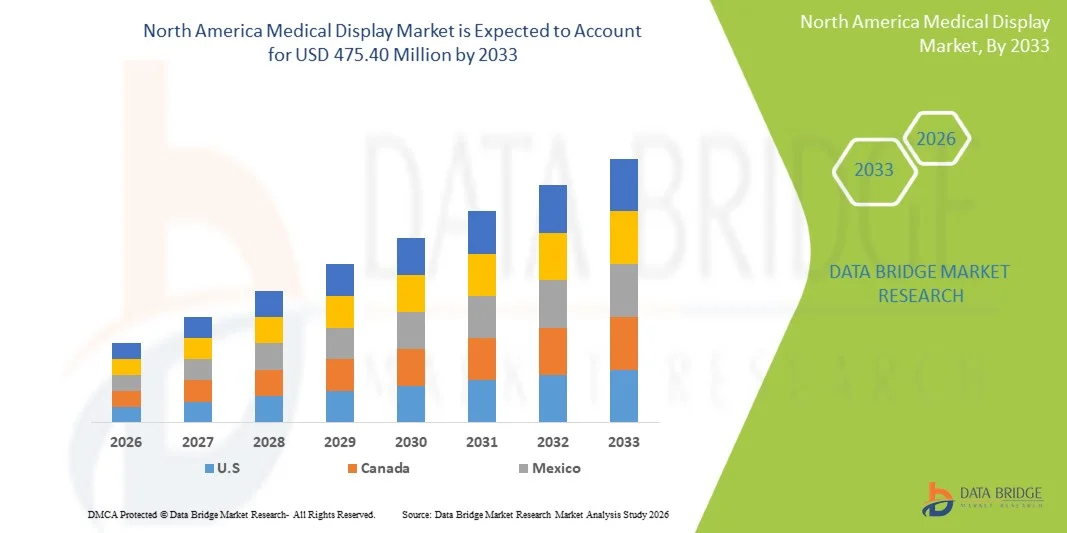
The North America Medical Display market was valued at USD 361.03 Million in 2025 and is projected to reach USD 475.40 Million by 2033, growing at a CAGR of 3.50% from 2026 to 2033. The North America Medical Display market is experiencing consistent growth driven by the increasing adoption of advanced diagnostic imaging technologies, rising demand for high-resolution medical visualization systems, and continuous investments in healthcare digitalization and infrastructure modernization. The growing prevalence of chronic diseases, expanding use of radiology and surgical imaging procedures, and rapid integration of AI-enabled healthcare technologies are further supporting market expansion across the region.
The increasing volume of diagnostic imaging procedures, coupled with the need for accurate image interpretation and enhanced clinical decision-making, is compelling hospitals, diagnostic centers, and ambulatory care facilities to invest in advanced medical display solutions. High-resolution LCD, LED, OLED, and 4K/8K medical displays are increasingly replacing conventional monitors, providing superior image clarity, color accuracy, and diagnostic precision for radiology, pathology, surgery, and telemedicine applications. In addition, the growing adoption of digital healthcare systems, PACS platforms, minimally invasive procedures, and AI-assisted diagnostics is accelerating demand for next-generation medical displays, offering healthcare providers improved workflow efficiency, patient outcomes, and operational performance.
Key Market Trends & Insights
- The U.S. dominated the North America Medical Display market in 2025, driven by high healthcare expenditure, strong presence of leading medical display manufacturers, and growing demand for advanced diagnostic imaging and minimally invasive surgical procedures.
- The Hardware segment dominated the market with a 78.91% share in 2025 due to the substantial demand for medical-grade display systems across hospitals, diagnostic laboratories, imaging centers, and surgical facilities.
- Canada is expected to be the fastest-growing country in the North America Medical Display market at a CAGR of 5.9% from 2026 to 2033, fueled by increasing healthcare digitization, expansion of imaging facilities, and rising investments in telehealth and diagnostic technologies.
- The OLED Display segment is the fastest-growing technology category, projected to register a CAGR of 6.4%, reflecting increasing demand for high-contrast imaging, enhanced color accuracy, and advanced visualization in radiology and surgical environments.
- The 23.0"-32.0" Inch Panels segment dominates the panel size category with a 36.75% revenue share in 2025, owing to its optimal balance between screen visibility, workspace efficiency, and diagnostic performance.
- The 2D Viewing Mode segment accounted for 68.93% of the market in 2025, preferred across healthcare facilities for routine diagnostic imaging, patient monitoring, and consultation applications.
- The 2.1–4MP segment dominated the megapixel category with a 34.58% share in 2025, supported by its extensive use in radiology, diagnostic review, and clinical imaging workflows.
- The 4K Resolution segment is the fastest-growing resolution category, projected to expand at a CAGR of 6.2%, driven by increasing demand for ultra-high-definition imaging in surgical and diagnostic procedures.
- The Colour Display segment held the largest share of 72.46% in 2025, supported by growing utilization in pathology, radiology, endoscopy, and multi-modality imaging applications.
- The Hardware segment dominated the component category with a 79.14% revenue share in 2025, driven by ongoing procurement of advanced medical monitors and display systems across healthcare facilities.
Market Size & Forecast
- North America Market Value (2025): USD 361.03 Million
- Expected Market Value (2033): USD 475.40 Million
- Forecast CAGR (2026–2033): 3.50%
- Leading Region in 2025: U.S.
- Fastest Growing Region: Canada
Report Scope and North America Medical Display Market Segmentation
|
Attributes |
Medical Display Key Market Insights |
|
Segments Covered |
|
|
Countries Covered |
North America · U.S. · Canada · Mexico |
|
Key Market Players |
• Barco NV (Belgium) |
|
Market Opportunities |
· Growing Adoption of AI-Enabled Diagnostic Imaging Systems · Expansion of Telehealth and Remote Diagnostic Services · Rising Demand for Advanced Surgical and Diagnostic Visualization |
|
Value Added Data Infosets |
In addition to the insights on market scenarios such as market value, growth rate, segmentation, geographical coverage, and major players, the market reports curated by the Data Bridge Market Research also include in-depth expert analysis, geographically represented company-wise production and capacity, network layouts of distributors and partners, detailed and updated price trend analysis and deficit analysis of supply chain and demand. |
North America Medical Display Market Trends
Trend: Growing Adoption of High-Resolution and 4K Medical Displays in Diagnostic Imaging
Healthcare providers across North America are increasingly adopting high-resolution and 4K medical displays to improve diagnostic accuracy and clinical workflow efficiency. The growing volume of digital imaging procedures, including radiology, mammography, pathology, and cardiology examinations, has accelerated demand for displays capable of delivering superior image clarity, color consistency, and grayscale performance. Advanced display technologies such as OLED panels, multi-modality monitors, and AI-enhanced visualization tools are gaining traction in hospitals and imaging centers. Furthermore, the transition toward digital healthcare ecosystems and Picture Archiving and Communication Systems (PACS) is increasing the need for high-performance medical displays that support precise image interpretation and collaborative diagnosis.
North America Medical Display Market Dynamics
Key Market Driver: Rising Volume of Diagnostic Imaging Procedures and Healthcare Digitalization
The increasing number of diagnostic imaging examinations performed across North America is a major driver for the medical display market. Medical displays play a critical role in radiology, mammography, pathology, surgery, and telehealth applications where image quality directly impacts clinical decision-making. According to healthcare industry estimates, millions of diagnostic imaging procedures, including X-rays, CT scans, MRI scans, ultrasound examinations, and mammograms, are conducted annually across the U.S. and Canada. The widespread implementation of electronic health records (EHRs), PACS platforms, and digital imaging workflows has further increased demand for advanced medical displays capable of delivering accurate visualization and seamless image management. In addition, growing investments in healthcare IT infrastructure and diagnostic imaging modernization continue to support market expansion.
Key Restraint/Challenge: High Cost of Advanced Medical Display Systems and Regulatory Compliance Requirements
A significant challenge in the North America Medical Display market is the high acquisition and maintenance cost associated with advanced diagnostic-grade displays. High-resolution 4K and OLED medical monitors require specialized calibration systems, quality assurance tools, and compliance with stringent healthcare standards to ensure diagnostic accuracy. The total cost of ownership extends beyond procurement to include software integration, regular calibration, maintenance, and replacement cycles. These costs can create adoption barriers for smaller clinics, independent imaging centers, and rural healthcare facilities with limited budgets.
For instance, diagnostic displays used in mammography and radiology applications must meet strict image quality and performance requirements established by healthcare regulatory authorities and accreditation bodies. Maintaining compliance often requires periodic testing, calibration, and system validation, adding to operational expenditures for healthcare providers.
Key Market Opportunity: Expansion of Telehealth, AI-Assisted Diagnostics, and Digital Imaging Platforms
The rapid expansion of telehealth services and AI-powered diagnostic technologies presents a significant growth opportunity for the North America Medical Display market. Healthcare providers are increasingly utilizing high-performance displays for remote consultations, teleradiology, digital pathology, and collaborative clinical decision-making. AI-enabled imaging platforms can assist clinicians by improving image interpretation, prioritizing critical cases, and enhancing workflow efficiency, thereby increasing the need for high-resolution display systems capable of supporting advanced visualization requirements.
Furthermore, the growing adoption of cloud-based imaging platforms, remote patient monitoring solutions, and enterprise-wide imaging networks is creating new demand for medical displays across hospitals, clinics, diagnostic laboratories, and telehealth environments. Continuous advancements in OLED technology, 4K and 8MP displays, touch-screen functionality, and color accuracy are expected to create substantial growth opportunities for manufacturers throughout the North American healthcare sector.
North America Medical Display Market Scope
The Medical Display market is segmented on the basis of technology, panel size, viewing mode, megapixel, resolution, display type, imaging technology, display color, aspect ratio, component, application, end user, and distribution channel.
- By Technology
On the basis of technology, the North America Medical Display market is segmented into LED-Backlit LCD Display, CCFL-Backlit LCD Display, TFT LCD Display, and OLED Display. The LED-Backlit LCD Display segment dominated the market with a 42.84% share in 2025 due to its superior brightness, energy efficiency, long operational lifespan, and widespread adoption across hospitals, diagnostic laboratories, and imaging centers. These displays provide excellent image quality, color consistency, and diagnostic accuracy required for radiology, pathology, and surgical applications. Increasing deployment of digital imaging systems, PACS platforms, and advanced visualization technologies is driving demand for LED-backlit displays. Their lower power consumption and reduced maintenance requirements make them a preferred choice for healthcare providers seeking cost-effective solutions. Furthermore, compatibility with high-resolution imaging modalities and compliance with medical display standards support broad adoption. Growing investments in healthcare infrastructure modernization and digital transformation initiatives across North America continue to strengthen the segment’s leadership position in the market.
The OLED Display segment is projected to register the fastest growth at a CAGR of 7.8% from 2026 to 2033, driven by increasing demand for premium image quality, higher contrast ratios, and superior color reproduction in medical imaging applications. OLED technology offers self-emissive pixels, deeper blacks, wider viewing angles, and faster response times, making it highly suitable for advanced diagnostic and surgical visualization. Rising adoption in radiology, interventional procedures, and precision diagnostics is accelerating segment expansion. Technological advancements and declining production costs are making OLED displays increasingly accessible to healthcare facilities. In addition, growing demand for minimally invasive surgeries and image-guided procedures is supporting uptake. The integration of OLED displays with next-generation imaging systems and AI-enabled diagnostic platforms is further contributing to market growth across North America.
- By Panel Size
On the basis of panel size, the North America Medical Display market is segmented into Under 22.9" Inch Panels, 23.0"-32.0" Inch Panels, 27.0-41.9 Inch Panels, and Above 42 Inch Panels. The 23.0"-32.0" Inch Panels segment dominated the market with a 38.76% share in 2025 owing to its optimal balance between display area, image clarity, and installation flexibility. These panel sizes are widely utilized in radiology departments, operating rooms, consultation areas, and diagnostic laboratories due to their ability to display high-quality medical images without occupying excessive workspace. Healthcare facilities prefer these displays because they support multi-modality imaging and enhance workflow efficiency. The increasing adoption of digital healthcare technologies and diagnostic imaging systems continues to drive demand. Their affordability and broad compatibility with medical equipment further reinforce their leading position in the market.
The Above 42 Inch Panels segment is expected to witness the fastest CAGR of 7.4% from 2026 to 2033, driven by increasing demand for large-format visualization in surgical suites, command centers, teaching hospitals, and collaborative diagnostic environments. These displays provide enhanced image visibility, support multi-image viewing, and improve clinical decision-making during complex procedures. Growing investments in advanced operating rooms and hybrid surgical environments are accelerating adoption. In addition, the rising need for real-time image sharing and multidisciplinary collaboration is further boosting demand. Continuous advancements in display resolution and image enhancement technologies are expected to support strong growth throughout the forecast period.
- By Viewing Mode
On the basis of viewing mode, the North America Medical Display market is segmented into 2D and 3D. The 2D segment dominated the market with a 68.43% share in 2025 due to its extensive use across radiology, pathology, consultation, patient monitoring, and general diagnostic imaging applications. Most healthcare facilities continue to rely on 2D displays because they offer proven diagnostic reliability, lower acquisition costs, and compatibility with a wide range of imaging modalities. These displays are widely integrated into PACS systems, hospital information systems, and digital workflow platforms. Their ease of use, standardized image interpretation protocols, and broad clinical acceptance continue to drive demand. In addition, ongoing investments in digital healthcare infrastructure and imaging modernization programs are reinforcing segment growth. The availability of high-resolution 2D medical displays further supports accurate image interpretation and clinical decision-making. As a result, the segment maintains a strong position across hospitals, clinics, and diagnostic laboratories throughout North America.
The 3D segment is projected to register the fastest growth at a CAGR of 7.6% from 2026 to 2033, driven by increasing adoption in surgical navigation, minimally invasive procedures, and advanced diagnostic imaging. Healthcare providers are increasingly utilizing 3D visualization technologies to improve depth perception, anatomical understanding, and procedural accuracy. The growth of robotic-assisted surgeries and image-guided interventions is accelerating demand for advanced 3D displays. Furthermore, advancements in rendering technologies and visualization software are improving image quality and clinical usability. Growing investments in next-generation operating rooms and medical training facilities are also supporting adoption. Increased emphasis on precision medicine and complex surgical procedures continues to create new opportunities for 3D medical display solutions across North America.
- By Megapixel
On the basis of megapixel, the North America Medical Display market is segmented into Up to 2MP, 2.1–4MP, 4.1–8MP, and Above 8MP. The 2.1–4MP segment dominated the market with a 36.92% share in 2025 due to its widespread utilization in routine diagnostic imaging applications including radiology, consultation, and general medical imaging. These displays offer an ideal combination of image quality, affordability, and operational efficiency. Healthcare providers prefer this category because it meets the resolution requirements for a broad range of diagnostic procedures while maintaining cost-effectiveness. Growing demand for digital imaging systems and increasing imaging procedure volumes are supporting segment expansion. The segment also benefits from strong compatibility with PACS environments and diagnostic workflows. In addition, widespread deployment across hospitals and outpatient facilities reinforces its leadership position in the market.
The Above 8MP segment is expected to witness the fastest CAGR of 7.9% from 2026 to 2033, driven by increasing demand for ultra-high-resolution imaging in mammography, pathology, and advanced radiology applications. These displays provide exceptional image detail and enable healthcare professionals to detect subtle abnormalities more effectively. Rising adoption of AI-assisted diagnostics and advanced imaging technologies is supporting demand for higher-resolution visualization platforms. Furthermore, ongoing improvements in display performance and image processing capabilities are accelerating market penetration. The growing need for enhanced diagnostic accuracy and precision healthcare solutions continues to drive strong growth within this segment.
- By Resolution
On the basis of resolution, the North America Medical Display market is segmented into 4K, Ultra Full HD, Full HD, and Others. The Full HD segment dominated the market with a 39.18% share in 2025 owing to its extensive adoption across hospitals, clinics, diagnostic laboratories, and patient monitoring applications. Full HD displays provide sufficient image clarity for a wide range of medical applications while maintaining cost efficiency. Healthcare facilities continue to deploy these systems because of their reliability, broad compatibility, and ease of integration with existing medical infrastructure. Rising demand for digital healthcare technologies and medical imaging solutions further supports segment growth. In addition, the availability of affordable Full HD display solutions encourages widespread adoption among small and medium-sized healthcare facilities. These factors continue to strengthen the segment’s leading market position.
The 4K segment is projected to register the fastest CAGR of 8.1% from 2026 to 2033, driven by increasing demand for superior image quality in radiology, surgery, pathology, and advanced diagnostic applications. 4K displays offer significantly higher resolution, enabling healthcare professionals to visualize fine anatomical details with greater accuracy. The growing adoption of minimally invasive procedures and image-guided surgeries is accelerating demand for ultra-high-definition visualization systems. Furthermore, technological advancements and declining display costs are encouraging broader implementation. The increasing integration of AI-enabled diagnostic tools and advanced imaging modalities is expected to further drive segment expansion across North America.
- By Display Type
On the basis of display type, the North America Medical Display market is segmented into Wall Mounted, Portable, and Modular. The Wall Mounted segment dominated the market with a 47.36% share in 2025 due to its widespread deployment in hospitals, operating rooms, intensive care units, and diagnostic departments. These displays provide permanent installation, space optimization, and continuous accessibility for healthcare professionals. Their ability to support high-resolution imaging and patient monitoring applications contributes significantly to adoption. Growing healthcare infrastructure investments and rising demand for digital clinical environments are reinforcing segment growth. In addition, wall-mounted systems improve workflow efficiency and support centralized visualization across multiple healthcare settings. Their durability and long operational lifespan further contribute to market dominance.
The Portable segment is anticipated to witness the fastest CAGR of 8.0% from 2026 to 2033, driven by increasing demand for point-of-care diagnostics, telehealth services, and mobile healthcare delivery. Portable medical displays enable healthcare professionals to access diagnostic information across various clinical environments. Growing adoption of portable ultrasound systems, mobile imaging solutions, and remote patient monitoring technologies is accelerating segment growth. Furthermore, advancements in lightweight display technologies and wireless connectivity are enhancing functionality and usability. The rising emphasis on flexible healthcare delivery models and decentralized care is expected to support strong market expansion during the forecast period.
- By Imaging Technology
On the basis of imaging technology, the North America Medical Display market is segmented into Touch Screen, Scratch Resistant Front Glass, Failsafe Mode, Cleanable Options, Softglow & Spotview, and Others. The Touch Screen segment dominated the market with a 31.84% share in 2025 due to its increasing adoption across hospitals, diagnostic laboratories, operating rooms, and point-of-care environments. Touch-enabled medical displays improve workflow efficiency by allowing healthcare professionals to interact directly with patient records, diagnostic images, and clinical software platforms. The technology reduces dependency on peripheral devices and enhances operational convenience in fast-paced healthcare environments. Growing implementation of digital healthcare systems, electronic medical records, and interactive imaging platforms is driving demand. In addition, touch-screen displays support faster clinical decision-making and improve accessibility in multidisciplinary healthcare settings. Continuous advancements in display responsiveness and durability are further strengthening adoption. These factors collectively reinforce the segment’s dominant position in the North America market.
The Cleanable Options segment is projected to register the fastest CAGR of 7.7% from 2026 to 2033, driven by increasing emphasis on infection prevention and hygiene compliance across healthcare facilities. Hospitals and diagnostic centers are adopting displays specifically designed to withstand frequent cleaning and disinfection procedures. Rising awareness regarding healthcare-associated infections and stricter sanitation regulations are accelerating demand. Furthermore, the growing use of displays in surgical suites, intensive care units, and isolation wards is creating additional opportunities. Manufacturers are developing advanced coatings and antimicrobial technologies to improve durability and safety. The increasing focus on patient safety and contamination control is expected to support strong market growth throughout the forecast period.
- By Display Color
On the basis of display color, the North America Medical Display market is segmented into Colour and Monochrome. The Colour segment dominated the market with a 72.68% share in 2025 due to its extensive utilization across radiology, pathology, surgical visualization, cardiology, and diagnostic imaging applications. Color displays enable enhanced visualization of anatomical structures, tissue differentiation, and diagnostic details, improving clinical interpretation and decision-making. Growing adoption of advanced imaging modalities and digital healthcare systems is supporting demand. Healthcare professionals increasingly prefer color displays because they provide superior image clarity and workflow efficiency. In addition, technological advancements in color calibration and display accuracy continue to improve diagnostic performance. Expanding use of telemedicine and image-sharing platforms further strengthens segment growth. These factors collectively contribute to the segment’s leadership position across North America.
The Colour segment is also expected to witness the fastest CAGR of 7.5% from 2026 to 2033, driven by increasing demand for high-definition visualization in diagnostic and surgical applications. The growing deployment of advanced imaging systems, AI-assisted diagnostics, and digital pathology platforms is accelerating adoption. Healthcare providers are increasingly investing in high-performance color displays to improve patient outcomes and operational efficiency. Continued innovation in display technologies and image enhancement solutions is expected to support sustained growth during the forecast period.
- By Aspect Ratio
On the basis of aspect ratio, the North America Medical Display market is segmented into 16:09, 21:09, and 4:03. The 16:09 segment dominated the market with a 57.24% share in 2025 owing to its broad compatibility with modern medical imaging systems, PACS platforms, and healthcare IT infrastructure. This aspect ratio provides an optimal balance between image viewing area and workspace efficiency, making it suitable for radiology, pathology, consultation, and patient monitoring applications. Healthcare facilities widely utilize 16:09 displays because they support high-resolution imaging and multi-window functionality. The growing adoption of digital imaging technologies and advanced diagnostic workflows continues to drive segment demand. In addition, strong manufacturer support and widespread product availability reinforce market leadership. These advantages contribute significantly to the segment’s dominance.
The 21:09 segment is projected to register the fastest CAGR of 7.3% from 2026 to 2033, driven by increasing demand for ultra-wide displays capable of supporting multitasking and advanced visualization applications. Healthcare professionals are adopting wider display formats to improve workflow efficiency and facilitate simultaneous viewing of multiple diagnostic images. Rising investments in advanced radiology and surgical visualization systems are accelerating growth. Furthermore, increasing demand for collaborative healthcare environments and integrated digital workstations is supporting adoption. Continued innovation in display technologies is expected to sustain segment expansion throughout the forecast period.
- By Component
On the basis of component, the North America Medical Display market is segmented into Hardware and Services. The Hardware segment dominated the market with a 78.91% share in 2025 due to the substantial demand for medical-grade display systems across hospitals, diagnostic laboratories, imaging centers, and surgical facilities. Healthcare organizations continue to invest heavily in advanced display technologies to improve diagnostic accuracy and clinical efficiency. Hardware solutions represent a critical component of digital healthcare infrastructure and account for a significant portion of capital expenditure. Increasing adoption of high-resolution displays, AI-enabled imaging platforms, and advanced visualization systems is supporting segment growth. In addition, ongoing replacement cycles and healthcare modernization initiatives contribute to sustained demand. These factors collectively reinforce the segment’s leading position in the market.
The Services segment is anticipated to witness the fastest CAGR of 7.2% from 2026 to 2033, driven by growing demand for installation, maintenance, calibration, technical support, and software integration services. As healthcare facilities deploy increasingly sophisticated display technologies, the need for specialized support services continues to rise. Healthcare providers are focusing on maximizing equipment performance and ensuring regulatory compliance. In addition, the increasing complexity of integrated healthcare systems is generating demand for professional service offerings. Expanding digital transformation initiatives are expected to further accelerate segment growth across North America.
- By Application
On the basis of application, the North America Medical Display market is segmented into Consultation, Diagnostic, Surgical/Interventional, Telehealth, Teaching / Practice, Fetal Monitoring, Dentistry, Point of Care, Patient-Worn Monitoring, and Others. The Diagnostic segment dominated the market with a share of 34.86% in 2025 due to the extensive use of medical displays in radiology, pathology, mammography, cardiology, and other diagnostic imaging applications. High-resolution displays play a critical role in accurate image interpretation, disease detection, and clinical decision-making. The growing prevalence of chronic diseases, rising imaging procedure volumes, and increasing adoption of digital healthcare technologies continue to drive demand. Healthcare providers are investing in advanced diagnostic visualization systems to improve efficiency, reduce diagnostic errors, and enhance patient outcomes. Furthermore, the widespread implementation of PACS and AI-assisted imaging platforms is reinforcing segment growth. Continuous technological advancements in display quality, brightness, and image calibration are further supporting adoption. These factors collectively strengthen the Diagnostic segment’s dominant position across North America.
The Surgical/Interventional segment is anticipated to witness the fastest CAGR of 8.2% from 2026 to 2033, driven by the increasing number of minimally invasive surgeries and image-guided procedures performed across healthcare facilities. Surgeons require advanced visualization technologies to improve procedural precision, patient safety, and clinical outcomes. The growing adoption of robotic-assisted surgery, hybrid operating rooms, and real-time imaging systems is accelerating demand for high-performance medical displays. In addition, advancements in 4K, OLED, and ultra-high-definition display technologies are enhancing visualization capabilities during complex interventions. Rising investments in surgical infrastructure and increasing demand for precision medicine are further contributing to growth. The integration of AI-enabled surgical imaging platforms is also expected to support long-term expansion of this segment.
- By End User
On the basis of end user, the North America Medical Display market is segmented into Hospitals, Clinics, Nursing Facilities, Diagnostic Laboratories, Imaging/Radiology Lab, Laboratory, Rehabilitation Centers, and Others. The Hospitals segment dominated the market with a share of 43.91% in 2025 due to the high volume of diagnostic imaging procedures, surgical interventions, and patient monitoring activities conducted within hospital environments. Hospitals represent the largest users of advanced medical display systems because they require high-performance visualization solutions across multiple departments including radiology, cardiology, pathology, emergency medicine, and surgery. Growing patient admissions, increasing prevalence of chronic diseases, and rising investments in healthcare infrastructure are supporting segment growth. Hospitals also possess greater financial capacity to adopt premium display technologies and integrated digital healthcare systems. In addition, the ongoing modernization of healthcare facilities and expansion of imaging capabilities continue to reinforce demand. These factors collectively maintain the segment’s leadership position across the North America market.
The Imaging/Radiology Lab segment is projected to register the fastest CAGR of 7.8% from 2026 to 2033, driven by increasing demand for specialized imaging services and advanced diagnostic solutions. The growing number of imaging procedures, including CT, MRI, ultrasound, mammography, and digital radiography examinations, is accelerating adoption of high-resolution medical displays. Imaging laboratories are increasingly investing in advanced visualization technologies to improve diagnostic accuracy and workflow efficiency. Furthermore, the expansion of outpatient imaging centers and teleradiology services is creating additional growth opportunities. Technological advancements in display resolution and image enhancement capabilities are further supporting market expansion. Rising demand for early disease detection and preventive healthcare services is expected to sustain strong growth throughout the forecast period.
- By Distribution Channel
On the basis of distribution channel, the North America Medical Display market is segmented into Direct Tender, Retail Sales, and Others. The Direct Tender segment dominated the market with a share of 61.47% in 2025 due to large-scale procurement activities undertaken by hospitals, healthcare systems, diagnostic networks, and government healthcare organizations. Direct tender purchasing enables healthcare providers to secure competitive pricing, long-term supply agreements, and standardized procurement processes for medical display equipment. The segment benefits from strong relationships between manufacturers and institutional buyers, ensuring consistent product availability and technical support. Growing investments in healthcare infrastructure and digital transformation initiatives are further supporting demand. In addition, direct procurement facilitates compliance with healthcare regulations and quality standards. These advantages continue to reinforce the segment’s leading position across North America.
The Retail Sales segment is expected to witness the fastest CAGR of 7.1% from 2026 to 2033, driven by increasing demand from private clinics, specialty healthcare facilities, outpatient centers, and independent imaging laboratories. The availability of a wider range of display products, improved distribution networks, and growing accessibility of digital procurement platforms are supporting segment growth. Healthcare providers are increasingly utilizing retail channels to obtain flexible purchasing options and faster product delivery. In addition, the expansion of e-commerce platforms and specialized medical equipment distributors is improving market reach. Rising adoption of advanced medical displays among small and medium-sized healthcare facilities is further contributing to growth. Continued digitalization of healthcare procurement processes is expected to accelerate expansion of the retail sales segment during the forecast period.
North America Medical Display Market Regional Analysis
North America dominated the Medical Display market and accounted for the largest revenue share of 38.67% in 2025, supported by advanced healthcare infrastructure, high adoption of digital imaging technologies, and substantial investments in healthcare IT and diagnostic imaging systems. The region benefits from increasing utilization of medical displays across radiology, pathology, surgery, telehealth, and patient monitoring applications. Growing demand for high-resolution diagnostic displays, expanding adoption of PACS and electronic health record systems, and rising healthcare expenditure continue to strengthen North America's leadership position in the global Medical Display market.
U.S. Medical Display Market Insight
The U.S. dominated the North America Medical Display market in 2025, driven by high healthcare expenditure, strong presence of leading medical display manufacturers, and growing demand for advanced diagnostic imaging and minimally invasive surgical procedures. The country's extensive network of hospitals, imaging centers, and specialty clinics continues to generate significant demand for high-performance medical displays used in radiology, mammography, pathology, and surgical visualization. In addition, increasing adoption of AI-assisted diagnostics, telehealth platforms, and digital healthcare technologies is further accelerating market growth across the U.S.
Canada Medical Display Market Insight
Canada is expected to be the fastest-growing country in the North America Medical Display market at a CAGR of 5.9% from 2026 to 2033, fueled by increasing healthcare digitization, expansion of imaging facilities, and rising investments in telehealth and diagnostic technologies. Growing modernization of healthcare infrastructure, increasing deployment of digital imaging systems, and rising demand for remote healthcare services are supporting the adoption of advanced medical displays across hospitals, diagnostic laboratories, and imaging centers. Furthermore, government initiatives aimed at improving healthcare accessibility and digital health integration are expected to create significant growth opportunities for the Medical Display market in Canada during the forecast period.
North America Medical Display Market Share
The Medical Display industry is primarily led by well-established companies, including:
- Barco NV (Belgium)
- EIZO Corporation (Japan)
- Sony Group Corporation (Japan)
- LG Electronics Inc. (South Korea)
- Novanta Inc. (U.S.)
- Advantech Co., Ltd. (Taiwan)
- FSN Medical Technologies (U.S.)
- Double Black Imaging (U.S.)
- Jusha Medical Co., Ltd. (China)
- Dell Technologies Inc. (U.S.)
- HP Inc. (U.S.)
- ASUSTeK Computer Inc. (Taiwan)
- Quest International Inc. (U.S.)
- Richardson Healthcare (U.S.)
- Canvys – Richardson Electronics Ltd. (U.S.)
- Stryker Corporation (U.S.)
- Siemens Healthineers AG (Germany)
- GE HealthCare Technologies Inc. (U.S.)
- Koninklijke Philips N.V. (Netherlands)
- Fujifilm Holdings Corporation (Japan)
- Canon Medical Systems Corporation (Japan)
- Samsung Electronics Co., Ltd. (South Korea)
- NDS Surgical Imaging, LLC (U.S.)
- Steris plc (Ireland)
- Ampronix LLC (U.S.)
- Beacon International (U.S.)
- Axiomtek Co., Ltd. (Taiwan)
- Advantech Medical Computing (Taiwan)
- WIDE Corporation (Japan)
- COJE Co., Ltd. (South Korea)
Latest Developments in North America Medical Display Market
- In February 2023, EIZO Corporation, a leading provider of medical visualization solutions, announced the launch of the RadiForce MX217, a 21.3-inch, 2-megapixel medical monitor designed for patient chart display and diagnostic image review. The monitor features improved contrast performance, DICOM Part 14 compliance, and support for reviewing images from X-ray, CT, MRI, endoscopy, nuclear medicine, and ultrasound applications. This launch underscores EIZO’s commitment to enhancing diagnostic accuracy and supporting healthcare digitalization initiatives
- In March 2023, EIZO Corporation announced that its RadiForce medical monitors and RadiCS quality control software complied with the new IEC 62563-2 international standard for medical display quality control. The compliance enables healthcare providers to maintain consistent image quality and diagnostic reliability while meeting evolving global standards for medical imaging systems. This development highlights EIZO’s focus on advancing quality assurance and patient safety in medical imaging environments
- In June 2023, EIZO Corporation unveiled the RadiForce MX317W, a 30.5-inch, 8-megapixel medical monitor equipped with USB Type-C docking functionality for teleradiology and home-reading applications. The display was developed to support remote diagnostic workflows, offering high-resolution image review capabilities for radiologists and pathologists. This launch reflects the growing demand for flexible healthcare delivery and remote diagnostic services across North America
- In October 2023, EIZO expanded commercial availability of the RadiForce MX317W across key healthcare markets, providing healthcare professionals with advanced display solutions optimized for remote image interpretation and digital pathology workflows. The product supports multiple imaging modalities and enhanced connectivity features, helping healthcare organizations improve operational efficiency and diagnostic accessibility
- In October 2024, Barco NV, a global leader in medical visualization technologies, launched the Coronis OneLook, its next-generation flagship breast imaging display. The monitor offers one of the highest resolutions available in breast imaging and incorporates advanced visualization technologies designed to help radiologists detect subtle abnormalities with greater precision. This launch demonstrates Barco’s continued investment in high-performance diagnostic display solutions.
- In December 2024, Barco showcased its latest medical display innovations at the Radiological Society of North America (RSNA) Annual Meeting in Chicago, including the Coronis OneLook® breast imaging display and new medical visualization service offerings. The company highlighted advanced diagnostic imaging capabilities and workflow optimization solutions designed to improve radiologist productivity and clinical outcomes. This development reinforces Barco’s strategic focus on innovation within the medical display sector
SKU-
Get online access to the report on the World's First Market Intelligence Cloud

- Interactive Data Analysis Dashboard
- Company Analysis Dashboard for high growth potential opportunities
- Research Analyst Access for customization & queries
- Competitor Analysis with Interactive dashboard
- Latest News, Updates & Trend analysis
- Harness the Power of Benchmark Analysis for Comprehensive Competitor Tracking
Research Methodology
Data collection and base year analysis are done using data collection modules with large sample sizes. The stage includes obtaining market information or related data through various sources and strategies. It includes examining and planning all the data acquired from the past in advance. It likewise envelops the examination of information inconsistencies seen across different information sources. The market data is analysed and estimated using market statistical and coherent models. Also, market share analysis and key trend analysis are the major success factors in the market report. To know more, please request an analyst call or drop down your inquiry.
The key research methodology used by DBMR research team is data triangulation which involves data mining, analysis of the impact of data variables on the market and primary (industry expert) validation. Data models include Vendor Positioning Grid, Market Time Line Analysis, Market Overview and Guide, Company Positioning Grid, Patent Analysis, Pricing Analysis, Company Market Share Analysis, Standards of Measurement, Global versus Regional and Vendor Share Analysis. To know more about the research methodology, drop in an inquiry to speak to our industry experts.
Customization Available
Data Bridge Market Research is a leader in advanced formative research. We take pride in servicing our existing and new customers with data and analysis that match and suits their goal. The report can be customized to include price trend analysis of target brands understanding the market for additional countries (ask for the list of countries), clinical trial results data, literature review, refurbished market and product base analysis. Market analysis of target competitors can be analyzed from technology-based analysis to market portfolio strategies. We can add as many competitors that you require data about in the format and data style you are looking for. Our team of analysts can also provide you data in crude raw excel files pivot tables (Fact book) or can assist you in creating presentations from the data sets available in the report.












