


North America Plastic Optical Fiber Market
Market Size in USD Million
CAGR :
% 
 USD
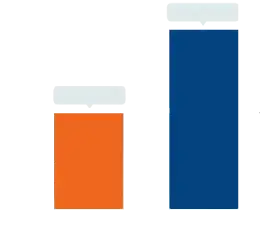
624.49 Million
USD
1,096.03 Million
2025
2033
USD
624.49 Million
USD
1,096.03 Million
2025
2033
 Forecast Period Forecast Period |
2026 –2033 |
 Market Size (Base Year) Market Size (Base Year) |
USD 624.49 Million |
 Market Size (Forecast Year) Market Size (Forecast Year) |
USD 1,096.03 Million |
 CAGR CAGR |
% |
| Major Markets Players |
|
North America Plastic Optical Fiber Market Size
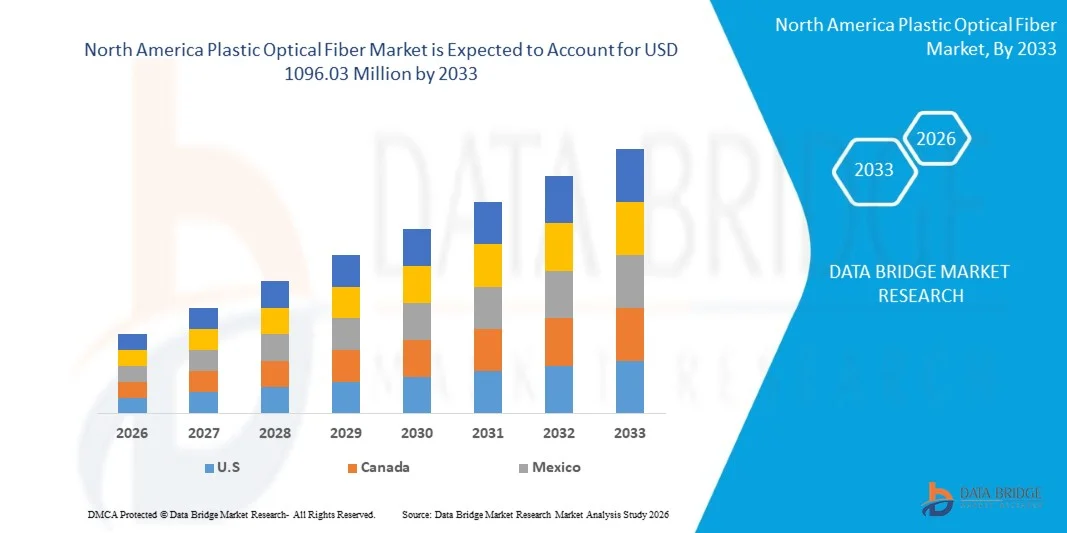
- The North America Plastic Optical Fiber Market is expected to reach USD 1096.03 Million by 2033 from USD 624.49 Million in 2025, growing with a substantial CAGR of 8.0% in the forecast period of 2026 to 2033
- The Plastic Optical Fiber (POF) Market is witnessing steady and accelerating growth, driven by increasing demand for cost-effective short-distance optical communication, rapid expansion of connected automotive systems, growing industrial automation, and rising adoption of smart home and consumer electronics networks. Organizations across automotive, manufacturing, healthcare, and residential sectors are increasingly adopting Plastic Optical Fiber solutions to enable reliable high-speed data transmission with simplified installation, reduced weight, and improved electromagnetic interference (EMI) immunity compared to copper-based cabling systems.
- The accelerated deployment of in-vehicle infotainment systems, advanced driver-assistance systems (ADAS), industrial control networks, robotics communication platforms, and home broadband extensions has significantly increased demand for step-index and graded-index POF cables, optical transceivers, connectors, and optoelectronic components. As automotive manufacturers transition toward connected and software-defined vehicle architectures, POF provides lightweight, vibration-resistant, and flexible communication infrastructure suitable for confined automotive environments. In industrial environments, POF supports robust data transmission in electrically noisy settings where immunity to electromagnetic interference is critical for operational reliability.
North America Plastic Optical Fiber Market Analysis
- The Plastic Optical Fiber (POF) Market is positioned for sustained long-term growth, driven by increasing demand for cost-effective short-distance optical communication, rapid expansion of connected vehicles, rising adoption of industrial automation systems, and growing deployment of smart home and consumer networking solutions. Plastic Optical Fiber enables high-speed data transmission using lightweight, flexible polymer-based cables, significantly reducing installation complexity, improving electromagnetic interference (EMI) immunity, and lowering maintenance requirements across automotive, industrial, medical, and residential environments.
- The market is further strengthened by continuous advancements in polymer materials, particularly PMMA-based step-index POF and perfluorinated graded-index POF technologies, enabling improved bandwidth performance, enhanced thermal stability, and extended transmission distances. Increasing integration of in-vehicle infotainment systems, advanced driver-assistance systems (ADAS), factory automation networks, robotics communication platforms, and home entertainment connectivity is accelerating POF adoption.
- In 2025, the U.S. dominated the North American North America Plastic Optical Fiber Market, holding a 78.35% share. This was driven by strong demand in consumer electronics, automotive networks, and advanced communication infrastructure, coupled with significant technological adoption and investment.
- Mexico is the fastest-growing country in the North American North America Plastic Optical Fiber Market, with a CAGR of 8.4% during the forecast period. This growth is driven by rising investments in telecommunication infrastructure, increasing demand for high-speed data connectivity, and expanding adoption in automotive and industrial applications.
- In 2025, Step-Index Plastic Optical Fiber (POF) led the North American market, capturing 63.37% of the share. Its dominance was driven by widespread adoption in short-distance data transmission and consumer electronics. The cost-effectiveness and ease of installation of Step-Index POF further reinforced its market leadership.
Report Scope and North America Plastic Optical Fiber Market Segmentation
|
Attributes |
North America Plastic Optical Fiber Market Key Market Insights |
|
Segments Covered |
|
|
Countries Covered |
|
|
Key Market Players |
|
|
Market Opportunities |
|
|
Value Added Data Infosets |
In addition to the insights on market scenarios such as market value, growth rate, segmentation, geographical coverage, and major players, the market reports curated by the Data Bridge Market Research also include in-depth expert analysis, geographically represented company-wise production and capacity, network layouts of distributors and partners, detailed and updated price trend analysis and deficit analysis of supply chain and demand. |
North America Plastic Optical Fiber Market Trends
“Rising Demand for Short‑Range, High‑Speed Connectivity ”
- The plastic optical fiber (POF) market is increasingly driven by the rising demand for short‑range, high‑speed connectivity across several sectors. Plastic optical fiber stands out from traditional glass fiber and copper solutions due to attributes like flexibility, robust performance in confined spaces, immunity to electromagnetic interference, and easier, lower‑cost installation; making it attractive for localized, high‑bandwidth communication needs. Fundamentally designed for distances typically under nearly100 m, POF provides sufficient bandwidth for real‑time data exchange in automotive, residential, industrial, and enterprise networks, where short‑distance performance is critical.
- POF’s short‑range capability helps enable a range of modern high‑speed systems, from in‑vehicle infotainment to localized area networks, by offering a balance of speed, cost, and installation simplicity compared with more complex glass fiber or copper alternatives.
For instance,
- In May 2025, Keio University published a press release on May 29, 2025, announcing that a research team from its Keio Frontier Research & Education Collaborative Square (K‑FRECS) had developed a multi‑core graded‑index plastic optical fiber (GI‑POF) capable of ultra‑high-speed transmission of up to 106.25 Gbps per core; this press release was issued directly by the university as the publisher and the results were subsequently presented at OFC 2025, one of the world’s leading conferences in optical communications. This breakthrough demonstrates that plastic optical fiber can now support extremely high-speed, low-latency communication over short distances, directly addressing the rising demand for short-range, high-speed connectivity, which is a key driver of the POF market.
- In October 2025, the 33rd International Conference on Plastic Optical Fibers (POF2025) was held, organized by the International Cooperative of Plastic Optical Fibers (ICPOF) and supported by associations including the Japan Society of Applied Physics and several national research institutions. The conference showcased the latest advances in POF technologies and applications, covering sectors such as automotive networks, consumer and industrial communications, sensor systems, and data interconnects. By promoting collaboration between academia, industry, and standardization bodies, POF2025 emphasizes the role of plastic optical fiber in enabling short-range, high-speed connectivity, reinforcing its status as a key driver of the POF market.
- In May 2025, TechRadar published an article reporting on the 106 Gbps Plastic Optical Fiber (POF) breakthrough announced ahead of the Optical Fiber Communication Conference (OFC 2025), emphasizing that multicore POF could dramatically simplify high‑speed, short‑reach connectivity in AI and data center environments due to reduced cost and complexity compared to traditional glass fiber, highlighting real‑world innovation where speed and short‑distance communication are key performance criteria driving POF adoption.
- In summary, the demand for short‑range, high‑speed connectivity is a core driver shaping the growth of the North America Plastic Optical Fiber Market. As industries and consumers alike seek reliable, cost‑effective solutions for localized data transmission, POF has emerged as a compelling alternative to traditional cabling technologies in specific applications where ease of installation, mechanical flexibility, and EMI resistance are paramount. With continued advancements in polymer materials and integration technologies, POF is well‑positioned to support the next wave of connected vehicles, smart infrastructure, and consumer network solutions, even as longer‑haul glass fiber systems continue to dominate backbone communications.
North America Plastic Optical Fiber Market Dynamics
Driver
“Expansion Of Automotive and Industrial Applications ”
- The Plastic Optical Fiber (POF) market is increasingly driven by the expansion of applications across automotive and industrial sectors, as both industries prioritize lightweight, flexible, robust, and interference‑resistant communication solutions. In the automotive domain, the shift toward connected, electric, and autonomous vehicles has elevated the need for high‑speed in‑vehicle data networks capable of handling infotainment, sensor communications, and advanced driver‑assistance systems (ADAS). Meanwhile, industrial settings; particularly factory automation, robotics, and control systems; require cabling that can withstand harsh environments while ensuring reliable short‑distance data transmission. These evolving application landscapes are prompting manufacturers and OEMs to adopt POF technologies, expanding usage beyond traditional consumer and home networking scenarios and solidifying POF’s role in future digital infrastructure.
For instance,
- In September 2025, FibreTX published an industry news report highlighting that plastic optical fiber (POF) is gaining momentum in automotive and home networks, with rapid expansion in automotive infotainment systems and short‑range data links due to advantages like electromagnetic immunity, cost efficiency, and ease of installation, including usage in onboard sensors, control systems, and factory automation environments, showing that expanding applications in both automotive and industrial sectors are driving the POF market.
- In August 2025, FibreTX published a report noting that POF’s lightweight properties, anti‑interference benefits, and stability under high EMI conditions are fueling its adoption in automotive autonomous driving networks and industrial robots/power systems, with China’s industrial automation and new energy vehicle developments providing strong growth momentum, highlighting that expanding applications in both automotive and industrial sectors are driving the POF market.
- In 2025, Jiangsu TX Plastic Optical Fibers Co., Ltd. (exhibiting at PO F2025) highlighted industrial control system products and automotive intelligence POF solutions, reflecting manufacturer efforts to target both industrial automation and connected car systems, signaling that expanded application portfolios by manufacturers are driving POF market demand.
- In 2025, Yazaki Corporation (POF2025 exhibition) featured in‑vehicle optical components for autonomous driving ECUs and ADAS, showing that supplier innovation in automotive optical technologies is aligning with industry needs, confirming that growing automotive applications are key drivers of the POF market.
- The expansion of automotive and industrial applications has become a core driver of the North America Plastic Optical Fiber Market, as these sectors increasingly adopt POF technologies to meet connectivity needs that copper cables and traditional glass optical fibers cannot efficiently satisfy in localized, interference‑prone environments. Real‑world instances from industry news and reports demonstrate that automotive infotainment, sensor systems, ADAS, and industrial automation networks are actively deploying POF solutions to provide lightweight, reliable, and high‑performance communication links. This broader application footprint is reinforcing POF’s market position and fueling ongoing innovation and deployment across key growth industries.
Restraint/Challenge
“Limitations In Transmission Distance and Bandwidth ”
- Plastic Optical Fiber (POF) offers advantages such as flexibility, low cost, ease of installation, and EMI resistance, making it suitable for short-range high-speed connectivity and localized networks. However, POF faces inherent limitations in transmission distance and bandwidth compared to glass optical fiber. Standard POF typically supports distances up to 100 meters with gigabit-class speeds, while multimode or glass fibers can reach several kilometers at similar or higher bandwidths. These physical limitations restrict its use in long-haul telecom, metro networks, and large-scale industrial backbones, confining adoption primarily to home networks, in-vehicle systems, and short-distance industrial links.
For instance,
- In May 2025, TechRadar reported on a 106 Gbps multicore POF prototype, noting that while speed improvements are significant, the technology is still limited to short-reach applications in data centers and AI environments, with longer-distance transmission requiring repeaters or alternative glass fiber solutions. This highlights that POF’s distance and bandwidth constraints remain a key factor limiting broader adoption in telecom and long-haul network segments.
- In May 2025, Scientific Reports (Nature) published a research article showing that even newly designed microstructured POFs require specialized designs to improve bandwidth and still struggle with mode coupling issues as distance increases, indicating ongoing challenges in achieving high bandwidth over longer fiber lengths. This reflects that POF’s inherent transmission and bandwidth limitations continue to constrain its broader use in high‑performance or longer‑reach telecom and data applications.
- In 2025, DSPof.com reported that plastic optical fiber offers advantages like ease of installation and EMI resistance but suffers from “shorter transmission distance” (typically up to 50–100 m) and “lower bandwidth” than glass fiber, restricting its use for long‑distance or high‑speed communication scenarios beyond consumer or short network links. This demonstrates that POF’s limited range and bandwidth capacity directly limit its applicability in larger telecom and infrastructure networks.
- The limitations in transmission distance and bandwidth are a significant restraint for the POF market. While short-range applications in automotive, residential, and industrial systems continue to grow, POF’s inability to support long-haul communications or very high-speed wide-area networks limits adoption in broader telecom, metro, and enterprise backbone applications, restraining market growth potential despite ongoing technological innovations.
North America Plastic Optical Fiber Market Scope
North America Plastic Optical Fiber Market is segmented into eight notable segments based on type, offering, data transmission speed, network architecture, light source, communication protocol, application, and end-user.
• By type
On the basis of type, the North American North America Plastic Optical Fiber Market is segmented into Step-Index POF and Gradient-Index POF. In 2026, Step-Index POF is expected to dominate the market with a 63.24% share, driven by its cost-effectiveness, ease of installation, and widespread use in short-distance data transmission and consumer electronics applications.
The Gradient-Index POF segment is expected to be the fastest-growing in the North American North America Plastic Optical Fiber Market, with a CAGR of 8.4%, driven by increasing demand for high-speed data transmission, enhanced performance in longer-distance communication, and rising adoption in automotive, industrial, and consumer electronics applications.
• By offering
On the basis of offering, the North America Plastic Optical Fiber Market is segmented into Components and Services. In 2026, the Components segment is expected to dominate the market with an 83.59% share, driven by growing demand for optical fiber cables, connectors, and related hardware across automotive, consumer electronics, and industrial applications.
The Components segment is projected to be the fastest-growing in the North American North America Plastic Optical Fiber Market, with a CAGR of 8.1%, driven by increasing demand for high-performance fiber optic cables, connectors, and hardware in automotive networks, industrial automation, and consumer electronics applications.
• By data transmission speed
On the basis of data transmission speed, the North America Plastic Optical Fiber Market is segmented into Low-Speed POF (<100 Mbps), Medium-Speed POF (100 Mbps–1 Gbps), and High-Speed POF (>1 Gbps). In 2026, the Low-Speed POF (<100 Mbps) segment is expected to dominate the market with a 46.49% share, driven by its widespread use in short-distance communication, cost-effectiveness, and strong adoption in consumer electronics, automotive networks, and indoor data transmission applications.
The High-Speed POF (>1 Gbps) segment is projected to be the fastest-growing in the North American North America Plastic Optical Fiber Market, with a CAGR of 8.4%, driven by rising demand for high-bandwidth applications, advanced automotive and industrial networks, and increasing deployment in data centers and smart infrastructure requiring ultra-fast data transmission.
• By network architecture
On the basis of network architecture, the North America Plastic Optical Fiber Market is segmented into Point-to-Point POF Systems, Star Network POF Systems, and Ring Network POF Systems. In 2026, the Star Network POF Systems segment is expected to dominate the market with a 43.21% share, driven by its scalability, reliability, and widespread adoption in automotive networks, industrial automation, and smart infrastructure applications.
The Ring Network POF Systems segment is projected to be the fastest-growing in the North America Plastic Optical Fiber Market, with a CAGR of 8.3%, driven by increasing demand for fault-tolerant network architectures, enhanced data reliability, and growing adoption in industrial automation, automotive systems, and mission-critical communication networks.
• By light source
On the basis of light source, the North America Plastic Optical Fiber Market is segmented into LED-Based POF Systems and Laser-Based POF Systems. In 2026, the LED-Based POF Systems segment is expected to dominate the market with a 64.21% share, driven by its cost-effectiveness, energy efficiency, ease of integration, and widespread use in consumer electronics, automotive networks, and short-distance communication applications.
The Laser-Based POF Systems segment is projected to be the fastest-growing in the North America Plastic Optical Fiber Market, with a CAGR of 8.4%, driven by increasing demand for high-speed, long-distance data transmission, superior signal quality, and growing adoption in automotive, industrial, and data center applications.
• By communication protocol
On the basis of communication protocol, the North America Plastic Optical Fiber Market is segmented into MOST (Media Oriented Systems Transport), Ethernet over POF, FlexRay, and CAN over POF. In 2026, the MOST (Media Oriented Systems Transport) segment is expected to dominate the market with a 42.70% share, driven by its widespread adoption in automotive infotainment and networking systems, high data transfer reliability, and support for multimedia and real-time communication applications.
The Ethernet over POF segment is projected to be the fastest-growing in the North America Plastic Optical Fiber Market, with a CAGR of 8.5%, driven by increasing demand for high-speed data communication, growing deployment in industrial automation, smart infrastructure, and data center networks, and the need for reliable, low-latency Ethernet-based connectivity.
• By application
On the basis of application, the North America Plastic Optical Fiber Market is segmented into Industrial Automation & Control, Automotive, Consumer Electronics, Medical Applications, Data Centers & Server Rooms, Smart Infrastructure, and Others. In 2026, the Automotive segment is expected to dominate the market with a 28.00% share, driven by increasing integration of POF in in-vehicle networks, infotainment systems, advanced driver-assistance systems (ADAS), and rising demand for high-speed, reliable data transmission in modern vehicles.
The Data Centers & Server Rooms segment is projected to be the fastest-growing in the North America Plastic Optical Fiber Market, with a CAGR of 8.6%, driven by the rising demand for high-speed data transmission, increased adoption of cloud computing and edge data centers, and the need for reliable, low-latency optical interconnects to support growing digital infrastructure.
• By end-user
On the basis of end user, the North America Plastic Optical Fiber Market is segmented into Industrial, Automotive OEMs, Telecommunication Providers, Consumer Electronics Companies, Healthcare Organizations, Defense, Energy & Aerospace, and Others. In 2026, the Automotive OEMs segment is expected to dominate the market with a 28.49% share, driven by the growing integration of POF in in-vehicle communication networks, infotainment systems, advanced driver-assistance systems (ADAS), and the increasing demand for high-speed, reliable data transmission in modern vehicles.
The Industrial segment is projected to be the fastest-growing in the North America Plastic Optical Fiber Market, with a CAGR of 8.5%, driven by rising adoption of automation and control systems, increasing demand for high-speed and reliable data communication in manufacturing, and growing use of POF in industrial IoT and smart factory applications.
North America Plastic Optical Fiber Market Share
The North America Plastic Optical Fiber Market industry is primarily led by well-established companies, including:
- Toray Industries, Inc. (Japan)
- Mitsubishi Chemical Group Corporation (Japan)
- Asahi Kasei Corporation (Japan)
- AGC Inc. (Japan)
- Firecomms Ltd. (Ireland)
- COMOSS (Taiwan)
- Fiberoptics Technology Incorporated (U.S.)
- Industrial Fiber Optics, Inc. (U.S.)
- Zdea Group Co., Ltd. (China)
- Nanoptics, Inc. (U.S.)
- FiberFin (U.S.)
- XiOptics LLC (U.S.)
- Jiangsu TX Plastic Optic Fibers Co., Ltd. (China)
- Sichuan Huiyuan Plastic Optical Fiber Co. Ltd (China)
- Daishing POF Co., Ltd. (China)
Latest Developments in North America Plastic Optical Fiber Market
- In October 2025, Asahi Kasei has received official approval to establish new facilities at its Kawasaki Works for the production of electrolysis system components, covering both alkaline water electrolysis and chlor-alkali electrolysis. The company anticipates strong demand for alkaline water electrolysis systems as clean hydrogen production expands globally. This signals potential indirect benefits, as the company’s strengthened material expertise and production capabilities may facilitate innovations in polymer-based optical fibers, support advanced manufacturing processes, and enable the development of high-performance POF products for industrial, sensor, and data communication applications.
- In march 2025, OFC 2025 (Optical Fiber Communication Conference) in San Francisco, AGC Inc. showcased its latest optical communications technologies, including polymer optical waveguides, glass optical waveguides, micro lens arrays, and other advanced optical materials. The demonstration highlighted AGC’s focus on high-performance optical components for data transmission, imaging, and sensing applications, reflecting its commitment to innovation in the optical communications industry. This news is directly related to plastic optical fiber, as polymer optical waveguides are a type of plastic optical fiber used for short-distance data transmission, industrial sensors, automotive networks, and consumer electronics.
- In June 2025, Firecomms Ltd. announced a strategic regional distribution partnership with Tecnomic Components to expand demand creation and strengthen customer support for its optical transceivers and fiber optic solutions across South East Asia and India, enhancing its regional market presence and service capabilities.
- In 2025, COMOSS expanding its representation of Firecomms POF products directly impacts the market by increasing the availability and reach of POF solutions in key Asian markets—Japan and South Korea. This expansion helps accelerate adoption of plastic optical fiber technology in industrial, automotive, and communication applications. By distributing Firecomms’ POF transceivers, connectors, and networking solutions, COMOSS strengthens supply chains, supports market growth, and enhances competition, which can drive innovation, price competitiveness, and broader deployment of POF systems in the region.
SKU-
Get online access to the report on the World's First Market Intelligence Cloud

- Interactive Data Analysis Dashboard
- Company Analysis Dashboard for high growth potential opportunities
- Research Analyst Access for customization & queries
- Competitor Analysis with Interactive dashboard
- Latest News, Updates & Trend analysis
- Harness the Power of Benchmark Analysis for Comprehensive Competitor Tracking
North America Plastic Optical Fiber Market, Supply Chain Analysis and Ecosystem Framework
To support market growth and help clients navigate the impact of geopolitical shifts, DBMR has integrated in-depth supply chain analysis into its North America Plastic Optical Fiber Market research reports. This addition empowers clients to respond effectively to global changes affecting their industries. The supply chain analysis section includes detailed insights such as North America Plastic Optical Fiber Market consumption and production by country, price trend analysis, the impact of tariffs and geopolitical developments, and import and export trends by country and HSN code. It also highlights major suppliers with data on production capacity and company profiles, as well as key importers and exporters. In addition to research, DBMR offers specialized supply chain consulting services backed by over a decade of experience, providing solutions like supplier discovery, supplier risk assessment, price trend analysis, impact evaluation of inflation and trade route changes, and comprehensive market trend analysis.
Research Methodology
Data collection and base year analysis are done using data collection modules with large sample sizes. The stage includes obtaining market information or related data through various sources and strategies. It includes examining and planning all the data acquired from the past in advance. It likewise envelops the examination of information inconsistencies seen across different information sources. The market data is analysed and estimated using market statistical and coherent models. Also, market share analysis and key trend analysis are the major success factors in the market report. To know more, please request an analyst call or drop down your inquiry.
The key research methodology used by DBMR research team is data triangulation which involves data mining, analysis of the impact of data variables on the market and primary (industry expert) validation. Data models include Vendor Positioning Grid, Market Time Line Analysis, Market Overview and Guide, Company Positioning Grid, Patent Analysis, Pricing Analysis, Company Market Share Analysis, Standards of Measurement, Global versus Regional and Vendor Share Analysis. To know more about the research methodology, drop in an inquiry to speak to our industry experts.
Customization Available
Data Bridge Market Research is a leader in advanced formative research. We take pride in servicing our existing and new customers with data and analysis that match and suits their goal. The report can be customized to include price trend analysis of target brands understanding the market for additional countries (ask for the list of countries), clinical trial results data, literature review, refurbished market and product base analysis. Market analysis of target competitors can be analyzed from technology-based analysis to market portfolio strategies. We can add as many competitors that you require data about in the format and data style you are looking for. Our team of analysts can also provide you data in crude raw excel files pivot tables (Fact book) or can assist you in creating presentations from the data sets available in the report.












