




North America Smart Irrigation Market
Market Size in USD Million
CAGR :
% 
 USD
406.24 Million
USD
1,118.80 Million
2025
2033
USD
406.24 Million
USD
1,118.80 Million
2025
2033
 Forecast Period Forecast Period |
2026 –2033 |
 Market Size (Base Year) Market Size (Base Year) |
USD 406.24 Million |
 Market Size (Forecast Year) Market Size (Forecast Year) |
USD 1,118.80 Million |
 CAGR CAGR |
% |
| Major Markets Players |
|
North America Smart Irrigation Market Size
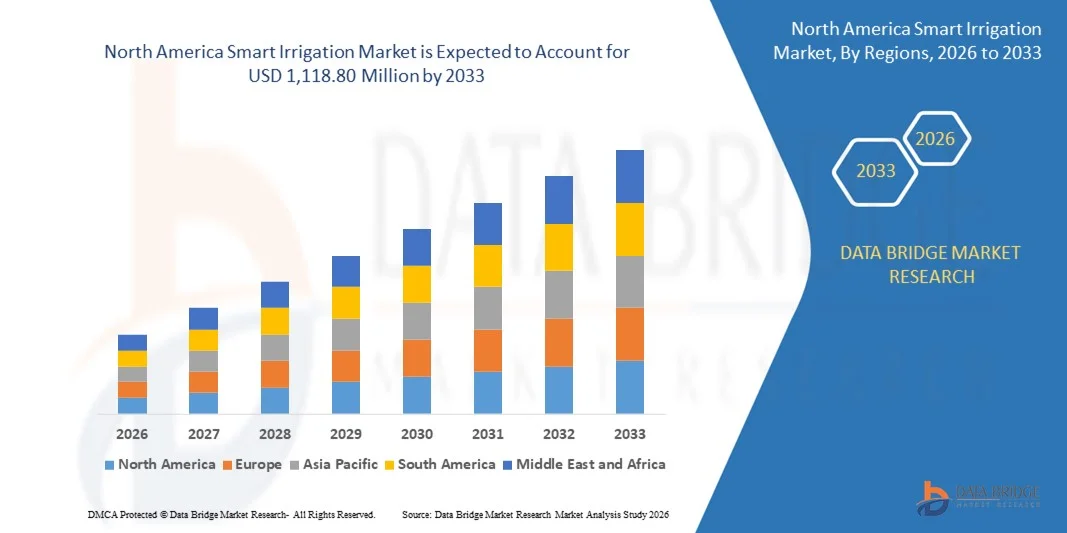
- The North America smart irrigation market size was valued at USD 406.24 million in 2025 and is expected to reach USD 1,118.80 million by 2033, at a CAGR of 13.50% during the forecast period
- The market growth is largely fuelled by the increasing adoption of precision agriculture techniques and the need to optimize water usage in farming operations
- Growing awareness of sustainable agricultural practices and government initiatives promoting water conservation and efficient irrigation systems
North America Smart Irrigation Market Analysis
- The market is witnessing steady growth due to advancements in automation and smart sensor technologies that allow precise control over water distribution and irrigation scheduling
- Increasing adoption by large-scale commercial farms, greenhouse operations, and urban agriculture projects to improve operational efficiency and reduce environmental impact
- U.S. dominated the smart irrigation market with the largest revenue share in 2025, driven by the rapid adoption of precision agriculture technologies and increasing demand for efficient water management solutions across farms, golf courses, and landscapes
- Canada is expected to witness the highest compound annual growth rate (CAGR) in the North America smart irrigation market due to rising investments in smart farming technologies, increasing awareness of sustainable water management practices, and growing adoption of IoT-based irrigation monitoring and control systems
- The hardware segment held the largest market revenue share in 2025 driven by the widespread adoption of irrigation controllers, sensors, and connectivity modules used for monitoring soil moisture and environmental conditions. These hardware components form the core infrastructure of smart irrigation systems and are essential for enabling automated water management across agricultural fields, landscapes, and golf courses
Report Scope and North America Smart Irrigation Market Segmentation
|
Attributes |
North America Smart Irrigation Key Market Insights |
|
Segments Covered |
|
|
Countries Covered |
North America
|
|
Key Market Players |
|
|
Market Opportunities |
|
|
Value Added Data Infosets |
In addition to the market insights such as market value, growth rate, market segments, geographical coverage, market players, and market scenario, the market report curated by the Data Bridge Market Research team includes in-depth expert analysis, import/export analysis, pricing analysis, production consumption analysis, and pestle analysis. |
North America Smart Irrigation Market Trends
Increasing Adoption of Precision Agriculture and Water-Efficient Technologies
- The growing focus on sustainable farming practices and efficient water management is significantly shaping the smart irrigation market, as farmers and agricultural enterprises increasingly adopt technologies that optimize water usage and improve crop productivity. Smart irrigation systems are gaining traction due to their ability to monitor soil moisture, weather conditions, and crop requirements in real time, enabling precise irrigation scheduling and reducing water wastage while maintaining crop health and yield stability
- Rising awareness regarding water scarcity and environmental sustainability has accelerated the demand for smart irrigation systems across agricultural, landscaping, and turf management applications. Farmers and land managers are actively seeking solutions that minimize water consumption while improving operational efficiency, prompting manufacturers to introduce advanced controllers, sensors, and automated irrigation platforms designed to support modern agricultural practices
- Technological advancements such as IoT integration, cloud-based analytics, and AI-powered irrigation controllers are influencing purchasing decisions, with manufacturers focusing on intelligent solutions that provide remote monitoring and automated adjustments. These features allow users to analyze soil and weather data, optimize irrigation schedules, and reduce operational costs while ensuring optimal crop growth and resource efficiency
- For instance, in 2024, several agricultural technology providers introduced advanced smart irrigation controllers equipped with real-time monitoring and predictive analytics for commercial farms and large landscapes. These systems were designed to optimize irrigation based on environmental conditions and crop needs, helping farmers improve water efficiency and operational productivity while supporting sustainable farming initiatives
- While demand for smart irrigation systems is growing, sustained market expansion depends on continuous technological innovation, cost-effective product development, and improved accessibility for farmers and landscaping operators. Companies are focusing on enhancing system compatibility, expanding connectivity options, and improving sensor accuracy to ensure reliable performance and broader adoption across agricultural and non-agricultural applications
North America Smart Irrigation Market Dynamics
Driver
Growing Need for Water Conservation and Efficient Agricultural Practices
- Increasing global concerns regarding water scarcity and inefficient irrigation practices are major drivers for the smart irrigation market. Governments, agricultural organizations, and environmental agencies are promoting advanced irrigation technologies that reduce water wastage while maintaining agricultural productivity. Smart irrigation systems allow farmers to manage water usage more efficiently by adjusting irrigation schedules based on soil moisture levels and climatic conditions
- Expanding adoption of precision agriculture is also influencing market growth. Smart irrigation systems support data-driven farming by integrating soil sensors, weather forecasting tools, and automated controllers that help farmers optimize irrigation practices. These technologies improve crop yield, reduce operational costs, and enable sustainable resource management, making them increasingly attractive for modern agricultural operations
- Agricultural equipment manufacturers and technology providers are actively promoting smart irrigation solutions through product innovation, training programs, and digital platforms designed to support farmers in implementing advanced irrigation techniques. These initiatives are supported by increasing awareness of sustainable agriculture and the need to enhance food production while conserving natural resources
- For instance, in 2023, several agritech companies launched new smart irrigation platforms featuring integrated sensors, automated valves, and cloud-based monitoring systems designed for large-scale farming operations. These systems allowed farmers to remotely control irrigation activities and analyze environmental data, improving water efficiency and overall crop management while supporting sustainable agricultural practices
- Although rising demand for efficient irrigation solutions supports market growth, wider adoption depends on affordability, infrastructure availability, and technical awareness among farmers. Investment in training programs, digital agriculture platforms, and cost-effective irrigation technologies will be essential to ensure widespread adoption and long-term market expansion
Restraint/Challenge
High Initial Investment and Technical Complexity
- The relatively high initial cost associated with installing smart irrigation systems remains a key challenge for market growth, particularly for small and medium-scale farmers. Advanced components such as sensors, controllers, connectivity modules, and automated valves increase upfront investment, which may limit adoption in cost-sensitive agricultural operations
- Limited technical knowledge and lack of digital infrastructure can also restrict the effective implementation of smart irrigation technologies. Farmers in certain regions may face difficulties in managing data-driven irrigation systems, leading to slower adoption rates and reduced utilization of advanced system capabilities
- Maintenance requirements and system integration challenges may further impact market expansion, as smart irrigation systems often require reliable internet connectivity, regular calibration of sensors, and technical support for optimal operation. These factors can increase operational complexity and maintenance costs for farmers and landscape managers
- For instance, in 2024, several farming cooperatives reported slower adoption of advanced irrigation systems due to installation costs, limited technical expertise, and concerns regarding long-term maintenance requirements. These factors also encouraged some farmers to continue using traditional irrigation methods, affecting the overall penetration of smart irrigation technologies
- Addressing these challenges will require the development of affordable smart irrigation solutions, expanded training programs, and improved technical support for end users. Collaboration between agritech companies, agricultural organizations, and technology providers will play a key role in enhancing accessibility and unlocking the long-term growth potential of the global smart irrigation market while supporting sustainable water management practices
North America Smart Irrigation Market Scope
The market is segmented on the basis of offering, system type, and application.
- By Offering
On the basis of offering, the North America smart irrigation market is segmented into hardware, software, and services. The hardware segment held the largest market revenue share in 2025 driven by the widespread adoption of irrigation controllers, sensors, and connectivity modules used for monitoring soil moisture and environmental conditions. These hardware components form the core infrastructure of smart irrigation systems and are essential for enabling automated water management across agricultural fields, landscapes, and golf courses.
The software segment is expected to witness the fastest growth rate from 2026 to 2033, driven by the increasing integration of cloud-based platforms, analytics tools, and mobile applications for irrigation management. Smart irrigation software allows users to remotely monitor irrigation schedules, analyze weather patterns, and optimize water usage through data-driven insights. These solutions are gaining popularity due to their ability to improve operational efficiency while reducing water wastage.
- By System Type
On the basis of system type, the market is segmented into sensor-based controller systems and weather-based controller systems. The weather-based controller systems segment held the largest market revenue share in 2025 driven by their ability to automatically adjust irrigation schedules based on real-time weather data such as temperature, rainfall, humidity, and wind conditions. These systems help reduce unnecessary irrigation and ensure efficient water usage, making them widely adopted across landscaping and agricultural applications.
The sensor-based controller systems segment is expected to witness the fastest growth rate from 2026 to 2033, driven by the increasing adoption of soil moisture sensors and environmental monitoring devices. These systems provide precise irrigation control by directly measuring soil conditions and adjusting water supply accordingly. The growing demand for precision agriculture and efficient water resource management is further supporting the adoption of sensor-based irrigation technologies.
- By Application
On the basis of application, the market is segmented into agriculture and non-agriculture. The agriculture segment held the largest market revenue share in 2025 driven by the growing need to optimize irrigation practices in crop production and improve water management efficiency. Smart irrigation systems are increasingly used by farmers to monitor soil conditions, automate irrigation schedules, and enhance crop yield while minimizing water consumption.
The non-agriculture segment is expected to witness the fastest growth rate from 2026 to 2033 driven by increasing adoption across landscapes, golf courses, sports fields, and residential lawns. Property managers and municipal authorities are increasingly deploying smart irrigation solutions to maintain green spaces efficiently while conserving water resources. The integration of automated irrigation technologies with landscaping management platforms is further driving growth in this segment.
North America Smart Irrigation Market Regional Analysis
- The U.S. dominated the smart irrigation market with the largest revenue share in 2025, driven by the rapid adoption of precision agriculture technologies and increasing demand for efficient water management solutions across farms, golf courses, and landscapes
- Farmers and property managers in the country highly value the automation, remote monitoring, and data-driven capabilities offered by smart irrigation systems to optimize water usage and improve crop productivity
- This widespread adoption is further supported by strong technological infrastructure, high awareness of sustainable agriculture practices, and government initiatives encouraging water conservation and smart farming technologies
Canada Smart Irrigation Market Insight
The Canada smart irrigation market is expected to witness the fastest growth rate from 2026 to 2033, fueled by increasing investments in modern agricultural technologies and rising awareness regarding water conservation. Farmers and landscape managers are increasingly adopting smart irrigation systems to monitor soil conditions and automate irrigation schedules for improved efficiency. The growing integration of IoT-enabled sensors, weather-based irrigation controllers, and mobile monitoring platforms is further supporting market growth. Moreover, government programs promoting sustainable agriculture and efficient resource management are significantly contributing to the expansion of the smart irrigation market in Canada.
Argentina dominated the smart irrigation market with the largest revenue share in 2025, driven by the country’s strong agricultural sector and increasing adoption of advanced irrigation technologies to improve crop yield and water efficiency
North America Smart Irrigation Market Share
The North America smart irrigation industry is primarily led by well-established companies, including:
- The Toro Company (U.S.)
- Rain Bird Corporation (U.S.)
- Hunter Industries (U.S.)
- Rachio Inc. (U.S.)
- Hydropoint Data Systems (U.S.)
- Weathermatic (U.S.)
- Banyan Water (U.S.)
- Galcon USA (U.S.)
- BlueSpray (U.S.)
- Calsense (U.S.)
- ETwater (U.S.)
- Netafim USA (U.S.)
- Nelson Irrigation Corporation (U.S.)
- Orbit Irrigation Products (U.S.)
- Baseline Inc. (U.S.)
SKU-
Get online access to the report on the World's First Market Intelligence Cloud

- Interactive Data Analysis Dashboard
- Company Analysis Dashboard for high growth potential opportunities
- Research Analyst Access for customization & queries
- Competitor Analysis with Interactive dashboard
- Latest News, Updates & Trend analysis
- Harness the Power of Benchmark Analysis for Comprehensive Competitor Tracking
Research Methodology
Data collection and base year analysis are done using data collection modules with large sample sizes. The stage includes obtaining market information or related data through various sources and strategies. It includes examining and planning all the data acquired from the past in advance. It likewise envelops the examination of information inconsistencies seen across different information sources. The market data is analysed and estimated using market statistical and coherent models. Also, market share analysis and key trend analysis are the major success factors in the market report. To know more, please request an analyst call or drop down your inquiry.
The key research methodology used by DBMR research team is data triangulation which involves data mining, analysis of the impact of data variables on the market and primary (industry expert) validation. Data models include Vendor Positioning Grid, Market Time Line Analysis, Market Overview and Guide, Company Positioning Grid, Patent Analysis, Pricing Analysis, Company Market Share Analysis, Standards of Measurement, Global versus Regional and Vendor Share Analysis. To know more about the research methodology, drop in an inquiry to speak to our industry experts.
Customization Available
Data Bridge Market Research is a leader in advanced formative research. We take pride in servicing our existing and new customers with data and analysis that match and suits their goal. The report can be customized to include price trend analysis of target brands understanding the market for additional countries (ask for the list of countries), clinical trial results data, literature review, refurbished market and product base analysis. Market analysis of target competitors can be analyzed from technology-based analysis to market portfolio strategies. We can add as many competitors that you require data about in the format and data style you are looking for. Our team of analysts can also provide you data in crude raw excel files pivot tables (Fact book) or can assist you in creating presentations from the data sets available in the report.












