


North America Smart Locks Market
Market Size in USD Billion
CAGR :
% 
 USD
1.44 Billion
USD
3.75 Billion
2025
2033
USD
1.44 Billion
USD
3.75 Billion
2025
2033
 Forecast Period Forecast Period |
2026 –2033 |
 Market Size (Base Year) Market Size (Base Year) |
USD 1.44 Billion |
 Market Size (Forecast Year) Market Size (Forecast Year) |
USD 3.75 Billion |
 CAGR CAGR |
% |
| Major Markets Players |
|
North America Smart Locks Market Size
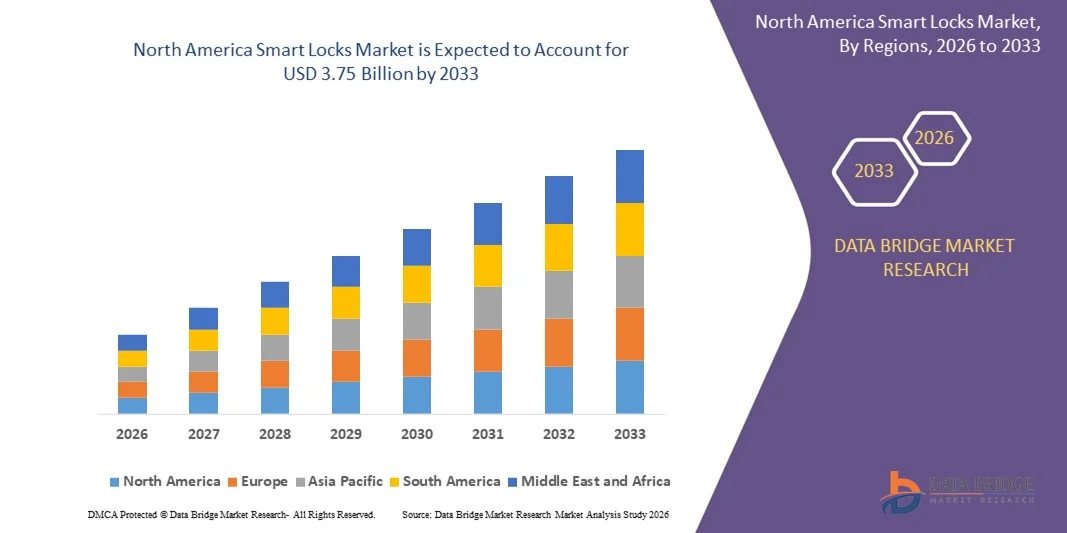
- The North America smart locks market size was valued at USD 1.44 billion in 2025 and is expected to reach USD 3.75 billion by 2033, at a CAGR of 12.70% during the forecast period
- The market growth is largely fueled by the growing adoption and technological progress within connected home devices and smart home technology, leading to increased digitalization in both residential and commercial settings
- Furthermore, rising consumer demand for secure, user-friendly, and integrated solutions for their homes and businesses is establishing smart locks as the modern access control system of choice. These converging factors are accelerating the uptake of smart lock solutions, thereby significantly boosting the industry's growth
North America Smart Locks Market Analysis
- Smart locks, offering electronic or digital access control for doors and gates, are increasingly vital components of modern home security and automation systems in both residential and commercial settings due to their enhanced convenience, remote access capabilities, and seamless integration with smart home ecosystems
- The escalating demand for smart locks is primarily fueled by the widespread adoption of smart home technologies, growing security concerns among consumers, and a rising preference for the convenience of keyless entry
- U.S. dominated smart locks market in 2025, due to rising adoption of smart home technologies, strong residential and commercial security demand, and widespread availability of advanced IoT-enabled locking solutions
- Canada is expected to be the fastest growing country in the smart locks market during the forecast period due to growing adoption of smart home solutions, rising consumer awareness of security and convenience, and government incentives for smart building infrastructure
- Deadbolt segment dominated the market with a market share of 43.2% in 2025, due to its established reputation for security and ease of retrofit into existing door setups. Homeowners often prioritize deadbolt smart locks for their perceived robustness and the straightforward replacement of traditional deadbolts. The market also sees strong demand for deadbolt types due to their compatibility with various smart home ecosystems and the availability of diverse features enhancing security and convenience
Report Scope and Smart Locks Market Segmentation
|
Attributes |
Smart Locks Key Market Insights |
|
Segments Covered |
|
|
Countries Covered |
North America
|
|
Key Market Players |
|
|
Market Opportunities |
|
|
Value Added Data Infosets |
In addition to the insights on market scenarios such as market value, growth rate, segmentation, geographical coverage, and major players, the market reports curated by the Data Bridge Market Research also include in-depth expert analysis, pricing analysis, brand share analysis, consumer survey, demography analysis, supply chain analysis, value chain analysis, raw material/consumables overview, vendor selection criteria, PESTLE Analysis, Porter Analysis, and regulatory framework. |
North America Smart Locks Market Trends
Enhanced Convenience Through AI and Voice Integration
- A significant and accelerating trend in the smart locks market is the deepening integration with artificial intelligence (AI) and popular voice-controlled ecosystems such as Amazon Alexa, Google Assistant, and Apple HomeKit. This fusion of technologies is significantly enhancing user convenience and control over their security systems.
- For instance, the August Wi-Fi Smart Lock seamlessly integrates with all three major voice assistants, allowing users to lock or unlock their doors with simple voice commands. Similarly, Level Lock+ can be controlled via Siri and Apple HomeKit, offering a discreet smart lock solution
- AI integration in smart locks enables features such as learning user access patterns to potentially suggest security optimizations and providing more intelligent alerts based on activity. For instance, some Ultraloq models utilize AI to improve fingerprint recognition accuracy over time and can send intelligent alerts if unusual door activity is detected. Furthermore, voice control capabilities offer users the ease of hands-free operation, allowing them to lock or unlock doors remotely using simple verbal commands.
- The seamless integration of smart locks with digital assistants and broader smart home platforms facilitates centralized control over various aspects of the connected home environment. Through a single interface, users can manage their door locks alongside lighting, climate control, and other security devices, creating a unified and automated living experience.
- This trend towards more intelligent, intuitive, and interconnected locking systems is fundamentally reshaping user expectations for home security. Consequently, companies such as WELOCK are developing AI-enabled smart locks with features such as automatic locking/unlocking based on authorized access and voice control compatibility with Google Assistant and Amazon Alexa
- The demand for smart locks that offer seamless AI and voice control integration is growing rapidly across both residential and commercial sectors, as consumers increasingly prioritize convenience and comprehensive smart home functionality
North America Smart Locks Market Dynamics
Driver
Growing Need Due to Rising Security Concerns and Smart Home Adoption
- The increasing prevalence of security concerns among homeowners and businesses, coupled with the accelerating adoption of smart home ecosystems, is a significant driver for the heightened demand for smart locks
- For instance, in April 2024, Onity, Inc. (Honeywell International, Inc.) announced an advancement in IoT-based self-storage security, looking forward to integrating state-of-the-art sensors into the Passport locking solution. Such strategies by key companies are expected to drive the smart lock industry growth in the forecast period
- As consumers become more aware of potential security threats and seek enhanced protection for their properties, smart locks offer advanced features such as remote monitoring, activity logs, and tamper alerts, providing a compelling upgrade over traditional mechanical locks
- Furthermore, the growing popularity of smart home devices and the desire for interconnected living spaces are making smart locks an integral component of these systems, offering seamless integration with other smart devices and platforms
- The convenience of keyless entry, remote access control for family members or service providers, and the ability to manage access through smartphone applications are key factors propelling the adoption of smart locks in both residential and commercial sectors. The trend towards DIY smart home installations and the increasing availability of user-friendly smart lock options further contribute to market growth
Restraint/Challenge
Concerns Regarding Cybersecurity and High Initial Costs
- Concerns surrounding the cybersecurity vulnerabilities of connected devices, including smart locks, pose a significant challenge to broader market penetration. As smart locks rely on network connectivity and software, they are susceptible to hacking attempts and data breaches, raising anxieties among potential consumers about the security of their homes and data
- For instance, high-profile reports of vulnerabilities in IoT devices have made some consumers hesitant to adopt smart home security solutions, including smart locks
- Addressing these cybersecurity concerns through robust encryption, secure authentication protocols, and regular software updates is crucial for building consumer trust. Companies such as August and Level Home emphasize their advanced encryption methods and security features in their marketing to reassure potential buyers
- While prices are gradually decreasing, the perceived premium for smart technology can still hinder widespread adoption, especially for those who do not see an immediate need for the advanced features offered
- Overcoming these challenges through enhanced cybersecurity measures, consumer education on security best practices, and the development of more affordable smart lock options will be vital for sustained market growth
North America Smart Locks Market Scope
The market is segmented on the basis of type, communication protocol, unlocking mechanism, and application.
- By Type
On the basis of type, the smart locks market is segmented into deadbolt, lever handles, padlock, server locks and latches, knob locks, and others. The deadbolt segment dominated the market with the largest market revenue share of 43.2% in 2025, driven by its established reputation for security and ease of retrofit into existing door setups. Homeowners often prioritize deadbolt smart locks for their perceived robustness and the straightforward replacement of traditional deadbolts. The market also sees strong demand for deadbolt types due to their compatibility with various smart home ecosystems and the availability of diverse features enhancing security and convenience.
The lever handles segment is anticipated to witness the fastest growth rate of 21.7% from 2026 to 2033, fueled by increasing adoption in commercial and hospitality sectors. Lever handles offer ease of access, making them suitable for individuals with mobility challenges, and their integration with smart technology provides businesses with convenient, controlled access solutions for employees and guests. The aesthetic appeal and design flexibility of smart lever handles also contribute to their growing popularity in modern commercial spaces.
- By Communication Protocol
On the basis of communication protocol, the smart locks market is segmented into Bluetooth, Wi-Fi, Z-Wave, Zigbee, and Others. The Wi-Fi segment held the largest market revenue share in 2025 driven by the widespread availability of home Wi-Fi networks and the ease of direct internet connectivity for smart locks. Wi-Fi-enabled smart locks often offer seamless remote access and integration with cloud-based services and voice assistants, making them a popular choice for residential users.
The Bluetooth segment is expected to witness the fastest CAGR from 2026 to 2033, driven by its low power consumption and direct peer-to-peer connectivity, making it ideal for smartphone-based unlocking and localized access control. Bluetooth-enabled smart locks are particularly popular for their ease of setup and reliable performance within a limited range, often serving as a primary unlocking mechanism.
- By Unlocking Mechanism
On the basis of unlocking mechanism, the smart locks market is segmented into keypad, card key, touch based, key fob, and smartphone based. The smartphone-based segment held the largest market revenue share in 2025, driven by the ubiquitous use of smartphones and the convenience of managing access through dedicated mobile applications. Smartphone-based unlocking offers features such as remote access, digital key sharing, and activity logs, making it a highly versatile and user-friendly option.
The keypad is expected to witness the fastest CAGR from 2026 to 2033, favored for its reliability and the ability to grant access using PIN codes, providing a convenient alternative to physical keys or smartphones. Keypads are particularly popular in rental properties and for providing access to service personnel.
- By Application
On the basis of application, the smart locks market is segmented into commercial, residential, industrial, government institution, and others. The residential segment accounted for the largest market revenue share in 2025, driven by the increasing adoption of smart home ecosystems, rising awareness about home security, and the convenience of remote locking/unlocking. Real estate developments and the boom in short-term rentals also encourage adoption.
The commercial segment is expected to witness the fastest CAGR from 2026 to 2033, driven by the growing need for centralized security, employee access control, and audit trails. Businesses benefit from keyless solutions that can be managed remotely, offering flexibility for multiple users and locations.
North America Smart Locks Market Regional Analysis
- U.S. dominated the smart locks market with the largest revenue share of 40.01% in 2025, driven by rising adoption of smart home technologies, strong residential and commercial security demand, and widespread availability of advanced IoT-enabled locking solutions
- Increasing integration of smart locks with home automation systems, growing consumer preference for keyless entry, and rapid adoption in multifamily housing and office spaces support sustained market demand across residential, commercial, and institutional applications
- The strong presence of companies such as August Home, Yale, and Schlage, continuous investments in wireless connectivity, biometric technologies, and strategic partnerships with real estate developers reinforce the U.S. leadership position in the regional market. Rising focus on home security, convenience, and smart city initiatives is expected to maintain the country’s dominant role during the forecast period
Canada Smart Locks Market Insight
Canada is projected to register the fastest CAGR in the North America smart locks market from 2026 to 2033, supported by growing adoption of smart home solutions, rising consumer awareness of security and convenience, and government incentives for smart building infrastructure. Increased use of Wi-Fi and Bluetooth-enabled locks in residential and commercial spaces is accelerating market growth. For instance, companies such as August Home and Kwikset supply advanced smart locking solutions for Canadian smart home projects. Expansion of multifamily housing, integration with home automation platforms, and strong technology adoption rates position Canada as the fastest-growing market in the region.
Mexico Smart Locks Market Insight
Mexico is expected to grow steadily from 2026 to 2033, driven by rising residential and commercial construction, growing demand for security solutions, and increasing awareness of smart home technologies. Urbanization, industrial expansion, and foreign investment in commercial infrastructure support consistent adoption of smart locks. Companies such as Yale and Kwikset play a key role in strengthening domestic supply through product localization and technology upgrades. Alignment with North American security standards and increasing integration with IoT-enabled systems contribute to stable market growth throughout the forecast period.
North America Smart Locks Market Share
The smart locks industry is primarily led by well-established companies, including:
- Assa Abloy (Sweden)
- Allegion (Ireland)
- Kwikset (U.S.)
- Yale (Sweden)
- August Home (U.S.)
- Schlage (U.S.)
- Level Lock (U.S.)
- Lockly (U.S.)
- U-tec (U.S.)
- TP-Link (China)
- Eufy Security (China)
- Aqara (China)
- Nuki (Austria)
- Danalock (Denmark)
- Samsung SmartThings (South Korea)
- Honeywell (U.S.)
- Brinks Home (U.S.)
- Vivint (U.S.)
- ZKTeco (China)
- Tesa (Spain)
Latest Developments in North America Smart Locks Market
- In April 2023, ASSA ABLOY Group, a global leader in access solutions, launched a strategic initiative in South Africa aimed at strengthening the security of residential and commercial properties through its advanced smart lock technologies. This initiative underscores the company's dedication to delivering innovative, reliable access control solutions tailored to the unique security needs of the local market. By leveraging its global expertise and cutting-edge product offerings, ASSA ABLOY is addressing regional challenges and also reinforcing its position in the rapidly growing smart lock market
- In March 2023, HavenLock Inc., a veteran-led company based in Tennessee, introduced the Power G version of its smart locking system, specifically engineered for schools and commercial environments. The innovative Haven Lockdown System is designed to enhance security protocols, offering a reliable and effective solution for emergency situations. This advancement highlights HavenLock's commitment to developing cutting-edge safety technologies that safeguard vulnerable spaces, ensuring greater protection and peace of mind for institutions and their communities
- In March 2023, Honeywell International Inc. successfully deployed the Bengaluru Safe City Project, aimed at enhancing urban safety through its advanced smart lock and security technologies. This initiative harnesses state-of-the-art solutions to create a more secure and resilient city environment, underscoring Honeywell's dedication to utilizing its expertise in innovative security systems. The project highlights the increasing significance of smart technology in urban safety, contributing to the development of safer, smarter communities
- In February 2023, Sentrilock, LLC, a leading provider of electronic lockbox solutions for the real estate industry, announced a strategic partnership with the Chesapeake Bay and Rivers Association of REALTORS (CBRAR) to create a smart electronic lockbox marketplace for REALTOR members. This collaboration is designed to enhance security and streamline accessibility for real estate professionals, facilitating more efficient and secure property transactions. The initiative underscores Sentrilock's commitment to driving innovation and improving operational effectiveness within the real estate sector
- In January 2023, Schlage, a leading provider of access and home security solutions under Allegion Plc, unveiled the Schlage Encode Smart Wi-Fi Lever at the NAHB International Builders’ Show (IBS) 2023. This innovative residential smart lock, equipped with Wi-Fi connectivity, enables users to manage access remotely through a dedicated app. The Schlage Encode lever highlights the company’s commitment to integrating advanced technology into home security systems, offering homeowners enhanced convenience and control while ensuring robust security
SKU-
Get online access to the report on the World's First Market Intelligence Cloud

- Interactive Data Analysis Dashboard
- Company Analysis Dashboard for high growth potential opportunities
- Research Analyst Access for customization & queries
- Competitor Analysis with Interactive dashboard
- Latest News, Updates & Trend analysis
- Harness the Power of Benchmark Analysis for Comprehensive Competitor Tracking
Research Methodology
Data collection and base year analysis are done using data collection modules with large sample sizes. The stage includes obtaining market information or related data through various sources and strategies. It includes examining and planning all the data acquired from the past in advance. It likewise envelops the examination of information inconsistencies seen across different information sources. The market data is analysed and estimated using market statistical and coherent models. Also, market share analysis and key trend analysis are the major success factors in the market report. To know more, please request an analyst call or drop down your inquiry.
The key research methodology used by DBMR research team is data triangulation which involves data mining, analysis of the impact of data variables on the market and primary (industry expert) validation. Data models include Vendor Positioning Grid, Market Time Line Analysis, Market Overview and Guide, Company Positioning Grid, Patent Analysis, Pricing Analysis, Company Market Share Analysis, Standards of Measurement, Global versus Regional and Vendor Share Analysis. To know more about the research methodology, drop in an inquiry to speak to our industry experts.
Customization Available
Data Bridge Market Research is a leader in advanced formative research. We take pride in servicing our existing and new customers with data and analysis that match and suits their goal. The report can be customized to include price trend analysis of target brands understanding the market for additional countries (ask for the list of countries), clinical trial results data, literature review, refurbished market and product base analysis. Market analysis of target competitors can be analyzed from technology-based analysis to market portfolio strategies. We can add as many competitors that you require data about in the format and data style you are looking for. Our team of analysts can also provide you data in crude raw excel files pivot tables (Fact book) or can assist you in creating presentations from the data sets available in the report.












