


North America Speech Voice Recognition Market
Market Size in USD Billion
CAGR :
% 
 USD
18.10 Billion
USD
111.76 Billion
2025
2033
USD
18.10 Billion
USD
111.76 Billion
2025
2033
 Forecast Period Forecast Period |
2026 –2033 |
 Market Size (Base Year) Market Size (Base Year) |
USD 18.10 Billion |
 Market Size (Forecast Year) Market Size (Forecast Year) |
USD 111.76 Billion |
 CAGR CAGR |
% |
| Major Markets Players |
|
North America Speech and Voice Recognition Market Size
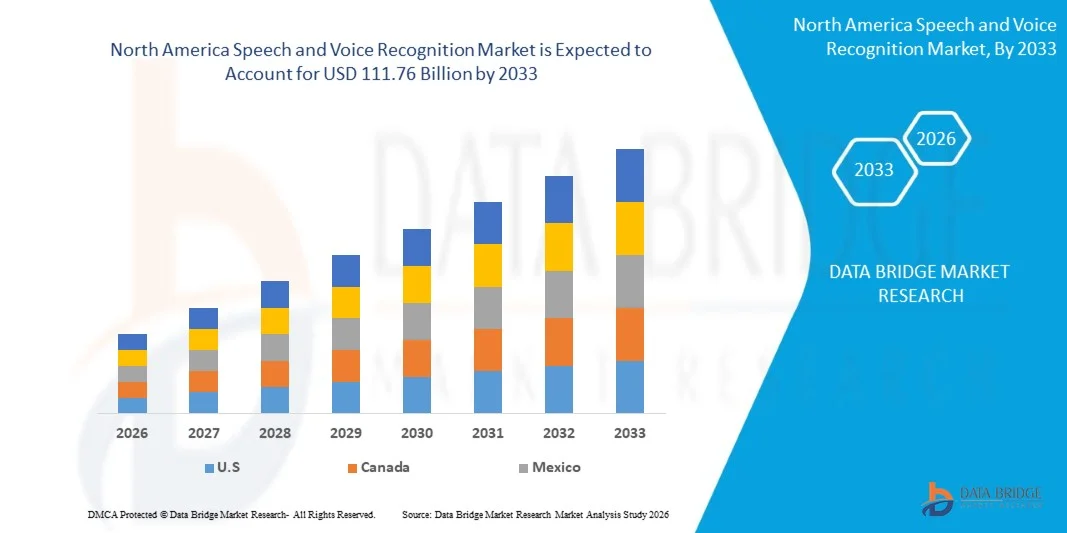
- The North America Speech and Voice Recognition Market size was valued at USD 18.10 billion in 2025 and is expected to reach USD 111.76 billion by 2033, at a CAGR of 25.55% during the forecast period
- The market growth is largely fueled by the increasing adoption of voice-enabled technologies across consumer electronics, automotive systems, and enterprise applications, supported by rapid advancements in artificial intelligence, natural language processing, and machine learning, leading to enhanced accuracy and real-time speech processing capabilities across diverse use cases
- Furthermore, rising demand for hands-free interaction, improved customer engagement, and efficient automation in business operations is positioning speech and voice recognition as a critical component of digital transformation strategies. These converging factors are accelerating the integration of voice technologies across industries, thereby significantly boosting the market growth
North America Speech and Voice Recognition Market Analysis
- Speech and voice recognition technologies, enabling machines to interpret, process, and respond to human speech, are becoming essential components of modern digital ecosystems across residential, commercial, and industrial environments due to their ability to enhance user experience, enable automation, and support real-time communication
- The escalating demand for these solutions is primarily driven by the widespread adoption of virtual assistants, increasing deployment in customer service and healthcare documentation, and a growing preference for intuitive and voice-driven interfaces that improve operational efficiency and accessibility
- U.S. dominated the North America Speech and Voice Recognition Market in 2025, due to strong adoption across consumer electronics, automotive, healthcare, and enterprise applications, supported by advanced AI ecosystem, high penetration of smart devices, and early adoption of voice-enabled technologies
- Canada is expected to be the fastest growing country in the North America Speech and Voice Recognition Market during the forecast period due to increasing adoption in healthcare documentation, enterprise communication, and AI-driven customer interaction solutions
- Artificial intelligence based segment dominated the market with a market share of 68.9% in 2025, due to its superior accuracy, contextual understanding, and ability to continuously improve through machine learning algorithms. Organizations increasingly rely on AI-powered systems for real-time speech processing, multilingual support, and natural language understanding, which enhances user experience across applications such as virtual assistants and customer service automation
Report Scope and North America Speech and Voice Recognition Market Segmentation
|
Attributes |
Speech and Voice Recognition Key Market Insights |
|
Segments Covered |
|
|
Countries Covered |
North America
|
|
Key Market Players |
|
|
Market Opportunities |
|
|
Value Added Data Infosets |
In addition to the insights on market scenarios such as market value, growth rate, segmentation, geographical coverage, and major players, the market reports curated by the Data Bridge Market Research also include in-depth expert analysis, geographically represented company-wise production and capacity, network layouts of distributors and partners, detailed and updated price trend analysis and deficit analysis of supply chain and demand. |
North America Speech and Voice Recognition Market Trends
“Rising Integration of Generative AI in Voice Recognition Systems”
- A significant trend in the North America Speech and Voice Recognition Market is the increasing integration of generative AI into voice recognition systems, driven by the need for more natural, context-aware, and human-like interactions across digital platforms. This integration is enhancing conversational accuracy, enabling systems to understand intent, tone, and complex queries more effectively across multiple applications
- For instance, Amazon has enhanced its Alexa platform with generative AI capabilities to deliver more dynamic and contextually relevant responses in smart home and consumer environments. These advancements are improving user engagement and strengthening the adoption of voice-enabled ecosystems across households and enterprises
- The deployment of generative AI in customer service platforms is expanding as organizations seek to automate interactions while maintaining conversational quality. This is enabling real-time response generation, reducing dependency on scripted systems, and improving overall customer experience across industries
- Voice assistants are evolving into intelligent digital companions capable of performing complex tasks such as scheduling, recommendations, and personalized assistance. This progression is increasing reliance on advanced voice technologies across consumer and enterprise applications
- Industries such as automotive and healthcare are incorporating generative AI-driven voice interfaces to enhance user interaction and operational efficiency. This is supporting safer driving experiences and more efficient clinical workflows through voice-enabled controls and documentation
- The market is witnessing a strong shift toward more adaptive and intelligent voice systems that continuously learn from user interactions. This growing integration of generative AI is reinforcing the transformation of voice recognition technologies into highly interactive and indispensable digital tools across global markets
North America Speech and Voice Recognition Market Dynamics
Driver
“Increasing Demand for Voice-Enabled Smart Devices and Virtual Assistants”
- The increasing adoption of voice-enabled smart devices and virtual assistants is a major driver for the North America Speech and Voice Recognition Market, supported by the growing preference for hands-free interaction and seamless user experiences. These technologies are widely integrated into smartphones, smart speakers, and connected home devices, enhancing convenience and accessibility for users
- For instance, Apple Inc. continues to expand the capabilities of Siri across its ecosystem of devices, enabling users to perform tasks through voice commands across applications and services. This integration is driving consistent user engagement and increasing reliance on voice-based interfaces in daily activities
- The proliferation of smart home ecosystems is further accelerating demand for voice recognition technologies as users seek centralized and intuitive control of connected devices. This trend is strengthening the role of voice interfaces in managing lighting, security, and entertainment systems
- Enterprises are increasingly deploying voice-enabled solutions in customer service and support functions to improve response time and operational efficiency. This adoption is reducing manual intervention and enabling scalable interaction models across high-volume service environments
- The growing consumer inclination toward convenience, automation, and personalized experiences continues to reinforce this driver. The widespread deployment of voice-enabled technologies across multiple sectors is significantly contributing to the sustained growth of the North America Speech and Voice Recognition Market
Restraint/Challenge
“Data Privacy and Security Concerns in Voice Data Processing”
- The North America Speech and Voice Recognition Market faces significant challenges related to data privacy and security, as voice-enabled systems require continuous collection and processing of sensitive user data. These concerns are creating barriers to adoption, particularly in regions with strict data protection regulations and high awareness of digital privacy risks
- For instance, European Commission has enforced stringent data protection regulations under GDPR, impacting how companies collect, store, and process voice data across applications. These regulatory requirements increase compliance costs and limit the flexibility of deploying voice-based solutions in certain markets
- The risk of unauthorized access, data breaches, and misuse of voice recordings is raising concerns among consumers and enterprises. This is prompting organizations to invest heavily in encryption, secure storage, and advanced authentication mechanisms
- Voice biometrics systems, while enhancing security, also introduce challenges related to spoofing and identity theft if not properly secured. These vulnerabilities necessitate continuous innovation in security protocols and system design
- The ongoing concerns regarding privacy, security, and regulatory compliance continue to restrain market growth. These challenges are compelling companies to develop more secure, transparent, and compliant voice recognition solutions to maintain user trust and support long-term adoption
North America Speech and Voice Recognition Market Scope
The market is segmented on the basis of delivery mode, technology, deployment mode, and vertical.
• By Delivery Mode
On the basis of delivery mode, the North America Speech and Voice Recognition Market is segmented into artificial intelligence based and non-artificial intelligence based. The artificial intelligence based segment dominated the market with the largest market revenue share of 68.9% in 2025, driven by its superior accuracy, contextual understanding, and ability to continuously improve through machine learning algorithms. Organizations increasingly rely on AI-powered systems for real-time speech processing, multilingual support, and natural language understanding, which enhances user experience across applications such as virtual assistants and customer service automation. The integration of deep learning and neural networks further strengthens performance in noisy environments and complex speech patterns, making AI-based solutions the preferred choice across industries.
The non-artificial intelligence based segment is anticipated to witness steady growth from 2026 to 2033, supported by its cost-effectiveness and suitability for basic voice command applications. These systems are commonly used in controlled environments where high-level contextual interpretation is not required, ensuring consistent performance with minimal computational requirements. Their simplicity and lower deployment costs make them relevant for small-scale applications and legacy systems where advanced AI capabilities are not essential.
• By Technology
On the basis of technology, the North America Speech and Voice Recognition Market is segmented into voice recognition and speech recognition. The speech recognition segment dominated the market with the largest market revenue share in 2025, driven by its widespread use in transcription services, virtual assistants, and enterprise communication tools. The ability of speech recognition systems to convert spoken language into accurate text in real time enhances productivity and operational efficiency across sectors such as healthcare, legal, and customer support. Continuous advancements in acoustic modeling and natural language processing further improve accuracy and adaptability, reinforcing its dominance in large-scale deployments.
The voice recognition segment is anticipated to witness the fastest growth rate from 2026 to 2033, fueled by increasing demand for biometric authentication and personalized user experiences. Voice recognition enables secure identity verification and is increasingly adopted in banking, smart devices, and automotive systems. Its ability to differentiate between individual voices and provide tailored responses enhances both security and convenience, supporting rapid adoption across consumer and enterprise applications.
• By Deployment Mode
On the basis of deployment mode, the North America Speech and Voice Recognition Market is segmented into on-cloud, on-premises, and embedded. The on-cloud segment dominated the market with the largest market revenue share in 2025, driven by its scalability, flexibility, and ease of integration with various applications and platforms. Cloud-based solutions enable real-time processing, continuous updates, and remote accessibility, making them highly suitable for enterprises seeking cost-efficient and scalable deployment options. The growing reliance on cloud infrastructure and increasing internet penetration further support widespread adoption across industries.
The embedded segment is anticipated to witness the fastest growth rate from 2026 to 2033, driven by the rising integration of voice recognition capabilities directly into devices such as smartphones, wearables, and automotive systems. Embedded solutions offer low latency, enhanced privacy, and offline functionality, which are critical for applications requiring instant response and data security. The expansion of IoT ecosystems and smart devices further accelerates demand for embedded voice-enabled technologies.
• By Vertical
On the basis of vertical, the North America Speech and Voice Recognition Market is segmented into automotive, enterprise, consumer, banking, financial services and insurance, government, retail, healthcare, military, legal, education, and others. The consumer segment dominated the market with the largest market revenue share in 2025, driven by the widespread adoption of voice-enabled devices such as smartphones, smart speakers, and home automation systems. Increasing consumer preference for hands-free interaction and personalized digital experiences significantly boosts demand for speech and voice recognition technologies. Continuous innovation in virtual assistants and smart home ecosystems further strengthens growth in this segment.
The healthcare segment is anticipated to witness the fastest growth rate from 2026 to 2033, fueled by increasing adoption of voice technology for clinical documentation, patient interaction, and workflow optimization. Speech recognition solutions help reduce administrative burden on healthcare professionals by enabling accurate and efficient transcription of medical records. The growing emphasis on digital healthcare transformation and the need for improved patient care outcomes further drive rapid adoption in this vertical.
North America Speech and Voice Recognition Market Regional Analysis
- U.S. dominated the North America Speech and Voice Recognition Market with the largest revenue share in 2025, driven by strong adoption across consumer electronics, automotive, healthcare, and enterprise applications, supported by advanced AI ecosystem, high penetration of smart devices, and early adoption of voice-enabled technologies
- The demand for advanced speech and voice recognition solutions is supported by large-scale innovation and deployment by companies such as Microsoft and Google, enabling widespread use across applications including virtual assistants, real-time transcription, customer service automation, and smart home systems
- The presence of major technology providers, continuous advancements in natural language processing and machine learning, and increasing integration of voice interfaces across multiple digital platforms reinforce the U.S. leadership position in the North America market
Canada North America Speech and Voice Recognition Market Insight
Canada is projected to register the fastest CAGR in the North America Speech and Voice Recognition Market from 2026 to 2033, supported by increasing adoption in healthcare documentation, enterprise communication, and AI-driven customer interaction solutions. Rising deployment of cloud-based voice technologies and growing demand for multilingual and real-time speech processing are accelerating market growth. The development of advanced AI research centers and collaborations with companies such as IBM are strengthening innovation capabilities across the country. Growing emphasis on automation, digital transformation, and voice-enabled services positions Canada as the fastest-growing country in the region during the forecast period.
Mexico North America Speech and Voice Recognition Market Insight
Mexico is expected to grow steadily from 2026 to 2033, driven by expanding adoption in customer service, retail, and telecommunications sectors and increasing demand for voice-enabled digital platforms. The country’s growing digital infrastructure and rising smartphone penetration are supporting the integration of speech recognition in mobile and web-based applications. Collaborations with global technology providers and expansion of IT service capabilities are improving accessibility and deployment across industries. Major companies such as Nuance Communications and Amazon are strengthening their presence in the region. These developments contribute to sustained growth of the North America Speech and Voice Recognition Market throughout the forecast period.
North America Speech and Voice Recognition Market Share
The speech and voice recognition industry is primarily led by well-established companies, including:
- iFLYTEK Co., Ltd. (China)
- Advanced Voice Recognition Systems, Inc. (U.S.)
- Sensory, Inc. (U.S.)
- LumenVox, LLC (U.S.)
- Acapela Group SA (Belgium)
- VocalZoom (Israel)
- BioTrust (U.S.)
- Uniphore (U.S.)
- Voicebox Technologies Corporation (U.S.)
- Cantab Research Limited (U.K.)
- Microsoft (U.S.)
- Google Inc. (U.S.)
- Apple Inc. (U.S.)
- IBM (U.S.)
- Raytheon Company (U.S.)
- Voice Vault Authentication (U.K.)
Latest Developments in North America Speech and Voice Recognition Market
- In January 2024, Microsoft expanded its Azure AI Speech services with enhanced real-time multilingual speech recognition and voice synthesis capabilities, enabling enterprises to deploy highly accurate and scalable voice-enabled applications across global markets. This development strengthens the adoption of cloud-based speech technologies by improving language coverage, reducing latency, and supporting advanced conversational AI use cases, thereby accelerating enterprise digital transformation and expanding market penetration
- In November 2023, Amazon upgraded its Alexa voice AI with more advanced generative AI-driven conversational abilities, allowing users to interact with devices in a more natural and context-aware manner. This advancement significantly enhances user engagement across smart home ecosystems and consumer devices, driving increased demand for sophisticated voice recognition systems and reinforcing the role of AI-powered assistants in everyday applications
- In March 2023, Google introduced an advanced update to its Universal Speech Model under the 1,000 Languages Initiative, significantly improving automatic speech recognition across both low-resource and widely spoken languages. This innovation expands global accessibility and accelerates adoption of speech recognition technologies in diverse linguistic markets, strengthening the overall scalability and inclusivity of voice-enabled solutions
- In May 2023, Apple launched new cognitive accessibility features including Live Speech and Personal Voice, enhancing usability for individuals with disabilities through advanced speech processing capabilities. This initiative drives inclusive technology adoption and broadens the application scope of voice recognition, contributing to increased consumer demand and innovation in assistive communication technologies
- In October 2022, iFLYTEK introduced a speech translation platform for Southeast Asian languages, enabling real-time multilingual communication across public services and administrative platforms. This development supports regional digital transformation and increases demand for multilingual speech recognition solutions, strengthening the market’s growth potential in emerging economies
SKU-
Get online access to the report on the World's First Market Intelligence Cloud

- Interactive Data Analysis Dashboard
- Company Analysis Dashboard for high growth potential opportunities
- Research Analyst Access for customization & queries
- Competitor Analysis with Interactive dashboard
- Latest News, Updates & Trend analysis
- Harness the Power of Benchmark Analysis for Comprehensive Competitor Tracking
North America Speech Voice Recognition Market, Supply Chain Analysis and Ecosystem Framework
To support market growth and help clients navigate the impact of geopolitical shifts, DBMR has integrated in-depth supply chain analysis into its North America Speech Voice Recognition Market research reports. This addition empowers clients to respond effectively to global changes affecting their industries. The supply chain analysis section includes detailed insights such as North America Speech Voice Recognition Market consumption and production by country, price trend analysis, the impact of tariffs and geopolitical developments, and import and export trends by country and HSN code. It also highlights major suppliers with data on production capacity and company profiles, as well as key importers and exporters. In addition to research, DBMR offers specialized supply chain consulting services backed by over a decade of experience, providing solutions like supplier discovery, supplier risk assessment, price trend analysis, impact evaluation of inflation and trade route changes, and comprehensive market trend analysis.
Research Methodology
Data collection and base year analysis are done using data collection modules with large sample sizes. The stage includes obtaining market information or related data through various sources and strategies. It includes examining and planning all the data acquired from the past in advance. It likewise envelops the examination of information inconsistencies seen across different information sources. The market data is analysed and estimated using market statistical and coherent models. Also, market share analysis and key trend analysis are the major success factors in the market report. To know more, please request an analyst call or drop down your inquiry.
The key research methodology used by DBMR research team is data triangulation which involves data mining, analysis of the impact of data variables on the market and primary (industry expert) validation. Data models include Vendor Positioning Grid, Market Time Line Analysis, Market Overview and Guide, Company Positioning Grid, Patent Analysis, Pricing Analysis, Company Market Share Analysis, Standards of Measurement, Global versus Regional and Vendor Share Analysis. To know more about the research methodology, drop in an inquiry to speak to our industry experts.
Customization Available
Data Bridge Market Research is a leader in advanced formative research. We take pride in servicing our existing and new customers with data and analysis that match and suits their goal. The report can be customized to include price trend analysis of target brands understanding the market for additional countries (ask for the list of countries), clinical trial results data, literature review, refurbished market and product base analysis. Market analysis of target competitors can be analyzed from technology-based analysis to market portfolio strategies. We can add as many competitors that you require data about in the format and data style you are looking for. Our team of analysts can also provide you data in crude raw excel files pivot tables (Fact book) or can assist you in creating presentations from the data sets available in the report.












