




Saudi Arabia Asphalt Market
Market Size in USD Million
CAGR :
% 
 USD
539.42 Million
USD
711.58 Million
2025
2033
USD
539.42 Million
USD
711.58 Million
2025
2033
 Forecast Period Forecast Period |
2026 –2033 |
 Market Size (Base Year) Market Size (Base Year) |
USD 539.42 Million |
 Market Size (Forecast Year) Market Size (Forecast Year) |
USD 711.58 Million |
 CAGR CAGR |
% |
| Major Markets Players |
|
Saudi Arabia Asphalt Market Size
- The Saudi Arabia Asphalt Market was valued at USD 539.42 Million in 2025 and is expected to reach USD 711.58 Million by 2033
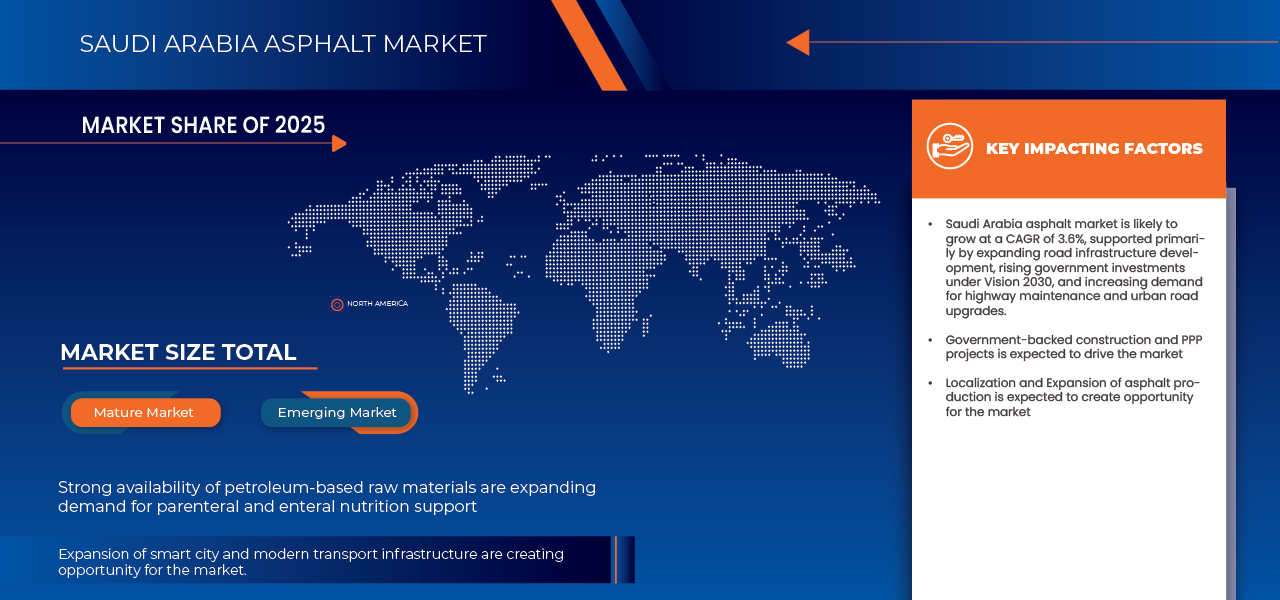
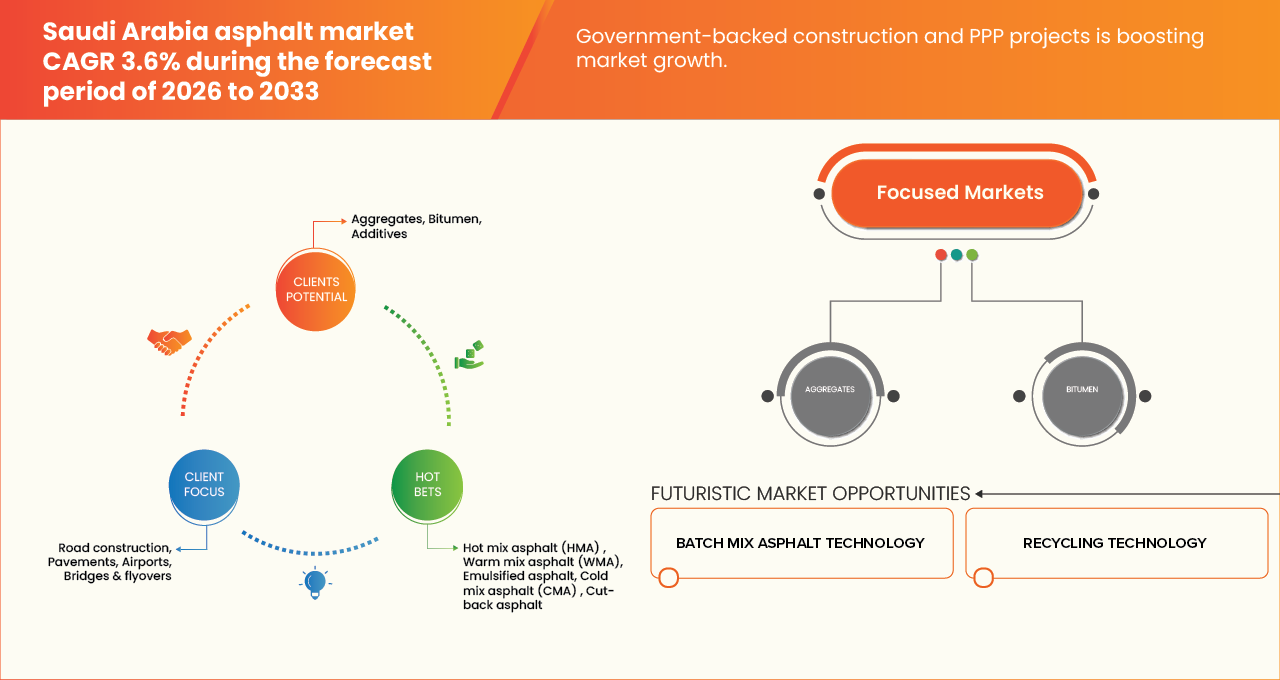
- During the forecast period of 2026 to 2033 the market is likely to grow at a CAGR of 3.6%, supported primarily by expanding road infrastructure development, rising government investments under Vision 2030, and increasing demand for highway maintenance and urban road upgrades.
- Additionally, growth in airport expansion projects, industrial zone development, and the adoption of advanced asphalt mixing and paving technologies continues to support steady market expansion across Saudi Arabia.
Saudi Arabia Asphalt Market Analysis
- The Saudi Arabia Asphalt Market is advancing steadily as contractors and asphalt producers adopt modern plant automation, intelligent paving systems, and digital quality-control tools to improve production efficiency, mix consistency, and project delivery timelines. Technologies such as automated batch controls, infrared thermal profiling, and GPS-enabled paving equipment are increasingly shaping asphalt production and road construction across the Kingdom.
- These innovations are strengthening the regional value chain by reducing material wastage, minimizing manual variability, improving pavement durability, and enabling scalable, cost-efficient asphalt production. Digital plant monitoring, predictive maintenance tools, and cloud-based fleet and project management platforms support faster execution cycles and consistent mix quality for contractors and infrastructure developers.
- In 2026, the Hot Mix Asphalt (HMA) segment is expected to dominate the market with a 51.34% share, reflecting its widespread use in highways, urban roads, and airport runways due to superior strength, durability, moisture resistance, and suitability for high-traffic conditions across Saudi Arabia’s expanding transport network.
- In 2026, the Aggregates segment is expected to dominate the market with a 49.27% share, driven by strong demand for high-quality crushed stone, gravel, and sand as essential inputs in asphalt mixtures, supported by ongoing road construction programs and large-scale infrastructure development across the Kingdom.
- In 2026, the Batch Mix Asphalt Technology segment is expected to dominate the market with a 48.43% share, supported by its operational flexibility, precise mix control, and suitability for varied project requirements, making it a preferred choice for contractors handling diverse road and urban infrastructure projects in Saudi Arabia.
Report Scope and Saudi Arabia Asphalt Market Segmentation
|
Attributes |
Saudi Arabia Asphalt Key Market Insights |
|
Segments Covered |
|
|
Countries Covered |
|
|
Key Market Players |
|
|
Market Opportunities |
|
|
Value Added Data Infosets |
In addition to the insights on market scenarios such as market value, growth rate, segmentation, geographical coverage, and major players, the market reports curated by the Data Bridge Market Research also include import export analysis, production capacity overview, production consumption analysis, price trend analysis, climate change scenario, supply chain analysis, value chain analysis, raw material/consumables overview, vendor selection criteria, PESTLE Analysis, Porter Analysis, and regulatory framework. |
Saudi Arabia Asphalt Market Trends
“Integration of AI And Digital Health Platforms to Enhance Result Analytics ”
- The integration of artificial intelligence and digital health platforms creates a significant opportunity for long-COVID diagnostics by transforming how clinical information is collected, interpreted, and translated into meaningful decisions. AI-enabled analytics connect laboratory results, imaging findings, wearable-device data, and patient-reported symptoms into a single digital ecosystem, allowing clinicians to recognize complex patterns that are difficult to detect through conventional methods. Such platforms support more personalized assessment of post-viral complications by continuously learning from real-world data and adapting algorithms to emerging clinical knowledge. Digital tools also facilitate remote monitoring and telehealth consultations, making diagnostic services accessible to patients who experience fluctuating or multi-system symptoms and cannot frequently visit hospitals. Automation of result interpretation reduces the burden on laboratories and helps standardize reporting across different care settings, improving confidence among physicians and patients.
- Furthermore, AI can assist in triaging individuals based on risk profiles, guiding them toward appropriate confirmatory tests and specialist care. Collaboration between technology providers and healthcare institutions encourages the development of interoperable systems that strengthen surveillance of long-COVID trends and support evidence-based treatment pathways. Overall, the convergence of AI and digital health infrastructure fosters a more responsive, patient-centric diagnostic environment that can accelerate innovation and expand the reach of long-COVID care.
- In November 2024, Investigators at Mass General Brigham have developed an AI-based tool to help clinicians identify cases of long COVID, an often-mysterious condition that can encompass a litany of enduring symptoms, including fatigue, chronic cough, and brain fog after infection from SARS-CoV-2.
- In December 2025, according to the article published by delta4.ai, AI is proving valuable in managing long COVID by integrating clinical, laboratory, and imaging data to assist with diagnosis, monitoring, and prognosis.
- In March 2020, the Beijing-based start-up Infervision trained its software to detect pneumonia associated with respiratory diseases such as coronavirus. The company reported that at least 34 Chinese hospitals have used this technology to help them screen 32,000 suspected cases.
- In March 2020, the Council of Europe, in its article, stated that in South Korea, AI is reported to have helped reduce the time needed to design testing kits based on the genetic makeup of the virus to a few weeks, when it would normally take two to three months. The biotech company Seegene used its automated test development system to develop the test kit and distribute it widely.
- According to the International Journal of Biological Sciences article, artificial intelligence (AI) is being used to aid in various aspects of the COVID-19 crisis, including epidemiology, molecular research and drug development, medical diagnosis and treatment, and socioeconomics. The association of AI and COVID-19 can accelerate to rapidly diagnose positive patients.
Saudi Arabia Asphalt Market Dynamics
Driver
“Rising Prevalence of Long-Covid and Multi-System Complications”
- The rising prevalence of long-covid and its multi-system complications is creating a sustained need for advanced COVID-19 diagnostics as patients continue to experience symptoms long after the acute infection has resolved. Individuals report persistent respiratory weakness, cardiovascular irregularities, neurological fatigue, and metabolic disturbances, and these varied manifestations require clinicians to rely on diagnostic tools to understand whether the problems are linked to prior viral exposure or to other underlying diseases. As Long-COVID does not present in a uniform manner, physicians increasingly depend on molecular tests, immune profiling, and follow-up screening to differentiate post-viral inflammation from new infections, which expands the role of diagnostics beyond the initial detection phase. Healthcare providers are also adopting a more cautious approach, using diagnostic confirmation to design rehabilitation plans and to monitor recovery over time.
- The uncertainty surrounding the duration and severity of these complications encourages hospitals and laboratories to maintain testing capabilities so that patients can be evaluated whenever symptoms fluctuate. In addition, multidisciplinary clinics managing cardiac, pulmonary, and neurological effects depend on COVID-19 test results to coordinate care, making diagnostics an essential component of long-term disease management.
- In January 2026, according to an article published by Cognitive FX, advanced PET imaging studies show that Long COVID patients have elevated markers of brain inflammation, particularly in areas controlling attention, memory, and energy regulation.
- In January 2026, according to an article published by Cognitive FX, post-COVID fatigue affects nearly half of all COVID-19 survivors, making it the most common and persistent symptom of long COVID.
- In August 2024, according to the Mayo Clinic, common symptoms of long COVID include extreme tiredness, especially after activity, problems with memory, often called brain fog, a feeling of being lightheaded or dizzy, and problems with taste or smell.
- Overall, the growing burden of Long-COVID is transforming COVID-19 diagnostics from an emergency tool into a continuing pillar of chronic disease management. Persistent multi-system symptoms require molecular testing, immune profiling, and imaging to link complications with prior infection. Evidence of brain inflammation, widespread fatigue, and cognitive impairment highlights the scale of unmet clinical needs. Hospitals therefore maintain testing capacity to guide rehabilitation, monitor fluctuating conditions, and exclude new infections. Multidisciplinary clinics depend on diagnostic confirmation to coordinate cardiac, pulmonary, and neurological care. Continued investment in advanced diagnostics will remain essential for long-term recovery strategies and health system resilience worldwide.
Restraint/Challenge
“Stringent And Complex Regulatory Approval Processes ”
- Stringent and complex regulatory approval processes significantly hamper demand for long-COVID diagnostics by creating uncertainty and delays across the development and commercialization pathway. Manufacturers are often required to navigate multiple layers of documentation, clinical validation, and compliance reviews, which increases the time needed to bring a test to market and discourages investment in new solutions. Differing requirements across countries and regions further fragment the market, as companies must redesign studies and submissions to meet separate standards, making widespread availability difficult. Frequent updates in post-pandemic regulations also create confusion about acceptable evidence for long-COVID, a condition that is still evolving scientifically.
- Smaller diagnostic developers, in particular, struggle with the financial and technical burden of meeting these expectations, leading many to postpone or abandon product plans. Health-care providers may hesitate to adopt tests that are still undergoing approvals, limiting clinical confidence and reimbursement support. The absence of harmonized definitions for long-COVID symptoms adds another layer of complexity, as regulators demand robust proof of clinical utility before authorization. All these factors slow innovation, restrict the number of approved products, and ultimately weaken the enthusiasm of laboratories and hospitals to integrate long-COVID diagnostics into routine care.
- In August 2025, the Central Drugs Standard Control Organization (CDSCO) and ICMR released new draft rules that clearly define how IVD kits should be tested. A major part of these guidelines includes 15 testing protocols, mainly focusing on viral diseases like influenza, COVID-19, RSV, dengue, malaria, and even high-risk viruses like Nipah and Chandipura. These rules ensure that every company, Indian or international, follows the same scientific standards.
- In April 2024, according to the article by Morrison Foerster LLP, the FDA has the authority to regulate in vitro diagnostics (IVDs) for end-to-end use at home (such as pregnancy tests or COVID rapid tests) under both the Federal Food, Drug, and Cosmetics Act (FDCA) and the Public Health Service Act. This regulatory authority extends throughout the product lifecycle, from premarket clinical studies to post-market obligations like adverse event reporting and manufacturing controls.
- In December 2022, according to the GOV.UK, before the introduction of CTDA on 28 July 2021, entry to the UK market for COVID-19 diagnostic tests was achieved through Conformitè Europëenne (CE) marking or UK Conformity Assessed (UKCA) marking, a self-declaration by manufacturers on the performance and functionality of their test kit or equipment. Enforcement action would only be taken if a problem arises after the product has come to market.
- Overall, stringent and evolving regulatory frameworks significantly restrain long-COVID diagnostics by extending approval timelines and raising development costs. Requirements for extensive clinical validation and multilayer documentation fragment markets and discourage investment, especially for small developers. Uncertain definitions of the condition and changing evidence expectations reduce confidence among clinicians and payers. Recent measures including India’s CDSCO-ICMR protocols, the FDA lifecycle oversight of home IVDs, and the UK shift from CE marking to CTDA show how compliance pathways continue to evolve. Without greater harmonization and predictability, hospitals and laboratories will remain cautious about routine adoption. Innovation will recover gradually and access expands.

Saudi Arabia Asphalt Market Scope
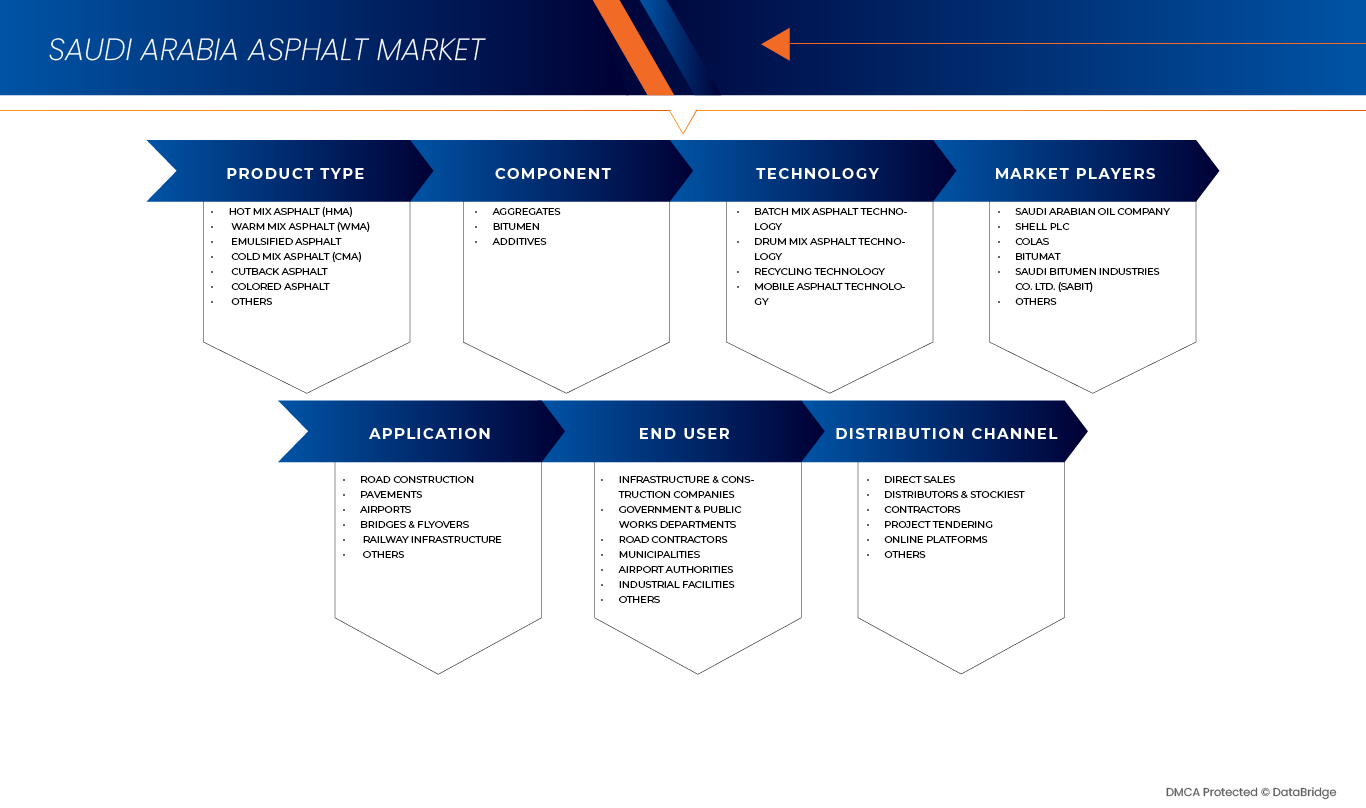
Saudi Arabia Asphalt Market is categorized into six notable segments which are based on product type, component, technology, application, end user, and distribution channel.
- By Product Type
On the basis of product type, Asia-Pacific Saudi Arabia Asphalt Market is segmented into Hot mix asphalt (HMA), Warm mix asphalt (WMA), Emulsified asphalt, Cold mix asphalt (CMA), Cutback asphalt, Colored asphalt, Others. In 2026, the Hot mix asphalt (HMA) segment is expected to dominate the market with a 51.60% market share, driven by its widespread use in highway construction, urban road development, airport runways, and heavy-traffic corridors. Its superior durability, load-bearing capacity, and performance in high-temperature environments continue to support strong demand across rapidly urbanizing economies in the middle east region.
The Hot mix asphalt (HMA) segment is the fastest-growing in the Saudi Arabia Asphalt Market, with a CAGR of 4.1%, driven by expanding road infrastructure programs, increased investments under national development initiatives, and rising maintenance and rehabilitation activities for existing road networks. Additionally, ongoing upgrades in asphalt plant technologies, improved mix design standards, and the expansion of large-scale transport and logistics corridors are expected to accelerate segment growth during the forecast period in Saudi Arabia.
- By Component
On the basis of component, the Asia-Pacific Saudi Arabia Asphalt Market is segmented into Aggregates, Bitumen, Additives. In 2026, the Aggregates segment is expected to dominate with a 49.22% market share, driven by their essential role as the primary bulk material in asphalt mixtures. Strong demand from highway expansion, urban road development, and large-scale infrastructure projects under national development programs continues to reinforce the segment’s leadership across Saudi Arabia.
The Bitumen segment is the fastest-growing segment in the Saudi Arabia Asphalt Market, with a CAGR of 3.8%, driven by rising refinery output, increasing road maintenance activities, and growing adoption of polymer-modified and performance-grade bitumen for enhanced pavement durability. Continued investments in transport corridors, logistics hubs, and airport infrastructure are expected to further accelerate segment growth during the forecast period.
- By Technology
On the basis of technology, the Asia-Pacific Saudi Arabia Asphalt Market is segmented into Batch mix asphalt technology, Drum mix asphalt technology, Recycling technology, Mobile asphalt technology. In 2026, the Batch mix asphalt technology segment is expected to dominate the market with 48.61% market share, driven by its ability to deliver precise mix control, operational flexibility, and consistent quality for diverse paving requirements. Its strong suitability for large-scale highway projects, urban road construction, and airport infrastructure continues to support widespread adoption across Saudi Arabia.
Batch mix asphalt technology is the fastest-growing segment with a CAGR of 4.0% in the Saudi Arabia Asphalt Market driven by increasing investments in modern asphalt plants, rising demand for high-performance pavement materials, and the need for customized mix designs across varied climatic and traffic conditions. Additionally, ongoing infrastructure expansion under national development programs and the growing focus on quality assurance and plant automation are expected to further accelerate segment growth during the forecast period.
- By Application
On the basis of application, the Saudi Arabia Asphalt Market is segmented into Road construction, Pavements, Airports, Bridges & flyovers, Railway infrastructure, Others. In 2026, the Road construction segment is expected to dominate the market with 58.36% market share, driven by large-scale highway expansion, urban road development, and significant government investments under national infrastructure programs. The Kingdom’s continued focus on improving intercity connectivity, logistics corridors, and urban mobility is further supporting strong asphalt demand in this segment across Saudi Arabia.
Bridges & flyovers is the fastest-growing segment with CAGR of 4.2% in the Saudi Arabia Asphalt Market driven by increasing construction of grade-separated interchanges, urban congestion mitigation projects, and major transport corridor upgrades. Additionally, the expansion of megacity developments, industrial zones, and smart city initiatives is expected to further accelerate asphalt consumption in bridge and elevated roadway infrastructure during the forecast period.
- By End User
On the basis of End User, the Asia-Pacific Saudi Arabia Asphalt Market is segmented into Infrastructure & construction companies, Government & public works departments, Road contractors, Municipalities, Airport authorities, Industrial facilities, Others. In 2026, the Infrastructure & construction companies segment is expected to dominate the market with 29.78% market share, driven by their central role in executing large-scale road, highway, airport, and urban development projects. Strong participation in Vision 2030 infrastructure programs, coupled with their procurement scale and project execution capabilities, continues to support segment leadership across Saudi Arabia.
Government & public works departments is the fastest-growing segment with CAGR of 3.1% in the Saudi Arabia Asphalt Market driven by rising public investment in transport networks, road rehabilitation programs, and urban mobility initiatives. Additionally, expanding municipal budgets, increased focus on pavement quality standards, and the rollout of new infrastructure corridors are expected to further accelerate asphalt demand from public sector entities during the forecast period.
- By Distribution Channel
On the basis of distribution channel, the Asia-Pacific Saudi Arabia Asphalt Market is segmented into Direct sales, Distributors & stockiest Contractors, Project tendering, Online platforms, Others. In 2026, the direct sales segment is expected to dominate the market with 43.65% market share, driven by large-volume procurement agreements between asphalt producers and major contractors executing highway, airport, and urban infrastructure projects. Direct engagement enables better pricing efficiency, assured supply continuity, and tighter quality control, supporting the segment’s leadership across Saudi Arabia.
Project tendering is the fastest-growing segment with CAGR of 4.5% in the Saudi Arabia Asphalt Market driven by increasing government-led infrastructure programs, transparent public procurement frameworks, and the expansion of mega transport and urban development projects. Additionally, the growing scale of public–private partnerships (PPPs), improved bidding processes, and rising participation of international contractors are expected to accelerate growth in this channel during the forecast period.
The Major Market Leaders Operating in the Market Are:
- Saudi Arabian Oil Company (Saudi Arabia)
- Shell Plc (U.K.)
- Colas (France)
- Bitumat (Saudi Arabia)
- Saudi Bitumen Industries Co. Ltd. (SABIT) (Saudi Arabia)
- Passing Road Company (Saudi Arabia)
- CPP (Saudi Arabia)
- SAR (Saudi Arabia)
- Al Majara (Saudi Arabia)
- Reda National (Saudi Arabia)
- Nawafedh Ataa Trading (Saudi Arabia)
- Nassir Hazza & Bros. (Saudi Arabia)
- Saudi Insulation Factory Company (Saudi Arabia)
- Al-azizia Asphalt & Aggregates Manufacturers (Saudi Arabia)
Latest Developments in Saudi Arabia asphalt
- In Nov 2023, Saudi Bitumen Industries showcased its bitumen and waterproofing product portfolio at Big 5 Dubai, one of the Middle East’s largest construction exhibitions. The company engaged with industry professionals, highlighted its manufacturing capabilities and explored regional business collaborations.
- In December 2025, Shell and Equinor have officially launched Adura, a 50/50 joint venture that combines their UK offshore oil and gas assets to create the largest independent producer in the North Sea. The venture brings together 12 producing fields and development projects, aiming to maximise value, efficiency and long-term returns across their UK portfolio.
- In February 2024 — The Mapei Group completed the acquisition of Bitumat, a Saudi Arabian waterproofing systems manufacturer, strengthening Mapei’s presence in the Middle East and expanding its portfolio of construction and waterproofing solutions. This deal enhances Bitumat’s reach through Mapei’s global network and supports regional infrastructure opportunities tied to Saudi Vision 2030.
- In October 2025 — TotalEnergies and Colas renewed their partnership for decarbonizing the construction business, focusing on multi-energy solutions such as biofuels, renewable electricity infrastructure and on-site solar installations to cut greenhouse gas emissions.
- In August 2025 — Colas Inc signed an agreement to acquire Suit-Kote Corporation, a specialist in road solutions in the United States, to strengthen its presence in the North American bitumen and road construction market and expand its distribution and implementation network.
SKU-
Get online access to the report on the World's First Market Intelligence Cloud

- Interactive Data Analysis Dashboard
- Company Analysis Dashboard for high growth potential opportunities
- Research Analyst Access for customization & queries
- Competitor Analysis with Interactive dashboard
- Latest News, Updates & Trend analysis
- Harness the Power of Benchmark Analysis for Comprehensive Competitor Tracking
Table of Content
1 INTRODUCTION
1.1 OBJECTIVES OF THE STUDY
1.2 MARKET DEFINITION
1.3 OVERVIEW OF SAUDI ARABIA ASPHALT MARKET
1.4 LIMITATIONS
1.5 MARKETS COVERED
2 MARKET SEGMENTATION
2.1 MARKETS COVERED
2.2 GEOGRAPHICAL SCOPE
2.3 YEARS CONSIDERED FOR THE STUDY
2.4 CURRENCY AND PRICING
2.5 DBMR TRIPOD DATA VALIDATION MODEL
2.6 MULTIVARIATE MODELLING
2.7 PRIMARY INTERVIEWS WITH KEY OPINION LEADERS
2.8 DBMR MARKET POSITION GRID
2.9 MARKET END USER COVERAGE GRID
2.1 VENDOR SHARE ANALYSIS
2.11 SECONDARY SOURCES
2.12 ASSUMPTIONS
3 EXECUTIVE SUMMARY
4 PREMIUM INSIGHTS
4.1 PORTERS FIVE FORCES ANALYSIS
4.2 BRAND OUTLOOK
4.3 COMPANY EVALUATION QUADRANT
4.4 CONSUMER BUYING BEHAVIOUR
4.4.1 GROUP 1 STRATEGIC INFRASTRUCTURE DEVELOPERS
4.4.2 GROUP 2 GOVERNMENT CONTRACTORS AND TIER-1 EPC FIRMS
4.4.3 GROUP 3 REGIONAL CONTRACTORS AND MID-SIZED DEVELOPERS
4.4.4 GROUP 4 COST-FOCUSED LOCAL CONTRACTORS
4.4.5 GROUP 5 PRICE-DRIVEN BULK BUYERS
4.4.6 GROUP 6 SPECIALIZED AND NICHE PROJECT BUYERS
4.5 INDUSTRY ECOSYSTEM ANALYSIS
4.5.1 PROMINENT COMPANIES
4.5.2 SMALL & MEDIUM-SIZE COMPANIES
4.5.3 END USERS
4.6 INNOVATION TRACKER AND STRATEGIC ANALYSIS
4.6.1 INTRODUCTION
4.6.2 MAJOR DEALS AND STRATEGIC ALLIANCES ANALYSIS
4.6.2.1 JOINT VENTURES
4.6.2.2 MERGERS AND ACQUISITIONS
4.6.2.3 LICENSING AND PARTNERSHIPS
4.6.2.4 TECHNOLOGY COLLABORATIONS
4.6.2.5 STRATEGIC DIVESTMENTS
4.6.3 NUMBER OF PRODUCTS IN DEVELOPMENT
4.6.4 STAGE OF DEVELOPMENT
4.6.5 TIMELINES AND MILESTONES
4.6.6 INNOVATION STRATEGIES AND METHODOLOGIES
4.6.7 RISK ASSESSMENT AND MITIGATION
4.6.8 FUTURE OUTLOOK
4.7 RAW MATERIAL COVERAGE
4.7.1 BITUMEN SOURCING AND CHARACTERISTICS
4.7.2 AGGREGATE SUPPLY AND QUALITY
4.7.3 ADDITIVES AND MODIFIERS USAGE
4.7.4 INDUSTRY CHALLENGES WITH RAW MATERIALS
4.8 SUPPLY CHAIN ANALYSIS
4.8.1 OVERVIEW
4.8.2 LOGISTIC COST SCENARIO
4.8.3 IMPORTANCE OF LOGISTIC SERVICE PROVIDERS
4.9 TECHNOLIGICAL ADVANCEMENT
4.1 VALUE CHAIN ANALYSIS
4.10.1 RAW MATERIALS SOURCING
4.10.2 REFINING AND PRODUCTION
4.10.3 COMPOUNDING AND MODIFICATION
4.10.4 CONSTRUCTION APPLICATION
4.10.5 END-USE AND RECYCLING
4.11 VENDOR SELECTION CRITERIA
4.11.1 DEFINE REQUIREMENTS
4.11.2 IDENTIFY POTENTIAL VENDORS
4.11.3 ISSUE REQUESTS FOR PROPOSALS
4.11.4 EVALUATE PROPOSALS
4.11.5 CONDUCT DUE DILIGENCE
4.11.6 NEGOTIATE AND FINALIZE
5 TARIFFS & IMPACT ON THE MARKET
5.1 CURRENT TARIFF RATES IN TOP-5 COUNTRY MARKETS
5.2 OUTLOOK: LOCAL PRODUCTION V/S IMPORT RELIANCE
5.3 VENDOR SELECTION CRITERIA DYNAMICS
5.4 IMPACT ON SUPPLY CHAIN
5.4.1 RAW MATERIAL PROCUREMENT
5.4.2 MANUFACTURING AND PRODUCTION
5.4.3 LOGISTICS AND DISTRIBUTION
5.4.4 PRICE PITCHING AND POSITION OF MARKET
5.5 INDUSTRY PARTICIPANTS: PROACTIVE MOVES
5.5.1 SUPPLY CHAIN OPTIMIZATION
5.5.2 JOINT VENTURE ESTABLISHMENTS
5.6 IMPACT ON PRICES
5.7 REGULATORY INCLINATION
5.7.1 GEOPOLITICAL SITUATION
5.7.2 TRADE PARTNERSHIP BETWEEN THE COUNTRIES
5.7.2.1 FREE TRADE AGREEMENTS (FTAS)
5.7.2.2 ALLIANCES ESTABLISHMENTS
5.7.3 STATUS ACCREDITATION (INCLUDING MFN)
5.7.4 DOMESTIC COURSE OF CORRECTION
5.7.4.1 INCENTIVE SCHEMES TO BOOST PRODUCTION OUTPUTS
5.7.4.2 ESTABLISHMENT OF SPECIAL ECONOMIC ZONES/INDUSTRIAL PARKS
6 REGULATION COVERAGE
6.1 INTRODUCTION
6.2 PRODUCT CODES
6.3 CERTIFIED STANDARDS
6.4 SAFETY STANDARDS
6.4.1 MATERIAL HANDLING & STORAGE
6.4.2 TRANSPORT & PRECAUTIONS
6.4.3 HAZARD IDENTIFICATION
6.5 QUALITY CONTROL, TESTING, AND APPROVAL FRAMEWORK
6.6 MARKET IMPLICATION
7 MARKET OVERVIEW
7.1 DRIVERS
7.1.1 LARGE-SCALE INFRASTRUCTURE DEVELOPMENT UNDER VISION 2030
7.1.2 STRONG AVAILABILITY OF PETROLEUM-BASED RAW MATERIALS
7.1.3 GOVERNMENT-BACKED CONSTRUCTION AND PPP PROJECTS
7.2 RESTRAINTS
7.2.1 STRINGENT ENVIRONMENTAL AND EMISSION REGULATIONS
7.2.2 VOLATILITY IN CRUDE OIL AND BITUMEN PRICES
7.3 OPPORTUNITIES
7.3.1 EXPANSION OF SMART CITY AND MODERN TRANSPORT INFRASTRUCTURE
7.3.2 LOCALIZATION AND EXPANSION OF ASPHALT PRODUCTION
7.4 CHALLENGES
7.4.1 EXTREME CLIMATIC CONDITIONS AFFECTING ASPHALT PERFORMANCE
7.4.2 HIGH CAPITAL INVESTMENT FOR ASPHALT PLANTS AND MACHINERY
8 SAUDI ARABIA ASPHALT MARKET , BY PRODUCT TYPE
8.1 OVERVIEW
8.2 HOT MIX ASPHALT (HMA)
8.2.1 BY RAW MATERIAL
8.2.1.1 AGGREGATES
8.2.1.2 BITUMEN
8.2.1.3 ADDITIVES
8.2.2 BY GRADE
8.2.2.1 STANDARD GRADE
8.2.2.2 MODIFIED GRADE
8.3 WARM MIX ASPHALT (WMA)
8.3.1 BY RAW MATERIAL
8.3.1.1 AGGREGATES
8.3.1.2 BITUMEN
8.3.1.3 ADDITIVES
8.3.2 BY GRADE
8.3.2.1 STANDARD GRADE
8.3.2.2 MODIFIED GRADE
8.4 EMULSIFIED ASPHALT
8.5 COLD MIX ASPHALT (CMA)
8.5.1 BY RAW MATERIAL
8.5.1.1 AGGREGATES
8.5.1.2 BITUMEN
8.5.1.3 ADDITIVES
8.5.2 BY GRADE
8.5.2.1 STANDARD GRADE
8.5.2.2 MODIFIED GRADE
8.6 CUTBACK ASPHALT
8.7 COLORED ASPHALT
8.8 OTHERS
8.8.1 HOT MIX ASPHALT (HMA)
8.8.2 WARM MIX ASPHALT (WMA)
8.8.3 EMULSIFIED ASPHALT
8.8.4 COLD MIX ASPHALT (CMA)
8.8.5 CUTBACK ASPHALT
8.8.6 COLORED ASPHALT
8.8.7 OTHERS
9 SAUDI ARABIA ASPHALT MARKET , BY COMPONENT
9.1 OVERVIEW
9.2 AGGREGATES
9.2.1 CRUSHED STONE
9.2.2 SAND
9.2.3 GRAVEL
9.3 BITUMEN
9.3.1 REFINED PETROLEUM
9.3.2 RECYCLED BITUMEN
9.3.3 NATURAL BITUMEN
9.4 ADDITIVES
9.4.1 POLYMER
9.4.2 ANTI-STRIPPING AGENTS
9.4.3 WARM MIX ADDITIVES
9.4.4 RUBBER CRUMB
9.4.5 FIBERS
9.4.6 AGGREGATES
9.4.7 BITUMEN
9.4.8 ADDITIVES
10 SAUDI ARABIA ASPHALT MARKET , BY TECHNOLOGY
10.1 OVERVIEW
10.2 BATCH MIX ASPHALT TECHNOLOGY
10.2.1 HIGHWAYS
10.2.2 URBAN ROADS
10.2.3 AIRPORT RUNWAYS
10.3 DRUM MIX ASPHALT TECHNOLOGY
10.3.1 HIGHWAY PROJECTS
10.3.2 SERVICE ROADS
10.3.3 PARKING LOTS
10.4 RECYCLING TECHNOLOGY
10.4.1 HOT RECYCLING
10.4.2 COLD RECYCLING
10.5 MOBILE ASPHALT TECHNOLOGY
10.5.1 ON-SITE PLANT SETUPS
10.5.2 MOBILE MIXING UNITS
10.5.3 BATCH MIX ASPHALT TECHNOLOGY
10.5.4 DRUM MIX ASPHALT TECHNOLOGY
10.5.5 RECYCLING TECHNOLOGY
10.5.6 MOBILE ASPHALT TECHNOLOGY
11 SAUDI ARABIA ASPHALT MARKET , BY APPLICATION
11.1 OVERVIEW
11.2 ROAD CONSTRUCTION
11.2.1 HIGHWAYS
11.2.2 EXPRESSWAYS
11.2.3 CITY STREETS
11.2.4 RURAL ROADS
11.3 PAVEMENTS
11.3.1 PARKING LOTS
11.3.2 WALKWAYS
11.4 AIRPORTS
11.4.1 RUNWAY SURFACES
11.4.2 TAXIWAYS
11.5 BRIDGES & FLYOVERS
11.5.1 WATERPROOFING
11.5.2 SURFACING
11.6 RAILWAY INFRASTRUCTURE
11.7 OTHERS
11.8 SAUDI ARABIA ASPHALT MARKET , BY APPLICATION, 2018-2033 (THOUSAND TON)
11.8.1 ROAD CONSTRUCTION
11.8.2 PAVEMENTS
11.8.3 AIRPORTS
11.8.4 BRIDGES & FLYOVERS
11.8.5 RAILWAY INFRASTRUCTURE
11.8.6 OTHERS
12 SAUDI ARABIA ASPHALT MARKET , BY END USER
12.1 OVERVIEW
12.2 INFRASTRUCTURE & CONSTRUCTION COMPANIES
12.2.1 HOT MIX ASPHALT (HMA)
12.2.2 WARM MIX ASPHALT (WMA)
12.2.3 EMULSIFIED ASPHALT
12.2.4 COLD MIX ASPHALT (CMA)
12.2.5 CUTBACK ASPHALT
12.2.6 COLORED ASPHALT
12.2.7 OTHERS
12.3 GOVERNMENT & PUBLIC WORKS DEPARTMENTS
12.3.1 HOT MIX ASPHALT (HMA)
12.3.2 WARM MIX ASPHALT (WMA)
12.3.3 EMULSIFIED ASPHALT
12.3.4 COLD MIX ASPHALT (CMA)
12.3.5 CUTBACK ASPHALT
12.3.6 COLORED ASPHALT
12.3.7 OTHERS
12.4 ROAD CONTRACTORS
12.4.1 HOT MIX ASPHALT (HMA)
12.4.2 COLD MIX ASPHALT (CMA)
12.4.3 WARM MIX ASPHALT (WMA)
12.4.4 EMULSIFIED ASPHALT
12.4.5 CUTBACK ASPHALT
12.4.6 COLORED ASPHALT
12.4.7 OTHERS
12.5 MUNICIPALITIES
12.5.1 HOT MIX ASPHALT (HMA)
12.5.2 COLD MIX ASPHALT (CMA)
12.5.3 WARM MIX ASPHALT (WMA)
12.5.4 EMULSIFIED ASPHALT
12.5.5 CUTBACK ASPHALT
12.5.6 COLORED ASPHALT
12.5.7 OTHERS
12.6 AIRPORT AUTHORITIES
12.6.1 HOT MIX ASPHALT (HMA)
12.6.2 WARM MIX ASPHALT (WMA)
12.6.3 EMULSIFIED ASPHALT
12.6.4 COLD MIX ASPHALT (CMA)
12.6.5 CUTBACK ASPHALT
12.6.6 COLORED ASPHALT
12.6.7 OTHERS
12.7 INDUSTRIAL FACILITIES
12.7.1 HOT MIX ASPHALT (HMA)
12.7.2 COLD MIX ASPHALT (CMA)
12.7.3 WARM MIX ASPHALT (WMA)
12.7.4 EMULSIFIED ASPHALT
12.7.5 CUTBACK ASPHALT
12.7.6 COLORED ASPHALT
12.7.7 OTHERS
12.8 OTHERS
12.8.1 HOT MIX ASPHALT (HMA)
12.8.2 WARM MIX ASPHALT (WMA)
12.8.3 COLD MIX ASPHALT (CMA)
12.8.4 EMULSIFIED ASPHALT
12.8.5 CUTBACK ASPHALT
12.8.6 COLORED ASPHALT
12.8.7 OTHERS
12.8.8 INFRASTRUCTURE & CONSTRUCTION COMPANIES
12.8.9 GOVERNMENT & PUBLIC WORKS DEPARTMENTS
12.8.10 ROAD CONTRACTORS
12.8.11 MUNICIPALITIES
12.8.12 AIRPORT AUTHORITIES
12.8.13 INDUSTRIAL FACILITIES
12.8.14 OTHERS
13 SAUDI ARABI ASPHALT MARKET, BY DISTRIBUTION CHANNEL
13.1 OVERVIEW
13.2 DIRECT SALES
13.3 DISTRIBUTORS & STOCKIEST
13.4 CONTRACTORS
13.5 PROJECT TENDERING
13.6 ONLINE PLATFORMS
13.7 OTHERS
13.7.1 DIRECT SALES
13.7.2 DISTRIBUTORS & STOCKIEST
13.7.3 CONTRACTORS
13.7.4 PROJECT TENDERING
13.7.5 ONLINE PLATFORMS
13.7.6 OTHERS
14 SAUDI ARABIA ASPHALT MARKET , COMPANY LANDSCAPE
14.1 COMPANY SHARE ANALYSIS: U.S.
15 SWOT ANALYSIS
16 COMPANY PROFILES
16.1 SAUDI BITUMEN INDUSTRIES
16.1.1 COMPANY SNAPSHOT
16.1.2 PRODUCT/SERVICE PORTFOLIO
16.1.3 RECENT DEVELOPMENT
16.2 SHELL PL
16.2.1 COMPANY SNAPSHOT
16.2.2 REVENUE ANALYSIS
16.2.3 PRODUCT/SERVICE PORTFOLIO
16.2.4 RECENT DEVELOPMENT
16.3 AL MAJARA
16.3.1 COMPANY SNAPSHOT
16.3.2 PRODUCT/SERVICE PORTFOLIO
16.3.3 RECENT DEVELOPMENT
16.4 PASSING ROAD COMPANY
16.4.1 COMPANY SNAPSHOT
16.4.2 PRODUCT PORTFOLIO
16.4.3 RECENT DEVELOPMENT
16.5 BITUMAT
16.5.1 COMPANY SNAPSHOT
16.5.2 PRODUCT/SERVICE PORTFOLIO
16.5.3 RECENT DEVELOPMENT
16.6 SAR
16.6.1 COMPANY SNAPSHOT
16.6.2 PRODUCT PORTFOLIO
16.6.3 RECENT DEVELOPMENT
16.7 COLAS GROUP
16.7.1 COMPANY SNAPSHOT
16.7.2 PRODUCT/SERVICE PORTFOLIO
16.7.3 RECENT DEVELOPMENT
16.8 REDA NATIONAL
16.8.1 COMPANY SNAPSHOT
16.8.2 PRODUCT PORTFOLIO
16.8.3 RECENT DEVELOPMENT
16.9 COASTS PETROLEUM PRODUCTS (CPP)
16.9.1 COMPANY SNAPSHOT
16.9.2 PRODUCT PORTFOLIO
16.9.3 RECENT DEVELOPMENT
16.1 AL-AZIZIA ASPHALT & AGGREGATES MANUFACTURERS
16.10.1 COMPANY SNAPSHOT
16.10.2 PRODUCT PORTFOLIO
16.10.3 RECENT DEVELOPMENT
16.11 EXXONMOBIL CORPORATION
16.11.1 COMPANY SNAPSHOT
16.11.2 REVENUE ANALYSIS
16.11.3 PRODUCT PORTFOLIO
16.11.4 RECENT DEVELOPMENT
16.12 SAUDI INSULATION FACTORY COMPANY
16.12.1 COMPANY SNAPSHOT
16.12.2 PRODUCT PORTFOLIO
16.12.3 RECENT DEVELOPMENT
16.13 SAUDI ARABIAN OIL CO.
16.13.1 COMPANY SNAPSHOT
16.13.2 REVENUE ANALYSIS
16.13.3 PRODUCT/SERVICE PORTFOLIO
16.13.4 RECENT DEVELOPMENT
16.14 NAWAFEDH ATAA TRADING CO
16.14.1 COMPANY SNAPSHOT
16.14.2 PRODUCT/SERVICE PORTFOLIO
16.14.3 RECENT DEVELOPMENT
16.15 NASSIR HAZZA & BROS
16.15.1 COMPANY SNAPSHOT
16.15.2 PRODUCT/SERVICE PORTFOLIO
16.15.3 RECENT DEVELOPMENT
17 QUESTIONNAIRE
18 RELATED REPORTS
List of Table
TABLE 1 BRAND COMPARATIVE ANALYSIS
TABLE 2 COMPANY VS BRAND OVERVIEW
TABLE 3 ASPHALT AND BITUMEN TARIFF RATES IN SAUDI ARABIA AND COMAPARTOR MARKETS
TABLE 4 SAUDI ARABIA ASPHALT MARKET , BY PRODUCT TYPE, 2018-2033 (USD THOUSAND)
TABLE 5 SAUDI ARABIA HOT MIX ASPHALT (HMA) IN ASPHALT MARKET, BY RAW MATERIAL, 2018-2033 (USD THOUSAND)
TABLE 6 SAUDI ARABIA HOT MIX ASPHALT (HMA) IN ASPHALT MARKET, BY GRADE, 2018-2033 (USD THOUSAND)
TABLE 7 SAUDI ARABIA WARM MIX ASPHALT (WMA) IN ASPHALT MARKET, BY RAW MATERIAL, 2018-2033 (USD THOUSAND)
TABLE 8 SAUDI ARABIA WARM MIX ASPHALT (WMA) IN ASPHALT MARKET, BY GRADE, 2018-2033 (USD THOUSAND)
TABLE 9 SAUDI ARABIA COLD MIX ASPHALT (CMA) IN ASPHALT MARKET, BY RAW MATERIAL, 2018-2033 (USD THOUSAND)
TABLE 10 SAUDI ARABIA COLD MIX ASPHALT (CMA) IN ASPHALT MARKET, BY GRADE, 2018-2033 (USD THOUSAND)
TABLE 11 SAUDI ARABIA ASPHALT MARKET , BY PRODUCT TYPE, 2018-2033 (THOUSAND TON)
TABLE 12 SAUDI ARABIA ASPHALT MARKET , BY COMPONENT, 2018-2033 (USD THOUSAND)
TABLE 13 SAUDI ARABIA AGGREGATES IN ASPHALT MARKET, BY SOURCE, 2018-2033 (USD THOUSAND)
TABLE 14 SAUDI ARABIA BITUMEN IN ASPHALT MARKET, BY SOURCE, 2018-2033 (USD THOUSAND)
TABLE 15 SAUDI ARABIA ADDITIVES & MODIFIERS IN ASPHALT MARKET, BY TYPE, 2018-2033 (USD THOUSAND)
TABLE 16 SAUDI ARABIA ASPHALT MARKET , BY COMPONENT, 2018-2033 (THOUSAND TON)
TABLE 17 SAUDI ARABIA ASPHALT MARKET , BY TECHNOLOGY, 2018-2033 (USD THOUSAND)
TABLE 18 SAUDI ARABIA BATCH MIX ASPHALT TECHNOLOGY IN ASPHALT MARKET, BY APPLICATION, 2018-2033 (USD THOUSAND)
TABLE 19 SAUDI ARABIA DRUM MIX ASPHALT TECHNOLOGY IN ASPHALT MARKET, BY APPLICATION, 2018-2033 (USD THOUSAND)
TABLE 20 SAUDI ARABIA RECYCLING TECHNOLOGY IN ASPHALT MARKET, BY TYPE, 2018-2033 (USD THOUSAND)
TABLE 21 SAUDI ARABIA MOBILE ASPHALT TECHNOLOGY IN ASPHALT MARKET, BY TYPE, 2018-2033 (USD THOUSAND)
TABLE 22 SAUDI ARABIA ASPHALT MARKET , BY TECHNOLOGY, 2018-2033 (THOUSAND TON)
TABLE 23 SAUDI ARABIA ASPHALT MARKET , BY APPLICATION, 2018-2033 (USD THOUSAND)
TABLE 24 SAUDI ARABIA ROAD CONSTRUCTION IN ASPHALT MARKET, BY TYPE, 2018-2033 (USD THOUSAND)
TABLE 25 SAUDI ARABIA PAVEMENTS IN ASPHALT MARKET, BY TYPE, 2018-2033 (USD THOUSAND)
TABLE 26 SAUDI ARABIA AIRPORTS IN ASPHALT MARKET, BY TYPE, 2018-2033 (USD THOUSAND)
TABLE 27 SAUDI ARABIA BRIDGES & FLYOVERS IN ASPHALT MARKET, BY TYPE, 2018-2033 (USD THOUSAND)
TABLE 28 SAUDI ARABIA ASPHALT MARKET , BY APPLICATION, 2018-2033 (THOUSAND TON)
TABLE 29 SAUDI ARABIA ASPHALT MARKET , BY END USER, 2018-2033 (USD THOUSAND)
TABLE 30 SAUDI ARABIA INFRASTRUCTURE & CONSTRUCTION COMPANIES IN ASPHALT MARKET, BY PRODUCT TYPE, 2018-2033 (USD THOUSAND)
TABLE 31 SAUDI ARABIA GOVERNMENT & PUBLIC WORKS DEPARTMENTS IN ASPHALT MARKET, BY PRODUCT TYPE, 2018-2033 (USD THOUSAND)
TABLE 32 SAUDI ARABIA ROAD CONTRACTORS IN ASPHALT MARKET, BY PRODUCT TYPE, 2018-2033 (USD THOUSAND)
TABLE 33 SAUDI ARABIA MUNICIPALITIES IN ASPHALT MARKET, BY PRODUCT TYPE, 2018-2033 (USD THOUSAND)
TABLE 34 SAUDI ARABIA AIRPORT AUTHORITIES IN ASPHALT MARKET, BY PRODUCT TYPE, 2018-2033 (USD THOUSAND)
TABLE 35 SAUDI ARABIA INDUSTRIAL FACILITIES IN ASPHALT MARKET, BY PRODUCT TYPE, 2018-2033 (USD THOUSAND)
TABLE 36 SAUDI ARABIA OTHERS IN ASPHALT MARKET, BY PRODUCT TYPE, 2018-2033 (USD THOUSAND)
TABLE 37 SAUDI ARABIA ASPHALT MARKET , BY END USER, 2018-2033 (THOUSAND TON)
TABLE 38 SAUDI ARABIA ASPHALT MARKET , BY DISTRIBUTION CHANNEL, 2018-2033 (USD THOUSAND)
TABLE 39 SAUDI ARABIA ASPHALT MARKET , BY DISTRIBUTION CHANNEL, 2018-2033 (THOUSAND TON)
List of Figure
FIGURE 1 SAUDI ARABIA ASPHALT MARKET : SEGMENTATION
FIGURE 2 SAUDI ARABIA ASPHALT MARKET : DATA TRIANGULATION
FIGURE 3 SAUDI ARABIA ASPHALT MARKET : DROC ANALYSIS
FIGURE 4 SAUDI ARABIA ASPHALT MARKET : GLOBAL VS REGIONAL ANALYSIS
FIGURE 5 SAUDI ARABIA ASPHALT MARKET : COMPANY RESEARCH ANALYSIS
FIGURE 6 SAUDI ARABIA ASPHALT MARKET : INTERVIEW DEMOGRAPHICS
FIGURE 7 SAUDI ARABIA ASPHALT MARKET : DBMR MARKET POSITION GRID
FIGURE 8 SAUDI ARABIA ASPHALT MARKET : MARKET END USER COVERAGE GRID
FIGURE 9 SAUDI ARABIA ASPHALT MARKET : VENDOR SHARE ANALYSIS
FIGURE 10 EXECUTIVE SUMMARY
FIGURE 11 STRATEGIC DECISIONS
FIGURE 12 SEVEN SEGMENTS COMPRISE THE SAUDI ARABIA MARKET, BY PRODUCT TYPE (2025)
FIGURE 13 SAUDI ARABIA ASPHALT MARKET : SEGMENTATION
FIGURE 14 STRONG AVAILABILITY OF PETROLEUM-BASED RAW MATERIALS ARE EXPECTED TO DRIVE THE SAUDI ARABIA ASPHALT MARKET IN THE FORECAST PERIOD OF 2026 TO 2033
FIGURE 15 HOT MIX ASPHALT (HMA) SEGMENT IS EXPECTED TO ACCOUNT FOR THE LARGEST SHARE OF THE SAUDI ARABIA ASPHALT MARKET IN 2026 & 2033
FIGURE 16 NUMBER OF DEALS, BY TYPE
FIGURE 17 YEARLY NUMBER OF DEALS BY COMPANIES
FIGURE 18 VENDOR SELECTION CRITERIA
FIGURE 19 DROC ANALYSIS
FIGURE 20 SAUDI ARABIA ASPHALT MARKET : BY PRODUCT TYPE, 2025
FIGURE 21 SAUDI ARABIA ASPHALT MARKET : BY COMPONENT, 2025
FIGURE 22 SAUDI ARABIA ASPHALT MARKET : BY TECHNOLOGY, 2025
FIGURE 23 SAUDI ARABIA ASPHALT MARKET : BY APPLICATION, 2025
FIGURE 24 SAUDI ARABIA ASPHALT MARKET : BY END USER, 2025
FIGURE 25 SAUDI ARABIA ASPHALT MARKET : BY DISTRIBUTION CHANNEL, 2025
FIGURE 26 SAUDI ARABIA ASPHALT MARKET : COMPANY SHARE 2025 (%)

Saudi Arabia Asphalt Market, Supply Chain Analysis and Ecosystem Framework
To support market growth and help clients navigate the impact of geopolitical shifts, DBMR has integrated in-depth supply chain analysis into its Saudi Arabia Asphalt Market research reports. This addition empowers clients to respond effectively to global changes affecting their industries. The supply chain analysis section includes detailed insights such as Saudi Arabia Asphalt Market consumption and production by country, price trend analysis, the impact of tariffs and geopolitical developments, and import and export trends by country and HSN code. It also highlights major suppliers with data on production capacity and company profiles, as well as key importers and exporters. In addition to research, DBMR offers specialized supply chain consulting services backed by over a decade of experience, providing solutions like supplier discovery, supplier risk assessment, price trend analysis, impact evaluation of inflation and trade route changes, and comprehensive market trend analysis.
Research Methodology
Data collection and base year analysis are done using data collection modules with large sample sizes. The stage includes obtaining market information or related data through various sources and strategies. It includes examining and planning all the data acquired from the past in advance. It likewise envelops the examination of information inconsistencies seen across different information sources. The market data is analysed and estimated using market statistical and coherent models. Also, market share analysis and key trend analysis are the major success factors in the market report. To know more, please request an analyst call or drop down your inquiry.
The key research methodology used by DBMR research team is data triangulation which involves data mining, analysis of the impact of data variables on the market and primary (industry expert) validation. Data models include Vendor Positioning Grid, Market Time Line Analysis, Market Overview and Guide, Company Positioning Grid, Patent Analysis, Pricing Analysis, Company Market Share Analysis, Standards of Measurement, Global versus Regional and Vendor Share Analysis. To know more about the research methodology, drop in an inquiry to speak to our industry experts.
Customization Available
Data Bridge Market Research is a leader in advanced formative research. We take pride in servicing our existing and new customers with data and analysis that match and suits their goal. The report can be customized to include price trend analysis of target brands understanding the market for additional countries (ask for the list of countries), clinical trial results data, literature review, refurbished market and product base analysis. Market analysis of target competitors can be analyzed from technology-based analysis to market portfolio strategies. We can add as many competitors that you require data about in the format and data style you are looking for. Our team of analysts can also provide you data in crude raw excel files pivot tables (Fact book) or can assist you in creating presentations from the data sets available in the report.












