
The water infrastructure market in Africa is witnessing steady and strategic growth, fueled by rising investments in water supply systems, sanitation networks, and climate-resilient infrastructure. Governments across the continent, along with international development agencies, are allocating significant funding to expand and modernize water infrastructure to meet the demands of rapid urbanization and population growth. In addition, increasing focus on sustainable water management, access to clean water, and improved sanitation services is driving the adoption of advanced technologies and construction practices. These efforts are creating substantial opportunities for infrastructure developers and technology providers across Africa.
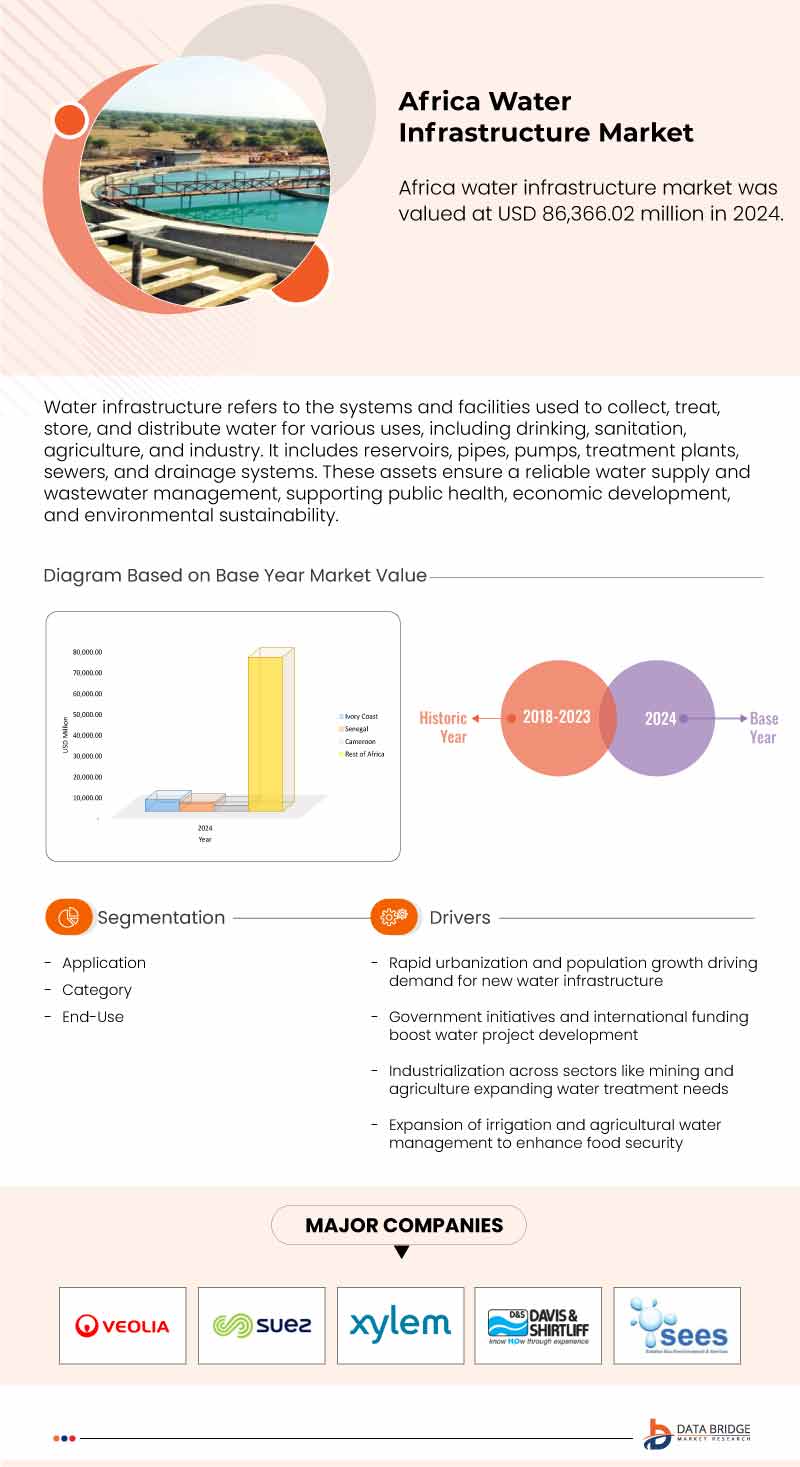
Installed Base of Water Infrastructure in Africa
The installed base refers to the total existing capacity of water infrastructure systems currently in operation across Africa, encompassing pipelines, treatment plants, reservoirs, irrigation networks, and sanitation facilities. These systems are vital for ensuring reliable access to clean water, supporting agricultural productivity, and enhancing public health outcomes. The market landscape is shaped by the urgent need to improve water access, address climate vulnerabilities, and expand infrastructure in both urban and rural regions.
Countries like South Africa, Egypt, and Morocco are leading with large-scale water infrastructure programs, while Sub-Saharan nations are accelerating development through multilateral funding and public-private partnerships. Additionally, cities across the continent are beginning to adopt smart water technologies and resilient, climate-adaptive infrastructure to support sustainable growth and mitigate the impacts of water scarcity and urban expansion.
Applications and Use-Cases of Africa Water Infrastructure Market
Water infrastructure in Africa serves as a foundational element for socio-economic development, supporting a wide range of applications critical to health, agriculture, urban planning, and climate resilience. As the continent grapples with population growth, urbanization, and the impacts of climate change, the development and modernization of water systems have become a central priority.
Urban Water Supply and Distribution
Rapid urbanization is driving the expansion of municipal water networks to meet the growing demand in cities. Water treatment plants, underground pipelines, and pumping stations are being developed to ensure consistent and safe water delivery to urban populations.
Use-Case: In Nairobi, Kenya, recent upgrades to the city’s water distribution system have improved access for over 300,000 residents through World Bank-funded infrastructure.
Rural Water Access and Borehole Systems
In remote and underserved regions, boreholes, hand-pump wells, and small-scale distribution systems provide essential water access for domestic use. These solutions are often supported by NGOs and donor agencies to improve health outcomes and reduce water collection times.
Use-Case: In Northern Nigeria, community borehole projects have significantly increased access to potable water in rural villages, reducing reliance on unsafe water sources.
Agricultural Irrigation Systems
Agriculture accounts for the majority of water use in Africa. Modern irrigation infrastructure, including canals, drip systems, and small dams, is vital to improve food security and enable year-round farming.
Use-Case: In Ethiopia, the government’s irrigation expansion strategy includes the construction of new irrigation canals to support smallholder farmers in drought-prone areas.
Flood Control and Stormwater Management
As extreme weather events become more common, flood control infrastructure such as drainage systems, retention basins, and embankments are increasingly necessary to protect urban and agricultural areas.
Use-Case: In Dakar, Senegal, the city has implemented stormwater drainage improvements to prevent seasonal flooding, particularly in informal settlements.
Wastewater Treatment and Sanitation Infrastructure
Investments in sewer networks and wastewater treatment plants are critical to improving sanitation, reducing disease, and protecting water resources.
Use-Case: South Africa has expanded its municipal wastewater treatment capacity in cities like Cape Town, supporting both environmental sustainability and public health.
Climate-Resilient Infrastructure Projects
With climate variability affecting water availability, many countries are investing in multi-functional infrastructure that can store water during droughts and manage surplus during floods.
Use-Case: In Mauritania, the government has launched integrated water storage and distribution projects to buffer communities against seasonal water scarcity.
Types of Water Infrastructure in the Africa Market
Water infrastructure in Africa encompasses a broad array of systems designed to collect, treat, store, distribute, and manage water resources. These infrastructure types are foundational to addressing key challenges such as water scarcity, urban population growth, agricultural productivity, sanitation, and climate resilience.
Water Supply and Distribution Networks
Purpose: To ensure access to clean and reliable drinking water for urban and peri-urban populations.
Key Components:
- Surface water intake structures from rivers and lakes
- Water treatment plants for filtration and purification
- High-capacity pipelines for transmission and distribution
- Water towers and storage tanks for pressure management
- Household and community water connections
Use: These networks are typically developed in urban centers, connecting water treatment facilities to residential, commercial, and industrial users.
For instance, In Kenya, the Nairobi City Water and Sewerage Company expanded its urban network in 2023 to cover informal settlements, reducing dependency on water vendors and improving public health outcomes.
Boreholes and Groundwater Extraction Systems
Purpose: To provide decentralized water access in rural and arid regions, particularly where piped systems are not viable.
Key Components:
- Mechanized or hand-drilled boreholes
- Solar-powered or manual pumps
- Overhead storage tanks
- Gravity-fed distribution points
Use: Boreholes are often installed in schools, health centers, and village centers to provide localized water access, especially during dry seasons.
For instance, In Niger, UNICEF-supported solar-powered boreholes have enabled continuous water supply in remote villages, reducing water collection times by over 60%.
Irrigation Infrastructure
Purpose: To support food production, improve agricultural yields, and enable climate-resilient farming.
Key Components:
- Irrigation canals and channels
- Dams and water diversion structures
- Pressurized drip or sprinkler systems
- Water storage ponds for rainwater harvesting
Use: Used for both large-scale commercial farms and smallholder irrigation schemes, especially in regions prone to drought.
For instance, The Bura Irrigation Scheme in Kenya’s Tana River Basin has been revitalized to irrigate over 12,000 hectares, supporting rice and horticultural crops for both domestic consumption and export.
Dams and Reservoirs
Purpose: Multipurpose structures used for water storage, irrigation, hydroelectric power generation, and flood control.
Key Components:
- Main dam structure
- Reservoir/catchment area
- Hydropower turbines (where applicable)
- Spillways, gates, and downstream regulation systems
Use: These are strategic national assets that regulate river flow and provide long-term water security.
For instance, The Grand Ethiopian Renaissance Dam (GERD) on the Blue Nile, when fully operational, will generate over 6,000 MW of electricity and store more than 74 billion cubic meters of water, providing benefits to agriculture and energy sectors alike.
Wastewater Treatment and Sanitation Infrastructure
Purpose: To manage and treat sewage and industrial wastewater before safe discharge or reuse, reducing environmental contamination.
Key Components:
- Sewerage collection networks
- Primary and secondary treatment plants
- Sludge drying beds
- Effluent quality monitoring systems
Use: Crucial in urban areas where untreated wastewater contributes to pollution, disease outbreaks, and degradation of water bodies.
For instance, In Durban, South Africa, the municipality operates advanced decentralized wastewater systems in peri-urban zones, treating sewage locally and reusing treated effluent for irrigation and industrial applications.
Market Developments
- In February 2024, the African Development Bank (AfDB) approved a USD 150 million loan for the Greater Accra Metropolitan Area Water and Sanitation Project in Ghana. The initiative focuses on expanding access to clean drinking water and improving sanitation infrastructure in low-income urban communities. The project includes the construction of pipelines, water treatment plants, and household connections, aiming to benefit over 2.5 million people
- In May 2024, Lesico Infrastructure, an Israeli engineering firm, commenced work on a major desalination plant in Namibia’s Erongo Region. The plant will produce 20 million liters of potable water daily, helping alleviate severe water shortages in coastal cities such as Swakopmund and Walvis Bay. This development marks a key step in Southern Africa’s shift toward non-conventional water supply solutions
- In August 2024, the Government of Kenya, with support from the World Bank, launched the Kenya Water Security and Climate Resilience Project – Phase II, targeting arid and semi-arid regions. The project involves the construction of small dams, irrigation infrastructure, and boreholes, aiming to enhance water access for over 1 million residents affected by climate-induced droughts
- In October 2024, Rand Water, South Africa’s largest bulk water utility, announced a USD 200 million investment in modernizing its Johannesburg water treatment and transmission infrastructure. The upgrade includes the integration of smart metering systems and high-efficiency pumps to reduce water losses and improve service delivery across the Gauteng Province
- In December 2024, Morocco’s National Office for Electricity and Drinking Water (ONEE) inaugurated a new wastewater treatment plant in Agadir, designed to treat over 40,000 cubic meters of wastewater per day. The facility includes advanced filtration and energy recovery systems, contributing to national sustainability targets and reducing marine pollution along the Atlantic coast
Future Opportunities –
The Africa water infrastructure market is entering a critical phase of transformation, propelled by the urgent need for climate adaptation, urban service expansion, and technological modernization. As water scarcity intensifies due to population growth and environmental pressures, governments and private investors are identifying forward-looking strategies that prioritize resilience, sustainability, and access equity. Below are key opportunity areas shaping the future of the market:
Climate-Resilient Water Infrastructure Development
With increasing exposure to extreme weather events—such as prolonged droughts and seasonal floods—there is a pressing opportunity to build infrastructure that withstands climatic stress while ensuring long-term water security.
For instance, in March 2025, the African Union Commission, in partnership with the Green Climate Fund, launched the Continental Climate Water Resilience Program. This initiative will finance flood control systems, rainwater harvesting infrastructure, and drought-proof water supply systems in vulnerable nations like Mozambique, Chad, and Malawi, directly benefiting more than 8 million people by 2030.
Smart Water Systems and Digital Monitoring
Digital technologies are increasingly being integrated into urban water infrastructure to improve operational efficiency, reduce water loss, and ensure quality compliance. These innovations present major opportunities for technology providers and utility reform initiatives.
For instance, in April 2025, the Lagos State Water Corporation (Nigeria) rolled out West Africa’s largest smart water monitoring system in partnership with a European engineering firm. This project involves the installation of over 10,000 IoT-enabled smart meters and real-time sensors across Lagos' urban network, aiming to reduce non-revenue water losses by 25% over the next three years.
Decentralized and Off-Grid Rural Water Systems
In remote and underserved areas where large-scale infrastructure is impractical, decentralized solutions such as solar-powered boreholes, compact filtration stations, and community-managed systems offer scalable, cost-effective access.
For instance, as of January 2025, the Solar Water for Resilience Program—a collaboration between multiple NGOs and the African Water Facility—has installed over 120 solar-powered boreholes in rural Burkina Faso, reaching 400,000+ people and eliminating the need for diesel-powered pumps, thus lowering operational costs and carbon emissions.
Desalination and Water Reuse Expansion
For arid and coastal regions facing water shortages, desalination and wastewater reuse present untapped potential for increasing freshwater availability. These technologies are becoming more viable due to falling costs and improved energy efficiency.
For instance, by June 2025, Egypt is set to bring online three new seawater desalination plants in the Sinai Peninsula, adding a daily combined capacity of 200,000 cubic meters. These plants will serve both residential and agricultural sectors, marking a critical step toward Egypt’s 2030 water sustainability goals.
Public-Private Partnerships (PPPs) and Infrastructure Investment Vehicles
As national budgets are strained, PPPs offer an effective model to mobilize private capital for large-scale water infrastructure. These partnerships unlock technical expertise, risk-sharing mechanisms, and long-term operational stability.
For instance, in February 2025, the Government of Rwanda finalized a USD 300 million PPP agreement with a consortium of European and African investors to construct the Kigali Bulk Water Supply Project. Once completed, it will provide safe water to over 1 million residents and introduce smart billing systems and performance-based maintenance contracts.
Africa Water Infrastructure Market Leaders Operating in the Market
Veolia
Headquarters: France
Veolia is a global leader in environmental services, including water treatment, waste management, and energy services. In Africa, Veolia has a robust presence, offering comprehensive water management solutions ranging from desalination to wastewater treatment and smart water systems. They have been particularly involved in urban water supply and sanitation projects across Morocco, South Africa, and Senegal. In 2019, Veolia signed a significant contract to upgrade the water and wastewater infrastructure in Abidjan, Côte d'Ivoire, enhancing water accessibility for over 4 million residents.
SUEZ
Headquarters: France
SUEZ is a leading global provider of water and waste management solutions, with a strong foothold in Africa. The company provides water treatment solutions, including water recycling, desalination, and wastewater management, playing a pivotal role in tackling water scarcity and ensuring sustainable water systems. In Morocco, SUEZ completed a state-of-the-art water treatment plant that serves Casablanca, and in South Africa, SUEZ has been working on projects to improve water access in urban areas, particularly in Cape Town during its drought crisis.
Xylem
Headquarters: USA
Xylem is known for its advanced water technologies, particularly in water transport, treatment, and testing. In Africa, Xylem focuses on providing energy-efficient solutions such as pumps, filtration systems, and smart water solutions for municipalities and industries. The company has been involved in South Africa, Egypt, and Nigeria, where they provide smart water metering, leak detection, and wastewater treatment systems. Their commitment to innovative water management helps improve water sustainability in urban and rural regions.
Davis & Shirtliff Group
Headquarters: Kenya
Davis & Shirtliff is one of the leading suppliers of water pumps, solar solutions, and water treatment equipment in Africa. They specialize in providing water solutions for both domestic and industrial purposes, including solar-powered pumping systems, which are particularly crucial in off-grid areas. Davis & Shirtliff operates across many African countries, including Kenya, Uganda, and Tanzania, and has been a key player in the push towards renewable energy in water infrastructure. Their solar pump systems are especially important in addressing water scarcity in rural communities.
SEES (Sustainable Environmental Engineering Solutions)
Headquarters: South Africa
SEES is focused on providing sustainable water treatment solutions across Africa, specializing in water purification, desalination, and wastewater treatment. The company has been actively involved in creating eco-friendly and low-energy solutions for municipal water treatment plants and industries across Southern Africa. SEES has also worked on decentralized water solutions to address water scarcity in rural and remote communities.
Fluence Corporation Limited
Headquarters: USA
Fluence Corporation is an innovative provider of water treatment and wastewater treatment solutions, including modular, decentralized systems. The company focuses on small- to medium-sized communities and industries in Africa, particularly where water infrastructure is not as developed. Fluence is recognized for its Containerized Water Treatment Plants (CWTP), which are flexible and efficient solutions that can be deployed quickly. They have implemented several successful projects in Kenya, Nigeria, and Egypt, particularly for treating industrial wastewater and municipal water supply.
Waterleau
Headquarters: Belgium
Waterleau is a global environmental services company with extensive expertise in water treatment, air purification, and waste management. In Africa, the company provides advanced water treatment solutions for both industrial and municipal applications, including wastewater treatment and water reuse. Waterleau has been active in various projects in North Africa and West Africa, especially in Tunisia, Algeria, and Ghana, where they offer solutions for municipal wastewater treatment plants and industrial water reuse.
Molecor
Headquarters: Spain
Molecor specializes in the development of PVC-O (oriented PVC) pipes for water distribution. The company's advanced piping systems are highly durable and resistant, making them ideal for high-pressure water distribution systems in both urban and industrial settings. Molecor’s innovative technology has found applications in South Africa, Nigeria, and other regions in Africa, where infrastructure modernization is crucial for improving water delivery and reducing water losses.
Genesis Water Technologies
Headquarters: USA
Genesis Water Technologies is known for its advanced water treatment and wastewater recycling technologies. The company provides solutions tailored to industrial, municipal, and commercial sectors. In Africa, Genesis focuses on water reuse, desalination, and wastewater treatment technologies that are critical in water-scarce regions. Their systems are being implemented in various parts of East Africa and West Africa, where the company is helping to address industrial and municipal water challenges.
Vikas Pump
Headquarters: India
Vikas Pump is a leading manufacturer of water pumps and water management systems, with a significant presence in Africa. Their solutions are widely used in agricultural, industrial, and domestic water supply applications. In Africa, they are known for providing high-efficiency pumps for irrigation, water distribution, and industrial water treatment. Vikas Pump has been involved in water projects across East Africa and South Africa, helping improve water accessibility and irrigation capabilities.
Related Reports-









