


Global Catalytic Converter Toll Refining Market Segmentation, By Application (Passenger Vehicles and Commercial Vehicles), Vehicle Type (Automotive and Motorcycles), Material Type (Palladium and Platinum), Technology (Two-Way Catalytic Converter and Three-Way Catalytic Converter), Catalyst Type (Monolithic Catalysts and Honeycomb Catalysts) - Industry Trends and Forecast to 2032
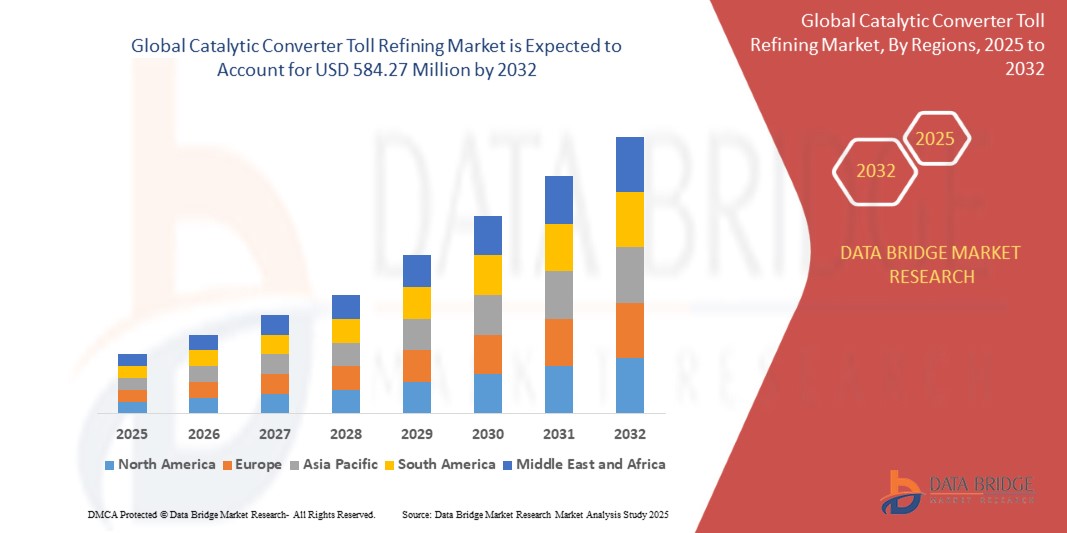
Catalytic Converter Toll Refining Market Size
- The global catalytic converter toll refining market size was valued at USD 355.7 million in 2024 and is expected to reach USD 584.27 million by 2032, at a CAGR of 6.40% during the forecast period
- This growth is driven by factors such as rising vehicle scrappage rates, high demand for precious metals, strict emission regulations, cost benefits of recycling, growing focus on sustainability, and advancements in refining technologies
Catalytic Converter Toll Refining Market Analysis
- Catalytic converter toll refining is a specialized process in which third-party service providers extract valuable precious metals such as palladium, platinum, and rhodium, from used catalytic converters on behalf of clients, typically for reuse or resale
- The catalytic converter toll refining market is witnessing steady growth, driven by increasing vehicle scrappage rates, high demand for precious metals, and stringent emission regulations. In addition, rising environmental awareness, the economic benefits of metal recovery, and technological advancements in refining processes are further fueling market expansion
- North America is expected to dominate the catalytic converter toll refining market with a share of 35.5%, due to the high volume of end-of-life vehicles and stringent emission regulations in the region
- Asia-Pacific is expected to be the fastest growing region in the catalytic converter toll refining market during the forecast period with a share of 30.5%, due to rapid industrialization, expanding automotive production, and increasing demand for resource recovery in the region
- Passenger vehicles segment is expected to dominate the market due to high global production and sales volume of passenger cars, which results in a larger number of spent catalytic converters entering the recycling stream. In addition, strict emission regulations in regions such as the U.S. and Europe have increased the use of advanced catalytic converters in these vehicles, further boosting the demand for toll refining services to recover valuable metals such as palladium, platinum, and rhodium
Report Scope and Catalytic Converter Toll Refining Market Segmentation
|
Attributes |
Catalytic Converter Toll Refining Key Market Insights |
|
Segments Covered |
|
|
Countries Covered |
North America
Europe
Asia-Pacific
Middle East and Africa
South America
|
|
Key Market Players |
|
|
Market Opportunities |
|
|
Value Added Data Infosets |
In addition to the insights on market scenarios such as market value, growth rate, segmentation, geographical coverage, and major players, the market reports curated by the Data Bridge Market Research also include import export analysis, production capacity overview, production consumption analysis, price trend analysis, climate change scenario, supply chain analysis, value chain analysis, raw material/consumables overview, vendor selection criteria, PESTLE Analysis, Porter Analysis, and regulatory framework. |
Catalytic Converter Toll Refining Market Trends
“Growing Adoption of Advanced Refining Technologies”
- One prominent trend in the global catalytic converter toll refining market is the growing adoption of advanced refining technologies
- This trend is driven by the need for higher recovery efficiency of precious metals such as palladium, platinum, and rhodium, as well as the increasing volume of spent catalytic converters from end-of-life vehicles
- For instance, companies such as Heraeus and Umicore are investing in state-of-the-art refining technologies, including automated smelting and advanced analytical systems, to enhance metal recovery rates and improve operational efficiency
- The focus on sustainability and maximizing resource recovery is also encouraging refiners to upgrade their facilities with more precise and environmentally friendly technologies
- As the demand for precious metals rises and regulatory pressures grow, the adoption of advanced refining technologies is expected to significantly propel the catalytic converter toll refining market forward
Catalytic Converter Toll Refining Market Dynamics
Driver
“Growing Need for Recovery of Precious Metals”
- The growing need for recovery of precious metals is a significant driver for growth in the catalytic converter toll refining market, as it enables the extraction and reuse of high-value materials such as palladium, platinum, and rhodium from spent converters
- This demand is particularly strong in the automotive and manufacturing sectors, where these metals are essential for producing new catalytic converters and various industrial components
- With global supplies of precious metals becoming increasingly constrained and prices remaining high, industries are turning to toll refining as a sustainable and cost-effective solution for resource recovery
- Refining service providers are enhancing their capabilities to maximize metal yield and meet the rising expectations for purity and efficiency in recycled materials
- The emphasis on environmental responsibility and circular economy practices is further accelerating the demand for toll refining services across regions
For instance,
- Johnson Matthey and BASF are actively expanding their toll refining operations to recover and refine greater volumes of precious metals, meeting the growing demand from automakers and industrial users
- Heraeus has invested in advanced recycling facilities to process larger batches of spent catalytic converters and improve the recovery of scarce metals
- The catalytic converter toll refining market is poised for continued growth, driven by the critical need for precious metal recovery and the expanding adoption of efficient refining practices
Opportunity
“Expansion of Refining Capabilities”
- The expansion of refining capabilities presents a significant opportunity for the catalytic converter toll refining market, driven by the growing need to efficiently recover precious metals such as palladium, platinum, and rhodium from a rising volume of end-of-life vehicles
- As the demand for precious metals continues to increase, refining companies are focusing on enhancing their capabilities to process larger quantities of spent catalytic converters while improving recovery rates, creating an opportunity for investment in advanced refining technologies and infrastructure
- This opportunity aligns with the broader trend toward resource efficiency and sustainability, as better refining techniques maximize metal recovery and reduce environmental impact, further driving the market's growth
For instance,
- Johnson Matthey has expanded its refining facilities to enhance its processing capabilities, focusing on increasing recovery efficiency through state-of-the-art technologies
- Umicore is investing in high-capacity smelting and refining technologies to accommodate the growing volume of catalytic converter waste and improve metal extraction rates
- As the automotive industry continues to generate large volumes of spent catalytic converters, the expansion of refining capabilities is expected to be a key growth driver for the catalytic converter toll refining market, enabling refiners to meet both current and future demand
Restraint/Challenge
“Price Volatility for Precious Metals”
- Price volatility for precious metals presents a significant challenge for the catalytic converter toll refining market, particularly given the fluctuations in the prices of palladium, platinum, and rhodium, which are crucial for refining processes
- The volatility of precious metal prices impacts the profitability of toll refining operations, as refiners must adapt to sudden price changes that can either increase or decrease the value of recovered metals. This uncertainty creates financial risk for companies, especially those with large-scale operations dependent on metal market stability
- This challenge is especially prominent in periods of market instability, where sharp price increases can drive up operational costs and affect the pricing models for toll refining services, complicating long-term planning and investment decisions
For instance,
- Heraeus has implemented more dynamic pricing strategies in response to metal price volatility, allowing for flexibility in refining agreements
- The fluctuating costs of precious metals pose a barrier to consistent profitability in the toll refining market, potentially slowing down investment in new technologies and limiting the expansion of refining capacities, especially for smaller firms operating on tighter margins
Catalytic Converter Toll Refining Market Scope
The market is segmented on the basis of application, vehicle type, material type, technology, and catalyst type.
|
Segmentation |
Sub-Segmentation |
|
By Application |
|
|
By Vehicle Type |
|
|
By Material Type |
|
|
By Technology
|
|
|
By Catalyst Type |
|
In 2025, the passenger vehicles is projected to dominate the market with a largest share in application segment
The passenger vehicles segment is expected to dominate the catalytic converter toll refining market due to high global production and sales volume of passenger cars, which results in a larger number of spent catalytic converters entering the recycling stream. In addition, strict emission regulations in regions such as the U.S. and Europe have increased the use of advanced catalytic converters in these vehicles, further boosting the demand for toll refining services to recover valuable metals such as palladium, platinum, and rhodium.
The palladium is expected to account for the largest share during the forecast period in material type market
In 2025, the palladium segment is expected to dominate the market due to its widespread use in gasoline engine catalytic converters, which are more common globally than diesel engines. Palladium offers high catalytic efficiency at a lower cost compared to platinum, making it the preferred material for automakers aiming to meet stringent emission standards while managing production costs.
Catalytic Converter Toll Refining Market Regional Analysis
“North America Holds the Largest Share in the Catalytic converter toll refining Market”
- North America dominates the catalytic converter toll refining market with a share of 35.5%, driven by the high volume of end-of-life vehicles and stringent emission regulations in the region
- U.S. holds a significant share due to its advanced automotive industry, well-established recycling infrastructure, and extensive regulations regarding vehicle emissions and waste management
- The region's robust regulatory framework, supported by regulations such as the Clean Air Act, encourages the use of catalytic converters in vehicles, thereby driving the need for efficient toll refining services. In addition, the increasing focus on sustainability and precious metal recovery is further bolstering the demand for toll refining
- As the demand for metal recovery continues to rise and the automotive sector embraces more efficient recycling practices, North America is expected to maintain its dominant position in the market through 2032, supported by innovations in refining technology and environmental policies
“Asia-Pacific is Projected to Register the Highest CAGR in the Catalytic converter toll refining Market”
- Asia-Pacific is expected to witness the highest growth rate in the catalytic converter toll refining market with a share of 30.5%, driven by rapid industrialization, expanding automotive production, and increasing demand for resource recovery in the region
- China holds a significant share due to its massive automotive industry, growing vehicle scrappage rates, and increasing focus on environmental sustainability and recycling
- As vehicle ownership and emissions-related regulations grow, especially in urban areas, the need for efficient catalytic converter toll refining services is expected to rise significantly.
- Local players in the region are also contributing to market growth by establishing refining facilities and offering cost-effective recycling solutions, making catalytic converter toll refining more accessible in emerging markets. With continued investments in recycling technologies and the expansion of the automotive sector, Asia-Pacific is poised to become the fastest-growing region in the catalytic converter toll refining market through 2032
Catalytic Converter Toll Refining Market Share
Die Wettbewerbslandschaft des Marktes liefert detaillierte Informationen zu den einzelnen Wettbewerbern. Zu den Details gehören Unternehmensübersicht, Unternehmensfinanzen, Umsatz, Marktpotenzial, Investitionen in Forschung und Entwicklung, neue Marktinitiativen, globale Präsenz, Produktionsstandorte und -anlagen, Produktionskapazitäten, Stärken und Schwächen des Unternehmens, Produkteinführung, Produktbreite und -umfang sowie Anwendungsdominanz. Die oben genannten Datenpunkte beziehen sich ausschließlich auf die Marktausrichtung der Unternehmen.
Die wichtigsten Marktführer auf dem Markt sind:
- PMR-Katalysator-Recycling (USA)
- Hensel Recycling (Deutschland)
- Ecotrade Group (Kanada)
- CCC Katalysator-Recycling (USA)
- Global Refining Group (USA)
- PGM-Raffination (USA)
- Phoenix Group Metals (USA)
- G and D CATS Recycling (USA)
- BASF Metals Recycling (Deutschland)
- FJ Church & Sons (Großbritannien)
SKU-
Erhalten Sie Online-Zugriff auf den Bericht zur weltweit ersten Market Intelligence Cloud

- Interaktives Datenanalyse-Dashboard
- Unternehmensanalyse-Dashboard für Chancen mit hohem Wachstumspotenzial
- Zugriff für Research-Analysten für Anpassungen und Abfragen
- Konkurrenzanalyse mit interaktivem Dashboard
- Aktuelle Nachrichten, Updates und Trendanalyse
- Nutzen Sie die Leistungsfähigkeit der Benchmark-Analyse für eine umfassende Konkurrenzverfolgung
Forschungsmethodik
Die Datenerfassung und Basisjahresanalyse werden mithilfe von Datenerfassungsmodulen mit großen Stichprobengrößen durchgeführt. Die Phase umfasst das Erhalten von Marktinformationen oder verwandten Daten aus verschiedenen Quellen und Strategien. Sie umfasst die Prüfung und Planung aller aus der Vergangenheit im Voraus erfassten Daten. Sie umfasst auch die Prüfung von Informationsinkonsistenzen, die in verschiedenen Informationsquellen auftreten. Die Marktdaten werden mithilfe von marktstatistischen und kohärenten Modellen analysiert und geschätzt. Darüber hinaus sind Marktanteilsanalyse und Schlüsseltrendanalyse die wichtigsten Erfolgsfaktoren im Marktbericht. Um mehr zu erfahren, fordern Sie bitte einen Analystenanruf an oder geben Sie Ihre Anfrage ein.
Die wichtigste Forschungsmethodik, die vom DBMR-Forschungsteam verwendet wird, ist die Datentriangulation, die Data Mining, die Analyse der Auswirkungen von Datenvariablen auf den Markt und die primäre (Branchenexperten-)Validierung umfasst. Zu den Datenmodellen gehören ein Lieferantenpositionierungsraster, eine Marktzeitlinienanalyse, ein Marktüberblick und -leitfaden, ein Firmenpositionierungsraster, eine Patentanalyse, eine Preisanalyse, eine Firmenmarktanteilsanalyse, Messstandards, eine globale versus eine regionale und Lieferantenanteilsanalyse. Um mehr über die Forschungsmethodik zu erfahren, senden Sie eine Anfrage an unsere Branchenexperten.
Anpassung möglich
Data Bridge Market Research ist ein führendes Unternehmen in der fortgeschrittenen formativen Forschung. Wir sind stolz darauf, unseren bestehenden und neuen Kunden Daten und Analysen zu bieten, die zu ihren Zielen passen. Der Bericht kann angepasst werden, um Preistrendanalysen von Zielmarken, Marktverständnis für zusätzliche Länder (fordern Sie die Länderliste an), Daten zu klinischen Studienergebnissen, Literaturübersicht, Analysen des Marktes für aufgearbeitete Produkte und Produktbasis einzuschließen. Marktanalysen von Zielkonkurrenten können von technologiebasierten Analysen bis hin zu Marktportfoliostrategien analysiert werden. Wir können so viele Wettbewerber hinzufügen, wie Sie Daten in dem von Ihnen gewünschten Format und Datenstil benötigen. Unser Analystenteam kann Ihnen auch Daten in groben Excel-Rohdateien und Pivot-Tabellen (Fact Book) bereitstellen oder Sie bei der Erstellung von Präsentationen aus den im Bericht verfügbaren Datensätzen unterstützen.











