



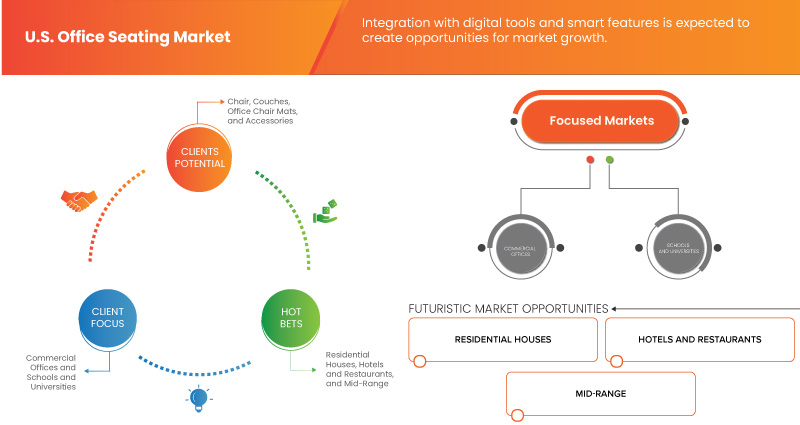
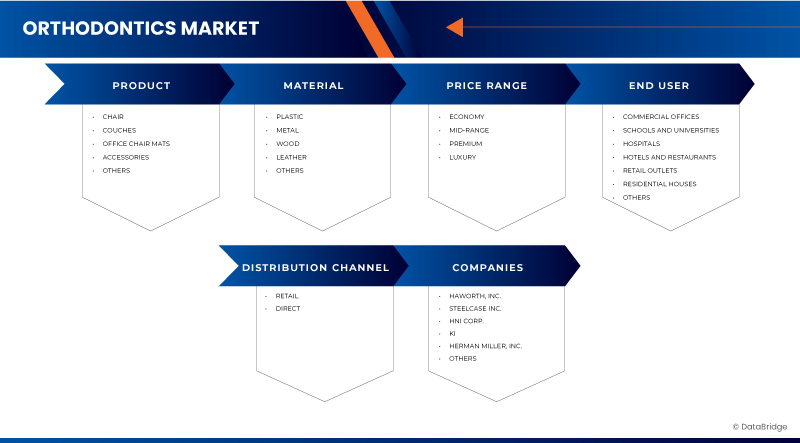
U.S. Office Seating Market Segmentation, By Product (Chair, Couches, Office Chair Mats, Accessories and Others), Material (Plastic, Metal, Wood, Leather and Others), Price Range (Economy, Mid-Range, Premium and Luxury), End User (Commercial Offices, Schools and Universities, Hospitals, Hotels and Restaurants, Retail Outlets, Residential Houses and Others), Distribution Channel (Retail and Direct) – Industry Trends and Forecast to 2031.
Office Seating Market Analysis
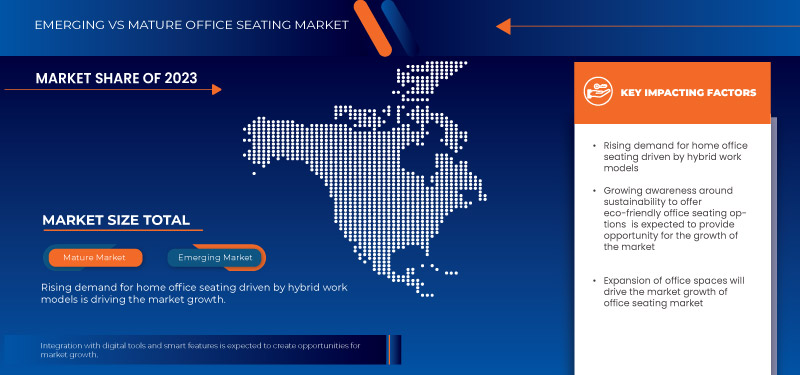
Office Seating rising demand for home office seating, driven by hybrid work models, is significantly influencing the office seating market. Hybrid work arrangements, which blend remote and in-office work, have become increasingly popular as organizations seek flexibility and improved employee work-life balance. This shift has created a burgeoning market for high-quality home office furniture, particularly ergonomic seating solutions. As organizations and employees become more conscious of the long-term effects of sedentary work and poor ergonomics, the demand for ergonomic and health-conscious office seating solutions has surged. The modern office landscape is increasingly recognizing the link between ergonomic design and employee health. The heightened awareness of health impacts is also reflected in corporate wellness programs, which increasingly incorporate ergonomic assessments and investments in high-quality office seating.
Office Seating Market Size
U.S. office seating market size was valued at 8.48 billion in 2024 and is projected to reach USD 10.11 billion by 2031, with a CAGR of 2.57% during the forecast period of 2025 to 2031. In addition to the insights on market scenarios such as market value, growth rate, segmentation, geographical coverage, and major players, the market reports curated by the Data Bridge Market Research also include in-depth expert analysis, pricing analysis, brand share analysis, consumer survey, demography analysis, supply chain analysis, value chain analysis, raw material/consumables overview, vendor selection criteria, PESTLE Analysis, Porter Analysis, and regulatory framework.
Office Seating Market Trends
“Rising Demand for Home Office Seating Driven by Hybrid Work Models”
As businesses and employees increasingly adopt flexible work arrangements that blend remote and in-office work, there is a growing demand for home office seating solutions. This shift is transforming the traditional office furniture landscape, with a notable focus on ergonomic and versatile seating options designed to enhance comfort and productivity in a home environment. Hybrid work models require office furniture that supports extended hours of use and accommodates various work styles. Consequently, there is a heightened emphasis on ergonomic chairs that offer adjustable features, lumbar support, and improved posture alignment to prevent discomfort and strain. In addition, the aesthetic appeal and integration of office furniture into home settings are becoming important, with many opting for stylish yet functional designs that complement their home decor.
Manufacturers are responding to these needs by innovating with new materials and technologies, and offering customizable solutions that cater to diverse preferences. As remote work continues to solidify its place in the professional landscape, the demand for high-quality, ergonomic home office seating is set to remain strong, driving growth in the office seating market.
Report Scope and Office Seating Market Segmentation
|
Attributes |
Office Seating Market Insights |
|
Segments Covered |
|
|
Key Market Players |
Haworth, Inc. (U.S.), Steelcase Inc. (U.S.), HNI Corp. (U.S.), KI (U.S.), Herman Miller, Inc (U.S.), LA-Z-BOY INCORPORATED (U.S.), Teknion (Canada), UCHIDA YOKO GLOBAL LIMITED / UCHIDA YOKO GLOBAL CO., LTD. (Hong Kong), OFS (U.S.), Kinnarps AB (Sweden), OKAMURA CORPORATION (Japan), Humanscale (U.S.), Itoki Corporation (Japan), Kimball International (U.S.), Hooker Furniture (U.S.), Flexsteel Industries, Inc. (U.S.), JASPER GROUP (U.S.), Wilkhahn Wilkening+Hahne GmbH+Co. KG (Germany), Fursys Inc. (South Korea), Virco Inc. (U.S.), Groupe Lacasse (Canada), Affordable Interior Systems (U.S.), ACTIU Berbegal y Formas S.A. (Spain), Berco Designs (U.S.), UPLIFT DESK (U.S.), HOWE-MOVING DESIGN (Denmark), Trendway Corporation (U.S.), Great Openings (U.S.), and INTER IKEA SYSTEMS B.V. (Netherlands) among others |
|
Market Opportunities |
|
|
Value Added Data Infosets |
In addition to the insights on market scenarios such as market value, growth rate, segmentation, geographical coverage, and major players, the market reports curated by the Data Bridge Market Research also include in-depth expert analysis, pricing analysis, brand share analysis, consumer survey, demography analysis, supply chain analysis, value chain analysis, raw material/consumables overview, vendor selection criteria, PESTLE Analysis, Porter Analysis, and regulatory framework. |
Office Seating Market Definition
The office seating market encompasses the supply and demand for various types of office chairs and seating solutions, including task chairs, executive chairs, conference chairs, and ergonomic models. It includes products designed for comfort, functionality, and aesthetic appeal in work environments. This market serves businesses of all sizes, from small startups to large corporations, and is influenced by trends in workplace design, ergonomic innovations, and the growing emphasis on employee well-being. Market dynamics are driven by factors like technological advancements, economic conditions, and evolving work styles.
Office Seating Market Dynamics
Drivers
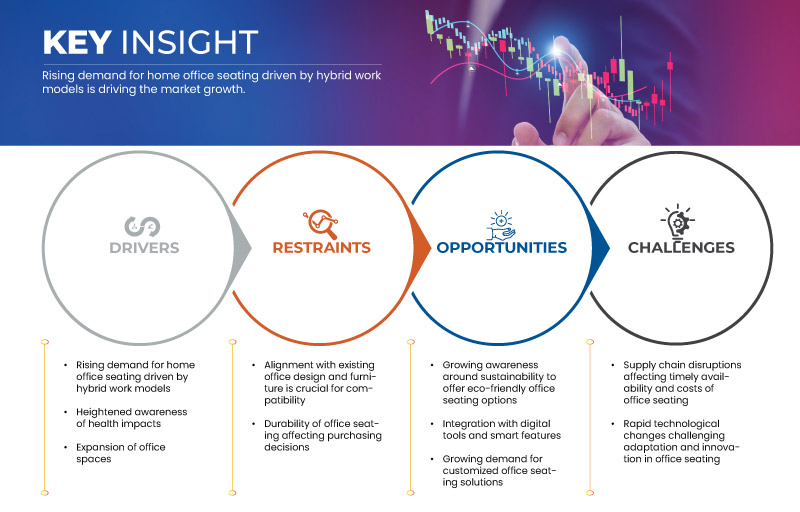
- Rising Demand for Home Office Seating Driven by Hybrid Work Models
The rising demand for home office seating, driven by hybrid work models, is significantly influencing the U.S. office seating market. Hybrid work arrangements, which blend remote and in-office work, have become increasingly popular as organizations seek flexibility and improved employee work-life balance. This shift has created a burgeoning market for high-quality home office furniture, particularly ergonomic seating solutions. As more employees work from home, there is a growing need for comfortable and functional home office setups. The traditional office chair is being replaced by more sophisticated home office seating designed for prolonged use, reflecting a heightened focus on ergonomics and well-being. Employees are now investing in chairs that offer adjustable features, lumbar support, and durable materials to mimic the comfort and support of office environments. Furthermore, the rise of hybrid work models has led to increased home office setup spending, boosting demand for various seating options, from task chairs to executive-style chairs. This growing market is also attracting new players and innovations, with manufacturers offering advanced features such as built-in technology and customizable designs.
For instance,
According to an article published by Steelcase Inc., Steelcase's research shows that hybrid work models, which gained momentum during the pandemic, are now widely adopted, with 89% of global business leaders expecting to offer hybrid options. Employees value the flexibility to work remotely, with 78% desiring continued remote work options. Steelcase emphasizes that a well-designed hybrid work approach should balance in-office and remote work, providing choice and control while maintaining organizational culture. Their studies reveal that effective hybrid work requires spaces that support focus, collaboration, and employee well-being, making the office an attractive and functional option.
- Heightened Awareness of Health Impacts
As organizations and employees become more conscious of the long-term effects of sedentary work and poor ergonomics, the demand for ergonomic and health-conscious office seating solutions has surged. The modern office landscape is increasingly recognizing the link between ergonomic design and employee health. Prolonged sitting in non-ergonomic chairs has been associated with a range of health issues, including musculoskeletal disorders, back pain, and poor posture. This has led to a growing emphasis on office furniture that supports proper posture and reduces physical strain. As a result, ergonomic office chairs—designed to offer adjustability, lumbar support, and improved posture alignment—have become highly sought after.
The heightened awareness of health impacts is also reflected in corporate wellness programs, which increasingly incorporate ergonomic assessments and investments in high-quality office seating. Companies are recognizing that investing in employee health can lead to reduced absenteeism, increased productivity, and overall better job satisfaction.
For instance,
- In August 2024, according to an article published by Wirecutter, the best office chairs emphasize the shift towards ergonomic designs driven by increased health awareness. Highlighted picks include the Steelcase Gesture for its exceptional adjustability and comfort, the Herman Miller Aeron for its breathability and durability, and the Herman Miller Sayl for its unique design and support at a lower price. The budget-friendly HON Ignition 2.0 is noted for offering good adjustments and comfort for under $500. These recommendations reflect the growing demand for office furniture that supports long-term health and productivity.
Opportunities
- Growing Awareness around Sustainability to Offer Eco-Friendly Office Seating Options
The increasing focus on sustainability represents a significant growth opportunity for the U.S. office seating market. As environmental concerns become more prominent, businesses are under growing pressure to adopt sustainable practices, including their choice of office furniture. This trend is driven by a combination of regulatory requirements such as Environmental Protection Agency (EPA), U.S. Green Building Council (USGBC) and many more, consumer preferences, and corporate values cantered on environmental responsibility. In the U.S. office seating market, eco-friendly options include chairs made from recycled materials, certified sustainable wood, and low-VOC finishes. Ergonomic and modular designs extend product lifecycles, while energy-efficient manufacturing and recycled packaging further reduces environmental impact. Certifications like GREENGUARD and Cradle to Cradle ensures sustainability. The five U.S. companies making eco-friendly office chairs includes, Herman Miller, Steelcase, Humanscale, Knoll and HON.
For instance,
According to an article published by Herman Mille, it has long prioritized environmental stewardship, reflecting its commitment to sustainability. Key milestones include achieving zero-waste-to-landfill in 1993, becoming a founding member of NextWave Plastics in 2018 to develop ocean-bound plastic supply chains, and launching a 100% recycled textile collection in 2021. The company’s Mirra Chair earned Cradle to Cradle certification, and their Aeron Chair and Sayl Chair now incorporate ocean-bound plastics. These initiatives underscore Herman Miller’s dedication to reducing environmental impact while meeting growing consumer demand for sustainable office solutions.
- Integration with Digital Tools and Smart Features
The integration of digital tools and smart features into office seating represents a significant opportunity for the U.S. office seating market. As work environments evolve and technology continues to advance, there is a growing demand for office furniture that not only provides ergonomic support but also enhances productivity and well-being through smart technology. Smart office seating solutions integrate digital tools such as sensors, connectivity, and adjustability features that respond to user needs in real time. For example, chairs equipped with sensors can monitor and analyse posture, alerting users to adjust their sitting position to prevent discomfort and improve ergonomics. Some models even connect to mobile apps, allowing users to track their sitting habits and receive personalized recommendations for better posture and movement throughout the day.
For instance,
- In May 2023, according to an article published by IEEE Xplore, a standard office chair equipped to monitor both physiological parameters—such as posture, body temperature, and respiratory rate—and environmental factors like temperature, humidity, CO2 levels, noise, and light. The system provides real-time data and interactive features for adjusting comfort, advising on breaks, and repositioning. Tested with six users, the chair achieved 100% accuracy in posture detection and up to 18% error in physiological measurements, demonstrating its potential to prevent posture-related issues and boost productivity.
Restraints/Challenges
- Supply Chain Disruptions Affecting Timely Availability and Costs of Office Seating
Certain office seating, such as oxybenzone and octocrylene, have raised concerns due to their potential health impacts. Research has indicated that these compounds may have endocrine-disrupting effects, which can interfere with hormonal systems in humans. This has led to increased scrutiny and regulation, as consumers become more aware of the potential risks associated with these chemicals. Consequently, the demand for office seating is impacted by the growing preference for products with safer, more natural ingredients. Environmental issues also contribute to the restraint on the Office Seating market. Many office seating have been found to have harmful effects on marine ecosystems. For example, some chemicals can contribute to coral reef bleaching and disrupt aquatic life, leading to adverse environmental impacts. This has led to stricter regulations and bans on certain office seating in various regions, particularly in places with sensitive marine environments. These ecological concerns result in increased regulatory compliance costs and limit the market's ability to use certain office seating, impacting overall market growth.
For instance,
- In October 2023, according to an article published by Truecommerce, the furniture industry faced severe disruptions with closures and increased demand causing significant supply chain issues. Factories struggled to keep up with the surge in home furnishings demand, leading to extensive delays and confusion due to multiple purchase order acknowledgments and raw material shortages. As the industry adapted to a new normal, TrueCommerce Home offered solutions like EDI and dropped shipping to streamline operations, improving visibility, and enhancing its efficiency. Retailers started to invest in technology to better manage supply chains and meet evolving consumer expectations.
Supply Chain Disruptions Affecting Timely Availability and Costs of Office Seating
As technology evolves, so do the expectations for office furniture, particularly how it integrates with modern work environments and supports new ways of working. One primary challenge is the need for office seating to keep pace with the increasing demand for ergonomic and multifunctional designs. Modern workplaces are increasingly adopting flexible work arrangements, such as hot-desking and collaborative spaces, which requires adaptable and customizable seating solutions. Furniture must not only offer comfort but also support a range of activities, from traditional desk work to collaborative meetings. Integrating advanced features like built-in connectivity for devices or smart adjustment mechanisms adds complexity and drives up costs for manufacturers. Additionally, the rise of remote and hybrid work models has introduced a new layer of competition. Office seating manufacturers must innovate to cater to both traditional office settings and home offices. This means developing products that are aesthetically pleasing yet functional for diverse environments, can strain resources and require significant investment in research and development.
For instance,
According to an article published by Steelcase Inc., The Steelcase and Microsoft case study is highly relevant for the office seating market. It showcases the shift towards flexible, creative workspaces that integrate technology to support diverse work modes. This adaptation addresses the challenge of evolving office designs in response to rapid technological changes and new employee needs. The emphasis on spaces like Maker Commons and Focus Studios highlights the move towards environments that enhance collaboration and creativity. Overall, it reflects the growing trend of designing offices to foster productivity and well-being in a rapidly changing work landscape.
This market report provides details of new recent developments, trade regulations, import-export analysis, production analysis, value chain optimization, market share, impact of domestic and localized market players, analyses opportunities in terms of emerging revenue pockets, changes in market regulations, strategic market growth analysis, market size, category market growths, application niches and dominance, product approvals, product launches, geographic expansions, technological innovations in the market. To gain more info on the market contact Data Bridge Market Research for an Analyst Brief, our team will help you take an informed market decision to achieve market growth.
Regulatory Framework Content
Regulations The office seating market is governed by regulations ensuring safety, ergonomics, and environmental standards. Key frameworks include ANSI/BIFMA (American National Standards Institute/Business and Institutional Furniture Manufacturers Association) standards for performance and safety, and adherence to OSHA (Occupational Safety and Health Administration) guidelines for ergonomic workplace safety.
Below is a detailed coverage of regulations and standards affecting the U.S. Office Seating market:
Regulations across U.S.
According to Occupational Safety and Health Administration (OSHA) Regulation, Office chairs must support ergonomic safety and productivity. They should feature an adjustable backrest that aligns with the spine, a comfortable seat allowing feet to rest flat, adjustable armrests for arm support, and a stable five-leg base with casters. Proper chair adjustments are crucial for a well-designed workstation.
According to the Lacey Act, enforced by USDA APHIS, the U.S. Fish and Wildlife Service, and the National Marine Fisheries Service, regulates the trade of plants, fish, and wildlife, including wooden products such as upholstered teak chairs and wooden tableware. Importers must exercise due care and submit declarations for plant-containing products meeting specific criteria.
According to formaldehyde standards for composite wood products (40 CFR Part 770) – TSCA, 40 CFR Part 770 of the TSCA, administered by the EPA, regulates formaldehyde emissions from composite wood products. It sets emission limits for hardwood plywood, medium-density fiberboard, thin medium-density fiberboard, and particleboard. Importers must obtain certification from an approved third-party certifier, including relevant documentation and test reports.
Moreover according to Consumer Product Safety Act (CPSA), The Consumer Product Safety Act, entered into law on October 27, 1972, was enacted to establish the Consumer Product Safety Commission and define its authority with the purpose of protecting the public against unreasonable risks of injury associated with consumer products; assisting consumers in evaluating the comparative safety of consumer products, developing uniform safety standards for consumer products; and promoting research and investigation into the causes and prevention of product-related deaths, illnesses, and injuries.
Impact and Current Market Scenario of Raw Material Shortage and Shipping Delays
Data Bridge Market Research offers a high-level analysis of the market and delivers information by keeping in account the impact and current market environment of raw material shortage and shipping delays. This translates into assessing strategic possibilities, creating effective action plans, and assisting businesses in making important decisions.
Apart from the standard report, we also offer in-depth analysis of the procurement level from forecasted shipping delays, distributor mapping by region, commodity analysis, production analysis, price mapping trends, sourcing, category performance analysis, supply chain risk management solutions, advanced benchmarking, and other services for procurement and strategic support.
Expected Impact of Economic Slowdown on the Pricing and Availability of Products
Wenn die Wirtschaftstätigkeit nachlässt, leiden auch die Branchen darunter. Die prognostizierten Auswirkungen des Konjunkturabschwungs auf die Preisgestaltung und Verfügbarkeit der Produkte werden in den von DBMR bereitgestellten Markteinblickberichten und Informationsdiensten berücksichtigt. Damit sind unsere Kunden ihren Konkurrenten in der Regel immer einen Schritt voraus, können ihre Umsätze und Erträge prognostizieren und ihre Gewinn- und Verlustaufwendungen abschätzen.
Marktumfang für Bürositze
Der Markt ist nach Produkt, Material, Preisspanne, Endverbraucher und Vertriebskanal segmentiert. Das Wachstum dieser Segmente hilft Ihnen bei der Analyse schwacher Wachstumssegmente in den Branchen und bietet den Benutzern einen wertvollen Marktüberblick und Markteinblicke, die ihnen bei der strategischen Entscheidungsfindung zur Identifizierung der wichtigsten Marktanwendungen helfen.
Produkt
- Stuhl
- Bürostühle
- Ergonomischer Stuhl
- Chefsessel
- Bürostuhl mit Netzstoff
- Drehbarer Bürostuhl
- Ballstuhl
- Zeichenstuhl/Hocker
- Kniestuhl
- Klappstuhl
- Stapelklappstuhl
- Gaming Stuhl
- Spezialstuhl
- Sonstiges
- Sofas
- Schnitt
- Modular
- Zweisitzer
- Ruhesessel
- Chesterfield
- Schläfer
- Smoking
- Lawson
- Mitte des Jahrhunderts
- Englischer Rollarm
- Spurarm
- Kamelrücken
- Cabrio
- Cabriolet
- Tief verwurzelt
- Niedrig sitzend
- Bürostuhlmatten
- Glühbirne
- Lippe
- Rechteckig
- Zubehör
- Sonstiges
Material
- Plastik
- Polypropylen
- ABS
- Polyethylen
- aus PVC
- Polycarbonat
- Nylon
- Sonstiges
- Metall
- Stahl
- Aluminium
- Eisen
- Messing
- Sonstiges
- Holz
- Hartholz
- Eiche
- Ahornholz
- Kirschholz
- Nussbaum
- Mahagoni
- Teakholz
- Asche
- Birke
- Kiefernholz
- Rosenholz
- Sonstiges
- Holzwerkstoff
- aus massivem Holz
- Weichholz
- Hartholz
- Leder
- Pigmentiert
- Oberes Korn
- Verbunden
- Anilin
- Nubukleder
- Vollnarbenleder
- Bi-Cast
- Gespaltenes Korn
- Sonstiges
- Sonstiges
Preisklasse
- Wirtschaft
- Mittelklasse
- Prämie
- Luxus
Endbenutzer
- Geschäftsräume
- Schulen und Universitäten
- Krankenhäuser
- Hotels und Restaurants
- Verkaufsstellen
- Wohnhäuser
- Sonstiges
Vertriebskanal
- Einzelhandel
- Offline
- Möbel-Outlets
- Mono-Marke
- Mehrere Marken
- Fachgeschäfte
- Supermärkte und Hypermärkte
- Sonstiges
- Möbel-Outlets
- Online
- Websites von Drittanbietern
- Firmeneigen
- Offline
- Direkt
Marktanteil Bürositze
Die Wettbewerbslandschaft des Marktes liefert Einzelheiten zu den Wettbewerbern. Zu den enthaltenen Einzelheiten gehören Unternehmensübersicht, Unternehmensfinanzen, erzielter Umsatz, Marktpotenzial, Investitionen in Forschung und Entwicklung, neue Marktinitiativen, Präsenz in den USA, Produktionsstandorte und -anlagen, Produktionskapazitäten, Stärken und Schwächen des Unternehmens, Produkteinführung, Produktbreite und -umfang, Anwendungsdominanz. Die oben angegebenen Datenpunkte beziehen sich nur auf den Fokus der Unternehmen in Bezug auf den Markt.
Die Marktführer für Bürositzmöbel sind:
- Haworth, Inc. (USA)
- Steelcase Inc. (USA)
- HNI Corp. (USA)
- KI (USA)
- Herman Miller, Inc (USA)
- LA-Z-BOY INCORPORATED (USA)
- Teknion (Kanada)
- UCHIDA YOKO GLOBAL LIMITED / UCHIDA YOKO GLOBAL CO., LTD. (Hongkong)
- OFS (USA)
- Kinnarps AB (Schweden)
- OKAMURA CORPORATION (Japan)
- Humanscale (USA)
- Itoki Corporation (Japan)
- Kimball International (USA)
- Hooker Furniture (USA)
- Flexsteel Industries, Inc. (USA)
- JASPER GROUP (USA)
- Wilkhahn Wilkening+Hahne GmbH+Co. KG (Deutschland)
- Fursys Inc. (Südkorea)
- Virco Inc. (USA)
- Groupe Lacasse (Kanada)
- Erschwingliche Innenraumsysteme (USA)
- ACTIU Berbegal y Formas SA (Spanien)
- Berco Designs (USA)
- UPLIFT-SCHREIBTISCH (USA)
- HOWE-MOVING DESIGN (Dänemark)
- Trendway Corporation (USA)
- Tolle Eröffnungen (USA)
- INTER IKEA SYSTEMS BV (Niederlande)
Neueste Entwicklungen auf dem Markt für Bürositze
- Im April 2024 verwandelte Steelcase Inc. Arbeitsräume in ganz China durch die Vorstellung bahnbrechender Entwicklungen in Design und Nachhaltigkeit, darunter die Spring Collection von Vicar. Ziel dieser Zusammenarbeit war es, Funktionalität, kulturelle Resonanz und Innovation zu verbessern und den Bedürfnissen sich rasch entwickelnder asiatischer Arbeitsräume gerecht zu werden.
- Im August 2024 brachte Haworth seinen neuen Bürostuhl Breck auf den Markt. Er verfügt über die innovative Geostretch-Technologie für überlegene ergonomische Unterstützung und Komfort. Breck wiegt 30 Pfund und lässt sich ohne Werkzeug zusammenbauen. Er bietet erstklassige Funktionen und Nachhaltigkeit mit über 50 % recyceltem Material. Diese Entwicklung stärkt Haworths Marktposition und kombiniert fortschrittliches Design mit umweltfreundlicher Produktion.
SKU-
Erhalten Sie Online-Zugriff auf den Bericht zur weltweit ersten Market Intelligence Cloud

- Interaktives Datenanalyse-Dashboard
- Unternehmensanalyse-Dashboard für Chancen mit hohem Wachstumspotenzial
- Zugriff für Research-Analysten für Anpassungen und Abfragen
- Konkurrenzanalyse mit interaktivem Dashboard
- Aktuelle Nachrichten, Updates und Trendanalyse
- Nutzen Sie die Leistungsfähigkeit der Benchmark-Analyse für eine umfassende Konkurrenzverfolgung
Forschungsmethodik
Die Datenerfassung und Basisjahresanalyse werden mithilfe von Datenerfassungsmodulen mit großen Stichprobengrößen durchgeführt. Die Phase umfasst das Erhalten von Marktinformationen oder verwandten Daten aus verschiedenen Quellen und Strategien. Sie umfasst die Prüfung und Planung aller aus der Vergangenheit im Voraus erfassten Daten. Sie umfasst auch die Prüfung von Informationsinkonsistenzen, die in verschiedenen Informationsquellen auftreten. Die Marktdaten werden mithilfe von marktstatistischen und kohärenten Modellen analysiert und geschätzt. Darüber hinaus sind Marktanteilsanalyse und Schlüsseltrendanalyse die wichtigsten Erfolgsfaktoren im Marktbericht. Um mehr zu erfahren, fordern Sie bitte einen Analystenanruf an oder geben Sie Ihre Anfrage ein.
Die wichtigste Forschungsmethodik, die vom DBMR-Forschungsteam verwendet wird, ist die Datentriangulation, die Data Mining, die Analyse der Auswirkungen von Datenvariablen auf den Markt und die primäre (Branchenexperten-)Validierung umfasst. Zu den Datenmodellen gehören ein Lieferantenpositionierungsraster, eine Marktzeitlinienanalyse, ein Marktüberblick und -leitfaden, ein Firmenpositionierungsraster, eine Patentanalyse, eine Preisanalyse, eine Firmenmarktanteilsanalyse, Messstandards, eine globale versus eine regionale und Lieferantenanteilsanalyse. Um mehr über die Forschungsmethodik zu erfahren, senden Sie eine Anfrage an unsere Branchenexperten.
Anpassung möglich
Data Bridge Market Research ist ein führendes Unternehmen in der fortgeschrittenen formativen Forschung. Wir sind stolz darauf, unseren bestehenden und neuen Kunden Daten und Analysen zu bieten, die zu ihren Zielen passen. Der Bericht kann angepasst werden, um Preistrendanalysen von Zielmarken, Marktverständnis für zusätzliche Länder (fordern Sie die Länderliste an), Daten zu klinischen Studienergebnissen, Literaturübersicht, Analysen des Marktes für aufgearbeitete Produkte und Produktbasis einzuschließen. Marktanalysen von Zielkonkurrenten können von technologiebasierten Analysen bis hin zu Marktportfoliostrategien analysiert werden. Wir können so viele Wettbewerber hinzufügen, wie Sie Daten in dem von Ihnen gewünschten Format und Datenstil benötigen. Unser Analystenteam kann Ihnen auch Daten in groben Excel-Rohdateien und Pivot-Tabellen (Fact Book) bereitstellen oder Sie bei der Erstellung von Präsentationen aus den im Bericht verfügbaren Datensätzen unterstützen.











