
Packaging plays an important role as plastic packaging in food packaging, which protects foods against environmental, chemical, and physical factors that could contaminate all of the food if not packaged correctly. The essential role of packaging is to protect the product from damage during transit, but packaging also protects the product in the warehouse and retail shoes before the sale of the product. Different types of packaging are used for different types of products. The demand for eco-friendly products for packaging is increasing because eco-friendly products have low-cost production and can be reused and recycled, which lowers the production of waste in the region. For packaging, several manufacturers prefer recycled plastic packaging more as packaging processes are less energy-consuming. In addition to that, they are said to emit minimal carbon as well they help in the reduction of plastic waste.
Access Full Report @ https://www.databridgemarketresearch.com/reports/asia-pacific-recycled-plastic-market
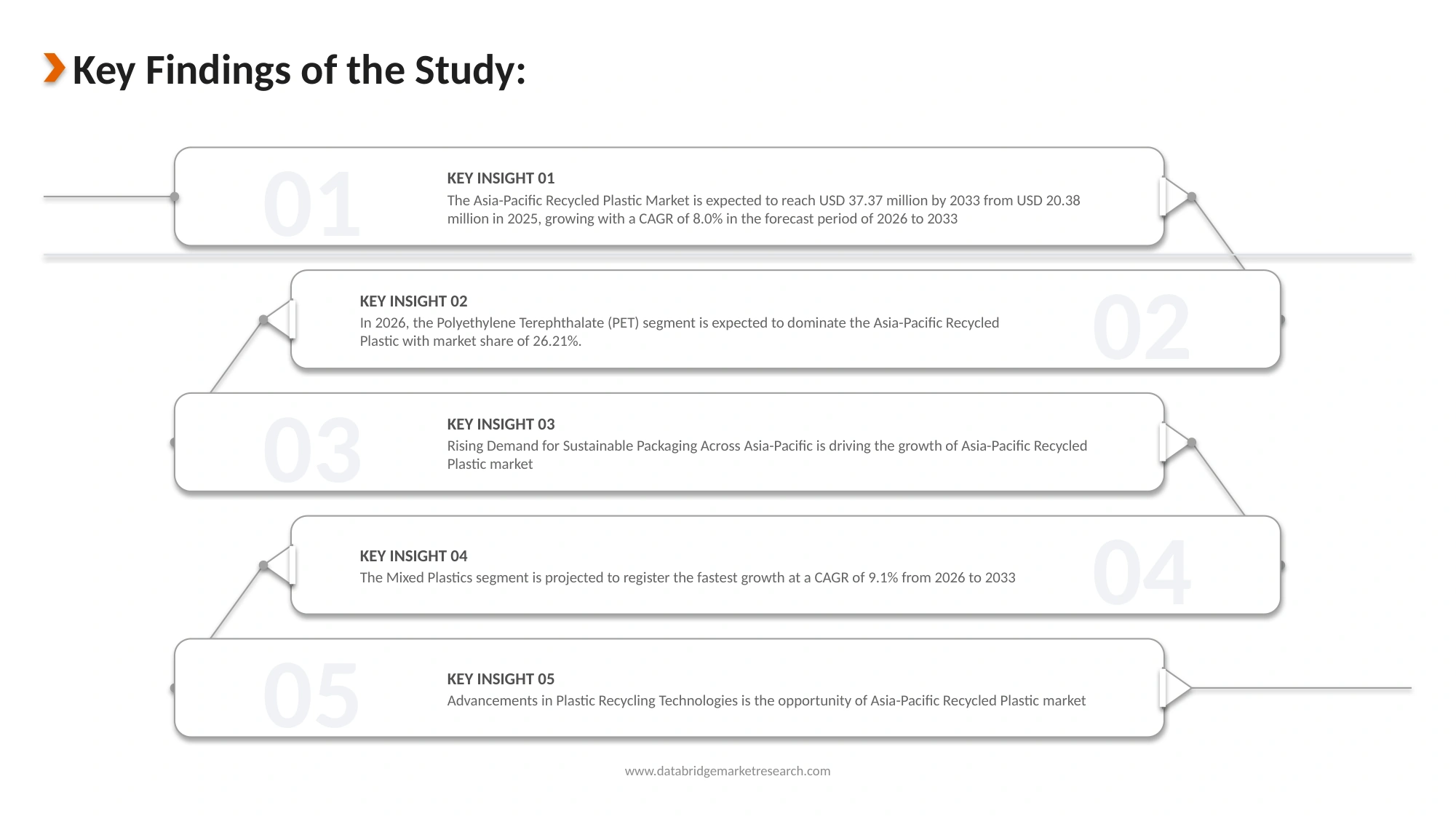
Data Bridge market research analyzes that the Asia-Pacific Recycled Plastic Market is expected to reach USD 37.37 million by 2033 from USD 20.38 million in 2025, growing with a CAGR of 8.0% in the forecast period of 2026 to 2033.
Key Findings of the Study
Implementation of Supportive Initiatives by Various Governments Regarding Recyclable Plastic
The implementation of supportive government initiatives across Asia-Pacific is strengthening the recycled plastics market by creating clearer collection, recycling, producer-responsibility, traceability, and sustainable-design frameworks. Governments are increasingly using measures such as extended producer responsibility (EPR), deposit-return systems, packaging reporting requirements, recycled-content initiatives, and design-for-recyclability standards to improve the recovery and quality of plastic waste. These measures are helping create more reliable feedstock streams for recyclers while encouraging manufacturers and brand owners to incorporate recycled materials into new products. In addition, government-backed guidelines and financial or regulatory support are helping businesses address challenges related to recyclability, material traceability, and the integration of recycled plastics into packaging and other applications.
Report Scope and Market Segmentation
|
Report Metric
|
Details
|
|
Forecast Period
|
2026 to 2033
|
|
Base Year
|
2025
|
|
Historic Years
|
2018-2024 (Customizable to 2013-2017)
|
|
Quantitative Units
|
Revenue in USD millions
|
|
Segments Covered
|
By Polymer Type (Polyethylene Terephthalate (PET), High-Density Polyethylene (HDPE), Polypropylene (PP), Low-Density Polyethylene (LDPE), Linear Low-Density Polyethylene (LLDPE), Polystyrene (PS), Polyvinyl Chloride (PVC), Mixed Plastics, Acrylonitrile Butadiene Styrene (ABS), Polycarbonate (PC), Polyamide (PA), and Others), Feedstock Type (Bottles, Containers, Films, Fibers & Textiles, Mixed Plastic Waste, Sheets, Agricultural Plastics, Pipes & Profiles, Electrical & Electronic Plastic Waste, Automotive Plastic Parts, Crates & Pallets, Fishing Nets & Marine Plastics, Foams, and Others), Waste Source (Post-Consumer Waste and Post-Industrial Waste), Recycling Technology (Mechanical Recycling, Chemical Recycling, Physical Recycling, Dissolution Recycling, Biological Recycling, and Others), Product Form (Pellets, Flakes, Regrind, Compounds, Fibers, Chips, and Others), Grade (Bottle Grade, Fiber Grade, Film Grade, Injection Molding Grade, Extrusion Grade, Food-Contact Grade, and General-Purpose Grade), Quality (Standard Quality, Utility Quality, and Premium Quality), Processing Technology (Injection Molding, Extrusion, Blow Molding, Thermoforming, Fiber Spinning, Compression Molding, Rotational Molding, and Others), Distribution Channel (Indirect Sales and Direct Sales), End User (Packaging, Building & Construction, Automotive, Electrical & Electronics, Consumer Goods, Textile & Apparel, Agriculture, Industrial Manufacturing, Healthcare, and Others)
|
|
Countries Covered
|
U.S., Canada, Mexico, Germany, U.K., France, Italy, Spain, Netherlands, Switzerland, Sweden, Russia, Belgium, Turkey, Norway, Denmark, Finland, Rest of Europe, China, Japan, India, Australia, South Korea, Taiwan, Thailand, Indonesia, Malaysia, Singapore, Philippines, Hong Kong, New Zealand, Rest of Asia-Pacific, Brazil, Argentina, Colombia, Chile, Peru, Ecuador, Uruguay, Venezuela, Bolivia, Paraguay, Rest of South America, Saudi Arabia, South Africa, U.A.E, Israel, Egypt, Kuwait, Qatar, Oman, Bahrain, and Rest of Middle East & Africa
|
|
Market Players Covered
|
|
|
Data Points Covered in the Report
|
In addition to the insights on market scenarios such as market value, growth rate, segmentation, geographical coverage, and major players, the market reports curated by the Data Bridge Market Research also include in-depth expert analysis, geographically represented company-wise production and capacity, network layouts of distributors and partners, detailed and updated price trend analysis and deficit analysis of supply chain and demand.
|
Segment Analysis
The Asia-Pacific Recycled Plastic Market is segmented into ten notable segments based on polymer type, feedstock type, waste source, recycling technology, product form, grade, quality, processing technology, distribution channel and end user.
- On the basis of Polymer Type, the market is segmented into Polyethylene Terephthalate (PET), High-Density Polyethylene (HDPE), Polypropylene (PP), Low-Density Polyethylene (LDPE), Linear Low-Density Polyethylene (LLDPE), Polystyrene (PS), Polyvinyl Chloride (PVC), Mixed Plastics, Acrylonitrile Butadiene Styrene (ABS), Polycarbonate (PC), Polyamide (PA), and Others.
In 2026, the Polyethylene Terephthalate (PET) segment is expected to dominate the market
In 2026, the Polyethylene Terephthalate (PET) segment is expected to dominate the Asia-Pacific Recycled Plastic Market due to its extensive availability in post-consumer bottles and containers, established collection and recycling infrastructure, strong demand for recycled PET in packaging and textile applications, and increasing emphasis on recycled content across major Asia-Pacific economies.
- On the basis of Feedstock Type, the market is segmented into Bottles, Containers, Films, Fibers & Textiles, Mixed Plastic Waste, Sheets, Agricultural Plastics, Pipes & Profiles, Electrical & Electronic Plastic Waste, Automotive Plastic Parts, Crates & Pallets, Fishing Nets & Marine Plastics, Foams, and Others.
In 2026, the Bottles segment is expected to dominate the market
In 2026, the Bottles segment is expected to dominate the Asia-Pacific Recycled Plastic Market due to the large volume of discarded plastic bottles generated from beverage and consumer product consumption, relatively established collection systems, and high suitability of bottle waste for producing recycled PET and HDPE materials.
- On the basis of Waste Source, the market is segmented into Post-Consumer Waste and Post-Industrial Waste.
In 2026, the Post-Consumer Waste segment is expected to dominate the market
In 2026, the Post-Consumer Waste segment is expected to dominate the Asia-Pacific Recycled Plastic Market due to the increasing generation of household and commercial plastic waste, growing collection and sorting activities, and rising investments in recycling infrastructure across major regional economies.
- On the basis of Recycling Technology, the market is segmented into Mechanical Recycling, Chemical Recycling, Physical Recycling, Dissolution Recycling, Biological Recycling, and Others.
In 2026, the Mechanical Recycling segment is expected to dominate the market
In 2026, the Mechanical Recycling segment is expected to dominate the Asia-Pacific Recycled Plastic Market due to its established commercial application, comparatively lower processing complexity, broad availability of recycling infrastructure, and extensive use for PET, HDPE, PP, and other commonly recycled plastic streams.
- On the basis of Recycling Technology, the market is segmented into Mechanical Recycling, Chemical Recycling, Physical Recycling, Dissolution Recycling, Biological Recycling, and Others.
In 2026, the Pellets segment is anticipated to dominate the market
In 2026, the Pellets segment is expected to dominate the Asia-Pacific Recycled Plastic Market due to their convenient handling, storage, transportation, and compatibility with conventional plastic-processing equipment, making recycled pellets widely suitable for injection molding, extrusion, blow molding, and other downstream manufacturing processes.
- On the basis of Grade, the market is segmented into Bottle Grade, Fiber Grade, Film Grade, Injection Molding Grade, Extrusion Grade, Food-Contact Grade, and General-Purpose Grade.
In 2026, the Bottle Grade segment is anticipated to dominate the market
In 2026, the Bottle Grade segment is expected to dominate the Asia-Pacific Recycled Plastic Market due to strong demand for recycled PET in beverage and packaging applications, increasing recycled-content requirements, and the availability of established bottle collection and recycling systems across the region.
- On the basis of Quality, the market is segmented into Standard Quality, Utility Quality, and Premium Quality.
In 2026, the Standard Quality segment is anticipated to dominate the market
In 2026, the Standard Quality segment is expected to dominate the Asia-Pacific Recycled Plastic Market due to its broad applicability across cost-sensitive manufacturing applications, wider availability from conventional recycling processes, and suitability for products where stringent virgin-like performance is not required.
- On the basis of Distribution Channel, the market is segmented into Indirect Sales and Direct Sales. Indirect Sales is further sub-segmented into Distributors, Traders, Wholesalers, Recycling Aggregators & Brokers, Dealers, B2B E-Commerce Platforms, and Others
In 2026, the Injection Molding segment is anticipated to dominate the market
In 2026, the Injection Molding segment is expected to dominate the Asia-Pacific Recycled Plastic Market due to its extensive use in manufacturing consumer goods, automotive components, electrical and electronic parts, packaging products, industrial components, and other molded plastic products, supported by the broad compatibility of recycled polymers with injection molding processes.
- On the basis of Distribution Channel, the market is segmented into Indirect Sales and Direct Sales.
In 2026, the Indirect Sales segment is anticipated to dominate the market
In 2026, the Indirect Sales segment is expected to dominate the Asia-Pacific Recycled Plastic Market due to the fragmented nature of regional recycling supply chains, the presence of intermediaries connecting recyclers with processors, and the need for efficient sourcing and distribution of recycled plastic materials across different countries and end-use industries.
- On the basis of End User, the market is segmented into Packaging, Building & Construction, Automotive, Electrical & Electronics, Consumer Goods, Textile & Apparel, Agriculture, Industrial Manufacturing, Healthcare, and Others. Packaging is further sub-segmented into Bottles, Films & Wraps, Containers, Caps & Closures, Industrial Packaging, and Others
In 2026, the Packaging segment is anticipated to dominate the market
In 2026, the Packaging segment is expected to dominate the Asia-Pacific Recycled Plastic Market due to the extensive consumption of plastic packaging products, increasing adoption of recycled-content packaging, growing collection of packaging waste, and strong demand for recycled PET, HDPE, and PP across the region.
Major Players
JEPLAN, INC. (Japan), Mitsubishi Chemical Corporation (Japan), ENEOS Corporation (Japan), Toray Industries, Inc. (Japan), Teijin Limited (Japan)
Market Developments
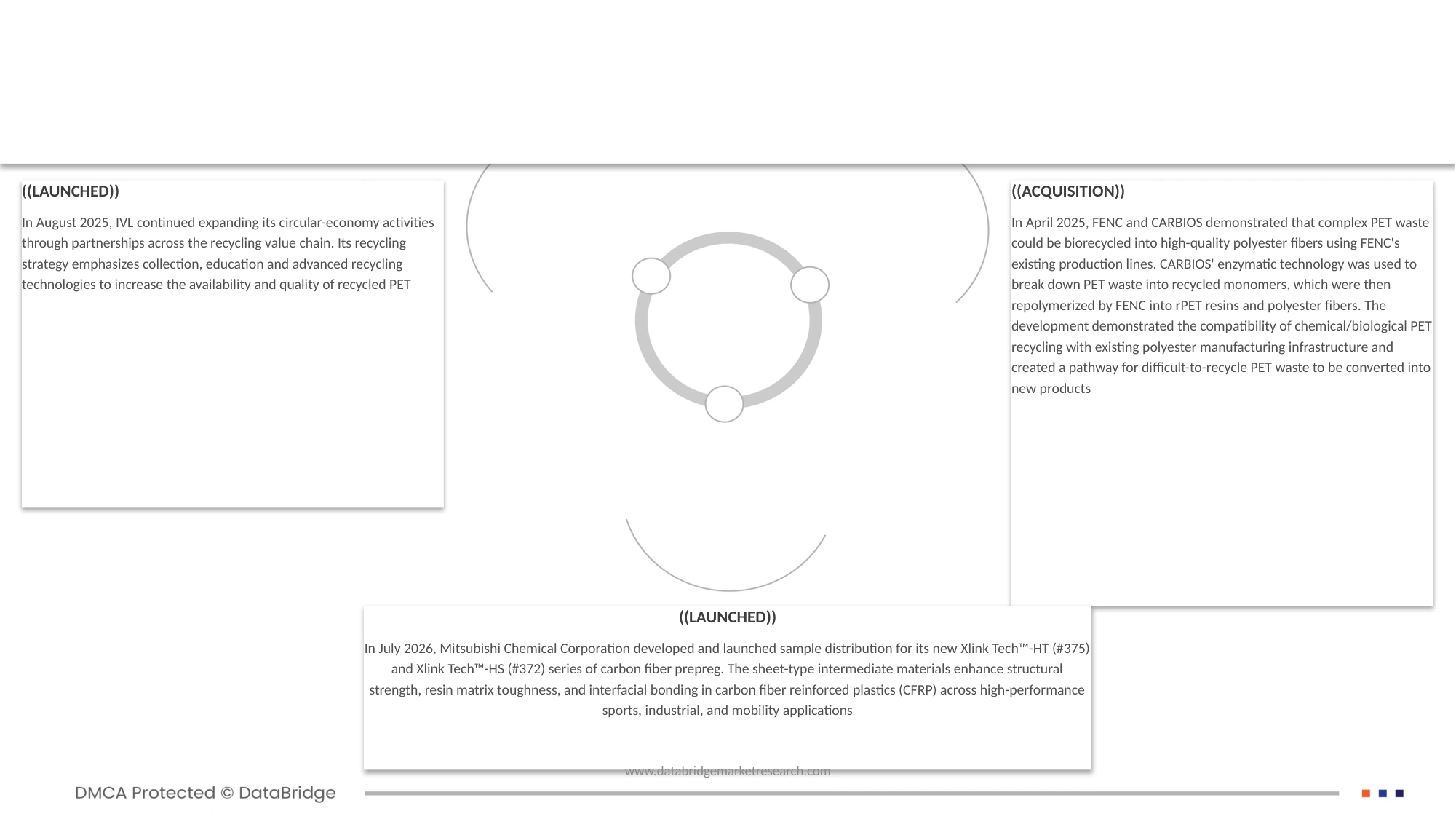
- In August 2025, IVL continued expanding its circular-economy activities through partnerships across the recycling value chain. Its recycling strategy emphasizes collection, education and advanced recycling technologies to increase the availability and quality of recycled PET..
- In April 2025, FENC and CARBIOS demonstrated that complex PET waste could be biorecycled into high-quality polyester fibers using FENC's existing production lines. CARBIOS' enzymatic technology was used to break down PET waste into recycled monomers, which were then repolymerized by FENC into rPET resins and polyester fibers. The development demonstrated the compatibility of chemical/biological PET recycling with existing polyester manufacturing infrastructure and created a pathway for difficult-to-recycle PET waste to be converted into new products.
- In July 2026, Mitsubishi Chemical Corporation developed and launched sample distribution for its new Xlink Tech™-HT (#375) and Xlink Tech™-HS (#372) series of carbon fiber prepreg. The sheet-type intermediate materials enhance structural strength, resin matrix toughness, and interfacial bonding in carbon fiber reinforced plastics (CFRP) across high-performance sports, industrial, and mobility applications.
- In April 2026, JEPLAN announced that its chemically recycled PET material "HELIX was adopted by Kirin Brewery Company for 1L PET bottles used in the "KIRIN Home Tap" draft beer delivery service. Through JEPLAN's chemical recycling technology, post-consumer PET bottles are broken down at the molecular level and purified to achieve petroleum-equivalent resin quality, enabling safe usage for carbonated alcoholic beverage containers.
- In June 2026, Toray Industries announced plans to establish a new manufacturing facility in India dedicated to producing TORELINA™ polyphenylene sulfide (PPS) resin. The expansion aims to capture surging demand for high-performance, heat-resistant engineering plastics across South Asia's automotive, electrical, and electronic manufacturing sectors.
As per Data Bridge Market Research analysis:
For more detailed information about the Asia-Pacific Recycled Plastic Market report, click here – https://www.databridgemarketresearch.com/reports/asia-pacific-recycled-plastic-market










