


Europa protectora Segmentación del mercado, por tipo de producto (Flexible, Rigid, Semi-Rigid), por material (Plástico, Paper " Paperboard, Foam, Metal, Others), por aplicación (Cushioning, Wrapping, Filling, Bloqueo " Bracing, Insulation, Others), por usuario final (Automotive (2900), Industria, Comercio (4700 Canal directo)
¿Cuál es la tasa de tamaño y crecimiento del mercado de embalaje protector de Europa
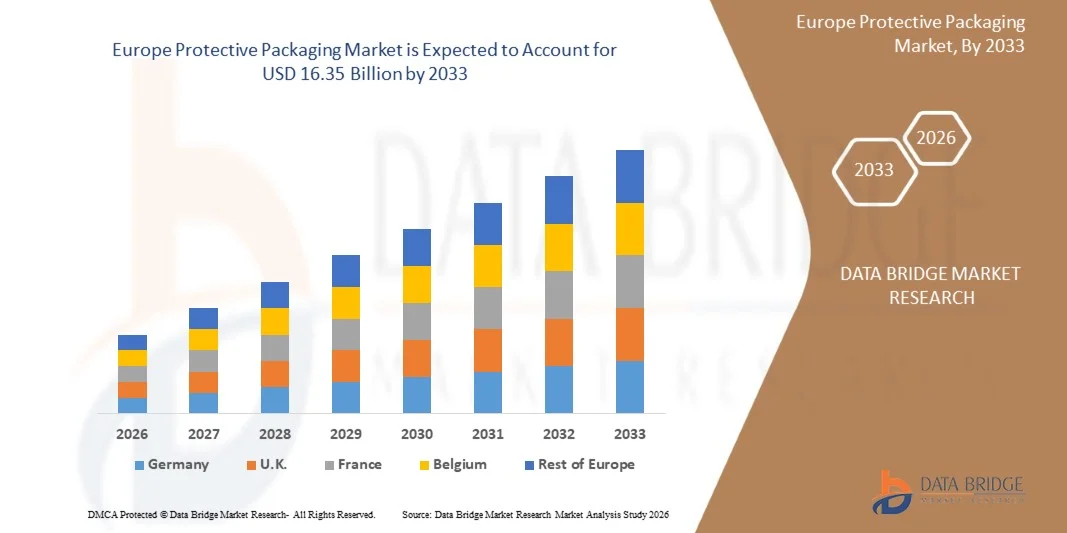
- Según Data Bridge Market Research Analysis Europe Protective Packaging Market size was valued atUSD 16.35 billion en 2033desdeUSD 10.50 billion in 2025, creciendo con unCAGR of 5.8%durante el período previsto
- El Mercado de Embalajes Protectivos de Europa está experimentando un crecimiento constante, apoyado por la fuerte demanda de industrias de uso final, como productos químicos, alimentos y bebidas, materiales de construcción y agricultura, impulsado por una mayor necesidad de manejo, almacenamiento y transporte seguros de bienes.
- El aumento de las actividades comerciales y exportadoras intraeuropeas, junto con el crecimiento del transporte a granel y la logística transfronteriza, contribuyen significativamente a la expansión de soluciones de embalaje de protección en toda la región.
Tamaño del mercado
- Valor mundial del mercado (2025):USD 16.35 billion
- Valor de mercado esperado (2033):USD 10.50 billion
- CAGR prefabricado (2026–2033):5.8%
Europe Protective Packaging Market Analysis
- El Mercado de Embalajes Protectivos de Europa está experimentando un crecimiento constante, impulsado por el aumento de la demanda de industrias como alimentos " bebidas " , productos químicos, farmacéuticos, electrónicos y productos industriales, donde la seguridad de los productos durante el almacenamiento y el transporte es crítica.
- Aumentar la adopción de soluciones logísticas avanzadas, la automatización de almacenes y las redes de distribución del comercio electrónico está acelerando la demanda de soluciones de embalaje protectoras de alto rendimiento.
- El creciente hincapié en la sostenibilidad, los materiales reciclables y el cumplimiento de las normas reglamentarias, junto con los servicios de embalaje con valor añadido, está fortaleciendo aún más el crecimiento del mercado a largo plazo.
- Alemania domina el mercado, con un 23,30% de participación en 2025, apoyado por su sólida base de fabricación, infraestructura logística avanzada y alta actividad de exportación en toda Europa.
- El segmento de embalaje protector flexible lidera el mercado, con una cuota de 66,28%, debido a su eficacia en función de costos, naturaleza ligera, facilidad de manejo y idoneidad para aplicaciones diversas.
Report Scope and Europe Protective Packaging Market Segmentation
|
Atributos |
Protective Packaging Key Market Insights |
|
Segmentos cubiertos |
|
|
Países cubiertos |
Europa
|
|
Principales jugadores del mercado |
|
|
Oportunidades de mercado |
|
|
Valor añadido Data Infosets |
Además de las ideas sobre escenarios de mercado como el valor de mercado, la tasa de crecimiento, la segmentación, la cobertura geográfica y los principales actores, los informes de mercado comisariados por el Data Bridge Market Research también incluyen análisis de exportaciones de importaciones, visión general de la capacidad de producción, análisis de consumo de producción, escenario de cambio climático, análisis de la cadena de suministro, análisis de la cadena de valor, visión general de materias primas/consumibles, criterios de selección de proveedores, análisis PESTLE Analysis, análisis, análisis de PESTLE, análisis de valores y análisis de valores. |
¿Cuál es la tendencia clave en el mercado de embalajes de protección de Europa
“Integración de Smart & Advanced Technologies”
- Tecnologías inteligentes de seguimiento, comoRFID, códigos QR y sensores habilitados para IoT están cada vez más integrados en envases protectores para permitir el seguimiento en tiempo real de los envíos, mejorar la visibilidad del inventario y reducir la pérdida o el robo durante el tránsito.
- Las soluciones de control de condiciones incorporadas en el embalaje ayudan a rastrear la temperatura, la humedad, el shock y la vibración, garantizando la integridad del producto, especialmente para productos sensibles como electrónica, farmacéutica y productos alimenticios.
- La automatización y la robótica en las líneas de embalaje están mejorando la eficiencia mejorando la velocidad de embalaje, la consistencia y la precisión, reduciendo al mismo tiempo la dependencia laboral y los costos operativos.
- Se están desarrollando materiales avanzados y sistemas inteligentes de amortiguación para proporcionar mayor resistencia al impacto, protección adaptativa y uso optimizado de materiales, apoyando objetivos de embalaje ligeros y sostenibles.
- La integración digital con sistemas logísticos y de gestión de almacenes permite la adopción de decisiones basadas en datos, el mantenimiento predictivo y la coordinación ininterrumpida en cadenas de suministro, mejorando el desempeño operacional general.
Para Instance,
- En abril de 2025, Sonoco completó la adquisición de la empresa de embalaje flexible de TC Transcontinental, mejorando sus capacidades de embalaje flexible y automatizada, un movimiento que expande la cartera de soluciones tecnológicas y de soluciones de protección de Sonoco.
- En marzo de 2024, Sealed Air firmó una alianza estratégica con DHL Supply Chain para desarrollar soluciones de embalaje de protección más sostenibles en toda la red logística global de DHL, centrándose en la eficiencia y el impacto ambiental reducido.
- En febrero de 2025, Flexible Packaging Partners completó la adquisición de New Tech Plastics, un fabricante de películas sopladas, permitiendo a la empresa ampliar la capacidad de fabricación e introducir soluciones de protección personalizadas más avanzadas para clientes de la industria.
- En noviembre de 2025, Alexander Watson Associates (AWA) anunció la adquisición de la Active & Intelligent Packaging Industry Association (AIPIA) para ampliar suembalaje inteligenteexperiencia, análisis y ofertas de servicios, fortaleciendo su posición en el espacio de embalaje inteligente/conectado.
Europe Protective Packaging Market Dynamics
Conductor
“El crecimiento del comercio internacional”
- El creciente comercio internacional aumenta la demanda de envases protectores a medida que las empresas mueven mayores volúmenes de mercancías en cadenas de suministro más largas y complejas. Los exportadores envían productos a través de múltiples puntos de manejo como puertos, almacenes, instalaciones aduaneras y centros de distribución, lo que aumenta el riesgo de impacto, vibración, compresión y exposición ambiental.
- El embalaje protector ayuda a las empresas a prevenir el daño del producto, reducir los rendimientos y mantener estándares de calidad mientras los productos viajan por mar, aire, ferrocarril y carretera a través de las fronteras. El comercio transfronterizo también impulsa a los fabricantes a cumplir con diversos requisitos de regulación, etiquetado y seguridad en diferentes países.
- Las soluciones de embalaje protectoras apoyan estas necesidades proporcionando resistencia al manipulador, control de humedad, aislamiento térmico y prevención de contaminación, especialmente para productos farmacéuticos, electrónicos, componentes automotrices y productos alimenticios.
Para Instances
- En octubre de 2024, la Organización Mundial del Comercio (OMC) revisó su pronóstico para el crecimiento del comercio mundial de mercancías en 2024 a 2,7%, un poco más de la estimación anterior del 2,6%, y al 3,0% en 2025.
- En noviembre de 2025, según la Oficina de Información de Prensa, las exportaciones totales de la India (Merchandise y Servicios combinados) para noviembre de 2025 se estiman en 73.99 mil millones de dólares, registrando un crecimiento positivo del 15,52% con respecto a noviembre de 2024.
- En noviembre de 2025, la Oficina Nacional de Estadística de Vietnam informó que la facturación comercial total se acercaba a USD 840 mil millones a finales de noviembre, hasta el 17,2% a partir de un año antes. Las exportaciones alcanzaron más de USD 430 mil millones, una ganancia del 16,1% que ya superó la cifra del año 2024.
- En noviembre de 2025, según la Oficina de Estadísticas Nacionales (ONS), el valor del comercio total del Reino Unido en los 12 meses hasta finales de septiembre de 2025 alcanzó USD 2.518.47 mil millones, hasta el 5,1% en los 12 meses anteriores.
Restraint/Challenge
“Volatilidad en materia prima”
- La volatilidad en los precios de las materias primas dificulta la demanda de envases protectores, ya que las fluctuaciones de costos frecuentes perturban los presupuestos de fabricación y las estrategias de fijación de precios. Los aumentos repentinos de los precios de la pulpa, el papel y la resina aumentan los costos de producción para los fabricantes de envases protectores, lo que los obliga a aumentar los precios de los productos para los usuarios finales.
- Muchos clientes, especialmente pequeñas y medianas empresas, responden reduciendo el uso de envases, pasando a materiales de menor calidad o retrasando las decisiones de adquisición, que suprime directamente la demanda. El precio inestable de materias primas también crea incertidumbre en las cadenas de suministro y desalienta la inversión a largo plazo en soluciones avanzadas de embalaje de protección. Los fabricantes luchan por bloquear los contratos, mantener los márgenes de ganancia y planificar la expansión de la capacidad cuando los costos de entrada cambian impredeciblemente.
- Como resultado, las empresas priorizan el control de costos sobre el rendimiento de los envases y las actualizaciones de sostenibilidad, lo que reduce la adopción de productos de embalaje de alto valor y limita el crecimiento general del mercado.
Para Instances,
- En octubre de 2024, The Times of India reportó que el papel kraft, una materia prima clave para cajas onduladas, "ropada por más del 20% en los últimos tres meses", poniendo presión de costes severas en los fabricantes de cajas onduladas.
- En febrero de 2025, el boletín sobre tiempos de pulpa y papel observó que la depreciación de la Rupia india y el aumento de los precios mundiales de la pulpa (pulula de madera blanda cotizada alrededor de USD 890/ton) aumentaron considerablemente el costo de las materias primas importadas para los fabricantes locales de papel.
- En marzo de 2021, The Economic Times informó de que los fabricantes de cajas onduladas indios se enfrentaban a una crisis de materia prima, ya que los precios del papel de Kraft habían aumentado considerablemente durante los meses anteriores, impulsados por el aumento de las exportaciones de pulpa y papel a China, ejerciendo una fuerte presión sobre los costos de los proveedores de embalaje.
- En julio de 2022, Tissue World Magazine informó que en Europa el precio del eucalipto aumentará a USD 1.380 por tonelada, mientras que en América del Norte aumentará sus precios en USD 40 por tonelada, lo que significa que el costo de una tonelada de pulpa de eucalipto será ahora USD 1.610.
Europa Protective Packaging Market Scope
El mercado mundial de embalaje de protección Europa se clasifica en cinco segmentos notables que se basan en el tipo de producto, el material, la aplicación, el usuario final, el canal de distribución.
Por tipo de producto
sobre la base del tipo de producto, el mercado mundial de embalaje de protección de Europa se segmenta en flexible, rígido, semirígido.
Se espera que el segmento flexible domine el mercado con 66.41% de cuota de mercado en 2026 y que crezca con la CAGR más alta de 6.0% debido a su adopción generalizada en las industrias del comercio electrónico, la logística y los bienes de consumo, impulsada por su naturaleza ligera, la eficiencia de los costos y la versatilidad. Soluciones de embalaje protector flexibles como almohadas de aire, envoltura de burbujas, envolturas de espuma, rellenos de papel y sobres de amortiguación ofrecen una capacidad efectiva de absorción de choque y llenado de vacío al tiempo que reducen los costos generales de peso y transporte. El rápido crecimiento de los envíos en línea al por menor y directo al consumidor ha aumentado considerablemente la demanda de embalaje flexible, ya que estos materiales son fáciles de utilizar, escalables y adaptables a los productos de formas y tamaños variables.
Por Materiales
sobre el material base, el mercado mundial de embalaje de protección de Europa se segmenta en plásticos, papel " cartón, espuma, metal, otros.
Se espera que el segmento de Plásticos domine el mercado con 40,57% de cuota de mercado en 2026 y CAGR de 6,2% debido a su durabilidad superior, versatilidad y rentabilidad en una amplia gama de aplicaciones. Materiales plásticos como polietileno (PE), polipropileno (PP), poliuretano (PU), y cloruro de polivinilo (PVC) ofrecen una excelente amortiguación, resistencia al impacto, protección de la humedad y flexibilidad, haciéndolos altamente adecuados para salvaguardar productos durante el transporte y almacenamiento. Estos materiales se utilizan ampliamente en formatos de embalaje flexibles como almohadas de aire, envoltura de burbujas y películas protectoras, así como en soluciones rígidas y semirígidas, soportando la demanda en el comercio electrónico, electrónica, automotriz, farmacéutica y sectores industriales. Los plásticos también permiten el embalaje ligero, lo que ayuda a reducir los costos de envío y mejora la eficiencia logística.
By Application
sobre la base de la aplicación, el mercado mundial de embalaje de protección Europa se segmenta en amortiguación, envolvimiento, llenado de vacío, bloqueo " bracing, aislamiento, otros.
Se espera que el segmento de Cushioning dominará el mercado con una cuota de mercado de 38,23% en 2026 y CAGR de 6,3% debido a la creciente necesidad de proteger los productos de choque, vibración y daños de impacto en cadenas de suministro cada vez más complejas. Las soluciones de limpieza se utilizan ampliamente en industrias como el comercio electrónico, la electrónica, los bienes de consumo, los productos farmacéuticos y la automoción, donde la prevención de roturas y rendimientos de productos es una prioridad crítica. La rápida expansión de los servicios de venta al por menor en línea y de entrega en casa ha aumentado considerablemente la demanda de materiales de amortiguación eficaces que pueden proteger los artículos durante múltiples etapas de manipulación y entrega de última millas. Materiales de limpieza como envoltura de burbujas, insertos de espuma, almohadas de aire y pulpa moldeada proporcionan protección adaptable para productos de diversas formas, tamaños y pesos, haciéndolos altamente versátiles y rentables.
Por fin de uso
sobre la base del usuario final, el mercado mundial de embalaje de protección de Europa se segmenta en automoción (2900), industria, comercio (retail) (4700), logística (4900), otros.
Se espera que el segmento Automotriz (2900) domine el mercado con 35.18% de cuota de mercado en 2026 y CAGR de 6.4% debido al alto valor, complejidad y sensibilidad de los componentes y sistemas automotrices que requieren una protección robusta durante el transporte y almacenamiento. Los fabricantes y proveedores automotrices manejan una amplia gama de piezas, incluyendo motores, transmisiones, módulos electrónicos, paneles corporales y componentes de precisión, todos los cuales son vulnerables a choque, vibración, humedad y corrosión. Las soluciones de embalaje protectoras tales como bandejas moldeadas, bloques de espuma, cajas onduladas y amortiguación personalizada son esenciales para prevenir daños, garantizar la integridad de los componentes y mantener operaciones de fabricación justo a tiempo. El crecimiento de los vehículos eléctricos y la electrónica automotriz avanzada ha aumentado aún más la demanda de embalaje protector especializado con propiedades de amortiguación y aislamiento mejoradas.
Por canal de distribución
sobre la base del canal de distribución, el mercado mundial de embalaje de protección de Europa se segmenta en forma directa e indirecta.
Se espera que el segmento directo domine el mercado con 65,67% de cuota de mercado en 2026 y CAGR de 5,7% debido a la creciente preferencia de los fabricantes y los grandes usuarios finales para la contratación directa de proveedores de embalaje. Los canales directos permiten una mejor personalización, un control de calidad coherente y una colaboración más estrecha entre los fabricantes de envases y las industrias de uso final, como automotriz, electrónica, farmacéutica y comercio electrónico. Mediante ventas directas, los clientes pueden obtener soluciones de embalaje de protección adaptadas para satisfacer dimensiones específicas de productos, requisitos de protección y objetivos de sostenibilidad, que son particularmente importantes para envíos de alto volumen y alto valor.
Europe Protective Packaging Market Regional Analysis
- Alemania lidera el mercado europeo con 23.30% de participación, seguido de Francia, Italia y el Reino Unido. La demanda de la región está impulsada por sectores industriales fuertes, como productos químicos, agroproductos, materiales de construcción y productos farmacéuticos, que dependen del embalaje a granel para polvos, productos secos y productos industriales.
- El crecimiento regional robusto es apoyado por el comercio intraeuropeo, la expansión de la fabricación y la adopción creciente de FIBCs y otras soluciones de embalaje protectoras para el almacenamiento y transporte eficientes a granel.
- La infraestructura industrial avanzada, las normas reglamentarias estrictas y las redes logísticas bien desarrolladas aumentan la penetración del mercado. La creciente tendencia de soluciones de valor añadido de la FIBC, la automatización de almacenes y las instalaciones especializadas de almacenamiento refuerza aún más el mercado europeo de embalajes protectores, con Alemania como el contribuyente dominante que garantiza una inversión continua y un crecimiento estable.
Alemania Europa Mercado de embalaje protector
Alemania domina el European Europe Protective Packaging Market, con una participación del 23,30% impulsada por su fuerte base industrial en productos químicos, farmacéuticos, alimentos, bebidas, construcción y agroproductos. La demanda se alimenta de los requisitos de manejo a granel para polvos, productos secos y materiales sensibles, con FIBCs, embalaje flexible y soluciones de amortiguación avanzadas ampliamente adoptadas. El país se beneficia de redes logísticas bien desarrolladas, almacenamiento moderno y normas reglamentarias estrictas, asegurando un almacenamiento y transporte seguros. Además, la tendencia creciente de los embalajes automatizados, las soluciones de protección inteligente y los servicios de valor añadido apoyan la eficiencia operacional y refuerza la posición de Alemania como el principal contribuyente al mercado europeo de embalajes de protección.
U.K Europa Protective Packaging Market Insight
El Reino Unido es uno de los principales contribuyentes del Mercado Europeo de Embalajes Protectivos, apoyado por una fuerte presencia en el comercio electrónico, farmacéuticos, alimentos, bebidas, electrónicas y bienes de consumo. La demanda está impulsada por la necesidad de un manejo seguro de productos frágiles, de alto valor y sensibles a la temperatura, con embalaje protector flexible, fibra moldeada, espumas y amortiguación basada en papel ampliamente adoptado. El Reino Unido se beneficia de infraestructuras logísticas avanzadas, volúmenes elevados de envío de paquetes y normas estrictas de seguridad y sostenibilidad. Además, la creciente adopción de materiales ecológicos, automatización y soluciones inteligentes de embalaje aumenta la eficiencia y el cumplimiento, reforzando la posición competitiva del Reino Unido dentro del entorno europeo de embalaje protector.
France Europe Protective Packaging Market Insight
Francia cuenta con el apoyo de sus industrias fuertes en productos alimenticios, farmacéuticos, cosméticos, automotriz y bienes de consumo. La demanda es impulsada por la necesidad de proteger productos frágiles, de alto valor y perecederos, con embalaje flexible, fibra moldeada, amortiguación basada en papel y soluciones de espuma ampliamente utilizadas. Francia se beneficia de una infraestructura logística bien establecida y de cadena fría, garantizando un almacenamiento y transporte seguros. Además, las estrictas normas ambientales y las iniciativas de sostenibilidad están acelerando la adopción de envases protectores reciclables, biodegradables y ecológicos. El creciente uso de la automatización, el embalaje inteligente y las soluciones personalizadas aumenta aún más la eficiencia y fortalece la contribución de Francia al mercado europeo de embalajes de protección.
Italia Europa Protective Packaging Market Insight
Italia está impulsada por su fuerte presencia en alimentos, bebidas, productos farmacéuticos, componentes automotrices, productos químicos y productos de lujo. La demanda se alimenta en gran medida de la necesidad de proteger productos frágiles, de alto valor y orientados a la exportación, en particular en el transporte a granel y a larga distancia. Los embalajes de protección flexibles, las soluciones onduladas, las espumas y la amortiguación basada en papel son ampliamente adoptados en todas las industrias. Italia se beneficia de un ecosistema manufacturero bien desarrollado, ampliando las redes logísticas y de exportación y cumpliendo con las normas de seguridad y sostenibilidad de la UE. Además, la adopción creciente de materiales ecológicos, embalajes personalizados y tecnologías automatizadas de embalaje aumenta la eficiencia y fortalece el papel de Italia en el mercado europeo de embalajes de protección.
Países Bajos Europa Protective Packaging Market Insight
Netherland está impulsada por su fuerte presencia en alimentos, bebidas, productos farmacéuticos, componentes automotrices, productos químicos y productos de lujo. La demanda se alimenta en gran medida de la necesidad de proteger productos frágiles, de alto valor y orientados a la exportación, en particular en el transporte a granel y a larga distancia. Los embalajes de protección flexibles, las soluciones onduladas, las espumas y la amortiguación basada en papel son ampliamente adoptados en todas las industrias. Italia se beneficia de un ecosistema manufacturero bien desarrollado, ampliando las redes logísticas y de exportación y cumpliendo con las normas de seguridad y sostenibilidad de la UE. Además, el aumento de la adopción de materiales ecológicos, embalajes personalizados y tecnologías automatizadas de embalaje aumenta la eficiencia y fortalece el papel de Italia en el mercado europeo de embalajes protectores
¿Cuáles son las mejores empresas de Europa Protective Packaging Market
La industria de embalaje protectora está dirigida principalmente por empresas bien establecidas, incluyendo:
- AbrisoJiffy (Países Bajos)
- ASH Automated Packaging Systems Inc. (U.S.)
- Atlas Roofing Corporation (Estados Unidos)
- BASF (Alemania)
- Paquete de caja azul (U.S.)
- Crown Holdings, Inc. (U.S.)
- Dow Inc. (U.S.)
- FlexiPack (India)
- Huhtamaki (Finlandia)
- International Paper (U.S.)
- IPG – Intertape Polymer Group (U.S.)
- Mondi Group (Reino Unido)
- NEFAB Group (Suecia)
- Novolex (U.S.
- Oasis Industries (U.S.)
- Packaging Corporation of America (Estados Unidos)
- Packman Packaging Private Limited (India)
- Packtek (Canadá)
- Pregis LLC (U.S.)
- ProAmpac (Estados Unidos)
- Pro-Pac Packaging Limited (Australia)
- Ranpak (Estados Unidos)
- Sealed Air (U.S.)
- Smurfit Westrock (Irlanda)
- Sonoco Products Company (U.S.)
- Storopack Hans Reichenecker GmbH (Alemania)
- UFP Technologies, Inc. (Estados Unidos)
- Universal Protective Packaging, Inc. (U.S.)
- Veritiv Operating Company (Estados Unidos)
Últimos desarrollos en Europa Mercado de Empaquetado Protectivo
- En septiembre de 2025, Sealed Air Corporation está promoviendo su estrategia como una tienda única para las operaciones de cumplimiento con el lanzamiento de la AUTOBAG 850HB Hybrid Bagging Machine, un nuevo sistema automatizado de embolsado diseñado para ejecutar tanto los correos de poli y papel.
- En noviembre de 2025, Smurfit Westrock inauguró el primer centro de adherencia y embalaje clínico, reforzando el papel de Irlanda en la vanguardia de la salud mundial. Más de 40 millones de euros se invirtió en el nuevo sitio, que proporcionará soluciones de embalaje para ensayos clínicos y embalajes regulados de flema.
- En septiembre de 2025, Smurfit Westrock completó su 150o proyecto Design2Market. Design2Market es el pionero proceso de desarrollo acelerado de Smurfit Westrock, dedicado a acelerar el viaje desde el diseño del producto hasta la disponibilidad en el mercado.
- En septiembre de 2024, Marigold Health Foods ha colaborado con Sonoco, líder mundial en soluciones de embalaje sostenible, para introducir una nueva solución de embalaje totalmente reciclable para una gama de productos alimenticios basados en plantas, incluyendo cubos de stock, salsas y alternativas de carne y pescado. Este innovador envase marca un avance significativo en el envase de alimentos sostenibles para consumidores e industrias por igual.
- En octubre de 2024, Sonoco introduce la última innovación en envases de papel con latas de papel totalmente reciclables 95%. Esta solución más sostenible reemplaza el fondo de metal convencional con un fondo basado en fibras, lo que hace que todo el cuerpo pueda reciclarse completamente en hogares del Reino Unido y Europa continental.
SKU-
Obtenga acceso en línea al informe sobre la primera nube de inteligencia de mercado del mundo

- Panel de análisis de datos interactivo
- Panel de análisis de empresas para oportunidades con alto potencial de crecimiento
- Acceso de analista de investigación para personalización y consultas
- Análisis de la competencia con panel interactivo
- Últimas noticias, actualizaciones y análisis de tendencias
- Aproveche el poder del análisis de referencia para un seguimiento integral de la competencia
Metodología de investigación
La recopilación de datos y el análisis del año base se realizan utilizando módulos de recopilación de datos con muestras de gran tamaño. La etapa incluye la obtención de información de mercado o datos relacionados a través de varias fuentes y estrategias. Incluye el examen y la planificación de todos los datos adquiridos del pasado con antelación. Asimismo, abarca el examen de las inconsistencias de información observadas en diferentes fuentes de información. Los datos de mercado se analizan y estiman utilizando modelos estadísticos y coherentes de mercado. Además, el análisis de la participación de mercado y el análisis de tendencias clave son los principales factores de éxito en el informe de mercado. Para obtener más información, solicite una llamada de un analista o envíe su consulta.
La metodología de investigación clave utilizada por el equipo de investigación de DBMR es la triangulación de datos, que implica la extracción de datos, el análisis del impacto de las variables de datos en el mercado y la validación primaria (experto en la industria). Los modelos de datos incluyen cuadrícula de posicionamiento de proveedores, análisis de línea de tiempo de mercado, descripción general y guía del mercado, cuadrícula de posicionamiento de la empresa, análisis de patentes, análisis de precios, análisis de participación de mercado de la empresa, estándares de medición, análisis global versus regional y de participación de proveedores. Para obtener más información sobre la metodología de investigación, envíe una consulta para hablar con nuestros expertos de la industria.
Personalización disponible
Data Bridge Market Research es líder en investigación formativa avanzada. Nos enorgullecemos de brindar servicios a nuestros clientes existentes y nuevos con datos y análisis que coinciden y se adaptan a sus objetivos. El informe se puede personalizar para incluir análisis de tendencias de precios de marcas objetivo, comprensión del mercado de países adicionales (solicite la lista de países), datos de resultados de ensayos clínicos, revisión de literatura, análisis de mercado renovado y base de productos. El análisis de mercado de competidores objetivo se puede analizar desde análisis basados en tecnología hasta estrategias de cartera de mercado. Podemos agregar tantos competidores sobre los que necesite datos en el formato y estilo de datos que esté buscando. Nuestro equipo de analistas también puede proporcionarle datos en archivos de Excel sin procesar, tablas dinámicas (libro de datos) o puede ayudarlo a crear presentaciones a partir de los conjuntos de datos disponibles en el informe.











