



Global Data Fabric Market Segmentation, By Deployment (Cloud and On-premise), By Type (Disk-based and In-memory), By Application (Fraud Detection & Security Management, Governance, Risk & Compliance Management, Customer Experience Management, Sales & Marketing Management, Business Process Management, and Others), By Enterprise Type (Large Enterprise and Small & Medium Enterprise), By Industry (BFSI, IT & Telecom, Retail & E-Commerce, Healthcare & Life Sciences, Manufacturing, Government, Energy & Utilities and Others) - Industry Trends and Forecast to 2032
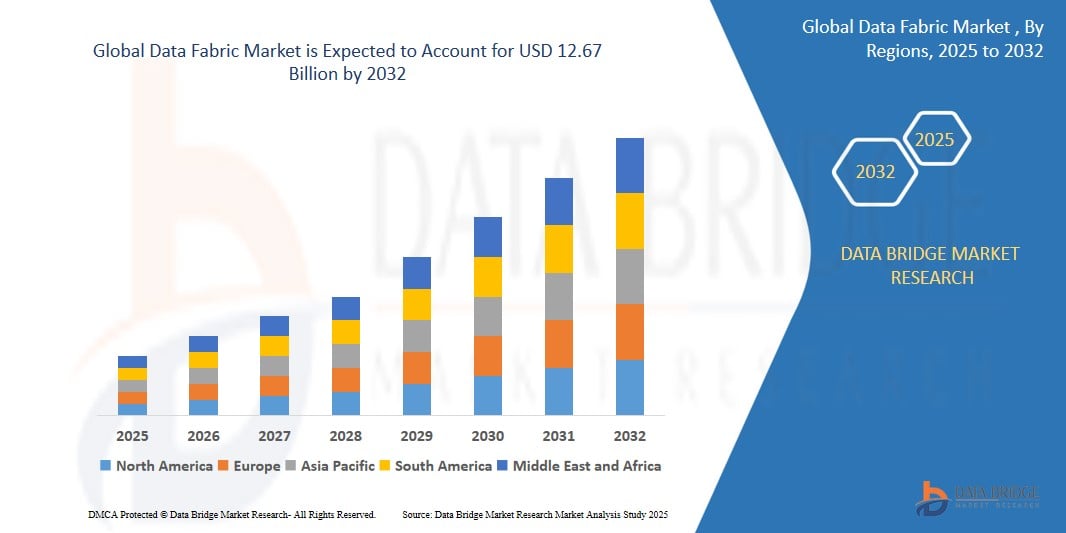
Data Fabric Market Size
- The Global Data Fabric market size was valued atUSD 2.76 billion in 2024 and is expected to reachUSD 12.67 billion by 2032, at aCAGR of 20.98%during the forecast period
- This growth is driven by factors such as the digital transformation and adoption of online platforms have fueled the data generation process
Data Fabric Market Analysis
- Data fabric is an emerging data management architecture that enables seamless access, integration, and sharing of data across diverse environments and platforms. It plays a vital role in real-time analytics, artificial intelligence, and cloud data management
- The demand for data fabric solutions is primarily driven by the rapid growth of big data, increased adoption of hybrid and multi-cloud strategies, and the need for agile and scalable data infrastructure across enterprises
- North America leads the data fabric market, largely due to the strong presence of numerous data management solution providers in the U.S. The region is recognized as an early adopter of advanced technologies. In particular, the U.S. market is driven by the growing volume of unstructured data and the concentration of data centers across the country.
- The Asia Pacific region is expected to the fastest growing region in the data fabric market during the forecast period. The rapid expansion of data centers and accelerated digital transformation across the region are key factors driving this growth. Notably, China ranks as the second-largest country globally—after the U.S.—in terms of data center adoption
- The cloud segment is expected to dominate the market in 2025 as it offers the efficiency, choice, and flexibility that enterprises need. Companies are scaling up their artificial intelligence and advanced analytics projects on the cloud, aiding them in making better data-driven decisions in progressively competitive markets.
Report Scope and Data Fabric Market Segmentation
|
Attributes |
Data Fabric Key Market Insights |
|
Segments Covered |
|
|
Countries Covered |
North America
Europe
Asia-Pacific
Middle East and Africa
South America
|
|
Key Market Players |
|
|
Market Opportunities |
|
|
Value Added Data Infosets |
In addition to the insights on market scenarios such as market value, growth rate, segmentation, geographical coverage, and major players, the market reports curated by the Data Bridge Market Research also include import export analysis, production capacity overview, production consumption analysis, price trend analysis, climate change scenario, supply chain analysis, value chain analysis, raw material/consumables overview, vendor selection criteria, PESTLE Analysis, Porter Analysis, and regulatory framework. |
Data Fabric Market Trends
“Increasing Adoption of Real-Time Data Integration and Intelligent Data Fabric Solutions”
- A significant trend in the worldwide data fabric market is the heightened focus on real-time data integration and analytical capabilities within hybrid and multi-cloud settings.
- Intelligent data fabrics, enhanced with AI and machine learning, are allowing organizations to automate processes related to data discovery, integration, and governance.
- For instance, In June 2024, IBM launched Cloud Pak for Data 5.0, introducing powerful features like Immersive Experience, Remote Data Planes, Data Product Hub, and Relationship Explorer to enhance data access, governance, and AI readiness. The update strengthened IBM’s Data Fabric architecture, which unifies data integration, governance, observability, lineage, and master data management into a single, composable platform. This allowed organizations to break data silos, improve data quality, comply with regulations, and scale AI and analytics with trusted data, ultimately boosting productivity, reducing costs, and accelerating insights across the enterprise.
- These innovations facilitate more agile decision-making, enhance customer experiences, and optimize data operations, thereby increasing the demand for advanced data fabric solutions.
Data Fabric Market Dynamics
Driver
“Rapid Expansion of Data Volumes and Complexity”
- The massive surge in data production from IoT devices, social media, enterprise applications, and cloud platforms is a key factor driving the adoption of data fabric.
- Organizations face increasing pressure to quickly extract actionable insights from large amounts of both structured and unstructured data that are often distributed across different environments.
For instance,
- In June 2023, experts predicted the global datasphere would reach up to 200 zettabytes by 2025, with healthcare leading data growth. Companies faced challenges like limited tech and expertise but saw opportunities in AI, cloud, and data lake analytics. Data fabric helped by integrating and governing massive data, enabling trusted insights. This allowed businesses to improve personalization, efficiency, and stay competitive.
- Data fabric solutions enable businesses to integrate and process complex datasets in real time, enhancing operational efficiency and speeding up innovation.
Opportunity
“Integrating AI and ML into Data Fabric Architecture”
- Incorporating AI and machine learning features into data fabric platforms is creating new opportunities in data automation, quality, and governance.
- These technologies facilitate intelligent data cataloging, anomaly detection, predictive analytics, and dynamic policy enforcement, revolutionizing data management and utilization.
For instance,
- In March 2025, an article from Data Management Review reported that AI-driven data fabrics can autonomously identify data quality problems and suggest optimal data flows, greatly decreasing the need for manual intervention.
- The inclusion of AI not only shortens the time to gain insights but also improves compliance, scalability, and flexibility, offering substantial growth opportunities in industries such as finance, healthcare, and retail
Restraint/Challenge
“Integration Complexities and Legacy Infrastructure Constraints”
- A significant hurdle in the global data fabric market is the intricate process of incorporating the solution with current legacy systems.
- Numerous organizations depend on outdated data infrastructures that are not geared for real-time processing or hybrid cloud setups, resulting in a transition that is both expensive and lengthy.
For instance,
- In January 2024 report from TechTarget highlighted that more than 60% of enterprises continue to use legacy ERP and data warehouse systems, which creates obstacles to achieving comprehensive data fabric adoption.
- Moreover, the presence of data privacy regulations and compliance issues across different regions adds to the complexity of deployment, hindering progress in industries with stringent regulatory requirements
Data Fabric Market Scope
The market is segmented on the basis deployment, type, application, enterprise type, industry .
|
Segmentation |
Sub-Segmentation |
|
By Deployment |
|
|
By Type |
|
|
By Application
|
|
|
By Enterprise Type
|
|
|
By Industry
|
|
In 2025, the cloud is projected to dominate the market with a largest share in deployment segment
The cloud segment is expected to dominate the market in 2025 as it offers the efficiency, choice, and flexibility that enterprises need. Companies are scaling up their artificial intelligence and advanced analytics projects on the cloud, aiding them in making better data-driven decisions in progressively competitive markets.
The Disk-based is expected to account for the largest share during the forecast period in type segment
Disk-based segment is likely to capture maximum market share owing to less cost of ownership and data compliance and the ever-increasing need for data integration and management across various data repositories.
Data Fabric Market Regional Analysis
“North America Holds the Largest Share in the Data Fabric Market”
- North America is at the forefront of the data fabric market, influenced by its early embrace of advanced data management solutions, strong digital infrastructure, and a plethora of leading technology companies
- U.S commands a significant share of the market due to the rising need for real-time data integration in sectors like healthcare, finance, and retail, alongside substantial investments in digital transformation projects
- The region enjoys a well-established IT ecosystem and a high density of cloud service providers, which further facilitates the implementation of scalable and flexible data fabric solutions.
- Moreover, regulatory compliance mandates such as HIPAA, GDPR, and SOX are encouraging companies to adopt data fabric platforms for secure and centralized management of data, thereby driving overall market expansion
“Asia-Pacific is Projected to Register the Highest CAGR in the Data Fabric Market”
- The Asia-Pacific region is anticipated to experience the fastest growth in the Data Fabric market, fueled by rapid digitization, increasing cloud adoption, and growing enterprise focus on real-time analytics and decision-making
- Countries such as China, India, and Japan are emerging as major contributors due to expanding IT infrastructure, rising volumes of unstructured data, and a growing emphasis on business intelligence
- Japan continues to lead in the adoption of cutting-edge data integration technologies, supported by a technologically advanced corporate sector and favourable government initiatives toward Industry 4.0
- Meanwhile, China and India are witnessing increased investments from both public and private sectors to build scalable data platforms, enhance data governance, and support digital innovation, which are key drivers of market expansion in the region
Data Fabric Market Share
The market competitive landscape provides details by competitor. Details included are company overview, company financials, revenue generated, market potential, investment in research and development, new market initiatives, global presence, production sites and facilities, production capacities, company strengths and weaknesses, product launch, product width and breadth, application dominance. The above data points provided are only related to the companies' focus related to market.
The Major Market Leaders Operating in the Market Are:
- IBM Corporation (U.S.)
- Oracle Corporation (U.S.)
- Hewlett Packard Enterprise Company (U.S.)
- SAP SE (Germany)
- NetApp, Inc. (U.S.)
- TIBCO Software Inc. (U.S.)
- Talend Inc. (U.S.)
- Denodo Technologies Inc. (U.S.)
- Cloudera, Inc. (U.S.)
- CluedIn (Denmark)
Latest Developments in Global Data Fabric Market
- In July 2024, IBM Corporation acquired StreamSets, a leading real-time data integration company. This acquisition strengthens IBM's capabilities in next-generation data fabric solutions, enabling enterprises to address fragmented data stacks, streamline integration and governance, and accelerate readiness for generative AI adoption
- In August 2024, SAP SE and Collibra expanded their partnership with native integrations to SAP Datasphere. This collaboration aims to provide trusted, governed data across enterprises, empowering users with reliable insights and supporting AI-driven decision-making in data-driven environments
- In May 2023, Talend integrated new innovations into its Data Fabric platform to provide data professionals with high-performance integrations to leading cloud intelligence platforms. The enhancements include collaborative data governance capabilities, a self-service API portal, and private connections between Microsoft Azure and Amazon AWS to ensure data security
- In March 2025, French advertising company Publicis announced its acquisition of data and ID technology group Lotame. This acquisition will integrate into Publicis' targeted marketing arm, Epsilon, doubling its individual consumer profiles to 4 billion and allowing the company to engage with 91% of all internet-using adults
- In September 2024, Oracle Corporation and Amazon Web Services (AWS) announced the launch of Oracle Database@AWS, a service that enables seamless access to Oracle Autonomous Database and Exadata Database Service within the AWS environment. This integration simplifies data migration, enhances flexibility, and supports unified data management, key components of data fabric solutions. The collaboration aims to provide enterprises with a comprehensive data architecture that facilitates real-time analytics and streamlined data operations across hybrid cloud environments.
SKU-
Obtenga acceso en línea al informe sobre la primera nube de inteligencia de mercado del mundo

- Panel de análisis de datos interactivo
- Panel de análisis de empresas para oportunidades con alto potencial de crecimiento
- Acceso de analista de investigación para personalización y consultas
- Análisis de la competencia con panel interactivo
- Últimas noticias, actualizaciones y análisis de tendencias
- Aproveche el poder del análisis de referencia para un seguimiento integral de la competencia
Metodología de investigación
La recopilación de datos y el análisis del año base se realizan utilizando módulos de recopilación de datos con muestras de gran tamaño. La etapa incluye la obtención de información de mercado o datos relacionados a través de varias fuentes y estrategias. Incluye el examen y la planificación de todos los datos adquiridos del pasado con antelación. Asimismo, abarca el examen de las inconsistencias de información observadas en diferentes fuentes de información. Los datos de mercado se analizan y estiman utilizando modelos estadísticos y coherentes de mercado. Además, el análisis de la participación de mercado y el análisis de tendencias clave son los principales factores de éxito en el informe de mercado. Para obtener más información, solicite una llamada de un analista o envíe su consulta.
La metodología de investigación clave utilizada por el equipo de investigación de DBMR es la triangulación de datos, que implica la extracción de datos, el análisis del impacto de las variables de datos en el mercado y la validación primaria (experto en la industria). Los modelos de datos incluyen cuadrícula de posicionamiento de proveedores, análisis de línea de tiempo de mercado, descripción general y guía del mercado, cuadrícula de posicionamiento de la empresa, análisis de patentes, análisis de precios, análisis de participación de mercado de la empresa, estándares de medición, análisis global versus regional y de participación de proveedores. Para obtener más información sobre la metodología de investigación, envíe una consulta para hablar con nuestros expertos de la industria.
Personalización disponible
Data Bridge Market Research es líder en investigación formativa avanzada. Nos enorgullecemos de brindar servicios a nuestros clientes existentes y nuevos con datos y análisis que coinciden y se adaptan a sus objetivos. El informe se puede personalizar para incluir análisis de tendencias de precios de marcas objetivo, comprensión del mercado de países adicionales (solicite la lista de países), datos de resultados de ensayos clínicos, revisión de literatura, análisis de mercado renovado y base de productos. El análisis de mercado de competidores objetivo se puede analizar desde análisis basados en tecnología hasta estrategias de cartera de mercado. Podemos agregar tantos competidores sobre los que necesite datos en el formato y estilo de datos que esté buscando. Nuestro equipo de analistas también puede proporcionarle datos en archivos de Excel sin procesar, tablas dinámicas (libro de datos) o puede ayudarlo a crear presentaciones a partir de los conjuntos de datos disponibles en el informe.











