


Global Motor Management Market, Por Producto (Hardware, Software & Solution Services), Tipo (Asynchronous Motors, Synchronous Motors), Control (Controles Automáticos, Controles Semi-Automáticos, Controles Manuales), Rango de voltaje (Voltaje remoto, Tensión Media, High Voltaje), Aplicación (Pumps, Compresores, Manejo de materiales, otros) Tendencias y pronósticos industriales a 2032
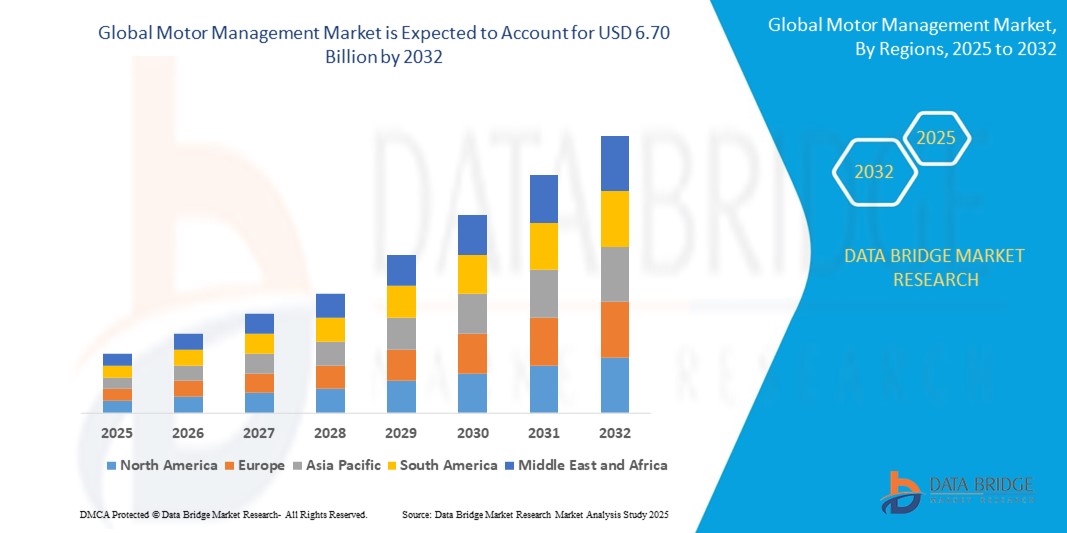
Motor Management Market Size
- The global Motor Management market size was valued atUSD 4.12 billion in 2024and is expected to reachUSD 6.70 billion by 2032, at aCAGR of 6.4%during the forecast period
- This growth is driven by factors such as Increasing demand for energy-efficient motor management systems across various industries.
Motor Management Market Analysis
- Motor management can be defined as the process of organising the motors and machineries present in a factory. This process of technology integrates the hardware of motors with modernised digital software solutions making it manageable through these systems.
- Increasing need for reducing unplanned industrial downtime is a crucial factor accelerating the market growth, also growing demand for reducing unplanned industrial downtime, increasing focus on advancing the efficiency of motor-driven equipment and preventive maintenance to avoid unplanned downtime, increasing environmental regulations hovering around the carbon emissions from generator sets and increased demands for enhanced power productivity are the major factors among others boosting the motor management market.
- North America is expected to dominate the Motor Management market due to growing demand for reducing unplanned industrial downtime and increasing focus on advancing the efficiency of motor-driven equipment and preventive maintenance to avoid unplanned downtime in this region.
- Asia-Pacific is expected to be the fastest growing region in the Motor Management market during the forecast period driven by increasing industrialization, significant investments in automation and smart manufacturing technologies
- The predictive maintenance segment is expected to dominate the Motor Management market, with a market share 37.23% during the forecast period. This segment’s growth is driven by the growing emphasis on reducing operational downtime, enhancing motor performance, and improving energy efficiency through real-time monitoring and data-driven insights
Report Scope and Motor Management Market Segmentation
|
Attributes |
Motor Management Key Market Insights |
|
Segments Covered |
|
|
Countries Covered |
North America
Europe
Asia-Pacific
Middle East and Africa
South America
|
|
Key Market Players |
|
|
Market Opportunities |
|
|
Value Added Data Infosets |
In addition to the insights on market scenarios such as market value, growth rate, segmentation, geographical coverage, and major players, the market reports curated by the Data Bridge Market Research also include import export analysis, production capacity overview, production consumption analysis, price trend analysis, climate change scenario, supply chain analysis, value chain analysis, raw material/consumables overview, vendor selection criteria, PESTLE Analysis, Porter Analysis, and regulatory framework. |
Motor Management Market Trends
“Advancements in Smart Motors & IoT Integration”
- A key trend is the integration of AI, wireless communication protocols (Zigbee, Bluetooth Mesh), and cloud-based motor management systems, allowing for real-time adaptive control of motor operations.
- These innovations enhance energy efficiency (up to 80% savings) and offer increased automation through predictive maintenance, load optimization, and remote diagnostics.
- For instance, On April 16, 2025, WEG will present its latest water management solutions at The Water Equipment Show 2025 in Telford, UK, on May 15. Highlights include IE6+ and IE5+ motors, smart drives, and digital tools designed to reduce energy use in water operations. WEG will showcase innovations like W23 Sync+, W80 AXgen motors, and the ADV200 SP solar pump drive for enhanced efficiency and sustainability.
- Such advancements are reshaping industrial operations, smart factories, and urban infrastructure, driving demand for next-generation motor control systems with predictive analytics and voice control
Motor Management Market Dynamics
Driver
“Growing Demand for Energy-Efficient Motors”
- The increasing demand for energy-efficient motors is being driven by stricter government regulations, rising energy costs, and sustainability objectives. Smart motor controls like variable frequency drives (VFDs) and automated monitoring systems can reduce electricity consumption by up to 80%, yielding significant cost savings.
- Governments worldwide are imposing stringent energy-efficiency standards (e.g., EU’s Ecodesign Directive, U.S. ENERGY STAR) to reduce carbon footprints. These regulations require the use of smart motor controls (e.g., sensors, energy management systems) in commercial and industrial applications, prompting businesses to adopt compliant systems or risk facing penalties.
- Businesses and industries are increasingly implementing these systems to comply with green building standards (e.g., LEED) and reduce operational expenses.
For instance,
- As of March 20, 2024, electric motors and motor-driven systems account for 70% of industrial electricity use. According to the IEA, 57 countries have set minimum energy performance standards for motors. The National Motor Replacement Programme (NMRP) aims to replace inefficient motors with IE3 motors. Rising demand for energy-efficient motors is driven by energy conservation, EV adoption, and stringent regulations.
- As a result, advancements in wireless controls and AI-powered motor management systems further boost adoption, making energy-efficient motor solutions a major growth driver in the market.
Opportunity
“AI-Driven Predictive Motor Management & Wireless Technologies”
- AI-driven predictive motor management, alongside wireless technologies, presents a transformative opportunity for the Motor Management Market. AI utilizes machine learning to analyze operational patterns and adjust motor performance accordingly, enhancing energy efficiency by up to 60%.
- Wireless protocols, such as Wi-Fi, Zigbee, and LoRaWAN, facilitate real-time data transmission and remote monitoring, further improving automation, operational efficiency, and energy optimization.
- These innovations are accelerating adoption in industries such as manufacturing, logistics, and smart cities, with early adopters gaining a competitive edge by implementing these cutting-edge technologies for predictive maintenance and automated operations.
For instance,
- On December 18, 2024, Renesas introduced the High-Power 10.5kW Motor Control system, combining high-power BLDC motor control with embedded AI to enhance HVAC efficiency. Designed for heat pumps, it optimizes performance through predictive maintenance and real-time data. With increasing regulatory pressure and a shift to energy-efficient, AI-driven solutions, this innovation promises to improve system reliability and sustainability in HVAC systems.
- The convergence of AI-powered motor management and wireless technologies is set to revolutionize the market, offering significant energy savings, superior connectivity, and smarter automation.
Restraint/Challenge
“High Initial Costs & Compatibility Barriers”
- The Motor Management Market faces notable growth challenges due to the high upfront investment required for advanced motor management systems, including hardware, software, and installation.
- Many motor management solutions, particularly IoT-based and AI-powered systems, involve substantial costs, making them unaffordable for small businesses or budget-conscious sectors. Additionally, the lack of standardized communication protocols leads to compatibility issues. Various systems (e.g., Zigbee, Z-Wave) often don’t integrate well with others, creating interoperability challenges.
- Companies implementing advanced motor management solutions need to invest in robust cybersecurity measures to protect their infrastructure and sensitive operational data, adding to the overall cost and complexity of deployment
For instance,
- On June 24, 2024, a survey by Luminous Power Technologies revealed that high installation costs and a shortage of skilled workforce are among the top three barriers to rooftop solar adoption in India. The survey, which included 4,318 respondents across five metro and eight non-metro cities, highlights key challenges hindering wider implementation of solar power solutions.
- This fragmentation in system interoperability hinders widespread adoption, particularly in industries with legacy motor systems. While long-term energy savings justify the investment, the immediate financial burden and technical difficulties slow decision-making in price-sensitive markets.
Motor Management Market Scope
The market is segmented on the basis product, type, control, voltage range, application, end-use industry.
|
Segmentation |
Sub-Segmentation |
|
By Product |
|
|
By Type |
|
|
By Control |
|
|
By Voltage Range |
|
|
By Application
|
|
|
By End-Use Industry |
|
In 2025, the retrofit installations is projected to dominate the market with a largest share in installation type segment
In 2025, the predictive maintenance segment is expected to dominate the Motor Management market, with a market share 37.23% during the forecast period. This segment’s growth is driven by the growing emphasis on reducing operational downtime, enhancing motor performance, and improving energy efficiency through real-time monitoring and data-driven insights.
The automatic controls microscopes is expected to account for the largest share during the forecast period in motor management market
In 2025, the automatic controls segment in the Motor Management Market is projected to lead the market with the largest share of approximately 35.23%. This growth is fueled by the increasing adoption of smart technologies, automation, and energy-efficient solutions across various industries. The integration of advanced control systems that enable real-time monitoring, predictive maintenance, and energy optimization is driving the market expansion in this segment.
Motor Management Market Regional Analysis
“North America Holds the Largest Share in the Motor Management Market”
- North America dominates the Motor Management Market, driven by the widespread adoption of smart technologies, a strong presence of leading motor management providers, and robust demand for energy-efficient solutions across commercial, industrial, and residential sectors.
- The U.S. holds a significant share due to the rapid implementation of IoT-enabled motor control systems, government initiatives promoting energy conservation, and the growing adoption of automation and smart systems in industrial applications.
- The presence of well-established infrastructure, favorable regulatory frameworks, and increasing investments in smart city and smart factory projects further strengthens the regional market.
- Additionally, the rising number of industrial facilities, commercial buildings, and ongoing renovation activities, along with the adoption of wireless and cloud-based motor control technologies, continue to drive market growth across North America America
“Asia-Pacific is Projected to Register the Highest CAGR in the Motor Management Market”
- The Asia-Pacific region is expected to register the highest growth rate in the Motor Management Market, driven by rapid industrialization, urbanization, and increasing demand for energy-efficient and automated motor control solutions across various sectors.
- Countries such as China, India, and Japan are emerging as key markets due to large-scale industrial developments, government initiatives focusing on energy efficiency, and growing demand for smart automation technologies in manufacturing and infrastructure projects.
- Japan, known for its advanced technological infrastructure, continues to lead in the adoption of intelligent motor management systems, particularly in industrial automation, transportation, and public infrastructure, enhancing energy efficiency and operational control.
- China and India, with their rapidly expanding industrial and commercial sectors, are seeing substantial investments from both the government and private sector in smart infrastructure and motor automation. The increasing presence of global motor management manufacturers and improving digital infrastructure are further boosting the region’s market growth.
Motor Management Market Share
The market competitive landscape provides details by competitor. Details included are company overview, company financials, revenue generated, market potential, investment in research and development, new market initiatives, global presence, production sites and facilities, production capacities, company strengths and weaknesses, product launch, product width and breadth, application dominance. The above data points provided are only related to the companies' focus related to market.
The Major Market Leaders Operating in the Market Are:
- BARTEC (Germany)
- Fanox (Spain)
- IAR Systems (Sweden)
- Analog Devices, Inc. (U.S.)
- Larsen & Toubro Limited (L&T) (India)
- Boston Engineering Corporation (U.S.)
- Velmex, Inc. (U.S.)
- Texas Instruments Incorporated (U.S.)
- Arm Limited (U.K.)
- Bosch Rexroth AG (Germany)
- Mitsubishi Electric Corporation (Japan)
- ABB (Switzerland)
- WEG (Brazil)
- Rockwell Automation, Inc. (U.S.)
- Nidec Motor Corporation (Japan)
- Fuji Electric Co., Ltd. (Japan)
- Anaheim Automation, Inc. (U.S.)
- Eaton (Ireland) [Note: Operational HQ in U.S., legal HQ in Ireland]
- Nanotec Electronic GmbH & Co. KG (Germany)
- Renesas Electronics Corporation (Japan)
- General Electric (GE) (U.S.)
- c3controls (U.S.)
- AMETEK, Inc. (U.S.)
- Hitachi, Ltd. (Japan)
- Schneider Electric (France)
Latest Developments in Global Motor Management Market
- On March, 2025, at ProMat Chicago, Schneider Electric unveiled the TeSys Deca Advanced contactor, featuring wide-band coil technology (24V–500V AC/DC) for enhanced motor management. Designed for Industry 4.0, it reduces energy use, CO2 emissions, and operational costs—offering digital capabilities and simplified wiring to support OEMs in optimizing material handling, packaging, and logistics machinery.
- On October 21, 2024, Siemens unveiled the SIMOCODE M-CP, an advanced motor management system tailored for motor control centers. Designed for space-efficient switchboard integration, it features flexible installation, built-in digital inputs/outputs, and scalable licensable functions. Utilizing Single Pair Ethernet (SPE) for streamlined, reliable communication, SIMOCODE M-CP reduces wiring complexity and installation costs while enhancing operational control across industries such as mining, water, chemicals, and infrastructure.
- On October 22, 2024, Feng Gao highlighted the growing role of electric motors in modern vehicles, powering systems from HVAC and seat controls to thermal management in EVs. Components like grille actuators, air vents, and BLDC motors enhance comfort, aerodynamics, and efficiency. Accurate motor control ensures optimal performance across systems, making them essential for improving vehicle functionality, especially in hybrid, electric, and luxury models.
- On December 18, 2024, Renesas introduced the High-Power 10.5kW Motor Control system, combining high-power BLDC motor control with embedded AI to enhance HVAC efficiency. Designed for heat pumps, it optimizes performance through predictive maintenance and real-time data. With increasing regulatory pressure and a shift to energy-efficient, AI-driven solutions, this innovation promises to improve system reliability and sustainability in HVAC systems.
SKU-
Obtenga acceso en línea al informe sobre la primera nube de inteligencia de mercado del mundo

- Panel de análisis de datos interactivo
- Panel de análisis de empresas para oportunidades con alto potencial de crecimiento
- Acceso de analista de investigación para personalización y consultas
- Análisis de la competencia con panel interactivo
- Últimas noticias, actualizaciones y análisis de tendencias
- Aproveche el poder del análisis de referencia para un seguimiento integral de la competencia
Metodología de investigación
La recopilación de datos y el análisis del año base se realizan utilizando módulos de recopilación de datos con muestras de gran tamaño. La etapa incluye la obtención de información de mercado o datos relacionados a través de varias fuentes y estrategias. Incluye el examen y la planificación de todos los datos adquiridos del pasado con antelación. Asimismo, abarca el examen de las inconsistencias de información observadas en diferentes fuentes de información. Los datos de mercado se analizan y estiman utilizando modelos estadísticos y coherentes de mercado. Además, el análisis de la participación de mercado y el análisis de tendencias clave son los principales factores de éxito en el informe de mercado. Para obtener más información, solicite una llamada de un analista o envíe su consulta.
La metodología de investigación clave utilizada por el equipo de investigación de DBMR es la triangulación de datos, que implica la extracción de datos, el análisis del impacto de las variables de datos en el mercado y la validación primaria (experto en la industria). Los modelos de datos incluyen cuadrícula de posicionamiento de proveedores, análisis de línea de tiempo de mercado, descripción general y guía del mercado, cuadrícula de posicionamiento de la empresa, análisis de patentes, análisis de precios, análisis de participación de mercado de la empresa, estándares de medición, análisis global versus regional y de participación de proveedores. Para obtener más información sobre la metodología de investigación, envíe una consulta para hablar con nuestros expertos de la industria.
Personalización disponible
Data Bridge Market Research es líder en investigación formativa avanzada. Nos enorgullecemos de brindar servicios a nuestros clientes existentes y nuevos con datos y análisis que coinciden y se adaptan a sus objetivos. El informe se puede personalizar para incluir análisis de tendencias de precios de marcas objetivo, comprensión del mercado de países adicionales (solicite la lista de países), datos de resultados de ensayos clínicos, revisión de literatura, análisis de mercado renovado y base de productos. El análisis de mercado de competidores objetivo se puede analizar desde análisis basados en tecnología hasta estrategias de cartera de mercado. Podemos agregar tantos competidores sobre los que necesite datos en el formato y estilo de datos que esté buscando. Nuestro equipo de analistas también puede proporcionarle datos en archivos de Excel sin procesar, tablas dinámicas (libro de datos) o puede ayudarlo a crear presentaciones a partir de los conjuntos de datos disponibles en el informe.











