


Asie-PacifiqueProduits chimiques d'utilisation finale (dihydroxyéthylène urée (DHEU), 2-imidazolidinone, polyacrylamide glycoxalisé (GPAM), acide glycoxylique, amidon glycoxal, phénol glycol résin, urée glycol glycol diformate, urée-glycol glycoxal concentré, quinoxal dérivés, éthylol glycol glycol glycol glycol glycol glycol glycol glycol glycol glycol glycol glycol glycol glycol glycol glycol glycol glycol glycol glycol glycol glycol glycol glycol glycol glycol glycol glycol glycol glycol glycol glycol glycol glycol glycol glycol glycol glycol glycol glycol glycol glycol glycol glycol glycol glycol glycol glycol glycol glycol glycol glycol glycol glycol glycol
Quelle est la taille et l'aperçu du marché du Glyoxal en Asie-Pacifique
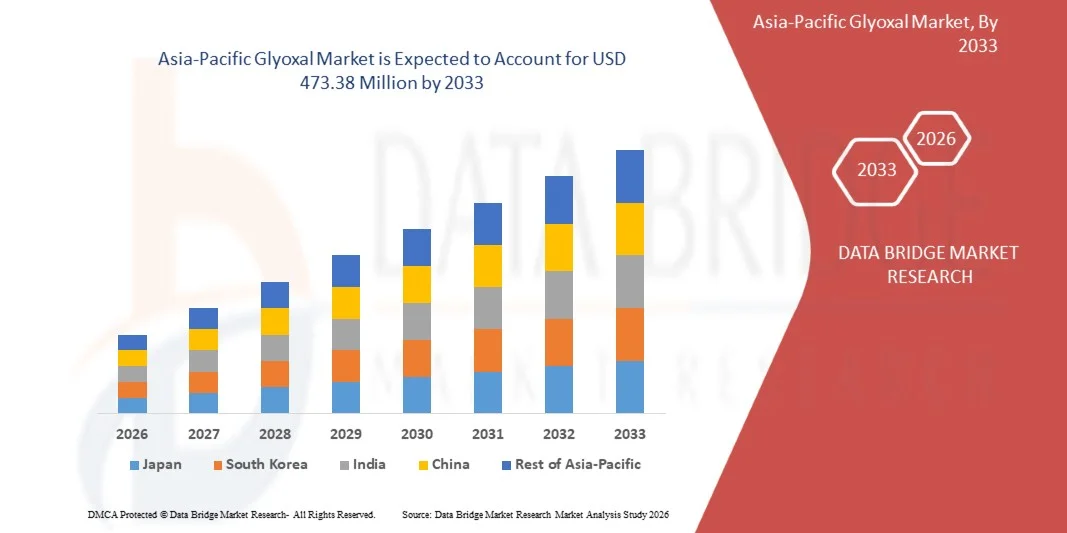
- Selon l'analyse de l'étude de marché de Data Bridge, la taille du marché du Glyoxal en Asie-Pacifique a été évaluée à274,18 millions de dollars en 2025et devrait atteindre473,38 millions de dollars en 2033, à unTCAC de 6,1 %pendant la période de prévision
- L'utilisation croissante du glyoxal en tant qu'agent de liaison dans les finitions textiles est un facteur déterminant de la demande dans toute la région.
- L'adoption croissante du papier et de l'emballage pour les applications en matière de résistance au mouillé et de traitement de surface renforce encore la portée du marché.
Taille du marché et prévisions
- Valeur marchande Asie-Pacifique (2025):274,18 millions de dollars
- Valeur marchande prévue (2033) :473,38 millions de dollars
- Prévisions CAGR (2026-2033): 6.1%
Analyse du marché du Glyoxal Asie-Pacifique
- Le marché du Glyoxal de l'Asie-Pacifique dessert diverses industries, notamment les textiles, le papier, les résines, les produits pharmaceutiques, les cosmétiques et le traitement de l'eau. La demande est motivée par ses fortes propriétés de couplage et son rôle d'intermédiaire clé dans les formulations chimiques spécialisées et performantes.
- L'augmentation des activités de finition textile, l'augmentation de la consommation d'emballages en papier et l'utilisation croissante de résines respectueuses de l'environnement sont les principaux moteurs de la demande. L'expansion de la fabrication pharmaceutique et l'application de règlements plus stricts en matière de traitement des eaux usées favorisent une consommation soutenue de glyoxal dans le monde entier.
- Le marché comprend un mélange de producteurs de produits chimiques multinationaux et de fabricants régionaux. La concurrence repose sur la pureté des produits, les qualités propres aux applications, les prix, la fiabilité de l'offre et le respect des règlements sur l'environnement et la sécurité dans les principales industries d'utilisation finale.
- La Chine domine le marché du Glyoxal en Asie et dans le Pacifique, avec une part de marché de 43,69 %, tirée par une grande capacité de fabrication, des coûts de production faibles et une disponibilité abondante de matières premières. La forte demande en aval des industries des textiles, des résines, du papier et du cuir, combinée à une chaîne d'approvisionnement chimique bien établie, renforce encore son leadership sur le marché.
- En 2025, le segment de classe industrielle devrait dominer le marché du Glyoxal de l'Asie-Pacifique avec une part de 81,39 % en raison de son utilisation généralisée dans la fabrication de résines, d'adhésifs et de produits chimiques de traitement du papier. Le segment bénéficie d'une forte demande dans les applications industrielles à grande échelle et d'un rapport coût-efficacité pour la production en vrac, ce qui en fait le choix préféré par rapport aux autres catégories.
Portée du rapport et segmentation des marchés du Glyoxal en Asie-Pacifique
|
Attributs |
Asie-Pacifique Glyoxal Principales perspectives du marché |
|
Segments couverts |
|
|
Pays couverts |
Asie-Pacifique
|
|
Principaux acteurs du marché |
|
|
Possibilités de marché |
|
|
Infos sur la valeur ajoutée |
En plus des renseignements sur les scénarios du marché tels que la valeur marchande, le taux de croissance, la segmentation, la couverture géographique et les principaux intervenants, les rapports de marché établis par Data Bridge Market Research comprennent aussi l'analyse des exportations d'importations, l'aperçu des capacités de production, l'analyse de la consommation de production, l'analyse des tendances des prix, le scénario du changement climatique, l'analyse de la chaîne d'approvisionnement, l'analyse de la chaîne de valeur, l'aperçu des matières premières et des consommables, les critères de sélection des fournisseurs, l'analyse PESTLE, l'analyse Porter et le cadre réglementaire. |
Quelle est la tendance clé du marché du Glyoxal en Asie-Pacifique
L'utilisation croissante du glyoxal comme agent de recoupement dans la finition textile.
- Glyoxal est de plus en plus utilisé comme agent de recoupement dans la finition textile en raison de sa capacité à améliorer la performance du tissu sans affecter la texture ou le confort.
- Il améliore la résistance aux rides, la stabilité dimensionnelle, la récupération des plis et les propriétés d'entretien faciles, en particulier dans les tissus à base de coton et de cellulose.
- Glyoxal est compatible avec les procédés de finition existants et rentable, ce qui en fait un choix privilégié dans la fabrication de textiles à grande échelle
- Les rapports de l'industrie (nbinno.com, Silver Fern Chemical, AlphaChem.biz, Ataman Chemicals, 2025) soulignent son rôle dans l'amélioration de la résistance aux tissus, de l'humidité et de la durabilité dans les textiles et le cuir.
- Son adoption reflète la demande de l'industrie du vêtement pour des tissus durables, résistants aux rides et faciles à entretenir, soutenant des finitions à valeur ajoutée et une qualité de produit constante.
- On s'attend à ce que le Glyoxal demeure une composante essentielle des formulations de finitions textiles, soutenant ainsi la demande sur le marché du Glyoxal de l'Asie-Pacifique.
Dynamique du marché du Glyoxal en Asie-Pacifique
Chauffeur
Demande croissante du secteur des aliments et boissons
- L'adoption du glyoxal dans le papier et l'emballage augmente en raison de sa capacité à améliorer la résistance humide, la durabilité de la surface et la performance globale des produits à base de papier.
- Il améliore la résistance à l'humidité, la stabilité dimensionnelle, l'imprimabilité et l'intégrité structurale, ce qui la rend précieuse pour les papiers d'emballage, le carton et les produits de papier spécialisés.
- Les rapports de l'industrie (ChemCeed, NBINNO.com, ivySCI, 2025) mettent en évidence le rôle des glyoxales dans l'amélioration de la résistance à l'humidité et à la sécheresse, la réduction de l'absorption d'eau et l'amélioration de la résistance à la traction dans les préparations à base de papier et d'amidon.
- Sa compatibilité avec diverses qualités de papier et les traitements de surface permet aux fabricants de produire des papiers d'emballage de haute qualité, durables et fonctionnels qui résistent aux conditions humides ou humides.
- Avec la demande croissante d'emballages fiables dans les secteurs des aliments, des biens de consommation et de l'industrie, le glyoxal devrait demeurer un agent clé pour l'amélioration de la résistance au mouillé et le traitement de surface sur le marché mondial du papier et de l'emballage.
Restriction/Défi
complexité de manipulation due à une forte réactivité et à une grande sensibilité à la stabilité
- La manipulation du glyoxal pose des défis importants en raison de sa grande réactivité chimique et de sa sensibilité aux conditions de stockage et d'environnement. Un stockage inadéquat, des fluctuations de température ou une exposition prolongée à l'air et à la lumière peuvent entraîner une polymérisation ou une dégradation, nécessitant des protocoles de sécurité stricts, des solutions de stockage spécialisées et des méthodes de transport contrôlées. Ces besoins augmentent les coûts opérationnels et exigent du personnel qualifié, en particulier dans les petites et moyennes installations de fabrication.
- Par exemple, comme l'a signalé Amzole India Pvt. Ltd. en juillet 2025, la fiche de données de sécurité pour le glyoxal 40% met l'accent sur son caractère hautement réactif et sur la nécessité d'une manipulation spécialisée pour prévenir la polymérisation, l'exposition irritante et les réactions avec des substances incompatibles telles que les oxydants forts et les bases. De même, la documentation de ChemSpider en avril 2025 souligne que le glyoxal peut réagir violemment avec l'air, l'eau et des agents chimiques comme l'hydroxyde de sodium, rendant l'entreposage contrôlé, le transport soigneux et des mesures de sécurité strictes essentielles pendant la manipulation.
- Ces complexités de manutention affectent directement les coûts d'entreposage, de transport et d'exploitation, ce qui pose des défis particuliers aux petits fabricants. Malgré ces contraintes, le glyoxal continue d'être largement utilisé dans les textiles, le papier, les adhésifs et les produits chimiques intermédiaires en raison de ses applications polyvalentes et de ses avantages fonctionnels.
- Par conséquent, une gestion soigneuse des propriétés réactives du glyoxal est essentielle pour une utilisation sûre et efficace, afin que les industries puissent tirer parti de ses avantages tout en atténuant les risques sur le marché mondial.
Étendue du marché du Glyoxal en Asie-Pacifique
Le marché est segmenté en fonction de la catégorie, de la pureté, du processus de production, de la demande d'emballage, des produits chimiques d'utilisation finale et de l'industrie de l'utilisation finale.
Par grade
Selon le grade, le marché du Glyoxal de l'Asie-Pacifique est principalement segmenté en grade industriel et en grade pharmaceutique.
En 2026, le segment des classes industrielles devrait dominer le marché, représentant 81,30 % de la part totale. Cette prédominance est attribuée à ses applications étendues dans diverses industries, y compris les textiles, le traitement du papier, les résines, le traitement du cuir et le traitement de l'eau. La consommation en volume élevée de glyoxal de qualité industrielle est également soutenue par son rapport coût-efficacité et son efficacité dans les opérations à grande échelle. En outre, l'expansion rapide des secteurs industriel et manufacturier dans la région Asie-Pacifique est à l'origine d'une demande forte et soutenue. Par conséquent, le glyoxal de qualité industrielle devrait demeurer le principal moteur de croissance sur le marché régional.
Le segment des grades pharmaceutiques du marché du Glyoxal de l'Asie-Pacifique devrait croître plus rapidement de 2026 à 2033, en raison de l'augmentation de la demande en synthèse pharmaceutique, des exigences réglementaires rigoureuses pour les produits chimiques à haute pureté et de l'expansion des applications spécialisées et de fabrication de médicaments de pointe. Ces facteurs stimulent l'adoption du glyoxal de haute qualité dans les IPA et les formulations pharmaceutiques innovantes.
Par pureté
Sur la base de la pureté, le marché du Glyoxal de l'Asie-Pacifique est segmenté en 90%–99%, 40%–60%, et autres.
D'ici 2026, le segment de pureté de 40% à 60% devrait dominer le marché, représentant 72,34% de la part totale. Ce segment est attribué à sa performance supérieure, à sa réactivité et à son aptitude à des applications avancées dans les domaines pharmaceutique, des résines spécialisées, des textiles et des cosmétiques. Sa qualité constante, ainsi que le respect de normes strictes de l'industrie, stimule une demande forte et soutenue. De plus, l'équilibre entre efficacité et rentabilité rend cette gamme de pureté hautement préférée par les fabricants. Par conséquent, le segment de la pureté de 40 à 60 % devrait demeurer le principal facteur de croissance du marché du Glyoxal de l'Asie-Pacifique.
Le segment de la pureté de 90 à 99 % sur le marché du Glyoxal de l'Asie-Pacifique devrait connaître la croissance la plus rapide de 2026 à 2033, en raison de son utilisation généralisée dans le secteur de l'eau.pharmaceutiqueet les applications chimiques spécialisées qui nécessitent le glyoxal à haute pureté, ainsi que la demande croissante de formulations de médicaments de pointe et de procédés de production conformes à la réglementation.
Par procédé de production
Sur la base du processus de production, le marché du Glyoxal de l'Asie-Pacifique est segmenté en oxydation catalytique de l'éthylène glycol, oxydation de l'acétylène et d'autres.
D'ici 2026, l'oxydation catalytique du segment de l'éthylène glycol devrait dominer le marché, représentant 89,61 % de la part totale. La dominance de ce segment est due à une plus grande efficacité de production, à un meilleur contrôle des rendements et à des niveaux d'impureté plus faibles par rapport aux procédés à base d'acétylène. De plus, il offre une meilleure sécurité et est plus respectueux de l'environnement, ce qui le rend très adapté pour la fabrication à grande échelle. La rentabilité et l'évolutivité de cette méthode renforcent encore sa préférence parmi les fabricants. En conséquence, la voie d'oxydation catalytique est prête à rester le principal moteur de la croissance du marché du Glyoxal Asie-Pacifique.
L'oxydation du segment des procédés de production d'acétylène dans le marché du Glyoxal de l'Asie-Pacifique devrait connaître la croissance la plus rapide entre 2026 et 2033, grâce à sa capacité à produire du glyoxal à haute pureté adapté aux applications pharmaceutiques et chimiques spécialisées, ainsi qu'à la demande croissante de formulations de médicaments de pointe et au respect de normes strictes en matière de qualité et de réglementation.
Par emballage
Sur la base de l'emballage, le marché du Glyoxal Asie-Pacifique est segmenté en tambours, GRV composite, Bulk, Jerrycans et bouteilles.
D'ici 2026, le segment des bouteilles devrait dominer le marché, représentant 38,28 % de la part totale. Cette dominance est attribuée à sa polyvalence, à sa facilité de manipulation et à son stockage sûr, en particulier pour les applications de petite quantité. Les bouteilles sont particulièrement adaptées aux usages pharmaceutiques, cosmétiques et chimiques spécialisés, où la précision et la sécurité sont essentielles. De plus, leur grande disponibilité et leur production rentable favorisent une forte adoption dans toutes les industries. La commodité et la fiabilité de l'emballage en bouteille en font un choix privilégié pour les fabricants et les utilisateurs finaux.
Le segment de l'emballage composite IBC de l'Asie-Pacifique Glyoxal devrait connaître la croissance la plus rapide de 2026 à 2033, en raison de son efficacité dans le stockage et le transport de produits chimiques en vrac, de l'amélioration de la sécurité et de la résistance chimique, et de la demande croissante des utilisateurs pharmaceutiques, chimiques spécialisés et industriels qui ont besoin de solutions d'emballage fiables et de grande capacité.
Par demande
Sur la base de l'emballage, le marché du Glyoxal Asie-Pacifique est segmenté en tambours, GRV composite, Bulk, Jerrycans et bouteilles.
En 2026, le segment des bouteilles devrait dominer le marché, représentant 64,31 % de la part totale. Cette dominance est attribuée à sa polyvalence, à sa facilité de manipulation et à son stockage sûr, en particulier pour les applications de petite quantité. Les bouteilles sont particulièrement adaptées aux usages pharmaceutiques, cosmétiques et chimiques spécialisés, où la précision et la sécurité sont essentielles. De plus, leur grande disponibilité et leur production rentable favorisent une forte adoption dans toutes les industries. La commodité et la fiabilité de l'emballage en bouteille en font un choix privilégié pour les fabricants et les utilisateurs finaux.
Le segment d'application des produits chimiques intermédiaires dans le marché du Glyoxal de l'Asie-Pacifique devrait connaître la croissance la plus rapide de 2026 à 2033, en raison de la demande croissante de résines, de polymères et de produits chimiques spécialisés, de l'expansion de l'industrie chimique et de l'utilisation du glyoxal comme intermédiaire polyvalent et réactif dans les applications industrielles et spécialisées.
Par produits chimiques d'utilisation finale
Sur la base des produits chimiques d'utilisation finale, le marché du Glyoxal de l'Asie-Pacifique est segmenté en urée de dihydroxyéthylène (DHEU), 2-imidazolidinone, polyacrylamide glycoxalisé (GPAM), acide glycoxylique, amidon glycoxalisé, résine de phénol glycyoxal, résine d'urée glycyoxale, éthylène glycol diformate, concentré d'urée-glycol, dérivés de quinoxaline, glycylol glycéroxal, glycéroxal-Bis(2-Hydroxyanil), glycéroxal sodique bisulfite, quinoxaline, 2-méthylimidazole, imidazole, glycoluril, allantoïne et tétraméthylol acétylendiurée.
D'ici 2026, le segment du Dihydroxyéthylène urée (DHEU) devrait dominer le marché, représentant 17,79 % de la part totale. Sa domination est déterminée par sa grande applicabilité à la finition textile, au traitement du papier et à la fabrication de résines. Le segment bénéficie d'une forte réactivité, d'une performance constante et d'une compatibilité avec divers processus industriels. De plus, la demande croissante de textiles de haute qualité et de produits chimiques spécialisés dans la région Asie-Pacifique soutient sa position sur le marché. Le rapport coût-efficacité et l'efficacité renforcent encore sa préférence parmi les fabricants et les utilisateurs finals.
Le segment 2-Imidazolidinone des produits chimiques d'utilisation finale dans le marché du Glyoxal de l'Asie-Pacifique devrait connaître la croissance la plus rapide de 2026 à 2033, en raison de son utilisation croissante dans les produits pharmaceutiques, les produits agrochimiques et les applications chimiques spécialisées. Sa croissance est alimentée par la demande croissante de glyoxal à haute pureté en tant qu'intermédiaire clé dans la synthèse du 2-imidazolidinone pour les formulations avancées et la production chimique conforme à la réglementation.
Par utilisateur final
Sur la base de l'utilisateur final, le marché du Glyoxal Asie-Pacifique est segmenté en textiles, pâtes et papiers, cuir, peintures et revêtements, traitement de l'eau, produits pharmaceutiques, produits ménagers,Produits cosmétiqueset soins personnels, emballage, électricité et électronique, pétrole et gaz, et autres.
D'ici 2026, le segment textile devrait dominer le marché, représentant 33,55 % de la part totale. Cette croissance est due à son utilisation généralisée dans les finitions de tissus, la résistance aux rides et les traitements anti-plis. La demande croissante de textiles durables et de haute qualité, conjuguée à l'expansion rapide des industries de l'habillement et de l'ameublement domestique, soutient davantage la croissance du marché. De plus, l'augmentation de la préférence des consommateurs pour les tissus haut de gamme et de longue durée stimule l'adoption de solutions à base de glyoxal. En conséquence, le segment textile est sur le point de rester le principal contributeur du marché du Glyoxal Asie-Pacifique.
Le segment des utilisateurs finals de pâtes et papiers dans le marché du Glyoxal de l'Asie-Pacifique devrait connaître la croissance la plus rapide de 2026 à 2033, en raison de la demande croissante de résines à résistance humide et d'additifs chimiques qui améliorent la durabilité et la qualité du papier. La croissance est soutenue par l'expansion de l'industrie du papier et de l'emballage et le passage à des produits de papier durables et performants.
Analyse régionale du marché du Glyoxal en Asie et dans le Pacifique
- En 2026, la Chine devrait dominer le marché du Glyoxal de l'Asie-Pacifique, représentant 43,88 % du chiffre d'affaires total. Ce leadership est motivé par une industrialisation rapide, une forte demande des industries du textile et du papier, et le pays possède une infrastructure de fabrication de produits chimiques bien établie.
- L'Inde connaît une croissance rapide en raison de l'augmentation de la production de textiles et de papier, de l'expansion des applications industrielles et de l'augmentation des investissements dans la fabrication de produits chimiques et les procédés de finition à valeur ajoutée.
- Le Japon connaît une croissance en raison des technologies de fabrication de produits chimiques de pointe, de la forte demande de produits chimiques spécialisés et de l'adoption du glyoxal dans les industries des textiles, du papier et des revêtements.
- La Corée du Sud connaît une croissance en raison de sa forte base industrielle, de l'utilisation croissante du glyoxal dans les textiles, le papier et les adhésifs, et de l'accent mis sur les applications chimiques à haute performance et à valeur ajoutée.
Inde Asie-Pacifique Glyoxal Market Insight
L'Inde connaît une croissance rapide sur le marché du Glyoxal Asie-Pacifique en raison de l'expansion de la production de textiles et de papier et de l'augmentation des applications industrielles. Les investissements croissants dans la fabrication de produits chimiques et les procédés de finition à valeur ajoutée favorisent une adoption accrue. La demande de tissus durables et faciles à entretenir et de produits en papier à haute performance est à l'origine de l'expansion du marché. Comme les industries se concentrent sur l'efficacité et la qualité, le marché du Glyoxal de l'Asie-Pacifique devrait poursuivre sa trajectoire ascendante.
Japon Asie-Pacifique Glyoxal Market Insight
Japon Le marché du Glyoxal Asie-Pacifique connaît une croissance stimulée par des technologies de fabrication de produits chimiques de pointe et une forte demande de produits chimiques spécialisés. L'adoption du glyoxal dans les textiles, le papier, les revêtements et les adhésifs soutient diverses applications industrielles. L'accent mis sur les produits chimiques à haute performance et à valeur ajoutée favorise le développement du marché. L'innovation continue et le progrès technologique devraient soutenir la croissance du marché japonais.
Les principaux leaders du marché sont :
- Asis Scientific Pty Ltd (Australie)
- Ataman Chemicals (Inde)
- BASF SE (Allemagne)
- Bidvest Chemical (Afrique du Sud)
- Bisley Asia (M) Sdn Bhd (Malaisie)
- Eastman Chemical Company (États-Unis)
- Fluorochem Limited (Royaume-Uni)
- Fujifilm Wako Pure Chemical Corporation (Japon)
- Glentham Life Sciences Limited (Royaume-Uni)
- GetChem Co., Ltd. (Chine)
- Hanna Instruments Ltd (États-Unis)
- Laboratoires Himedia (Inde)
- Kanto Kagaku (Japon)
- Kemira Oyj (Finlande)
- Merck KGaA (Allemagne)
- Meru Chem Pvt. Ltd (Inde)
- Muby Chemicals (Inde)
- Multichem Specialities Private Limited (Inde)
- Oakwood Products Inc. (États-Unis)
- Otto Chemie Pvt. Ltd (Inde)
- Oxford Lab Fine Chem LLP (Inde)
- Santa Cruz Biotechnology Inc. (États-Unis)
- Sasol (Afrique du Sud)
- Silver Fern Chemical, Inc. (États-Unis)
- Thermo Fisher Scientific Inc. (États-Unis)
- Univar Solutions LLC (États-Unis)
- Weylchem International GmbH (Allemagne)
- Zhishang Chemical (Chine)
Les derniers développements du marché du Glyoxal en Asie-Pacifique
- En juin 2022, Univar Solutions a été nommé distributeur exclusif de BASF. Ce partenariat vise à fournir aux clients des industries du textile, de la désinfection, du papier, du cuir, des cosmétiques et de l'époxy un accès fiable au Glyoxal BASF, un agent de couplage biodégradable qui améliore la flexibilité, la viscosité, les propriétés antirides, l'adoucissement et la résistance à l'humidité dans diverses formulations. Cette collaboration aidera BASF à renforcer sa présence sur le marché nord-américain en tirant parti des capacités étendues du réseau de distribution et de la chaîne d'approvisionnement Univar Solutions, assurant ainsi une plus grande portée et une livraison fiable de Glyoxal aux clients.
- En janvier, Merck KGaA a annoncé l'achèvement de son acquisition de l'activité chimique de Mecaro, actuellement exploitée sous le nom de M Chemicals Inc. Cette acquisition a élargi les capacités de recherche et de développement de Merck ainsi que les installations de production, renforçant son portefeuille de matériaux précurseurs à semi-conducteurs et de produits chimiques électroniques. Bien qu'il représente une croissance stratégique dans l'industrie chimique Merck, l'acquisition n'est pas liée aux produits glyoxaux (glycoxyl), car l'accent demeure mis sur les matériaux avancés pour l'industrie des semi-conducteurs et de l'électronique plutôt que sur la chimie de l'aldéhyde spécialisé.
- En décembre 2025, Thermo Fisher Scientific Inc. a annoncé le lancement de deux nouveaux produits Gibco Bacto CD Supreme FPM Plus et Gibco Bacto CD Supreme Feed (2X) qui étendent l'entreprise Gibco Bacto CD ligne de médias chimiquement définis pour améliorer et simplifier les flux de production de la biofabrication Escherichia coli (E. coli). Ces formulations définies chimiquement de prochaine génération sont conçues pour soutenir des rendements plus élevés, des performances constantes et une production évolutive d'ADN plasmidique et de protéines recombinantes, en particulier pour des applications dans la thérapie génique et le développement de vaccins contre l'ARNm.
- En mai 2025, Alpha Chemika a élargi son portefeuille de réactifs de laboratoire et de produits chimiques fins en introduisant des produits de qualité AR/GR/LR supplémentaires et des produits chimiques de laboratoire spécialisés diversifiés pour soutenir des applications de recherche analytique, pharmaceutique et des sciences de la vie, renforçant ainsi son engagement à répondre à l'évolution de la recherche mondiale et de la demande industrielle.
SKU-
Accédez en ligne au rapport sur le premier cloud mondial de veille économique

- Tableau de bord d'analyse de données interactif
- Tableau de bord d'analyse d'entreprise pour les opportunités à fort potentiel de croissance
- Accès d'analyste de recherche pour la personnalisation et les requêtes
- Analyse de la concurrence avec tableau de bord interactif
- Dernières actualités, mises à jour et analyse des tendances
- Exploitez la puissance de l'analyse comparative pour un suivi complet de la concurrence
Table des matières
1 INTRODUCTION
1.1 OBJECTIFS DE L'ÉTUDE
1.2 DÉFINITION DU MARCHÉ
1.3 APERÇU DU MARCHÉ GLYOXIQUE ASIE-PACIFIQUE
1.4 LIMITATIONS
1.5 MARCHÉS COUVERTS
2 SEGMENTATION DU MARCHÉ
2.1 MARCHÉS COUVERTS
2.2 CHAMP D'APPLICATION GÉOGRAPHIQUE
2.3 ANS CONSIDÉRÉS POUR L'ÉTUDE
2.4 MONNAIE ET PRÊT
2.5 MODÈLE DE VALIDATION DES DONNÉES DU TRIPOD DBMR
2.6 MODÉLISATION MULTIVARIÉE
2.7 TYPE DE PRODUITS CURVÉE EN LIGNE
2.8 INTERVIEWS PRIMAIRES AVEC LES PRINCIPAUX DIRECTEURS DE L'AVIS
2.9 GRID DE POSITION DU MARCHÉ DBMR
2.1 GRID DE COUVERTURE DES UTILISATEURS DU MARCHÉ
2.11 SOURCES SECONDAIRES
2.12 OBSERVATIONS
3 RÉSUMÉ
4 PRIMAIRES
4.1 MARCHÉ GLYOXIQUE ASIE-PACIFIQUE: ANALYSE DE LA CHAINE DE VALEUR
4.1.1 MATÉRIEL RAW ET DÉCHETS D'APPROVISIONNEMENT (5 à 10 %)
4.1.2 FABRICATION ET TRAITEMENT (15 % à 25 %)
4.1.3 DISTRIBUTION ET LOGISTIQUE (30% à 40% PARTAGE DE VALEUR)
4.1.4 INDUSTRIES ET CHANEAUX DE VENTE D'USAGE FIN (10 à 20 %)
4.2 ANALYSE DE LA CHAINE D'APPROVISIONNEMENT
4.2.1 SOURCES ET MARCHÉS DES MATÉRIAUX RÉVISÉS
4.2.2 TRAITEMENT ET FABRICATION DES PRODUITS (PRODUCTION)
4.2.3 LOGISTIQUE DE LA CHAINE DE DÉPÔT ET DE LA DISTRIBUTION (TRANSPORTATION)
4.2.4 CHANEAUX D'ACHETS ET D'ACHETS COMMERCIAUX (DISTRIBUTION ET VENTES)
4.3 ANALYSE DES CINQ FORCES
4.3.1 POUVOIR D'ACHETS / CONSOMMATEURS D'ACHETS – HAUTE
4.3.2 MENACES DES NOUVEAUX ENTRANTS – MOINS À MODÉRER
4.3.3 MENACES DES PRODUITS SUBSTITUTAIRES – MODÈLE À HAUTE
4.3.4 POUVOIR DE FABRICATION DES FOURNISSEURS – MODÉRAT
4.3.5 INTENSITÉ DE LA RIVALISATION COMPÉTITIVE – HAUTE
5 APERÇU DU MARCHÉ
5.1 RÉFÉRENCES
5.1.1 UTILISATION RISQUE DU GLYOXAL EN TEXTILAGE
5.1.2 ADOPTION DE LA CROISSANCE DANS LE PAPIER ET L' EMBALLAGE POUR LES DEMANDES DE TRAITEMENT DE LA STRANGE ET DE LA SURFACE.
5.1.3 EXPANSION DE LA DEMANDE CHIMIQUE INTERMÉDIAIRE DANS LES PHARMACEUTIQUES ET LES AGROCHEMIQUES.
5.1.4 RENFORCEMENT DE LA PRÉFÉRENCE POUR LES ALDEHYDES DE POISSANCE MOLÉCULAIRE INFÉRIEURES DANS LES SYSTÈMES DE RÉSINE ET D'ADHÉSIF.
5.2 RÉSULTATS
5.2.1 COMPLEXITÉ MAINTENANTE DUE À LA HAUTE RÉACTIVITÉ ET SENSIBILITÉ
5.2.2 DISPONIBILITÉ DES SUBSTITATS CHIMIQUES SPÉCIFIQUES D'APPLICATION.
5.3 POSSIBILITÉ
5.3.1 VOLATILITÉ DANS LES FRAIS PRIVANT LA STRUCTURE DES COÛTS
5.3.2 RÈGLEMENT SUR LA SÉCURITÉ ENVIRONNEMENTALE ET PROFESSIONNELLE.
5.3.3 DIFFÉRENCE DES PRODUITS LIMITÉS SUR UN MARCHÉ COMPÉTITIVE DES PRIX
5.4 DÉFIS
5.4.1 DÉVELOPPEMENT DE GRADES GLYOXIQUES MODIFIÉS ET D'APPLICATION SPÉCIFIQUES.
5.4.2 DEMANDE D'ÉMERGAGE D'ÉCONOMIES INDUSTRIELLES
6 MARCHÉ GLYOXIQUE ASIE-PACIFIQUE, PAR GRADE
6.1 Aperçu général
6.2 GRADE INDUSTRIELLE
6.3 GRADE PHARMACEUTIQUE
6.4 MARCHÉ GLYOXIQUE ASIE-PACIFIQUE, PAR GRADE, 2018-2033
6.4.1 GRADE INDUSTRIELLE
6.4.2 GRADE PHARMACEUTIQUE
6.5 GRADE INDUSTRIELLE ASIE-PACIFIQUE SUR LE MARCHÉ GLYOXAL, PAR RÉGION, 2018-2033 (MILLIERS USD)
6.5.1 ASIE-PACIFIQUE
6.5.2 AMÉRIQUE DU NORD
6.5.3 L'EUROPE
6.5.4 MOYEN-ORIENT ET AFRIQUE
6.5.5 AMÉRIQUE DU SUD
6.6 GRADE PHARMACEUTIQUE ASIE-PACIFIQUE SUR LE MARCHÉ GLYOXAL, PAR RÉGION, 2018-2033 (en MILLE USD)
6.6.1 ASIE-PACIFIQUE
6.6.2 AMÉRIQUE DU NORD
6.6.3 L'EUROPE
6.6.4 MOYEN-ORIENT ET AFRIQUE
6.6.5 AMÉRIQUE DU SUD
7 MARCHÉ GLYOXIQUE ASIE-PACIFIQUE, PAR PURITÉ
7.1 Aperçu général
7.1.1 40%-60%
7.1.2 90%-99%
7.1.3 AUTRES
7.2 ASIE-PACIFIQUE 40 %-60 % SUR LE MARCHÉ GLYOXAL, PAR RÉGION, 2018-2033 (en MILLE)
7.2.1 ASIE-PACIFIQUE
7.2.2 AMÉRIQUE DU NORD
7.2.3 L'EUROPE
7.2.4 MOYEN-ORIENT ET AFRIQUE
7.2.5 AMÉRIQUE DU SUD
7.3 ASIE-PACIFIQUE 90 %-99% SUR LE MARCHÉ GLYOXAL, PAR RÉGION, 2018-2033 (en MILLIERS)
7.3.1 ASIE-PACIFIQUE
7.3.2 AMÉRIQUE DU NORD
7.3.3 L'EUROPE
7.3.4 MOYEN-ORIENT ET AFRIQUE
7.3.5 AMÉRIQUE DU SUD
7.4 AUTRES ASIE-PACIFIQUES SUR LE MARCHÉ GLYOXAL, PAR RÉGION, 2018-2033 (MILLIERS USD)
7.4.1 ASIE-PACIFIQUE
7.4.2 AMÉRIQUE DU NORD
7.4.3 L'EUROPE
7.4.4 MOYEN-ORIENT ET AFRIQUE
7.4.5 AMÉRIQUE DU SUD
8 MARCHÉ GLYOXIQUE ASIE-PACIFIQUE, PAR PROCESSUS DE PRODUCTION
8.1 Aperçu général
8.1.1 OXYDATION CATALYTIQUE DU GLYCOL D'ÉTHYLÈNE
8.1.2 OXIDATION DE L'ACÉTYLÈNE
8.1.3 AUTRES
8.2 OXYDATION CATALYTIQUE ASIE-PACIFIQUE DU GLYCOL DE L'ÉTHYLÈNE SUR LE MARCHÉ GLYOXAL, PAR RÉGION, 2018-2033 (en millions de dollars)
8.2.1 ASIE-PACIFIQUE
8.2.2 AMÉRIQUE DU NORD
8.2.3 L'EUROPE
8.2.4 MOYEN-ORIENT ET AFRIQUE
8.2.5 AMÉRIQUE DU SUD
8.3 OXIDATION ASIE-PACIFIQUE DE L'ACÉTYLÈNE SUR LE MARCHÉ GLYOXAL, PAR RÉGION, 2018-2033 (en MILLIERS DE USD)
8.3.1 ASIE-PACIFIQUE
8.3.2 AMÉRIQUE DU NORD
8.3.3 L'EUROPE
8.3.4 MOYEN-ORIENT ET AFRIQUE
8.3.5 AMÉRIQUE DU SUD
8.4 AUTRES ASIE-PACIFIQUES SUR LE MARCHÉ GLYOXAL, PAR RÉGION, 2018-2033 (MILLIERS USD)
8.4.1 ASIE-PACIFIQUE
8.4.2 AMÉRIQUE DU NORD
8.4.3 L'EUROPE
8.4.4 MOYEN-ORIENT ET AFRIQUE
8.4.5 AMÉRIQUE DU SUD
9 MARCHÉ GLYOXIQUE ASIE-PACIFIQUE, PAR EMBALLAGE
9.1 Aperçu général
9.2 DRUMS
9.3 GRV COMPOSITE
9.4 BULK
9.5 JERRYCANS
9.6 BOITE
9.7 DRUMES ASIE-PACIFIQUES SUR LE MARCHÉ GLYOXAL, PAR TYPE, 2018-2033 (en milliers de dollars)
9.7.1 DRUMS PLASTIQUES (HDPE)
9.7.2 DRUMS DURABLES
9.7.3 DRUMS INSIDES DE LINERS
9.7.4 DRUMES AVEC COMPATIBILITÉ CHIMIQUE
9.7.5 DRUMS OUVERTS
9.8 DRUMES ASIE-PACIFIQUES SUR LE MARCHÉ GLYOXAL, PAR RÉGION, 2018-2033 (en MILLIERS USD)
9.8.1 ASIE-PACIFIQUE
9.8.2 AMÉRIQUE DU NORD
9.8.3 L'EUROPE
9.8.4 MOYEN-ORIENT ET AFRIQUE
9.8.5 AMÉRIQUE DU SUD
9.9 GRV COMPOSITIFS ASIE-PACIFIQUES SUR LE MARCHÉ GLYOXAL, PAR TYPE, 2018-2033 (en milliers d'USD)
9.9.1 GRV COMPOSITIFS
9.9.2 GRV RIGIDE
9.9.3 GRV AVEC INSULATION
9.9.4 AUTRES
9.1 GRV COMPOSITIQUE ASIE-PACIFIQUE SUR LE MARCHÉ GLYOXAL, PAR RÉGION, 2018-2033 (en milliers de dollars)
9.10.1 ASIE-PACIFIQUE
9.10.2 AMÉRIQUE DU NORD
9.10.3 EUROPE
9.10.4 MOYEN-ORIENT & AFRIQUE
9.10.5 AMÉRIQUE DU SUD
9.11 BULK ASIE-PACIFIQUE SUR LE MARCHÉ GLYOXAL, PAR RÉGION, 2018-2033 (en MILLIERS)
9.11.1 ASIE-PACIFIQUE
9.11.2 AMÉRIQUE DU NORD
9.11.3 L'EUROPE
9.11.4 MOYEN-ORIENT ET AFRIQUE
9.11.5 AMÉRIQUE DU SUD
9.12 JERRYCANS ASIA-PACIFIQUES SUR LE MARCHÉ GLYOXAL, PAR TYPE, 2018-2033 (MILLIERS USD)
9.12.1 JERRYCANS PLASTIQUES
9.12.2 JERRYCANS STACKABLES
9.12.3 JERRYCANS MÉTAUX
9.12.4 AUTRES JERRYCANS
9.13 JERRYCANS ASIE-PACIFIQUES SUR LE MARCHÉ GLYOXAL, PAR RÉGION, 2018-2033 (en MILLIERS)
9.13.1 ASIE-PACIFIQUE
9.13.2 AMÉRIQUE DU NORD
9.13.3 L'EUROPE
9.13.4 MOYEN-ORIENT & AFRIQUE
9.13.5 AMÉRIQUE DU SUD
9.14 BOTTLES ASIE-PACIFIQUES SUR LE MARCHÉ GLYOXAL, PAR TYPE, 2018-2033 (MILLIERS USD)
9.14.1 PETITS LABORATOIRES
9.14.2 FEUILLES D'UTILISATION DES SOINS COSMETIQUES / PERSONNELS
9.14.3 CARACTÉRISTIQUES PARTICULIÈRES
9.14.4 AUTRES BOTS
9.15 BOTTLES ASIE-PACIFIQUES SUR LE MARCHÉ GLYOXAL, PAR RÉGION, 2018-2033 (MILLIERS USD)
9.15.1 ASIE-PACIFIQUE
9.15.2 AMÉRIQUE DU NORD
9.15.3 L'EUROPE
9.15.4 MOYEN-ORIENT & AFRIQUE
9.15.5 AMÉRIQUE DU SUD
10 MARCHÉ GLYOXIQUE ASIE-PACIFIQUE, PAR DEMANDE
10.1 Aperçu général
10.2 RENFORCEMENT DES LIENS
10.3 INTERMÉDIATS CHIMIQUES
10.4 AUTRES
10.5 LIEN DE CROISSANCE ASIE-PACIFIQUE SUR LE MARCHÉ GLYOXAL, PAR TYPE, 2018-2033 (en MILLIERS USD)
10.5.1 POLYACRYLAMIDE GLYOXALÉ (GPAM)
10.5.2 ÉTABLISSEMENT GLYOXALÉ
10.6 LIEN DE CROISSANCE ASIE-PACIFIQUE SUR LE MARCHÉ GLYOXAL, PAR RÉGION, 2018-2033 (en milliers de dollars)
10.6.1 ASIE-PACIFIQUE
10.6.2 AMÉRIQUE DU NORD
10.6.3 L'EUROPE
10.6.4 MOYEN-ORIENT ET AFRIQUE
10.6.5 AMÉRIQUE DU SUD
10.7 INTERMÉDIATS CHIMIQUES ASIE-PACIFIQUES, SUR LE MARCHÉ GLYOXAL, PAR TYPE, 2018-2033 (MILLIERS USD)
10.7.1 PRODUITS CHIMIQUES BULK FABRICANT
10.7.2 TRAITEMENT DES POLYMES
10.8 PRODUITS CHIMIQUES DE LA BULQUE ASIE-PACIFIQUE FABRICANT SUR LE MARCHÉ GLYOXAL, PAR TYPE, 2018-2033 (en milliers de dollars)
10.8.1 2-IMIDAZOLIDINONE
10.8.2 DIFORMATE DE GLYCOL D'ÉTHYLÈNE
10.8.3 DÉRIVÉS QUINOXALINES
10.9 TRAITEMENT DE LA POLYMERE ASIE-PACIFIQUE SUR LE MARCHÉ GLYOXAL, PAR TYPE, 2018-2033 (en milliers de dollars)
10.9.1 RÉSINE D'URÉE GLYOXALE
10.9.2 RÉSINE PHÉNOLE GLYOXALE
10.9.3 GLYOXAL-BIS(2-HYDROXYANIL)
10.1 INTERMÉDIATS CHIMIQUES ASIE-PACIFIQUES SUR LE MARCHÉ GLYOXAL, PAR RÉGION, 2018-2033 (MILLIERS USD)
10.10.1 ASIE-PACIFIQUE
10.10.2 AMÉRIQUE DU NORD
10.10.3 EUROPE
10.10.4 MOYEN-ORIENT & AFRIQUE
10.10.5 AMÉRIQUE DU SUD
10.11 AUTRES ASIE-PACIFIQUES SUR LE MARCHÉ GLYOXAL, PAR TYPE, 2018-2033 (en milliers de dollars)
10.11.1 URE DIHYDROXYÉTHYLÈNE (DHEU)
10.11.2 GLYOXAL MÉTHYLOL
10.12 AUTRES ASIE-PACIFIQUES SUR LE MARCHÉ GLYOXAL, PAR RÉGION, 2018-2033 (en MILLIERS)
10.12.1 ASIE-PACIFIQUE
10.12.2 AMÉRIQUE DU NORD
10.12.3 L'EUROPE
10.12.4 MOYEN-ORIENT & AFRIQUE
10.12.5 AMÉRIQUE DU SUD
11 MARCHÉ GLYOXIQUE ASIE-PACIFIQUE, PAR PRODUITS CHIMIQUES D'UTILISATION FINALE
11.1 Aperçu général
11.2 URE DE DIHYDROXYÉTHYLÈNE (DHEU)
11.3 2-IMIDAZOLIDINONE
11.4 POLYACRYLAMIDE GLYOXALÉ (GPAM)
11.5 ACIDE GLYOXYLIQUE
11.6 ÉTAT GLYOXALÉ
11.7 RESIN GLYOXAL PHÉNOL
11.8 RÉSINE D'URÉE GLYOXALE
11.9 DIFORMATE DE GLYCOL D'ÉTHYLÈNE
11.1 CONCENTRATION URÉE-GLYOXALE
11.11 DÉRIVÉS QUINOXALINES
11.12 GLYOXAL MÉTHYLOL
11.13 GLYOXAL-BIS(2-HYDROXYANIL)
11.14 BISULFITE GLYOXIQUE DU SODIUM
11.15 QUINOXALINE
11.16 2-METHYLIMIDAZOLE
11.17 IMIDAZOLE
11.18 GLYCOLURIL
11.19 ALLANTOINE
11.2 ACÉTYLÈNE TÉTRAMÉTHYLIQUE
11.21 URÉE DE DIHYDROXYÉTHYLÈNE ASIE-PACIFIQUE (DHEU) SUR LE MARCHÉ GLYOXAL, PAR RÉGION, 2018-2033 (MILLIERS DE USD)
11.21.1 ASIE-PACIFIQUE
11.21.2 AMÉRIQUE DU NORD
11.21.3 L'EUROPE
11.21.4 MOYEN-ORIENT ET AFRIQUE
11.21.5 AMÉRIQUE DU SUD
11.22 ASIE-PACIFIQUE 2-IMIDAZOLIDINE SUR LE MARCHÉ GLYOXAL, PAR RÉGION, 2018-2033 (en MILLIERS USD)
11.22.1 ASIE-PACIFIQUE
11.22.2 AMÉRIQUE DU NORD
11.22.3 EUROPE
11.22.4 MOYEN-ORIENT ET AFRIQUE
11.22.5 AMÉRIQUE DU SUD
11.23 POLYACRYLAMIDE GLYOXALIQUE ASIE-PACIFIQUE (GPAM) SUR LE MARCHÉ GLYOXAL, PAR RÉGION, 2018-2033 (en millions de dollars)
11.23.1 ASIE-PACIFIQUE
11.23.2 AMÉRIQUE DU NORD
11.23.3 L'EUROPE
11.23.4 MOYEN-ORIENT ET AFRIQUE
11.23.5 AMÉRIQUE DU SUD
11.24 ACIDE GLYOXYLIQUE ASIE-PACIFIQUE SUR LE MARCHÉ GLYOXAL, PAR RÉGION, 2018-2033 (MILLIERS USD)
11.24.1 ASIE-PACIFIQUE
11.24.2 AMÉRIQUE DU NORD
11.24.3 EUROPE
11.24.4 MOYEN-ORIENT ET AFRIQUE
11.24.5 AMÉRIQUE DU SUD
11.25 STARCH GLYOXALATE D'ASIE-PACIFIQUE SUR LE MARCHÉ GLYOXAL, PAR RÉGION, 2018-2033 (en milliers de dollars)
11.25.1 ASIE-PACIFIQUE
11.25.2 AMÉRIQUE DU NORD
11.25.3 EUROPE
11.25.4 MOYEN-ORIENT ET AFRIQUE
11.25.5 AMÉRIQUE DU SUD
11.26 RESIN DE PHÉNOL GLYOXIQUE ASIE-PACIFIQUE SUR LE MARCHÉ GLYOXIQUE, PAR RÉGION, 2018-2033
11.26.1 ASIE-PACIFIQUE
11.26.2 AMÉRIQUE DU NORD
11.26.3 EUROPE
11.26.4 MOYEN-ORIENT ET AFRIQUE
11.26.5 AMÉRIQUE DU SUD
11.27 URÉE GLYOXALE ASIE-PACIFIQUE RÉSINE SUR LE MARCHÉ GLYOXAL, PAR RÉGION, 2018-2033 (en MILLE USD)
11.27.1 ASIE-PACIFIQUE
11.27.2 AMÉRIQUE DU NORD
11.27.3 EUROPE
11.27.4 MOYEN-ORIENT ET AFRIQUE
11.27,5 AMÉRIQUE DU SUD
11.28 DIFORME DE GLYCOL ASIE-PACIFIQUE ETHYLÈNE SUR LE MARCHÉ GLYOXAL, PAR RÉGION, 2018-2033 (en MILLIERS DE USD)
11.28.1 ASIE-PACIFIQUE
11.28.2 AMÉRIQUE DU NORD
11.28.3 EUROPE
11.28.4 MOYEN-ORIENT ET AFRIQUE
11.28.5 AMÉRIQUE DU SUD
11.29 CONCENTRATION URÉE-GLYOXIQUE ASIE-PACIFIQUE SUR LE MARCHÉ GLYOXAL, PAR RÉGION, 2018-2033 (en milliers de dollars)
11.29.1 ASIE-PACIFIQUE
11.29.2 AMÉRIQUE DU NORD
11.29.3 EUROPE
11.29.4 MOYEN-ORIENT ET AFRIQUE
11.29.5 AMÉRIQUE DU SUD
11.3 Dérivés de l'ASIE-PACIFIQUE SUR LE MARCHÉ GLYOXAL, PAR RÉGION, 2018-2033 (en milliers de dollars)
11.2.1 ASIE-PACIFIQUE
11.3.2 AMÉRIQUE DU NORD
11.2.3 L'EUROPE
11.30.4 MOYEN-ORIENT & AFRIQUE
11.2.5 AMÉRIQUE DU SUD
11.31 GLYOXAL DE MÉTHYLOL ASIE-PACIFIQUE SUR LE MARCHÉ GLYOXAL, PAR RÉGION, 2018-2033 (en MILLIERS USD)
11.31.1 ASIE-PACIFIQUE
11.31.2 AMÉRIQUE DU NORD
11.31.3 L'EUROPE
11.31.4 MOYEN-ORIENT & AFRIQUE
11,31.5 AMÉRIQUE DU SUD
11.32 GLYOXAL-BIS (2-HYDROXYANIL) ASIE-PACIFIQUE SUR LE MARCHÉ GLYOXAL, PAR RÉGION, 2018-2033 (en MILLOIS USD)
11.32.1 ASIE-PACIFIQUE
11,32.2 AMÉRIQUE DU NORD
11.32.3 L'EUROPE
11.32.4 MOYEN-ORIENT ET AFRIQUE
11,32.5 AMÉRIQUE DU SUD
11.33 BISULFITE DE SODIUM GLYOXIQUE ASIE-PACIFIQUE SUR LE MARCHÉ GLYOXIQUE, PAR RÉGION, 2018-2033
11.33.1 ASIE-PACIFIQUE
11,33.2 AMÉRIQUE DU NORD
11.3.3.3 L'EUROPE
11.33.4 MOYEN-ORIENT ET AFRIQUE
11.33,5 AMÉRIQUE DU SUD
11.34 QUINOXALINE ASIE-PACIFIQUE SUR LE MARCHÉ GLYOXAL, PAR RÉGION, 2018-2033 (MILLIERS USD)
11.34.1 ASIE-PACIFIQUE
11.34.2 AMÉRIQUE DU NORD
11.34.3 L'EUROPE
11.34.4 MOYEN-ORIENT & AFRIQUE
11.34,5 AMÉRIQUE DU SUD
11.35 ASIE-PACIFIQUE 2-MÉTHYLIMIDAZOLE SUR LE MARCHÉ GLYOXAL, PAR RÉGION, 2018-2033 (en MILLIERS USD)
11.35.1 ASIE-PACIFIQUE
11,35.2 AMÉRIQUE DU NORD
11.35.3 L'EUROPE
11.35.4 MOYEN-ORIENT ET AFRIQUE
11.35.5 AMÉRIQUE DU SUD
11.36 IMIDAZOLE ASIE-PACIFIQUE SUR LE MARCHÉ GLYOXAL, PAR RÉGION, 2018-2033 (MILLIERS USD)
11.36.1 ASIE-PACIFIQUE
11.36.2 AMÉRIQUE DU NORD
11.36.3 L'EUROPE
11.36.4 MOYEN-ORIENT ET AFRIQUE
11.36.5 AMÉRIQUE DU SUD
11.37 GLYCOLURIL ASIE-PACIFIQUE SUR LE MARCHÉ GLYOXAL, PAR RÉGION, 2018-2033 (en MILLE USD)
11.37.1 ASIE-PACIFIQUE
11.37.2 AMÉRIQUE DU NORD
1137.3 EUROPE
11.37.4 MOYEN-ORIENT ET AFRIQUE
11.37,5 AMÉRIQUE DU SUD
11.38 ALLANTOINE ASIE-PACIFIQUE SUR LE MARCHÉ GLYOXAL, PAR RÉGION, 2018-2033 (MILLIERS USD)
11.38.1 ASIE-PACIFIQUE
11.38.2 AMÉRIQUE DU NORD
11.38.3 EUROPE
11.38.4 MOYEN-ORIENT ET AFRIQUE
11.38.5 AMÉRIQUE DU SUD
11.39 ACETYLENEDIURE DE TÉTRAMÉTHYLOLE ASIE-PACIFIQUE SUR LE MARCHÉ GLYOXAL, PAR RÉGION, 2018-2033 (en MILLIERS USD)
11.39.1 ASIE-PACIFIQUE
11.39.2 AMÉRIQUE DU NORD
11.39.3 EUROPE
11.39.4 MOYEN-ORIENT ET AFRIQUE
11.39.5 AMÉRIQUE DU SUD
12 MARCHÉ GLYOXIQUE ASIE-PACIFIQUE, PAR UTILISATEUR FINAL
12.1 Aperçu général
12.2 TEXTILES
12.3 POUVOIR ET PAPIER
12.4 NIVEAU
12.5 PAINTES ET COATURES
12.6 TRAITEMENT DE L'EAU
12,7 PHARMACEUTIQUES
12.8 PRODUITS MÉNAGES
12.9 COSMÉTIQUES ET SOINS PERSONNELS
12.1 EMBALLAGE
12.11 ÉLECTRONIQUE ET ÉLECTRONIQUE
12.12 OIL ET GAZ
12.13 AUTRES
12.14 TEXTILE ASIE-PACIFIQUE SUR LE MARCHÉ GLYOXAL, PAR RÉGION, 2018-2033 (en MILLE USD)
12.14.1 ASIE-PACIFIQUE
12.14.2 AMÉRIQUE DU NORD
12.14.3 EUROPE
12.14.4 MOYEN-ORIENT ET AFRIQUE
12.14.5 AMÉRIQUE DU SUD
12.15 PULPE ET PAPIER ASIE-PACIFIQUES SUR LE MARCHÉ GLYOXAL, PAR RÉGION, 2018-2033 (en milliers de dollars)
12.15.1 ASIE-PACIFIQUE
12.15.2 AMÉRIQUE DU NORD
12.15.3 EUROPE
12.15.4 MOYEN-ORIENT ET AFRIQUE
12.15.5 AMÉRIQUE DU SUD
12.16 LEATHER ASIE-PACIFIQUE SUR LE MARCHÉ GLYOXAL, PAR RÉGION, 2018-2033 (MILLIERS USD)
12.16.1 ASIE-PACIFIQUE
12.16.2 AMÉRIQUE DU NORD
12.16.3 EUROPE
12.16.4 MOYEN-ORIENT ET AFRIQUE
12.16.5 AMÉRIQUE DU SUD
12.17 PAINTES ET CHAUFFAGE ASIA-PACIFIQUES SUR LE MARCHÉ GLYOXAL, PAR RÉGION, 2018-2033 (en MILLE USD)
12.17.1 ASIE-PACIFIQUE
12.17.2 AMÉRIQUE DU NORD
12.17.3 EUROPE
12.17.4 MOYEN-ORIENT ET AFRIQUE
12.17.5 AMÉRIQUE DU SUD
12.18 TRAITEMENT DE L'EAU ASIE-PACIFIQUE SUR LE MARCHÉ GLYOXAL, PAR RÉGION, 2018-2033 (MILLIERS DE USD)
12.18.1 ASIE-PACIFIQUE
12.18.2 AMÉRIQUE DU NORD
12.18.3 EUROPE
12.18.4 MOYEN-ORIENT & AFRIQUE
12.18.5 AMÉRIQUE DU SUD
12.19 PHARMACEUTIQUES ASIE-PACIFIQUES SUR LE MARCHÉ GLYOXAL, PAR RÉGION, 2018-2033 (MILLIERS USD)
12.19.1 ASIE-PACIFIQUE
12.19.2 AMÉRIQUE DU NORD
12.19.3 EUROPE
12.19.4 MOYEN-ORIENT & AFRIQUE
12.19.5 AMÉRIQUE DU SUD
12.2 PRODUITS DE LA MAISON ASIE-PACIFIQUE SUR LE MARCHÉ GLYOXAL, PAR RÉGION, 2018-2033 (MILLIERS USD)
12.20.1 ASIE-PACIFIQUE
12.20.2 AMÉRIQUE DU NORD
12.20.3 EUROPE
12.20.4 MOYEN-ORIENT & AFRIQUE
12.20.5 AMÉRIQUE DU SUD
12.21 COSMÉTIQUES ASIE-PACIFIQUES ET SOINS PERSONNELS SUR LE MARCHÉ GLYOXAL, PAR TYPE, 2018-2033 (MILLIERS USD)
12.21.1 LOTIONS ET CRÉAMMES
12.21.2 PERFUMS ET DÉODORANTS
12.21.3 AUTRES
12.22 COSMÉTIQUES ASIE-PACIFIQUES ET SOINS PERSONNELS SUR LE MARCHÉ GLYOXAL, PAR RÉGION, 2018-2033 (MILLIERS USD)
12.22.1 ASIE-PACIFIQUE
12.22.2 AMÉRIQUE DU NORD
12.22.3 EUROPE
12.22.4 MOYEN-ORIENT & AFRIQUE
12.22.5 AMÉRIQUE DU SUD
12.23 EMBALLAGE ASIE-PACIFIQUE SUR LE MARCHÉ GLYOXAL, PAR RÉGION, 2018-2033 (en MILLE USD)
12.23.1 ASIE-PACIFIQUE
12.23.2 AMÉRIQUE DU NORD
12.23.3 L'EUROPE
12.23.4 MOYEN-ORIENT ET AFRIQUE
12.23.5 AMÉRIQUE DU SUD
12.24 ÉLECTRONIQUE ASIE-PACIFIQUE ET ÉLECTRONIQUE SUR LE MARCHÉ GLYOXAL, PAR RÉGION, 2018-2033 (en MILLIERS USD)
12.24.1 ASIE-PACIFIQUE
12.24.2 AMÉRIQUE DU NORD
12.24.3 EUROPE
12.24.4 MOYEN-ORIENT ET AFRIQUE
12.24.5 AMÉRIQUE DU SUD
12.25 OIL ET GAZ ASIE-PACIFIQUES SUR LE MARCHÉ GLYOXAL, PAR RÉGION, 2018-2033 (MILLIERS USD)
12.25.1 ASIE-PACIFIQUE
12.25.2 AMÉRIQUE DU NORD
12.25.3 EUROPE
12.25.4 MOYEN-ORIENT ET AFRIQUE
12.25.5 AMÉRIQUE DU SUD
12.26 AUTRES ASIE-PACIFIQUES SUR LE MARCHÉ GLYOXAL, PAR RÉGION, 2018-2033 (en MILLIERS)
12.26.1 ASIE-PACIFIQUE
12.26.2 AMÉRIQUE DU NORD
12.26.3 EUROPE
12.26.4 MOYEN-ORIENT ET AFRIQUE
12.26.5 AMÉRIQUE DU SUD
13 MARCHÉ GLYOXIQUE ASIE-PACIFIQUE, PAR RÉGION
13.1 ASIE PACIFIQUE
13.1.1 CHINE
13.1.2 INDE
13.1.3 JAPON
13.1.4 CORÉE DU SUD
13.1.5 TAIWAN
13.1.6 VIETNAM
13.1.7 INDONÉSIE
13.1.8 THAILANDE
13.1.9 AUSTRALIE
13.1.10 MALAISIE
13.1.11 SINGAPORE
13.1.12 PHILIPPINES
13.1.13 EST D'ASIE-PACIFIQUE
14 MARCHÉ GLYOXIQUE ASIE-PACIFIQUE, PAYSAGE DES ENTREPRISES
14.1 ANALYSE DU PARTAGE DES ENTREPRISES:
15 ANALYSE SWOT
16 PROFIL D'ENTREPRISE
16.1 BASSE
16.1.1 COMPAGNIE
16.1.2 ANALYSE DES RECETTES
16.1.3 PORTEFEUILLE DE PRODUITS
16.1.4 DÉVELOPPEMENT RÉCENT
16.2 MERCK KGAA
16.2.1 COMPAGNIE SNAPSHOT
16.2.2 ANALYSE DES RECETTES
16.2.3 PORTEFEUILLE DE PRODUITS
16.2.4 DÉVELOPPEMENT RÉCENT
16.3 THERMO FISHER SCIENTIFIC INC.
16.3.1 COMPAGNIE SNAPSHOT
16.3.2 ANALYSE DES RECETTES
16.3.3 PORTEFEUILLE DE PRODUITS
16.3.4 DÉVELOPPEMENT RÉCENT
16.4 WEYLCHEM INTERNATIONAL GMBH
16.4.1 COMPAGNIE SNAPSHOT
16.4.2 PORTEFEUILLE DE PRODUITS
16.4.3 DÉVELOPPEMENT RÉCENT
16.5 ALPHA CHEMIKA.
16.5.1 COMPAGNIE SNAPSHOT
16.5.2 PORTEFEUILLE DE PRODUITS
16.5.3 DÉVELOPPEMENT RÉCENT
16.6 AMZOLE INDIA PVT. LTD
16.6.1 COMPAGNIE SNAPSHOT
16.6.2 PORTEFEUILLE DE PRODUITS
16.6.3 DÉVELOPPEMENT RÉCENT
16.7 DYESTUF EMCO
16.7.1 COMPAGNIE SNAPSHOT
16.7.2 PORTEFEUILLE DE PRODUITS
16.7.3 DÉVELOPPEMENT RÉCENT
16.8 FLUOROCHEM LIMITÉE
16.8.1 COMPAGNIE SNAPSHOT
16.8.2 PORTEFEUILLE DE PRODUITS
16.8.3 DÉVELOPPEMENT RÉCENT
16.9 SOCIÉTÉ CHIMIQUE FUJIFILM WAKO PURE
16.9.1 COMPAGNIE SNAPSHOT
16.9.2 PORTEFEUILLE DE PRODUITS
16.9.3 DÉVELOPPEMENT RÉCENT
16.1 GETCHEM CO., LTD.
16.10.1 COMPAGNIE SNAPSHOT
16.10.2 PORTEFEUILLE DE PRODUITS
16.10.3 DÉVELOPPEMENT RÉCENT
16.11 LES SCIENCES DE VIE DE GLENTHAM LIMITÉES
16.11.1 COMPAGNIE SNAPSHOT
16.11.2 PORTEFEUILLE DE PRODUITS
16.11.3 DÉVELOPPEMENT RÉCENT
16.12 ÉQUIPEMENTS HANNA (INDE) PVT. Tél.
16.12.1 COMPAGNIE SNAPSHOT
16.12.2 PORTEFEUILLE DE PRODUITS
16.12.3 DÉVELOPPEMENT RÉCENT
16.13 HEZE RUNQUAN CHEMICAL CO., LTD.
16.13.1 COMPAGNIE SNAPSHOT
16.13.2 PORTEFEUILLE DE PRODUITS
16.13.3 DÉVELOPPEMENT RÉCENT
16.14 LABORATOIRES DE L'HIMEDIA
16.14.1 COMPAGNIE SNAPSHOT
16.14.2 PORTEFEUILLE DE PRODUITS
16.14.3 DÉVELOPPEMENT RÉCENT
16.15 HUBEI SHUNHUI BIO-TECHNOLOGY CO., LTD.
16.15.1 COMPAGNIE SNAPSHOT
16.15.2 PORTEFEUILLE DE PRODUITS
16.15.3 DÉVELOPPEMENT RÉCENT
16.16 KANTO KAGAKU
16.16.1 COMPAGNIE SNAPSHOT
16.16.2 PORTEFEUILLE DE PRODUITS
16.16.3 DÉVELOPPEMENT RÉCENT
16.17 KEMIRA
16.17.1 COMPAGNIE SNAPSHOT
16.17.2 ANALYSE DES RECETTES
16.17.3 PORTEFEUILLE DE PRODUITS
16.17.4 DÉVELOPPEMENT RÉCENT
16.18 LOBACHEMIE PVT. LTD.
16.18.1 COMPAGNIE SNAPSHOT
16.18.2 PORTEFEUILLE DE PRODUITS
16.18.3 DÉVELOPPEMENT RÉCENT
16.19 MERU CHEM PVT.LTD.
16.19.1 COMPAGNIE SNAPSHOT
16.19.2 PORTEFEUILLE DE PRODUITS
16.19.3 DÉVELOPPEMENT RÉCENT
16.2 SPÉCIALITÉS MULTICHEMALES LIMITÉES PRIVÉES
16.20.1 COMPAGNIE SNAPSHOT
16.20.2 PORTEFEUILLE DE PRODUITS
16.20.3 DÉVELOPPEMENT RÉCENT
16.21 OTTO CHEMIE PVT. LTD
16.21.1 COMPAGNIE SNAPSHOT
16.21.2 PORTEFEUILLE DE PRODUITS
16.21.3 DÉVELOPPEMENT RÉCENT
16.22 OXFORD LAB FINE CHEM s.r.l.
16.22.1 COMPAGNIE SNAPSHOT
16.22.2 PORTEFEUILLE DE PRODUITS
16.22.3 DÉVELOPPEMENT RÉCENT
16.23 SANTA CRUZ BIOTECHNOLOGY INC.
16.23.1 COMPAGNIE SNAPSHOT
16.23.2 PORTEFEUILLE DE PRODUITS
16.23.3 DÉVELOPPEMENT RÉCENT
16.24 POUDRE CHIMIQUE DE ZHISHANG,
16.24.1 COMPAGNIE SNAPSHOT
16.24.2 PORTEFEUILLE DE PRODUITS
16.24.3 DÉVELOPPEMENT RÉCENT
16.25 PRODUITS CHIMIQUES SIHAULI LIMITÉS
16.25.1 COMPAGNIE SNAPSHOT
16.25.2 PORTEFEUILLE DE PRODUITS
16.25.3 DÉVELOPPEMENT RÉCENT
16.26 SILVER FERN CHEMICAL LLC
16.26.1 COMPAGNIE SNAPSHOT
16.26.2 PORTEFEUILLE DE PRODUITS
16.26.3 DÉVELOPPEMENT RÉCENT
16.27 SIMSON PHARMA LIMITED
16.27.1 COMPAGNIE SNAPSHOT
16.27.2 PORTEFEUILLE DE PRODUITS
16.27.3 DÉVELOPPEMENT RÉCENT
16.28 TOKYO CHEMICAL INDUSTRIE UK LTD.
16.28.1 COMPAGNIE SNAPSHOT
16.28.2 PORTEFEUILLE DE PRODUITS
16.28.3 DÉVELOPPEMENT RÉCENT
16.29 SOLUTIONS UNIVAIRES LLC
16.29.1 COMPAGNIE SNAPSHOT
16.29.2 PORTEFEUILLE DE PRODUITS
16.29.3 DÉVELOPPEMENT RÉCENT
16.3 WUXI LANSEN CHEMICALS CO., LTD.
16.30.1 COMPAGNIE SNAPSHOT
16.30.2 PORTEFEUILLE DE PRODUITS
16.30.3 DÉVELOPPEMENT RÉCENT
17 QUESTIONNAIRE
18 RAPPORTS CONNEXES
Liste des tableaux
TABLEAU 1 PRINCIPAUX PRODUITS D'UTILISATION POUR LE GLYOXAL
TABLEAU 2 MARCHÉ GLYOXIQUE ASIE-PACIFIQUE, PAR GRADE, 2018-2033 (en MILLIERS)
TABLEAU 3 MARCHÉ GLYOXIQUE ASIE-PACIFIQUE, PAR GRADE, 2018-2033 (TANTES)
TABLEAU 4 GRADE INDUSTRIELLE ASIE-PACIFIQUE SUR LE MARCHÉ GLYOXAL, PAR RÉGION, 2018-2033 (MILLIERS USD)
TABLEAU 5 GRADE PHARMACEUTIQUE ASIE-PACIFIQUE SUR LE MARCHÉ GLYOXAL, PAR RÉGION, 2018-2033 (MILLIERS USD)
TABLEAU 6 MARCHÉ GLYOXIQUE ASIE-PACIFIQUE, PAR PURITÉ, 2018-2033 (en MILLIERS)
TABLEAU 7 ASIE-PACIFIQUE 40 %-60 % SUR LE MARCHÉ GLYOXAL, PAR RÉGION, 2018-2033 (MILLIERS USD)
TABLEAU 8 ASIE-PACIFIQUE 90 %-99 % SUR LE MARCHÉ GLYOXAL, PAR RÉGION, 2018-2033 (en milliers de dollars)
TABLEAU 9 AUTRES ASIE-PACIFIQUES SUR LE MARCHÉ GLYOXAL, PAR RÉGION, 2018-2033 (en MILLIERS)
TABLEAU 10 MARCHÉ GLYOXIQUE ASIE-PACIFIQUE, PAR PROCESSUS DE PRODUCTION, 2018-2033 (MILLIERS USD)
TABLEAU 11 OXYDATION CATALYTIQUE ASIE-PACIFIQUE DU GLYCOL DE L'ÉTHYLÈNE SUR LE MARCHÉ GLYOXAL, PAR RÉGION, 2018-2033 (en millions d'USD)
TABLEAU 12 OXIDATION ASIE-PACIFIQUE DE L'ACÉTYLÈNE SUR LE MARCHÉ GLYOXAL, PAR RÉGION, 2018-2033 (MILLIERS USD)
TABLEAU 13 AUTRES ASIE-PACIFIQUES SUR LE MARCHÉ GLYOXAL, PAR RÉGION, 2018-2033 (en MILLIERS USD)
TABLEAU 14 MARCHÉ DE LA GLYOXIE ASIE-PACIFIQUE, PAR EMBALLAGE, 2018-2033 (en milliers de dollars)
TABLEAU 15 DRUMES ASIE-PACIFIQUES SUR LE MARCHÉ GLYOXAL, PAR TYPE, 2018-2033 (en milliers de dollars)
TABLEAU 16 DRUMES ASIE-PACIFIQUES SUR LE MARCHÉ GLYOXAL, PAR RÉGION, 2018-2033 (en milliers de dollars)
TABLEAU 17 GRV COMPOSITIFS ASIE-PACIFIQUE SUR LE MARCHÉ GLYOXAL, PAR TYPE, 2018-2033 (en MILLE USD)
TABLEAU 18 GRV COMPOSITIFS ASIE-PACIFIQUES SUR LE MARCHÉ GLYOXAL, PAR RÉGION, 2018-2033 (en milliers de dollars)
TABLEAU 19 BULK ASIE-PACIFIQUE SUR LE MARCHÉ GLYOXAL, PAR RÉGION, 2018-2033 (en milliers de dollars)
TABLEAU 20 JERRYCANES ASIE-PACIFIQUES SUR LE MARCHÉ GLYOXAL, PAR TYPE, 2018-2033 (MILLIERS USD)
TABLEAU 21 JERRYCANES ASIE-PACIFIQUES SUR LE MARCHÉ GLYOXAL, PAR RÉGION, 2018-2033 (en milliers de dollars)
TABLEAU 22 BOTTLES ASIE-PACIFIQUES SUR LE MARCHÉ GLYOXAL, PAR TYPE, 2018-2033 (MILLIERS USD)
TABLEAU 23 BOTTLES ASIE-PACIFIQUES SUR LE MARCHÉ GLYOXAL, PAR RÉGION, 2018-2033 (MILLIERS USD)
TABLEAU 24 MARCHÉ GLYOXIQUE ASIE-PACIFIQUE, PAR DEMANDE, 2018-2033 (en MILLIERS)
TABLEAU 25 LIEN DE CROISSANCE ASIE-PACIFIQUE SUR LE MARCHÉ GLYOXAL, PAR TYPE, 2018-2033 (en milliers de dollars)
TABLEAU 26 LIEN DE CROISSANCE ASIE-PACIFIQUE SUR LE MARCHÉ GLYOXAL, PAR RÉGION, 2018-2033 (en milliers de dollars)
TABLEAU 27 INTERMÉDIATS CHIMIQUES ASIE-PACIFIQUES, SUR LE MARCHÉ GLYOXAL, PAR TYPE, 2018-2033 (MILLIERS USD)
TABLEAU 28 PRODUITS CHIMIQUES ASI-PACIFIQUES FABRICANT SUR LE MARCHÉ GLYOXIQUE, PAR TYPE, 2018-2033 (MILLIERS USD)
TABLEAU 29 TRAITEMENT DE LA POLYMERE ASIE-PACIFIQUE SUR LE MARCHÉ GLYOXAL, PAR TYPE, 2018-2033 (en milliers de dollars)
TABLEAU 30 INTERMÉDIATS CHIMIQUES ASIE-PACIFIQUES SUR LE MARCHÉ GLYOXAL, PAR RÉGION, 2018-2033 (MILLIERS USD)
TABLEAU 31 AUTRES ASIE-PACIFIQUES SUR LE MARCHÉ GLYOXAL, PAR TYPE, 2018-2033 (MILLIERS USD)
TABLEAU 32 AUTRES ASIE-PACIFIQUES SUR LE MARCHÉ GLYOXAL, PAR RÉGION, 2018-2033 (en MILLIERS)
TABLEAU 33 MARCHÉ GLYOXIQUE ASIE-PACIFIQUE, PAR PRODUITS CHIMIQUES DE LA FIN, 2018-2033
TABLEAU 34 URÉE DE DIHYDROXYÉTHYLÈNE ASIE-PACIFIQUE (DHEU) SUR LE MARCHÉ GLYOXAL, PAR RÉGION, 2018-2033 (MILLIERS DE USD)
TABLEAU 35 ASIE-PACIFIQUE 2-IMIDAZOLIDINE SUR LE MARCHÉ GLYOXAL, PAR RÉGION, 2018-2033 (MILLIERS USD)
TABLEAU 36 POLYACRYLAMIDE GLYOXALIQUE ASIE-PACIFIQUE (GPAM) SUR LE MARCHÉ GLYOXAL, PAR RÉGION, 2018-2033 (MILLIERS USD)
TABLEAU 37 ACIDE GLYOXYLIQUE ASIE-PACIFIQUE SUR LE MARCHÉ GLYOXAL, PAR RÉGION, 2018-2033 (MILLIERS USD)
TABLEAU 38 STARCH GLYOXALATED ASIE-PACIFIQUE SUR LE MARCHÉ GLYOXAL, PAR RÉGION, 2018-2033 (en milliers de dollars)
TABLEAU 39 RÉSIN GLYOXIQUE ASIE-PACIFIQUE SUR LE MARCHÉ GLYOXAL, PAR RÉGION, 2018-2033 (en milliers de dollars)
TABLEAU 40 URÉE GLYOXALE ASIE-PACIFIQUE RÉSINE SUR LE MARCHÉ GLYOXAL, PAR RÉGION, 2018-2033 (en milliers de dollars)
TABLEAU 41 DIFORMATIQUE ASIE-PACIFIQUE DU GLYCOL ETHYLÈNE SUR LE MARCHÉ GLYOXAL, PAR RÉGION, 2018-2033 (en milliers de dollars)
TABLEAU 42 CONCENTRATION URÉE-GLYOXIQUE ASIE-PACIFIQUE SUR LE MARCHÉ GLYOXAL, PAR RÉGION, 2018-2033 (MILLIERS DE USD)
TABLEAU 43 DÉRIVÉS DE L'ASIE-PACIFIQUE SUR LE MARCHÉ GLYOXAL, PAR RÉGION, 2018-2033 (en milliers de dollars)
TABLEAU 44 GLYOXAL DE MÉTHYLOL ASIE-PACIFIQUE SUR LE MARCHÉ GLYOXAL, PAR RÉGION, 2018-2033 (MILLIERS USD)
TABLEAU 45 GLYOXAL-BIS ASI-PACIFIQUE(2-HYDROXYANIL) SUR LE MARCHÉ GLYOXAL, PAR RÉGION, 2018-2033 (en MILLOIS USD)
TABLEAU 46 BISULFITE DE SODIUM GLYOXIQUE ASIE-PACIFIQUE SUR LE MARCHÉ GLYOXIQUE, PAR RÉGION, 2018-2033
TABLEAU 47 QUINOXALINE ASIE-PACIFIQUE SUR LE MARCHÉ GLYOXAL, PAR RÉGION, 2018-2033 (MILLIERS USD)
TABLEAU 48 ASIE-PACIFIQUE 2-MÉTHYLIMIDAZOLE SUR LE MARCHÉ GLYOXAL, PAR RÉGION, 2018-2033 (MILLIERS USD)
TABLEAU 49 IMIDAZOLE ASIE-PACIFIQUE SUR LE MARCHÉ GLYOXAL, PAR RÉGION, 2018-2033 (MILLIERS USD)
TABLEAU 50 GLYCOLURIL ASIE-PACIFIQUE SUR LE MARCHÉ GLYOXAL, PAR RÉGION, 2018-2033 (en MILLIERS)
TABLEAU 51 ALLANTOINE ASIE-PACIFIQUE SUR LE MARCHÉ GLYOXAL, PAR RÉGION, 2018-2033 (MILLIERS USD)
TABLEAU 52 ACETYLENEDIURE DE TÉTRAMÉTHYLOLE ASIE-PACIFIQUE SUR LE MARCHÉ GLYOXAL, PAR RÉGION, 2018-2033 (MILLIERS DE USD)
TABLEAU 53 MARCHÉ GLYOXIQUE ASIE-PACIFIQUE, PAR UTILISATEUR FINAL, 2018-2033 (MILLIERS USD)
TABLEAU 54 TEXTILES ASIE-PACIFIQUES DU MARCHÉ GLYOXAL, PAR RÉGION, 2018-2033 (en MILLIERS)
TABLEAU 55 PULPE ET PAPIER ASIE-PACIFIQUES SUR LE MARCHÉ GLYOXAL, PAR RÉGION, 2018-2033 (MILLIERS USD)
TABLEAU 56 ÉTABLISSEMENT ASIE-PACIFIQUE SUR LE MARCHÉ GLYOXAL, PAR RÉGION, 2018-2033 (MILLIERS USD)
TABLEAU 57 PAINTES ET CHAUFFAGE ASIA-PACIFIQUES SUR LE MARCHÉ GLYOXAL, PAR RÉGION, 2018-2033 (MILLIERS USD)
TABLEAU 58 TRAITEMENT DE L'EAU ASIE-PACIFIQUE SUR LE MARCHÉ GLYOXAL, PAR RÉGION, 2018-2033 (MILLIERS USD)
TABLEAU 59 PHARMACEUTIQUES ASIE-PACIFIQUES SUR LE MARCHÉ GLYOXAL, PAR RÉGION, 2018-2033 (MILLIERS USD)
TABLEAU 60 PRODUITS DE LA MÉNAGE ASIE-PACIFIQUE SUR LE MARCHÉ GLYOXAL, PAR RÉGION, 2018-2033 (en MILLIERS USD)
TABLEAU 61 COSMÉTIQUES ASIE-PACIFIQUES ET SOINS PERSONNELS SUR LE MARCHÉ GLYOXAL, PAR TYPE, 2018-2033 (MILLIERS USD)
TABLEAU 62 COSMÉTIQUES ASIE-PACIFIQUES ET SOINS PERSONNELS SUR LE MARCHÉ GLYOXAL, PAR RÉGION, 2018-2033 (MILLIERS USD)
TABLEAU 63 EMBALLAGE ASIE-PACIFIQUE SUR LE MARCHÉ GLYOXAL, PAR RÉGION, 2018-2033 (MILLIERS USD)
TABLEAU 64 ÉLECTRONIQUE ASIE-PACIFIQUE ET ÉLECTRONIQUE SUR LE MARCHÉ GLYOXAL, PAR RÉGION, 2018-2033 (MILLIERS USD)
TABLEAU 65 HUILES ET GAZ ASIE-PACIFIQUES SUR LE MARCHÉ GLYOXAL, PAR RÉGION, 2018-2033 (MILLIERS USD)
TABLEAU 66 AUTRES ASIE-PACIFIQUES SUR LE MARCHÉ GLYOXAL, PAR RÉGION, 2018-2033 (MILLIERS USD)
TABLEAU 67 MARCHÉ DE LA GLYOXIE ASIE-PACIFIQUE, PAR PAYS, 2018-2033 (en milliers de dollars)
TABLEAU 68 MARCHÉ GLYOXIQUE ASIE-PACIFIQUE, PAR PAYS, 2018-2033 (TANTES)
TABLEAU 69 MILLIERS
TABLEAU 70 MARCHÉ DE LA GLYOXIE ASIE-PACIFIQUE, PAR GRADE, 2018-2033 (en MILLIERS)
TABLEAU 71 MARCHÉ GLYOXIQUE ASIE-PACIFIQUE, PAR GRADE, 2018-2033 (TANTES)
TABLEAU 72 MARCHÉ GLYOXIQUE ASIE-PACIFIQUE, PAR PURITÉ, 2018-2033 (MILLIERS USD)
TABLEAU 73 MARCHÉ DE LA GLYOXIE ASIE-PACIFIQUE, PAR PROCESSUS DE PRODUCTION, 2018-2033 (MILLIERS USD)
TABLEAU 74 MARCHÉ GLYOXIQUE ASIE-PACIFIQUE, PAR EMBALLAGE, 2018-2033 (MILLIERS USD)
TABLEAU 75 DRUMES ASIE-PACIFIQUES SUR LE MARCHÉ GLYOXAL, PAR TYPE, 2018-2033 (MILLIERS USD)
TABLEAU 76 GRV COMPOSITIFS ASIE-PACIFIQUES SUR LE MARCHÉ GLYOXAL, PAR TYPE, 2018-2033 (en MILLE USD)
TABLEAU 77 JERRYCANES ASIE-PACIFIQUES SUR LE MARCHÉ GLYOXAL, PAR TYPE, 2018-2033 (MILLIERS USD)
TABLEAU 78 OBJECTIFS ASIE-PACIFIQUES DU MARCHÉ GLYOXAL, PAR TYPE, 2018-2033 (en milliers de dollars)
TABLEAU 79 MARCHÉ DE LA GLYOXIE ASIE-PACIFIQUE, PAR DEMANDE, 2018-2033 (MILLIERS USD)
TABLEAU 80 LIEN DE CROISSANCE ASIE-PACIFIQUE SUR LE MARCHÉ GLYOXAL, PAR TYPE, 2018-2033 (en milliers de dollars)
TABLEAU 81 INTERMÉDIATS CHIMIQUES ASIE-PACIFIQUES, SUR LE MARCHÉ GLYOXAL, PAR TYPE, 2018-2033 (en milliers de dollars)
TABLEAU 82 PRODUITS CHIMIQUES ASI-PACIFIQUES FABRICANT SUR LE MARCHÉ GLYOXIQUE, PAR TYPE, 2018-2033 (en milliers de dollars)
TABLEAU 83 TRAITEMENT DE LA POLYMERE ASIE-PACIFIQUE SUR LE MARCHÉ GLYOXAL, PAR TYPE, 2018-2033 (en milliers de dollars)
TABLEAU 84 AUTRES ASIE-PACIFIQUES SUR LE MARCHÉ GLYOXAL, PAR TYPE, 2018-2033 (en milliers de dollars)
TABLEAU 85 MARCHÉ GLYOXIQUE ASIE-PACIFIQUE, PAR PRODUITS CHIMIQUES D'UTILISATION FINALE, 2018-2033 (MILLIERS USD)
TABLEAU 86 MARCHÉ GLYOXIQUE ASIE-PACIFIQUE, PAR UTILISATEUR FINAL, 2018-2033 (MILLIERS USD)
TABLEAU 87 COSMÉTIQUES ASIE-PACIFIQUES ET SOINS PERSONNELS SUR LE MARCHÉ GLYOXAL, PAR TYPE, 2018-2033 (en milliers de dollars)
TABLEAU 88 MARCHÉ GLYOXAL DE LA CHINE, PAR GRADE, 2018-2033 (MILLIERS USD)
TABLEAU 89 MARCHÉ GLYOXIQUE DE LA CHINE, PAR GRADE, 2018-2033
TABLEAU 90 MARCHÉ GLYOXIQUE DE LA CHINE, PAR PURITÉ, 2018-2033 (en MILLIERS)
TABLEAU 91 MARCHÉ GLYOXAL DE LA CHINE, PAR PROCESSUS DE PRODUCTION, 2018-2033 (MILLIERS USD)
TABLEAU 92 MARCHÉ GLYOXIQUE DE LA CHINE, PAR EMBALLAGE, 2018-2033 (MILLIERS USD)
TABLEAU 93 DRUMES DE CHINE SUR LE MARCHÉ GLYOXAL, PAR TYPE, 2018-2033 (MILLIERS USD)
TABLEAU 94 GRV COMPOSITE DE CHINE SUR LE MARCHÉ GLYOXAL, PAR TYPE, 2018-2033 (en MILLIERS USD)
TABLEAU 95 JERRYCANS DE CHINE SUR LE MARCHÉ GLYOXAL, PAR TYPE, 2018-2033 (MILLIERS USD)
TABLEAU 96 BOTTLES DE CHINE SUR LE MARCHÉ GLYOXAL, PAR TYPE, 2018-2033 (MILLIERS USD)
TABLEAU 97 MARCHÉ GLYOXAL DE LA CHINE, PAR DEMANDE, 2018-2033 (MILLIERS)
TABLEAU 98 LIEN DE CHINE DANS LE MARCHÉ GLYOXAL, PAR TYPE, 2018-2033 (en MILLIERS USD)
TABLEAU 99 INTERMÉDIATS CHIMIQUES DE LA CHINE, SUR LE MARCHÉ GLYOXAL, PAR TYPE, 2018-2033 (en milliers d'USD)
TABLEAU 100 CHINE BULK CHEMICALS FABRICANT SUR LE MARCHÉ GLYOXAL, PAR TYPE, 2018-2033 (MILLE US)
TABLEAU 101 TRAITEMENT DU POLYMER DE LA CHINE SUR LE MARCHÉ GLYOXAL, PAR TYPE, 2018-2033 (en milliers de dollars)
TABLEAU 102 CHINE AUTRES SUR LE MARCHÉ GLYOXAL, PAR TYPE, 2018-2033 (MILLIERS USD)
TABLEAU 103 MARCHÉ GLYOXIQUE DE LA CHINE, PAR PRODUITS CHIMIQUES D'UTILISATION FINALE, 2018-2033 (MILLIERS USD)
TABLEAU 104 MARCHÉ GLYOXAL DE LA CHINE, PAR UTILISATEUR FINAL, 2018-2033 (MILLIERS USD)
TABLEAU 105 COSMÉTIQUES DE LA CHINE ET SOINS PERSONNELS SUR LE MARCHÉ GLYOXAL, PAR TYPE, 2018-2033 (MILLIERS USD)
TABLEAU 106 MARCHÉ GLYOXIQUE DE L'INDE, PAR GRADE, 2018-2033
TABLEAU 107 MARCHÉ GLYOXIQUE DE L'INDE, PAR GRADE, 2018-2033 (TONS EN MATIERE DE TANTES)
TABLEAU 108 MARCHÉ GLYOXIQUE DE L'INDE, PAR PURITÉ, 2018-2033
TABLEAU 109 MARCHÉS GLYOXIQUES DE L'INDE, PAR PROCESSUS DE PRODUCTION, 2018-2033
TABLEAU 110 MARCHÉ GLYOXIQUE DE L'INDE, PAR EMBALLAGE, 2018-2033 (en millions de dollars)
TABLEAU 111 DRUMES DE L'INDE SUR LE MARCHÉ GLYOXAL, PAR TYPE, 2018-2033 (en MILLIERS USD)
TABLEAU 112 GRV COMPOSITE INDE SUR LE MARCHÉ GLYOXAL, PAR TYPE, 2018-2033 (MILLIERS USD)
TABLEAU 113 INDIA JERRYCANS SUR LE MARCHÉ GLYOXAL, PAR TYPE, 2018-2033 (en milliers de dollars)
TABLEAU 114 OBJECTIFS DE L'INDE SUR LE MARCHÉ GLYOXAL, PAR TYPE, 2018-2033 (en milliers de dollars)
TABLEAU 115 MARCHÉ GLYOXIQUE DE L'INDE, PAR DEMANDE, 2018-2033
TABLEAU 116 LIEN DE CROISSANCE INDIENNE SUR LE MARCHÉ GLYOXAL, PAR TYPE, 2018-2033 (en milliers de dollars)
TABLEAU 117 INTERMÉDIATS CHIMIQUES INDIENNES, SUR LE MARCHÉ GLYOXAL, PAR TYPE, 2018-2033 (en milliers de dollars É.-U.)
TABLEAU 118 INDIA BULK CHEMICALS FABRICANT SUR LE MARCHÉ GLYOXAL, PAR TYPE, 2018-2033 (MILLIERS USD)
TABLEAU 119 TRAITEMENT DE L'INDIA POLYMER SUR LE MARCHÉ GLYOXAL, PAR TYPE, 2018-2033 (en milliers de dollars)
TABLEAU 120 INDE AUTRES SUR LE MARCHÉ GLYOXAL, PAR TYPE, 2018-2033 (MILLIERS USD)
TABLEAU 121 MARCHÉ GLYOXIQUE DE L'INDE, PAR PRODUITS CHIMIQUES D'UTILISATION FINALE, 2018-2033 (MILLIERS USD)
TABLEAU 122 MARCHÉ GLYOXIQUE DE L'INDE, PAR UTILISATEUR FINAL, 2018-2033 (MILLIERS USD)
TABLEAU 123 COSMÉTIQUES DE L'INDE ET SOINS PERSONNELS SUR LE MARCHÉ GLYOXAL, PAR TYPE, 2018-2033 (MILLIERS USD)
TABLEAU 124 MARCHÉ GLYOXIQUE DU JAPON, PAR GRADE, 2018-2033 (MILLIERS)
TABLEAU 125 MARCHÉ GLYOXIQUE DU JAPON, PAR GRADE, 2018-2033 (TANTES)
TABLEAU 126 MARCHÉ GLYOXIQUE DU JAPON, PAR PURITÉ, 2018-2033 (MILLIERS)
TABLEAU 127 MARCHÉ GLYOXAL DU JAPON, PAR PROCESSUS DE PRODUCTION, 2018-2033 (MILLIERS USD)
TABLEAU 128 MARCHÉ GLYOXIQUE DU JAPON, PAR EMBALLAGE, 2018-2033 (en MILLIERS)
TABLEAU 129 DRUMES JAPONNÉES SUR LE MARCHÉ GLYOXAL, PAR TYPE, 2018-2033 (en milliers de dollars)
TABLEAU 130 GRV COMPOSITE JAPON SUR LE MARCHÉ GLYOXAL, PAR TYPE, 2018-2033 (en MILLIERS USD)
TABLEAU 131 JAPAN JERRYCANS SUR LE MARCHÉ GLYOXAL, PAR TYPE, 2018-2033 (MILLIERS USD)
TABLEAU 132 BOTTES DE JAPON SUR LE MARCHÉ GLYOXAL, PAR TYPE, 2018-2033 (en MILLIERS)
TABLEAU 133 MARCHÉ GLYOXAL DU JAPON, PAR DEMANDE, 2018-2033 (MILLIERS USD)
TABLEAU 134 LIEN DE CROISSANCE DU JAPON SUR LE MARCHÉ GLYOXAL, PAR TYPE, 2018-2033 (en milliers de dollars É.-U.)
TABLEAU 135 INTERMÉDIATS CHIMIQUES DU JAPON, SUR LE MARCHÉ GLYOXAL, PAR TYPE, 2018-2033 (en milliers de dollars)
TABLEAU 136 PRODUITS CHIMIQUES DU BULK JAPON FABRICANT SUR LE MARCHÉ GLYOXAL, PAR TYPE, 2018-2033 (MILLIERS USD)
TABLEAU 137 TRAITEMENT DE LA POLYMER DU JAPON SUR LE MARCHÉ GLYOXAL, PAR TYPE, 2018-2033 (en milliers de dollars)
TABLEAU 138 JAPON AUTRES SUR LE MARCHÉ GLYOXAL, PAR TYPE, 2018-2033 (en milliers de dollars)
TABLEAU 139 MARCHÉ GLYOXAL DU JAPON, PAR PRODUITS CHIMIQUES D'UTILISATION FINALE, 2018-2033 (MILLIERS USD)
TABLEAU 140 MARCHÉ GLYOXIQUE DU JAPON, PAR UTILISATEUR FINAL, 2018-2033 (en MILLIERS USD)
TABLEAU 141 COSMÉTIQUES DU JAPON ET SOINS PERSONNELS SUR LE MARCHÉ GLYOXAL, PAR TYPE, 2018-2033 (MILLIERS USD)
TABLEAU 142 MARCHÉ GLYOXIQUE DE LA CORÉE DU SUD, PAR GRADE, 2018-2033 (en MILLIERS)
TABLEAU 143 MARCHÉ GLYOXIQUE DE LA CORÉE DU SUD, PAR GRADE, 2018-2033
TABLEAU 144 MARCHÉ GLYOXIQUE DE LA CORÉE DU SUD, PAR PURITÉ, 2018-2033 (MILLIERS USD)
TABLEAU 145 MARCHÉ GLYOXIQUE DE LA CORÉE DU SUD, PAR PROCESSUS DE PRODUCTION, 2018-2033 (MILLIERS USD)
TABLEAU 146 MARCHÉ GLYOXIQUE DE LA CORÉE DU SUD, PAR EMBALLAGE, 2018-2033 (MILLIERS USD)
TABLEAU 147 DRUMES DE LA CORÉE DU SUD SUR LE MARCHÉ GLYOXAL, PAR TYPE, 2018-2033 (en milliers de dollars)
TABLEAU 148 GRV COMPOSITE DE LA CORÉE DU SUD SUR LE MARCHÉ GLYOXAL, PAR TYPE, 2018-2033 (en MILLE USD)
TABLEAU 149 JERRYCANS DE LA CORÉE DU SUD SUR LE MARCHÉ GLYOXAL, PAR TYPE, 2018-2033 (en milliers d'USD)
TABLEAU 150 BOTTLES DE CORÉE DU SUD SUR LE MARCHÉ GLYOXAL, PAR TYPE, 2018-2033 (en MILLIERS)
TABLEAU 151 MARCHÉ GLYOXAL DE LA CORÉE DU SUD, PAR DEMANDE, 2018-2033 (en MILLIERS)
TABLEAU 152 CORÉE DU SUD LIENS AVEC LES BREVETS SUR LE MARCHÉ GLYOXAL, PAR TYPE, 2018-2033 (en milliers de dollars)
TABLEAU 153 INTERMÉDIATS CHIMIQUES DE LA CORÉE DU SUD, SUR LE MARCHÉ GLYOXAL, PAR TYPE, 2018-2033 (en milliers de dollars)
TABLEAU 154 PRODUITS CHIMIQUES DU BULK DE LA CORÉE DU SUD FABRICANT SUR LE MARCHÉ GLYOXAL, PAR TYPE, 2018-2033
TABLEAU 155 TRANSFORMATION DU POLYMER DE LA CORÉE DU SUD SUR LE MARCHÉ GLYOXAL, PAR TYPE, 2018-2033 (MILLIERS USD)
TABLEAU 156 CORÉE DU SUD AUTRES SUR LE MARCHÉ GLYOXAL, PAR TYPE, 2018-2033 (en milliers de dollars)
TABLEAU 157 MARCHÉ GLYOXIQUE DE LA CORÉE DU SUD, PAR PRODUITS CHIMIQUES D'UTILISATION FINALE, 2018-2033 (MILLIERS USD)
TABLEAU 158 MARCHÉ GLYOXIQUE DE LA CORÉE DU SUD, PAR UTILISATEUR FINAL, 2018-2033 (MILLIERS USD)
TABLEAU 159 COSMÉTIQUES DE LA CORÉE DU SUD ET SOINS PERSONNELS SUR LE MARCHÉ GLYOXAL, PAR TYPE, 2018-2033 (MILLIERS USD)
TABLEAU 160 MARCHÉ GLYOXIQUE TAIWAN, PAR GRADE, 2018-2033 (MILLIERS USD)
TABLEAU 161 MARCHÉ GLYOXIQUE TAIWAN, PAR GRADE, 2018-2033 (TANTES)
TABLEAU 162 MARCHÉ GLYOXAL TAIWAN, PAR PURITÉ, 2018-2033 (MILLIERS USD)
TABLEAU 163 MARCHÉ GLYOXAL DE TAIWAN, PAR PROCESSUS DE PRODUCTION, 2018-2033 (MILLIERS USD)
TABLEAU 164 MARCHÉ GLYOXIQUE DE TAIWAN, PAR EMBALLAGE, 2018-2033 (MILLIERS USD)
TABLEAU 165 DRUMES DE TAIWAN SUR LE MARCHÉ GLYOXAL, PAR TYPE, 2018-2033 (en milliers d'USD)
TABLEAU 166 GRV COMPOSITE DE TAIWAN SUR LE MARCHÉ GLYOXAL, PAR TYPE, 2018-2033 (en MILLIERS USD)
TABLEAU 167 TAIWAN JERRYCANS SUR LE MARCHÉ GLYOXAL, PAR TYPE, 2018-2033 (en milliers de dollars)
TABLEAU 168 COUPES DE TAIWAN SUR LE MARCHÉ GLYOXAL, PAR TYPE, 2018-2033 (en MILLIERS)
TABLEAU 169 MARCHÉ GLYOXIQUE DE TAIWAN, PAR DEMANDE, 2018-2033 (MILLIERS USD)
TABLEAU 170 LIEN DE TAILWAN SUR LE MARCHÉ GLYOXAL, PAR TYPE, 2018-2033 (en MILLIERS)
TABLEAU 171 INTERMÉDIATS CHIMIQUES DE TAIWAN, SUR LE MARCHÉ GLYOXAL, PAR TYPE, 2018-2033 (en milliers de dollars)
TABLEAU 172 PRODUITS CHIMIQUES TAIWAN BULK FABRICANT SUR LE MARCHÉ GLYOXAL, PAR TYPE, 2018-2033 (en milliers de dollars)
TABLEAU 173 TRAITEMENT PAR TAIWAN POLYMER SUR LE MARCHÉ GLYOXAL, PAR TYPE, 2018-2033 (en milliers de dollars É.-U.)
TABLEAU 174 TAIWAN AUTRES SUR LE MARCHÉ GLYOXAL, PAR TYPE, 2018-2033 (en milliers de dollars)
TABLEAU 175 MARCHÉ GLYOXIQUE TAIWAN, PAR PRODUITS CHIMIQUES D'UTILISATION FINALE, 2018-2033 (en MILLIERS)
TABLEAU 176 MARCHÉ GLYOXIQUE TAIWAN, PAR UTILISATEUR FINAL, 2018-2033 (MILLIERS USD)
TABLEAU 177 COSMÉTIQUES TAIWAN ET SOINS PERSONNELS SUR LE MARCHÉ GLYOXAL, PAR TYPE, 2018-2033 (MILLIERS USD)
TABLEAU 178 MARCHÉ GLYOXAL VIETNAM, PAR GRADE, 2018-2033 (MILLIERS USD)
TABLEAU 179 MARCHÉ GLYOXIQUE DU VIETNAM, PAR GRADE, 2018-2033 (TONS EN TANT QUE TANTES)
TABLEAU 180 MARCHÉ GLYOXAL VIETNAM, PAR PURITÉ, 2018-2033 (MILLIERS USD)
TABLEAU 181 MARCHÉ GLYOXAL VIETNAM, PAR PROCESSUS DE PRODUCTION, 2018-2033
TABLEAU 182 MARCHÉ GLYOXIQUE DU VIETNAM, PAR EMBALLAGE, 2018-2033 (MILLIERS USD)
TABLEAU 183 DRUMES DE VIETNAM SUR LE MARCHÉ GLYOXAL, PAR TYPE, 2018-2033 (en milliers d'USD)
TABLEAU 184 GRV COMPOSITE VIETNAM SUR LE MARCHÉ GLYOXAL, PAR TYPE, 2018-2033 (en MILLIERS)
TABLEAU 185 JERRYCANS VIETNAM SUR LE MARCHÉ GLYOXAL, PAR TYPE, 2018-2033 (en milliers de dollars)
TABLEAU 186 OBLIGATIONS DE VIETNAM SUR LE MARCHÉ GLYOXAL, PAR TYPE, 2018-2033 (en milliers de dollars)
TABLEAU 187 MARCHÉ GLYOXAL VIETNAM, PAR DEMANDE, 2018-2033 (MILLIERS USD)
TABLEAU 188 LIEN DE VIETNAM SUR LE MARCHÉ GLYOXAL, PAR TYPE, 2018-2033 (en milliers de dollars É.-U.)
TABLEAU 189 INTERMÉDIATS CHIMIQUES DU VIETNAM, SUR LE MARCHÉ GLYOXAL, PAR TYPE, 2018-2033 (en milliers de dollars)
TABLEAU 190 VIETNAM BULK CHEMICALS FABRICANT SUR LE MARCHÉ GLYOXAL, PAR TYPE, 2018-2033 (en milliers de dollars)
TABLEAU 191 VIETNAM POLYMER TRAITEMENT SUR LE MARCHÉ GLYOXAL, PAR TYPE, 2018-2033 (en milliers de dollars)
TABLEAU 192 VIETNAM AUTRES SUR LE MARCHÉ GLYOXAL, PAR TYPE, 2018-2033 (en milliers de dollars)
TABLEAU 193 MARCHÉ GLYOXIQUE DU VIETNAM, PAR PRODUITS CHIMIQUES D'UTILISATION FINALE, 2018-2033 (MILLIERS USD)
TABLEAU 194 MARCHÉ GLYOXAL VIETNAM, PAR UTILISATEUR FINAL, 2018-2033 (MILLIERS USD)
TABLEAU 195 COSMÉTIQUES DU VIETNAM ET SOINS PERSONNELS SUR LE MARCHÉ GLYOXAL, PAR TYPE, 2018-2033 (MILLIERS USD)
TABLEAU 196 MARCHÉ GLYOXIQUE INDONÉSIE, PAR GRADE, 2018-2033 (MILLIERS USD)
TABLEAU 197 MARCHÉ GLYOXIQUE INDONÉSIE, PAR GRADE, 2018-2033 (TANTES)
TABLEAU 198 MARCHÉS GLYOXIQUES INDONÉSIELS, PAR PURITÉ, 2018-2033 (en milliers de dollars)
TABLEAU 199 MARCHÉS GLYOXIQUES INDONÉSIELS, PAR PROCESSUS DE PRODUCTION, 2018-2033 (MILLIERS USD)
TABLEAU 200 MARCHÉS GLYOXIQUES INDONÉSIELS, PAR EMBALLAGE, 2018-2033 (MILLIERS USD)
TABLEAU 201 DRUMES INDONÉSIENNES SUR LE MARCHÉ GLYOXAL, PAR TYPE, 2018-2033 (en milliers de dollars)
TABLEAU 202 GRV COMPOSITE INDONÉSIE SUR LE MARCHÉ GLYOXIQUE, PAR TYPE, 2018-2033 (en MILLIERS USD)
TABLEAU 203 JERRYCANS INDONÉSIE SUR LE MARCHÉ GLYOXAL, PAR TYPE, 2018-2033 (en milliers de dollars)
TABLEAU 204 MOTS DE L'INDONÉSIE SUR LE MARCHÉ GLYOXAL, PAR TYPE, 2018-2033 (en milliers de dollars)
TABLEAU 205 MARCHÉ GLYOXIQUE INDONÉSIE, PAR DEMANDE, 2018-2033 (MILLIERS)
TABLEAU 206 LIENS INDONÉSIE-CROISSANCE SUR LE MARCHÉ GLYOXAL, PAR TYPE, 2018-2033 (en milliers de dollars)
TABLEAU 207 INTERMÉDIATS CHIMIQUES INDONÉSIELS, SUR LE MARCHÉ GLYOXAL, PAR TYPE, 2018-2033 (MILLIERS USD)
TABLEAU 208 INDONÉSIE BULK CHEMICALS FABRICANT SUR LE MARCHÉ GLYOXAL, PAR TYPE, 2018-2033 (MILLIERS USD)
TABLEAU 209 TRAITEMENT DE LA POLYMER DE L'INDONÉSIE SUR LE MARCHÉ GLYOXAL, PAR TYPE, 2018-2033 (en milliers de dollars)
TABLEAU 210 INDONÉSIE AUTRES SUR LE MARCHÉ GLYOXAL, PAR TYPE, 2018-2033 (en milliers de dollars)
TABLEAU 211 MARCHÉ GLYOXIQUE INDONÉSIE, PAR PRODUITS CHIMIQUES D'UTILISATION FINALE, 2018-2033 (en milliers de dollars É.-U.)
TABLEAU 212 MARCHÉ DE LA GLYOXIE INDONÉSIE, PAR UTILISATEUR FINAL, 2018-2033 (MILLIERS USD)
TABLEAU 213 COSMÉTIQUES DE L'INDONÉSIE ET SOINS PERSONNELS DU MARCHÉ GLYOXAL, PAR TYPE, 2018-2033 (en milliers de dollars)
TABLEAU 214 MARCHÉ GLYOXAL DE LA THAÏLANDE, PAR GRADE, 2018-2033 (en millions d'USD)
TABLEAU 215 MARCHÉ GLYOXAL DE LA THAÏLANDE, PAR GRADE, 2018-2033
TABLEAU 216 MARCHÉ GLYOXAL DE LA THAÏLANDE, PAR PURITÉ, 2018-2033 (en millions de dollars)
TABLEAU 217 MARCHÉ GLYOXAL DE LA THAÏLANDE, PAR PROCESSUS DE PRODUCTION, 2018-2033
TABLEAU 218 MARCHÉ GLYOXAL DE LA THAÏLANDE, PAR EMBALLAGE, 2018-2033 (MILLIERS USD)
TABLEAU 219 DRUMES THAÏLANDE SUR LE MARCHÉ GLYOXAL, PAR TYPE, 2018-2033 (en milliers de dollars)
TABLEAU 220 GRV COMPOSITE THAÏLANDE SUR LE MARCHÉ GLYOXAL, PAR TYPE, 2018-2033 (MILLIERS USD)
TABLEAU 221 JERRYCANS THAÏLAND SUR LE MARCHÉ GLYOXAL, PAR TYPE, 2018-2033 (MILLIERS USD)
TABLEAU 222 BOTTLES DE LA THAILANDE SUR LE MARCHÉ GLYOXAL, PAR TYPE, 2018-2033 (en MILLIERS)
TABLEAU 223 MARCHÉ GLYOXAL DE LA THAÏLANDE, PAR DEMANDE, 2018-2033 (en milliers de dollars)
TABLEAU 224 CROISSANCE DE LA THAÏLANDE SUR LE MARCHÉ GLYOXAL, PAR TYPE, 2018-2033 (en milliers de dollars)
TABLEAU 225 INTERMÉDIATS CHIMIQUES DE LA THAÏLANDE, SUR LE MARCHÉ GLYOXAL, PAR TYPE, 2018-2033 (en milliers de dollars)
TABLEAU 226 THAILANDE BULK CHEMICALS FABRICANT SUR LE MARCHÉ GLYOXAL, PAR TYPE, 2018-2033 (MILLIERS USD)
TABLEAU 227 TRAITEMENT DU POLYMER DE LA THAÏLANDE SUR LE MARCHÉ GLYOXAL, PAR TYPE, 2018-2033 (en milliers de dollars)
TABLEAU 228 THAÏLANDE AUTRES SUR LE MARCHÉ GLYOXAL, PAR TYPE, 2018-2033
TABLEAU 229 MARCHÉ GLYOXAL DE LA THAÏLANDE, PAR PRODUITS CHIMIQUES D'UTILISATION FINALE, 2018-2033 (MILLIERS USD)
TABLEAU 230 MARCHÉ GLYOXAL DE LA THAÏLANDE, PAR UTILISATEUR FINAL, 2018-2033 (MILLIERS USD)
TABLEAU 231 COSMÉTIQUE DE LA THAÏLANDE ET SOINS PERSONNELS SUR LE MARCHÉ GLYOXAL, PAR TYPE, 2018-2033 (en MILLOIS USD)
TABLEAU 232 MARCHÉ GLYOXIQUE DE L'AUSTRALIE, PAR GRADE, 2018-2033 (MILLIERS USD)
TABLEAU 233 MARCHÉ GLYOXAL DE L'AUSTRALIE, PAR GRADE, 2018-2033
TABLEAU 234 MARCHÉ GLYOXAL DE L'AUSTRALIE, PAR PURITÉ, 2018-2033 (MILLIERS USD)
TABLEAU 235 MARCHÉ GLYOXIQUE DE L'AUSTRALIE, PAR PROCESSUS DE PRODUCTION, 2018-2033 (MILLIERS USD)
TABLEAU 236 MARCHÉ GLYOXIQUE DE L'AUSTRALIE, PAR EMBALLAGE, 2018-2033 (MILLIERS USD)
TABLEAU 237 DRUMES D'AUSTRALIE SUR LE MARCHÉ GLYOXAL, PAR TYPE, 2018-2033 (en milliers de dollars)
TABLEAU 238 GRV COMPOSITE D'AUSTRALIE SUR LE MARCHÉ GLYOXAL, PAR TYPE, 2018-2033 (en MILLE)
TABLEAU 239 JERRYCANS DE L'AUSTRALIE SUR LE MARCHÉ GLYOXAL, PAR TYPE, 2018-2033 (en milliers de dollars)
TABLEAU 240 BOTTLES DE L'AUSTRALIE SUR LE MARCHÉ GLYOXAL, PAR TYPE, 2018-2033 (en milliers de dollars)
TABLEAU 241 MARCHÉ GLYOXIQUE DE L'AUSTRALIE, PAR DEMANDE, 2018-2033 (MILLIERS USD)
TABLEAU 242 LIEN DE CROISSANCE D'AUSTRALIE SUR LE MARCHÉ GLYOXAL, PAR TYPE, 2018-2033 (en milliers de dollars)
TABLEAU 243 INTERMÉDIATS CHIMIQUES DE L'AUSTRALIE, SUR LE MARCHÉ GLYOXAL, PAR TYPE, 2018-2033 (MILLIERS USD)
TABLEAU 244 AUSTRALIE BULK CHEMICALS FABRICANT SUR LE MARCHÉ GLYOXAL, PAR TYPE, 2018-2033 (en milliers de dollars)
TABLEAU 245 AUSTRALIE POLYMER TRAITEMENT SUR LE MARCHÉ GLYOXAL, PAR TYPE, 2018-2033 (en milliers de dollars)
TABLEAU 246 AUSTRALIE AUTRES SUR LE MARCHÉ GLYOXAL, PAR TYPE, 2018-2033 (en milliers d'USD)
TABLEAU 247 MARCHÉ GLYOXIQUE DE L'AUSTRALIE, PAR PRODUITS CHIMIQUES D'UTILISATION FINALE, 2018-2033 (en milliers de dollars)
TABLEAU 248 MARCHÉ GLYOXIQUE DE L'AUSTRALIE, PAR UTILISATEUR FINAL, 2018-2033 (MILLIERS USD)
TABLEAU 249 COSMÉTIQUES DE L'AUSTRALIE ET SOINS PERSONNELS SUR LE MARCHÉ GLYOXAL, PAR TYPE, 2018-2033 (MILLIERS USD)
TABLEAU 250 MARCHÉ GLYOXIQUE DE LA MALAISIE, PAR GRADE, 2018-2033
TABLEAU 251 MARCHÉ GLYOXIQUE DE LA MALAISIE, PAR GRADE, 2018-2033
TABLEAU 252 MARCHÉ GLYOXIQUE DE LA MALAISIE, PAR PURITÉ, 2018-2033
TABLEAU 253 MARCHÉ GLYOXIQUE DE LA MALAISIE, PAR PROCESSUS DE PRODUCTION, 2018-2033
TABLEAU 254 MARCHÉ GLYOXIQUE DE LA MALAISIE, PAR EMBALLAGE, 2018-2033
TABLEAU 255 DRUMES DE MALAISIE SUR LE MARCHÉ GLYOXAL, PAR TYPE, 2018-2033 (en MILLIERS)
TABLEAU 256 GRV COMPOSITE DE LA MALAISIE SUR LE MARCHÉ GLYOXAL, PAR TYPE, 2018-2033 (en MILLIERS)
TABLEAU 257 JERRYCANS MALAYSIA SUR LE MARCHÉ GLYOXAL, PAR TYPE, 2018-2033 (en milliers de dollars)
TABLEAU 258 MOTS DE LA MALAISIE SUR LE MARCHÉ GLYOXAL, PAR TYPE, 2018-2033 (MILLIERS USD)
TABLEAU 259 MARCHÉ GLYOXIQUE DE LA MALAISIE, PAR DEMANDE, 2018-2033
TABLEAU 260 LIEN DE CROISSANCE MALAYSIE SUR LE MARCHÉ GLYOXAL, PAR TYPE, 2018-2033 (en milliers de dollars É.-U.)
TABLEAU 261 INTERMÉDIATS CHIMIQUES DE MALAYSIE, SUR LE MARCHÉ GLYOXAL, PAR TYPE, 2018-2033 (MILLIERS USD)
TABLEAU 262 MALAYSIA BULK CHEMICALS FABRICANT SUR LE MARCHÉ GLYOXAL, PAR TYPE, 2018-2033 (en milliers de dollars)
TABLEAU 263 TRAITEMENT DE LA MALAISIE POLYMÈRE SUR LE MARCHÉ GLYOXAL, PAR TYPE, 2018-2033 (en milliers de dollars)
TABLEAU 264 MALAYSIE AUTRES SUR LE MARCHÉ GLYOXAL, PAR TYPE, 2018-2033 (en milliers de dollars)
TABLEAU 265 MARCHÉ GLYOXIQUE DE LA MALAISIE, PAR PRODUITS CHIMIQUES D'UTILISATION FINALE, 2018-2033 (MILLIERS)
TABLEAU 266 MARCHÉ GLYOXIQUE DE LA MALAISIE, PAR UTILISATEUR FINAL, 2018-2033
TABLEAU 267 COSMÉTIQUE DE LA MALAISIE ET SOINS PERSONNELS SUR LE MARCHÉ GLYOXAL, PAR TYPE, 2018-2033 (en milliers de dollars)
TABLEAU 268 MARCHÉ GLYOXIQUE DU SINGAPORE, PAR GRADE, 2018-2033 (MILLIERS USD)
TABLEAU 269 MARCHÉ GLYOXIQUE DU SINGAPORE, PAR GRADE, 2018-2033 (TANTES)
TABLEAU 270 MARCHÉ GLYOXIQUE DU SINGAPORE, PAR PURITÉ, 2018-2033 (en milliers de dollars)
TABLEAU 271 MARCHÉ GLYOXIQUE DU SINGAPORE, PAR PROCESSUS DE PRODUCTION, 2018-2033 (MILLIERS USD)
TABLEAU 272 MARCHÉ GLYOXIQUE DU SINGAPORE, PAR EMBALLAGE, 2018-2033 (MILLIERS USD)
TABLEAU 273 DRUMES DE SINGAPORE SUR LE MARCHÉ GLYOXAL, PAR TYPE, 2018-2033 (en milliers de dollars)
TABLEAU 274 GRV COMPOSITE DE SINGAPORE SUR LE MARCHÉ GLYOXAL, PAR TYPE, 2018-2033 (en MILLIERS USD)
TABLEAU 275 JERRYCANS DU SINGAPORE SUR LE MARCHÉ GLYOXAL, PAR TYPE, 2018-2033 (en milliers de dollars)
TABLEAU 276 OBLIGATIONS DE SINGAPORE SUR LE MARCHÉ GLYOXAL, PAR TYPE, 2018-2033 (en milliers de dollars É.-U.)
TABLEAU 277 MARCHÉ GLYOXIQUE DU SINGAPORE, PAR DEMANDE, 2018-2033 (MILLIERS USD)
TABLEAU 278 RENFORCEMENT DE LA CROISSANCE DU SINGAPORE SUR LE MARCHÉ GLYOXAL, PAR TYPE, 2018-2033 (en milliers de dollars)
TABLEAU 279 INTERMÉDIATS CHIMIQUES DU SINGAPORE, SUR LE MARCHÉ GLYOXAL, PAR TYPE, 2018-2033 (MILLIERS USD)
TABLEAU 280 PRODUITS CHIMIQUES DU BULK DE SINGAPORE FABRICANT SUR LE MARCHÉ GLYOXAL, PAR TYPE, 2018-2033 (en milliers de dollars)
TABLEAU 281 TRAITEMENT DU POLYMÈRE DU SINGAPORE SUR LE MARCHÉ GLYOXAL, PAR TYPE, 2018-2033 (en milliers de dollars)
TABLEAU 282 SINGAPORE AUTRES SUR LE MARCHÉ GLYOXAL, PAR TYPE, 2018-2033 (en milliers de dollars)
TABLEAU 283 MARCHÉ GLYOXIQUE DU SINGAPORE, PAR PRODUITS CHIMIQUES D'UTILISATION FINALE, 2018-2033 (MILLIERS USD)
TABLEAU 284 MARCHÉ GLYOXIQUE DU SINGAPORE, PAR UTILISATEUR FINAL, 2018-2033 (MILLIERS USD)
TABLEAU 285 COSMÉTIQUES DU SINGAPORE ET SOINS PERSONNELS SUR LE MARCHÉ GLYOXAL, PAR TYPE, 2018-2033 (MILLIERS USD)
TABLEAU 286 MARCHÉ GLYOXIQUE DES PHILLIPINES, PAR GRADE, 2018-2033 (en MILLIERS)
TABLEAU 287 MARCHÉ GLYOXIQUE DES PHILLIPINES, PAR GRADE, 2018-2033 (TANTES)
TABLEAU 288 MARCHÉ GLYOXIQUE DES PHILLIPINES, PAR PURITÉ, 2018-2033 (MILLIERS)
TABLEAU 289 MARCHÉ GLYOXIQUE DES PHILLIPINES, PAR PROCESSUS DE PRODUCTION, 2018-2033
TABLEAU 290 MARCHÉ GLYOXIQUE DES PHILLIPINES, PAR EMBALLAGE, 2018-2033 (MILLIERS USD)
TABLEAU 291 DRUMES PHILLIPINES SUR LE MARCHÉ GLYOXAL, PAR TYPE, 2018-2033 (en milliers d'USD)
TABLEAU 292 GRV COMPOSITIFS PHILLIPINES SUR LE MARCHÉ GLYOXAL, PAR TYPE, 2018-2033 (en MILLE USD)
TABLEAU 293 PHILLIPINES JERRYCANS SUR LE MARCHÉ GLYOXAL, PAR TYPE, 2018-2033 (en milliers de dollars)
TABLEAU 294 OBJECTIFS DE PHILLIPINES SUR LE MARCHÉ GLYOXAL, PAR TYPE, 2018-2033 (en milliers de dollars)
TABLEAU 295 MARCHÉ GLYOXIQUE DES PHILLIPINES, PAR DEMANDE, 2018-2033 (MILLIERS)
TABLEAU 296 PHILLIPINES LIÉES À LA CROISSANCE SUR LE MARCHÉ GLYOXAL, PAR TYPE, 2018-2033 (en milliers de dollars)
TABLEAU 297 INTERMÉDIATS CHIMIQUES PHILLIPINES, SUR LE MARCHÉ GLYOXAL, PAR TYPE, 2018-2033 (en milliers de dollars)
TABLEAU 298 PHILLIPINES BULK CHEMICALS FABRICANT SUR LE MARCHÉ GLYOXAL, PAR TYPE, 2018-2033 (en milliers d'USD)
TABLEAU 299 TRANSFORMATION DES PHILLIPINES POLYMÉR DANS LE MARCHÉ GLYOXAL, PAR TYPE, 2018-2033 (en milliers de dollars)
TABLEAU 300 PHILLIPINES AUTRES SUR LE MARCHÉ GLYOXAL, PAR TYPE, 2018-2033 (en milliers de dollars)
TABLEAU 301 MARCHÉ GLYOXIQUE DES PHILLIPINES, PAR PRODUITS CHIMIQUES D'UTILISATION FINALE, 2018-2033 (MILLIERS)
TABLEAU 302 MARCHÉ GLYOXIQUE DES PHILLIPINES, PAR UTILISATEUR DE FIN, 2018-2033 (MILLIERS)
TABLEAU 303 PHILLIPINES COSMÉTIQUES ET SOINS PERSONNELS SUR LE MARCHÉ GLYOXAL, PAR TYPE, 2018-2033 (MILLIERS USD)
TABLEAU 304 RESTAURATION DU MARCHÉ GLYOXIQUE ASIE-PACIFIQUE, PAR GRADE, 2018-2033 (en MILLIERS)
TABLEAU 305 RESTAURATION DU MARCHÉ GLYOXIQUE ASIE-PACIFIQUE, PAR GRADE, 2018-2033 (TANTES)
TABLEAU 306 RESTAURATION DU MARCHÉ GLYOXIQUE ASIE-PACIFIQUE, PAR PURITÉ, 2018-2033 (MILLIERS USD)
TABLEAU 307 RESTAURATION DU MARCHÉ GLYOXIQUE ASIE-PACIFIQUE, PAR PROCESSUS DE PRODUCTION, 2018-2033 (MILLIERS USD)
TABLEAU 308 RESTAURATION DU MARCHÉ GLYOXIQUE ASIE-PACIFIQUE, PAR EMBALLAGE, 2018-2033 (MILLIERS USD)
TABLEAU 309 RESTAURATION DES DRUMS ASIE-PACIFIQUES SUR LE MARCHÉ GLYOXAL, PAR TYPE, 2018-2033 (en MILLIERS USD)
TABLEAU 310 RESTAURATION DU GRV COMPOSITIQUE ASIE-PACIFIQUE SUR LE MARCHÉ GLYOXAL, PAR TYPE, 2018-2033 (MILLIERS USD)
TABLEAU 311 RESTAURATION DES JERRYCANS ASIE-PACIFIQUES SUR LE MARCHÉ GLYOXAL, PAR TYPE, 2018-2033 (en MILLIERS USD)
TABLEAU 312 RESTAURATION DES BOTTLES ASIE-PACIFIQUES SUR LE MARCHÉ GLYOXAL, PAR TYPE, 2018-2033 (en MILLIERS USD)
TABLEAU 313 RESTAURATION DU MARCHÉ GLYOXIQUE ASIE-PACIFIQUE, PAR DEMANDE, 2018-2033 (en MILLIERS)
TABLEAU 314 RESTAURATION DE LA CROISSANCE ASIE-PACIFIQUE SUR LE MARCHÉ GLYOXAL, PAR TYPE, 2018-2033 (MILLIERS DE USD)
TABLEAU 315 RESTAURATION DES INTERMÉDIATS CHIMIQUES ASIE-PACIFIQUES, SUR LE MARCHÉ GLYOXAL, PAR TYPE, 2018-2033 (en milliers de dollars)
TABLEAU 316 RESTAURATION DES PRODUITS CHIMIQUES DE L'ASIE-PACIFIQUE FABRICANT SUR LE MARCHÉ GLYOXAL, PAR TYPE, 2018-2033 (MILLIERS DE USD)
TABLEAU 317 RESTAURATION DE LA TRANSFORMATION POLYMIQUE ASIE-PACIFIQUE SUR LE MARCHÉ GLYOXAL, PAR TYPE, 2018-2033 (MILLIERS DE USD)
TABLEAU 318 RESTAURATION D'AUTRES PRODUITS ASIE-PACIFIQUES SUR LE MARCHÉ GLYOXAL, PAR TYPE, 2018-2033 (en milliers de dollars)
TABLEAU 319 RESTAURATION DU MARCHÉ GLYOXIQUE ASIE-PACIFIQUE, PAR PRODUITS CHIMIQUES D'UTILISATION FINALE, 2018-2033 (MILLIERS USD)
TABLEAU 320 RESTAURATION DU MARCHÉ GLYOXIQUE ASIE-PACIFIQUE, PAR UTILISATEUR FINAL, 2018-2033 (en MILLIERS USD)
TABLEAU 321 RESTAURATION DES COSMÉTIQUES ASIE-PACIFIQUES ET DES SOINS PERSONNELS SUR LE MARCHÉ GLYOXAL, PAR TYPE, 2018-2033 (MILLIERS USD)
Liste des figures
FIGURE 1 MARCHÉ GLYOXIQUE ASIE-PACIFIQUE: SEGMENTATION
FIGURE 2 MARCHÉ GLYOXIQUE ASIE-PACIFIQUE: TRIANGULATION DES DONNÉES
FIGURE 3 MARCHÉ GLYOXIQUE ASIE-PACIFIQUE: ANALYSE DES DROGUES
FIGURE 4 MARCHÉ GLYOXIQUE ASIE-PACIFIQUE: ANALYSE RÉGIONALE DES PHILIPPINES
FIGURE 5 MARCHÉ GLYOXIQUE ASIE-PACIFIQUE: ANALYSE DE RECHERCHE DES ENTREPRISES
GRAPHIQUE 6 MARCHÉ GLYOXIQUE ASIE-PACIFIQUE: DÉMOGRAPHIQUES INTERVIEW
FIGURE 7 MARCHÉ GLYOXIQUE ASIE-PACIFIQUE: GRID DE POSITION DU MARCHÉ DBMR
FIGURE 8 ANALYSE DU PARTAGE DES VENDEURS DBMR
GRAPHIQUE 9 MARCHÉ GLYOXIQUE ASIE-PACIFIQUE: SEGMENTATION
FIGURE 10 RÉSUMÉ
FIGURE 11 DÉCISIONS STRATÉGIQUES
FIGURE 12 SIX SEGMENTS COMPRIS LE MARCHÉ GLYOXIQUE ASIE-PACIFIQUE, PAR PRODUIT (2025)
FIGURE 13 RISQUER L'UTILISATION DU GLYOXAL EN FAVEUR D'UN AGENT CROISSANT DANS LA FINANCEMENT TEXTILE EST PRÉVUE À LA CONDUITE DU MARCHÉ GLYOXIQUE ASIE-PACIFIQUE AU COURS DE LA PÉRIODE PRÉCEDENTE DE 2026 À 2033
FIGURE 14 LE SEGMENT DE GRADE INDUSTRIELLE EST EXPRIMÉ EN 2026 ET 2033
FIGURE 15 ANALYSE DE LA CHAINE DE VALEUR
FIGURE 16 ANALYSE DE LA CHAINE D'APPROVISIONNEMENT
FIGURE 17 ANALYSE DES CINQ FORCES
GRAPHIQUE 18 RÉSULTATS, OPPORTUNITÉS ET DÉFIS DU MARCHÉ GLYOXIQUE ASIE-PACIFIQUE
FIGURE 19 MARCHÉ GLYOXIQUE: PAR GRADE, 2025
FIGURE 20 MARCHÉ GLYOXIQUE: PAR PURITÉ, 2025
FIGURE 21 MARCHÉ GLYOXIQUE: PAR PROCESSUS DE PRODUCTION, 2025
FIGURE 22 MARCHÉ GLYOXIQUE ASIE-PACIFIQUE: PAR EMBALLAGE, 2025
FIGURE 23 MARCHÉ GLYOXIQUE ASIE-PACIFIQUE: PAR DEMANDE, 2025
FIGURE 24 MARCHÉ GLYOXIQUE ASIE-PACIFIQUE: PAR PRODUITS CHIMIQUES D'UTILISATION, 2025
FIGURE 25 MARCHÉ GLYOXIQUE ASIE-PACIFIQUE: PAR UTILISATEUR DE FIN, 2025
FIGURE 26 MARCHÉ GLYOXIQUE ASIE-PACIFIQUE: ANALYSE GÉOGRAPHIQUE
FIGURE 27 MARCHÉ GLYOXIQUE ASIE-PACIFIQUE: PARTAGE DE L'ENTREPRISE 2025 (%)
FIGURE 28 MARCHÉ GLYOXIQUE ASIE-PACIFIQUE, SNAPSHOT (2025)

Méthodologie de recherche
La collecte de données et l'analyse de l'année de base sont effectuées à l'aide de modules de collecte de données avec des échantillons de grande taille. L'étape consiste à obtenir des informations sur le marché ou des données connexes via diverses sources et stratégies. Elle comprend l'examen et la planification à l'avance de toutes les données acquises dans le passé. Elle englobe également l'examen des incohérences d'informations observées dans différentes sources d'informations. Les données de marché sont analysées et estimées à l'aide de modèles statistiques et cohérents de marché. De plus, l'analyse des parts de marché et l'analyse des tendances clés sont les principaux facteurs de succès du rapport de marché. Pour en savoir plus, veuillez demander un appel d'analyste ou déposer votre demande.
La méthodologie de recherche clé utilisée par l'équipe de recherche DBMR est la triangulation des données qui implique l'exploration de données, l'analyse de l'impact des variables de données sur le marché et la validation primaire (expert du secteur). Les modèles de données incluent la grille de positionnement des fournisseurs, l'analyse de la chronologie du marché, l'aperçu et le guide du marché, la grille de positionnement des entreprises, l'analyse des brevets, l'analyse des prix, l'analyse des parts de marché des entreprises, les normes de mesure, l'analyse globale par rapport à l'analyse régionale et des parts des fournisseurs. Pour en savoir plus sur la méthodologie de recherche, envoyez une demande pour parler à nos experts du secteur.
Personnalisation disponible
Data Bridge Market Research est un leader de la recherche formative avancée. Nous sommes fiers de fournir à nos clients existants et nouveaux des données et des analyses qui correspondent à leurs objectifs. Le rapport peut être personnalisé pour inclure une analyse des tendances des prix des marques cibles, une compréhension du marché pour d'autres pays (demandez la liste des pays), des données sur les résultats des essais cliniques, une revue de la littérature, une analyse du marché des produits remis à neuf et de la base de produits. L'analyse du marché des concurrents cibles peut être analysée à partir d'une analyse basée sur la technologie jusqu'à des stratégies de portefeuille de marché. Nous pouvons ajouter autant de concurrents que vous le souhaitez, dans le format et le style de données que vous recherchez. Notre équipe d'analystes peut également vous fournir des données sous forme de fichiers Excel bruts, de tableaux croisés dynamiques (Fact book) ou peut vous aider à créer des présentations à partir des ensembles de données disponibles dans le rapport.











