



Asia-Pacific Revenue Cycle Management Market Segmentation, By Product Type (Integrated RCM, Standalone RCM), Deployment (Web-Based, On-Premise, Cloud-Based), Component (Software, Service), Stage (Front Office, Mid Office, Back Office), End-User (Healthcare Providers and Healthcare Payers) - Industry Trends and Forecast to 2032
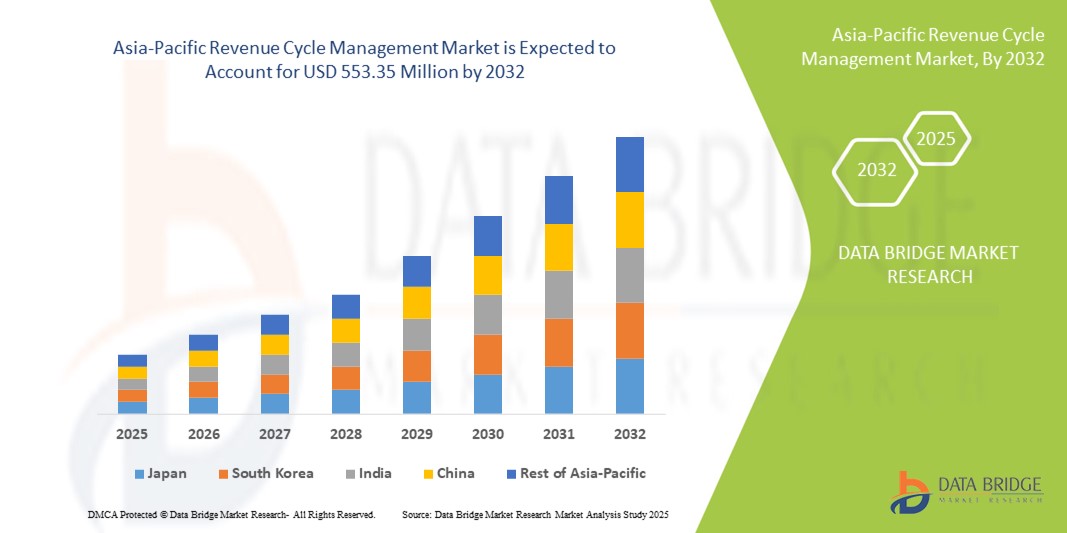
Asia-Pacific Revenue Cycle Management Market Size
- The Asia-Pacific revenue cycle management market size was valued atUSD 188.62 million in 2024and is expected to reachUSD 553.35 million by 2032, at aCAGR of 14.40%during the forecast period
- This growth is driven by factors such as the increasing adoption of digital healthcare solutions, rising healthcare expenditures, and the growing demand for efficient billing and payment systems in the region
Asia-Pacific Revenue Cycle Management Market Analysis
- The revenue cycle management market is experiencing significant growth due to the increasing reliance on digital solutions for managing healthcare billing and payments. Healthcare providers are moving towards automated systems to streamline their revenue cycles and improve financial efficiency
- As healthcare organizations prioritize reducing administrative costs, they are increasingly adopting software that automates key aspects of the revenue cycle, such as claim processing and patient billing.
- Japan is expected to dominate the ophthalmic operational microscopes market due to its advanced healthcare infrastructure and strong focus on digital transformation
- China is expected to be the fastest growing region in the Asia-Pacific Revenue Cycle Management Market during the forecast period due to accelerated healthcare digitization and modern hospital expansions
- The Software segment is expected to dominate the Asia-Pacific Revenue Cycle Management Market with the largest share of 56.22% in 2025 due to the increasing adoption of automated solutions that streamline billing, coding, and claims processing. Software solutions offer healthcare providers enhanced efficiency, accuracy, and cost-effectiveness by minimizing human errors and reducing operational costs. The growing need for compliance with evolving regulations, alongside the shift towards cloud-based solutions, further drives the demand for advanced RCM software. Additionally, the software’s ability to integrate with existing healthcare systems and improve overall financial performance makes it a key component of healthcare organizations' digital transformation efforts
Report Scope and Asia-Pacific Revenue Cycle Management Market Segmentation
|
Attributes |
Asia-Pacific Revenue Cycle Management Market Key Market Insights |
|
Segments Covered |
|
|
Countries Covered |
Asia-Pacific
|
|
Key Market Players |
|
|
Market Opportunities |
|
|
Value Added Data Infosets |
In addition to the insights on market scenarios such as market value, growth rate, segmentation, geographical coverage, and major players, the market reports curated by the Data Bridge Market Research also include in-depth expert analysis, patient epidemiology, pipeline analysis, pricing analysis, and regulatory framework. |
Asia-Pacific Revenue Cycle Management Market Trends
“Rising Adoption of Cloud-Based RCM Solutions”
- Healthcare providers are increasingly shifting to cloud-based revenue cycle management systems to enhance scalability and flexibility
- This transition allows for real-time data access and improved collaboration across departments, streamlining the revenue cycle process
- Cloud-based solutions reduce the need for substantial infrastructure investments, making them cost-effective for healthcare organizations
- For instance, many hospitals using cloud platforms have reported smoother billing operations and faster claim processing
- In conclusion, the growing demand for these solutions is contributing to the expansion and advancement of the revenue cycle management market in the region
Asia-Pacific Revenue Cycle Management Market Dynamics
Driver
“Growing Focus on Healthcare Digitization”
- The Asia-Pacific healthcare sector is embracing digital transformation with increasing adoption of digital health records and automated claim processing across hospitals and clinics
- Governments and private providers are prioritizing digital billing systems to improve efficiency and reduce administrative errors in revenue cycle management
- For instance, India’s Ayushman Bharat Digital Mission is pushing the adoption of digital health infrastructure across public and private healthcare sectors
- The rise of telemedicine and mobile health apps is boosting demand for RCM systems that support multi-channel interactions and real-time processing
- Digital RCM platforms also support advanced analytics, helping healthcare organizations make better financial decisions while ensuring compliance with changing insurance regulations
- In conclusion, this shift toward digitization is set to accelerate the adoption of revenue cycle management solutions across Asia-Pacific’s healthcare landscape
Opportunity
“Expansion of Medical Tourism Industry”
- Asia-Pacific is seeing rapid growth in medical tourism with India, Thailand, Malaysia, and Singapore attracting international patients due to affordable and quality healthcare
- Healthcare providers treating foreign patients face complex challenges such as cross-border insurance claims and multi-currency billing processes
- Revenue cycle management systems help streamline these tasks through automated billing, international insurance verification, and customized documentation workflows
- For instance, Bumrungrad International Hospital in Thailand uses advanced digital systems to manage high volumes of overseas patients with diverse billing needs
- This trend offers RCM vendors a strong opportunity to provide specialized solutions for hospitals and clinics catering to medical tourists across the region
- In conclusion, as the demand for cross-border healthcare increases, so does the need for efficient RCM systems tailored to international patient flows
Restraint/Challenge
“Data Privacy and Security Concerns”
- Data privacy and cybersecurity remain significant concerns in the Asia-Pacific revenue cycle management market due to the handling of sensitive patient and financial information
- Inconsistent data protection laws across countries create confusion and risk for healthcare providers and RCM vendors operating in multiple jurisdictions
- For instance, while Singapore enforces strict data protection through PDPA, other countries are still evolving their regulatory frameworks leading to compliance gaps
- Ransomware attacks on hospitals have increased across the region, raising doubts about the security of cloud-based RCM platforms, especially among smaller providers
- Without strong encryption and standardized security protocols, patient trust and adoption of digital revenue management systems may be severely impacted
- In conclusion, addressing these security challenges is essential for building confidence in RCM adoption across Asia-Pacific's healthcare industry
Asia-Pacific Revenue Cycle Management Market Scope
The market is segmented on the basis of product type, deployment, component. Stage, and end user.
|
Segmentation |
Sub-Segmentation |
|
By Product Type |
|
|
By Deployment |
|
|
By Component |
|
|
By Stage |
|
|
By End User |
|
In 2025, the Software segment is projected to dominate the market with a largest share in component segment
The software segment is expected to dominate the Asia-Pacific revenue cycle management market with the largest share of 56.22% in 2025 due to the increasing adoption of automated solutions that streamline billing, coding, and claims processing. Software solutions offer healthcare providers enhanced efficiency, accuracy, and cost-effectiveness by minimizing human errors and reducing operational costs. The growing need for compliance with evolving regulations, alongside the shift towards cloud-based solutions, further drives the demand for advanced RCM software. Additionally, the software’s ability to integrate with existing healthcare systems and improve overall financial performance makes it a key component of healthcare organizations' digital transformation efforts.
The Integrated RCM segment is expected to account for the largest share during the forecast period in technology segment
In 2025, the integrated RCM segment is expected to dominate the market with the largest market share of 51.31% due to the increasing demand for end-to-end solutions that streamline the entire revenue cycle. Integrated RCM systems offer seamless coordination between various healthcare functions such as patient registration, billing, coding, and claims processing. This integration helps reduce errors, improve operational efficiency, and ensure faster reimbursements.
Asia-Pacific Revenue Cycle Management Market Regional Analysis
“Japan Holds the Largest Share in the Asia-Pacific Revenue Cycle Management Market”
- Japan leads the Asia-Pacific revenue cycle management market due to its advanced healthcare infrastructure and strong focus on digital transformation
- The country has widely adopted electronic health records and automated billing systems, streamlining complex healthcare transactions
- An aging population and increased demand for healthcare services drive the need for efficient financial and administrative systems
- Integrated revenue cycle management platforms are widely used to improve compliance and align with national reimbursement standards
- Continuous updates in Japan’s universal healthcare policies push providers to optimize revenue operations for better financial outcomes
“China is Projected to Register the Highest CAGR in the Asia-Pacific Revenue Cycle Management Market”
- China is experiencing rapid growth in the RCM market driven by accelerated healthcare digitization and modern hospital expansions
- The country’s growing urban population and increased healthcare utilization highlight the demand for scalable RCM systems
- Integrated platforms are being adopted to manage high patient volumes and administrative loads across public and private facilities
- Healthcare reforms and investment in digital infrastructure are creating a favorable environment for RCM implementation
- Government efforts to improve healthcare efficiency and transparency further support the widespread adoption of RCM solutions across the region
Asia-Pacific Revenue Cycle Management Market Share
The market competitive landscape provides details by competitor. Details included are company overview, company financials, revenue generated, market potential, investment in research and development, new market initiatives, presence, production sites and facilities, production capacities, company strengths and weaknesses, product launch, product width and breadth, application dominance. The above data points provided are only related to the companies' focus related to market.
The Major Market Leaders Operating in the Market Are:
- Quest Diagnostics Incorporated (U.S.)
- McKesson Corporation (U.S.)
- Athenahealth Inc. (U.S.)
- Allscripts Healthcare Solutions Inc. (U.S.)
- eClinicalWorks LLC (U.S.)
- CareCloud Corporation (U.S.)
- The SSI Groups Inc. (Philippines)
- General Electric (U.S.)
- Epic Systems Corporation (U.S.)
- Siemens Healthcare Gmbh (Germany)
- Kareo Inc. (U.S.)
- NCS Group (Singapore)
- Medtronic (Ireland)
- IntelliSoft Group (India)
- CureMD (India)
- Zhongjin Healthcare (China)
- Rays Technologies (India)
- GE Healthcare (Australia)
- Cognizant Technology Solutions (India)
Latest Developments in Asia-Pacific Revenue Cycle Management Market
- In June 2024, InsideDesk launched InsideDial, a cutting-edge digital assistant integrated with an AI-powered revenue cycle management solution. InsideDial, supported by SuperDial, is set to transform how dental practices handle insurance payor calls, offering enhanced efficiency, compliance, and flexibility. By automating interactions with insurance payors, InsideDial allows revenue cycle management teams to free up valuable time and improve overall workflow productivity
- In April 2024, Ensemble Health Partners, a leading provider of end-to-end revenue cycle outsourcing for both large and mid-sized healthcare organizations, expanded its partnership with Microsoft to drive further innovation in its proprietary revenue cycle intelligence platform, EIQ. Leveraging the generative AI and machine learning capabilities of Microsoft Azure, EIQ enhances the efficiency of artificial intelligence, automation, and machine learning across the entire revenue cycle, helping healthcare providers optimize financial operations and streamline claims management
- In April 2024, Zentist, a major provider of cloud-based insurance revenue cycle management software for dental groups across the United States, launched Cavi AR, a groundbreaking service within their Remit AI product suite. Cavi AR aims to boost operational efficiency for dental support organizations (DSOs), improving their claim management processes and driving better outcomes
- In January 2024, Veradigm Inc., a leading healthcare data and technology services company, announced its strategic acquisition of Koha Health, a full-service revenue cycle management firm. This acquisition strengthens Veradigm’s position as a vital provider of revenue cycle services in the ambulatory healthcare sector, enhancing its capabilities to support healthcare providers with comprehensive financial solutions
SKU-
Accédez en ligne au rapport sur le premier cloud mondial de veille économique

- Tableau de bord d'analyse de données interactif
- Tableau de bord d'analyse d'entreprise pour les opportunités à fort potentiel de croissance
- Accès d'analyste de recherche pour la personnalisation et les requêtes
- Analyse de la concurrence avec tableau de bord interactif
- Dernières actualités, mises à jour et analyse des tendances
- Exploitez la puissance de l'analyse comparative pour un suivi complet de la concurrence
Méthodologie de recherche
La collecte de données et l'analyse de l'année de base sont effectuées à l'aide de modules de collecte de données avec des échantillons de grande taille. L'étape consiste à obtenir des informations sur le marché ou des données connexes via diverses sources et stratégies. Elle comprend l'examen et la planification à l'avance de toutes les données acquises dans le passé. Elle englobe également l'examen des incohérences d'informations observées dans différentes sources d'informations. Les données de marché sont analysées et estimées à l'aide de modèles statistiques et cohérents de marché. De plus, l'analyse des parts de marché et l'analyse des tendances clés sont les principaux facteurs de succès du rapport de marché. Pour en savoir plus, veuillez demander un appel d'analyste ou déposer votre demande.
La méthodologie de recherche clé utilisée par l'équipe de recherche DBMR est la triangulation des données qui implique l'exploration de données, l'analyse de l'impact des variables de données sur le marché et la validation primaire (expert du secteur). Les modèles de données incluent la grille de positionnement des fournisseurs, l'analyse de la chronologie du marché, l'aperçu et le guide du marché, la grille de positionnement des entreprises, l'analyse des brevets, l'analyse des prix, l'analyse des parts de marché des entreprises, les normes de mesure, l'analyse globale par rapport à l'analyse régionale et des parts des fournisseurs. Pour en savoir plus sur la méthodologie de recherche, envoyez une demande pour parler à nos experts du secteur.
Personnalisation disponible
Data Bridge Market Research est un leader de la recherche formative avancée. Nous sommes fiers de fournir à nos clients existants et nouveaux des données et des analyses qui correspondent à leurs objectifs. Le rapport peut être personnalisé pour inclure une analyse des tendances des prix des marques cibles, une compréhension du marché pour d'autres pays (demandez la liste des pays), des données sur les résultats des essais cliniques, une revue de la littérature, une analyse du marché des produits remis à neuf et de la base de produits. L'analyse du marché des concurrents cibles peut être analysée à partir d'une analyse basée sur la technologie jusqu'à des stratégies de portefeuille de marché. Nous pouvons ajouter autant de concurrents que vous le souhaitez, dans le format et le style de données que vous recherchez. Notre équipe d'analystes peut également vous fournir des données sous forme de fichiers Excel bruts, de tableaux croisés dynamiques (Fact book) ou peut vous aider à créer des présentations à partir des ensembles de données disponibles dans le rapport.











