


Segmentation du marché mondial du 1,4-dicyclohexylbenzène, par application (intermédiaire chimique, solvant, additif, plastifiant), secteur d'utilisation finale (automobile, aérospatiale, électronique, construction), type de formulation (liquide, solide), canal de distribution (ventes directes, distributeurs, ventes en ligne) - Tendances du secteur et prévisions jusqu'en 2033
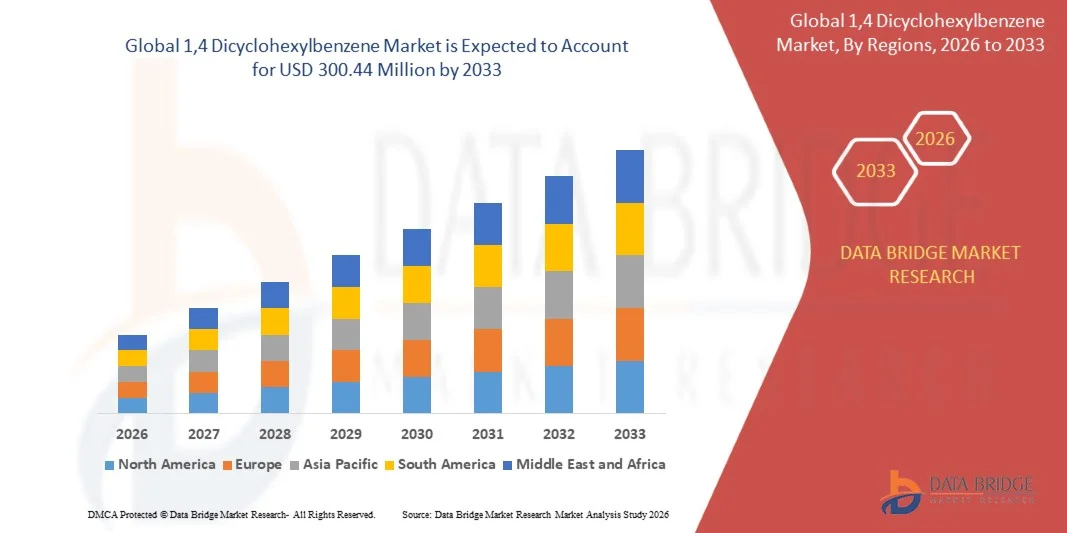
Taille du marché du 1,4-dicyclohexylbenzène
- La taille du marché du 1,4-dicyclohexylbenzène était évaluée à 194,29 millions de dollars en 2025 et devrait atteindre 300,44 millions de dollars d'ici 2033 , avec un TCAC de 5,60 % au cours de la période de prévision.
- La croissance du marché est principalement tirée par la demande croissante de polymères haute performance, tels que les polyesters et les polycarbonates, qui utilisent le 1,4-dicyclohexylbenzène comme intermédiaire clé, associée aux progrès constants des technologies de traitement chimique.
- En outre, l'élargissement des applications du 1,4-dicyclohexylbenzène dans les revêtements, les adhésifs et les produits chimiques de spécialité stimule son adoption par le marché, tandis que le besoin croissant de matériaux durables et écologiques dans les secteurs de l'automobile, de la construction et de l'électronique soutient davantage l'expansion de l'industrie.
Analyse du marché du 1,4-dicyclohexylbenzène
- Le 1,4-dicyclohexylbenzène, un intermédiaire chimique clé utilisé dans la production de polymères haute performance, de revêtements et de produits chimiques de spécialité, est de plus en plus essentiel dans les applications industrielles modernes en raison de sa stabilité thermique, de sa polyvalence et de son rôle dans la production de matériaux durables et écologiques.
- La demande croissante de 1,4-dicyclohexylbenzène est principalement due à la production croissante de polyesters et de polycarbonates, à leur utilisation accrue dans les secteurs de l'automobile, de l'électronique et de la construction, et à l'intérêt croissant porté aux matériaux durables et performants.
- L'Amérique du Nord a dominé le marché du 1,4-dicyclohexylbenzène avec la plus grande part de revenus de 34,1 % en 2025, ce qui est attribué à la forte présence de grands fabricants de produits chimiques, à des industries de polymères bien établies et à une forte adoption des technologies de fabrication avancées, les États-Unis étant en tête en matière de consommation de polymères et d'innovations chimiques de spécialité.
- La région Asie-Pacifique devrait être la région à la croissance la plus rapide sur le marché du 1,4-dicyclohexylbenzène au cours de la période de prévision, grâce à une industrialisation rapide, à la multiplication des projets d'infrastructures urbaines et à la demande croissante de matériaux durables et légers dans les applications automobiles et électroniques.
- Le segment des intermédiaires chimiques a dominé le marché avec la plus grande part de revenus (45,6 %) en 2025, grâce à son rôle essentiel dans la production de polymères haute performance tels que les polyesters et les polycarbonates.
Portée du rapport et segmentation du marché du 1,4-dicyclohexylbenzène
|
Attributs |
1,4-dicyclohexylbenzène : principaux enseignements du marché |
|
Segments couverts |
|
|
Pays couverts |
Amérique du Nord
Europe
Asie-Pacifique
Moyen-Orient et Afrique
Amérique du Sud
|
|
Acteurs clés du marché |
|
|
Opportunités de marché |
|
|
Ensembles d'informations de données à valeur ajoutée |
Outre les informations sur les scénarios de marché tels que la valeur du marché, le taux de croissance, la segmentation, la couverture géographique et les principaux acteurs, les rapports de marché élaborés par Data Bridge Market Research comprennent également une analyse des importations et des exportations, un aperçu de la capacité de production, une analyse de la consommation de production, une analyse des tendances des prix, un scénario de changement climatique, une analyse de la chaîne d'approvisionnement, une analyse de la chaîne de valeur, un aperçu des matières premières/consommables, les critères de sélection des fournisseurs, une analyse PESTLE, une analyse de Porter et le cadre réglementaire. |
Tendances du marché du 1,4-dicyclohexylbenzène
« Performances améliorées grâce à des applications polymères avancées »
- L'une des tendances majeures et en pleine accélération du marché du 1,4-dicyclohexylbenzène est son intégration croissante dans les polymères de pointe et les applications chimiques de spécialité, notamment les polyesters, les polycarbonates, les revêtements et les adhésifs. Cette intégration améliore considérablement les performances, la durabilité et la pérennité des matériaux dans de nombreux secteurs industriels.
- Par exemple, Covestro et BASF utilisent le 1,4-dicyclohexylbenzène comme intermédiaire clé dans la production de polycarbonate haute performance, permettant ainsi d'obtenir des matériaux plus légers, plus résistants et plus résistants à la chaleur pour les applications automobiles et électroniques. De même, Mitsubishi Chemical l'utilise dans des revêtements spéciaux qui améliorent la résistance à la corrosion et aux produits chimiques des équipements industriels.
- Advanced processing of 1,4 Dicyclohexylbenzene enables manufacturers to produce polymers with optimized thermal stability, mechanical strength, and eco-friendly properties. For example, Arkema and Solvay incorporate it into high-performance resins that can withstand extreme temperatures while maintaining structural integrity in aerospace and construction materials.
- The seamless integration of 1,4 Dicyclohexylbenzene into modern polymer manufacturing facilitates the creation of multi-functional materials that meet both performance and environmental standards. Through a single chemical intermediate, manufacturers can enhance polymer versatility, enabling broader adoption across automotive, electronics, and infrastructure sectors.
- This trend towards more durable, versatile, and sustainable polymer solutions is fundamentally reshaping industrial expectations for material performance. Consequently, companies such as Huntsman, Wanhua Chemical, and Celanese are developing innovative DCH-based polymers with improved thermal, mechanical, and chemical properties.
- The demand for 1,4 Dicyclohexylbenzene in advanced polymers and specialty chemicals is growing rapidly across both developed and emerging markets, as manufacturers increasingly prioritize high-performance, lightweight, and environmentally friendly materials.
1,4 Dicyclohexylbenzene Market Dynamics
Driver
“Growing Demand Due to Expanding Industrial Applications and Polymer Adoption”
- The increasing demand for high-performance polymers, coatings, and specialty chemicals, coupled with expanding industrialization in emerging and developed markets, is a significant driver for the heightened demand for 1,4 Dicyclohexylbenzene.
- For instance, in 2025, BASF and Covestro announced advancements in high-performance polycarbonate production using 1,4 Dicyclohexylbenzene as a key intermediate, targeting automotive, electronics, and construction sectors. Such strategic initiatives by key players are expected to drive market growth during the forecast period.
- As industries prioritize durable, lightweight, and eco-friendly materials, 1,4 Dicyclohexylbenzene enables manufacturers to produce polymers with enhanced thermal stability, mechanical strength, and chemical resistance, offering a significant upgrade over conventional intermediates.
- Furthermore, the growing adoption of sustainable materials and advanced manufacturing technologies is making 1,4 Dicyclohexylbenzene an integral component of modern industrial production, facilitating integration into coatings, adhesives, and specialty chemical formulations.
- The versatility of 1,4 Dicyclohexylbenzene in producing high-performance polymers, resins, and coatings, combined with the rising demand in automotive, electronics, and construction applications, is propelling its adoption across both developed and emerging markets.
Restraint/Challenge
“Environmental Concerns and High Production Costs”
- Environmental regulations and sustainability concerns regarding chemical intermediates, including 1,4 Dicyclohexylbenzene, pose a significant challenge to broader market penetration. The production processes are energy-intensive and involve the use of hazardous chemicals, raising concerns about emissions and environmental impact.
- For instance, stringent chemical manufacturing regulations in the U.S., EU, and China require companies to invest in advanced emission control technologies, increasing operational costs and compliance requirements.
- Addressing these environmental concerns through greener production processes, recycling initiatives, and adoption of cleaner technologies is crucial for maintaining market growth. Companies such as Huntsman, Wanhua Chemical, and Arkema are focusing on sustainable production methods and energy-efficient processes to meet regulatory standards. Additionally, the relatively high cost of producing 1,4 Dicyclohexylbenzene compared to alternative intermediates can be a barrier for smaller manufacturers or cost-sensitive applications.
- While technological advancements are gradually improving production efficiency, the high capital expenditure and operational costs associated with large-scale manufacturing can still limit market expansion, particularly in price-sensitive regions.
- Overcoming these challenges through environmentally friendly production, cost optimization, and regulatory compliance will be vital for sustained growth in the 1,4 Dicyclohexylbenzene Market.
1,4 Dicyclohexylbenzene Market Scope
The market is segmented on the basis of type, communication protocol, unlocking mechanism, and application.
• By Application
On the basis of application, the 1,4 Dicyclohexylbenzene Market is segmented into chemical intermediate, solvent, additive, and plasticizer. The chemical intermediate segment dominated the market with the largest revenue share of 45.6% in 2025, driven by its critical role in producing high-performance polymers such as polyesters and polycarbonates. Industrial manufacturers prioritize DCH as a core intermediate due to its ability to enhance polymer durability, thermal stability, and chemical resistance. Solvent and additive applications also contribute significantly, particularly in coatings, adhesives, and specialty chemicals, where DCH improves processing efficiency and material properties.
The plasticizer segment is expected to witness the fastest CAGR of 20.8% from 2026 to 2033, fueled by increasing demand for flexible plastics in automotive, electronics, and construction applications. Growing industrialization and the push for lightweight, high-performance materials are encouraging broader adoption of DCH across diverse chemical applications.
• By End-Use Industry
Le marché du 1,4-dicyclohexylbenzène est segmenté, selon le secteur d'utilisation finale, en automobile, aérospatiale, électronique et construction. Le segment automobile représentait la plus grande part de marché (42,3 %) en 2025, grâce à l'utilisation croissante de polymères légers et durables ainsi que de plastiques haute performance pour les intérieurs, les extérieurs et les composants électroniques des véhicules. Les polymères à base de DCH permettent aux fabricants de répondre aux exigences de résistance, de résistance à la chaleur et de durabilité, favorisant ainsi l'adoption des véhicules électriques et hybrides.
Le secteur aérospatial devrait connaître le taux de croissance annuel composé (TCAC) le plus rapide, à 21,4 %, entre 2026 et 2033, porté par la demande croissante de matériaux composites avancés pour les aménagements intérieurs d'aéronefs, les composants structurels légers et les polymères résistants aux hautes températures. L'augmentation de la production d'aéronefs et l'importance accrue accordée à l'efficacité énergétique et à la réduction du poids contribuent également à l'adoption accélérée des composites à haute densité (DHC) dans les applications aérospatiales. Les industries de l'électronique et de la construction y contribuent également de manière significative grâce aux plastiques durables, aux revêtements et aux adhésifs.
• Par type de formulation
Le marché du 1,4-dicyclohexylbenzène (DCH) est segmenté en deux catégories selon sa formulation : liquide et solide. En 2025, le segment liquide dominait le marché avec une part de revenus de 47,1 %, grâce à ses nombreuses applications dans les intermédiaires chimiques, la synthèse de polymères et les formulations de revêtements. Le DCH liquide garantit une meilleure mise en œuvre, une plus grande uniformité et une meilleure intégration avec d’autres matériaux. Il est particulièrement apprécié pour sa qualité constante et sa facilité de manipulation dans les systèmes automatisés, notamment pour la production industrielle à grande échelle.
Le segment des solides devrait connaître le taux de croissance annuel composé le plus rapide, soit 19,9 %, entre 2026 et 2033, porté par la demande croissante d'applications spécifiques telles que les additifs, les stabilisants et les plastifiants haute performance. L'essor des formulations solides est également favorisé par leur facilité de transport, leur stabilité au stockage à long terme et leur utilisation croissante dans des secteurs de niche exigeant des dosages précis et des conditions de traitement contrôlées.
• Par canal de distribution
Le marché du 1,4-dicyclohexylbenzène est segmenté, selon le canal de distribution, en ventes directes, distributeurs et ventes en ligne. En 2025, le segment des ventes directes dominait le marché avec une part de revenus de 50,2 %, grâce à des relations solides entre les principaux fabricants de produits chimiques et les grands consommateurs industriels. Ces relations garantissent des livraisons ponctuelles, l'assurance qualité et un support technique. Les ventes directes sont particulièrement privilégiées dans les secteurs de l'automobile, de l'aérospatiale et de l'électronique, où la constance et la fiabilité sont essentielles.
Le segment des ventes en ligne devrait connaître le taux de croissance annuel composé (TCAC) le plus rapide, à 22,1 %, entre 2026 et 2033. Cette croissance est alimentée par la digitalisation croissante, les plateformes de commerce électronique pour les produits chimiques de spécialité et l'adoption grandissante des achats de DCH en ligne par les PME. Les distributeurs jouent également un rôle clé en assurant la disponibilité régionale, la livraison en gros et la flexibilité des quantités commandées, soutenant ainsi les industries utilisatrices finales sur les marchés émergents.
Analyse régionale du marché du 1,4-dicyclohexylbenzène
- L'Amérique du Nord a dominé le marché du 1,4-dicyclohexylbenzène avec la plus grande part de revenus de 34,1 % en 2025, grâce à une forte croissance industrielle, des secteurs de fabrication de polymères et de produits chimiques bien établis et une forte adoption de matériaux avancés dans les industries automobile, aérospatiale et électronique.
- Les fabricants de la région privilégient le 1,4-dicyclohexylbenzène pour la production de polymères, de revêtements et de produits chimiques de spécialité haute performance, en raison de son rôle dans l'amélioration de la stabilité thermique, de la durabilité et de la résistance chimique des produits finis.
- Cette adoption généralisée est également soutenue par les progrès technologiques, une main-d'œuvre qualifiée, des normes de qualité rigoureuses et de solides capacités de R&D, faisant de l'Amérique du Nord un centre névralgique du marché du 1,4-dicyclohexylbenzène dans les applications industrielles et commerciales.
Analyse du marché américain du 1,4-dicyclohexylbenzène
Le marché américain du 1,4-dicyclohexylbenzène (DCH) a représenté 81 % des revenus en Amérique du Nord en 2025, porté par la forte présence des industries des polymères, de l'automobile, de l'aérospatiale et de l'électronique. Les fabricants privilégient de plus en plus les intermédiaires haute performance tels que le DCH pour produire des polymères durables, résistants à la chaleur et chimiquement stables. L'intérêt croissant pour les matériaux légers destinés aux véhicules électriques et à l'électronique de pointe stimule davantage la demande. Par ailleurs, de solides capacités de R&D, des infrastructures de traitement chimique avancées et des politiques industrielles favorables permettent le développement de polymères et de revêtements innovants à base de DCH, soutenant ainsi la croissance du marché.
Analyse du marché européen du 1,4-dicyclohexylbenzène
Le marché européen du 1,4-dicyclohexylbenzène devrait connaître une croissance annuelle composée (TCAC) importante tout au long de la période de prévision, portée par la demande croissante de polymères haute performance et de produits chimiques de spécialité dans les secteurs de l'automobile, de l'aérospatiale et de la construction. Des réglementations environnementales et de qualité strictes incitent les fabricants à adopter des intermédiaires efficaces et durables, tels que le DCH. L'urbanisation croissante, les investissements dans les procédés de fabrication avancés et la demande de matériaux légers et écologiques stimulent également l'adoption du marché. Des pays européens clés, dont l'Allemagne, la France et l'Italie, enregistrent une forte croissance de leur production industrielle de polymères.
Analyse du marché britannique du 1,4-dicyclohexylbenzène
The U.K. 1,4 Dicyclohexylbenzene market is anticipated to grow at a noteworthy CAGR during the forecast period, driven by expanding polymer and specialty chemical industries and the increasing use of DCH in automotive, electronics, and construction materials. The country’s focus on industrial innovation, combined with its strong chemical manufacturing infrastructure and growing adoption of advanced materials, is expected to continue stimulating market growth. Environmental sustainability requirements and rising demand for high-performance plastics also support the adoption of DCH intermediates.
Germany 1,4 Dicyclohexylbenzene Market Insight
The Germany 1,4 Dicyclohexylbenzene market is expected to expand at a considerable CAGR during the forecast period, fueled by increasing demand for high-performance polymers in automotive, aerospace, and industrial applications. Germany’s emphasis on innovation, eco-conscious chemical manufacturing, and advanced industrial infrastructure promotes the adoption of DCH as a critical intermediate. Integration of sustainable production methods and stringent quality standards ensures consistent demand across both commercial and industrial sectors.
Asia-Pacific 1,4 Dicyclohexylbenzene Market Insight
The Asia-Pacific 1,4 Dicyclohexylbenzene market is poised to grow at the fastest CAGR of 24% during 2026–2033, driven by rapid industrialization, rising automotive and electronics manufacturing, and expanding construction activities in China, Japan, India, and South Korea. Government initiatives promoting industrial growth and digitalization, along with growing domestic polymer production, are fueling demand. The region’s emergence as a manufacturing hub for polymers, specialty chemicals, and high-performance plastics is expanding the availability and affordability of DCH for industrial consumers.
Japan 1,4 Dicyclohexylbenzene Market Insight
The Japan 1,4 Dicyclohexylbenzene market is gaining momentum due to the country’s advanced industrial ecosystem, high-tech manufacturing, and increasing use of lightweight polymers in automotive and electronics applications. The adoption of DCH is supported by integration into eco-friendly, high-performance plastics and coatings. Additionally, Japan’s aging industrial infrastructure and the push for efficient production methods are expected to drive demand for reliable chemical intermediates such as DCH in both industrial and specialty applications.
China 1,4 Dicyclohexylbenzene Market Insight
The China 1,4 Dicyclohexylbenzene market accounted for the largest revenue share in Asia-Pacific in 2025, attributed to rapid industrialization, growth of the automotive and electronics sectors, and rising polymer consumption. China is a key hub for polymer and specialty chemical production, and DCH is increasingly used as an essential intermediate for high-performance plastics and coatings. Government initiatives supporting smart manufacturing, industrial modernization, and environmental compliance are further driving market expansion, while strong domestic manufacturers and cost-effective production enhance accessibility for industrial users.
1,4 Dicyclohexylbenzene Market Share
The 1,4 Dicyclohexylbenzene industry is primarily led by well-established companies, including:
- BASF SE (Germany)
- Covestro AG (Germany)
- Huntsman Corporation (U.S.)
- Wanhua Chemical Group (China)
- Celanese Corporation (U.S.)
- Arkema SA (France)
- Mitsubishi Chemical Corporation (Japan)
- Solvay S.A. (Belgium)
- LG Chem Ltd. (South Korea)
- Dow Inc. (U.S.)
- Mitsui Chemicals, Inc. (Japan)
- Ascend Performance Materials (U.S.)
- SABIC (Saudi Arabia)
- LyondellBasell Industries (Netherlands)
- Evonik Industries AG (Germany)
- Henkel AG & Co. KGaA (Germany)
- Sinopec Shanghai Petrochemical Company (China)
- AdvanSix Inc. (U.S.)
- Tosoh Corporation (Japan)
- Lanxess AG (Germany)
What are the Recent Developments in 1,4 Dicyclohexylbenzene Market?
- In April 2024, BASF SE, a global leader in chemical manufacturing, announced the expansion of its high-performance polymer production lines in Germany, focusing on the integration of 1,4 Dicyclohexylbenzene as a key intermediate. This initiative underscores BASF’s commitment to delivering advanced chemical solutions that meet the growing demand for durable, heat-resistant, and eco-friendly polymers in automotive, electronics, and construction sectors. By leveraging its global expertise and cutting-edge production technologies, BASF is reinforcing its position in the rapidly growing 1,4 Dicyclohexylbenzene Market.
- In March 2024, Covestro AG, a leading manufacturer of polycarbonates and specialty chemicals, launched a new DCH-based polymer line specifically tailored for lightweight automotive components. The initiative highlights Covestro’s dedication to supporting the automotive industry’s push for fuel efficiency and sustainability through innovative chemical solutions, ensuring enhanced performance and safety of polymer-based components.
- In March 2024, Huntsman Corporation successfully commissioned a new specialty chemical plant in India, aimed at producing high-purity 1,4 Dicyclohexylbenzene for electronics and industrial applications. The project demonstrates Huntsman’s commitment to meeting the growing demand for advanced polymer intermediates in Asia-Pacific, contributing to regional industrial growth and high-performance material adoption.
- En février 2024, Wanhua Chemical Group a annoncé un partenariat stratégique avec des fabricants de matériaux de construction de premier plan en Chine pour la fourniture d'intermédiaires à base de DCH destinés aux revêtements et adhésifs haute performance. Cette collaboration vise à améliorer la durabilité et la résistance chimique des matériaux, en apportant aux secteurs de la construction et de l'industrie des solutions polymères fiables et de haute qualité.
- En janvier 2024, Celanese Corporation a dévoilé une solution polymère innovante dérivée du DCH lors du salon International Chemical Industry Expo 2024. Cette nouvelle offre se concentre sur des plastiques durables et performants pour les applications électroniques et automobiles, démontrant l'engagement de Celanese à intégrer des technologies chimiques avancées dans les matériaux industriels courants, améliorant ainsi à la fois les performances et la conformité environnementale.
SKU-
Accédez en ligne au rapport sur le premier cloud mondial de veille économique

- Tableau de bord d'analyse de données interactif
- Tableau de bord d'analyse d'entreprise pour les opportunités à fort potentiel de croissance
- Accès d'analyste de recherche pour la personnalisation et les requêtes
- Analyse de la concurrence avec tableau de bord interactif
- Dernières actualités, mises à jour et analyse des tendances
- Exploitez la puissance de l'analyse comparative pour un suivi complet de la concurrence
Méthodologie de recherche
La collecte de données et l'analyse de l'année de base sont effectuées à l'aide de modules de collecte de données avec des échantillons de grande taille. L'étape consiste à obtenir des informations sur le marché ou des données connexes via diverses sources et stratégies. Elle comprend l'examen et la planification à l'avance de toutes les données acquises dans le passé. Elle englobe également l'examen des incohérences d'informations observées dans différentes sources d'informations. Les données de marché sont analysées et estimées à l'aide de modèles statistiques et cohérents de marché. De plus, l'analyse des parts de marché et l'analyse des tendances clés sont les principaux facteurs de succès du rapport de marché. Pour en savoir plus, veuillez demander un appel d'analyste ou déposer votre demande.
La méthodologie de recherche clé utilisée par l'équipe de recherche DBMR est la triangulation des données qui implique l'exploration de données, l'analyse de l'impact des variables de données sur le marché et la validation primaire (expert du secteur). Les modèles de données incluent la grille de positionnement des fournisseurs, l'analyse de la chronologie du marché, l'aperçu et le guide du marché, la grille de positionnement des entreprises, l'analyse des brevets, l'analyse des prix, l'analyse des parts de marché des entreprises, les normes de mesure, l'analyse globale par rapport à l'analyse régionale et des parts des fournisseurs. Pour en savoir plus sur la méthodologie de recherche, envoyez une demande pour parler à nos experts du secteur.
Personnalisation disponible
Data Bridge Market Research est un leader de la recherche formative avancée. Nous sommes fiers de fournir à nos clients existants et nouveaux des données et des analyses qui correspondent à leurs objectifs. Le rapport peut être personnalisé pour inclure une analyse des tendances des prix des marques cibles, une compréhension du marché pour d'autres pays (demandez la liste des pays), des données sur les résultats des essais cliniques, une revue de la littérature, une analyse du marché des produits remis à neuf et de la base de produits. L'analyse du marché des concurrents cibles peut être analysée à partir d'une analyse basée sur la technologie jusqu'à des stratégies de portefeuille de marché. Nous pouvons ajouter autant de concurrents que vous le souhaitez, dans le format et le style de données que vous recherchez. Notre équipe d'analystes peut également vous fournir des données sous forme de fichiers Excel bruts, de tableaux croisés dynamiques (Fact book) ou peut vous aider à créer des présentations à partir des ensembles de données disponibles dans le rapport.











