



Segmentation du marché mondial des boissons alcoolisées en conserve, par type (bière, cidre, vin, cocktails prêts à boire et spiritueux), saveur (Fruity, Spicy, Herbal, Classic et Savory), type d'emballage (boîtes standard, bidons minces, grand format, boîtes multi-emballages et bouteilles d'aluminium), chaîne de distribution (supermarchés/marchés de détail, magasins d'agrément, commerce de détail en ligne, magasins spécialisés et bars/restaurants) Tendances et prévisions de l'industrie à 2033
Quelle est la taille et le taux de croissance du marché des boissons alcoolisées en conserve
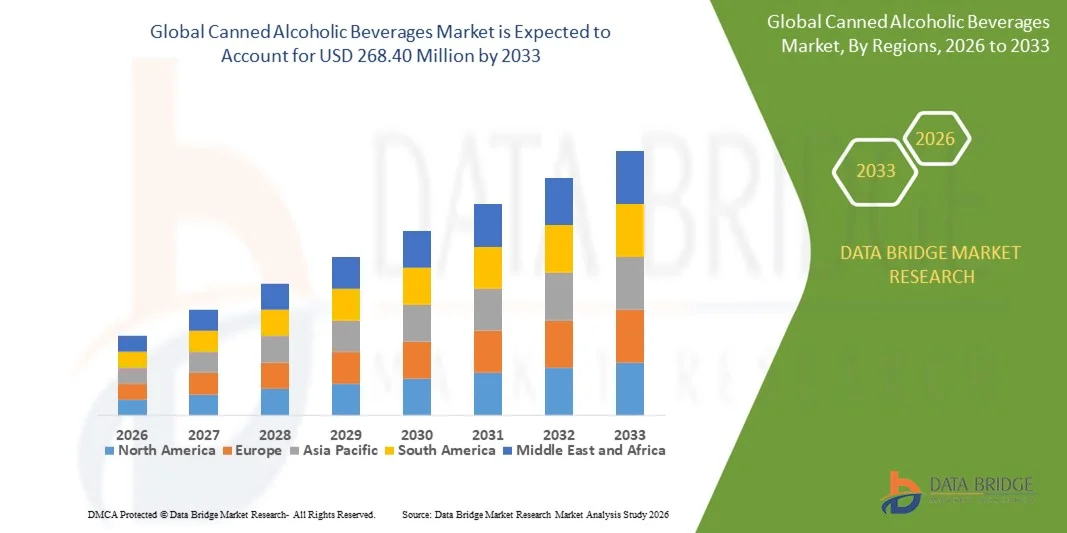
- Selon Data Bridge études de marché Analyse la taille du marché mondial des boissons alcoolisées en conserve a été évaluée à104,98 millions de dollars en 2025et devrait atteindre268,40 millions de dollars en 2033, à unTCAC de 12,45 %pendant la période de prévision
- La croissance du marché est en grande partie alimentée par l'évolution des préférences des consommateurs à l'égard des produits pratiques, portables etalcoolique prêt à boireles produits qui s'alignent sur les modes de vie en déplacement
- L'augmentation de la demande chez les jeunes consommateurssaveurs, l'emballage contrôlé par portion et les formats en conserve haut de gamme soutiennent de façon significative l'expansion du marché
Taille du marché et prévisions
- Valeur marchande mondiale (2025):104,98 millions de dollars
- Valeur marchande prévue (2033) :268,40 millions de dollars
- Prévisions CAGR (2026-2033):12.45%
Quels sont les principaux débouchés du marché des boissons alcoolisées en conserve
- Le marché connaît une forte dynamique en raison du passage de l'emballage en verre traditionnel à des boîtes légères et recyclables offrant de meilleurs avantages en termes de portabilité et de durabilité
- L'innovation de produits en termes de boissons alcoolisées à faible teneur en calories, à faible teneur en sucre et à style artisanal renforce l'attrait des consommateurs et encourage les essais dans divers groupes démographiques.
- L'Amérique du Nord a dominé le marché mondial des boissons alcoolisées en conserve avec la plus grande part de revenu de 95,3 % en 2025, en raison de la préférence croissante des consommateurs pour des options alcoolisées pratiques et prêtes à boire et d'une culture croissante de la consommation en plein air et en déplacement
- La région Asie-Pacifique devrait connaître le taux de croissance le plus élevé du monde.boissons alcoolisées en conservemarché, entraîné par l'urbanisation rapide, l'adoption des tendances occidentales de la consommation d'alcool, l'augmentation des revenus disponibles, et la popularité croissante de la RDT pratique et des boissons alcoolisées aromatisées
- En 2025, le segment des cocktails prêts à boire détenait la plus grande part de revenu du marché, en raison de l'augmentation de la préférence des consommateurs pour des boissons alcoolisées prémélangées qui offrent un goût et une facilité de consommation uniformes. Les cocktails de RDT dans les boîtes de conserve attirent fortement les consommateurs urbains et les jeunes en raison de leur portabilité, de leur positionnement haut de gamme et de la grande variété de profils de saveurs, en soutenant leur adoption forte dans les occasions de consommation sociale et en déplacement
Portée du rapport et segmentation du marché des boissons alcoolisées en conserve
|
Attributs |
Boissons alcoolisées en conserve Principales perspectives du marché |
|
Segments couverts |
|
|
Pays couverts |
Amérique du Nord
Europe
Asie-Pacifique
Moyen-Orient et Afrique
Amérique du Sud
|
|
Principaux acteurs du marché |
|
|
Possibilités de marché |
|
|
Infos sur la valeur ajoutée |
|
Quelle est la tendance clé du marché des boissons alcoolisées en conserve
Demande croissante de produits alcoolisés pratiques et prêts à boire
- La préférence croissante pour la consommation axée sur la commodité et sur la marche façonne de façon significative le marché des boissons alcoolisées en conserve, car les consommateurs recherchent de plus en plus des formats d'alcool portables et faciles à consommer. Les boissons alcoolisées en conserve gagnent en popularité en raison de leur emballage léger, des portions à usage unique et de la facilité d'entreposage, les rendant adaptés pour les réunions sociales, les activités de plein air et les occasions de consommation occasionnelle
- La demande croissante de produits alcoolisés prêts à boire chez les jeunes consommateurs accélère la croissance du marché, en particulier pour les bières aromatisées, les selsers durs, les cocktails en conserve et les boissons à base de vin. Les consommateurs recherchent activement des variétés, des saveurs innovantes et des options moins alcoolisées ou caloriques, encourageant les fabricants à élargir leurs gammes de produits et à expérimenter de nouvelles formulations.
- Les tendances de l'innovation en matière de durabilité et d'emballage influencent les décisions d'achat, les boîtes d'aluminium étant favorisées par leur recyclabilité et leur impact environnemental moindre que les bouteilles de verre. Les marques mettent l'accent sur les emballages écologiques, le design minimaliste et l'esthétique de qualité pour différencier les produits et attirer les consommateurs soucieux de l'environnement tout en renforçant l'identité de la marque
- Par exemple, en 2024, des entreprises comme Anheuser-Busch InBev en Belgique et Diageo au Royaume-Uni ont élargi leurs offres de boissons alcoolisées en conserve, introduisant de nouveaux cocktails en conserve et des boissons alcoolisées aromatisées sur les chaînes de vente au détail et en ligne. Ces projets visent les consommateurs à la recherche de commodités et mettent en évidence les avantages de la portabilité et de la durabilité pour favoriser une plus grande adoption.
- Bien que la demande de boissons alcoolisées en conserve continue de croître, l'expansion soutenue du marché dépend de l'innovation constante des produits, de l'image de marque efficace et de la conformité à la réglementation dans toutes les régions. Les fabricants se concentrent sur la diversification des saveurs, le positionnement haut de gamme et les partenariats stratégiques de distribution pour maintenir la compétitivité et élargir la portée des consommateurs.
Dynamique du marché des boissons alcoolisées en conserve
Chauffeur
Préférence croissante pour la commodité et la consommation d'alcool en déplacement
- La tendance croissante des consommateurs à consommer des boissons alcoolisées pratiques et prêtes à boire est un des principaux moteurs du marché des boissons alcoolisées en conserve. Les fabricants offrent de plus en plus de formats en conserve pour s'adapter aux modes de vie actifs, aux occasions de consommation sociale et aux événements extérieurs, améliorant ainsi l'accessibilité et la fréquence de consommation des produits.
- L'expansion des applications de la bière, du vin, des spiritueux et des cocktails prêts à boire influe sur la croissance du marché. Les boissons alcoolisées en conserve offrent un contrôle de portions, une qualité constante et une facilité de transport, ce qui permet aux marques d'attirer un large éventail de consommateurs tout en maintenant la fraîcheur et l'intégrité de la saveur du produit.
- Les fabricants de boissons promeuvent activement les produits alcoolisés en conserve au moyen de campagnes de marketing, de lancements en édition limitée et de collaborations avec les détaillants et les organisateurs d'événements. Ces efforts sont soutenus par une forte demande pour des saveurs innovantes, des offres haut de gamme et des options à faible teneur en calories, encourageant les achats répétés et la fidélité de la marque
- Par exemple, en 2023, des marques comme Molson Coors aux États-Unis et Heineken aux Pays-Bas ont signalé une augmentation des ventes de bières en conserve et de boissons alcoolisées prêtes à boire. Cette croissance est due à la demande croissante de formats d'alcool portables et à la présence accrue dans les dépanneurs, les festivals et les plateformes de commerce électronique.
- Bien que la demande axée sur la commodité favorise la croissance du marché, l'expansion à long terme repose sur l'innovation continue, les stratégies de tarification et la distribution efficace. L'investissement dans la différenciation des produits, l'efficacité de la chaîne d'approvisionnement et l'engagement des consommateurs seront essentiels pour maintenir l'avantage concurrentiel
Restriction/Défi
Restrictions réglementaires et préoccupations en matière de prix à la hausse
- Une réglementation stricte de la production, de l'emballage, de l'étiquetage et de la distribution de l'alcool demeure un défi majeur pour le marché des boissons alcoolisées en conserve. Le respect de réglementations régionales différentes accroît la complexité opérationnelle et limite l'entrée des petits acteurs sur le marché, en particulier dans les économies émergentes.
- Les prix préférentiels des boissons alcoolisées en conserve par rapport aux alternatives traditionnelles en bouteille peuvent restreindre l'adoption parmi les consommateurs sensibles aux prix. L'augmentation des coûts de production associés aux formulations innovantes, à l'image de marque et à l'emballage durable contribue à l'augmentation des prix, ce qui influe sur la croissance en volume de certains marchés.
- Les contraintes liées à la distribution et à l'espace de stockage affectent également l'expansion du marché, car les détaillants peuvent limiter l'espace disponible pour les boissons alcoolisées ou hiérarchiser les marques établies. De plus, les restrictions à la publicité sur l'alcool dans plusieurs régions réduisent la flexibilité promotionnelle et la visibilité de la marque.
- Par exemple, en 2024, les détaillants sur des marchés tels que l'Inde et certaines parties de l'Asie du Sud-Est ont signalé une adoption plus lente des boissons alcoolisées en conserve en raison de restrictions réglementaires, d'un prix plus élevé et de possibilités de publicité restreinte. Ces facteurs ont influé sur la sensibilisation des consommateurs et sur la disponibilité limitée des produits dans les principaux circuits de distribution.
- Pour relever ces défis, il faudra établir des prix stratégiques, harmoniser la réglementation et adopter des méthodes de marketing ciblées. Le renforcement des partenariats avec les distributeurs, l'optimisation des coûts d'emballage et l'adaptation des produits aux réglementations locales seront essentiels pour libérer le potentiel de croissance à long terme sur le marché mondial des boissons alcoolisées en conserve
Comment le marché des boissons alcoolisées en conserve est-il segmenté
Le marché est segmenté en fonction du type, de la saveur, du type d'emballage et du canal de distribution
- Par type
Sur la base du type, le marché mondial des boissons alcoolisées en conserve est segmenté en bière, cidre, vin, cocktails prêts à boire et spiritueux. En 2025, le segment des cocktails prêts à boire détenait la plus grande part de revenu du marché, en raison de l'augmentation de la préférence des consommateurs pour des boissons alcoolisées prémélangées qui offrent un goût et une facilité de consommation uniformes. Les cocktails de RDT dans les boîtes de conserve attirent fortement les consommateurs urbains et les plus jeunes en raison de leur portabilité, de leur positionnement haut de gamme et de la grande variété de profils de saveurs, en soutenant leur forte adoption dans les occasions de consommation sociale et en déplacement.
Le segment de la bière devrait connaître une croissance régulière de 2026 à 2033 soutenue par l'acceptation croissante des formats de bière en conserve et la présence croissante d'options de bière artisanale et aromatisée dans les boîtes de conserve. La bière en conserve bénéficie d'une meilleure portabilité, d'un refroidissement plus rapide et d'une meilleure durabilité que les bouteilles de verre, ce qui en fait un choix privilégié pour les événements extérieurs et la consommation occasionnelle.
- Par Saveur
Sur la base de la saveur, le marché est segmenté en fruité, épicé, à base de plantes, classique et salé. Le segment fruité a représenté la plus grande part des revenus en 2025 en raison de la forte inclination des consommateurs vers des profils de saveur rafraîchissants et faciles à boire. Les boissons alcoolisées en conserve fruitées, telles que les variétés à base d'agrumes et de baies, sont largement favorisées par les premiers buveurs et les jeunes consommateurs, ce qui renforce leur popularité sur les marchés développés et émergents.
Le segment classique devrait enregistrer la croissance la plus rapide de 2026 à 2033 en raison de la demande de profils de goût traditionnels qui reproduisent des boissons de style bar. Les saveurs classiques attirent les consommateurs qui recherchent la familiarité et l'authenticité, en particulier dans la bière en conserve, le vin et les boissons à base d'alcool, soutenant l'expansion constante du marché.
- Par type d'emballage
Sur la base du type d'emballage, le marché mondial des boissons alcoolisées en conserve est segmenté en boîtes standard, boîtes minces, boîtes de grand format, boîtes multi-emballages et bouteilles d'aluminium. Le segment des boîtes standard a dominé le marché en 2025 en raison de leur rentabilité, de leur grande disponibilité et de leur aptitude à la production de masse. Les boîtes standard offrent une facilité de manipulation et un stockage efficace, ce qui en fait le format d'emballage privilégié pour les fabricants et les détaillants.
Le segment des boîtes minces devrait enregistrer la croissance la plus rapide de 2026 à 2033, sous l'effet des tendances de la valorisation et de l'attrait esthétique. Les boîtes minces sont de plus en plus utilisées pour les cocktails de RDT et les boissons alcoolisées aromatisées, car elles attirent les consommateurs soucieux de la santé et motivés par le style, tout en soutenant la différenciation de la marque sur le shelve de détail.
- Par canal de distribution
Sur la base du canal de distribution, le marché est segmenté en supermarchés/hypermarchés, dépanneurs, détaillants en ligne, magasins spécialisés et bars/restaurants. Le segment des supermarchés et des hypermarchés détenait la plus grande part de marché en 2025, sous l'impulsion de nombreux assortiments de produits, de prix concurrentiels et d'une forte visibilité des boissons alcoolisées en conserve. Ces formats de vente au détail permettent aux consommateurs de comparer facilement les marques et les saveurs, en soutenant les ventes en grand volume.
Le segment de la vente au détail en ligne devrait enregistrer la croissance la plus rapide de 2026 à 2033 alimentée par l'adoption numérique croissante et la commodité de la livraison à domicile. Les plateformes en ligne offrent un accès à une gamme plus large de produits, de modèles d'abonnement et de lancements exclusifs, ce qui en fait un canal attrayant pour les consommateurs de haute technologie et les marques de boissons haut de gamme.
Quelle région détient la plus grande part du marché des boissons alcoolisées en conserve
- L'Amérique du Nord a dominé le marché mondial des boissons alcoolisées en conserve avec la plus grande part de revenu de 95,3 % en 2025, en raison de la préférence croissante des consommateurs pour des options alcoolisées pratiques et prêtes à boire et d'une culture croissante de la consommation en plein air et en déplacement
- Les consommateurs de la région apprécient la portabilité, le goût constant et l'emballage haut de gamme, les boissons en conserve étant de plus en plus préférées pour les rassemblements sociaux, les événements et les occasions de boire occasionnellement.
- Le marché est en outre soutenu par des revenus disponibles élevés, une population axée sur les tendances, et l'influence croissante des consommateurs soucieux de la santé et de la saveur, établissant les boissons alcoolisées en conserve comme un choix privilégié à plusieurs reprises
Aperçu du marché américain des boissons alcoolisées en conserve
Le marché américain des boissons alcoolisées en conserve a enregistré la plus grande part des revenus en 2025 en Amérique du Nord, alimentée par la demande croissante de cocktails prêts à boire (TRD), de boissons de malt aromatisées et de bière artisanale dans les boîtes de conserve. Les consommateurs privilégient de plus en plus la commodité, la portabilité et la variété des boissons alcoolisées. La tendance croissante à la prime, conjuguée à une solide infrastructure de commerce électronique et de détail, stimule davantage la croissance du marché. En outre, les saveurs innovantes et les offres d'édition limitée attirent les jeunes et renforcent l'engagement des consommateurs.
Europe des boissons alcoolisées en conserve
Le marché européen des boissons alcoolisées en conserve devrait connaître le taux de croissance le plus rapide entre 2026 et 2033, principalement en raison de l'évolution des modes de vie des consommateurs, de l'augmentation de la consommation sur le marché et de l'augmentation de la demande de boissons alcoolisées RDT. L'urbanisation, conjuguée à l'influence des médias sociaux et des modes de vie, favorise l'adoption du marché. Les consommateurs européens apprécient également les avantages environnementaux de l'emballage en aluminium et la facilité de stockage, favorisant une forte croissance des segments bière, cidre et cocktail.
Aperçu du marché des boissons alcoolisées en conserve au Royaume-Uni
Le marché britannique des boissons alcoolisées en conserve devrait connaître le taux de croissance le plus rapide entre 2026 et 2033, dû à la popularité croissante des cocktails de RDT et des boissons alcoolisées aromatisées. Les préoccupations concernant le contrôle des portions, la commodité et la durabilité encouragent les détaillants et les consommateurs à favoriser les formats en conserve. La forte pénétration du commerce électronique et l'infrastructure du commerce de détail au Royaume-Uni, conjuguée à une tendance croissante à la consommation de boissons haut de gamme et artisanales, devraient continuer à propulser l'expansion du marché.
Allemagne Boissons alcoolisées en conserve Aperçu du marché
Le marché allemand des boissons alcoolisées en conserve devrait connaître le taux de croissance le plus rapide entre 2026 et 2033, alimenté par l'intérêt croissant pour les bières artisanales, les saveurs innovantes et l'emballage durable. Les consommateurs apprécient de plus en plus les ingrédients de haute qualité, les expériences gustatives et les solutions d'emballage respectueuses de l'environnement. L'intégration des boissons de RDT et des boissons alcoolisées aromatisées dans les événements sociaux, les festivals et les occasions en plein air favorise l'adoption dans les régions urbaines et suburbaines.
Aperçu du marché des boissons alcoolisées en conserve en Asie-Pacifique
Le marché des boissons alcoolisées en conserve en Asie et dans le Pacifique devrait connaître le taux de croissance le plus rapide entre 2026 et 2033, en raison de l'augmentation des revenus disponibles, de l'urbanisation et de l'exposition croissante aux tendances de la consommation occidentale dans des pays comme la Chine, le Japon et l'Inde. La préférence croissante pour des options pratiques et prêtes à boire, appuyées par l'expansion des circuits de vente au détail et de commerce électronique, alimente l'adoption. En outre, le nombre croissant de rassemblements sociaux, d'événements extérieurs et de tendances à la hausse contribue à la croissance du marché de la région.
Aperçu du marché japonais des boissons alcoolisées en conserve
Le marché japonais des boissons alcoolisées en conserve devrait connaître le taux de croissance le plus rapide entre 2026 et 2033 en raison d'une forte urbanisation, d'une forte culture de la consommation sur la route et de la préférence pour les saveurs innovantes. Les consommateurs adoptent de plus en plus de cocktails de RDT et de bières artisanales en conserve pour leur commodité et leur variété. La popularité des emballages compacts et faciles à transporter et l'intégration des boissons dans les événements sociaux et les activités de plein air est à l'origine de l'expansion du marché.
Chine Boissons alcoolisées en conserve Aperçu du marché
En 2025, le marché chinois des boissons alcoolisées en conserve représentait la part de marché la plus importante en Asie-Pacifique, attribuable à l'expansion de la classe moyenne, à l'urbanisation rapide et à la forte acceptation des tendances occidentales en matière de consommation d'alcool. Les cocktails prêts à boire, les boissons de malt aromatisées et les bières artisanales en conserve gagnent en traction dans les centres urbains. Les initiatives gouvernementales qui appuient la vente au détail moderne, de même que les fabricants canadiens solides offrant des produits abordables et diversifiés, sont des facteurs clés qui propulsent la croissance du marché en Chine.
Quelles sont les meilleures entreprises du marché des boissons alcoolisées en conserve
L'industrie des boissons alcoolisées en conserve est principalement dirigée par des entreprises bien établies, notamment :
•Bacardi Limited (Bermuda)
• Diageo (Royaume-Uni)
• Brown-Forman (États-Unis)
• Anheuser-Busch InBev (Belgique)
• Trésorerie (Australie)
•Union Wine Company (États-Unis)
• E. & J. Gallo Winery (États-Unis)
• Asahi Group Holdings, Ltd. (Japon)
• Pernod Ricard (France)
• Groupe intégré de boissons LLC (IBG) (États-Unis)
• Les vignobles de Sula (Inde)
• Kona Brewing Co. (États-Unis)
•Suntory Holdings Limited (Japon)
• Cellars à pieds fins (États-Unis)
•Marques Constellation (États-Unis)
Quels sont les derniers développements sur le marché des boissons alcoolisées en conserve
- En octobre 2025, Boston Beer Company a lancé une campagne de marketing ciblant les consommateurs millénaires, mettant en évidence les saveurs artisanales et les expériences de boisson uniques. La campagne se concentre sur la qualité et l'artisanat pour différencier la marque dans un marché concurrentiel des boissons en conserve. Cette approche vise à attirer une clientèle fidèle qui valorise les produits haut de gamme et innovants
- En septembre 2025, Heineken a introduit une gamme de boissons en conserve écologiques fabriquées à partir de matériaux 100% recyclables. Cette initiative répond à la demande croissante des consommateurs de produits durables et renforce l'engagement de Heineken envers la responsabilité environnementale. Le lancement devrait renforcer la loyauté de la marque et accroître la part de marché des consommateurs éco-conscients
- En août 2025, Constellation Brands a mis en place une plateforme pilotée par l'IA pour optimiser ses processus de production. La technologie est conçue pour améliorer l'efficacité opérationnelle, réduire les déchets et soutenir les initiatives de durabilité. Cette évolution stratégique place Constellation Brands comme leader de l'innovation dans la production sur le marché des boissons alcoolisées en conserve
- En août 2025, Diageo a lancé Baileys en boîte espresso martinis aux États-Unis et au Royaume-Uni, ciblant les consommateurs de cocktails de café de RDT haut de gamme. Le produit répond à la demande croissante de cocktails pratiques et prêts à boire pendant les vacances. Elle renforce le portefeuille haut de gamme de RDT de Diageo et renforce sa présence sur des marchés internationaux clés
- En juin 2025, Constellation Brands élargit sa marque High Noon avec l'introduction du Tequila Seltzer Variety Pack en Amérique du Nord. Le lancement vise les consommateurs qui recherchent des options de RDT pratiques et en cours et renforce la position concurrentielle de l'entreprise dans le segment de RDT basé sur la tequila. Il répond également à la demande croissante d'innovation en matière de variété et de saveur
- En mai 2025, AB InBev-S Cutwater Spirits lance un cocktail en boîte Mojito à zéro sucre. Le produit répond à la demande des consommateurs de boissons alcooliques à faible teneur en calories. En rafraîchissant son portefeuille d'été avec des options plus saines, la marque vise à attirer les buveurs soucieux de la santé tout en maintenant sa pertinence sur le marché de la RDT
- En mars 2025, Heineken a dévoilé sa première boîte de Gin & Tonic RDT à travers la marque Desperados en Espagne, en France et en Allemagne. Ce lancement cible les consommateurs Gen Z à la recherche de boissons branchées et pratiques. Le produit élargit les offres haut de gamme de RDT de Heineken et soutient la présence de la marque sur le marché des cocktails en conserve européen en croissance
- En janvier 2025, Molson Coors s'est associé à Coca-Cola pour développer de nouvelles saveurs Topo Chico Hard Seltzer au Mexique et aux États-Unis. La collaboration se concentre sur l'innovation de produits pour répondre à la demande croissante de seltzers de RDT. Il améliore la part de marché de la marque et renforce sa présence dans les principales régions nord-américaines
- En juillet 2022, Diageo s'est associé à The Vita Coco Company pour lancer une gamme premium de cocktails en conserve combinant le rhum capitaine Morgan et l'eau de coco. Le produit fait appel aux consommateurs soucieux de la santé et de la saveur. Cette collaboration renforce le portefeuille de RDT de Diageo et élargit sa portée dans le segment des cocktails en conserve premium
- En mai 2021, Bacardi élargit sa gamme de cocktails en boîte avec BACARDÍ Sunset Punch, Bahama Mama et Mojito. Ces boissons sans gluten utilisent des ingrédients réels et des saveurs naturelles, la restauration pour les consommateurs soucieux de la santé. Le lancement renforce la position de Bacardi sur le marché croissant de la RDT et répond à l'évolution des préférences des consommateurs
- En mars 2021, Koninklijke Grolsch, une filiale du groupe Asahi, a introduit un seltzer dur dans des boîtes et des bouteilles, le premier aux Pays-Bas. Le produit cible les consommateurs qui recherchent des boissons alcoolisées à faible teneur en calories. Ce lancement élargit l'empreinte du marché de la RDT et place Grolsch en tant qu'innovateur dans le segment néerlandais du seltzer dur
SKU-
Accédez en ligne au rapport sur le premier cloud mondial de veille économique

- Tableau de bord d'analyse de données interactif
- Tableau de bord d'analyse d'entreprise pour les opportunités à fort potentiel de croissance
- Accès d'analyste de recherche pour la personnalisation et les requêtes
- Analyse de la concurrence avec tableau de bord interactif
- Dernières actualités, mises à jour et analyse des tendances
- Exploitez la puissance de l'analyse comparative pour un suivi complet de la concurrence
Méthodologie de recherche
La collecte de données et l'analyse de l'année de base sont effectuées à l'aide de modules de collecte de données avec des échantillons de grande taille. L'étape consiste à obtenir des informations sur le marché ou des données connexes via diverses sources et stratégies. Elle comprend l'examen et la planification à l'avance de toutes les données acquises dans le passé. Elle englobe également l'examen des incohérences d'informations observées dans différentes sources d'informations. Les données de marché sont analysées et estimées à l'aide de modèles statistiques et cohérents de marché. De plus, l'analyse des parts de marché et l'analyse des tendances clés sont les principaux facteurs de succès du rapport de marché. Pour en savoir plus, veuillez demander un appel d'analyste ou déposer votre demande.
La méthodologie de recherche clé utilisée par l'équipe de recherche DBMR est la triangulation des données qui implique l'exploration de données, l'analyse de l'impact des variables de données sur le marché et la validation primaire (expert du secteur). Les modèles de données incluent la grille de positionnement des fournisseurs, l'analyse de la chronologie du marché, l'aperçu et le guide du marché, la grille de positionnement des entreprises, l'analyse des brevets, l'analyse des prix, l'analyse des parts de marché des entreprises, les normes de mesure, l'analyse globale par rapport à l'analyse régionale et des parts des fournisseurs. Pour en savoir plus sur la méthodologie de recherche, envoyez une demande pour parler à nos experts du secteur.
Personnalisation disponible
Data Bridge Market Research est un leader de la recherche formative avancée. Nous sommes fiers de fournir à nos clients existants et nouveaux des données et des analyses qui correspondent à leurs objectifs. Le rapport peut être personnalisé pour inclure une analyse des tendances des prix des marques cibles, une compréhension du marché pour d'autres pays (demandez la liste des pays), des données sur les résultats des essais cliniques, une revue de la littérature, une analyse du marché des produits remis à neuf et de la base de produits. L'analyse du marché des concurrents cibles peut être analysée à partir d'une analyse basée sur la technologie jusqu'à des stratégies de portefeuille de marché. Nous pouvons ajouter autant de concurrents que vous le souhaitez, dans le format et le style de données que vous recherchez. Notre équipe d'analystes peut également vous fournir des données sous forme de fichiers Excel bruts, de tableaux croisés dynamiques (Fact book) ou peut vous aider à créer des présentations à partir des ensembles de données disponibles dans le rapport.











