


Segmentation du marché mondial des thérapies cellulaires CAR-NK par indication (hémopathies malignes, tumeurs solides et autres), utilisateur final (hôpitaux, centres de cancérologie spécialisés, instituts de recherche et d'enseignement et autres) - Tendances du secteur et prévisions jusqu'en 2033
Taille du marché de la thérapie cellulaire CAR-NK
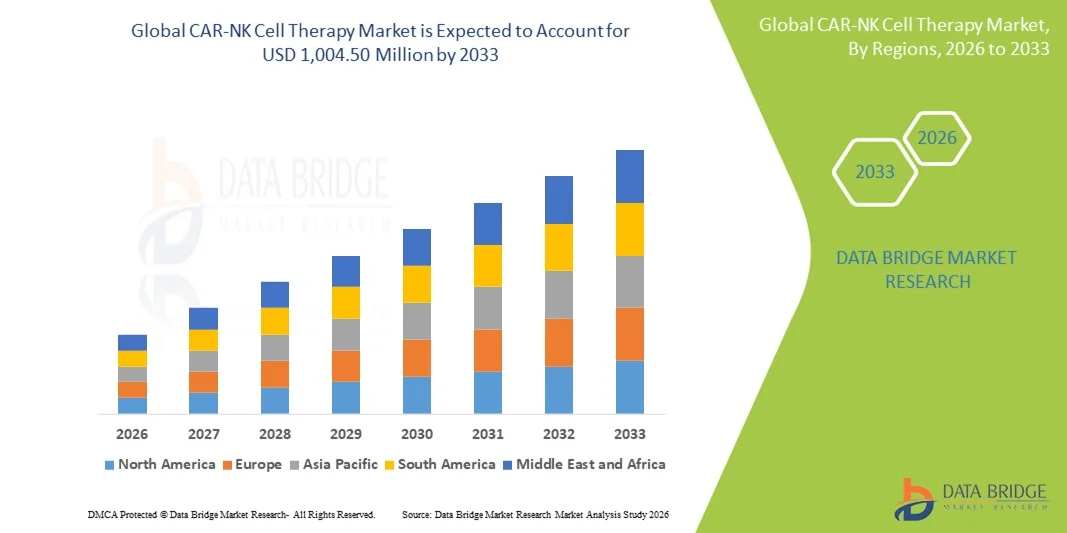
- Le marché mondial de la thérapie cellulaire CAR-NK était évalué à 346,5 millions de dollars américains en 2025 et devrait atteindre 1 004,50 millions de dollars américains d’ici 2033 , avec un TCAC de 14,20 % au cours de la période de prévision.
- La croissance du marché est largement alimentée par l'augmentation des investissements dans les immunothérapies avancées, la prévalence croissante du cancer et les progrès technologiques continus dans les techniques de génie génétique et de modification cellulaire, favorisant une adoption plus large de la thérapie cellulaire CAR-NK dans les contextes cliniques et de recherche.
- De plus, la demande croissante de traitements anticancéreux cellulaires plus sûrs et plus efficaces, ainsi que leurs avantages tels qu'un risque moindre de réaction du greffon contre l'hôte et leur disponibilité immédiate, accélèrent l'adoption des solutions de thérapie cellulaire CAR-NK, stimulant ainsi considérablement la croissance du marché.
Analyse du marché de la thérapie cellulaire CAR-NK
- La thérapie cellulaire CAR-NK, une forme émergente d'immunothérapie cellulaire adoptive, gagne en popularité en oncologie grâce à sa capacité à offrir une activité antitumorale ciblée avec une sécurité améliorée, un risque réduit de syndrome de libération de cytokines et un potentiel de traitement prêt à l'emploi par rapport aux thérapies CAR-T.
- La demande croissante de thérapie cellulaire CAR-NK est principalement due à l'augmentation de la prévalence mondiale du cancer, à l'intérêt grandissant porté aux immunothérapies de nouvelle génération, à l'intensification des essais cliniques et aux progrès constants des technologies de génie génétique et de production cellulaire.
- L'Amérique du Nord a dominé le marché de la thérapie cellulaire CAR-NK avec la plus grande part de revenus, soit environ 38,6 % en 2025, grâce à une infrastructure de R&D solide, un financement important de la recherche en oncologie, une adoption précoce des thérapies cellulaires avancées et une forte présence d'entreprises biotechnologiques et pharmaceutiques. Les États-Unis ont généré la majeure partie des revenus régionaux.
- La région Asie-Pacifique devrait connaître la croissance la plus rapide sur le marché de la thérapie cellulaire CAR-NK au cours de la période de prévision, enregistrant un TCAC élevé, grâce à l'expansion des secteurs biotechnologiques, au soutien gouvernemental croissant à la recherche en thérapie cellulaire, à la prévalence croissante du cancer et à l'amélioration des capacités d'essais cliniques dans des pays comme la Chine, le Japon et la Corée du Sud.
- Le segment des hémopathies malignes a représenté la plus grande part de revenus du marché (58,4 %) en 2025, grâce au succès clinique important des thérapies CAR-NK dans les cancers du sang tels que la leucémie, le lymphome et le myélome multiple.
Portée du rapport et segmentation du marché de la thérapie cellulaire CAR-NK
|
Attributs |
Thérapie cellulaire CAR-NK : principaux enseignements du marché |
|
Segments couverts |
|
|
Pays couverts |
Amérique du Nord
Europe
Asie-Pacifique
Moyen-Orient et Afrique
Amérique du Sud
|
|
Acteurs clés du marché |
• Nkarta Therapeutics (États-Unis) |
|
Opportunités de marché |
|
|
Ensembles d'informations de données à valeur ajoutée |
En plus des informations sur les scénarios de marché tels que la valeur du marché, le taux de croissance, la segmentation, la couverture géographique et les principaux acteurs, les rapports de marché élaborés par Data Bridge Market Research comprennent également une analyse approfondie par des experts, l'épidémiologie des patients, l'analyse du pipeline, l'analyse des prix et le cadre réglementaire. |
Tendances du marché de la thérapie cellulaire CAR-NK
Développement des plateformes de cellules CAR-NK allogéniques et prêtes à l'emploi
- Une tendance majeure et croissante sur le marché mondial des thérapies cellulaires CAR-NK est le passage aux thérapies CAR-NK allogéniques prêtes à l'emploi, qui offrent un profil de sécurité amélioré, des délais de production plus courts et des coûts de traitement réduits par rapport aux thérapies CAR-T autologues. Les cellules CAR-NK présentent des risques plus faibles de syndrome de libération de cytokines (SLC) et de réaction du greffon contre l'hôte (GVH), ce qui les rend adaptées à un plus large éventail de patients.
- Par exemple, en mars 2023, Fate Therapeutics a publié des données cliniques intermédiaires positives concernant son traitement CAR-NK prêt à l'emploi FT516 chez des patients atteints d'un lymphome à cellules B récidivant ou réfractaire, démontrant une sécurité et une activité antitumorale encourageantes.
- La disponibilité de produits cellulaires CAR-NK préfabriqués réduit considérablement le délai d'initiation du traitement, un facteur crucial pour les hémopathies malignes agressives. Cette tendance favorise la mise à l'échelle et la viabilité commerciale des thérapies CAR-NK.
- Les progrès du génie génétique, notamment l'amélioration des techniques de transduction virale et non virale, renforcent l'expression et la persistance des cellules NK et des CAR.
- L'utilisation de cellules souches pluripotentes induites (iPSC) comme source de cellules CAR-NK favorise une fabrication standardisée et une qualité de produit constante.
- Globalement, l'évolution vers des plateformes CAR-NK universelles remodèle le développement de la thérapie cellulaire et accélère son adoption clinique.
Dynamique du marché de la thérapie cellulaire CAR-NK
Conducteur
Prévalence croissante du cancer et limites des immunothérapies existantes
- L'augmentation du fardeau mondial du cancer, en particulier des hémopathies malignes et des tumeurs solides résistantes, est un facteur clé de la croissance du marché des thérapies cellulaires CAR-NK. Les limites associées à la chimiothérapie conventionnelle, à la radiothérapie et même aux thérapies CAR-T ont intensifié la demande d'immunothérapies plus sûres et plus efficaces.
- Par exemple, en janvier 2024, l'Institut national du cancer des États-Unis a mis en avant les thérapies CAR-NK comme une immunothérapie de nouvelle génération prometteuse en raison de leur toxicité réduite et de leur applicabilité plus large que les cellules CAR-T, justifiant ainsi une augmentation des financements de la recherche et des essais cliniques.
- Les thérapies CAR-NK offrent des capacités innées de destruction des tumeurs sans sensibilisation préalable à l'antigène, améliorant ainsi la polyvalence thérapeutique.
- Une incidence plus faible d'événements indésirables graves d'origine immunitaire améliore la sécurité des patients et la continuité des traitements.
- L'augmentation des investissements des entreprises pharmaceutiques et biotechnologiques accélère les processus de développement clinique.
- Le renforcement du soutien réglementaire aux thérapies cellulaires avancées consolide davantage les perspectives de croissance du marché.
Retenue/Défi
Complexité de fabrication, persistance limitée et coûts de développement élevés
- Malgré un fort potentiel clinique, le marché de la thérapie cellulaire CAR-NK est confronté à des défis liés à la complexité des procédés de fabrication, à la persistance in vivo limitée des cellules NK et aux coûts élevés de recherche et développement. Ces facteurs peuvent ralentir la commercialisation à grande échelle et l'accessibilité.
- Par exemple, des études cliniques publiées en 2022 ont indiqué que les cellules CAR-NK présentent une persistance plus courte chez les patients que les cellules CAR-T, ce qui nécessite des administrations répétées ou des approches combinées et augmente ainsi le coût global du traitement.
- La fabrication de cellules CAR-NK nécessite une infrastructure spécialisée, du personnel qualifié et des contrôles de qualité rigoureux.
- Une persistance cellulaire plus courte peut avoir un impact sur l'efficacité à long terme, notamment dans les indications de tumeurs solides.
- Les coûts de production élevés pourraient limiter l'adoption dans les systèmes de santé sensibles aux coûts.
- Relever ces défis grâce à une ingénierie cellulaire améliorée, des stratégies de soutien des cytokines et des plateformes de fabrication rentables sera essentiel pour une expansion durable du marché.
Étendue du marché de la thérapie cellulaire CAR-NK
Le marché est segmenté en fonction de l'indication et de l'utilisateur final.
- Par indication
Selon l'indication, le marché de la thérapie cellulaire CAR-NK est segmenté en hémopathies malignes, tumeurs solides et autres. Le segment des hémopathies malignes représentait la plus grande part de marché (58,4 %) en 2025, grâce au succès clinique important des thérapies CAR-NK dans les cancers du sang tels que la leucémie, le lymphome et le myélome multiple. Les cellules CAR-NK présentent une forte activité cytotoxique contre les antigènes CD19 et CD22, fréquemment exprimés dans les cancers hématologiques. La plus faible incidence du syndrome de libération de cytokines et de la réaction du greffon contre l'hôte, comparée aux thérapies CAR-T, a accéléré l'adoption de ces thérapies dans ce segment. Des résultats favorables lors des essais cliniques, des procédures réglementaires plus rapides et des taux de réponse plus élevés confortent cette position dominante. L'augmentation de la prévalence des cancers du sang à l'échelle mondiale et les investissements importants des entreprises de biotechnologie renforcent le leadership du marché. Des protocoles cliniques établis et une confiance accrue des médecins contribuent également à la pérennité des revenus.
Le segment des tumeurs solides devrait connaître le taux de croissance annuel composé (TCAC) le plus rapide, à 29,6 %, entre 2026 et 2033, grâce à l'innovation continue visant à surmonter les barrières du microenvironnement tumoral. Les progrès en ingénierie génétique, les constructions CAR multi-cibles et les cellules NK activées par les cytokines améliorent l'efficacité des traitements contre les tumeurs solides telles que le glioblastome, le cancer de l'ovaire et le cancer du pancréas. L'augmentation des besoins médicaux non satisfaits et l'efficacité limitée des immunothérapies existantes accélèrent l'orientation de la recherche. La multiplication des essais cliniques, les collaborations stratégiques et l'accroissement des financements alloués à l'immuno-oncologie des tumeurs solides favorisent une expansion rapide. L'amélioration des stratégies d'infiltration et de persistance contribue également à optimiser les résultats thérapeutiques. Ce segment représente une opportunité de croissance majeure pour le marché de la thérapie cellulaire CAR-NK.
- Par l'utilisateur final
Selon l'utilisateur final, le marché de la thérapie cellulaire CAR-NK se segmente en hôpitaux, centres de cancérologie spécialisés, instituts de recherche et établissements d'enseignement, et autres. En 2025, le segment des centres de cancérologie spécialisés représentait la plus grande part de marché (46,9 %), grâce à leurs infrastructures de pointe, leur expertise en immunothérapie cellulaire et leur capacité à gérer des traitements oncologiques complexes. Ces centres sont des sites privilégiés pour les essais cliniques CAR-NK et leur commercialisation précoce. La présence d'oncologues spécialisés, d'unités de traitement cellulaire et d'équipes de soins multidisciplinaires permet de traiter des volumes importants. Une forte implication dans la recherche translationnelle et des partenariats avec des entreprises de biotechnologie renforcent encore cette position dominante. La préférence des patients pour des soins oncologiques spécialisés et l'accès à des thérapies innovantes contribuent également à la concentration des revenus.
Le segment hospitalier devrait enregistrer le taux de croissance annuel composé (TCAC) le plus rapide, à 24,8 %, entre 2026 et 2033, grâce à l'adoption croissante des thérapies cellulaires avancées au-delà des centres de cancérologie spécialisés. L'augmentation des investissements hospitaliers dans les infrastructures d'oncologie et les unités de thérapie cellulaire améliore l'accessibilité. Le développement des collaborations avec les institutions universitaires et les entreprises de biotechnologie permet aux hôpitaux de proposer des traitements CAR-NK. L'afflux croissant de patients, l'amélioration des systèmes de remboursement et la sensibilisation accrue des médecins contribuent à cette croissance rapide. Les hôpitaux se positionnent de plus en plus comme des centres d'oncologie complets. Cette évolution accélère considérablement l'expansion du marché dans l'ensemble du système de santé.
Analyse régionale du marché de la thérapie cellulaire CAR-NK
- L'Amérique du Nord a dominé le marché de la thérapie cellulaire CAR-NK avec la plus grande part de revenus, soit environ 38,6 % en 2025.
- Soutenue par une infrastructure de R&D solide, un financement important de la recherche en oncologie, l'adoption précoce de thérapies cellulaires avancées et la forte présence d'entreprises biotechnologiques et pharmaceutiques
- La région bénéficie de réseaux d'essais cliniques bien établis, de cadres réglementaires favorables et d'investissements importants dans la recherche en immuno-oncologie, qui continuent d'accélérer le développement et la commercialisation des thérapies CAR-NK.
Aperçu du marché américain des thérapies cellulaires CAR-NK :
En 2025, le marché américain des thérapies cellulaires CAR-NK représentait la majeure partie des revenus en Amérique du Nord, grâce à d’importantes activités de recherche, à la prévalence croissante des hémopathies malignes et à un financement solide des secteurs public et privé. Aux États-Unis, les principaux instituts de recherche universitaires, les entreprises de biotechnologie et les sociétés pharmaceutiques s’emploient activement à développer des thérapies CAR-NK de nouvelle génération, plus sûres et plus efficaces. Par ailleurs, la présence de capacités de production avancées et le nombre croissant d’essais cliniques renforcent la position de leader des États-Unis sur ce marché.
Aperçu du marché européen des thérapies cellulaires CAR-NK :
Le marché européen des thérapies cellulaires CAR-NK devrait connaître une croissance annuelle composée (TCAC) notable au cours de la période de prévision, portée par l’augmentation des investissements dans la recherche en thérapie cellulaire et génique, des initiatives réglementaires favorables et une collaboration croissante entre les institutions académiques et les entreprises de biotechnologie. Plusieurs pays européens financent activement des programmes de recherche en oncologie, ce qui stimule l’innovation dans les thérapies cellulaires CAR-NK. L’incidence croissante du cancer et la demande d’alternatives plus sûres aux thérapies CAR-T contribuent également à la croissance du marché dans la région.
Aperçu du marché britannique des thérapies cellulaires CAR-NK :
Le marché britannique des thérapies cellulaires CAR-NK devrait connaître une croissance soutenue au cours de la période prévisionnelle, grâce à un fort soutien gouvernemental aux thérapies innovantes, un écosystème des sciences de la vie bien développé et une participation croissante aux essais cliniques. L’accent mis par le pays sur la recherche translationnelle et la médecine de précision favorise le développement de nouvelles plateformes CAR-NK, tandis que les partenariats entre universités, centres de recherche et entreprises de biotechnologie continuent de renforcer l’innovation et les perspectives de commercialisation.
Aperçu du marché allemand des thérapies cellulaires CAR-NK :
Le marché allemand des thérapies cellulaires CAR-NK devrait connaître une croissance annuelle composée (TCAC) considérable, portée par une infrastructure de recherche biomédicale solide, un système de santé performant et une attention accrue portée aux traitements innovants contre le cancer. Le leadership de l’Allemagne en matière de recherche clinique, conjugué à l’augmentation des investissements dans la production et le contrôle qualité des thérapies cellulaires, favorise l’adoption et le développement des thérapies CAR-NK, notamment dans les centres d’oncologie spécialisés.
Aperçu du marché des thérapies cellulaires CAR-NK en Asie-Pacifique :
Le marché des thérapies cellulaires CAR-NK en Asie-Pacifique devrait connaître la croissance la plus rapide au cours de la période de prévision, enregistrant un TCAC élevé. Cette croissance est alimentée par l’expansion des secteurs de la biotechnologie, le soutien croissant des gouvernements à la recherche en thérapie cellulaire, la prévalence croissante du cancer et l’amélioration des capacités en matière d’essais cliniques dans des pays comme la Chine, le Japon et la Corée du Sud. La région bénéficie également d’investissements croissants dans la production locale et la R&D, ce qui facilite l’accès aux thérapies cellulaires de pointe.
Aperçu du marché japonais de la thérapie cellulaire CAR-NK :
Le marché japonais de la thérapie cellulaire CAR-NK connaît une forte croissance grâce à des initiatives gouvernementales ambitieuses en faveur de la médecine régénérative, un cadre réglementaire bien établi pour les thérapies avancées et une recherche croissante sur les immunothérapies de nouvelle génération. Le vieillissement de la population japonaise et l’augmentation des cas de cancer stimulent la demande de traitements cellulaires innovants et plus sûrs, faisant de la thérapie CAR-NK une option prometteuse tant pour la recherche clinique que pour les applications cliniques futures.
Aperçu du marché chinois des thérapies cellulaires CAR-NK :
Le marché chinois des thérapies cellulaires CAR-NK représentait une part importante des revenus de la région Asie-Pacifique en 2025, grâce à l’expansion rapide du secteur des biotechnologies, à l’augmentation des financements publics pour la recherche en oncologie et à la multiplication des essais cliniques. L’accent mis par la Chine sur le développement de ses propres capacités en matière de thérapie cellulaire, conjugué à une collaboration étroite entre les instituts de recherche et les entreprises de biotechnologie, accélère le développement et la commercialisation potentielle des thérapies CAR-NK à travers le pays.
Part de marché de la thérapie cellulaire CAR-NK
L'industrie de la thérapie cellulaire CAR-NK est principalement dominée par des entreprises bien établies, notamment :
• Nkarta Therapeutics (États-Unis)
• Takeda Pharmaceutical (Japon)
• Cellular Biomedicine Group (États-Unis)
• Celyad Oncology (Belgique)
• Gilead Sciences (États-Unis)
• Bellicum Pharmaceuticals (États-Unis)
• Kiadis Pharma (Pays-Bas)
• Tessa Therapeutics (Singapour)
• Allogene Therapeutics (États-Unis)
• ImmunityBio (États -Unis)
• Karus Therapeutics (États-Unis)
• Mabwell Biotech (Chine)
• Innovative Cellular Therapeutics (Chine)
• Precision BioSciences (États-Unis)
• Sorrento Therapeutics (États-Unis)
• Adaptimmune Therapeutics (Royaume-Uni)
• Sangamo Therapeutics (États-Unis)
• Cellular Biologics (Chine)
• Freenome Therapeutics (États-Unis)
Dernières évolutions du marché mondial de la thérapie cellulaire CAR-NK
- En novembre 2024, Fate Therapeutics, société biopharmaceutique en phase clinique, a lancé FT522, une thérapie cellulaire CAR-NK ciblant CD19, prête à l'emploi et intégrant la technologie des récepteurs de défense allo-immune. Conçue pour persister et éliminer sélectivement les lymphocytes B pathogènes chez les patients atteints de lymphome B récidivant ou réfractaire et de maladies auto-immunes, cette thérapie a démontré une sécurité et une efficacité prometteuses lors des premières évaluations cliniques. Ce lancement s'inscrit dans la tendance plus générale des thérapies CAR-NK allogéniques « prêtes à l'emploi », qui visent à simplifier les traitements par rapport aux thérapies cellulaires personnalisées.
- En février 2025, le développement mondial des cellules CAR-NK a été mis en avant dans le cadre de la croissance plus large du marché des thérapies cellulaires NK. Le FT522, évalué lors d'essais de phase I, a démontré une déplétion rapide et durable des lymphocytes B, tandis que des plans d'extension du développement clinique à d'autres indications, notamment les maladies auto-immunes, étaient prévus. Ces résultats intermédiaires soulignent le potentiel des cellules CAR-NK à transformer les normes de soins dans de nombreux domaines pathologiques.
SKU-
Accédez en ligne au rapport sur le premier cloud mondial de veille économique
- Tableau de bord d'analyse de données interactif
- Tableau de bord d'analyse d'entreprise pour les opportunités à fort potentiel de croissance
- Accès d'analyste de recherche pour la personnalisation et les requêtes
- Analyse de la concurrence avec tableau de bord interactif
- Dernières actualités, mises à jour et analyse des tendances
- Exploitez la puissance de l'analyse comparative pour un suivi complet de la concurrence
Méthodologie de recherche
La collecte de données et l'analyse de l'année de base sont effectuées à l'aide de modules de collecte de données avec des échantillons de grande taille. L'étape consiste à obtenir des informations sur le marché ou des données connexes via diverses sources et stratégies. Elle comprend l'examen et la planification à l'avance de toutes les données acquises dans le passé. Elle englobe également l'examen des incohérences d'informations observées dans différentes sources d'informations. Les données de marché sont analysées et estimées à l'aide de modèles statistiques et cohérents de marché. De plus, l'analyse des parts de marché et l'analyse des tendances clés sont les principaux facteurs de succès du rapport de marché. Pour en savoir plus, veuillez demander un appel d'analyste ou déposer votre demande.
La méthodologie de recherche clé utilisée par l'équipe de recherche DBMR est la triangulation des données qui implique l'exploration de données, l'analyse de l'impact des variables de données sur le marché et la validation primaire (expert du secteur). Les modèles de données incluent la grille de positionnement des fournisseurs, l'analyse de la chronologie du marché, l'aperçu et le guide du marché, la grille de positionnement des entreprises, l'analyse des brevets, l'analyse des prix, l'analyse des parts de marché des entreprises, les normes de mesure, l'analyse globale par rapport à l'analyse régionale et des parts des fournisseurs. Pour en savoir plus sur la méthodologie de recherche, envoyez une demande pour parler à nos experts du secteur.
Personnalisation disponible
Data Bridge Market Research est un leader de la recherche formative avancée. Nous sommes fiers de fournir à nos clients existants et nouveaux des données et des analyses qui correspondent à leurs objectifs. Le rapport peut être personnalisé pour inclure une analyse des tendances des prix des marques cibles, une compréhension du marché pour d'autres pays (demandez la liste des pays), des données sur les résultats des essais cliniques, une revue de la littérature, une analyse du marché des produits remis à neuf et de la base de produits. L'analyse du marché des concurrents cibles peut être analysée à partir d'une analyse basée sur la technologie jusqu'à des stratégies de portefeuille de marché. Nous pouvons ajouter autant de concurrents que vous le souhaitez, dans le format et le style de données que vous recherchez. Notre équipe d'analystes peut également vous fournir des données sous forme de fichiers Excel bruts, de tableaux croisés dynamiques (Fact book) ou peut vous aider à créer des présentations à partir des ensembles de données disponibles dans le rapport.











