



Culture mondiale des cellules et tissus Réactifs et tampons des médias Segmentation du marché, par type de produit (Cell Culture Médias, réactifs et suppléments, tampons, serums et substituts de sérum), application (production biopharmaceutique, découverte et développement de médicaments, instituts universitaires et de recherche, diagnostics cliniques et médecine régénératrice) - Tendances et prévisions de l'industrie jusqu'en 2033
Qu'est-ce que la culture cellulaire et tissulaire Réactifs médiatiques et tampons Taille du marché et taux de croissance
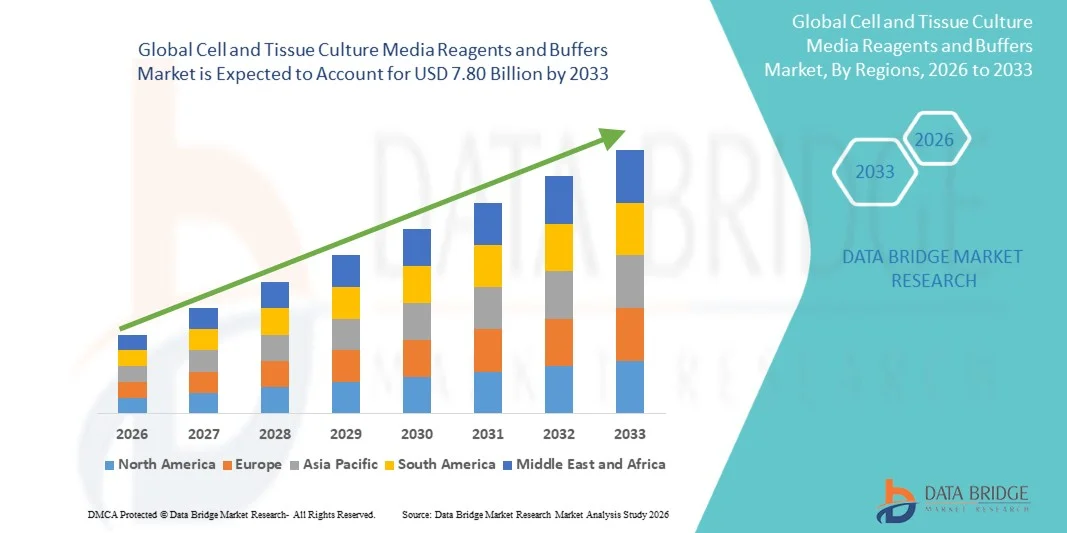
- La taille du marché des réactifs et des tampons des médias de la culture cellulaire et tissulaire a été évaluée à3,72 milliards de dollars en 2025et devrait atteindre7,80 milliards de dollars en 2033, à unTCAC de 9,70%pendant la période de prévision
- La croissance du marché est largement alimentée par l'adoption croissante d'une fabrication biopharmaceutique de pointe et l'expansion rapide de la recherche sur les cellules dans les laboratoires universitaires et industriels.
- De plus, la demande croissante de milieux de culture, de réactifs et de tampons de haute qualité et normalisés pour soutenir le développement de la thérapie cellulaire complexe, la médecine régénératrice et la production de produits biologiques est à l'origine de l'expansion du marché.
Culture cellulaire et tissulaire Réactifs et tampons des médias Analyse du marché
- Les milieux de culture cellulaire, les réactifs et les tampons sont des composantes essentielles des processus de culture cellulaire et tissulaire, qui permettent la croissance, la maintenance et l'analyse des cellules dans toutes les applications de recherche et de bioproduction.
- La demande croissante de réactifs et tampons pour les milieux de culture cellulaire et tissulaire est principalement alimentée par la croissance rapide de la fabrication de produits biologiques, l'adoption croissante de thérapies cellulaires et géniques et l'expansion des activités de recherche en médecine régénératrice et oncologie
- L'Amérique du Nord a dominé le marché des réactifs et des tampons pour la culture cellulaire et tissulaire avec la plus grande part des revenus de 38,5 % en 2025, en raison de la forte présence de grandes entreprises biopharmaceutiques, de l'infrastructure de recherche avancée, des dépenses élevées en R-D et de l'adoption massive de technologies de culture cellulaire novatrices.
- On s'attend à ce que l'Asie-Pacifique soit la région qui connaît la croissance la plus rapide du marché des réactifs et des tampons de culture cellulaire et tissulaire au cours de la période de prévision, avec un TCAC projeté de 12,8 %, en raison de l'augmentation des investissements dansbiotechnologie, l'expansion des services CRO/CDMO et l'adoption croissante de la recherche en thérapie cellulaire avancée dans des pays comme la Chine et l'Inde
- Le segment des médias de la culture cellulaire a dominé le marché avec la plus grande part des revenus de 42,5 % en 2025, soutenue par l'adoption croissante de la recherche sur les cellules et la demande croissante de médias de haute qualité pour la croissance et la prolifération des cellules.
Portée du rapport et culture des cellules et des tissus Réactifs des médias et segments de marché
|
Attributs |
Culture cellulaire et tissulaire Réactifs et tampons médiatiques Principales perspectives du marché |
|
Segments couverts |
|
|
Pays couverts |
Amérique du Nord
Europe
Asie-Pacifique
Moyen-Orient et Afrique
Amérique du Sud
|
|
Principaux acteurs du marché |
|
|
Possibilités de marché |
|
|
Infos sur la valeur ajoutée |
En plus des renseignements sur les scénarios de marché comme la valeur marchande, le taux de croissance, la segmentation, la couverture géographique et les principaux intervenants, les rapports de marché établis par Data Bridge Market Research comprennent également une analyse approfondie des experts, l'épidémiologie des patients, l'analyse des pipelines, l'analyse des prix et le cadre réglementaire. |
Quelle est la tendance clé du marché des réactifs et des tampons pour les médias de la culture cellulaire et tissulaire
(en milliers de dollars)Accent accru sur les formulations avancées de la culture des cellules et tissus(en milliers de dollars)
- L'une des tendances majeures et accélérées du marché des réactifs et des tampons pour les médias de la culture cellulaire et tissulaire est l'accent mis de plus en plus sur des formulations multimédias avancées et personnalisées conçues pour des types de cellules spécifiques, comme les cellules souches, les cellules primaires et les lignées cellulaires productrices de produits biologiques. Cette tendance s'explique par la nécessité d'améliorer la croissance cellulaire, d'accroître la productivité et d'obtenir des résultats expérimentaux cohérents.
- Par exemple, de nombreux fabricants de premier plan offrent maintenant des milieux sans sérum définis chimiquement, spécialement optimisés pour l'expansion des cellules souches, ainsi que des formulations de milieux adaptées à la fabrication de cellules CAR-T, assurant une reproductibilité et une conformité réglementaires accrues.
- Le passage à des milieux sans sérum et sans xénos est motivé par des préoccupations de sécurité et des attentes réglementaires, en particulier dans la production biopharmaceutique. Ces formulations réduisent le risque de contamination et de variabilité, ce qui favorise une culture cellulaire plus prévisible
- De plus, la demande de milieux offrant une stabilité accrue, une durée de conservation plus longue et une variabilité réduite entre lots augmente à mesure que les fabricants cherchent à améliorer l'efficacité de fabrication et la qualité des produits.
- Cette tendance est également soutenue par l'adoption accrue de systèmes de culture cellulaire évolués tels que la culture de cellules 3D, les organoïdes et les bioréacteurs, qui exigent des milieux spécialisés et des tampons pour soutenir des conditions de croissance cellulaire complexes
- Alors que les organismes de biopharmacie et de recherche poursuivent des thérapies plus sophistiquées, on s'attend à ce que le besoin de médias de culture adaptés et performants accélère davantage la croissance du marché.
Culture cellulaire et tissulaire Dynamique du marché des réactifs et des tampons
Chauffeur
Demande croissante de la fabrication de produits biopharmaceutiques et de thérapie cellulaire
- Le développement et la commercialisation croissants des thérapies cellulaires et géniques, y compris les thérapies CAR-T, les thérapies des cellules souches et les produits de médecine régénérative, sont des moteurs majeurs du marché des réactifs et des tampons pour les médias de culture cellulaire et tissulaire
- Par exemple, Lonza a élargi sa capacité de production de médias de thérapie cellulaire pour soutenir la demande croissante des développeurs de thérapie cellulaire, en particulier pour les médias de qualité GMP utilisés dans la fabrication clinique
- Au fur et à mesure que ces thérapies progressent au cours des étapes cliniques et commerciales, il existe une forte demande de solutions de support et de tampon de haute qualité et évolutives qui soutiennent la fabrication à grande échelle
- De plus, l'expansion du pipeline biopharmaceutique et l'augmentation des investissements dans la production de produits biologiques sont à l'origine d'une demande accrue de médias qui favorisent une forte densité cellulaire et une productivité élevée, assurant ainsi une fabrication rentable.
- En outre, l'augmentation des activités de recherche et des essais cliniques axés sur les produits biologiques complexes et la médecine personnalisée propulse la demande de médias spécialisés dans la culture
- La nécessité de solutions médiatiques reproductibles et conformes à la réglementation augmente à mesure que les fabricants cherchent des résultats cohérents pour les lots, ce qui stimule la croissance du marché.
Restriction/Défi
(en milliers de dollars)Coûts élevés et conformité réglementaire stricte(en milliers de dollars)
- Le coût élevé des milieux de culture cellulaire avancés, en particulier les formulations chimiquement définies et sans sérum, peut limiter l'adoption dans des milieux de recherche sensibles aux coûts et dans des laboratoires à petite échelle.
- Par exemple, le prix élevé des médias de qualité BPF utilisés dans la fabrication clinique limite souvent son utilisation aux grands acteurs biopharmaceutiques, ce qui limite l'accessibilité des petites entreprises de biotechnologie
- De nombreux médias spécialisés et produits tampons nécessitent des matières premières de haute qualité et des procédés de fabrication complexes, augmentant ainsi les coûts de production et les prix
- Des exigences réglementaires rigoureuses pour les milieux utilisés dans la fabrication clinique et la production de produits biologiques posent des défis aux fabricants, qui doivent maintenir un contrôle de la qualité rigoureux et la documentation nécessaire pour respecter les normes de conformité
- En outre, le coût élevé du développement et de la validation des formulations de nouveaux médias peut retarder le lancement des produits et restreindre l'entrée sur le marché des petits acteurs.
- Assurer une performance cohérente entre les différents lots reste un défi, en particulier dans les systèmes médiatiques complexes, qui peut avoir un impact sur la reproductibilité et la confiance des utilisateurs finals
- Surmonter ces obstacles aux coûts et à la conformité sera essentiel pour une adoption plus large du marché et une croissance soutenue
Culture cellulaire et tissulaire Réactifs et tampons des médias Portée du marché
Le marché est segmenté en fonction du type de produit et de l'application.
• Par type de produit
Sur la base du type de produit, le marché des réactifs et tampons de la culture cellulaire et tissulaire est segmenté en médias, réactifs et suppléments de la culture cellulaire, tampons, sériques et sériques. Le segment des médias de la culture cellulaire a dominé le marché avec la plus grande part de revenus de 42,5 % en 2025, soutenue par l'adoption croissante de la recherche sur les cellules et la demande croissante de médias de haute qualité pour la croissance et la prolifération des cellules. Le segment bénéficie de progrès continus dans les formulations de milieux pour les cellules de mammifères, les cellules souches et les lignées cellulaires spécialisées. La forte demande des établissements de fabrication biopharmaceutique et de recherche universitaire renforce encore son leadership. De plus, la tendance à la hausse de la production de produits biologiques et du développement de la thérapie cellulaire entraîne une consommation accrue de milieux de culture cellulaire. Le segment demeure dominant en raison de son rôle essentiel dans tous les workflows de culture cellulaire et de son utilisation élevée dans plusieurs applications.
Le segment des réactifs et des suppléments devrait connaître le TCAC le plus rapide de 22,1 % entre 2026 et 2033, en raison de la demande croissante de réactifs spécialisés comme les facteurs de croissance, les cytokines et les suppléments nécessaires à la culture cellulaire avancée et au biotraitement. L'adoption accrue de la culture cellulaire en 3D, des organoïdes et de la recherche sur les cellules souches accélère le besoin de suppléments avancés. La croissance des activités de découverte et de développement de médicaments stimule également la demande de réactifs de haute qualité. La croissance rapide du segment est soutenue par l'innovation continue et l'augmentation du financement de la recherche cellulaire.
• Par demande
Sur la base de la demande, le marché des réactifs et tampons des médias de culture cellulaire et tissulaire est segmenté en production biopharmaceutique, découverte et développement de médicaments, instituts universitaires et de recherche, diagnostics cliniques et médecine régénératrice. En 2025, le segment de la production biopharmaceutique a représenté la part de marché la plus importante de 39,8%, en raison de l'augmentation de la production d'anticorps monoclonaux, de vaccins et de thérapies cellulaires. La croissance de la fabrication de produits biologiques et l'expansion des organisations de fabrication sous contrat (OCM) stimulent considérablement la demande. Des normes réglementaires strictes et le besoin de médias et de tampons de haute qualité dans la production à grande échelle soutiennent davantage la domination du segment. L'augmentation des investissements dans les produits biologiques et l'expansion continue des capacités de production à l'échelle mondiale continuent de stimuler la croissance.
Le segment de la médecine régénératrice devrait connaître le TCAC le plus rapide de 23,5 % entre 2026 et 2033, en raison de l'augmentation de la recherche et de la commercialisation de la thérapie cellulaire et du génie tissulaire. La prévalence croissante des maladies chroniques et la demande de traitements personnalisés accélèrent l'adoption de la médecine régénérative. Le nombre croissant d'essais cliniques et le financement de la recherche sur les cellules souches sont aussi à l'origine de la demande de médias spécialisés et de suppléments. La croissance du segment est soutenue par l'expansion des applications dans la régénération des tissus et les thérapies à base de cellules.
Culture cellulaire et tissulaire Réactifs et tampons des médias Analyse régionale
- L'Amérique du Nord a dominé le marché des réactifs et tampons pour la culture cellulaire et tissulaire, avec la plus grande part des revenus de 38,5 % en 2025, en raison de la forte présence d'importantes entreprises biopharmaceutiques, de l'infrastructure de recherche avancée, des dépenses élevées en R-D et de l'adoption massive de technologies de culture cellulaire novatrices.
- Le leadership de la région est soutenu par un grand nombre d'essais cliniques, une demande croissante de produits biologiques et de thérapies cellulaires, et un financement public et privé solide pour la recherche en biotechnologie
- Les États-Unis sont les principaux contributeurs, en raison de leur écosystème biotechnologique bien établi, de leurs capacités de fabrication robustes et de l'adoption de milieux sans sérum et chimiquement définis pour la production à grande échelle.
La culture des cellules et tissus américains Réactifs et tampons des médias
Le marché américain des réactifs et des tampons de culture cellulaire et tissulaire a enregistré la plus grande part des revenus en 2025, en raison de la croissance rapide de la production biopharmaceutique, de l'augmentation des investissements dans la recherche sur les cellules et la thérapie génique et de l'adoption élevée de médias et de réactifs de culture de pointe. Le marché américain bénéficie d'une solide infrastructure en biotechnologie, d'institutions universitaires de premier plan et de grands services CRO/CDMO. Les innovations continues dans les milieux sans sérum, les réactifs sans xéno et les systèmes automatisés de culture cellulaire stimulent davantage la demande dans les secteurs de la recherche et de la fabrication.
Europe Culture des cellules et tissus Réactifs et tampons sur le marché
Le marché européen des réactifs et tampons pour la culture cellulaire et tissulaire devrait croître régulièrement en raison de l'augmentation des investissements dans la recherche biopharmaceutique, de l'augmentation de la demande de fabrication de produits biologiques et de la forte présence de grandes entreprises de biotechnologie en Allemagne, au Royaume-Uni et en France. La croissance est également soutenue par des politiques de réglementation favorables, l'augmentation du financement public pour la recherche en thérapie cellulaire et l'adoption croissante de technologies de médias de culture avancée dans la recherche universitaire et industrielle.
U.K. Culture des cellules et tissus Réactifs et tampons des médias Aperçu du marché
On s'attend à ce que le marché des réactifs et des tampons de culture cellulaire et tissulaire du Royaume-Uni augmente à un important TCAC en raison de l'augmentation de la recherche en thérapie cellulaire, de l'expansion de la fabrication biopharmaceutique et de solides collaborations en recherche universitaire. Le Royaume-Uni bénéficie d'un solide soutien gouvernemental, d'un grand nombre de start-up en biotechnologie et d'une demande croissante de médias et de réactifs spécialisés dans la découverte de médicaments et la recherche clinique.
Allemagne Culture des cellules et tissus Réactifs des médias et buffers Aperçu du marché
Allemagne On s'attend à ce que le marché des réactifs et des tampons de culture cellulaire et tissulaire augmente considérablement en raison des investissements croissants dans la biotechnologie et la thérapie cellulaire, des capacités de fabrication élevées et de la forte demande de médias de culture cellulaire de pointe. L'Allemagne est témoin d'une adoption accrue des milieux sans sérum, des réactifs de qualité GMP et de l'automatisation de la production et de la recherche biopharmaceutiques.
Asie-Pacifique Culture des cellules et tissus Réactifs et tampons sur le marché
Le marché des réactifs et tampons pour la culture cellulaire et tissulaire en Asie-Pacifique est sur le point de croître au rythme le plus rapide de 12,8% entre 2026 et 2033, en raison de l'augmentation des investissements dans la biotechnologie, de l'expansion des services CRO/CDMO et de l'adoption croissante de la recherche en thérapie cellulaire avancée dans des pays comme la Chine et l'Inde. L'augmentation du soutien gouvernemental, la croissance de la fabrication de produits biopharmaceutiques et l'expansion rapide des instituts de recherche accélèrent la croissance du marché.
Japon Culture des cellules et tissus Réactifs des médias et tampons Aperçu du marché
Le marché japonais des réactifs et des tampons de culture cellulaire et tissulaire est en croissance en raison d'investissements importants dans la médecine régénératrice et la thérapie cellulaire, de solides collaborations de recherche et de la demande croissante de médias spécialisés pour la recherche sur les cellules souches et les applications cliniques.
Chine Culture cellulaire et tissulaire Réactifs et tampons sur le marché
En 2025, le marché chinois des réactifs et des tampons pour la culture cellulaire et tissulaire a représenté la plus grande part du marché en Asie-Pacifique, en raison de la croissance rapide de la fabrication biopharmaceutique, de l'expansion de la recherche en thérapie cellulaire et de la forte production nationale de médias et de réactifs pour la culture. La Chine se concentre de plus en plus sur l'innovation en biotechnologie et la production de thérapie cellulaire à grande échelle soutient une forte croissance du marché.
Culture cellulaire et tissulaire Réactifs et tampons des médias Part de marché
L'industrie de la culture cellulaire et tissulaire des réactifs et des tampons médiatiques est principalement dirigée par des entreprises bien établies, notamment :
- Thermo Fisher Scientific (États-Unis)
- Merck KGaA (Allemagne)
- Corning Incorporated (États-Unis)
- Groupe Lonza AG (Suisse)
- Sartorius AG (Allemagne)
- GE Santé Sciences de la vie (États-Unis)
- Danaher Corporation (États-Unis)
- Bio-Techne Corporation (États-Unis)
- STEMCELL Technologies (Canada)
- Avantor, Inc. (États-Unis)
- Fujifilm Wako Pure Chemical Corporation (Japon)
- Takara Bio Inc. (Japon)
- Laboratoires HiMedia (Inde)
- PromoCell GmbH (Allemagne)
- PanReac AppliChem (Espagne)
- Cytiva (États-Unis)
- Miltenyi Biotec (Allemagne)
- PromoCell GmbH (Allemagne)
- Axygen Scientific (États-Unis)
- Biocon (Inde)
Les derniers développements dans la culture cellulaire et tissulaire Media Réactifs and Buffers Market
- En avril 2022, Captivate Bio a élargi son portefeuille de solutions de culture cellulaire en introduisant de nouveaux produits de médias classiques et des services de fabrication de médias personnalisés, y compris le kit Cocktail CET visant à améliorer les flux de travail des cellules souches pluripotentes humaines (hPSC), répondant à la demande de chercheurs pour des options multimédias fiables
- En juillet 2023, Sartorius AG a officiellement ouvert une nouvelle usine de fabrication de médias de culture cellulaire de 21 500 pieds carrés sur son site de Yauco (Porto Rico), améliorant ainsi la capacité de production des médias et des réactifs essentiels au développement biopharmaceutique et vaccinal.
- En juillet 2023, Lonza a lancé TheraPRO CHO Media System, une nouvelle plateforme de culture cellulaire conçue pour simplifier les processus et optimiser la production de protéines dans les lignées cellulaires GS-CHO, supportant les flux de production de protéines thérapeutiques
- En septembre 2024, Merck KGaA (qui opère sous le nom de MilliporeSigma aux États-Unis) a obtenu la première certification EXCiPACT cGMP pour ses processus de fabrication de supports de culture cellulaire sur plusieurs sites mondiaux, renforçant les normes de qualité et de sécurité des supports utilisés dans la production biopharmaceutique.
- En novembre 2024, Fujifilm Irvine Scientific a ouvert un nouveau centre d'innovation aux Pays-Bas axé sur la personnalisation des formulations de médias culturels pour les clients européens de la thérapie cellulaire, élargissant ainsi les capacités de développement et d'approvisionnement des médias mondiaux
- En janvier 2025, PromoCell a conclu un accord de distribution pluriannuel avec VWR International afin d'élargir l'accès aux cellules humaines primaires et aux réactifs de culture dans toute l'Europe, en améliorant la disponibilité des réactifs et le soutien aux laboratoires de recherche.
- En mars 2025, Thermo Fisher Scientific a annoncé une collaboration stratégique avec Lonza afin de co-développer des supports de culture cellulaire et des aliments pour la production biopharmaceutique à grande échelle, visant à améliorer la disponibilité des médias et l'évolutivité des procédés pour les fabricants mondiaux de produits biologiques.
- En mai 2025, Fujifilm Irvine Scientific a lancé un nouveau milieu de culture chimiquement défini, sans sérum, spécialement formulé pour l'entretien et la différenciation des cellules souches pluripotentes, pour répondre à la demande croissante dans les flux de travail de la thérapie cellulaire.
SKU-
Accédez en ligne au rapport sur le premier cloud mondial de veille économique

- Tableau de bord d'analyse de données interactif
- Tableau de bord d'analyse d'entreprise pour les opportunités à fort potentiel de croissance
- Accès d'analyste de recherche pour la personnalisation et les requêtes
- Analyse de la concurrence avec tableau de bord interactif
- Dernières actualités, mises à jour et analyse des tendances
- Exploitez la puissance de l'analyse comparative pour un suivi complet de la concurrence
Méthodologie de recherche
La collecte de données et l'analyse de l'année de base sont effectuées à l'aide de modules de collecte de données avec des échantillons de grande taille. L'étape consiste à obtenir des informations sur le marché ou des données connexes via diverses sources et stratégies. Elle comprend l'examen et la planification à l'avance de toutes les données acquises dans le passé. Elle englobe également l'examen des incohérences d'informations observées dans différentes sources d'informations. Les données de marché sont analysées et estimées à l'aide de modèles statistiques et cohérents de marché. De plus, l'analyse des parts de marché et l'analyse des tendances clés sont les principaux facteurs de succès du rapport de marché. Pour en savoir plus, veuillez demander un appel d'analyste ou déposer votre demande.
La méthodologie de recherche clé utilisée par l'équipe de recherche DBMR est la triangulation des données qui implique l'exploration de données, l'analyse de l'impact des variables de données sur le marché et la validation primaire (expert du secteur). Les modèles de données incluent la grille de positionnement des fournisseurs, l'analyse de la chronologie du marché, l'aperçu et le guide du marché, la grille de positionnement des entreprises, l'analyse des brevets, l'analyse des prix, l'analyse des parts de marché des entreprises, les normes de mesure, l'analyse globale par rapport à l'analyse régionale et des parts des fournisseurs. Pour en savoir plus sur la méthodologie de recherche, envoyez une demande pour parler à nos experts du secteur.
Personnalisation disponible
Data Bridge Market Research est un leader de la recherche formative avancée. Nous sommes fiers de fournir à nos clients existants et nouveaux des données et des analyses qui correspondent à leurs objectifs. Le rapport peut être personnalisé pour inclure une analyse des tendances des prix des marques cibles, une compréhension du marché pour d'autres pays (demandez la liste des pays), des données sur les résultats des essais cliniques, une revue de la littérature, une analyse du marché des produits remis à neuf et de la base de produits. L'analyse du marché des concurrents cibles peut être analysée à partir d'une analyse basée sur la technologie jusqu'à des stratégies de portefeuille de marché. Nous pouvons ajouter autant de concurrents que vous le souhaitez, dans le format et le style de données que vous recherchez. Notre équipe d'analystes peut également vous fournir des données sous forme de fichiers Excel bruts, de tableaux croisés dynamiques (Fact book) ou peut vous aider à créer des présentations à partir des ensembles de données disponibles dans le rapport.











