


Global continue Bioprocessing Consommables & Réactifs Marché Segmentation, Par Produit (Ensembles et sacs à usage unique, Tubage, raccords et connecteurs, Consommables Filtration, Membranes & cartouches, résines chromatographiques et colonnes à usage unique, Capteurs et sondes à usage unique, Consommables d'échantillonnage et de transfert aseptique, Consommables pour médias et tampons et produits auxiliaires jetables), Phase de traitement (traitement en amont, traitement en aval et traitement continu intégré), Application (anticorps monocloniens, protéines recombinantes, vaccins, thérapie génique et biosimilaires), Utilisateur final (entreprises pharmaceutiques et biopharmaceutiques, organisations de fabrication à contrat, instituts universitaires et de recherche et équipement OEM)- Tendances et prévisions de l'industrie jusqu'en 2033
Quelle est la taille et le taux de croissance du marché des consommables et réactifs en biotraitement continu
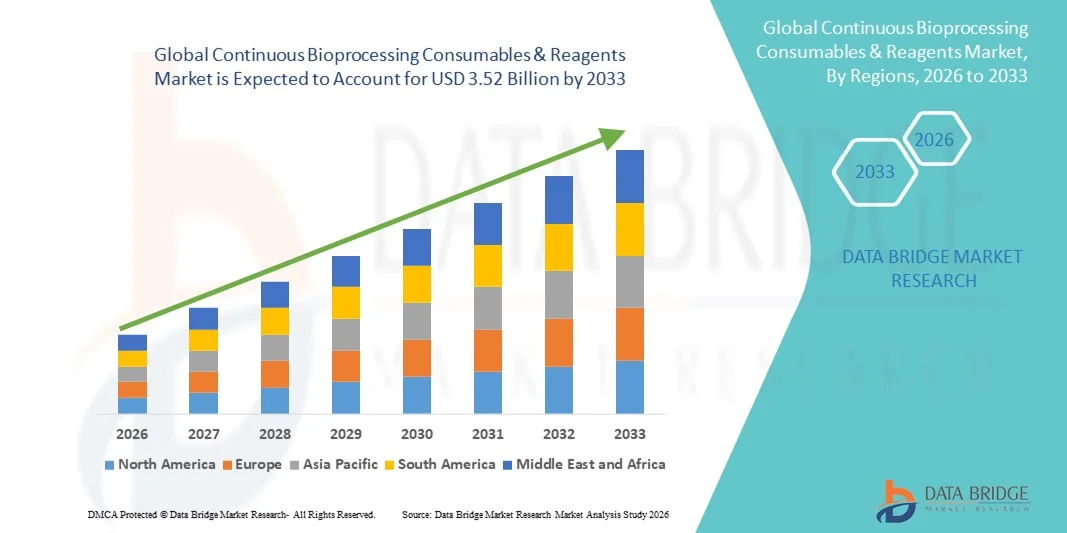
- La taille du marché mondial des consommables et des réactifs de biotraitement continu a été évaluée à1,81 milliard de dollars en 2025et devrait atteindre3,52 milliards de dollars en 2033, à unTCAC de 8,70%pendant la période de prévision
- La croissance du marché s'explique en grande partie par l'adoption croissante de technologies de fabrication continue dans l'industrie biopharmaceutique, ainsi que par l'augmentation de la demande de consommables à usage unique, de réactifs et de matériaux propres aux procédés, qui améliorent la productivité, l'évolutivité et l'efficacité économique.
- De plus, l'accent mis de plus en plus sur l'intensification des processus, la réduction des temps d'arrêt de fabrication et l'amélioration de la cohérence des produits accélèrent le passage du traitement traditionnel par lots aux flux de travail continus. Ces facteurs renforcent la demande de consommables et de réactifs spécialisés, ce qui favorise considérablement la croissance globale du marché.
Quels sont les principaux débouchés du marché des consommables et réactifs en biotraitement continu
- Les consommables et réactifs continus de biotraitement, y compris les assemblages et sacs à usage unique, les consommables de filtration, les membranes, les résines chromatographiques, les supports et tampons et les capteurs, sont essentiels pour permettre des flux de travail continus en amont et en aval de la fabrication de produits biologiques, pour soutenir le contrôle amélioré des procédés, la stérilité et la consistance des produits dans la production de produits biologiques.
- L'augmentation de la demande de ces consommables s'explique principalement par le passage de l'ensemble de l'industrie à des technologies de biotraitement continues, ce qui a pour effet d'accroître la production deanticorps monoclonauxet des protéines recombinantes, et adoption croissante de systèmes à usage unique qui réduisent les risques de contamination et les coûts opérationnels
- En 2025, l'Amérique du Nord a dominé le marché des consommables et des réactifs continus du biotraitement, avec la plus grande part de revenus de 40,6%, soutenue par un écosystème de fabrication biologique mature, une forte présence d'entreprises pharmaceutiques et biopharmaceutiques et l'adoption rapide de plates-formes de transformation continue, particulièrement aux États-Unis.
- L'Asie-Pacifique devrait être la région qui connaîtra la croissance la plus rapide au cours de la période de prévision en raison de l'accroissement de la capacité de fabrication de produits biologiques, de l'augmentation des investissements dans des infrastructures de pointe en matière de biotraitement et de l'augmentation de l'activité des organismes de fabrication contractuels (OCM) dans les économies émergentes.
- Le segment du traitement en amont a dominé le marché avec une part de 46,7 % en 2025, sous l'impulsion d'une forte demande de produits consommables pour les médias et les tampons, de matériaux de filtration, de tubes et de composants à usage unique utilisés dans les systèmes de biotraitement par culture cellulaire continue et par perfusion
Portée du rapport et segmentation du marché des consommables et des réactifs en biotraitement continu
|
Attributs |
Biotraitement continu Consommables et réactifs Principales perspectives du marché |
|
Segments couverts |
|
|
Pays couverts |
Amérique du Nord
Europe
Asie-Pacifique
Moyen-Orient et Afrique
Amérique du Sud
|
|
Principaux acteurs du marché |
|
|
Possibilités de marché |
|
|
Infos sur la valeur ajoutée |
En plus des renseignements sur les scénarios du marché comme la valeur du marché, le taux de croissance, la segmentation, la couverture géographique et les principaux intervenants, les rapports de marché établis par Data Bridge Market Research comprennent également une analyse approfondie des experts, l'épidémiologie des patients, l'analyse des pipelines, l'analyse des prix et le cadre réglementaire. |
Quelle est la tendance clé du marché des consommables et des réactifs en biotraitement continu
L'adoption croissante de consommables continus à usage unique et intégrés
- Une tendance importante et accélérée sur le marché mondial des consommables et des réactifs de biotraitement continu est la dépendance croissante à l'égard de solutions consommables intégrées à usage unique qui supportent des flux de travail continus en amont et en aval. Par exemple, les fabricants de produits biopharmaceutiques adoptent de plus en plus des tubulures à usage unique, des unités de filtration et des colonnes de chromatographie préassemblées pour accélérer les transitions et réduire le risque de contamination dans les lignes de traitement continu.
- L'utilisation de consommables de pointe tels que des capteurs à usage unique, des membranes et des réactifs de surveillance en temps réel permet d'améliorer le contrôle des processus, la qualité des produits et une intervention manuelle réduite dans les opérations continues. Par exemple, le déploiement croissant de systèmes de culture cellulaire à base de perfusion stimule la demande de supports de haute performance, de consommables tampons et de composants de filtration spécialement conçus pour des parcours continus de longue durée
- L'intégration des consommables en amont et en aval soutient le biotraitement continu de bout en bout, ce qui permet aux fabricants de minimiser les temps d'arrêt, de réduire la complexité de la validation et d'améliorer l'efficacité globale de la fabrication
- Cette évolution vers des consommables normalisés, jetables et interopérables remodelera les stratégies de fabrication, les fournisseurs se concentrant de plus en plus sur des plateformes consommables évolutives adaptées à la production continue de produits biologiques.
- L'accent mis de plus en plus sur la durabilité encourage le développement de consommables dont l'utilisation des matériaux est réduite, l'amélioration de la recyclabilité et l'atténuation de l'impact sur l'environnement sans compromettre la performance des procédés.
Quels sont les principaux moteurs du marché des consommables et des réactifs en biotraitement continu
Production croissante de produits biologiques et transition vers la fabrication continue
-
La demande mondiale croissante en produits biologiques, y compris les anticorps monoclonaux, les protéines recombinantes et les biosimilaires, associée à la transition de l'industrie de la fabrication par lots à la fabrication continue, est un facteur clé du marché des consommables et des réactifs. Par exemple, les entreprises pharmaceutiques et biopharmaceutiques développent des installations continues en amont et en aval pour améliorer le rendement, réduire les coûts de production et accélérer la commercialisation des produits biologiques complexes.
- La fabrication continue nécessite un approvisionnement régulier et fiable en consommables spécialisés tels que les milieux, les tampons, les matériaux de filtration et les résines chromatographiques, ce qui entraîne une demande récurrente tout au long du cycle de production.
- De plus, l'adoption de technologies à usage unique dans les procédés continus entraîne une augmentation des volumes de consommation d'assemblages jetables, de tubes et de consommables de transfert aseptique
- Le rôle croissant des organisations de fabrication sous contrat (OCM) dans la production de produits biologiques contribue davantage à la croissance du marché, les OCM investissant de plus en plus dans des plates-formes flexibles et continues qui dépendent fortement des consommables et des réactifs.
- Ensemble, ces facteurs accélèrent l'adoption de consommables et de réactifs continus de biotraitement à l'échelle de la fabrication commerciale et de la production clinique.
- L'encouragement réglementaire croissant à la fabrication continue par les autorités sanitaires incite davantage les entreprises biopharmaceutiques à passer à des flux de travail continus.
- De plus en plus d'investissements dans des pipelines de produits biologiques de pointe, y compris des thérapies géniques et des protéines complexes, élargissent le marché des produits consommables et des réactifs de grande valeur propres à chaque procédé.
Restriction/Défi
Exigences de qualification élevées et complexité de la chaîne d'approvisionnement
- La nécessité d'une validation, d'une qualification et d'une conformité réglementaire étendues des consommables et des réactifs utilisés dans le biotraitement continu pose un défi important à la croissance du marché Par exemple, les changements dans les matériaux consommables ou les fournisseurs exigent souvent une nouvelle validation des procédés continus, une augmentation du temps, des coûts et de la complexité opérationnelle pour les fabricants.
- Les perturbations de la chaîne d'approvisionnement ou les pénuries de consommables critiques comme les membranes de filtration, les milieux ou les résines chromatographiques peuvent avoir un impact direct sur la production continue, lorsque les interruptions sont plus coûteuses que dans le traitement par lots.
- De plus, le coût initial plus élevé des consommables spécialisés à usage continu par rapport aux consommables classiques par lots peut dissuader l'adoption parmi les petites entreprises biopharmaceutiques et les instituts de recherche
- Pour surmonter ces défis, il faudra mettre en place de solides stratégies de qualification des fournisseurs, améliorer la résilience de la chaîne d'approvisionnement et resserrer la collaboration entre les fabricants consommables et les producteurs biopharmaceutiques.
- La disponibilité limitée de consommables standardisés par les fournisseurs peut restreindre l'interopérabilité et la flexibilité dans les installations de biotraitement continu multivendeurs
- La gestion d'accords d'approvisionnement à long terme et l'assurance d'une qualité uniforme pour les usages consommables à forte consommation demeurent des défis critiques pour les activités de fabrication continues.
Comment le marché des consommables et des réactifs du biotraitement continu est-il segmenté
Le marché est segmenté en fonction du produit, de l'étape du processus, de l'application et de l'utilisateur final.
- Par produit
Sur la base du produit, le marché des consommables et réactifs de biotraitement continu est segmenté en assemblages et sacs à usage unique, tubulures, raccords et connecteurs, consommables de filtration, membranes et cartouches, résines chromatographiques et colonnes à usage unique, capteurs et sondes à usage unique, consommables de prélèvement et de transfert aseptique, consommables de support et de tampon et jetables auxiliaires. Le segment des consommables multimédias et tampons a dominé le marché en 2025, en raison de leur utilisation continue et en volume élevé dans le traitement en amont basé sur la perfusion et des flux de travail continus intégrés. Les milieux et les tampons sont consommés régulièrement tout au long des cycles de production, ce qui les rend indispensables au maintien de la viabilité cellulaire, de la productivité et de la qualité des produits. Leur nature récurrente entraîne une demande stable et prévisible dans la fabrication commerciale et clinique. En outre, la complexité croissante des produits biologiques a conduit à une plus grande personnalisation des formulations des médias, ce qui a renforcé la domination de ce segment.
Le segment des résines chromatographiques et des colonnes à usage unique devrait connaître la croissance la plus rapide durant la période de prévision, soutenue par l'adoption croissante de technologies de purification continue en aval. Les techniques de chromatographie continue comme la chromatographie multicolonne nécessitent des résines spécialisées optimisées pour des durées de vie opérationnelles élevées et prolongées. La production croissante d'anticorps monoclonaux et de biosimilaires accélère la demande de résines de pointe qui offrent une plus grande capacité de liaison et une plus grande efficacité des procédés. De plus, la transition vers des colonnes à usage unique réduit les exigences de validation du nettoyage, ce qui les rend de plus en plus attrayants pour les fabricants.
- Par étape du processus
Sur la base de l'étape du processus, le marché est segmenté en traitement en amont, en aval et en continu intégré. Le segment de transformation en amont a dominé le marché en 2025 avec une part de marché de 46,7 %, principalement en raison de l'adoption généralisée de cultures cellulaires continues et de systèmes de bioréacteur à base de perfusion. Les opérations en amont nécessitent de grandes quantités de consommables tels que les médias, les tampons, les composants de filtration, les tubes et les capteurs pour soutenir la croissance et la productivité des cellules. Les procédés continus en amont fonctionnent pendant des durées prolongées, ce qui entraîne une utilisation consommable beaucoup plus élevée que les procédés par lots. L'accent croissant mis sur l'amélioration des rendements et la réduction de l'empreinte des installations renforce encore la domination de ce segment.
On prévoit que le segment du traitement continu intégré augmentera au rythme le plus rapide au cours de la période de prévision, sous l'impulsion de l'industrie vers la fabrication continue de bout en bout. Les systèmes intégrés combinent les opérations en amont et en aval en un flux de travail sans faille, de plus en plus tributaire des consommables et des réactifs interopérables. Cette approche minimise les étapes de maintien, réduit la variabilité des processus et améliore l'efficacité globale. Au fur et à mesure que la confiance de la réglementation dans la fabrication continue augmentera, l'adoption de systèmes intégrés devrait s'accélérer, ce qui stimulera une croissance rapide dans ce segment.
- Par demande
Sur la base de l'application, le marché continu des consommables et des réactifs de biotraitement est segmenté en anticorps monoclonaux, protéines recombinantes, vaccins, thérapie génique et biosimilaires. Le segment des anticorps monoclonaux a représenté la plus grande part de marché en 2025, en raison de leur position dominante dans le pipeline mondial de produits biologiques et le paysage commercial de production. La fabrication continue d'anticorps monoclonaux nécessite l'utilisation intensive de consommables en amont et en aval, y compris les milieux, les résines chromatographiques, les systèmes de filtration et les assemblages à usage unique. Les volumes de production élevés et la demande commerciale à long terme de mAbs assurent une consommation consommable soutenue. De plus, l'innovation continue dans les formats d'anticorps continue de soutenir ce segment de leadership.
Le segment de la thérapie génique devrait connaître la croissance la plus rapide au cours de la période de prévision, en raison de l'expansion rapide des thérapies à base de vecteurs viraux et de l'augmentation de l'activité clinique et commerciale. La fabrication de la thérapie génique nécessite des consommables hautement spécialisés adaptés aux matériaux biologiques sensibles et complexes. Le traitement continu offre des avantages en termes de cohérence et d'évolutivité, ce qui le rend de plus en plus attrayant pour les développeurs de thérapie génique. À mesure que les thérapies génétiques progressent vers la commercialisation, la demande de consommables et de réactifs spécifiques à l'application devrait augmenter fortement.
- Par Utilisateur final
Sur la base de l'utilisateur final, le marché est segmenté en sociétés pharmaceutiques et biopharmaceutiques, organisations de fabrication sous contrat (OCM), instituts universitaires et de recherche, et équipement OEM. Le segment des entreprises pharmaceutiques et biopharmaceutiques a dominé le marché en 2025, soutenu par des investissements à grande échelle dans l'infrastructure de fabrication continue et les capacités de production de produits biologiques internes. Ces entreprises consomment des volumes élevés de consommables et de réactifs pour la fabrication commerciale, le développement des procédés et la gestion du cycle de vie. L'accent qu'ils ont mis sur l'efficience, l'évolutivité et la conformité à la réglementation entraîne une demande constante de consommables validés.
On s'attend à ce que le segment des organisations de fabrication à contrat enregistre le taux de croissance le plus rapide au cours de la période de prévision, en raison de l'externalisation accrue de la production de produits biologiques par les grandes entreprises pharmaceutiques et les nouvelles entreprises de biotechnologie. Les OCM adoptent rapidement la biotransformation continue pour offrir des services de fabrication flexibles et multiproduits. Ce modèle repose en grande partie sur des consommables et des réactifs normalisés et à haut débit pour soutenir plusieurs clients et produits. On s'attend à ce que le rôle croissant des OCM dans la fabrication de produits biologiques avancés accélère considérablement la demande de produits consommables dans ce segment.
Biotraitement continu Consommables et réactifs Analyse régionale du marché
- En 2025, l'Amérique du Nord a dominé le marché des consommables et des réactifs continus du biotraitement, avec la plus grande part de revenus de 40,6%, soutenue par un écosystème de fabrication biologique mature, une forte présence d'entreprises pharmaceutiques et biopharmaceutiques et l'adoption rapide de plates-formes de transformation continue, particulièrement aux États-Unis.
- Les fabricants de la région accordent une grande valeur à l'efficacité des procédés, à la cohérence des produits et à la conformité à la réglementation, ce qui accroît l'utilisation de consommables et de réactifs spécialisés dans les opérations continues en amont et en aval.
- Cette large adoption s'appuie également sur d'importants investissements en R-D, la présence d'entreprises pharmaceutiques et biopharmaceutiques de premier plan et la mise en place croissante de plates-formes de fabrication continue, le positionnement de l'Amérique du Nord comme le premier marché régional pour les consommables et les réactifs de biotraitement continu.
Consommables et réactifs de biotraitement continu aux États-Unis
En 2025, le marché américain des consommables et des réactifs de biotraitement continu a enregistré la plus grande part de revenus en Amérique du Nord, soutenue par l'écosystème de fabrication biopharmaceutique avancé du pays et l'adoption rapide de technologies de production continue. Aux États-Unis, les entreprises biopharmaceutiques se tournent de plus en plus vers des processus continus en amont et en aval pour améliorer l'efficacité, réduire les coûts et améliorer la cohérence des produits. Des investissements importants dans la R-D biologique, conjugués à un soutien réglementaire pour des approches de fabrication avancées, continuent de stimuler la demande soutenue de consommables et de réactifs de haute qualité dans les installations de production commerciale et clinique.
Europe Biotraitement continu Consommables & Réactifs Aperçu du marché
Le marché européen des consommables et des réactifs de biotraitement continu devrait s'étendre à un TCAC stable au cours de la période de prévision, principalement en raison de l'adoption croissante de technologies de fabrication de pointe et de normes réglementaires rigoureuses pour la production de produits biologiques. La région se concentre sur l'optimisation des processus, l'assurance de la qualité et la durabilité encourage les fabricants à adopter des solutions de traitement continu. La croissance est observée dans les entreprises pharmaceutiques et les OCM, la demande de produits consommables augmentant tant dans les activités commerciales de fabrication que dans les activités de développement des procédés en Europe occidentale et septentrionale.
Royaume-Uni Biotraitement continu Consommables & Réactifs Aperçu du marché
On s'attend à ce que le marché des consommables et des réactifs continus de biotraitement au Royaume-Uni augmente à un TCAC notable au cours de la période de prévision, grâce à un solide soutien gouvernemental aux sciences de la vie, à l'expansion des pipelines de produits biologiques et à l'augmentation des investissements dans des infrastructures de fabrication de pointe. La présence d'instituts de recherche de premier plan et la collaboration croissante entre les universités et l'industrie favorisent l'adoption d'un traitement continu. Ces facteurs stimulent la demande constante de consommables et de réactifs spécialisés utilisés dans le biotraitement en amont et en aval.
Allemagne Biotraitement continu Consommables & Réactifs Aperçu du marché
Le marché allemand des consommables et des réactifs de biotraitement continu devrait s'étendre à un TCAC considérable, alimenté par le pays, l'accent étant mis sur l'innovation, la fabrication de précision et la conformité réglementaire. L'Allemagne, secteur pharmaceutique et biotechnologique bien établi, adopte de plus en plus la biotransformation continue pour améliorer l'efficacité et l'évolutivité. L'accent de plus en plus mis sur la production de produits biologiques de haute qualité et l'automatisation des processus appuie la demande de consommables de pointe, en particulier dans les processus de purification en aval et de traitement intégré.
Asie-Pacifique Biotraitement continu Consommables et réactifs Aperçu du marché
Le marché des consommables et des réactifs continus de biotraitement en Asie et dans le Pacifique devrait croître le plus rapidement possible durant la période de prévision, en raison de l'expansion rapide de la capacité de fabrication biopharmaceutique, de l'augmentation des investissements dans les produits biologiques et des initiatives gouvernementales favorables. Des pays comme la Chine, le Japon, la Corée du Sud et l'Inde sont témoins d'une adoption croissante de technologies de fabrication continue. La région joue un rôle de plus en plus important en tant que pôle mondial de production de produits biologiques.
Japon Biotraitement continu Consommables et réactifs Aperçu du marché
Le marché japonais des consommables et des réactifs de biotraitement continue prend de l'ampleur en raison des capacités technologiques avancées du pays, de l'importance accordée à la qualité et de l'augmentation des activités de développement des produits biologiques. Les fabricants japonais mettent l'accent sur la cohérence et l'efficacité des processus, faisant du biotraitement continu une approche attrayante. L'intégration de technologies d'automatisation et de surveillance avancées stimule la demande de consommables et de réactifs de haute performance dans les opérations en amont et en aval.
Inde Biotraitement continu Consommables et réactifs Aperçu du marché
En 2025, le marché indien des consommables et des réactifs de biotraitement continu a représenté une part importante de l'Asie-Pacifique, soutenu par la croissance rapide de l'industrie biopharmaceutique nationale et l'augmentation des investissements dans la fabrication de produits biologiques et de biosimilaires. Le rôle croissant de l'Inde en tant que fournisseur mondial de produits biologiques abordables encourage l'adoption de plates-formes de traitement continu rentables. La présence d'un nombre croissant d'OCM, conjuguée aux initiatives gouvernementales de soutien à la biotechnologie et à la fabrication de produits pharmaceutiques, est à l'origine d'une augmentation de la consommation de produits consommables et de réactifs dans l'ensemble du pays.
Part de marché des consommables et des réactifs en biotraitement continu
L'industrie des consommables et réactifs en biotraitement continu est principalement dirigée par des entreprises bien établies, notamment :
- Thermo Fisher Scientific Inc.(États-Unis)
- La société Sartorius AG(Allemagne)
- Merck KGaA(Allemagne)
- Danaher(États-Unis)
- Pall Corporation (États-Unis)
- Société des Repligen (États-Unis)
- Eppendorf AG (Allemagne)
- Corning Incorporated (États-Unis)
- Meissner Filtration Products, Inc. (États-Unis)
- Avantor, Inc. (États-Unis)
- Saint-Gobain Sciences de la vie (France)
- Entegris, Inc. (États-Unis)
- PBS Biotech, Inc. (États-Unis)
- Groupe Lonza AG (Suisse)
- FUJIFILM Diosynth Biotechnologies (Japon)
- Asahi Kasei Corporation (Japon)
- 3M (États-Unis)
- Getinge AB (Suède)
- Samsung Biologics Co., Ltd. (Corée du Sud)
- Applikon Biotechnologie B.V. (Pays-Bas)
Quelles sont les évolutions récentes du marché mondial des consommables et des réactifs en biotraitement continu
- En décembre 2025, Thermo Fisher Scientific a élargi ses capacités de biotraitement dans toute l'Asie en créant et en élargissant des centres de conception de bioprocédés à Hyderabad (Inde), Incheon (Corée) et Singapour, offrant un soutien adapté et des technologies de pointe aux innovateurs biopharmaceutiques locaux, ces centres facilitent l'accès à une expertise continue en biotraitement des produits consommables et accélèrent l'adoption de produits de fabrication localisés
- En septembre 2025, Thermo Fisher Scientific a terminé l'acquisition de l'entreprise Solventums Purification & Filtration, intégrant les technologies de filtration avancées dans son segment Life Sciences Solutions pour mieux servir les clients biopharmaceutiques et améliorer les offres de biotraitement de bout en bout.
- En février 2025, Thermo Fisher Scientific a annoncé un accord définitif pour l'acquisition de l'entreprise Solventums Purification & Filtration pour environ 4,1 milliards de dollars, élargissant son portefeuille de solutions de filtration et de membranes bioprocédés afin de renforcer les flux de travail en amont et en aval concernant les consommables et réactifs continus de biotraitement.
- En novembre 2023, WuXi Biologics a annoncé qu'elle terminait sa fabrication en aval à l'échelle pilote en utilisant sa plate-forme brevetée de biotraitement continu à haute productivité (WuXiUP) à son usine pilote non GMP de Shanghai, et l'appliquera à l'échelle mondiale pour démontrer l'application réelle et l'échelle des technologies de biotraitement continu qui conduisent directement à la demande de consommables et de réactifs connexes.
- En juin 2023, Waters Corporation et Sartorius AG ont annoncé une collaboration pour intégrer des solutions analytiques pour la biofabrication en aval, en combinant la plate-forme de chromatographie de Sartorius et les systèmes d'analyse des processus de Waters, afin d'améliorer les données et l'efficacité pour les opérations continues en aval.
SKU-
Accédez en ligne au rapport sur le premier cloud mondial de veille économique

- Tableau de bord d'analyse de données interactif
- Tableau de bord d'analyse d'entreprise pour les opportunités à fort potentiel de croissance
- Accès d'analyste de recherche pour la personnalisation et les requêtes
- Analyse de la concurrence avec tableau de bord interactif
- Dernières actualités, mises à jour et analyse des tendances
- Exploitez la puissance de l'analyse comparative pour un suivi complet de la concurrence
Méthodologie de recherche
La collecte de données et l'analyse de l'année de base sont effectuées à l'aide de modules de collecte de données avec des échantillons de grande taille. L'étape consiste à obtenir des informations sur le marché ou des données connexes via diverses sources et stratégies. Elle comprend l'examen et la planification à l'avance de toutes les données acquises dans le passé. Elle englobe également l'examen des incohérences d'informations observées dans différentes sources d'informations. Les données de marché sont analysées et estimées à l'aide de modèles statistiques et cohérents de marché. De plus, l'analyse des parts de marché et l'analyse des tendances clés sont les principaux facteurs de succès du rapport de marché. Pour en savoir plus, veuillez demander un appel d'analyste ou déposer votre demande.
La méthodologie de recherche clé utilisée par l'équipe de recherche DBMR est la triangulation des données qui implique l'exploration de données, l'analyse de l'impact des variables de données sur le marché et la validation primaire (expert du secteur). Les modèles de données incluent la grille de positionnement des fournisseurs, l'analyse de la chronologie du marché, l'aperçu et le guide du marché, la grille de positionnement des entreprises, l'analyse des brevets, l'analyse des prix, l'analyse des parts de marché des entreprises, les normes de mesure, l'analyse globale par rapport à l'analyse régionale et des parts des fournisseurs. Pour en savoir plus sur la méthodologie de recherche, envoyez une demande pour parler à nos experts du secteur.
Personnalisation disponible
Data Bridge Market Research est un leader de la recherche formative avancée. Nous sommes fiers de fournir à nos clients existants et nouveaux des données et des analyses qui correspondent à leurs objectifs. Le rapport peut être personnalisé pour inclure une analyse des tendances des prix des marques cibles, une compréhension du marché pour d'autres pays (demandez la liste des pays), des données sur les résultats des essais cliniques, une revue de la littérature, une analyse du marché des produits remis à neuf et de la base de produits. L'analyse du marché des concurrents cibles peut être analysée à partir d'une analyse basée sur la technologie jusqu'à des stratégies de portefeuille de marché. Nous pouvons ajouter autant de concurrents que vous le souhaitez, dans le format et le style de données que vous recherchez. Notre équipe d'analystes peut également vous fournir des données sous forme de fichiers Excel bruts, de tableaux croisés dynamiques (Fact book) ou peut vous aider à créer des présentations à partir des ensembles de données disponibles dans le rapport.











