


Global Dental Equipment Market Segmentation, By Product (Dental Radiology Equipment, Dental Systems and Parts, Dental Lasers, Laboratory Machines, and Hygiene Maintenance), Treatment (Orthodontic, Endodontic, Periodontic, and Prosthodontic), End Use (Hospitals, Clinics, Dental Laboratories, and Others) - Industry Trends and Forecast to 2032
Quelle est la taille du marché de l'équipement dentaire et le taux de croissance
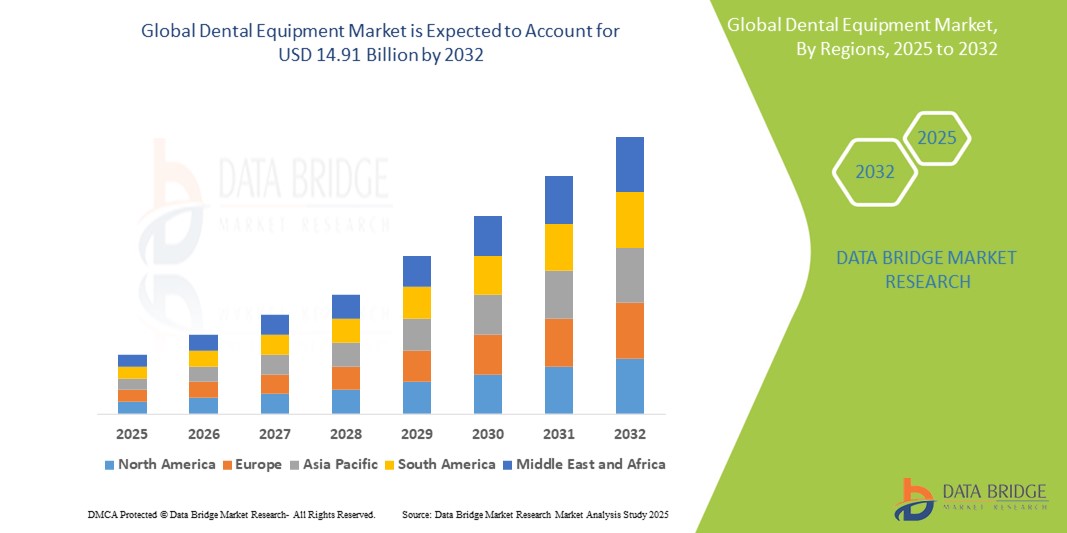
- Selon l'analyse de marché de Data Bridge, la taille du marché mondial du matériel dentaire a été évaluée à7,94 milliards de dollars en 2024et devrait atteindre14,91 milliards de dollars en 2032, à unTCAC de 8,20 %pendant la période de prévision
- Cette croissance est due à des facteurs tels que l'augmentation de la prévalence des troubles dentaires, l'augmentation de la demande dedentisterie cosmétique, et l'adoption de technologies avancées telles que l'imagerie numérique et les systèmes CAD/CAM
Taille du marché et prévisions
Valeur marchande mondiale (2024):7,94 milliards de dollars
Valeur marchande prévue (2032) :14,91 milliards de dollars
Prévisions CAGR (2026-2033):8.20%
Quels sont les principaux débouchés du marché de l'équipement dentaire
- Le matériel dentaire comprend les appareils utilisés pour le diagnostic, le traitement et la prévention des troubles dentaires, y compris les outils tels que les chaises dentaires, le matériel de radiologie, les systèmes CAO/CAM et les lasers
- La croissance du marché est principalement attribuable à l'augmentation de la prévalence des maladies dentaires, à l'augmentation de la demande en médecine esthétique et aux progrès technologiques tels que l'imagerie 3D et l'intégration de l'IA.
- L'Amérique du Nord devrait dominer le marché de l'équipement dentaire avec une part de marché de 38,9 %, en raison de l'infrastructure de soins dentaires de pointe, des dépenses élevées en soins buccodentaires et de l'adoption généralisée de technologies dentaires novatrices.
- On s'attend à ce que l'Asie-Pacifique soit la région qui connaît la croissance la plus rapide du marché du matériel dentaire, avec une part de marché de 44,1 %, au cours de la période de prévision, en raison de l'augmentation des investissements dans les soins de santé, de la sensibilisation accrue à l'hygiène buccodentaire et de l'urbanisation croissante.
- Le segment des systèmes dentaires et des pièces devrait dominer le marché avec une part de marché de 40,1 % en raison de son rôle essentiel dans la facilitation des interventions dentaires de base dans les domaines de traitement. Ce segment comprend des composants critiques tels que les systèmes CAO/CAM, les pièces à main et les appareils d'imagerie, qui sont essentiels pour la précision diagnostique et l'efficacité procédurale.
Portée du rapport et segmentation du marché de l'équipement dentaire
|
Attributs |
Équipement dentaire Principales perspectives du marché |
|
Segments couverts |
|
|
Pays couverts |
Amérique du Nord
Europe
Asie-Pacifique
Moyen-Orient et Afrique
Amérique du Sud
|
|
Principaux acteurs du marché |
|
|
Possibilités de marché |
|
|
Infos sur la valeur ajoutée |
En plus des renseignements sur les scénarios du marché tels que la valeur marchande, le taux de croissance, la segmentation, la couverture géographique et les principaux intervenants, les rapports de marché établis par Data Bridge Market Research comprennent aussi l'analyse des exportations d'importations, l'aperçu des capacités de production, l'analyse de la consommation de production, l'analyse des tendances des prix, le scénario du changement climatique, l'analyse de la chaîne d'approvisionnement, l'analyse de la chaîne de valeur, l'aperçu des matières premières et des consommables, les critères de sélection des fournisseurs, l'analyse PESTLE, l'analyse Porter et le cadre réglementaire. |
Quelle est la tendance clé du marché de l'équipement dentaire
Intégration des technologies numériques de dentisterie et d'IA
- Une tendance majeure sur le marché du matériel dentaire est l'adoption croissante d'outils de dentisterie numérique et de technologies alimentées par l'IA dans les flux de travail de diagnostic et de traitement
- Ces innovations améliorent la précision clinique, rationalisent les flux de travail et améliorent l'expérience des patients en permettant des traitements plus rapides et plus personnalisés.
- Par exemple, les systèmes CAO/CAM et les scanners intra-urbains permettent des restaurations du même jour, tandis que les outils d'imagerie à l'IA aident à un diagnostic précoce et à la planification du traitement, améliorant considérablement la précision et l'efficacité
- L'intégration de ces technologies de pointe consiste à remodeler les pratiques dentaires à l'échelle mondiale, à accroître l'efficacité procédurale et à stimuler la demande de matériel dentaire intelligent et interconnecté.
Dynamique du marché des équipements dentaires
Chauffeur
L'augmentation du fardeau des maladies dentaires et la demande de procédures de restauration
- La prévalence mondiale croissante de maladies dentaires telles que la carie dentaire, les maladies parodontales et l'édentulisme est un des principaux moteurs de la demande de matériel dentaire de pointe.
- Une mauvaise hygiène buccodentaire, des populations vieillissantes, une forte consommation de sucre et l'usage du tabac contribuent à accroître l'incidence des problèmes de santé buccodentaire dans le monde entier, nécessitant des soins dentaires professionnels et des interventions
- Par conséquent, la demande de dispositifs de diagnostic et de soins dentaires thérapeutiques, y compris de systèmes d'imagerie, de chaises dentaires et d'outils de restauration, est de plus en plus forte.
Par exemple,
- Selon l'Organisation mondiale de la santé (2023), les maladies buccodentaires touchent près de 3,5 milliards de personnes dans le monde, les caries dentaires non traitées étant la maladie la plus courante.
- Par conséquent, la charge croissante des maladies dentaires et l'accent croissant mis sur la médecine préventive et esthétique stimulent considérablement le marché mondial du matériel dentaire
Possibilités
Transformer les soins dentaires par l'intelligence artificielle et l'intégration numérique
- L'intégration de l'intelligence artificielle (IA) dans l'équipement dentaire offre une opportunité de croissance significative en améliorant la précision diagnostique, en rationalisant les flux de travail et en personnalisant les soins aux patients
- Les outils compatibles avec l'IA peuvent aider les dentistes à identifier les maladies dentaires à un stade précoce, à automatiser la planification du traitement et à prévoir les résultats avec une plus grande précision, ce qui permet une prestation de soins plus efficace et plus efficiente.
- De plus, les applications d'IA dans les systèmes d'imagerie, comme les scans de CT panoramiques et à faisceau de cônes, permettent l'analyse des données en temps réel, améliorent la prise de décisions cliniques et réduisent les erreurs diagnostiques
Par exemple,
- En février 2024, une étude publiée dans Frontiers in Dental Medicine a souligné que les systèmes de diagnostic alimentés par l'IA ont obtenu plus de 90% de précision dans la détection des caries précoces et des problèmes parodontaux, dépassant les examens visuels traditionnels.
- L'intégration de l'IA et des solutions numériques dans l'équipement dentaire permet non seulement d'améliorer les capacités cliniques, mais aussi d'améliorer l'expérience des patients, d'accélérer les délais de traitement et de réaliser des économies à long terme, en positionnant le marché pour une croissance technologique soutenue
Restriction/Défi
Coûts d'équipement élevés
- Le coût important du matériel dentaire de pointe constitue un obstacle majeur à la pénétration du marché, en particulier dans les pays à faible revenu et à revenu intermédiaire où les budgets de santé sont limités.
- Les appareils haut de gamme tels que les systèmes CAO/CAM, les outils d'imagerie numérique et les instruments laser peuvent coûter des dizaines de milliers de dollars, ce qui les rend inabordables pour les petites cliniques et les cabinets dentaires en solo
- Cette charge financière décourage l'investissement dans l'équipement moderne, conduisant de nombreuses installations à continuer d'utiliser des outils dépassés ou moins efficaces, ce qui peut compromettre la qualité et l'efficacité des soins dentaires.
Par exemple,
- En septembre 2024, un rapport de l'Association dentaire indienne a souligné que plus de 60 % des cliniques dentaires privées dans les villes de Tier-2 et Tier-3 en Inde dépendent toujours d'outils de base non numériques en raison du coût prohibitif de la mise à niveau de systèmes intelligents
- Par conséquent, le coût élevé du matériel continue de restreindre l'accès aux technologies dentaires de pointe, ce qui limite la croissance du marché et contribue aux inégalités dans la prestation de soins buccodentaires.
Comment le marché de l'équipement dentaire est-il segmenté
Le marché est segmenté en fonction du produit, du traitement et de l'utilisation finale.
|
Segmentation |
Sous-segmentation |
|
Par produit |
|
|
Par traitement |
|
|
Par utilisation finale |
|
En 2025, le système dentaire et les pièces devraient dominer le marché avec une part plus importante du segment de produits
Le secteur du système dentaire et des pièces devrait dominer le marché de l'équipement dentaire avec la plus grande part de 40,1% en 2025 en raison de son rôle essentiel dans la facilitation des interventions dentaires de base dans toutes les zones de traitement. Ce segment comprend des composants critiques tels que les systèmes CAO/CAM, les pièces à main et les dispositifs d'imagerie, qui sont essentiels pour la précision diagnostique et l'efficacité procédurale. La demande croissante de systèmes technologiquement avancés et l'adoption croissante de la dentisterie numérique accentuent la domination de ce segment.
La prosthodontie devrait représenter la part la plus importante au cours de la période de prévision sur le marché du traitement
En 2025, le segment prosthodontique devrait dominer le marché avec la plus grande part de marché de 32,9 % en raison de sa demande croissante pour des interventions dentaires réparatrices comme les couronnes, les ponts, les prothèses et les implants. La prévalence croissante de la perte de dents, en particulier chez les personnes vieillissantes, est à l'origine de la nécessité de solutions prosthodontiques. Les progrès technologiques dans les matériaux dentaires et les flux de travail numériques améliorent également les résultats et l'efficacité du traitement, ce qui stimule la croissance du segment.
Quelle région détient la plus grande part du marché de l'équipement dentaire
L'Amérique du Nord détient la plus grande part du marché des équipements dentaires
- L'Amérique du Nord domine le marché de l'équipement dentaire avec une part de marché estimée à 38,9 %, tirée par une infrastructure de soins dentaires de pointe, des dépenses élevées en soins buccodentaires et l'adoption généralisée de technologies dentaires novatrices
- Les États-Unis détiennent une part de marché de 33,3 %, en raison de la forte présence d'importants acteurs du marché, de l'augmentation de la demande en produits cosmétiques et en dentisterie réparatrice et de l'augmentation de la population âgée nécessitant des interventions dentaires fréquentes.
- Les politiques favorables de remboursement pour les procédures dentaires et l'intégration de technologies numériques telles que les diagnostics CAO/CAM et AI renforcent encore la position de premier plan de l'Amérique du Nord sur le marché
- De plus, le nombre croissant d'organismes de services dentaires et la tendance vers des cliniques multispécialisées appuient la croissance régionale en rendant les services dentaires avancés plus accessibles.
L'Asie-Pacifique devrait enregistrer le TCAC le plus élevé du marché des équipements dentaires.
- L'Asie-Pacifique devrait connaître le taux de croissance le plus élevé du marché du matériel dentaire avec une part de marché de 44,1 %, en raison de l'augmentation des investissements dans les soins de santé, de la sensibilisation accrue à l'hygiène buccodentaire et de l'urbanisation croissante.
- Des pays comme la Chine, l'Inde et le Japon deviennent des contributeurs clés en raison de la forte population, de l'augmentation des revenus de la classe moyenne et du fardeau croissant des maladies dentaires.
- Le Japon reste un chef de file dans l'adoption d'outils numériques de dentisterie et d'équipements de diagnostic avancés, soutenus par sa population technologique et une infrastructure de soins de santé solide
- L'Inde devrait enregistrer le TCAC le plus élevé de la région, alimenté par l'expansion du tourisme dentaire, un nombre croissant de cliniques dentaires et un accent croissant sur la dentisterie esthétique et les procédures orthodontiques
Quelles sont les meilleures entreprises du marché de l'équipement dentaire
Le paysage concurrentiel du marché fournit des détails par concurrent. Les détails inclus sont l'aperçu de l'entreprise, les finances de l'entreprise, les revenus générés, le potentiel du marché, les investissements dans la recherche et le développement, les nouvelles initiatives du marché, la présence mondiale, les sites et installations de production, les capacités de production, les forces et faiblesses de l'entreprise, le lancement de produits, la largeur et l'étendue du produit, la domination de l'application. Les données ci-dessus fournies ne sont liées qu'à la concentration des entreprises sur le marché.
Les principaux leaders du marché sont :
- Zimmer Biomet (États-Unis)
- 3M(États-Unis)
- Société Danaher (États-Unis)
- Young Innovations, Inc. (États-Unis)
- GC International AG(Japon)
- Institut Straumann AG (Suisse)
- Dentsply Sirona (États-Unis)
- Patterson Companies, Inc. (États-Unis)
- Henry Schein, Inc. (États-Unis)
- Société Midmark (États-Unis)
- PLANMECA OY (Finlande)
- BIOLASE, Inc. (États-Unis)
- Santé de Carestream (États-Unis)
- A-dec Inc. (États-Unis)
- Aseptico, Inc. (États-Unis)
- Chromadent (États-Unis)
- Crosstex International, Inc. (États-Unis).
- Société Midmark (États-Unis)
- NSK / Nakanishi inc. (Japon)
- Henry Schein, Inc. (États-Unis)
Quels sont les derniers développements sur le marché des équipements dentaires
- En mars 2025, Planmeca a présenté sa dernière gamme d'unités dentaires au Salon international des soins dentaires (IDS) 2025. Ces unités disposent de conceptions ergonomiques avancées, d'une intégration numérique améliorée et d'un meilleur confort du patient. Les nouveaux modèles visent à simplifier les procédures dentaires et à améliorer l'expérience globale du patient
- En février 2025, Dentsply Sirona a annoncé la sortie de ses nouveaux systèmes d'imagerie alimentés par l'IA. Ces systèmes utilisent l'intelligence artificielle pour fournir des diagnostics en temps réel, améliorer la précision dans la détection des pathologies dentaires et aider à la planification des traitements
- En janvier 2025, le groupe Straumann a dévoilé ses dernières solutions CAO/CAM conçues pour améliorer les flux de travail numériques dans les cabinets dentaires. Les nouveaux systèmes offrent des temps de traitement plus rapides et une plus grande précision dans la fabrication de prothèses, visant à améliorer l'efficacité et les résultats des patients
- En janvier 2025, Benco Dental, le plus important distributeur indépendant de technologies et de fournitures de soins buccodentaires aux États-Unis, a annoncé un nouvel accord de distribution avec A-dec, un leader mondial en solutions dentaires. Ce partenariat permet aux clients de Benco Dental aux États-Unis d'accéder à la gamme complète de produits de A-dec, y compris les chaises dentaires, les systèmes de livraison et les armoires. Cette collaboration vise à simplifier le processus d'approvisionnement pour les pratiques dentaires, en offrant des solutions intégrées qui améliorent l'efficacité clinique et les soins aux patients
- En avril 2025, 3Shape a lancé une version mise à jour de son scanner intra-oral populaire. Le nouveau modèle bénéficie d'une vitesse de numérisation améliorée, d'une précision accrue et d'un confort accru pour le patient, facilitant ainsi de meilleures impressions numériques pour diverses interventions dentaires.
SKU-
Accédez en ligne au rapport sur le premier cloud mondial de veille économique

- Tableau de bord d'analyse de données interactif
- Tableau de bord d'analyse d'entreprise pour les opportunités à fort potentiel de croissance
- Accès d'analyste de recherche pour la personnalisation et les requêtes
- Analyse de la concurrence avec tableau de bord interactif
- Dernières actualités, mises à jour et analyse des tendances
- Exploitez la puissance de l'analyse comparative pour un suivi complet de la concurrence
Méthodologie de recherche
La collecte de données et l'analyse de l'année de base sont effectuées à l'aide de modules de collecte de données avec des échantillons de grande taille. L'étape consiste à obtenir des informations sur le marché ou des données connexes via diverses sources et stratégies. Elle comprend l'examen et la planification à l'avance de toutes les données acquises dans le passé. Elle englobe également l'examen des incohérences d'informations observées dans différentes sources d'informations. Les données de marché sont analysées et estimées à l'aide de modèles statistiques et cohérents de marché. De plus, l'analyse des parts de marché et l'analyse des tendances clés sont les principaux facteurs de succès du rapport de marché. Pour en savoir plus, veuillez demander un appel d'analyste ou déposer votre demande.
La méthodologie de recherche clé utilisée par l'équipe de recherche DBMR est la triangulation des données qui implique l'exploration de données, l'analyse de l'impact des variables de données sur le marché et la validation primaire (expert du secteur). Les modèles de données incluent la grille de positionnement des fournisseurs, l'analyse de la chronologie du marché, l'aperçu et le guide du marché, la grille de positionnement des entreprises, l'analyse des brevets, l'analyse des prix, l'analyse des parts de marché des entreprises, les normes de mesure, l'analyse globale par rapport à l'analyse régionale et des parts des fournisseurs. Pour en savoir plus sur la méthodologie de recherche, envoyez une demande pour parler à nos experts du secteur.
Personnalisation disponible
Data Bridge Market Research est un leader de la recherche formative avancée. Nous sommes fiers de fournir à nos clients existants et nouveaux des données et des analyses qui correspondent à leurs objectifs. Le rapport peut être personnalisé pour inclure une analyse des tendances des prix des marques cibles, une compréhension du marché pour d'autres pays (demandez la liste des pays), des données sur les résultats des essais cliniques, une revue de la littérature, une analyse du marché des produits remis à neuf et de la base de produits. L'analyse du marché des concurrents cibles peut être analysée à partir d'une analyse basée sur la technologie jusqu'à des stratégies de portefeuille de marché. Nous pouvons ajouter autant de concurrents que vous le souhaitez, dans le format et le style de données que vous recherchez. Notre équipe d'analystes peut également vous fournir des données sous forme de fichiers Excel bruts, de tableaux croisés dynamiques (Fact book) ou peut vous aider à créer des présentations à partir des ensembles de données disponibles dans le rapport.











