


Global Disposable Gloves Market Segmentation, By Material Type (Natural Rubber, Nitrile, Vinyl, Neoprene, Polyethylene, and Others), Product Type (Powdered and Powder- free), Application (Medical and Healthcare and Non- Medical) - Industry Trends and Forecast to 2033
Disposable Gloves Market Size
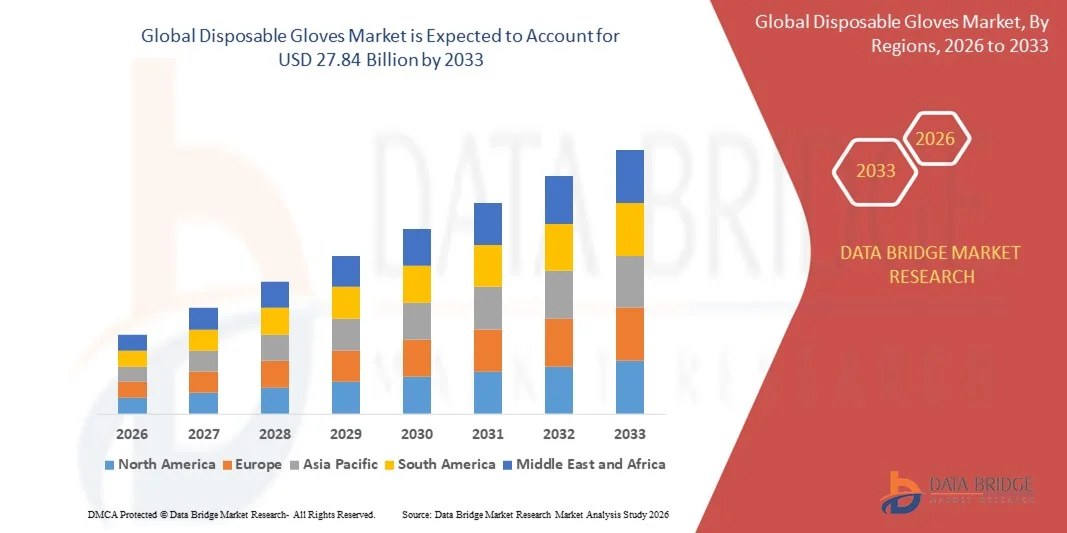
- The global disposable gloves market size was valued at USD 13.87 billion in 2025 and is expected to reach USD 27.84 billion by 2033, at a CAGR of 9.10% during the forecast period
- The market growth is largely fueled by increasing awareness of hygiene, safety, and infection control across healthcare, industrial, and food processing sectors, driving the adoption of disposable gloves globally
- Furthermore, rising demand for high-performance gloves such as nitrile, powder-free, and chemical-resistant variants is establishing disposable gloves as an essential protective solution for medical, laboratory, and industrial applications. These factors are accelerating the uptake of disposable gloves, thereby significantly boosting the industry’s growth
Disposable Gloves Market Analysis
- Disposable gloves, providing hand protection against contamination, chemicals, and pathogens, are increasingly vital in medical, industrial, and food handling settings due to their safety, comfort, and regulatory compliance
- The escalating demand for disposable gloves is primarily fueled by stringent hygiene and occupational safety regulations, growing healthcare and industrial activities, and rising awareness among consumers and professionals regarding hand protection and cross-contamination prevention
- North America dominated the disposable gloves market with a share of 37.2% in 2025, due to increasing demand in healthcare, laboratories, and food processing industries
- Asia-Pacific is expected to be the fastest growing region in the disposable gloves market during the forecast period due to increasing healthcare infrastructure, rising awareness about hygiene, and rapid urbanization in countries such as China, India, and Japan
- Powder- free segment dominated the market with a market share of 75.7% in 2025, due to growing safety concerns and the preference for gloves that minimize contamination risks. Powder-free gloves are widely adopted in medical and food handling applications due to their reduced risk of causing skin irritation and allergic reactions
Report Scope and Disposable Gloves Market Segmentation
|
Attributes |
Disposable Gloves Key Market Insights |
|
Segments Covered |
|
|
Countries Covered |
North America
Europe
Asia-Pacific
Middle East and Africa
South America
|
|
Key Market Players |
|
|
Market Opportunities |
|
|
Value Added Data Infosets |
In addition to the insights on market scenarios such as market value, growth rate, segmentation, geographical coverage, and major players, the market reports curated by the Data Bridge Market Research also include import export analysis, production capacity overview, production consumption analysis, price trend analysis, climate change scenario, supply chain analysis, value chain analysis, raw material/consumables overview, vendor selection criteria, PESTLE Analysis, Porter Analysis, and regulatory framework. |
Disposable Gloves Market Trends
Rising Adoption of Nitrile and Powder-Free Gloves
- A notable trend in the disposable gloves market is the growing adoption of nitrile and powder-free gloves due to their superior chemical resistance, hypoallergenic properties, and suitability for medical and industrial applications. This shift is driven by increased awareness of safety standards and hygiene protocols across healthcare, food processing, and laboratory environments
- For instance, Ansell and Top Glove manufacture a wide range of nitrile and powder-free gloves that are extensively used in hospitals, laboratories, and food service facilities. These gloves provide reliable protection against contaminants and reduce allergy risks compared to traditional latex options
- The healthcare sector is increasingly specifying powder-free nitrile gloves for surgical and examination purposes where contamination control is critical. This is enhancing product preference in hospitals and clinics that require stringent infection control measures
- Industries such as pharmaceuticals, biotechnology, and chemical manufacturing are expanding the use of nitrile gloves to protect workers from exposure to hazardous substances. This trend is supporting higher demand for durable gloves that meet international safety standards
- The food and hospitality sector is driving adoption of powder-free gloves to maintain hygiene during food handling and preparation. This is reinforcing the preference for gloves that prevent cross-contamination while offering flexibility and comfort for long-duration use
- Emerging applications in laboratories, cleanrooms, and cosmetic manufacturing are increasing demand for gloves with high tactile sensitivity and low particulate contamination. This trend is positioning disposable gloves as essential personal protective equipment in precision-driven environments
Disposable Gloves Market Dynamics
Driver
Increasing Awareness of Hygiene and Occupational Safety
- The rising focus on workplace safety and personal hygiene is driving the demand for disposable gloves across multiple sectors, including healthcare, food processing, and chemical industries. Employers and regulatory bodies are emphasizing protective measures to prevent occupational hazards and contamination risks
- For instance, Kimberly-Clark provides disposable glove solutions that comply with OSHA and CDC standards for infection control, reinforcing hygiene protocols in clinical and laboratory environments. These products help organizations meet regulatory compliance while safeguarding employee health
- Stringent hygiene standards in healthcare and food industries are encouraging organizations to invest in high-quality gloves that prevent cross-contamination and chemical exposure. This is creating sustained demand for gloves with proven protective performance
- The growth of infection control programs in hospitals and clinics is further driving adoption of gloves for routine procedures, surgery, and laboratory work. This is influencing procurement policies and increasing reliance on disposable glove solutions
- Global occupational safety regulations and corporate policies are shaping the requirement for consistent use of personal protective equipment, including gloves. This driver continues to support market expansion as awareness and compliance efforts intensify
Restraint/Challenge
Volatility in Raw Material Prices
- The disposable gloves market faces challenges from fluctuations in raw material prices, particularly nitrile, latex, and synthetic rubber, which directly affect manufacturing costs and profitability. These price variations are influenced by global supply-demand dynamics, geopolitical factors, and crude oil price movements
- For instance, Top Glove has reported production cost pressures due to increasing nitrile prices, impacting their profit margins and pricing strategies. Such volatility forces manufacturers to frequently adjust procurement and production plans to maintain market competitiveness
- Supply chain disruptions and dependence on key raw materials from limited regions can exacerbate cost instability. This can affect small and medium-sized producers more significantly, restricting their ability to maintain stable pricing
- The market also contends with competition-driven pricing pressures while balancing high-quality standards with material cost constraints. These challenges compel manufacturers to innovate in material usage and optimize operational efficiency
- Sustained fluctuations in raw material availability and cost can influence long-term growth forecasts and investment decisions, highlighting the need for strategic sourcing and risk management within the disposable gloves market
Disposable Gloves Market Scope
The market is segmented on the basis of material type, product type, and application.
- By Material Type
On the basis of material type, the disposable gloves market is segmented into natural rubber, nitrile, vinyl, neoprene, polyethylene, and others. The nitrile segment dominated the market with the largest revenue share of 41.5% in 2025, driven by its superior chemical resistance, puncture resistance, and hypoallergenic properties. Nitrile gloves are increasingly preferred in medical, laboratory, and industrial settings due to their durability and suitability for prolonged use. The segment’s growth is also supported by rising safety standards and regulatory requirements mandating high-performance protective gloves. In addition, nitrile gloves’ compatibility with powder-free variants enhances their adoption across healthcare and non-healthcare applications.
The natural rubber segment is anticipated to witness the fastest growth rate of 18.9% from 2026 to 2033, fueled by increasing demand in healthcare and food processing sectors. Natural rubber gloves provide excellent tactile sensitivity and elasticity, making them ideal for medical examinations and precision tasks. For instance, companies such as Top Glove Corporation Berhad are expanding their natural rubber glove production lines to meet rising hospital and laboratory requirements. Growing awareness about biodegradability and sustainable materials also contributes to the rising adoption of natural rubber gloves. The segment’s growth is further supported by innovations in allergy-reduced formulations, enhancing user safety and comfort.
- By Product Type
On the basis of product type, the disposable gloves market is segmented into powdered and powder-free gloves. The powder-free segment dominated the market with the largest revenue share of 75.7% in 2025, driven by growing safety concerns and the preference for gloves that minimize contamination risks. Powder-free gloves are widely adopted in medical and food handling applications due to their reduced risk of causing skin irritation and allergic reactions. The segment also benefits from regulatory trends in healthcare, where powder-free gloves are often mandated for patient safety. In addition, advancements in powder-free glove manufacturing have improved donning ease and tactile sensitivity, enhancing user convenience.
The powdered segment is expected to witness the fastest growth rate of 16.4% from 2026 to 2033, fueled by their cost-effectiveness and ease of use in high-volume industrial applications. Powdered gloves facilitate quick wearing and removal, making them suitable for repetitive tasks in manufacturing and laboratory settings. For instance, Ansell Limited has increased its production of powdered gloves for industrial users in emerging markets to meet rising operational demands. The segment’s growth is further supported by small-scale food processing units and laboratories seeking efficient and affordable hand protection solutions.
- By Application
On the basis of application, the disposable gloves market is segmented into medical and healthcare, and non-medical applications. The medical and healthcare segment dominated the market with the largest revenue share of 62.5% in 2025, driven by increasing healthcare expenditure, rising number of surgeries, and stringent hygiene protocols. Medical gloves are critical for preventing cross-contamination in hospitals, clinics, and laboratories, driving sustained demand. The segment also benefits from global health initiatives and rising awareness about personal protective equipment among healthcare professionals. In addition, the ongoing focus on infection control in pandemic and post-pandemic scenarios has reinforced the preference for high-quality medical gloves.
The non-medical segment is anticipated to witness the fastest growth rate of 19.2% from 2026 to 2033, fueled by expanding use in food processing, janitorial services, and industrial manufacturing. Non-medical gloves provide adequate protection while being cost-efficient, which encourages adoption across diverse sectors. For instance, Hartalega Holdings Berhad has launched specialized non-medical glove variants tailored for food handling and chemical processing industries. Rising occupational safety regulations and growing awareness of hygiene in public spaces further support segment growth. The segment’s expansion is also driven by increasing adoption in households for cleaning and general-purpose protection tasks.
Disposable Gloves Market Regional Analysis
- North America dominated the disposable gloves market with the largest revenue share of 37.2% in 2025, driven by increasing demand in healthcare, laboratories, and food processing industries
- Consumers in the region prioritize high-quality gloves that offer safety, comfort, and compliance with stringent hygiene regulations
- This widespread adoption is further supported by advanced healthcare infrastructure, high awareness of occupational safety standards, and growing demand for latex-free and nitrile gloves, establishing disposable gloves as a preferred protective solution across medical and non-medical sectors
U.S. Disposable Gloves Market Insight
The U.S. disposable gloves market captured the largest revenue share in 2025 within North America, fueled by rising healthcare expenditure and increasing awareness of infection control protocols. Hospitals, clinics, and laboratories are increasingly adopting high-performance gloves such as nitrile and powder-free variants to reduce cross-contamination. For instance, Top Glove Corporation Berhad is expanding its U.S. production and distribution to meet surging demand. Moreover, the rising trend of stringent FDA and OSHA regulations ensures continuous market growth, while growing adoption in food handling, industrial, and laboratory applications further supports expansion.
Europe Disposable Gloves Market Insight
The Europe disposable gloves market is projected to expand at a substantial CAGR throughout the forecast period, primarily driven by strict occupational safety regulations and increasing healthcare demand. Consumers and institutions across countries such as Germany, France, and Italy are increasingly adopting gloves to ensure compliance with hygiene and safety standards. For instance, Ansell Limited has introduced specialized powder-free and nitrile gloves for European hospitals and food processing units. The rise in hospitalizations, medical procedures, and awareness about hand protection is fostering market adoption in both healthcare and industrial sectors.
U.K. Disposable Gloves Market Insight
The U.K. disposable gloves market is anticipated to grow at a noteworthy CAGR during the forecast period, driven by increasing awareness of hand hygiene and workplace safety. Rising concerns regarding cross-contamination in healthcare facilities and food services are encouraging hospitals, clinics, and food processing units to adopt high-quality gloves. The country’s advanced healthcare infrastructure and regulatory compliance requirements continue to stimulate demand for powder-free and nitrile gloves. Furthermore, the growing adoption of single-use gloves in laboratories, manufacturing, and retail sectors is expected to sustain market growth.
Germany Disposable Gloves Market Insight
The Germany disposable gloves market is expected to expand at a considerable CAGR during the forecast period, fueled by rising healthcare expenditure, industrial safety standards, and strong regulatory frameworks. Germany’s emphasis on occupational safety and hygiene promotes the adoption of high-performance disposable gloves in hospitals, laboratories, and manufacturing facilities. For instance, Hartalega Holdings Berhad has introduced innovative nitrile and latex glove products for industrial and healthcare applications. Integration of gloves in non-medical sectors such as food processing and research laboratories is also contributing to market expansion.
Asia-Pacific Disposable Gloves Market Insight
The Asia-Pacific disposable gloves market is poised to grow at the fastest CAGR during the forecast period of 2026 to 2033, driven by increasing healthcare infrastructure, rising awareness about hygiene, and rapid urbanization in countries such as China, India, and Japan. The region’s growing demand for affordable, high-quality gloves in medical, laboratory, and industrial applications is propelling market growth. Furthermore, APAC is emerging as a manufacturing hub for disposable gloves, enhancing availability and reducing costs for domestic and export markets.
Japan Disposable Gloves Market Insight
The Japan disposable gloves market is gaining momentum due to the country’s aging population, high healthcare standards, and increasing adoption of safety protocols. Japanese hospitals and laboratories are increasingly prioritizing powder-free and nitrile gloves to reduce allergy risks and improve infection control. For instance, Top Glove and Ansell have expanded their presence in Japan to cater to rising demand. The adoption of gloves in industrial and food processing sectors, along with technological integration in hospitals, is further driving market growth.
China Disposable Gloves Market Insight
The China disposable gloves market accounted for the largest market revenue share in Asia-Pacific in 2025, attributed to the country’s expanding healthcare sector, rapid urbanization, and growing industrial safety awareness. China is a major manufacturer and consumer of nitrile, latex, and powder-free gloves, with strong domestic companies such as Top Glove and Hartalega supporting market growth. Government initiatives to improve healthcare standards and the rising prevalence of hygiene-conscious consumers are key factors propelling adoption. The expansion of hospitals, laboratories, and food processing units continues to drive significant demand for disposable gloves.
Disposable Gloves Market Share
The disposable gloves industry is primarily led by well-established companies, including:
- Semperit AG Holding (Austria)
- Supermax Corporation Berhad (Malaysia)
- Cardinal Health (U.S.)
- Medline Industries, Inc. (U.S.)
- ANSELL LTD. (Australia)
- Medicom (Canada)
- YTY Group (Taiwan)
- Kossan Rubber Industries Bhd (Malaysia)
- asiaEP.com (Asia)
- JIANGSU JAYSUN GLOVE CO., LTD (China)
- Bluesail Medical Co., Ltd. (China)
- Shandong Yuyuan Latex Gloves Co., Ltd. (China)
- Zhanjiang Jiali Glove Products Co., Ltd. (China)
- McKesson Corporation (U.S.)
- Dynarex Corporation (U.S.)
- Top Glove Corporation Bhd (Malaysia)
- Hartalega Holdings Berhad (Malaysia)
- Robinson Healthcare (U.K.)
- SHIELD Scientific B.V. (Netherlands)
- PAUL HARTMANN AG (Germany)
Latest Developments in Global Disposable Gloves Market
- In January 2026, Ansell introduced the TouchNTuff 93-800 disposable glove to address high-risk chemical handling applications. The glove offers enhanced resistance against harsh solvents while maintaining durability and user comfort. This launch strengthens Ansell’s position in the high-performance chemical-resistant glove segment and reinforces its leadership in industrial and laboratory safety markets. By expanding its specialized glove offerings, Ansell is better equipped to meet increasing demand from industries requiring robust protective solutions, boosting its competitive advantage globally
- In September 2025, Medline Industries, Inc. (US) entered into a strategic partnership with a leading healthcare provider to supply disposable gloves specifically designed for surgical applications. This collaboration enhances Medline’s product portfolio and strengthens its presence in the healthcare segment, particularly in hospitals and surgical centers. By partnering directly with healthcare providers, Medline gains insights into clinical needs, allowing for more targeted product development and improved market responsiveness, which supports sustained growth in medical glove adoption
- In May 2025, PIP expanded its market footprint by acquiring Honeywell’s personal protective equipment business, broadening its portfolio beyond hand protection into multiple safety categories. This acquisition enhances PIP’s global reach and distribution capabilities, enabling the company to serve a wider range of industrial and workplace safety needs. By integrating Honeywell’s PPE solutions, PIP strengthens its competitive positioning in key international markets, driving long-term growth across both industrial and healthcare segments
- In May 2021, Honeywell and Premier Inc. established a new business partnership aimed at increasing nitrile exam glove production in the U.S. The initiative is expected to produce at least 750 million gloves in its first year, addressing domestic demand for healthcare-grade nitrile gloves. This partnership ensures a reliable local supply for hospitals, clinics, and other healthcare providers, reducing dependency on imports and reinforcing the U.S. market’s resilience in critical medical glove supply chains
- In January 2021, Ansell Limited completed the acquisition of the Primus brand and Life Science business, including Sanrea Healthcare Products, while entering a long-term supply partnership with Primus. Primus, a key Indian manufacturer of long-cuff gloves in the Life Science and Specialty Medical sectors, enhances Ansell’s presence in India and strengthens its Life Sciences business globally. This acquisition allows Ansell to accelerate growth in the Life Sciences segment, expand market share in India, and leverage Primus’s strong brand recognition to meet rising demand in specialty medical applications
SKU-
Accédez en ligne au rapport sur le premier cloud mondial de veille économique

- Tableau de bord d'analyse de données interactif
- Tableau de bord d'analyse d'entreprise pour les opportunités à fort potentiel de croissance
- Accès d'analyste de recherche pour la personnalisation et les requêtes
- Analyse de la concurrence avec tableau de bord interactif
- Dernières actualités, mises à jour et analyse des tendances
- Exploitez la puissance de l'analyse comparative pour un suivi complet de la concurrence
Méthodologie de recherche
La collecte de données et l'analyse de l'année de base sont effectuées à l'aide de modules de collecte de données avec des échantillons de grande taille. L'étape consiste à obtenir des informations sur le marché ou des données connexes via diverses sources et stratégies. Elle comprend l'examen et la planification à l'avance de toutes les données acquises dans le passé. Elle englobe également l'examen des incohérences d'informations observées dans différentes sources d'informations. Les données de marché sont analysées et estimées à l'aide de modèles statistiques et cohérents de marché. De plus, l'analyse des parts de marché et l'analyse des tendances clés sont les principaux facteurs de succès du rapport de marché. Pour en savoir plus, veuillez demander un appel d'analyste ou déposer votre demande.
La méthodologie de recherche clé utilisée par l'équipe de recherche DBMR est la triangulation des données qui implique l'exploration de données, l'analyse de l'impact des variables de données sur le marché et la validation primaire (expert du secteur). Les modèles de données incluent la grille de positionnement des fournisseurs, l'analyse de la chronologie du marché, l'aperçu et le guide du marché, la grille de positionnement des entreprises, l'analyse des brevets, l'analyse des prix, l'analyse des parts de marché des entreprises, les normes de mesure, l'analyse globale par rapport à l'analyse régionale et des parts des fournisseurs. Pour en savoir plus sur la méthodologie de recherche, envoyez une demande pour parler à nos experts du secteur.
Personnalisation disponible
Data Bridge Market Research est un leader de la recherche formative avancée. Nous sommes fiers de fournir à nos clients existants et nouveaux des données et des analyses qui correspondent à leurs objectifs. Le rapport peut être personnalisé pour inclure une analyse des tendances des prix des marques cibles, une compréhension du marché pour d'autres pays (demandez la liste des pays), des données sur les résultats des essais cliniques, une revue de la littérature, une analyse du marché des produits remis à neuf et de la base de produits. L'analyse du marché des concurrents cibles peut être analysée à partir d'une analyse basée sur la technologie jusqu'à des stratégies de portefeuille de marché. Nous pouvons ajouter autant de concurrents que vous le souhaitez, dans le format et le style de données que vous recherchez. Notre équipe d'analystes peut également vous fournir des données sous forme de fichiers Excel bruts, de tableaux croisés dynamiques (Fact book) ou peut vous aider à créer des présentations à partir des ensembles de données disponibles dans le rapport.











