



Global Domestic Booster Pump Market Segmentation, By Product Type (Single Stage Pump and Multiple Stage Pump), Power Source (Hydraulic, Electric, Gasoline, and Others), Material (Cast Iron, Aluminium, Stainless Steel, and Others), End-Use (Residential Buildings, Industries, Agriculture, and Others), Distribution Channel (Direct Sales and Indirect Sales) – Industry Trends and Forecast to 2032.
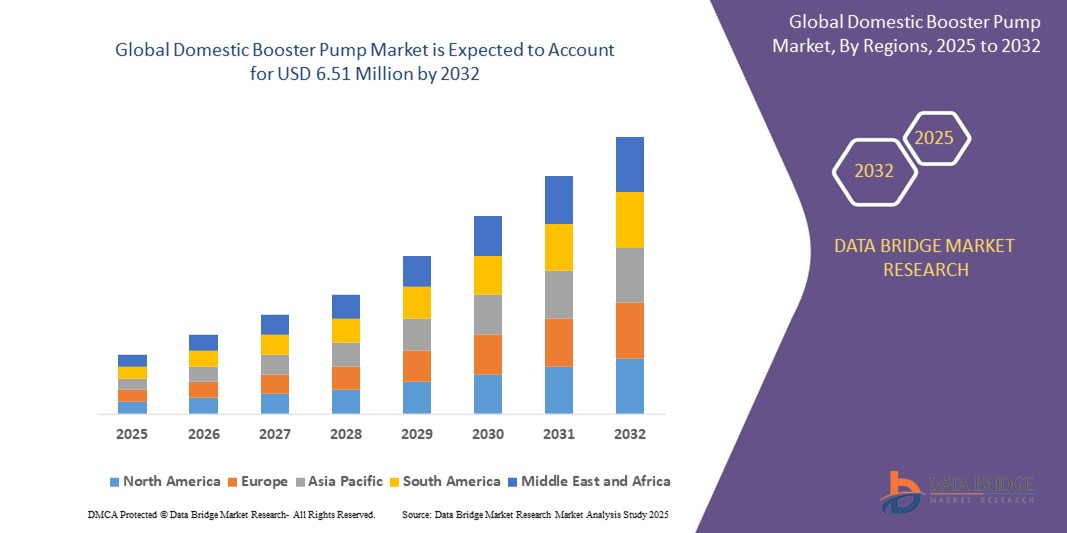
Domestic Booster Pump Market Size
- The global domestic booster pump market size was valued at USD 3.56 million in 2024 and is expected to reach USD 6.51 million by 2032, at a CAGR of 7.84% during the forecast period
- The market growth is primarily driven by increasing demand for efficient water supply systems in residential and industrial applications, coupled with advancements in pump technology and rising urbanization
- In addition, growing awareness of water conservation and the need for reliable water pressure in modern infrastructure are establishing domestic booster pumps as essential components, further accelerating market expansion
Domestic Booster Pump Market Analysis
- Domestic booster pumps, designed to enhance water pressure in residential, industrial, and agricultural settings, are critical for ensuring consistent water supply in low-pressure environments
- The surge in demand is fueled by rapid urbanization, increasing construction of high-rise residential buildings, and the growing need for efficient irrigation systems in agriculture
- Asia-Pacific dominated the domestic booster pump market with the largest revenue share of 42.5% in 2024, driven by rapid urbanization, population growth, and government initiatives for water management in countries such as China and India
- North America is expected to be the fastest-growing region during the forecast period due to rising investments in smart infrastructure, technological advancements in pump systems, and increasing adoption in residential and industrial sectors
- The single-stage pump segment dominated a significant market share of 25.9% in 2024, primarily driven by its simplicity, efficiency, and cost-effectiveness for various household applications. They are easy to install and maintain, making them a popular choice for homeowners
Report Scope and Domestic Booster Pump Market Segmentation
|
Attributes |
Domestic Booster Pump Key Market Insights |
|
Segments Covered |
|
|
Countries Covered |
North America
Europe
Asia-Pacific
Middle East and Africa
South America
|
|
Key Market Players |
|
|
Market Opportunities |
|
|
Value Added Data Infosets |
In addition to the insights on market scenarios such as market value, growth rate, segmentation, geographical coverage, and major players, the market reports curated by the Data Bridge Market Research also include in-depth expert analysis, pricing analysis, brand share analysis, consumer survey, demography analysis, supply chain analysis, value chain analysis, raw material/consumables overview, vendor selection criteria, PESTLE Analysis, Porter Analysis, and regulatory framework. |
Domestic Booster Pump Market Trends
“Increasing Integration of Smart Technology and IoT”
- The global domestic booster pump market is experiencing a notable trend toward the integration of smart technology and Internet of Things (IoT) capabilities
- These technologies enable real-time monitoring, remote control, and advanced data analytics, providing insights into pump performance, water usage, and maintenance needs
- IoT-enabled booster pumps allow for proactive maintenance by detecting potential issues, such as pressure fluctuations or motor inefficiencies, before they result in system failures
- For instances, companies are developing smart pump platforms that adjust water pressure dynamically based on household demand or provide usage data to optimize water conservation
- This trend enhances the appeal of booster pumps for residential, industrial, and agricultural users, offering greater efficiency, convenience, and sustainability
- Smart algorithms can analyze operational patterns, such as peak water usage times or irregular pressure demands, to improve energy efficiency and system longevity
Domestic Booster Pump Market Dynamics
Driver
“Growing Demand for Reliable Water Supply and Efficient Infrastructure”
- The rising need for consistent water pressure in residential buildings, industries, and agricultural applications is a key driver for the global domestic booster pump market
- Booster pumps enhance water distribution by ensuring adequate pressure for applications such as showers, irrigation systems, and industrial processes, particularly in multi-story buildings or areas with low municipal water pressure
- Government initiatives promoting water management and infrastructure development, especially in urbanizing regions such as Asia-Pacific, are accelerating the adoption of booster pumps
- Advancements in IoT and 5G technology are enabling more sophisticated pump functionalities, such as real-time performance monitoring and automated pressure adjustments, supporting market growth
- Manufacturers are increasingly offering pre-installed smart booster pump systems as standard or optional features to meet consumer expectations for efficient and sustainable water solutions
Restraint/Challenge
“High Installation Costs and Data Privacy Concerns”
- The significant upfront costs associated with purchasing, installing, and integrating advanced booster pump systems, including smart and IoT-enabled models, can deter adoption, particularly in cost-sensitive market
- Retrofitting existing water systems with modern booster pumps can be technically complex and expensive, posing a barrier for older residential or industrial facilities
- Data privacy and security concerns are a major challenge, as IoT-enabled pumps collect and transmit sensitive operational and usage data, raising risks of breaches or misuse
- The lack of standardized regulations across countries for data handling and storage complicates compliance for manufacturers and service providers operating globally
- These factors may slow market growth in regions with high cost sensitivity or strong awareness of data privacy issues, limiting the adoption of advanced booster pump systems
Domestic Booster Pump market Scope
The market is segmented on the basis of product type, power source, material, end-use, and distribution channel.
- By Product Type
On the basis of product type, the global domestic booster pump market is segmented into single-stage pumps and multiple-stage pumps. The single-stage pump segment dominated a significant market share of 25.9% in 2024, primarily driven by its simplicity, efficiency, and cost-effectiveness for various household applications. They are easy to install and maintain, making them a popular choice for homeowners.
The multiple-stage pump segment is expected to witness robust growth, particularly due to the increasing construction of high-rise buildings and the need for higher water pressure in multi-story residential and commercial settings. Their ability to deliver high pressure and volume makes them essential for such applications.
- By Power Source
On the basis of power source, the global domestic booster pump market is segmented into hydraulic, electric, gasoline, and others. The electric power source segment is expected to hold the largest market revenue share, owing to the widespread availability of electricity and the convenience of electric pumps for residential use. Advancements in energy-efficient electric motors further contribute to its dominance.
The others segment, which includes alternative power sources such as solar, is anticipated to witness significant growth, driven by increasing awareness of sustainable energy solutions and the demand for off-grid or energy-independent pumping systems, particularly in remote areas.
- By Material
On the basis of material, the global domestic booster pump market is segmented into cast iron, aluminium, stainless steel, and others. The cast iron segment is expected to hold the largest market revenue share, largely due to its durability, strength, and cost-effectiveness. Cast iron pumps are widely used in residential and commercial sectors due to their robust nature and long lifespan.
The stainless steel segment is anticipated to witness the fastest growth rate, driven by its excellent corrosion resistance, hygiene properties, and increasing demand for pumps in applications where water purity is critical. This material is also preferred for its aesthetic appeal and longevity.
- By End-Use
On the basis of end-use, the global domestic booster pump market is segmented into residential buildings, industries, agriculture, and others. The residential buildings segment is expected to hold the largest market revenue share, primarily driven by rapid urbanization, increasing construction of new homes and apartments, and the rising demand for consistent water pressure in households.
The agriculture segment is anticipated to experience robust growth, fueled by the increasing adoption of efficient irrigation systems and the need for reliable water supply to farmlands, especially in regions facing water scarcity.
- By Distribution Channel
On the basis of distribution channel, the global domestic booster pump market is segmented into direct sales and indirect sales. The indirect sales segment, which includes wholesalers and third-party installers, is expected to hold the largest market revenue share. This is due to the wide reach and extensive customer base that these channels offer to pump manufacturers, providing convenient access for consumers.
The direct sales segment is expected to witness significant growth, driven by manufacturers focusing on building direct relationships with customers for specialized solutions, after-sales service, and online platforms offering direct purchases.
Domestic Booster Pump Market Regional Analysis
- Asia-Pacific dominated the domestic booster pump market with the largest revenue share of 42.5% in 2024, driven by rapid urbanization, population growth, and government initiatives for water management in countries such as China and India
- Consumers prioritize booster pumps for ensuring consistent water pressure, enhancing water supply efficiency, and supporting water-intensive applications, particularly in regions with expanding urban infrastructure and water scarcity concerns
- Growth is supported by advancements in pump technology, including energy-efficient and smart pump systems with automatic pressure sensors, alongside rising adoption in both residential and industrial segments
U.S. Domestic Booster Pump Market Insight
The U.S. domestic booster pump market is expected to witness significant growth, fueled by strong demand in residential and agricultural sectors and increasing awareness of energy-efficient water management solutions. The trend towards home renovations and the integration of smart pumps in modern infrastructure further boost market expansion. The growing construction of high-rise residential complexes also drives demand for multi-stage pumps to ensure adequate water pressure.
Europe Domestic Booster Pump Market Insight
The Europe domestic booster pump market is expected to witness significant growth, supported by regulatory emphasis on energy efficiency and sustainable water management. Consumers seek pumps that provide reliable water pressure while reducing energy consumption. Growth is prominent in both new installations and retrofit projects, with countries such as Germany and France showing notable uptake due to increasing urban infrastructure and environmental concerns.
U.K. Domestic Booster Pump Market Insight
The U.K. market for domestic booster pumps is expected to experience rapid growth, driven by demand for consistent water pressure in urban and suburban residential settings. Increased awareness of energy-efficient pump solutions and the need for reliable water supply in high-rise buildings encourage adoption. Evolving regulations on water usage and sustainability further influence consumer choices, balancing performance with compliance.
Germany Domestic Booster Pump Market Insight
Germany is expected to witness rapid growth in the domestic booster pump market, attributed to its advanced industrial sector and strong consumer focus on energy efficiency and water management. German consumers prefer technologically advanced pumps that reduce operational costs and enhance water pressure in residential and commercial applications. The integration of these pumps in modern infrastructure and aftermarket solutions supports sustained market growth.
Asia-Pacific Domestic Booster Pump Market Insight
The Asia-Pacific region dominates the global domestic booster pump market and is expected to maintain its lead through 2032, driven by expanding residential construction, rising disposable incomes, and increasing demand for efficient water pressure solutions in countries such as China, India, and Japan. Growing awareness of water scarcity and government initiatives promoting sustainable water management further encourage the adoption of advanced booster pumps.
Japan Domestic Booster Pump Market Insight
Japan’s domestic booster pump market is expected to witness rapid growth due to strong consumer preference for high-quality, energy-efficient pumps that enhance water supply reliability and sustainability. The presence of major pump manufacturers and the integration of advanced pumps in residential and commercial buildings accelerate market penetration. Rising interest in smart pump technologies also contributes to growth.
China Domestic Booster Pump Market Insight
China holds the largest share of the Asia-Pacific domestic booster pump market, propelled by rapid urbanization, increasing residential and industrial water demand, and growing adoption of energy-efficient pump solutions. The country’s expanding middle class and focus on infrastructure development support the use of advanced booster pumps. Strong domestic manufacturing capabilities and competitive pricing enhance market accessibility.
Domestic Booster Pump Market Share
The domestic booster pump industry is primarily led by well-established companies, including:
- Smith & Loveless Inc. (U.S.)
- Aquatec International, Inc. (U.S.)
- Dab Pumps Spa (Italy)
- Alfred Kärcher SE & Co. KG (Germany)
- Pentair (U.S.)
- Franklin Electric Co. Inc. (U.S.)
- Zodiac Pool Systems LLC (U.S.)
- Witte Pumps & Technology GmbH (Germany)
- Xylem (U.S.)
- Davey Water Products (Australia)
- Grundfos Holding A/S (Denmark)
- WILO SE (Germany)
- Danfoss (Denmark)
- Peerless Pump Company (U.S.)
- CAT Pumps (U.S.)
- Zoeller Pump Company (U.S.)
- Vossche (U.S.)
- C.R.I. Pumps Private Limited (India)
- Davey Water (Australia)
What are the Recent Developments in Global Domestic Booster Pump Market?
- In May 2024, Grundfos introduced a new generation of its SCALA2 domestic water booster pump, engineered to deliver constant water pressure across all taps with ultra-quiet and energy-efficient performance. The updated model features enhanced hydraulics, a permanent magnet motor, and intelligent speed control, allowing it to automatically adjust to household demand while minimizing energy consumption and noise—operating as quietly as 44 dB(A). Designed for homes with up to three floors and eight taps, the SCALA2 is compact, self-priming, and easy to install, making it ideal for modern residential water systems
- In April 2025, Kirloskar Brothers Limited (KBL) launched two advanced borewell submersible pumps—KU7P and LEHR—designed to deliver high performance, energy efficiency, and long-term durability. The KU7P is India’s first 17.5 cm oil-filled submersible pump, optimized for low power consumption, enhanced lubrication, and solar compatibility, making it ideal for eco-conscious applications. The LEHR model, built for 10 cm borewells, features Flexi Drive Motor Technology, enabling low-voltage startability and wide voltage operability. Both pumps are suited for domestic, community, and agricultural water supply in rural and urban settings
- In March 2025, Kirloskar Brothers Limited (KBL) launched the DB xe Pump, a next-generation end-suction pump engineered to redefine industry standards in efficiency, performance, and sustainability. Built on the legacy of the DB platform, the DB xe features a back pull-out design, dry shaft construction, and modular interchangeability, making it easy to maintain and adapt across applications. It meets the EN733/DIN24255 standards and exceeds the Minimum Efficiency Index (MEI) of 0.7, far above the 0.4 global benchmark, ensuring low energy consumption and reduced carbon footprint. The pump is also GreenPro Ecolabel certified, underscoring its eco-conscious design
- In May 2023, Grundfos acquired Sideris Pumps, a Greek manufacturer specializing in booster pump systems, as part of its strategy to expand its product portfolio and reinforce its presence in the European market. This acquisition supports Grundfos’ ambition to deliver more localized and tailored solutions across Europe, particularly in the domestic and commercial water supply segments. By integrating Sideris’ regional expertise and product range, Grundfos aims to enhance its competitiveness and accelerate innovation in energy-efficient water boosting technologies
- In April 2023, Wilo Group acquired Calpeda S.p.A., a renowned Italian manufacturer of booster and centrifugal pumps, as part of its strategy to broaden its product portfolio and reinforce its market presence in Europe and North America. Calpeda’s strong brand recognition, engineering expertise, and established distribution networks complement Wilo’s global ambitions, particularly in the building services and water management sectors. The acquisition also supports Wilo’s commitment to energy-efficient and sustainable pumping solutions, aligning with its long-term innovation and growth roadmap
SKU-
Accédez en ligne au rapport sur le premier cloud mondial de veille économique

- Tableau de bord d'analyse de données interactif
- Tableau de bord d'analyse d'entreprise pour les opportunités à fort potentiel de croissance
- Accès d'analyste de recherche pour la personnalisation et les requêtes
- Analyse de la concurrence avec tableau de bord interactif
- Dernières actualités, mises à jour et analyse des tendances
- Exploitez la puissance de l'analyse comparative pour un suivi complet de la concurrence
Méthodologie de recherche
La collecte de données et l'analyse de l'année de base sont effectuées à l'aide de modules de collecte de données avec des échantillons de grande taille. L'étape consiste à obtenir des informations sur le marché ou des données connexes via diverses sources et stratégies. Elle comprend l'examen et la planification à l'avance de toutes les données acquises dans le passé. Elle englobe également l'examen des incohérences d'informations observées dans différentes sources d'informations. Les données de marché sont analysées et estimées à l'aide de modèles statistiques et cohérents de marché. De plus, l'analyse des parts de marché et l'analyse des tendances clés sont les principaux facteurs de succès du rapport de marché. Pour en savoir plus, veuillez demander un appel d'analyste ou déposer votre demande.
La méthodologie de recherche clé utilisée par l'équipe de recherche DBMR est la triangulation des données qui implique l'exploration de données, l'analyse de l'impact des variables de données sur le marché et la validation primaire (expert du secteur). Les modèles de données incluent la grille de positionnement des fournisseurs, l'analyse de la chronologie du marché, l'aperçu et le guide du marché, la grille de positionnement des entreprises, l'analyse des brevets, l'analyse des prix, l'analyse des parts de marché des entreprises, les normes de mesure, l'analyse globale par rapport à l'analyse régionale et des parts des fournisseurs. Pour en savoir plus sur la méthodologie de recherche, envoyez une demande pour parler à nos experts du secteur.
Personnalisation disponible
Data Bridge Market Research est un leader de la recherche formative avancée. Nous sommes fiers de fournir à nos clients existants et nouveaux des données et des analyses qui correspondent à leurs objectifs. Le rapport peut être personnalisé pour inclure une analyse des tendances des prix des marques cibles, une compréhension du marché pour d'autres pays (demandez la liste des pays), des données sur les résultats des essais cliniques, une revue de la littérature, une analyse du marché des produits remis à neuf et de la base de produits. L'analyse du marché des concurrents cibles peut être analysée à partir d'une analyse basée sur la technologie jusqu'à des stratégies de portefeuille de marché. Nous pouvons ajouter autant de concurrents que vous le souhaitez, dans le format et le style de données que vous recherchez. Notre équipe d'analystes peut également vous fournir des données sous forme de fichiers Excel bruts, de tableaux croisés dynamiques (Fact book) ou peut vous aider à créer des présentations à partir des ensembles de données disponibles dans le rapport.











