Global Dual HER2/EGFR Inhibiteurs de médicaments Segmentation du marché, par type de médicament (Inhibiteurs de la tyrosine kinase (ICT), Biologiques à double cible et Thérapies ciblées combinées), Mécanisme d'action (Inhibiteurs réversibles, Inhibiteurs irréversibles et Inhibiteurs multicibles), Indication (cancer du sein, cancer du poumon, cancer gastrique, cancer colorectal, cancer de la tête et du cou, etc.), Utilisateur final (Hôpitals, Cliniques spécialisées du cancer, Pharmacies de détail et Pharmacies en ligne) Tendances et prévisions de l'industrie à 2033
Double HER2/EGFR Inhibiteurs Médicaments Taille du marché
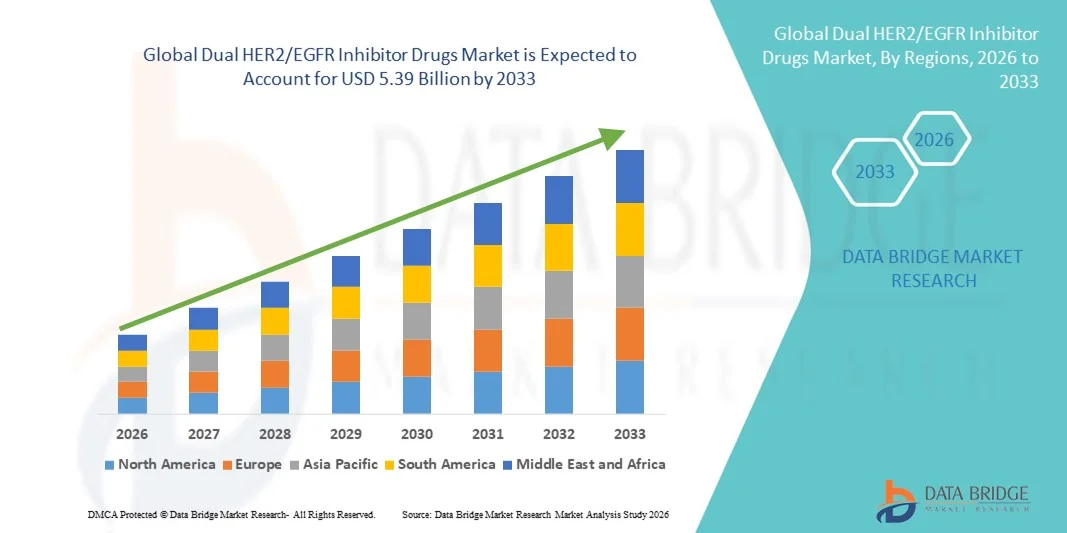
- La taille du marché mondial des médicaments inhibiteurs de HER2/EGFR a été évaluée à1,93 milliard de dollars en 2025et devrait atteindre5,39 milliards de dollars en 2033, à unTCAC de 13,70%pendant la période de prévision
- La croissance du marché est largement alimentée par l'adoption croissante et les progrès technologiques dans les thérapies oncologiques ciblées et la médecine de précision, ce qui entraîne une utilisation accrue tant dans les hôpitaux que dans les établissements spécialisés de soins contre le cancer.
- En outre, la demande croissante de patients pourbiomarqueur- les options de traitement par association pour le cancer établissent le double inhibiteur HER2/EGFR comme une approche thérapeutique ciblée préférée. Ces facteurs convergents accélèrent l'absorption clinique des inhibiteurs doubles, ce qui stimule significativement la croissance de l'industrie
Double HER2/EGFR Inhibiteur Médicaments Analyse du marché
- Les médicaments inhibiteurs du double HER2/EGFR, qui offrent un blocage simultané du récepteur 2 du facteur de croissance épidermique humain (HER2) et des voies du récepteur du facteur de croissance épidermique (EGFR), sont de plus en plus des composantes vitales de la thérapie anticancéreuse ciblée moderne dans des milieux hospitaliers et oncologiques spécialisés en raison de leur capacité à surmonter les mécanismes de résistance, à améliorer la réponse au traitement et à s'aligner sur les stratégies d'oncologie de précision
- L'augmentation de la demande d'inhibiteurs HER2/EGFR est principalement alimentée par l'augmentation du fardeau mondial du cancer, l'expansion du biomarqueur et des tests génomiques, et une préférence clinique croissante pour les thérapies ciblées et combinées par rapport à la chimiothérapie traditionnelle.
- L'Amérique du Nord a dominé le double marché des médicaments inhibiteurs de HER2/EGFR avec la plus grande part des revenus de 41,6 % en 2025, caractérisée par une infrastructure de soins en oncologie avancée, des cadres de remboursement solides et la présence debiopharmaceutiqueinnovateurs, les États-Unis voyant une absorption notable dans le sein HER2 positif et d'autres tumeurs solides entraînées par des progrès cliniques continus
- On s'attend à ce que l'Asie-Pacifique soit la région qui connaît la croissance la plus rapide du double marché des médicaments inhibiteurs du HER2/EGFR au cours de la période de prévision en raison de l'amélioration du diagnostic du cancer, de l'élargissement de l'accès aux produits biologiques ciblés et de l'augmentation des dépenses de santé dans les pays clés.
- Le segment du cancer du sein a dominé le double marché des médicaments inhibiteurs du HER2/EGFR avec une part de marché de 66,7 % en 2025, en raison de la forte prévalence du cancer du sein HER2 positif, d'une forte validation clinique des stratégies dual-cible et de leur inclusion dans plusieurs lignes directrices de traitement.
Portée du rapport et double segmentation du marché des inhibiteurs de la HER2/EGFR
| Attributs | Dual HER2/EGFR Inhibiteurs Médicaments Principales perspectives du marché |
| Segments couverts |
|
| Pays couverts | Amérique du Nord
Europe
Asie-Pacifique
Moyen-Orient et Afrique
Amérique du Sud
|
| Principaux acteurs du marché |
|
| Possibilités de marché |
|
| Infos sur la valeur ajoutée | En plus des renseignements sur les scénarios du marché comme la valeur du marché, le taux de croissance, la segmentation, la couverture géographique et les principaux intervenants, les rapports de marché établis par Data Bridge Market Research comprennent également une analyse approfondie des experts, l'épidémiologie des patients, l'analyse des pipelines, l'analyse des prix et le cadre réglementaire. |
Double HER2/EGFR Inhibiteurs de drogues Tendances du marché
Faire progresser l'oncologie de précision par le biais de thérapies à double échelle
- Une tendance significative et accélérée sur le marché mondial des médicaments inhibiteurs du HER2/EGFR est l'intégration accrue des approches d'oncologie de précision et des thérapies moléculairement ciblées qui inhibent simultanément les voies HER2 et EGFR. Cette convergence améliore considérablement la personnalisation du traitement et la prise de décision clinique dans les soins oncologiques
- Par exemple, des inhibiteurs doubles tels que le lapatinib et le neratinib sont incorporés dans les protocoles de traitement des cancers HER2-positifs où la signalisation EGFR joue également un rôle, permettant aux cliniciens de traiter plusieurs voies de croissance tumorale avec une seule stratégie thérapeutique
- L'inhibition double-cible permet des caractéristiques telles que surmonter la voie transversale, retarder les mécanismes de résistance et améliorer la survie sans progression dans certaines populations de patients. Par exemple, certaines stratégies cliniques utilisent une double inhibition pour soutenir la réponse tumorale où les thérapies mono-cible montrent une durabilité limitée. En outre, des stratégies de dosage optimisées permettent un blocage plus contrôlé et soutenu des récepteurs
- L'intégration harmonieuse des inhibiteurs du HER2/EGFR avec les tests biomarqueurs et le profilage génomique facilite une sélection plus précise des patients. Grâce à un seul flux de travail diagnostique, les oncologues peuvent aligner les thérapies ciblées sur la biologie tumorale, créant ainsi une expérience de traitement plus individualisée et fondée sur des données probantes
- Cette tendance vers un traitement du cancer plus personnalisé, axé sur la biologie et axé sur la combinaison remodelera fondamentalement les attentes cliniques pour les soins oncologiques ciblés. Par conséquent, les entreprises développent des inhibiteurs doubles de nouvelle génération et des molécules bispécifiques avec des profils de sélectivité et de sécurité améliorés
- La demande d'inhibiteurs dual HER2/EGFR qui offrent un contrôle efficace des voies multiples augmente régulièrement dans les centres d'oncologie et les cliniques spécialisées, les fournisseurs privilégiant de plus en plus le traitement de précision et l'amélioration des résultats de survie
Double HER2/EGFR Inhibiteur Médicaments Dynamique du marché
Chauffeur
Besoin croissant en raison de l'augmentation du fardeau du cancer et de la thérapie ciblée adoption
- L'augmentation de l'incidence mondiale des cancers HER2-positifs et EGFR, associée à l'adoption accélérée de thérapies oncologiques ciblées, est un facteur important de l'augmentation de la demande d'inhibiteurs HER2/EGFR
- Par exemple, au cours des dernières années, les concepteurs de médicaments en oncologie ont élargi les programmes cliniques d'évaluation des inhibiteurs à double cible dans le sein et d'autres tumeurs solides, ce qui reflète une plus grande concentration de l'industrie sur les stratégies de blocage à voies multiples
- À mesure que les cliniciens prennent davantage conscience des profils de résistance dans les thérapies à un seul objectif et cherchent à obtenir de meilleurs résultats, les doubles inhibiteurs fournissent une suppression de voie plus large, offrant une alternative convaincante aux monothérapies conventionnelles
- De plus, l'utilisation croissante de diagnostics complémentaires et de tests moléculaires fait des thérapies à double objectif une composante intégrante de la pratique moderne de l'oncologie, permettant une meilleure adéquation entre la thérapie et le patient.
- La sensibilisation accrue des oncologues à l'interaction des voies entre HER2 et l'EGFR encourage une prise en compte clinique plus large des stratégies de double inhibition dans les profils tumoraux complexes.
- L'élargissement de l'infrastructure en oncologie et l'accès aux centres spécialisés de lutte contre le cancer dans les marchés émergents favorisent une plus grande adoption de thérapies ciblées de pointe, y compris les inhibiteurs du double.
- La valeur clinique d'un meilleur contrôle de la maladie, d'une survie sans progression prolongée et d'une compatibilité combinée avec la chimiothérapie ou l'immunothérapie sont des facteurs clés propulsant l'adoption sur les marchés des soins de santé développés et émergents
Restriction/Défi
Préoccupations en matière de sécurité et problème de complexité réglementaire
- Les préoccupations entourant la gestion de la toxicité et les profils d'événements indésirables des médicaments oncologiques ciblés posent un défi important à l'expansion du marché. Comme les deux inhibiteurs affectent plusieurs voies, ils peuvent présenter des considérations de tolérance qui nécessitent une surveillance étroite
- Par exemple, les rapports d'effets indésirables gastro-intestinaux ou dermatologiques avec certains inhibiteurs de la tyrosine kinase ont mis certains cliniciens en garde dans certaines populations de patients.
- Il est essentiel de répondre à ces préoccupations de sécurité en optimisant les doses, la surveillance des patients et les soins de soutien pour une acceptation clinique plus large. Les entreprises mettent l'accent sur l'amélioration de la sélectivité et des données de sécurité dans les programmes de développement pour rassurer les fournisseurs de soins de santé. De plus, le coût élevé des thérapies contre le cancer ciblées par rapport aux traitements traditionnels peut constituer un obstacle dans les systèmes de soins de santé sensibles aux coûts, en particulier dans les régions à faible revenu et à revenu intermédiaire.
- Bien que la couverture de remboursement augmente progressivement, le fardeau de coûts perçu des thérapies ciblées nouvelles peut encore limiter l'accessibilité, en particulier lorsque les budgets des soins de santé sont limités.
- Des délais d'essais cliniques prolongés et des exigences réglementaires rigoureuses pour les médicaments en oncologie peuvent retarder l'entrée sur le marché de nouvelles thérapies à double objectif, ce qui ralentit la disponibilité commerciale
- La variabilité de la disponibilité des tests biomarqueurs entre les régions peut limiter l'identification optimale des patients, ce qui pourrait limiter la population de traitement admissible pour les inhibiteurs du double HER2/EGFR.
- Surmonter ces défis grâce à une conception plus sûre des médicaments, à un soutien plus large au remboursement et à la production continue de preuves cliniques sera vital pour une croissance soutenue du marché
Double HER2/EGFR Inhibiteurs Médicaments Portée du marché
Le marché est segmenté en fonction du type de drogue, du mécanisme d'action, de l'indication et de l'utilisateur final.
- Par type de drogue
Sur la base du type de médicament, le marché est segmenté en inhibiteurs de la tyrosine kinase (ICT), produits biologiques à double cible et thérapies combinées ciblées. Le segment des inhibiteurs de la tyrosine kinase (ICT) a dominé le marché avec la plus grande part des revenus du marché en 2025, en raison de leur efficacité clinique établie et des approbations réglementaires dans les cancers HER2 positifs. Ces médicaments sont largement utilisés parce qu'ils bloquent efficacement les voies de signalisation intracellulaires HER2 et EGFR simultanément. Leur administration orale améliore la commodité du patient et l'adhésion à long terme au traitement. Les oncologues connaissent très bien leurs profils d'innocuité et d'efficacité, ce qui appuie la préférence continue dans les protocoles de traitement. La disponibilité d'options génériques et de marque améliore l'accessibilité dans les marchés développés et émergents. Les expansions continues des étiquettes et les stratégies de gestion du cycle de vie renforcent également la domination de ce segment.
Le segment des produits biologiques à double objectif devrait connaître le taux de croissance le plus rapide entre 2026 et 2033, alimenté par la demande croissante de traitements hautement sélectifs et ciblés de la prochaine génération. Ces produits biologiques sont conçus pour lier les récepteurs extracellulaires avec une grande spécificité. Ils démontrent un potentiel de réduction de la toxicité hors cible par rapport aux médicaments à petites molécules. L'investissement croissant dans les anticorps et la technologie bispécifique renforce le pipeline de développement. Les essais cliniques élargissent leur évaluation dans les populations de tumeurs résistantes. Leur compatibilité avec les combinaisons d'immunothérapie contribue également à une croissance rapide.
- Par mécanisme d ' action
Sur la base du mécanisme d'action, le marché est segmenté en inhibiteurs réversibles, inhibiteurs irréversibles et inhibiteurs multi-cibles. Le segment des inhibiteurs irréversibles détenait la plus grande part des revenus du marché en 2025, grâce à leur capacité de se lier en permanence aux récepteurs HER2 et EGFR. Cela entraîne une suppression prolongée de la voie et des effets thérapeutiques durables. Ces inhibiteurs sont souvent préférés dans les cas de cancer résistant. Les données cliniques confirment leur utilisation dans les tumeurs HER2 positives agressives. Les médecins apprécient leur blocus des récepteurs fort et durable. La recherche continue et les résultats cliniques positifs maintiennent leur position de leadership.
On s'attend à ce que le segment des inhibiteurs multi-cibles soit témoin du TCAC le plus rapide de 2026 à 2033, entraîné par le passage vers des stratégies plus larges d'inhibition de la voie en oncologie. Ces inhibiteurs agissent sur plusieurs voies de signalisation au-delà de HER2 et EGFR. Ils aident à réduire les mécanismes d'évasion tumorale. Les entreprises pharmaceutiques investissent massivement dans le développement de médicaments multikinases. Leur applicabilité à plusieurs types de tumeurs augmente l'intérêt clinique. Une forte innovation dans les pipelines accélère la croissance du segment.
- Par indication
Sur la base de l'indication, le marché est segmenté encancer du sein, cancer du poumon, cancer gastrique, cancer colorectal, cancer de la tête et du cou, et autres. Le segment du cancer du sein a dominé le marché avec la plus grande part de revenus du marché de 66,7 % en 2025, en raison de la forte prévalence du cancer du sein HER2-positif dans le monde. Les inhibiteurs doubles sont bien intégrés dans les lignes directrices de traitement. De solides données cliniques appuient leur utilisation dans les situations précoces et métastatiques. HER2 test est de routine, permettant l'identification du patient. Les oncologues prescrivent fréquemment un traitement à double objectif dans cette indication. Les programmes de sensibilisation continue soutiennent également la demande.
Le segment du cancer du poumon devrait connaître le taux de croissance le plus rapide entre 2026 et 2033, alimenté par la détection croissante de mutations HER2 et EGFR dans les tumeurs pulmonaires. L'expansion du profilage génomique améliore le diagnostic. L'adoption de thérapies ciblées dans le cancer du poumon augmente à l'échelle mondiale. Les essais cliniques en cours valident les stratégies de double inhibition. Le fardeau mondial élevé du cancer du poumon favorise la croissance. L'adoption de plus en plus précise de l'oncologie stimule la demande. Le poids des maladies favorise un fort potentiel de croissance.
- Par Utilisateur final
Sur la base de l'utilisateur final, le marché est segmenté en hôpitaux, cliniques spécialisées dans le cancer, pharmacies de détail et pharmacies en ligne. Le segment des hôpitaux détenait la plus grande part du marché en 2025, grâce à son rôle central dans le diagnostic et le traitement en oncologie. La plupart des thérapies ciblées sont initiées en milieu hospitalier. Les hôpitaux offrent des équipes multidisciplinaires de soins du cancer. Ils ont une infrastructure avancée de diagnostic et de surveillance. Les systèmes de remboursement favorisent souvent les soins hospitaliers. Leur fort afflux de patients maintient leur domination.
On s'attend à ce que le segment des cliniques spécialisées du cancer soit témoin du TCAC le plus rapide de 2026 à 2033, en raison de la préférence croissante pour les soins oncologiques spécialisés. Ces cliniques se concentrent sur le traitement de précision et la gestion personnalisée. Les patients cherchent de plus en plus des centres spécialisés dans le cancer. L'expansion des réseaux d'oncologie privés favorise la croissance. L'accès aux essais cliniques attire davantage de patients. L'amélioration des modèles de soins ambulatoires contribue également à accroître l'adoption. L'expansion des réseaux d'oncologie privés soutient la croissance des segments. L'accès aux essais cliniques stimule l'afflux des patients.
Double HER2/EGFR Inhibiteur Médicaments Marché Analyse régionale
- L'Amérique du Nord a dominé le double marché des médicaments inhibiteurs de HER2/EGFR avec la plus grande part de revenus de 41,6 % en 2025, caractérisée par une infrastructure de soins en oncologie avancée, de solides cadres de remboursement et la présence de grands innovateurs biopharmaceutiques.
- Les fournisseurs de soins de santé de la région attachent une grande importance aux avantages cliniques, à l'efficacité ciblée et à l'approche de traitement guidée par les biomarqueurs proposée par les inhibiteurs du double HER2/EGFR, ainsi qu'à leur intégration dans les voies de soins en oncologie normalisées et les lignes directrices de traitement.
- Cette adoption généralisée est également soutenue par des dépenses élevées en soins de santé, une forte présence d'entreprises biopharmaceutiques de premier plan, et la préférence croissante pour des thérapies personnalisées contre le cancer, établissant le double inhibiteur HER2/EGFR comme une option privilégiée à la fois en milieu hospitalier et en oncologie spécialisée.
U.S. Dual HER2/EGFR Inhibiteurs de drogues Aperçu du marché
Le marché américain des médicaments inhibiteurs du HER2/EGFR a enregistré la plus grande part de revenus en Amérique du Nord en 2025, alimentée par l'adoption rapide de thérapies oncologiques ciblées et l'utilisation croissante de la médecine de précision dans les soins contre le cancer. Les cliniciens privilégient de plus en plus les stratégies de traitement axées sur les biomarqueurs par l'inhibition du double sentier. La préférence croissante pour des soins oncologiques personnalisés, conjuguée à une forte demande de médicaments ciblés avancés et à l'intégration des tests génomiques, propulse le marché. De plus, la disponibilité croissante de diagnostics complémentaires et de cadres de remboursement d'appui contribue de façon significative à l'expansion du marché.
Europe Dual HER2/EGFR Inhibiteur Médicaments Aperçu du marché
Le marché européen des médicaments inhibiteurs du HER2/EGFR devrait s'étendre à un TCAC important tout au long de la période de prévision, principalement en raison de la forte recherche en oncologie et de la nécessité croissante de thérapies efficaces ciblées contre le cancer. L'augmentation de l'incidence du cancer, associée à l'élargissement de l'accès aux diagnostics de précision, favorise l'adoption. Les systèmes de santé européens soutiennent également des traitements d'oncologie innovants ayant une valeur clinique avérée. La région connaît une croissance dans les centres de cancer hospitaliers et spécialisés, avec des inhibiteurs doubles incorporés dans les protocoles de traitement avancés.
Royaume-Uni Dual HER2/EGFR Inhibiteurs de drogues Aperçu du marché
Le marché britannique des médicaments inhibiteurs du HER2/EGFR devrait croître à un TCAC remarquable au cours de la période de prévision, en raison de l'adoption croissante de l'oncologie de précision et de l'accent mis sur l'amélioration des résultats de survie du cancer. De plus, de solides programmes nationaux de lutte contre le cancer et des initiatives de diagnostic précoce encouragent l'utilisation de thérapies ciblées. L'accent mis par le Royaume-Uni sur le traitement fondé sur des preuves et l'accès à des médicaments innovants devrait continuer à stimuler la croissance du marché.
Allemagne Inhibiteur Médicaments Aperçu du marché
Le double marché allemand des médicaments inhibiteurs du HER2/EGFR devrait se développer à un TCAC considérable au cours de la période de prévision, alimenté par une forte sensibilisation aux thérapies anticancéreuses avancées et la demande de solutions de traitement technologiquement innovantes. L'Allemagne dispose d'une infrastructure de soins de santé solide et met l'accent sur l'excellence clinique pour promouvoir l'adoption, en particulier dans les centres de cancer complets. L'intégration des diagnostics moléculaires dans les soins d'oncologie de routine est également en hausse, avec une forte préférence pour des thérapies ciblées à haute efficacité qui correspondent aux attentes du médecin et du patient.
Asie-Pacifique Dual HER2/EGFR Inhibiteur Médicaments Aperçu du marché
Le marché des médicaments inhibiteurs du HER2/EGFR en Asie et dans le Pacifique est sur le point de croître au rythme le plus rapide pendant la période de prévision de 2026 à 2033, en raison de l'augmentation de la prévalence du cancer, de l'amélioration de l'infrastructure des soins de santé et de l'élargissement de l'accès aux thérapies ciblées dans des pays comme la Chine, le Japon et l'Inde. L'adoption croissante de la médecine de précision dans la région, soutenue par des investissements publics dans les soins de santé, est un moteur de l'adoption. De plus, l'expansion des centres spécialisés en oncologie améliore l'accessibilité au traitement pour une population plus large de patients.
Japon Dual HER2/EGFR Inhibiteur Médicaments Aperçu du marché
Le marché japonais des médicaments inhibiteurs du HER2/EGFR prend de l'ampleur en raison du paysage technologique avancé du pays, du vieillissement de la population et de la forte demande de traitements efficaces contre le cancer. Le marché japonais met l'accent sur le diagnostic précoce et la thérapie de précision. L'adoption est appuyée par une forte utilisation des tests génomiques et des médicaments oncologiques ciblés. En outre, l'accent mis par le Japon sur le développement pharmaceutique novateur devrait stimuler la demande de thérapies à double objectif de pointe dans les hôpitaux et les établissements spécialisés.
Inde Dual HER2/EGFR Inhibiteurs Médicaments Aperçu du marché
Le marché indien des médicaments inhibiteurs du HER2/EGFR a représenté une part de marché de premier plan en Asie-Pacifique en 2025, attribuable à l'augmentation de l'incidence du cancer, à l'amélioration de l'infrastructure oncologique et à l'élargissement de l'accès aux thérapies ciblées. L'Inde apparaît comme un marché clé pour l'adoption d'oncologie de précision, avec des inhibiteurs doubles qui gagnent en visibilité dans les principaux centres de cancer. La croissance de la couverture de l'assurance maladie et des programmes de lutte contre le cancer appuyés par l'État, ainsi que la disponibilité accrue de diagnostics avancés, sont des facteurs clés qui propulsent le marché indien.
Double part de marché des inhibiteurs de la HER2/EGFR
L'industrie des médicaments inhibiteurs du HER2/EGFR est principalement dirigée par des entreprises bien établies, notamment :
- Pfizer Inc. (États-Unis)
- Sanofi (France)
- AstraZeneca (Royaume-Uni)
- Novartis AG (États-Unis)
- Daiichi Sankyo (Japon)
- Takeda Pharmaceutical Company Limited (Japon)
- F. Hoffmann-La Roche Ltd (Suisse)
- Genentech, Inc. (États-Unis)
- Puma Biotechnology, Inc. (États-Unis)
- Jazz Pharmaceuticals plc (Irlande)
- Zymeworks Inc. (Canada)
- Biocon Biopharmaceutiques Pvt. Ltd (Inde)
- Innovent Biologics, Inc. (Chine)
- Bristol-Myers Squibb Company (États-Unis)
- Merck & Co., Inc. (États-Unis)
- Eli Lilly and Company (États-Unis)
- AbbVie Inc. (États-Unis)
- Amgen Inc. (États-Unis)
- Boehringer Ingelheim International GmbH (Allemagne)
Quelles sont les évolutions récentes du marché mondial des médicaments inhibiteurs de la double HER2/EGFR?
- En août 2025, la FDA des États-Unis a approuvé les comprimés de zongertinib (Hernexeos) en tant que traitement oral ciblé pour les adultes atteints de NSCLC non squameux non résécables ou métastatiques avec des mutations activant le domaine HER2 tyrosine kinase, développant les options de ciblage du double chemin HER2 dans le cancer du poumon
- En juillet 2025, la FDA des États-Unis a accordé une approbation accélérée au sunvozertinib (Zegfrovy) pour le traitement des patients adultes atteints d'un cancer du poumon non à petites cellules localement avancé ou métastatique (NSCLC) contenant des mutations d'insertion EGFR exon 20, offrant une nouvelle option de thérapie orale ciblée pour ce sous-ensemble de mutation difficile à traiter
- En septembre 2024, les données cliniques mises à jour présentées lors d'une importante conférence sur le cancer du poumon ont montré que BAY 2927088 a montré des réponses rapides, substantielles et durables chez des patients atteints de NSCLC à mutant HER2 avancé, renforçant ainsi sa promesse en tant que nouveau traitement à double objectif dans une population à besoins élevés.
- En mars 2024, la FDA des États-Unis a accordé la désignation Breakthrough Therapy à un nouveau TKI ciblé par HER2/EGFR basé sur des preuves cliniques préliminaires de phase I de l'activité anti-tumorale significative dans le NSCLC avancé avec des mutations HER2 ou EGFR, soulignant l'encouragement réglementaire pour les petites molécules à double cible en oncologie de précision
- En février 2024, Bayers BAY 2927088 a reçu la désignation Breakthrough Therapy de la FDA pour le traitement des adultes atteints de NSCLC non résécables ou métastatiques dont les tumeurs ont activé des mutations HER2, soutenant le développement accéléré d'un TKI réversible puissant, ciblé par HER2/EGFR.
SKU-
Accédez en ligne au rapport sur le premier cloud mondial de veille économique
- Tableau de bord d'analyse de données interactif
- Tableau de bord d'analyse d'entreprise pour les opportunités à fort potentiel de croissance
- Accès d'analyste de recherche pour la personnalisation et les requêtes
- Analyse de la concurrence avec tableau de bord interactif
- Dernières actualités, mises à jour et analyse des tendances
- Exploitez la puissance de l'analyse comparative pour un suivi complet de la concurrence
Méthodologie de recherche
La collecte de données et l'analyse de l'année de base sont effectuées à l'aide de modules de collecte de données avec des échantillons de grande taille. L'étape consiste à obtenir des informations sur le marché ou des données connexes via diverses sources et stratégies. Elle comprend l'examen et la planification à l'avance de toutes les données acquises dans le passé. Elle englobe également l'examen des incohérences d'informations observées dans différentes sources d'informations. Les données de marché sont analysées et estimées à l'aide de modèles statistiques et cohérents de marché. De plus, l'analyse des parts de marché et l'analyse des tendances clés sont les principaux facteurs de succès du rapport de marché. Pour en savoir plus, veuillez demander un appel d'analyste ou déposer votre demande.
La méthodologie de recherche clé utilisée par l'équipe de recherche DBMR est la triangulation des données qui implique l'exploration de données, l'analyse de l'impact des variables de données sur le marché et la validation primaire (expert du secteur). Les modèles de données incluent la grille de positionnement des fournisseurs, l'analyse de la chronologie du marché, l'aperçu et le guide du marché, la grille de positionnement des entreprises, l'analyse des brevets, l'analyse des prix, l'analyse des parts de marché des entreprises, les normes de mesure, l'analyse globale par rapport à l'analyse régionale et des parts des fournisseurs. Pour en savoir plus sur la méthodologie de recherche, envoyez une demande pour parler à nos experts du secteur.
Personnalisation disponible
Data Bridge Market Research est un leader de la recherche formative avancée. Nous sommes fiers de fournir à nos clients existants et nouveaux des données et des analyses qui correspondent à leurs objectifs. Le rapport peut être personnalisé pour inclure une analyse des tendances des prix des marques cibles, une compréhension du marché pour d'autres pays (demandez la liste des pays), des données sur les résultats des essais cliniques, une revue de la littérature, une analyse du marché des produits remis à neuf et de la base de produits. L'analyse du marché des concurrents cibles peut être analysée à partir d'une analyse basée sur la technologie jusqu'à des stratégies de portefeuille de marché. Nous pouvons ajouter autant de concurrents que vous le souhaitez, dans le format et le style de données que vous recherchez. Notre équipe d'analystes peut également vous fournir des données sous forme de fichiers Excel bruts, de tableaux croisés dynamiques (Fact book) ou peut vous aider à créer des présentations à partir des ensembles de données disponibles dans le rapport.