


Global Electronic Grade Sulfuric Acid Market for Semiconductors Market Segmentation, By Type (Sulfuric Acid 95%, Sulfuric Acid 96%, Sulfuric Acid 97%, Sulfuric Acid 98%, and Sulfuric Acid 99%), Grade (Parts Per Trillion (PPT) and Parts Per Billion (PPB)), Product (Pressure Sensor, Temperature Sensor, Motion Sensor, Image Sensor, Proximity Sensor, Fingerprint Sensor, and Others), End User (Entertainment, Communication & I.T., Home Appliances, and Wearable Devices) - Industry Trends and Forecast to 2032
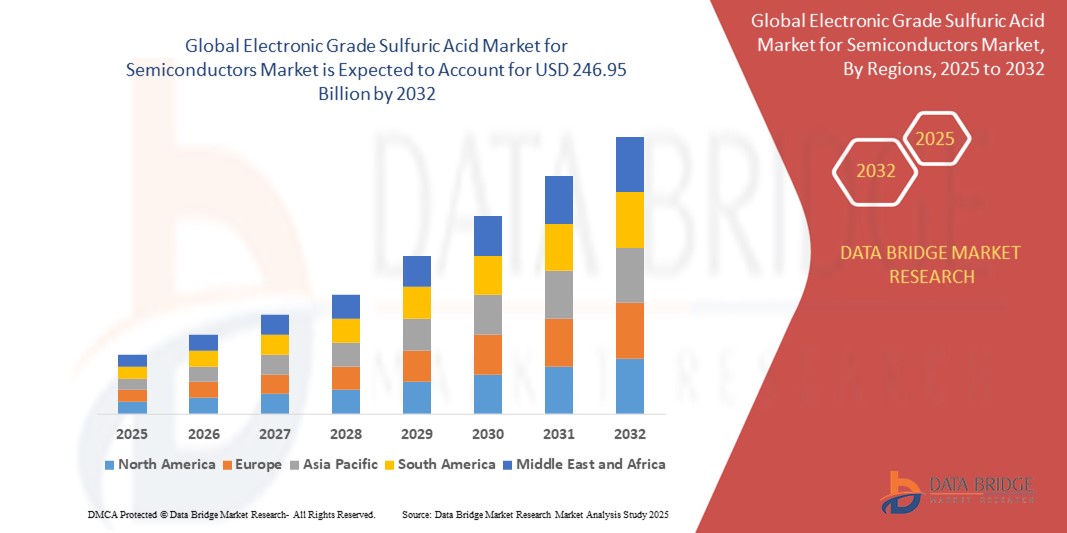
Electronic Grade Sulfuric Acid Market for Semiconductors Market Size
- The global electronic grade sulfuric acid market for semiconductors market was valued at USD 159.70 billion in 2024 and is expected to reach USD 246.95 billion by 2032
- During the forecast period of 2025 to 2032 the market is likely to grow at a CAGR of 5.60%, primarily driven by increasing industrial automation
- This growth is driven by factors such as industry 4.0 & smart manufacturing and demand for precision & quality
Electronic Grade Sulfuric Acid Market for Semiconductors Market Analysis
- Electronic grade sulfuric acid is a high-purity chemical used in semiconductor manufacturing for wafer cleaning, etching, and contamination removal. Its ultra-low metal ion content ensures precision and reliability in chip fabrication processes
- Market growth is primarily driven by the rising demand for advanced semiconductor nodes, increasing production of high-performance chips, and stringent purity requirements in the electronics industry
- In addition, the expansion of semiconductor fabrication facilities and the shift toward ultra-pure chemicals are reshaping the market landscape. Manufacturers are focusing on high-purity formulations to meet the stringent standards of next-generation semiconductor technologies
- For instance, key players such as BASF and Avantor are investing in refining technologies to enhance the purity and efficiency of electronic-grade sulfuric acid, catering to the evolving needs of semiconductor manufacturers
- The electronic grade sulfuric acid market for semiconductors is poised for steady growth, supported by ongoing advancements in semiconductor manufacturing, increasing investments in chip production, and the development of new purification techniques. The rise of AI, 5G, and IoT applications will further accelerate market expansion
Report Scope and Electronic Grade Sulfuric Acid Market for Semiconductors Market Segmentation
|
Attributes |
Electronic Grade Sulfuric Acid Market for Semiconductors Key Market Insights |
|
Segments Covered |
|
|
Countries Covered |
North America
Europe
Asia-Pacific
Middle East and Africa
South America
|
|
Key Market Players |
|
|
Market Opportunities |
|
|
Value Added Data Infosets |
In addition to the insights on market scenarios such as market value, growth rate, segmentation, geographical coverage, and major players, the market reports curated by the Data Bridge Market Research also include import export analysis, production capacity overview, production consumption analysis, price trend analysis, climate change scenario, supply chain analysis, value chain analysis, raw material/consumables overview, vendor selection criteria, PESTLE Analysis, Porter Analysis, and regulatory framework. |
Electronic Grade Sulfuric Acid Market for Semiconductors Market Trends
“Growing Expansion of the Semiconductor Industry”
- One prominent trend in the global electronic grade sulfuric acid market for semiconductors market is the growing expansion of the semiconductor industry
- This trend is driven by the increasing investments in advanced chip manufacturing, the rising demand for high-performance semiconductors in AI, 5G, and IoT applications, and the growing establishment of new fabrication facilities worldwide
- For instance, major semiconductor manufacturers such as TSMC, Intel, and Samsung are expanding their production capacity, driving higher consumption of ultra-pure sulfuric acid for wafer cleaning and etching
- In addition, the push for localizing semiconductor supply chains is expected to accelerate, with governments and private companies investing in domestic chip production and advanced manufacturing hubs to reduce dependency on specific regions
- As competition in the semiconductor sector intensifies, electronic-grade sulfuric acid suppliers will continue innovating in purification techniques, sustainability, and supply chain efficiency. The increasing shift toward next-generation semiconductor nodes and high-purity chemical requirements will further fuel market growth, reinforcing its critical role in the semiconductor ecosystem
Electronic Grade Sulfuric Acid Market for Semiconductors Market Dynamics
Driver
“High Usage Across End-User Industries”
- The increasing reliance on electronic-grade sulfuric acid across various end-user industries is a key driver of market growth. As semiconductor manufacturing expands, the demand for ultra-pure chemicals in wafer processing, cleaning, and etching continues to rise, reinforcing sulfuric acid’s critical role in chip fabrication
- This demand is particularly strong in sectors such as consumer electronics, automotive, and telecommunications, where advanced semiconductor technologies are essential for applications such as AI, 5G, and electric vehicles
- The push for higher-performance chips and miniaturization has further heightened the need for high-purity sulfuric acid to ensure contamination-free wafer production
- With industries prioritizing precision and efficiency, semiconductor manufacturers increasingly prefer ultra-clean, low-metal ion sulfuric acid over conventional alternatives to maintain stringent quality standards
- Leading chipmakers and foundries are driving demand by integrating more advanced semiconductor nodes into their manufacturing processes, requiring greater volumes of high-purity chemicals
For instance,
- Companies such as Intel, TSMC, and Samsung continue expanding their fabrication plants, significantly increasing consumption of electronic-grade sulfuric acid for wafer cleaning and etching
- Suppliers such as BASF, Avantor, and KANTO KAGAKU are enhancing their product offerings to meet the evolving purity and performance requirements of these industries
- As the semiconductor sector continues to advance, the growing use of electronic-grade sulfuric acid in next-generation chips, MEMS devices, and advanced packaging technologies will further accelerate market expansion
Opportunity
“Technological Advancements and Benefits”
- Rapid advancements in semiconductor manufacturing technologies present a significant opportunity for the electronic grade sulfuric acid market. As the industry moves toward smaller, more advanced nodes and complex chip architectures, the demand for ultra-high-purity chemicals continues to rise
- Electronic-grade sulfuric acid is increasingly valued for its role in precision wafer cleaning, etching, and contamination control, making it essential for next-generation semiconductor fabrication. Its ability to remove microscopic impurities without damaging delicate structures enhances its importance in advanced logic chips, memory devices, and 3D packaging technologies
- Compared to conventional cleaning agents, ultra-pure sulfuric acid offers superior metal ion control, minimal particle contamination, and improved process efficiency, driving its adoption in cutting-edge semiconductor manufacturing
For instance,
- Leading semiconductor chemical suppliers such as Merck KGaA and BASF are investing in advanced purification technologies to enhance the performance and consistency of electronic-grade sulfuric acid
- Avantor and KANTO KAGAKU are expanding their product portfolios to meet the stringent purity requirements of modern fabs
- As semiconductor technology progresses toward sub-3nm nodes, AI-driven chips, and high-performance computing, investments in ultra-high-purity chemical solutions will increase. This trend will foster innovation in chemical refining techniques, positioning electronic-grade sulfuric acid as a critical enabler of next-generation semiconductor advancements
Restraint/Challenge
“Fluctuations in Raw Material Prices”
- Volatility in raw material prices presents a significant challenge for the electronic grade sulfuric acid market for semiconductors, as fluctuations in sulfur and energy costs directly impact production expenses. The semiconductor industry’s reliance on ultra-high-purity chemicals makes price stability crucial for maintaining cost-effective manufacturing
- Sulfur, a key raw material for sulfuric acid production, is subject to supply chain disruptions, geopolitical uncertainties, and changing environmental regulations, leading to price variations. In addition, rising energy and transportation costs further contribute to market instability, affecting the profitability of sulfuric acid suppliers and semiconductor manufacturers
- The impact of fluctuating raw material prices is particularly significant in regions where supply constraints and environmental policies limit sulfur production or restrict chemical processing
For instance,
- Tightening regulations on industrial emissions and sulfur recovery processes in countries such as China and the U.S. have led to production cost hikes for high-purity sulfuric acid manufacturers
- As price competition intensifies, semiconductor fabs may seek cost-effective chemical alternatives or optimize consumption through advanced recycling and purification techniques. This challenge could slow market expansion, especially in regions where manufacturers prioritize cost efficiency over premium-grade chemical solutions
Electronic Grade Sulfuric Acid Market for Semiconductors Market Scope
The market is segmented on the basis of type, grade, product, and end user.
|
Segmentation |
Sub-Segmentation |
|
By Type |
|
|
By Grade |
|
|
By Product |
|
|
By End User
|
|
Electronic Grade Sulfuric Acid Market for Semiconductors Market Regional Analysis
“North America is the Dominant Region in the Electronic Grade Sulfuric Acid Market for Semiconductors Market”
- North America dominates the electronic grade sulfuric acid market for semiconductors market, driven by the presence of leading semiconductor manufacturers, advanced fabrication facilities, and increasing investments in high-purity chemicals
- The U.S. holds a significant share due to its strong semiconductor ecosystem, growing demand for next-generation chips, and government initiatives such as the CHIPS Act, which supports domestic semiconductor production
- The region's expanding 5G, AI, and automotive electronics sectors further contribute to market growth, as these industries rely heavily on ultra-pure sulfuric acid for wafer processing and contamination control
- In addition, major chemical suppliers in North America are investing in advanced purification technologies and sustainable production methods to meet the semiconductor industry's stringent purity requirements, reinforcing the region’s market dominance
“Asia-Pacific is Projected to Register the Highest Growth Rate”
- The Asia-Pacific region is expected to witness the highest growth rate in the electronic grade sulfuric acid market for semiconductors market, driven by rapid industrialization, urbanization, and rising semiconductor production in key economies such as China, Taiwan, South Korea, and India
- Countries such as China and Taiwan are at the forefront of the global semiconductor supply chain, with government-backed initiatives and large-scale investments in chip manufacturing, boosting the demand for high-purity chemicals
- The region’s increasing adoption of consumer electronics, electric vehicles, and smart devices fuels the need for advanced wafer fabrication and packaging technologies, further accelerating market growth
- As Asia-Pacific continues to strengthen its position as a global semiconductor hub, opportunities for electronic-grade sulfuric acid suppliers will expand, particularly in high-performance computing, 3D ICs, and next-generation chip manufacturing
Electronic Grade Sulfuric Acid Market for Semiconductors Market Share
The market competitive landscape provides details by competitor. Details included are company overview, company financials, revenue generated, market potential, investment in research and development, new market initiatives, global presence, production sites and facilities, production capacities, company strengths and weaknesses, product launch, product width and breadth, application dominance. The above data points provided are only related to the companies' focus related to market.
The Major Market Leaders Operating in the Market Are:
- INEOS (U.K.)
- K.M.G. Chemicals (U.S.)
- Chemtrade Logistics. (Canada)
- KANTO KAGAKU. (Japan)
- Linde plc (Ireland)
- P.V.S. Chemicals (U.S.)
- Spectrum Chemical (U.S.)
- Columbus Chemicals (U.S.)
- ASIA UNION ELECTRONIC CHEMICAL CORP. (Taiwan)
- Chung Hwa Chemical Industrial Works, Ltd. (Taiwan)
- Aurubis AG (Germany)
- Merck KGaA (Germany)
- Nouryon - Chamber of Commerce (Netherlands)
- Seastar Chemicals Inc (Canada)
- Supraveni Chemicals Pvt. Ltd (India)
- Moses Lake Industries (U.S.)
- BASF SE (Germany)
SKU-
Accédez en ligne au rapport sur le premier cloud mondial de veille économique

- Tableau de bord d'analyse de données interactif
- Tableau de bord d'analyse d'entreprise pour les opportunités à fort potentiel de croissance
- Accès d'analyste de recherche pour la personnalisation et les requêtes
- Analyse de la concurrence avec tableau de bord interactif
- Dernières actualités, mises à jour et analyse des tendances
- Exploitez la puissance de l'analyse comparative pour un suivi complet de la concurrence
Méthodologie de recherche
La collecte de données et l'analyse de l'année de base sont effectuées à l'aide de modules de collecte de données avec des échantillons de grande taille. L'étape consiste à obtenir des informations sur le marché ou des données connexes via diverses sources et stratégies. Elle comprend l'examen et la planification à l'avance de toutes les données acquises dans le passé. Elle englobe également l'examen des incohérences d'informations observées dans différentes sources d'informations. Les données de marché sont analysées et estimées à l'aide de modèles statistiques et cohérents de marché. De plus, l'analyse des parts de marché et l'analyse des tendances clés sont les principaux facteurs de succès du rapport de marché. Pour en savoir plus, veuillez demander un appel d'analyste ou déposer votre demande.
La méthodologie de recherche clé utilisée par l'équipe de recherche DBMR est la triangulation des données qui implique l'exploration de données, l'analyse de l'impact des variables de données sur le marché et la validation primaire (expert du secteur). Les modèles de données incluent la grille de positionnement des fournisseurs, l'analyse de la chronologie du marché, l'aperçu et le guide du marché, la grille de positionnement des entreprises, l'analyse des brevets, l'analyse des prix, l'analyse des parts de marché des entreprises, les normes de mesure, l'analyse globale par rapport à l'analyse régionale et des parts des fournisseurs. Pour en savoir plus sur la méthodologie de recherche, envoyez une demande pour parler à nos experts du secteur.
Personnalisation disponible
Data Bridge Market Research est un leader de la recherche formative avancée. Nous sommes fiers de fournir à nos clients existants et nouveaux des données et des analyses qui correspondent à leurs objectifs. Le rapport peut être personnalisé pour inclure une analyse des tendances des prix des marques cibles, une compréhension du marché pour d'autres pays (demandez la liste des pays), des données sur les résultats des essais cliniques, une revue de la littérature, une analyse du marché des produits remis à neuf et de la base de produits. L'analyse du marché des concurrents cibles peut être analysée à partir d'une analyse basée sur la technologie jusqu'à des stratégies de portefeuille de marché. Nous pouvons ajouter autant de concurrents que vous le souhaitez, dans le format et le style de données que vous recherchez. Notre équipe d'analystes peut également vous fournir des données sous forme de fichiers Excel bruts, de tableaux croisés dynamiques (Fact book) ou peut vous aider à créer des présentations à partir des ensembles de données disponibles dans le rapport.











