


Marché mondial du silicium à zone flottante, par taille de nœud (10 nm et moins, 12 à 22 nm et 28 nm et plus), collage de plaquettes (collage direct, collage par activation de surface, collage anodique et collage plasma), utilisateur final (télécommunications, instrumentation et recherche scientifique, santé, énergie, défense et surveillance, informatique et divertissement, industrie et automobile, vente au détail et autres) – Tendances du secteur et prévisions jusqu'en 2032.
Qu'est-ce que la taille de la zone de flottaison du silicium et le taux de croissance
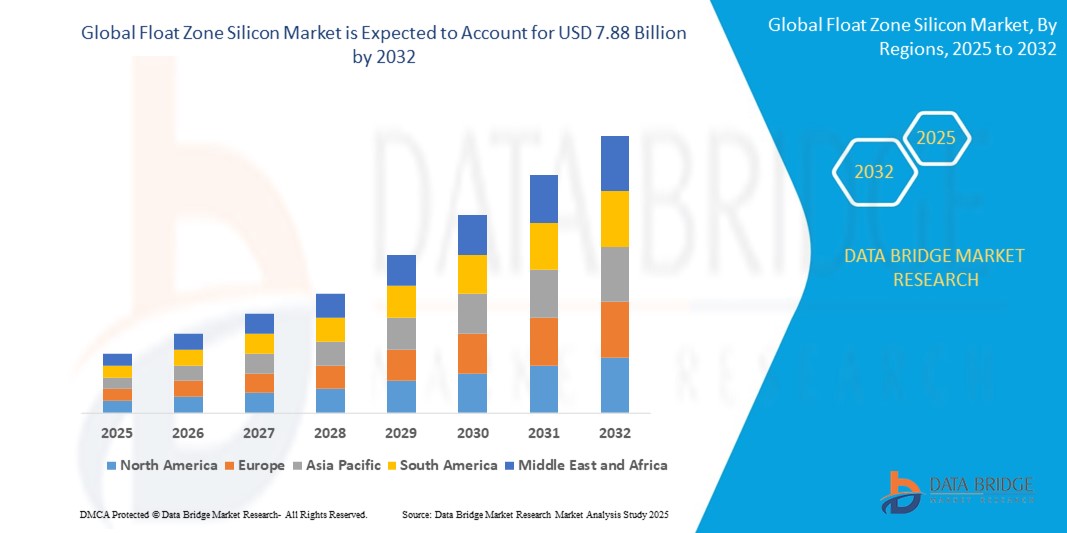
- Selon Data Bridge études de marché Analyse La taille du marché mondial du silicium de la zone flottante a été évaluée à3,84 milliards de dollars en 2024et devrait atteindre7,88 milliards de dollars en 2032, à unTCAC de 9,40%pendant la période de prévision
- La croissance du marché est principalement due à la demande croissante de silicium à haute pureté dans les applications de pointe des semi-conducteurs, en particulier dans les secteurs des télécommunications, de l'informatique et de l'énergie, alimentée par les progrès technologiques et par l'impulsion pour des nœuds plus petits dans la fabrication de copeaux
- L'adoption croissante du silicium de la zone flottante dans l'électronique à haute performance, associée à la nécessité de techniques efficaces et fiables d'assemblage de plaquettes, accélère l'expansion du marché, les industries privilégiant la précision et les performances dans les appareils de nouvelle génération
Taille du marché et prévisions
- Valeur marchande mondiale (2024):3,84 milliards de dollars
- Valeur marchande prévue (2032) :7,88 milliards de dollars
- Prévisions CAGR (2024-2032):9.40%
Quelles sont les principales captures de la zone de flottaison Silicon
- Le silicium de zone de flottaison, connu pour sa haute pureté et sa faible densité de défaut, est un matériau essentiel dans la production de semi-conducteurs avancés, d'électronique de puissance et de dispositifs haute performance, offrant des propriétés électriques supérieures à celles du silicium Czochralski
- Le marché est propulsé par la demande croissante de puces miniaturisées à haut rendement dans des applications telles que les télécommunications 5G, les véhicules électriques et les systèmes d'énergie renouvelable, tout en augmentant les investissements dans la fabrication de semi-conducteurs
- L'Amérique du Nord a dominé le marché du silicium de la zone flottante avec la plus grande part de revenus de 42,5 % en 2024, sous l'impulsion de son industrie de pointe des semi-conducteurs, d'importants investissements en R-D et de la présence d'acteurs clés aux États-Unis, en particulier dans l'innovation des wafers de silicium pour les technologies d'IA et de 5G
- La région Asie-Pacifique devrait connaître la croissance la plus rapide au cours de la période de prévision, alimentée par l'industrialisation rapide, l'augmentation des installations de fabrication de semi-conducteurs et l'augmentation de la demande d'électronique de consommation dans des pays comme la Chine, le Japon et la Corée du Sud.
- Le segment de 10 nm et du segment inférieur a dominé la plus grande part du marché de 50 % en 2024, en raison de la demande croissante de technologies de pointe qui permettent une plus grande densité de transistors et une meilleure performance pour les appareils électroniques de pointe, en particulier dans le domaine de l'informatique et des télécommunications à haute performance.
Rapport sur la portée et la zone de flottation segmentation du marché du silicium
|
Attributs |
Zone de flottaison Silicon Principales perspectives du marché |
|
Segments couverts |
|
|
Pays couverts |
Amérique du Nord
Europe
Asie-Pacifique
Moyen-Orient et Afrique
Amérique du Sud
|
|
Principaux acteurs du marché |
|
|
Possibilités de marché |
|
|
Infos sur la valeur ajoutée |
Outre les informations sur les scénarios du marché, tels que la valeur du marché, le taux de croissance, la segmentation, la couverture géographique et les principaux acteurs, les rapports de marché établis par Data Bridge Market Research comprennent également une analyse approfondie des experts, une production et une capacité géographiquement représentées par l'entreprise, des schémas de réseau des distributeurs et des partenaires, une analyse détaillée et actualisée des tendances des prix et une analyse du déficit de la chaîne d'approvisionnement et de la demande. |
Quelle est la tendance clé dans la zone de flottaison Silicon
Augmentation de l'adoption de technologies de fabrication de semi-conducteurs avancées
- Le marché mondial du silicium en zone de flottaison connaît une tendance notable à l'intégration de technologies de fabrication de semi-conducteurs de pointe, sous l'impulsion de la demande de plaquettes de silicium à haute pureté
- Ces technologies, telles que l'amélioration de la purification des zones de flottaison et les techniques avancées de collage des plaquettes, permettent la production de plaquettes de silicium ayant des propriétés électriques supérieures et des impuretés minimales, critiques pour des applications de haute performance
- Les procédés de fabrication avancés, en particulier pour les nœuds de 10 nm et moins, soutiennent le développement de semi-conducteurs de nouvelle génération utilisés dans les technologies AI, IoT et 5G
- Par exemple, les entreprises tirent parti de la liaison plasma et de la liaison de surface pour améliorer l'intégration des wafers pour des dispositifs complexes tels que les systèmes microélectromécaniques (MEMS) et les circuits haute fréquence
- Cette tendance accroît l'attrait du silicium des zones flottantes pour les industries telles que les télécommunications, l'informatique et l'automobile, où l'efficacité et la fiabilité sont primordiales
- Les innovations dans les techniques de bondage des wafers, telles que le bondage direct, permettent la création d'interconnexions robustes et à haute densité, ce qui stimule la croissance du marché.
Zone flottante Dynamique du marché du silicium
Chauffeur
Demande croissante de semi-conducteurs à haut rendement et de solutions pour les énergies renouvelables
- La demande croissante de semi-conducteurs à haute performance dans des applications telles que l'infrastructure 5G, les véhicules électriques (EV) et l'électronique grand public est un moteur clé du marché mondial du silicium Float Zone
- Les propriétés supérieures de pureté et d'électricité de la zone de flottaison le rendent idéal pour la fabrication de puces à haut rendement, d'amplificateurs RF et de cellules solaires, soutenant la croissance des dispositifs connectés et des systèmes d'énergie renouvelable
- Les initiatives gouvernementales visant à promouvoir l'énergie propre, en particulier en Amérique du Nord et en Europe, encouragent l'adoption de la zone flottante de silicium dans la production de cellules solaires à haut rendement
- La prolifération de l'IoT et le déploiement des réseaux 5G facilitent le traitement et la transmission des données plus rapides, ce qui accroît le besoin de plaquettes de silicium de pointe dans les secteurs des télécommunications et de l'informatique
- Les principaux fabricants de semi-conducteurs intègrent de plus en plus le silicium de la zone flottante dans leurs lignes de production pour répondre aux exigences de performance rigoureuses des dispositifs modernes.
Restriction/Défi
Coûts de production élevés et procédés de fabrication complexes
- Le coût élevé de la production de silicium en zone flottante, dû au procédé de purification à forte intensité énergétique et à l'équipement spécialisé, constitue un obstacle important à l'adoption du marché, en particulier dans les régions sensibles aux coûts.
- La complexité de la fabrication de wafers de silicium à haute pureté, en particulier pour les nœuds avancés tels que 10 nm et moins, nécessite des investissements substantiels dans la R-D et les installations de production.
- En outre, les préoccupations concernant la stabilité de la chaîne d'approvisionnement et la disponibilité de matières premières pour la production de silicium en zone flottante peuvent entraver la croissance du marché.
- La complexité des techniques de collage des wafers, comme le collage des anodes et des plasmas, ajoute aux défis de production, exigeant un contrôle précis pour obtenir des résultats fiables.
- Ces facteurs peuvent limiter l'expansion du marché dans les économies émergentes où les coûts et les limites de l'infrastructure sont importants.
Comment est la zone de flottaison Silicon segmenté
Le marché est segmenté en fonction de la taille des nœuds, de la fixation des wafers et de l'utilisateur final.
- Taille du nœud
Sur la base de la taille des nœuds, le marché mondial du silicium de la zone de flottaison est segmenté en 10 nm et inférieur, 12 à 22 nm et 28 nm et plus. En 2024, le segment des 10 nm et du segment inférieur a dominé la plus grande part des revenus du marché, soit 50 %, en raison de la demande croissante de technologies de pointe qui permettent une plus grande densité de transistors et une meilleure performance pour les appareils électroniques de pointe, en particulier dans le domaine de l'informatique et des télécommunications à haute performance.
Le segment des 28 nm et des Au-dessus devrait connaître le taux de croissance le plus rapide de 2025 à 2032, alimenté par les progrès dans les applications à haute performance et la pertinence continue des applications existantes où la fiabilité et la compatibilité sont primordiales, comme dans les secteurs industriel et automobile.
- Par l'affaissement
Sur la base de la liaison par wafer, le marché mondial du silicium de la zone de flottaison est segmenté en liaison directe, en liaison par surface, en liaison anodique et en liaison par plasma. Le segment des obligations directes devrait détenir la plus grande part du marché de 40 % en 2024, grâce à son application étendue dans la fabrication de semi-conducteurs, en particulier pour la production d'appareils électroniques de pointe tels que les circuits intégrés et les systèmes microélectromécaniques (MEMS).
Le segment de la liaison Plasma devrait connaître le taux de croissance le plus rapide de 2025 à 2032, en raison de sa force de liaison accrue, de son uniformité et de son contrôle des paramètres de liaison, ce qui le rend adapté aux applications avancées dans la fabrication de semi-conducteurs, la biotechnologie et la nanotechnologie.
- Par Utilisateur final
Sur la base de l'utilisateur final, le marché mondial du silicium de la zone flottante est segmenté en télécommunications, instrumentation et recherche scientifique, santé, énergie, défense et surveillance, informatique et divertissement, industrie et automobile, commerce de détail, etc. Le segment des télécommunications a dominé la part de marché de 35% en 2024, propulsée par l'expansion de l'infrastructure 5G et la demande de matériaux semi-conducteurs de haute qualité pour les amplificateurs RF et les circuits à haute fréquence, tirant parti de la pureté supérieure et des propriétés électriques de la zone de flottaison du silicium.
Le segment de l'industrie et de l'automobile devrait connaître une croissance rapide de 2025 à 2032, grâce à l'adoption croissante du silicium de zone flottante dans les véhicules électriques (EV) et l'électronique automobile pour une conversion de puissance efficace, la gestion de la batterie et des puces haute performance, ainsi que dans l'automatisation industrielle pour des solutions fiables et évolutives.
Quelle région détient la plus grande part de la zone de flottaison du silicium segmenté
- L'Amérique du Nord a dominé le marché du silicium de la zone flottante avec la plus grande part de revenus de 42,5 % en 2024, sous l'impulsion de son industrie de pointe des semi-conducteurs, d'importants investissements en R-D et de la présence d'acteurs clés aux États-Unis, en particulier dans l'innovation des wafers de silicium pour les technologies d'IA et de 5G
- Les consommateurs et les industries privilégient le silicium des zones flottantes pour sa pureté et ses performances exceptionnelles dans les semi-conducteurs, les cellules solaires et l'électronique électrique à haut rendement, en particulier dans les régions dotées d'infrastructures technologiques de pointe
- La croissance est soutenue par des innovations dans les techniques de purification, telles que le chauffage à induction avancé et le raffinage des zones, parallèlement à l'adoption croissante dans les secteurs d'origine et d'après-vente dans diverses industries
Zone de flottaison américaine Silicon Market Insight
Le marché américain du silicium de la zone flottante a enregistré la plus grande part des revenus de 87,7 % en 2024 en Amérique du Nord, alimentée par une forte demande dans les secteurs des semi-conducteurs et de l'énergie solaire, ainsi que par une sensibilisation croissante aux propriétés électriques supérieures du matériau. La tendance vers des nœuds semi-conducteurs avancés et l'augmentation des investissements dans les technologies des énergies renouvelables stimulent encore l'expansion du marché. La présence de fabricants clés comme GlobalWafers et Siltronic, ainsi que des initiatives de R-D favorables, crée un écosystème de marché robuste.
Europe Zone de flots Vue du marché du silicium
Le marché européen du silicium en zone flottante devrait connaître une croissance significative, soutenue par une forte insistance sur l'innovation technologique et l'efficacité énergétique. Les industries recherchent du silicium à haute pureté pour des applications à semi-conducteurs de pointe et des solutions d'énergie renouvelable, en particulier dans les cellules solaires. La croissance occupe une place de premier plan dans les nouveaux procédés de fabrication et les applications de modernisation, des pays comme l'Allemagne et la France montrant une forte adhésion en raison de leur concentration sur les industries de haute technologie et les objectifs de durabilité.
U.K. Zone flottante Silicon Market Insight
Le marché britannique du silicium de la zone flottante devrait connaître une croissance rapide, en raison de la demande croissante d'électronique à haute performance et d'applications d'énergie renouvelable dans les milieux urbains et industriels. La prise de conscience du matériel contribue à réduire la consommation d'énergie et à améliorer la performance des appareils. L'évolution de la réglementation favorisant les technologies à haut rendement énergétique influence les choix de l'industrie, en conciliant la performance et la conformité.
Allemagne Zone flottante Silicon Market Insight
L'Allemagne devrait connaître l'un des taux de croissance les plus rapides du marché du silicium de la zone flottante, attribué à son secteur de fabrication de semi-conducteurs de pointe et à l'accent mis sur l'efficacité énergétique. Les industries allemandes préfèrent le silicium de zone flottante technologiquement avancé pour des applications dans l'informatique à haute performance et l'énergie renouvelable, ce qui contribue à réduire la consommation d'énergie. L'intégration de ces matériaux dans l'électronique de pointe et les solutions après-vente favorise une croissance soutenue du marché.
Aperçu du marché du silicium dans la zone de flottaison Asie-Pacifique
La région Asie-Pacifique devrait connaître le taux de croissance le plus rapide, en raison de l'expansion de la production de semi-conducteurs et de l'augmentation des investissements dans des pays comme la Chine, le Japon et la Corée du Sud. La demande croissante de silicium à haute pureté dans les applications électroniques, solaires et automobiles stimule la croissance du marché. Les initiatives gouvernementales visant à promouvoir l'efficacité énergétique et l'adoption de technologies de pointe encouragent davantage l'utilisation du silicium de la zone flottante.
Japon Zone flottante Silicon Market Insight
Le marché japonais du silicium de la zone flottante devrait connaître une croissance rapide en raison de la forte préférence des consommateurs et de l'industrie pour le silicium de haute qualité et de haute pureté qui améliore les performances des semi-conducteurs et des applications solaires. La présence de grands fabricants tels que Shin-Etsu Chemical et SUMCO, ainsi que l'intégration du silicium de zone flottante dans les produits OEM, accélère la pénétration du marché. L'intérêt croissant pour l'électronique de pointe et les solutions d'énergie renouvelable contribue également à la croissance.
China Float Zone Silicon Market Insight
La Chine détient la plus grande part du marché du silicium de la zone flottante Asie-Pacifique, propulsée par une urbanisation rapide, une demande croissante d'électronique de pointe et une forte concentration sur les solutions d'énergie renouvelable. Le secteur technologique en expansion et les investissements dans la fabrication de semi-conducteurs soutiennent l'adoption de la zone flottante de silicium. Des capacités de fabrication nationales solides et des prix compétitifs améliorent l'accessibilité du marché, ce qui stimule une croissance importante.
Zone flottante Part du marché du silicium
L'industrie du silicium de la zone flottante est principalement dirigée par des entreprises bien établies, notamment :
- Topsil GlobalWafers A/S (Danemark)
- Sino-American Silicon Products Inc. (Taiwan)
- Shanghai Simgui Technology Co., Ltd. (Chine)
- Société d'assurance-vie. (Japon)
- SUMCO CORPORATION(Japon)
- Siltronic AG(Allemagne)
- SK siltron Co., Ltd. (Corée du Sud)
- Oy Okmétic(Finlande)
- Microchip Technology Inc. (États-Unis)
- JRH ELECTRONICS INC. (États-Unis)
- RS Technologies Co., Ltd. (Chine)
- TCL Technology Group Corporation (Chine)
- Wafer pur (États-Unis)
- MEMC Electronic Materials (États-Unis)
- Mitsubishi Materials Corporation (Japon)
- Société d'exploitation Ferrotec (Japon)
Quelles sont les évolutions récentes du marché mondial du silicium en zone de flottaison
- En juin 2024, un rapport de marché a mis en évidence la forte trajectoire de croissance du marché des wafers de silicium de la zone de flottaison (FZ), en raison de la demande croissante de substrats à haute pureté dans la fabrication de semi-conducteurs. D'une valeur d'environ 5 milliards de dollars en 2025, le marché devrait atteindre près de 9 milliards de dollars d'ici 2033, propulsé par des applications dans le calcul haute performance, l'électronique de puissance et les capteurs avancés. Les wafers FZ, réputés pour leur pureté exceptionnelle et leurs propriétés électriques, sont de plus en plus favorisés dans les industries exigeant précision et fiabilité, comme l'aérospatiale, l'automobile et les énergies renouvelables.
- En mai 2024, de nouvelles données ont révélé une augmentation notable de la demande de wafers en silicium dans les zones de flottaison (FZ) provenant du secteur MEMS et de l'intégration des capteurs, en particulier au sein de l'électronique grand public. Cette poussée est alimentée par l'utilisation croissante de smartwatchs, de capteurs médicaux et de moniteurs environnementaux, qui nécessitent tous des substrats à haute sensibilité et à faible défaut. La pureté supérieure du cristal et les caractéristiques électriques de FZ le rendent idéal pour améliorer la précision et la fiabilité du capteur, en particulier dans les appareils compacts et performants où même des défauts mineurs peuvent avoir un impact sur la fonctionnalité
- En mars 2024, l'industrie des semi-conducteurs a maintenu son élan vers des wafers de silicium à zone de flottaison (FZ) de plus grand diamètre, en particulier des formats de 300 mm, afin d'accroître l'efficacité de production et de réduire les coûts unitaires. Ce changement est dû au besoin croissant d'appareils électroniques compacts et performants dans des secteurs comme l'IA, l'électronique de puissance et les capteurs avancés. Les fabricants explorent également de nouvelles techniques de dopage et des traitements de surface innovants pour améliorer le rendement des wafers, les performances électriques et la stabilité thermique. Ces progrès visent à répondre aux exigences strictes en matière de pureté et d'absence de défauts dans les applications de prochaine génération, tout en soutenant l'évolutivité dans la fabrication à grand volume
- En janvier 2024, les données de l'industrie ont mis l'accent sur la demande croissante de wafers en silicium de la zone de flottaison (FZ) dans l'électronique électrique, en particulier dans les secteurs des véhicules électriques (EV) et de l'automatisation industrielle. Avec plus de 7 millions d'EV utilisant des modules de puissance basés sur des wafers FZ, l'importance du matériau est soulignée par sa résistivité uniforme, sa haute tension de panne et sa faible densité de défaut – tous essentiels pour les onduleurs à haute efficacité et les modules IGBT. Ces propriétés permettent des performances supérieures dans des environnements à haute tension et haute température, faisant du silicium FZ une pierre angulaire de l'évolution des systèmes de mobilité et d'énergie de la prochaine génération
- En octobre 2023, les principaux acteurs du marché des wafers en silicium de la zone de flottaison (FZ) – y compris Shin-Etsu Chemical, SUMCO CORPORATION et Siltronic – ont intensifié leurs investissements dans la production de silicium de haute pureté et les technologies avancées de traitement des wafers. Ces mouvements stratégiques sont conçus pour répondre à la demande croissante de substrats ultra-haute pureté, essentiels pour les composants semi-conducteurs de nouvelle génération utilisés dans l'électronique de puissance, l'informatique haute performance et les capteurs avancés. L'accent est mis sur l'augmentation de la production de plaquettes FZ de 300 mm, l'amélioration des techniques de croissance des cristaux et l'amélioration des procédés de traitement de surface pour répondre aux exigences de qualité rigoureuses des applications émergentes.
SKU-
Accédez en ligne au rapport sur le premier cloud mondial de veille économique

- Tableau de bord d'analyse de données interactif
- Tableau de bord d'analyse d'entreprise pour les opportunités à fort potentiel de croissance
- Accès d'analyste de recherche pour la personnalisation et les requêtes
- Analyse de la concurrence avec tableau de bord interactif
- Dernières actualités, mises à jour et analyse des tendances
- Exploitez la puissance de l'analyse comparative pour un suivi complet de la concurrence
Méthodologie de recherche
La collecte de données et l'analyse de l'année de base sont effectuées à l'aide de modules de collecte de données avec des échantillons de grande taille. L'étape consiste à obtenir des informations sur le marché ou des données connexes via diverses sources et stratégies. Elle comprend l'examen et la planification à l'avance de toutes les données acquises dans le passé. Elle englobe également l'examen des incohérences d'informations observées dans différentes sources d'informations. Les données de marché sont analysées et estimées à l'aide de modèles statistiques et cohérents de marché. De plus, l'analyse des parts de marché et l'analyse des tendances clés sont les principaux facteurs de succès du rapport de marché. Pour en savoir plus, veuillez demander un appel d'analyste ou déposer votre demande.
La méthodologie de recherche clé utilisée par l'équipe de recherche DBMR est la triangulation des données qui implique l'exploration de données, l'analyse de l'impact des variables de données sur le marché et la validation primaire (expert du secteur). Les modèles de données incluent la grille de positionnement des fournisseurs, l'analyse de la chronologie du marché, l'aperçu et le guide du marché, la grille de positionnement des entreprises, l'analyse des brevets, l'analyse des prix, l'analyse des parts de marché des entreprises, les normes de mesure, l'analyse globale par rapport à l'analyse régionale et des parts des fournisseurs. Pour en savoir plus sur la méthodologie de recherche, envoyez une demande pour parler à nos experts du secteur.
Personnalisation disponible
Data Bridge Market Research est un leader de la recherche formative avancée. Nous sommes fiers de fournir à nos clients existants et nouveaux des données et des analyses qui correspondent à leurs objectifs. Le rapport peut être personnalisé pour inclure une analyse des tendances des prix des marques cibles, une compréhension du marché pour d'autres pays (demandez la liste des pays), des données sur les résultats des essais cliniques, une revue de la littérature, une analyse du marché des produits remis à neuf et de la base de produits. L'analyse du marché des concurrents cibles peut être analysée à partir d'une analyse basée sur la technologie jusqu'à des stratégies de portefeuille de marché. Nous pouvons ajouter autant de concurrents que vous le souhaitez, dans le format et le style de données que vous recherchez. Notre équipe d'analystes peut également vous fournir des données sous forme de fichiers Excel bruts, de tableaux croisés dynamiques (Fact book) ou peut vous aider à créer des présentations à partir des ensembles de données disponibles dans le rapport.











