


Global Flow Wrap Packaging Market Segmentation, selon le matériel (plastique, papier et feuille d'aluminium), Application (paquets, chocolat et confiserie, produits de boulangerie, dispositifs médicaux et produits d'hygiène personnelle), Utilisation finale (aliments et boissons, produits médicaux et pharmaceutiques, cosmétiques et soins personnels, produits industriels, produits ménagers, aliments et fournitures pour animaux familiers et produits du tabac) - Tendances et prévisions de l'industrie jusqu'en 2033
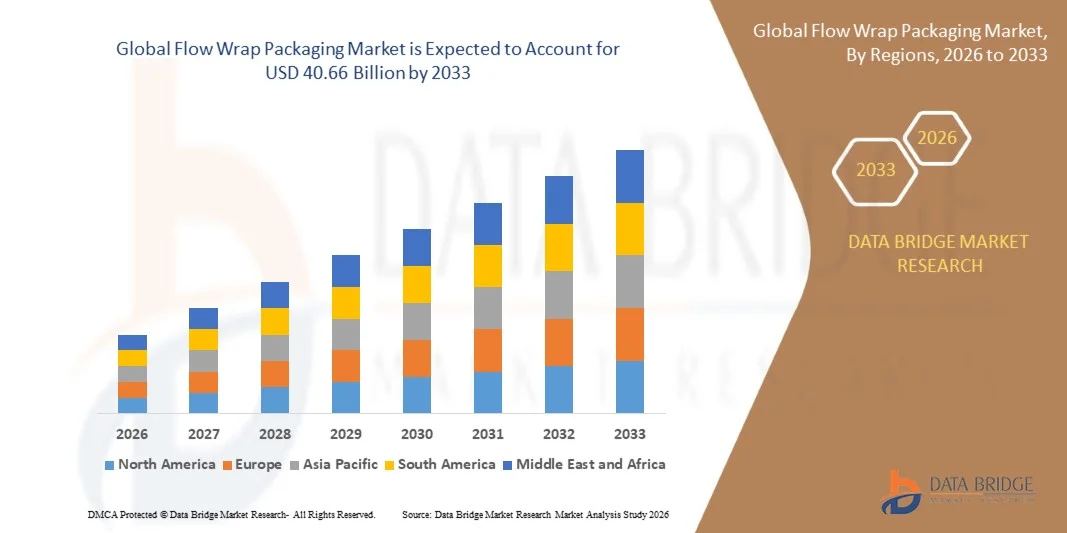
Taille du marché
- La taille du marché mondial des emballages d'emballages d'emballages d'écoulement a été évaluée à26,90 milliards de dollars en 2025et devrait atteindre40,66 milliards de dollars en 2033, à unTCAC de 5,30%pendant la période de prévision
- La croissance du marché s'explique en grande partie par la demande croissante de solutions d'emballage souples dans les secteurs des aliments, des confiseries, de la boulangerie, des produits laitiers et des soins personnels, soutenue par les progrès réalisés dans les machines d'emballage à grande vitesse et l'innovation matérielle qui améliorent l'efficacité, la durée de conservation et la protection des produits.
- De plus, l'accent mis de plus en plus sur les emballages rentables, l'augmentation de la consommation de produits emballés et en cours d'utilisation et l'adoption croissante de matériaux recyclables et sous-évalués renforcent l'emballage des enveloppes de flux comme format privilégié. Ces facteurs combinés accélèrent la pénétration des marchés tant dans les pays développés que dans les pays émergents, renforçant ainsi la croissance globale de l'industrie.
Analyse du marché de l'emballage des bandes de flux
- L'emballage d'emballage à flux est un format d'emballage souple dans lequel les produits sont enveloppés dans un film continu et scellés longitudinalement et transversalement, offrant un emballage à grande vitesse, une présentation uniforme et une protection efficace contre les obstacles. Il est largement utilisé pour les applications mono et multi-pack en raison de sa polyvalence et de sa compatibilité avec les lignes de production automatisées
- L'augmentation de la demande d'emballages d'emballages d'écoulement est principalement soutenue par la croissance de la consommation d'aliments emballés, l'expansion des circuits de vente au détail et de commerce électronique et l'accent accru mis sur les innovations en matière axées sur la durabilité qui équilibrent les performances, l'efficience et la conformité à la réglementation.
- L'Asie-Pacifique a dominé le marché de l'emballage de flux avec une part de40,90 % en 2025, en raison de la forte consommation d'aliments emballés, de l'accroissement de la population urbaine et de la croissance rapide des secteurs du commerce de détail et du commerce électronique organisés
- On s'attend à ce que l'Amérique du Nord soit la région qui connaît la croissance la plus rapide sur le marché des emballages d'emballage au cours de la période de prévision en raison de la forte demande d'aliments de commodité, de la croissance des repas prêts à manger et de l'automatisation accrue des opérations d'emballage.
- Le segment du plastique a dominé le marché avec une part de marché de 60,96 % en 2025, en raison de sa grande flexibilité, son intégrité aux joints, sa résistance à l'humidité et son rapport coût-efficacité sur les lignes d'emballage à grande vitesse. Les enveloppes en plastique sont largement préférées pour prolonger la durée de conservation et maintenir la visibilité des produits, en particulier dans les aliments de masse et les articles de soins personnels. Leur compatibilité avec l'équipement d'emballage automatisé et leur forte résistance aux contaminants continuent de renforcer leur domination sur les marchés mondiaux
Étendue du rapport et segmentation du marché de l'emballage en bandes
| Attributs | L'emballage d'enveloppes de flux Principales perspectives du marché |
| Segments couverts |
|
| Pays couverts | Amérique du Nord
Europe
Asie-Pacifique
Moyen-Orient et Afrique
Amérique du Sud
|
| Principaux acteurs du marché |
|
| Possibilités de marché |
|
| Infos sur la valeur ajoutée | En plus des renseignements sur les scénarios du marché tels que la valeur marchande, le taux de croissance, la segmentation, la couverture géographique et les principaux intervenants, les rapports de marché établis par Data Bridge Market Research comprennent aussi l'analyse des exportations d'importations, l'aperçu des capacités de production, l'analyse de la consommation de production, l'analyse des tendances des prix, le scénario du changement climatique, l'analyse de la chaîne d'approvisionnement, l'analyse de la chaîne de valeur, l'aperçu des matières premières et des consommables, les critères de sélection des fournisseurs, l'analyse PESTLE, l'analyse Porter et le cadre réglementaire. |
Tendances du marché de l'emballage en bandes
Vers des matériaux recyclables et à base de papier
- Une tendance importante sur le marché des emballages d'emballages d'écoulement est l'accélération de la transition vers des structures d'emballages d'écoulement recyclables, à base de papier et monomatériaux, en raison des engagements croissants des propriétaires de marques en matière de durabilité et du durcissement des règlements sur les déchets d'emballages plastiques. Les fabricants remodelent de plus en plus les formats d'enveloppes pour respecter les normes de recyclabilité tout en maintenant l'usinage et la protection des produits dans toutes les applications alimentaires et de biens de consommation
- Par exemple, en avril 2024, Cox & Co a mis en place des emballages en papier pour ses produits au chocolat à une seule origine, éliminant le plastique et permettant la recyclabilité du côté du trottoir tout en conservant une durée de conservation minimale de 12 mois. Ce développement démontre comment les enveloppes de papier gagnent en viabilité commerciale dans les segments d'aliments haut de gamme sans compromettre la performance
- Le secteur de l'alimentation et de la confiserie adopte activement des solutions de rechange à l'enroulement recyclable pour s'aligner sur les objectifs de l'économie circulaire et sur les cadres de responsabilité élargie des producteurs. Ce changement influence l'innovation matérielle axée sur les solutions à base de fibres et monomatériaux compatibles avec les lignes d'enroulement à grande vitesse existantes
- Les producteurs d'emballage investissent dans la recherche pour améliorer les propriétés des barrières et l'intégrité des joints de matériaux d'emballage durables. Ces efforts visent à combler l'écart de performance entre les stratifiés plastiques traditionnels et les alternatives recyclables
- Les détaillants et les marques de consommation privilégient de plus en plus les formats d'emballage qui communiquent clairement la recyclabilité aux utilisateurs finaux. Cela renforce la demande de structures matérielles simplifiées qui favorisent la confiance des consommateurs et le respect de la réglementation
- Le marché est en transition constante vers des solutions durables d'enroulement des flux qui équilibrent l'impact environnemental, la performance fonctionnelle et l'efficacité des coûts. Cette tendance renforce les changements structurels à long terme dans la sélection des matériaux dans l'industrie mondiale de l'emballage en emballage
Dynamique du marché de l'emballage des bandes de flux
Chauffeur
L'augmentation de la demande d'emballages haute vitesse et économique
- La demande croissante de solutions d'emballage à grande vitesse et rentables dans les secteurs des aliments, de la boulangerie, des collations et des soins personnels est un facteur clé qui soutient le marché des emballages d'emballage en flux. Les formats enveloppants permettent une production rapide, une utilisation réduite des matériaux et une présentation cohérente des produits, ce qui les rend très attrayants pour la fabrication à grande échelle.
- Par exemple, des entreprises telles que Huhtamaki et Mondi fournissent des solutions d'emballage d'emballage d'écoulement conçues pour la compatibilité avec les lignes automatisées d'emballage à haut rendement utilisées par les marques alimentaires mondiales. Ces solutions aident les fabricants à améliorer le débit tout en maintenant la qualité des emballages et leur efficacité opérationnelle.
- L'expansion de la consommation d'aliments emballés et de commodité s'appuie de plus en plus sur des systèmes d'emballage qui soutiennent des opérations continues et de grande quantité. L'emballage d'emballage d'écoulement répond à ces exigences en permettant un étanchéité rapide et un temps d'arrêt minimal
- Les fabricants sont soumis à des pressions croissantes pour optimiser les coûts d'emballage en raison des fluctuations des prix des matières premières. Les formats d'enveloppes de flux appuient les stratégies de réduction des déchets et des matériaux qui aident à contrôler les dépenses globales d'emballage
- Cet accent soutenu sur la vitesse, l'efficacité et le contrôle des coûts continue de positionner l'emballage d'enveloppe de flux comme une solution privilégiée pour les catégories de produits de consommation à forte croissance
Restriction/Défi
Limitations de la performance et de la durée de conservation des matériaux durables
- Le marché des emballages d'emballages d'écoulement est confronté à des défis liés aux limites de performance et de durée de conservation des matériaux durables et recyclables par rapport aux stratifiés plastiques multicouches traditionnels. L'obtention de barrières adéquates en matière d'humidité, d'oxygène et de graisse demeure une préoccupation essentielle pour les applications dans les aliments et les confiseries
- Par exemple, Innovia Films a mis en évidence des considérations de stockage et de sensibilité à la température pour ses films d'enroulement à très faible densité, qui exigent des conditions contrôlées pour maintenir l'intégrité du matériau pendant de longues périodes. De telles contraintes peuvent limiter l'adoption dans les régions à conditions climatiques variables
- Les structures d'enveloppes en papier et monomatériaux font souvent face à des compromis entre la recyclabilité et la performance de la barrière. Cela peut avoir une incidence sur la fraîcheur du produit et limiter l'aptitude à certains produits stables ou sensibles à l'humidité
- Les fabricants doivent investir dans des revêtements supplémentaires, des traitements ou des techniques d'ingénierie des matériaux afin d'améliorer les performances d'enrobage durables. Ces exigences peuvent accroître la complexité de la production et ralentir la commercialisation à grande échelle
- Ces défis liés à la performance continuent de ralentir le rythme d'adoption durable des matériaux dans les emballages d'emballage. Il est essentiel de surmonter ces limites pour assurer une plus grande pénétration du marché tout en répondant aux attentes environnementales et fonctionnelles.
Champ d'application du marché de l'emballage en bandes de flux
Le marché est segmenté en fonction du matériel, de l'application et de l'utilisation finale.
• Par matière
Sur la base du matériau, le marché de l'emballage de l'enveloppe est segmenté en plastique, papier et aluminium. Le segment du plastique a dominé la plus grande part du marché de 60,96 % en 2025, grâce à sa grande flexibilité, son intégrité aux joints, sa résistance à l'humidité et son rapport coût-efficacité sur les lignes d'emballage à grande vitesse. Les enveloppes en plastique sont largement préférées pour prolonger la durée de conservation et maintenir la visibilité des produits, en particulier dans les aliments de masse et les articles de soins personnels. Leur compatibilité avec l'équipement d'emballage automatisé et leur forte performance par rapport aux contaminants continuent de renforcer leur domination sur les marchés mondiaux.
Le segment papier devrait connaître le taux de croissance le plus rapide de 2026 à 2033, en raison de l'augmentation des mandats de durabilité et des engagements de marque envers les emballages recyclables et biodégradables. La préférence croissante des consommateurs pour les emballages écoconscients et les progrès dans les technologies du papier couché et du papier barrière accélèrent l'adoption. Les enveloppes en papier sont de plus en plus utilisées lorsque la perception de l'environnement et la conformité à la réglementation sont des facteurs d'achat critiques.
• Par demande
Sur la base de l'application, le marché de l'emballage de flux est segmenté en collations emballées, chocolat & confiserie, produits de boulangerie, dispositifs médicaux et produits d'hygiène personnelle. En 2025, les collations emballées représentaient la part prédominante des revenus, en raison de la fréquence élevée de la consommation, de la demande de contrôle des portions et de la nécessité d'accroître la fraîcheur pendant la distribution. Les formats d'enveloppes d'écoulement supportent la production en grand volume tout en préservant la texture et la saveur, les rendant intégrés aux opérations de fabrication de collations dans le monde entier.
On prévoit que le secteur des dispositifs médicaux augmentera au rythme le plus rapide au cours de la période de prévision, en raison des exigences croissantes en matière de stérilisation et des normes d'emballage rigoureuses. L'emballage d'enveloppes de flux offre des preuves falsifiées, un contrôle de la contamination et une compatibilité avec les systèmes de barrière stériles. L'expansion de l'infrastructure de soins de santé et l'augmentation de la consommation de dispositifs médicaux à usage unique accélèrent encore la croissance de ce segment.
• Par utilisation finale
Sur la base de l'utilisation finale, le marché de l'emballage de flux est segmenté en aliments et boissons, produits médicaux et pharmaceutiques, cosmétiques et soins personnels, produits industriels, produits ménagers, aliments et fournitures pour animaux familiers et produits du tabac. Le segment des aliments et boissons a dominé le marché en 2025, soutenu par la production à grande échelle d'aliments prêts-à-manger et la demande croissante de formats d'emballage pratiques et hygiéniques. Les solutions d'enroulement permettent une étanchéité, une marque et une stabilité des tablettes efficaces, ce qui les rend essentiels pour les fabricants d'aliments.
Le segment médical et pharmaceutique devrait enregistrer la croissance la plus rapide de 2026 à 2033, en raison de l'augmentation du contrôle réglementaire et de la demande de solutions d'emballage sûres et conformes. L'emballage d'enveloppes de flux soutient la traçabilité, la protection des produits et la présentation stérile, qui sont essentielles pour les applications pharmaceutiques et médicales. La croissance des dépenses mondiales de soins de santé et des exportations médicales continue de renforcer cette perspective.
Flow Wrap Packaging Market Analyse régionale
- L'Asie-Pacifique a dominé le marché de l'emballage de flux, avec la plus grande part des revenus de 40,90 % en 2025, en raison de la forte consommation d'aliments emballés, de l'expansion de la population urbaine et de la croissance rapide des secteurs du commerce de détail et du commerce électronique organisés.
- La forte base manufacturière de la région, la disponibilité de matériaux d'emballage flexibles à faible coût et l'augmentation des investissements dans les lignes automatisées d'emballage accélèrent l'expansion du marché
- La demande croissante d'aliments de commodité, l'accent accru mis sur l'extension de la durée de conservation et les initiatives gouvernementales favorables aux industries de transformation des aliments contribuent à l'adoption soutenue des emballages en emballage
China Flow Wrap Packaging Aperçu du marché
En 2025, la Chine détenait la plus grande part du marché des emballages d'emballages en écoulement en Asie et dans le Pacifique, avec l'appui de son industrie alimentaire et des boissons massives, de l'écosystème manufacturier à grande échelle et de la forte consommation intérieure de collations emballées, de boulangeries et de confiseries. Les capacités de fabrication avancées de machines d'emballage, le modèle de production axé sur l'exportation et les investissements continus dans l'infrastructure d'emballage automatique sont des facteurs clés de croissance. L'expansion de la logistique du commerce électronique et des formats d'emballage prêts au détail renforce encore la demande.
India Flow Wrap Packaging Aperçu du marché
L'Inde connaît la croissance la plus rapide dans la région de l'Asie et du Pacifique, grâce à l'expansion rapide des secteurs des aliments emballés, de la boulangerie, des produits laitiers et des produits pharmaceutiques. La croissance du commerce de détail organisé, l'urbanisation croissante et la demande croissante de formats d'emballage hygiéniques à usage unique accélèrent l'adoption de l'emballage à flux. Les initiatives gouvernementales visant à soutenir l'infrastructure de transformation des aliments et la croissance des marques nationales FMCG stimulent davantage l'expansion du marché.
Europe Flow Wrap Packaging Aperçu du marché
Le marché européen de l'emballage enroulé est en pleine expansion, soutenu par une forte demande d'emballage durable, des normes d'emballage de haute qualité et une automatisation avancée de la fabrication. La région met l'accent sur les films recyclables, l'efficacité des matériaux et les systèmes d'emballage à grande vitesse, notamment dans les aliments, les confiseries et les emballages pharmaceutiques. La croissance est également soutenue par la pression réglementaire pour des solutions d'emballage écologiques et l'innovation technologique dans la conception de machines.
Allemagne Flow Wrap Packaging Aperçu du marché
Allemagne Le marché de l'emballage de flux est motivé par son leadership dans la fabrication de machines d'emballage, de solides capacités d'automatisation industrielle et l'industrie de transformation alimentaire avancée. Le pays met l'accent sur la précision de l'ingénierie, les systèmes écoénergétiques et l'intégration d'usines intelligentes renforce l'adoption de technologies de flux à haute performance. La demande est particulièrement forte dans les applications de boulangerie, de confiserie et d'emballage industriel.
Aperçu du marché de l'emballage d'enveloppes de flux au Royaume-Uni
Le marché du Royaume-Uni est soutenu par une industrie alimentaire emballée mature, de solides chaînes d'approvisionnement au détail et une attention croissante accordée aux emballages flexibles durables. La croissance des marques de produits alimentaires sous marque privée, la demande d'emballages contrôlés en partie et les investissements dans les lignes d'emballage automatisées sont à l'origine de l'expansion du marché. L'accent mis de plus en plus sur les formats d'emballage recyclables et monomatériaux favorise l'adoption.
Aperçu du marché de l'emballage des bandes de flux en Amérique du Nord
L'Amérique du Nord devrait croître au TCAC le plus rapidement, de 2026 à 2033, en raison de la forte demande d'aliments de commodité, de la croissance des repas prêts à manger et de l'automatisation accrue des opérations d'emballage. L'accent mis sur l'optimisation de la productivité, la réduction des coûts de main-d'oeuvre et les technologies intelligentes d'emballage accélère l'adoption. L'expansion du commerce électronique et la demande d'emballages de protection durables favorisent encore la croissance du marché.
Aperçu du marché de l'emballage d'enveloppes de flux aux États-Unis
Les États-Unis ont représenté la plus grande part du marché nord-américain en 2025, avec l'appui de leur grande industrie des aliments emballés, de l'infrastructure d'emballage avancée et de la forte présence des sociétés mondiales FMCG et pharmaceutiques. L'adoption de machines automatisées à enroulement, la demande de lignes de production à grande vitesse et l'accent mis sur l'efficacité opérationnelle sont des facteurs clés de croissance. Les investissements croissants dans des matériaux d'emballage durables et des systèmes de fabrication intelligents renforcent encore la position du marché américain.
Part du marché de l'emballage en bobine de flux
L'industrie de l'emballage de flux est principalement dirigée par des entreprises bien établies, notamment :
- Amcor plc (Suisse)
- Groupe Constantia Flexibles (Autriche)
- Société aérienne scellée (États-Unis)
- Huhtamäki Oyj (Finlande)
- Billerud AB (Suède)
- Mondi plc (Royaume-Uni)
- Société de produits Sonoco (États-Unis)
- Glenroy, Inc. (États-Unis)
- Coveris Holdings S.A. (Autriche)
- Winpak Ltd. (Canada)
- KM Packaging Services Ltd. (Royaume-Uni)
- Polysack Flexible Packaging Ltd. (Israël)
- ePac Holdings, LLC. (États-Unis)
- Groupe Asteria (Packaging PrintCo NV) (Belgique)
Les derniers développements dans le marché mondial de l'emballage d'enveloppes de flux
- En avril 2024, Cox & Co a développé le marché de l'emballage d'emballage d'écoulement en remplaçant le plastique compostable par un emballage d'écoulement entièrement en papier, renforçant ainsi le déplacement de l'industrie vers des solutions recyclables à côté du trottoir. Ce mouvement répond directement à l'augmentation de la pression des consommateurs pour les emballages sans plastique, tout en démontrant que les enveloppes de papier peuvent encore offrir une durée de conservation minimale de 12 mois pour les produits au chocolat. La transition est également importante sur le plan commercial, car la réduction de 35 % des coûts d'emballage aide les marques à compenser la volatilité des prix du cacao, renforçant ainsi l'argument économique en faveur d'une adoption durable d'enveloppes sur les segments des confiseries haut de gamme.
- En 2023, Huhtamaki a élargi son empreinte d'emballage en enveloppe en investissant dans une nouvelle usine de fabrication en Chine, se positionnant plus près des marchés de biens de consommation à forte croissance en Asie-Pacifique. Cet investissement améliore l'efficacité de la chaîne d'approvisionnement régionale et permet une personnalisation plus rapide pour les marques locales d'aliments et de FMCG, ce qui favorise l'accélération de la demande de formats d'emballage flexibles à volume élevé. Le mouvement met en évidence la façon dont l'expansion des capacités en Asie-Pacifique devient un levier concurrentiel clé sur le marché mondial des emballages en emballage
- En novembre 2022, Innovia Films a influé sur l'innovation matérielle sur le marché de l'emballage en enveloppe avec le lancement d'un film ultra-faible densité conçu pour les applications de crème glacée. La résistance à la perforation élevée du film réduit les dommages causés aux produits et les déchets alimentaires, répondant ainsi à un défi de performance critique dans les emballages de chaîne froide. Sa capacité à maintenir l'intégrité pendant jusqu'à six mois dans des conditions contrôlées démontre comment les films sous-évalués peuvent équilibrer la réduction des matériaux avec la durabilité fonctionnelle
- En septembre 2022, Mondi a introduit des structures recyclables monomatériaux pour l'emballage alimentaire, accélérant la transition du marché aux stratifiés plastiques multicouches difficiles à recycler. Ces solutions s'harmonisent avec l'évolution des lignes directrices mondiales en matière de recyclage tout en maintenant les propriétés des barrières nécessaires à la fraîcheur et à la durée de conservation. Le développement appuie les propriétaires de marques qui cherchent à se conformer aux règlements sur la responsabilité élargie des producteurs et aux engagements en matière de durabilité
- En juin 2021, Amcor a renforcé le marché de l'emballage d'emballage d'écoulement en lançant des solutions d'emballage d'écoulement recyclables pour les collations et les produits de confiserie. Ce développement a permis aux marques d'atteindre les objectifs de recyclabilité sans sacrifier la machinabilité sur les lignes d'enroulement à grande vitesse existantes. L'innovation souligne que la compatibilité avec l'infrastructure d'emballage actuelle demeure un facteur décisif dans l'adoption à grande échelle de formats d'emballage à flux durable
SKU-
Accédez en ligne au rapport sur le premier cloud mondial de veille économique

- Tableau de bord d'analyse de données interactif
- Tableau de bord d'analyse d'entreprise pour les opportunités à fort potentiel de croissance
- Accès d'analyste de recherche pour la personnalisation et les requêtes
- Analyse de la concurrence avec tableau de bord interactif
- Dernières actualités, mises à jour et analyse des tendances
- Exploitez la puissance de l'analyse comparative pour un suivi complet de la concurrence
Méthodologie de recherche
La collecte de données et l'analyse de l'année de base sont effectuées à l'aide de modules de collecte de données avec des échantillons de grande taille. L'étape consiste à obtenir des informations sur le marché ou des données connexes via diverses sources et stratégies. Elle comprend l'examen et la planification à l'avance de toutes les données acquises dans le passé. Elle englobe également l'examen des incohérences d'informations observées dans différentes sources d'informations. Les données de marché sont analysées et estimées à l'aide de modèles statistiques et cohérents de marché. De plus, l'analyse des parts de marché et l'analyse des tendances clés sont les principaux facteurs de succès du rapport de marché. Pour en savoir plus, veuillez demander un appel d'analyste ou déposer votre demande.
La méthodologie de recherche clé utilisée par l'équipe de recherche DBMR est la triangulation des données qui implique l'exploration de données, l'analyse de l'impact des variables de données sur le marché et la validation primaire (expert du secteur). Les modèles de données incluent la grille de positionnement des fournisseurs, l'analyse de la chronologie du marché, l'aperçu et le guide du marché, la grille de positionnement des entreprises, l'analyse des brevets, l'analyse des prix, l'analyse des parts de marché des entreprises, les normes de mesure, l'analyse globale par rapport à l'analyse régionale et des parts des fournisseurs. Pour en savoir plus sur la méthodologie de recherche, envoyez une demande pour parler à nos experts du secteur.
Personnalisation disponible
Data Bridge Market Research est un leader de la recherche formative avancée. Nous sommes fiers de fournir à nos clients existants et nouveaux des données et des analyses qui correspondent à leurs objectifs. Le rapport peut être personnalisé pour inclure une analyse des tendances des prix des marques cibles, une compréhension du marché pour d'autres pays (demandez la liste des pays), des données sur les résultats des essais cliniques, une revue de la littérature, une analyse du marché des produits remis à neuf et de la base de produits. L'analyse du marché des concurrents cibles peut être analysée à partir d'une analyse basée sur la technologie jusqu'à des stratégies de portefeuille de marché. Nous pouvons ajouter autant de concurrents que vous le souhaitez, dans le format et le style de données que vous recherchez. Notre équipe d'analystes peut également vous fournir des données sous forme de fichiers Excel bruts, de tableaux croisés dynamiques (Fact book) ou peut vous aider à créer des présentations à partir des ensembles de données disponibles dans le rapport.











