


Segmentation du marché mondial des convertisseurs de fréquence, par type (convertisseurs de fréquence statiques, convertisseurs de fréquence rotatifs et convertisseurs matriciels), gamme de fréquences (basse fréquence, moyenne fréquence et haute fréquence), application (aérospatiale, industrie, marine et télécommunications), utilisation finale (commerciale, résidentielle et industrielle) - Tendances du secteur et prévisions jusqu'en 2033
Qu'est-ce que la taille du marché du convertisseur de fréquence et le taux de croissance
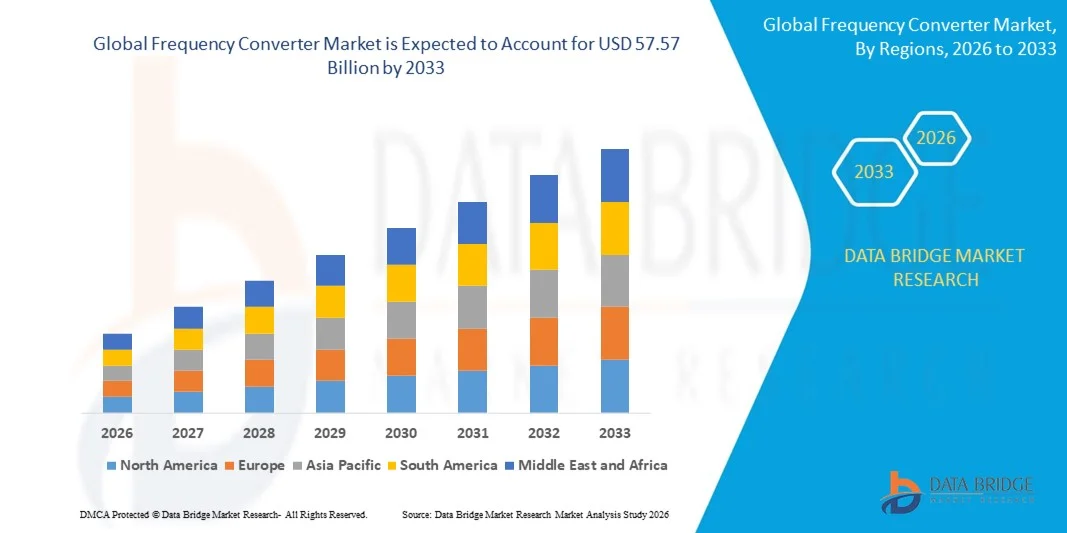
- Selon Data Bridge études de marché Analyse La taille du marché mondial des convertisseurs de fréquences a été évaluée à28,04 milliards de dollars en 2025et devrait atteindre57,57 milliards de dollars en 2033, à unTCAC de 9,41%pendant la période de prévision
- La croissance du marché est largement alimentée par la demande croissante de systèmes de commande de moteurs économes en énergie dans les secteurs industriel et commercial, associée à l'adoption croissante d'entraînements à fréquence variable (VFD) dans les applications d'automatisation et de contrôle des processus
- L'industrialisation croissante, en particulier dans les économies émergentes, conduit à l'installation de convertisseurs de fréquence dans les usines de fabrication, les systèmes CVC et les installations d'énergie renouvelable pour optimiser l'utilisation de l'énergie et réduire les coûts opérationnels
Taille du marché et prévisions
- Valeur marchande mondiale (2025): 28,04 milliards de dollars
- Valeur marchande prévue (2033): 57,57 milliards de dollars
- Prévisions CAGR (2026-2033): 9.41%
Analyse du marché du convertisseur de fréquence
- Les progrès technologiques dans la conception des convertisseurs, tels que les VFD compacts, les onduleurs à haute efficacité et l'intégration avec l'IoT et les systèmes de maintenance prédictive, améliorent les performances opérationnelles et réduisent les temps d'arrêt
- La nécessité croissante de moderniser les systèmes automobiles existants et de moderniser le matériel existant crée une demande supplémentaire de convertisseurs de fréquence dans les régions développées et en développement
- L'Amérique du Nord a dominé le marché des convertisseurs de fréquences avec la plus grande part des revenus de 32,45 % en 2025, en raison de l'adoption croissante de solutions industrielles éconergétiques et de l'accent accru mis sur la réduction des coûts opérationnels dans les secteurs manufacturier et commercial.
- La région Asie-Pacifique devrait connaître le taux de croissance le plus élevé du convertisseur de fréquence mondial marché, entraîné par l'urbanisation, l'expansion des industries manufacturières, l'augmentation de la demande d'énergie, et les initiatives gouvernementalesautomatisation industrielleet développement de réseaux intelligents
- Le segment des convertisseurs de fréquences statiques détenait la plus grande part du marché en 2025, en raison de leur grande efficacité, de leurs faibles besoins d'entretien et de leur aptitude à des opérations industrielles continues. Ces convertisseurs sont largement utilisés dans les usines de fabrication, les systèmes d'énergie renouvelable et les infrastructures essentielles où un contrôle fiable des fréquences est essentiel.
Découplage du marché de la portée et de la fréquence des rapports
|
Attributs |
Convertisseur de fréquence Principales perspectives du marché |
|
Segments couverts |
|
|
Pays couverts |
Amérique du Nord
Europe
Asie-Pacifique
Moyen-Orient et Afrique
Amérique du Sud
|
|
Principaux acteurs du marché |
|
|
Possibilités de marché |
|
|
Infos sur la valeur ajoutée |
Outre les informations sur les scénarios du marché, tels que la valeur du marché, le taux de croissance, la segmentation, la couverture géographique et les principaux acteurs, les rapports de marché établis par Data Bridge Market Research comprennent également une analyse approfondie des experts, une production et une capacité géographiquement représentées par l'entreprise, des schémas de réseau des distributeurs et des partenaires, une analyse détaillée et actualisée des tendances des prix et une analyse du déficit de la chaîne d'approvisionnement et de la demande. |
Qu'est-ce que le marché du convertisseur de fréquence de tendance clé
L'augmentation des convertisseurs de fréquences économes en énergie et intelligents
- L'adoption croissante de convertisseurs de fréquence économes en énergie transforme les opérations industrielles et commerciales en permettant un contrôle précis de la vitesse du moteur et une consommation d'énergie optimisée. Ces dispositifs permettent aux industries de réduire les coûts d'électricité, de réduire au minimum l'usure du matériel et d'améliorer l'efficacité opérationnelle globale. En outre, en réduisant la demande d'énergie pendant les périodes de pointe, les entreprises peuvent également contribuer à des initiatives de durabilité et à réduire l'empreinte carbone, en renforçant les engagements de l'ESG
- La demande croissante de convertisseurs de fréquence intelligents dotés de capacités intégrées de maintenance IoT et prédictive accélère leur mise en œuvre dans des secteurs tels que la fabrication, le CVC et les énergies renouvelables. Ces solutions offrent une surveillance en temps réel, l'analyse des données et la détection des défauts, améliorant ainsi la fiabilité des temps d'attente et des processus. De plus, la maintenance prédictive réduit les temps d'arrêt imprévus et réduit les coûts de maintenance tout en permettant aux gestionnaires d'installations de prendre des décisions fondées sur les données.
- L'accessibilité et l'amélioration des performances des convertisseurs de fréquence modernes les rendent attrayants pour les petites et moyennes entreprises ainsi que pour les grandes entreprises industrielles. Les entreprises bénéficient d'économies d'énergie, du respect de la réglementation énergétique et d'un meilleur contrôle de la production sans modification importante de l'infrastructure. La disponibilité croissante de solutions modulaires et évolutives améliore encore l'adoption en permettant une adaptation facile aux systèmes existants
- Par exemple, en 2023, plusieurs usines automobiles et chimiques en Allemagne ont signalé une réduction de 20 % de la consommation d'énergie après l'installation d'entraînements à fréquence variable avancés, ce qui a permis de renforcer l'efficacité opérationnelle et les mesures de durabilité. Des implémentations similaires dans les usines européennes et nord-américaines ont démontré une amélioration de la durée de vie des moteurs, une réduction des temps d'arrêt et une amélioration de l'efficacité globale des procédés
- Alors que les convertisseurs de fréquences intelligentes stimulent la croissance, l'adoption à long terme dépend de l'innovation technologique continue, de l'intégration aux systèmes existants et de la formation des travailleurs. Les fabricants doivent se concentrer sur des solutions fiables, évolutives et rentables pour tirer pleinement parti de la demande du marché. Il est tout aussi essentiel d'aider les utilisateurs finaux à mettre en place des programmes de formation et des services de maintenance pour assurer une utilisation optimale et une expansion du marché.
Dynamique du marché du convertisseur de fréquence
Chauffeur
Une demande croissante d'efficacité énergétique et d'automatisation industrielle
- La pression pour des opérations écoénergétiques et la réduction des coûts d'exploitation sont à l'origine de l'adoption de convertisseurs de fréquence dans la fabrication, le CVC et d'autres applications industrielles. Ces dispositifs permettent un contrôle moteur précis, une utilisation plus réduite de l'électricité et une durée de vie prolongée de l'équipement, ce qui contribue aux économies globales et à la conformité environnementale. La tendance est encore renforcée par les industries qui cherchent à atteindre des objectifs rigoureux en matière d'efficacité énergétique et de réduction du carbone
- La réglementation et les mesures d'incitation gouvernementales en matière d'économies d'énergie et de réduction de l'empreinte carbone accélèrent l'intégration des convertisseurs de fréquence dans toutes les industries. Des politiques de soutien dans des régions comme l'Europe, l'Amérique du Nord et l'Asie-Pacifique encouragent les investissements dans des technologies à haut rendement énergétique. Les remboursements d'impôt, les subventions et les programmes de financement pour des solutions industrielles durables stimulent également l'adoption dans les petites et grandes entreprises
- Les progrès technologiques dans la conception des convertisseurs de fréquences, y compris les commandes numériques, les capteurs intelligents et la connectivité IoT, améliorent leur fonctionnalité et leur fiabilité, ce qui permet une adoption plus large dans divers secteurs d'utilisation finale. Des innovations telles que des algorithmes de contrôle adaptatifs et des systèmes de surveillance basés sur le cloud permettent une plus grande efficacité énergétique, une maintenance prédictive et une intégration transparente avec les plateformes d'automatisation industrielle
- Par exemple, en 2022, plusieurs installations industrielles européennes ont réaménagé les anciens systèmes à fréquence variable, en améliorant l'efficacité énergétique et en s'adaptant aux objectifs de durabilité des entreprises. En outre, l'intégration avec les plateformes IoT industrielles a permis un suivi continu des performances, une maintenance prédictive et une consommation d'énergie optimisée
- Alors que l'automatisation industrielle et le soutien réglementaire alimentent le marché, les fabricants doivent assurer la facilité d'intégration, la rentabilité et la compatibilité des systèmes pour soutenir la croissance à long terme. L'innovation en cours dans les systèmes de contrôle intelligents, les conceptions modulaires et les solutions spécifiques à l'industrie restera essentielle pour obtenir des parts de marché supplémentaires
Restriction/Défi
Coûts d'investissement initiaux élevés et intégration complexe
- Le coût initial relativement élevé des convertisseurs de fréquence avancés limite l'adoption par les petites et moyennes entreprises. Les contraintes budgétaires et les longues périodes de récupération font que certaines organisations hésitent à mettre en œuvre ces solutions malgré les économies d'énergie potentielles. En outre, les retards dans la passation des marchés et les difficultés de financement peuvent encore restreindre l ' adoption sur des marchés sensibles aux coûts.
- Les difficultés d'intégration avec les systèmes motorisés existants et les équipements existants peuvent compliquer le déploiement, nécessitant un soutien technique spécialisé et une formation. Cette complexité peut accroître le temps et les coûts de mise en oeuvre, ce qui affecte la pénétration du marché. Les organisations peuvent également se heurter à des difficultés pour assurer la compatibilité avec les marques multiples ou les équipements industriels plus anciens, ce qui retarde encore l'adoption.
- Dans les régions où l'expertise technique ou l'infrastructure industrielle est limitée, l'adoption de convertisseurs de fréquence est encore limitée, ce qui retarde l'amélioration de l'efficacité énergétique et l'optimisation opérationnelle. Le manque de personnel qualifié, l ' insuffisance de l ' appui à la maintenance et le sous-développement des chaînes d ' approvisionnement peuvent aggraver les problèmes de mise en œuvre, en particulier dans les marchés émergents
- Par exemple, en 2023, plusieurs usines de fabrication en Asie du Sud-Est ont signalé un retard dans l'installation des convertisseurs de fréquence en raison de la nécessité d'une intégration sur mesure et de la disponibilité limitée de personnel technique qualifié. Ces retards ont conduit à des objectifs d'efficacité énergétique manqués et à un report de la réalisation du ROI, soulignant le besoin essentiel de main-d'œuvre qualifiée et d'un solide soutien après-vente
- Bien que la technologie continue de progresser, il est essentiel de s'attaquer aux obstacles liés aux coûts, à l'intégration et aux compétences. Les intervenants doivent se concentrer sur des solutions modulaires, faciles à installer, des programmes de formation et un soutien technique local pour libérer tout le potentiel du marché et assurer une adoption durable dans l'ensemble des industries.
Convertisseur de fréquence Portée du marché
Le marché est segmenté en fonction du type, de la gamme de fréquences, de l'application et de l'utilisation finale.
- Par type
Sur la base du type, le marché des convertisseurs de fréquence est segmenté en convertisseurs de fréquence statique, convertisseurs de fréquence rotatifs et convertisseurs de matrice. Le segment des convertisseurs de fréquences statiques détenait la plus grande part du marché en 2025, en raison de leur grande efficacité, de leurs faibles besoins d'entretien et de leur aptitude à des opérations industrielles continues. Ces convertisseurs sont largement utilisés dans les usines de fabrication, les systèmes d'énergie renouvelable et les infrastructures essentielles où un contrôle fiable des fréquences est essentiel.
Le segment des convertisseurs de fréquence rotatifs devrait connaître le taux de croissance le plus rapide de 2026 à 2033, grâce à leur capacité à gérer des applications de haute puissance et à la compatibilité avec les systèmes AC et DC. Les convertisseurs rotatifs sont particulièrement préférés dans les industries lourdes et les applications marines en raison de leur robustesse, de leur flexibilité et de leurs capacités supérieures de contrôle de la tension.
- Par gamme de fréquences
Sur la base de la gamme de fréquences, le marché est segmenté en basse fréquence, moyenne fréquence et haute fréquence. Le segment des basses fréquences a dominé le marché en 2025, alimenté par son utilisation intensive dans les moteurs industriels, les ascenseurs et les systèmes CVC où la conversion stable des fréquences est essentielle. Les convertisseurs à basse fréquence offrent une fiabilité élevée et un fonctionnement efficace pour les applications industrielles et commerciales à grande échelle.
Le segment de la haute fréquence devrait connaître le taux de croissance le plus rapide de 2026 à 2033, en raison de son adoption dans les secteurs de l'aérospatiale, de la défense et des télécommunications. Les convertisseurs haute fréquence offrent une taille compacte, un design léger et des temps de réponse rapides, ce qui les rend adaptés aux applications nécessitant une précision et un changement rapide.
- Par demande
Sur la base de l'application, le marché des convertisseurs de fréquences est segmenté en Aérospatiale, Industrielle, Marine et Télécommunications. Le segment industriel a représenté la plus grande part des revenus en 2025, sous l'effet de l'automatisation croissante des procédés de fabrication, des initiatives en matière d'efficacité énergétique et de la demande de commande de moteurs à vitesse variable. Les convertisseurs de fréquence industriels améliorent la productivité, réduisent la consommation d'énergie et améliorent la longévité de l'équipement.
Le segment de l'aérospatiale devrait connaître le taux de croissance le plus rapide entre 2026 et 2033, en raison de l'augmentation des voyages aériens, de la rigueur des règlements aériens et de la nécessité de systèmes précis de contrôle des moteurs et de la puissance. Les applications aérospatiales nécessitent des convertisseurs fiables, légers et performants pour assurer la sécurité et l'efficacité des opérations aériennes.
- Par utilisation finale
Sur la base de l'utilisation finale, le marché est segmenté en commercial, résidentiel et industriel. Le segment industriel détenait la plus grande part de marché en 2025, en raison de la forte dépendance à l'égard des convertisseurs de fréquence dans les usines de fabrication, les industries de transformation et les systèmes de gestion de l'énergie à grande échelle. Les utilisateurs finaux industriels bénéficient d'une réduction des coûts énergétiques, d'une amélioration des performances motrices et d'une flexibilité opérationnelle accrue.
Le segment commercial devrait connaître le taux de croissance le plus rapide de 2026 à 2033, propulsé par le déploiement croissant de systèmes CVC économes en énergie, de bâtiments intelligents et d'intégration des énergies renouvelables. Les convertisseurs de fréquence commerciale aident à réduire les coûts d'exploitation, à soutenir les initiatives de construction écologique et à assurer la fiabilité de l'alimentation électrique des infrastructures commerciales.
Convertisseur de fréquence Marché Analyse régionale
- L'Amérique du Nord a dominé le marché des convertisseurs de fréquences avec la plus grande part des revenus de 32,45 % en 2025, en raison de l'adoption croissante de solutions industrielles éconergétiques et de l'accent accru mis sur la réduction des coûts opérationnels dans les secteurs manufacturier et commercial.
- Les industries de la région apprécient fortement les avantages des convertisseurs de fréquence, notamment l'optimisation du contrôle moteur, les économies d'énergie et la durée de vie prolongée des équipements, qui contribuent à réduire les coûts opérationnels et à améliorer la fiabilité des procédés.
- Cette large adoption s'appuie en outre sur une infrastructure industrielle solide, une forte pénétration technologique et des incitations gouvernementales en faveur de l'efficacité énergétique, établissant des convertisseurs de fréquence comme solution clé pour les applications industrielles et commerciales.
Convertisseur de fréquence américain Aperçu du marché
Le marché américain des convertisseurs de fréquences a enregistré la plus grande part des revenus en 2025 en Amérique du Nord, alimentée par la mise en oeuvre croissante d'initiatives d'automatisation industrielle et d'efficacité énergétique. Les fabricants privilégient les économies de coûts, le contrôle moteur précis et la maintenance prédictive grâce à l'adoption de convertisseurs de fréquence intelligents. L'intégration croissante des moteurs compatibles avec l'IoT et contrôlés numériquement soutient davantage l'expansion du marché, permettant une surveillance en temps réel, une réduction des temps d'arrêt et le respect des règles de durabilité.
Europe Convertisseur de fréquence Aperçu du marché
Le marché européen des convertisseurs de fréquence devrait connaître le taux de croissance le plus rapide de 2026 à 2033, sous l'impulsion de réglementations strictes en matière d'efficacité énergétique et de l'accent croissant mis sur l'automatisation industrielle. La base industrielle croissante, associée à des initiatives visant à réduire les émissions de carbone, favorise l'adoption de moteurs à fréquence variable avancés. Les industries européennes intègrent de plus en plus des convertisseurs de fréquence dans toutes les applications de fabrication, d'énergie renouvelable et de CVC afin d'optimiser les performances et de réduire les coûts opérationnels.
U.K. Convertisseur de fréquence Aperçu du marché
Le marché des convertisseurs de fréquence au Royaume-Uni devrait connaître le taux de croissance le plus rapide de 2026 à 2033, en raison de l'accent mis sur la conservation de l'énergie, la numérisation des processus industriels et la promotion de l'automatisation dans les secteurs manufacturier et commercial. Les incitations gouvernementales à l'efficacité énergétique et la tendance croissante de la fabrication intelligente favorisent l'adoption de convertisseurs de fréquence. La modernisation industrielle du Royaume-Uni, combinée à la demande de technologies d'économies d'énergie fiables et rentables, devrait continuer à stimuler la croissance du marché.
Allemagne Convertisseur de fréquence Aperçu du marché
Le marché allemand des convertisseurs de fréquence devrait connaître le taux de croissance le plus rapide entre 2026 et 2033, alimenté par les progrès technologiques dans l'automatisation industrielle et l'accent mis sur la consommation d'énergie durable. L'Allemagne dispose d'infrastructures industrielles bien établies, met l'accent sur l'innovation, et des réglementations énergétiques strictes favorisent l'adoption de convertisseurs de fréquence dans la fabrication, les industries de procédés et les opérations à forte intensité énergétique. L'intégration des moteurs intelligents et économes en énergie s'harmonise avec les priorités industrielles locales et les objectifs de durabilité.
Aperçu du marché du convertisseur de fréquences Asie-Pacifique
Le marché des convertisseurs de fréquence Asie-Pacifique devrait connaître le taux de croissance le plus rapide entre 2026 et 2033, sous l'impulsion d'initiatives d'industrialisation rapide, d'urbanisation et d'efficacité énergétique croissante dans des pays comme la Chine, le Japon et l'Inde. L'adoption croissante par la région de systèmes industriels automatisés et de solutions de fabrication intelligentes soutient la mise en place de convertisseurs de fréquence. En outre, l'APAC, qui devient un centre de fabrication d'équipements industriels et de composants électriques, améliore l'accessibilité et l'accessibilité, ce qui favorise la croissance du marché.
Japon Convertisseur de fréquence Aperçu du marché
Le marché japonais des convertisseurs de fréquence devrait connaître le taux de croissance le plus rapide entre 2026 et 2033 en raison de l'adoption de technologies industrielles de pointe, de l'accent mis sur l'efficacité énergétique et de l'automatisation accrue entre les secteurs. Les industries japonaises mettent l'accent sur un contrôle moteur fiable et précis pour optimiser les processus de production, réduire la consommation d'énergie et prolonger la durée de vie des équipements. L'intégration des convertisseurs de fréquences compatibles avec l'IoT avec les systèmes industriels renforce encore l'efficacité opérationnelle et favorise une croissance industrielle durable.
Chine Convertisseur de fréquence Aperçu du marché
En 2025, le marché chinois des convertisseurs de fréquence a représenté la plus grande part des revenus du marché en Asie-Pacifique, attribuable à l'expansion de la base industrielle, à l'urbanisation croissante et à l'accent mis sur l'efficacité énergétique des industries manufacturières. Les convertisseurs de fréquence sont de plus en plus utilisés dans l'industrie automobile, chimique et manufacturière pour optimiser l'utilisation de l'énergie et améliorer l'efficacité de la production. Les initiatives gouvernementales visant à promouvoir la conservation de l'énergie, les usines intelligentes et la modernisation industrielle sont des facteurs clés du marché chinois.
Part de marché du convertisseur de fréquence
L'industrie du convertisseur de fréquence est principalement dirigée par des entreprises bien établies, notamment :
- Schneider Electric (France)
- Siemens (Allemagne)
- General Electric (États-Unis)
- ABB Ltd. (Suisse)
- Mitsubishi Electric Corporation (Japon)
- Rockwell Automation (États-Unis)
- Emerson Electric Co. (États-Unis)
- Danfoss A/S (Danemark)
- Hitachi Ltd. (Japon)
- Yaskawa Electric Corporation (Japon)
Derniers développements sur le marché mondial des convertisseurs de fréquences
- En août 2025, Schneider Electric (France) est entré dans un partenariat stratégique avec une entreprise leader dans le domaine des énergies renouvelables pour développer des convertisseurs de fréquences avancés pour les applications solaires. Cette initiative vise à améliorer l'efficacité énergétique et à réduire les émissions de carbone en intégrant la technologie de conversion des fréquences aux systèmes solaires. Schneider Electric est ainsi en mesure de capitaliser sur l'expansion du secteur des énergies renouvelables, de renforcer son portefeuille de développement durable et de soutenir les efforts mondiaux en faveur de solutions énergétiques à faible intensité de carbone
- En septembre 2025, Siemens (Allemagne) a lancé une nouvelle ligne de convertisseurs de fréquences pour l'automatisation industrielle, avec une maintenance prédictive pilotée par l'IA et une connectivité améliorée. Le développement est conçu pour permettre des processus de fabrication plus intelligents, minimiser les temps d'arrêt de l'équipement et optimiser l'efficacité opérationnelle. En intégrant les technologies numériques, Siemens renforce ses offres d'automatisation industrielle et répond à la demande croissante de systèmes de production intelligents et économes en énergie
- En juillet 2025, General Electric (États-Unis) a élargi son empreinte manufacturière en Asie en créant une installation dédiée à la production de convertisseurs de fréquence. Cette expansion stratégique vise à répondre à la demande régionale croissante de solutions industrielles économes en énergie tout en améliorant la résilience de la chaîne d'approvisionnement. En localisant la production, GE améliore la réactivité du marché, réduit les délais de livraison et renforce sa position sur le marché des convertisseurs de fréquences en croissance rapide en Asie-Pacifique
SKU-
Accédez en ligne au rapport sur le premier cloud mondial de veille économique

- Tableau de bord d'analyse de données interactif
- Tableau de bord d'analyse d'entreprise pour les opportunités à fort potentiel de croissance
- Accès d'analyste de recherche pour la personnalisation et les requêtes
- Analyse de la concurrence avec tableau de bord interactif
- Dernières actualités, mises à jour et analyse des tendances
- Exploitez la puissance de l'analyse comparative pour un suivi complet de la concurrence
Méthodologie de recherche
La collecte de données et l'analyse de l'année de base sont effectuées à l'aide de modules de collecte de données avec des échantillons de grande taille. L'étape consiste à obtenir des informations sur le marché ou des données connexes via diverses sources et stratégies. Elle comprend l'examen et la planification à l'avance de toutes les données acquises dans le passé. Elle englobe également l'examen des incohérences d'informations observées dans différentes sources d'informations. Les données de marché sont analysées et estimées à l'aide de modèles statistiques et cohérents de marché. De plus, l'analyse des parts de marché et l'analyse des tendances clés sont les principaux facteurs de succès du rapport de marché. Pour en savoir plus, veuillez demander un appel d'analyste ou déposer votre demande.
La méthodologie de recherche clé utilisée par l'équipe de recherche DBMR est la triangulation des données qui implique l'exploration de données, l'analyse de l'impact des variables de données sur le marché et la validation primaire (expert du secteur). Les modèles de données incluent la grille de positionnement des fournisseurs, l'analyse de la chronologie du marché, l'aperçu et le guide du marché, la grille de positionnement des entreprises, l'analyse des brevets, l'analyse des prix, l'analyse des parts de marché des entreprises, les normes de mesure, l'analyse globale par rapport à l'analyse régionale et des parts des fournisseurs. Pour en savoir plus sur la méthodologie de recherche, envoyez une demande pour parler à nos experts du secteur.
Personnalisation disponible
Data Bridge Market Research est un leader de la recherche formative avancée. Nous sommes fiers de fournir à nos clients existants et nouveaux des données et des analyses qui correspondent à leurs objectifs. Le rapport peut être personnalisé pour inclure une analyse des tendances des prix des marques cibles, une compréhension du marché pour d'autres pays (demandez la liste des pays), des données sur les résultats des essais cliniques, une revue de la littérature, une analyse du marché des produits remis à neuf et de la base de produits. L'analyse du marché des concurrents cibles peut être analysée à partir d'une analyse basée sur la technologie jusqu'à des stratégies de portefeuille de marché. Nous pouvons ajouter autant de concurrents que vous le souhaitez, dans le format et le style de données que vous recherchez. Notre équipe d'analystes peut également vous fournir des données sous forme de fichiers Excel bruts, de tableaux croisés dynamiques (Fact book) ou peut vous aider à créer des présentations à partir des ensembles de données disponibles dans le rapport.











