



Segmentation du marché mondial des vêtements pour enfants, par type de produit (vêtements habillés, décontractés et semi-habillés), utilisateur final (garçons et filles), groupe d'âge (moins de 5 ans, 5 à 10 ans et plus de 10 ans) et canal de distribution (hors ligne et en ligne) - Tendances du secteur et prévisions jusqu'en 2033
Quelle est la taille du marché et le taux de croissance des enfants à l'échelle mondiale
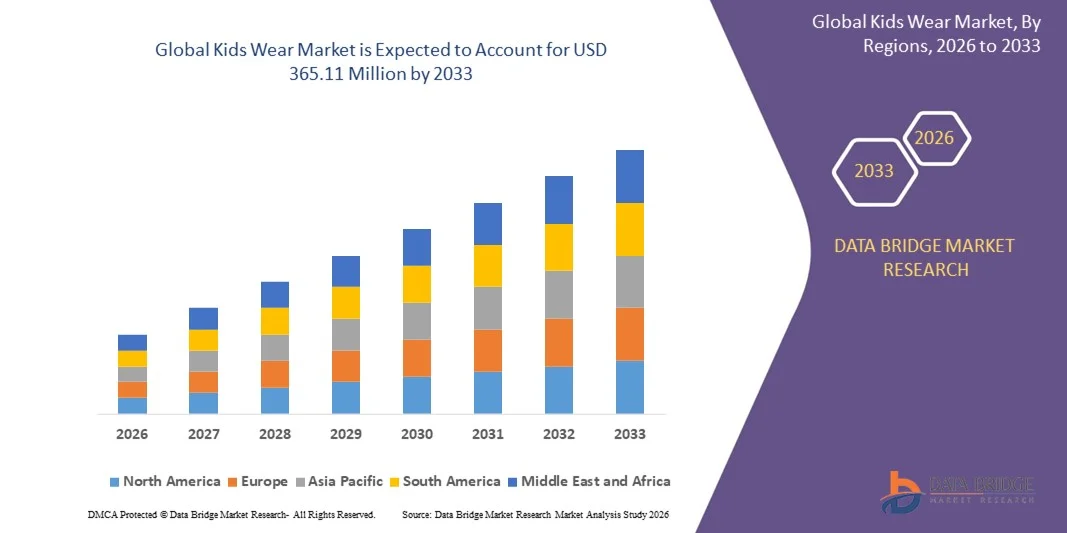
- La taille du marché mondial des enfants a été évaluée à212,50 millions de dollars en 2025et devrait atteindre365,11 millions de dollars en 2033, à unTCAC de 7,00%pendant la période de prévision
- La préférence croissante pour les vêtements élégants, confortables et durables, la sensibilisation accrue des parents à l'égard des vêtements haut de gamme et des vêtements de marque, la demande croissante de plateformes de vente au détail en ligne et de circuits de commerce électronique, l'expansion des chaînes de vente au détail organisées et l'augmentation du revenu disponible parmi les familles de la classe moyenne sont quelques-uns des principaux facteurs susceptibles de stimuler la croissance du marché du port des enfants.
Taille du marché et prévisions
- Valeur marchande mondiale (2025):212,50 millions de dollars
- Valeur marchande prévue (2033) :365,11 millions de dollars
- Prévisions CAGR (2026-2033):7.00%
Quelles sont les principales ventes d'enfants
- La popularité croissante des tissus écologiques, des vêtements à thème et des designs à la mode chez les enfants crée de nouvelles possibilités pour les fabricants et les détaillants, ce qui stimule la croissance du marché
- Les fluctuations saisonnières de la demande, la forte concurrence entre les marques locales et mondiales et les défis dans la gestion de la chaîne d'approvisionnement peuvent constituer des restrictions, ce qui pourrait avoir une incidence sur l'expansion du marché.
- L'Amérique du Nord a dominé le marché du port d'enfants avec une part des revenus de 31,13 % en 2025, en raison de l'augmentation des dépenses de consommation, de l'urbanisation croissante et de la forte adoption de vêtements pour enfants haut de gamme et occasionnels aux États-Unis et au Canada.
- L'Asie-Pacifique devrait enregistrer le TCAC le plus rapide de 8,25 % entre 2026 et 2033, en raison de l'urbanisation croissante, de l'augmentation des revenus disponibles, de la pénétration croissante du commerce de détail en ligne et de l'expansion rapide des chaînes de vente organisées en Chine, en Inde, au Japon, en Corée du Sud et en Asie du Sud-Est.
- Le segment Casual Wear a dominé le marché avec une part de 45,2% en 2025, en raison de sa polyvalence, son confort et son utilisation toute l'année dans les écoles, les dates de jeux et l'usure quotidienne
Portée du rapport et segmentation du marché chez les enfants
|
Attributs |
Les enfants portent les principales perspectives du marché |
|
Segments couverts |
|
|
Pays couverts |
Amérique du Nord
Europe
Asie-Pacifique
Moyen-Orient et Afrique
Amérique du Sud
|
|
Principaux acteurs du marché |
|
|
Possibilités de marché |
|
|
Infos sur la valeur ajoutée |
En plus des renseignements sur les scénarios du marché tels que la valeur du marché, le taux de croissance, la segmentation, la couverture géographique et les principaux intervenants, les rapports de marché établis par Data Bridge Market Research comprennent également une analyse approfondie des experts, une analyse des prix, une analyse des parts de marque, une enquête auprès des consommateurs, une analyse démographique, une analyse de la chaîne d'approvisionnement, une analyse de la chaîne de valeur, une vue d'ensemble des matières premières et des consommables, des critères de sélection des fournisseurs, une analyse PESTLE, une analyse Porter et un cadre réglementaire. |
Quelle est la tendance clé sur le marché des enfants
Accroître le changement vers des vêtements pour enfants de qualité supérieure, durables et à influence numérique
- Le marché du port d'enfants est témoin d'une forte adoption de tissus durables, de matériaux écologiques et de vêtements conçus numériquement pour les parents et les enfants soucieux du style
- Les fabricants introduisent des gammes de vêtements polyvalentes, y compris des tenues mixtes, des vêtements à thème et des designs personnalisables offrant confort, durabilité et attrait esthétique
- La demande croissante d'expériences d'achats pratiques, y compris de plateformes en ligne, de boîtes d'abonnement et d'outils d'ajustement virtuels, conduit les ventes à travers les circuits de vente au détail et de commerce électronique
- Par exemple, des entreprises telles que Carter, GAP Kids, H&M Kids et Zara Kids ont amélioré leurs gammes de produits avec des tissus durables, des collections à la mode et des expériences d'achat en ligne personnalisées
- Une sensibilisation accrue des parents à la mode, au confort et à la sécurité des enfants accélère l'adoption de vêtements pour enfants de marque et respectueux de l'environnement
- Comme la mode des enfants évolue, Kids Wears restera essentiel pour mélanger style, confort et durabilité dans les vêtements quotidiens
Quels sont les principaux moteurs du marché des enfants
- Augmentation de la demande de vêtements écologiques, de haute qualité et visuellement attrayants qui allient style et durabilité
- Par exemple, en 2025, les grandes marques telles que Carter, GAP Kids, H&M, Zara et Mothercare ont élargi leurs collections durables et des outils numériques intégrés pour des achats personnalisés
- La pénétration croissante du commerce électronique, des applications d'achat mobiles et des services de personnalisation en ligne stimule la portée du marché mondial
- L'expansion des chaînes de détail organisées et des franchises internationales accroît la visibilité de la marque et l'accès des consommateurs
- L'augmentation du revenu disponible et l'attention croissante portée à la mode des enfants dans les familles de la classe moyenne alimentent une consommation plus élevée
- Appuyé par des campagnes de marketing, des promotions d'influence et des collaborations avec des designers, le marché de Kids Wear devrait connaître une forte croissance à long terme
Quel est le facteur qui met en cause la croissance du marché des enfants
- Les coûts élevés associés aux vêtements haut de gamme et de marque limitent l'adoption parmi les familles sensibles aux prix
- Par exemple, entre 2024 et 2025, les fluctuations des coûts des matières premières, les pénuries de main-d'oeuvre et les perturbations de la chaîne d'approvisionnement ont augmenté le prix des produits pour plusieurs fournisseurs mondiaux.
- Les variations de taille complexes, les tendances saisonnières et l'évolution rapide des préférences de mode accroissent les défis opérationnels pour les fabricants et les détaillants
- Une connaissance limitée des vêtements durables ou écologiques dans les marchés émergents ralentit l'adoption
- La concurrence des vêtements locaux sans marque, de la mode rapide et des vêtements d'occasion crée une pression sur les prix et réduit la différenciation du marché
- Pour résoudre ces problèmes, les entreprises se concentrent sur des lignes durables abordables, la personnalisation numérique, les promotions ciblées et les stratégies de vente au détail omnicanal pour accroître l'adoption mondiale de Kids Wears
Comment le marché des enfants est-il segmenté
Le marché est segmenté sur la base denombre de canaux, application et verticale.
- Par type de produit
Sur la base du type de produit, le marché de l'usure des enfants est segmenté en Forme, Casual et Semi-Formale. Le segment Casual Wear a dominé le marché avec une part de 45,2% en 2025, en raison de sa polyvalence, confort et utilisation toute l'année dans les écoles, les dates de jeux et l'usure quotidienne. Des vêtements occasionnels comme des t-shirts, des shorts, des robes et des joggers sont largement préférés par les parents et les enfants pour leur facilité de mouvement et leur attrait élégant. L ' urbanisation croissante, les ménages à double revenu et les dépenses axées sur le mode de vie sont de plus en plus à l ' origine de l ' adoption.
Le segment de l'usure formelle devrait croître au rythme le plus rapide du TCAC de 2026 à 2033, en raison de l'augmentation de la demande d'uniformes scolaires, de vêtements de fête et de tenues de fête. Les fabricants présentent des collections formelles de créateurs avec des tissus innovants et des matériaux respectueux de l'environnement pour attirer des parents soucieux de la mode, améliorant ainsi l'expansion du marché pour des offres haut de gamme.
- Par utilisateur final
Sur la base de l'utilisateur final, le marché du port des enfants est segmenté en garçons et filles. Le segment des garçons a dominé le marché avec une part de 52,1% en 2025, alimentée par une demande accrue de vêtements occasionnels, sportifs et scolaires. Les tendances de l'habillement chez les garçons mettent l'accent sur le confort, la durabilité et la fonctionnalité, ce qui entraîne des achats constants dans les régions urbaines et semi-urbaines.
Le segment des filles devrait croître au CAGR le plus rapide de 2026 à 2033, avec un accent croissant sur les tenues tendance, à la mode et colorées. L'augmentation du revenu disponible, l'influence des médias sociaux et l'appétit croissant pour les vêtements de marque et respectueux de l'environnement chez les jeunes filles propulsent la croissance. Les détaillants et les plateformes en ligne offrent des collections personnalisées, des robes de designer et des vêtements de fête, ce qui accélère encore l'adoption dans le segment.
- Par groupe d'âge
En fonction du groupe d'âge, le marché du port d'enfants est divisé en moins de 5 ans, 5-10 ans et plus de 10 ans. Le segment des 5-10 ans a dominé le marché avec une part de 48,7 % en 2025, sous l'impulsion d'une forte demande d'uniformes scolaires, de tenues décontractées et de vêtements de jeu adaptés à l'âge. Les enfants de cette tranche d'âge sont plus actifs et les parents privilégient le confort, la durabilité et le style dans les achats de vêtements.
Le segment des 10 dernières années devrait croître au rythme le plus rapide du TCAC de 2026 à 2033, alimenté par l'influence croissante des tendances de la mode, des achats en ligne et des médias sociaux chez les préadolescents et les adolescents. Les marques se concentrent sur les collections branchées, les marchandises de marque et les options de personnalisation pour répondre à l'évolution des goûts et des préférences, ce qui stimule la croissance du marché.
- Par canal de distribution
Sur la base du canal de distribution, le marché du port d'enfants est segmenté en canaux hors ligne et en ligne. Le segment Offline a dominé le marché avec une part de 55,3% en 2025, en raison de la présence de magasins de détail organisés, de chaînes départementales et de magasins spécialisés locaux qui offrent une expérience tactile, des installations d'essai et une commodité d'achat immédiate.
Le segment en ligne devrait croître au rythme le plus rapide du TCAC de 2026 à 2033, grâce à la pénétration croissante du commerce électronique, à l'adoption d'applications mobiles et à la préférence croissante pour la livraison par porte. Les détaillants et les marques investissent dans des plateformes numériques, des équipements virtuels et des expériences d'achat personnalisées afin d'améliorer l'engagement des clients et d'accroître les ventes en ligne à l'échelle mondiale.
Quelle région détient la plus grande part du marché des enfants
- L'Amérique du Nord a dominé le marché du port d'enfants avec une part des revenus de 31,13 % en 2025, en raison de l'augmentation des dépenses de consommation, de l'urbanisation croissante et de la forte adoption de vêtements pour enfants haut de gamme et occasionnels aux États-Unis et au Canada.
- La forte sensibilisation à la marque, l'expansion rapide du commerce de détail organisé et la pénétration croissante des plateformes de vente en ligne continuent d'alimenter la demande d'enfants dans les régions urbaines et semi-urbaines. Les principales entreprises en Amérique du Nord introduisent des collections innovantes, des tissus durables et des solutions de commerce électronique intégrées sur le plan technologique, renforçant ainsi le leadership du marché régional.
- Les investissements continus dans la commercialisation, la R-D et les capacités de production renforcent encore la domination régionale, tandis que le revenu disponible élevé et l'évolution des tendances de la mode continuent de stimuler l'expansion à long terme du marché.
Les enfants américains portent une vision du marché
Les États-Unis sont le plus important contributeur en Amérique du Nord, appuyé par la demande croissante de vêtements pour enfants occasionnels, formels et semi-formels dans les écoles, les événements sociaux et les plateformes en ligne. La sensibilisation accrue aux vêtements durables et de marque, l'augmentation du commerce numérique et l'adoption rapide d'applications de vente au détail en ligne intensifient la demande pour Kids Wears. La présence de grandes marques de mode, de lignes de vêtements de démarrage et de réseaux de distribution puissants stimule la croissance du marché, faisant des États-Unis un pôle critique pour l'innovation et l'adoption par les consommateurs.
Les enfants du Canada portent une vision du marché
Le Canada contribue grandement à la croissance régionale, en raison de l'expansion des réseaux de détail, de l'augmentation de la demande de vêtements écologiques et biologiques pour enfants et de l'adoption croissante du commerce électronique. Les parents recherchent de plus en plus des vêtements durables, confortables et à la mode pour les enfants, soutenant ainsi l'expansion du marché. Les initiatives gouvernementales visant à promouvoir des textiles durables, associées à la croissance de la population urbaine et à l'augmentation du revenu disponible, renforcent encore le marché. Les établissements d'enseignement et les garderies sont également à l'origine d'achats massifs d'uniformes formels et occasionnels, ce qui maintient une croissance régulière.
Marché du port d'enfants Asie-Pacifique
L'Asie-Pacifique devrait enregistrer le TCAC le plus rapide de 8,25 % entre 2026 et 2033, en raison de l'urbanisation croissante, de l'augmentation des revenus disponibles, de la pénétration croissante du commerce de détail en ligne et de l'expansion rapide des chaînes de commerce de détail organisées en Chine, en Inde, au Japon, en Corée du Sud et en Asie du Sud-Est. L'augmentation de la population d'enfants, la prise de conscience de la mode chez les parents et l'augmentation des plateformes de commerce électronique sont des facteurs clés qui accélèrent la demande du marché. Les marques se concentrent sur des conceptions localisées, des prix abordables et des collections saisonnières pour saisir des parts de marché, tandis que les économies émergentes connaissent une forte croissance des segments de vêtements pour enfants haut de gamme et occasionnels.
Les enfants de la Chine portent une vision du marché
La Chine est le principal contributeur à l'Asie-Pacifique en raison de l'augmentation de la population de la classe moyenne, d'une prise de conscience croissante de la mode et d'une solide infrastructure de vente au détail. La demande de vêtements pour enfants occasionnels, formels et semi-formels augmente rapidement, soutenue par les canaux de vente en ligne et les marques de mode nationales. L'expansion des magasins de détail organisés, associée à des initiatives de marketing numérique, stimule l'adoption par les consommateurs et stimule la croissance globale du marché.
Japon Les enfants portent une vision du marché
Le Japon affiche une croissance soutenue par un revenu disponible élevé, une solide infrastructure de vente au détail et une demande croissante de vêtements pour enfants haut de gamme et respectueux de l'environnement. L'intérêt croissant pour les vêtements de créateurs, les collections saisonnières et l'usure formelle pour les occasions scolaires et sociales conduit à l'adoption du marché. Le commerce électronique et les plateformes de vente au détail en ligne influencent de plus en plus les décisions d'achat, soutenant la croissance dans les zones urbaines et suburbaines.
India Kids Wear Market Insight
L'Inde devient un pôle de croissance majeur, alimenté par l'urbanisation rapide, l'augmentation des revenus disponibles et l'accroissement de la population de la classe moyenne. Sensibiliser davantage les enfants à l'usage de marque, occasionnel et formel, combiné à l'expansion des plateformes de vente au détail en ligne, à l'adoption de carburants. Les initiatives gouvernementales visant à soutenir la fabrication de textiles et les start-up dans le secteur de l'habillement renforcent encore la pénétration du marché, tandis que les festivals saisonniers et les exigences d'uniformité scolaire maintiennent une demande constante.
Corée du Sud Les enfants portent une vision du marché
La Corée du Sud apporte une contribution importante en raison de la forte sensibilisation des parents à la mode, de l'augmentation du revenu disponible et de la pénétration accrue du commerce de détail en ligne. La demande de vêtements décontractés, de tenues de forme et de vêtements semi-formels à la mode augmente dans les régions urbaines. Les marques axées sur la qualité, le confort et les matériaux respectueux de l'environnement, associées à de fortes campagnes de marketing numérique, sont à l'origine de l'adoption. Les plateformes de commerce électronique et les médias sociaux influencent davantage la croissance rapide du marché.
Quelles sont les meilleures entreprises du marché des enfants
L'industrie du port d'enfants est principalement dirigée par des entreprises bien établies, notamment :
- L'industrie de l'Union européenne(États-Unis)
- Gianni Versace S.r.l.(Italie)
- Industrie de Diseño Textil, S.A. (Inditex) (Espagne)
- Hennes & Mauritz AB (Suède)
- La place des enfants, Inc. (États-Unis)
- Soins maternels
- Cotton On Group (Australie)
- Société d'État. (États-Unis)
- Burberry (Royaume-Uni)
- Gerber Childrenswear LLC (États-Unis)
Quelles sont les évolutions récentes du marché mondial de l'usure pour enfants
- En octobre 2022, H&M a lancé sa nouvelle collection « Imagine That », marquant la première gamme indépendante de vêtements pour enfants de son initiative Innovation Stories. La collection est fabriquée à partir de bouteilles recyclées et d'une alternative en cuir dérivé de cactus, mettant l'accent sur la durabilité et les tendances de mode éco-conscientes pour les enfants. Ce lancement renforce l'engagement de H&M à l'égard des vêtements pour enfants innovateurs et respectueux de l'environnement
- En octobre 2022, Les Petits, une marque de mode de luxe, a dévoilé une nouvelle gamme exclusive de vêtements pour enfants sous ses marques Rang et Stella Rossa. La collection Rang se concentre sur le port ethnique, tandis que Stella Rossa offre le port de fête pour des occasions spéciales, répondant à divers besoins de mode des enfants. Ce lancement renforce la présence de la marque dans les vêtements pour enfants premium
- En octobre 2022, Starrior, une marque de vêtements pour enfants, a présenté sa première collection écologique de vêtements pour enfants de haute qualité, incluant des t-shirts, des sweatshirts, des shorts, des pantalons, des chapeaux et des vêtements de tous les jours de Newborn à Youth XL. La collection met l'accent sur la durabilité et la polyvalence pour les jeunes consommateurs, améliorant le positionnement du marché de Starrior
- En juillet 2022, Abercrombie Kids, faisant partie d'Abercrombie & Fitch Co., a lancé sa nouvelle collection de denim 2022 pour enfants, avec des options mises à jour pour l'ajustement et le calibrage. La collection répond aux préférences de confort, de style et de mode contemporaine pour les enfants, renforçant la fidélité de la marque auprès des jeunes consommateurs
- En janvier 2022, Michael Kors, en collaboration avec Children Worldwide Fashion (CWF), a lancé une gamme de vêtements et d'accessoires pour enfants pour garçons et filles. La collection met l'accent sur les vêtements haut de gamme, élégants et fonctionnels, élargissant l'empreinte de Michael Kors sur le marché mondial des vêtements pour enfants
SKU-
Accédez en ligne au rapport sur le premier cloud mondial de veille économique

- Tableau de bord d'analyse de données interactif
- Tableau de bord d'analyse d'entreprise pour les opportunités à fort potentiel de croissance
- Accès d'analyste de recherche pour la personnalisation et les requêtes
- Analyse de la concurrence avec tableau de bord interactif
- Dernières actualités, mises à jour et analyse des tendances
- Exploitez la puissance de l'analyse comparative pour un suivi complet de la concurrence
Méthodologie de recherche
La collecte de données et l'analyse de l'année de base sont effectuées à l'aide de modules de collecte de données avec des échantillons de grande taille. L'étape consiste à obtenir des informations sur le marché ou des données connexes via diverses sources et stratégies. Elle comprend l'examen et la planification à l'avance de toutes les données acquises dans le passé. Elle englobe également l'examen des incohérences d'informations observées dans différentes sources d'informations. Les données de marché sont analysées et estimées à l'aide de modèles statistiques et cohérents de marché. De plus, l'analyse des parts de marché et l'analyse des tendances clés sont les principaux facteurs de succès du rapport de marché. Pour en savoir plus, veuillez demander un appel d'analyste ou déposer votre demande.
La méthodologie de recherche clé utilisée par l'équipe de recherche DBMR est la triangulation des données qui implique l'exploration de données, l'analyse de l'impact des variables de données sur le marché et la validation primaire (expert du secteur). Les modèles de données incluent la grille de positionnement des fournisseurs, l'analyse de la chronologie du marché, l'aperçu et le guide du marché, la grille de positionnement des entreprises, l'analyse des brevets, l'analyse des prix, l'analyse des parts de marché des entreprises, les normes de mesure, l'analyse globale par rapport à l'analyse régionale et des parts des fournisseurs. Pour en savoir plus sur la méthodologie de recherche, envoyez une demande pour parler à nos experts du secteur.
Personnalisation disponible
Data Bridge Market Research est un leader de la recherche formative avancée. Nous sommes fiers de fournir à nos clients existants et nouveaux des données et des analyses qui correspondent à leurs objectifs. Le rapport peut être personnalisé pour inclure une analyse des tendances des prix des marques cibles, une compréhension du marché pour d'autres pays (demandez la liste des pays), des données sur les résultats des essais cliniques, une revue de la littérature, une analyse du marché des produits remis à neuf et de la base de produits. L'analyse du marché des concurrents cibles peut être analysée à partir d'une analyse basée sur la technologie jusqu'à des stratégies de portefeuille de marché. Nous pouvons ajouter autant de concurrents que vous le souhaitez, dans le format et le style de données que vous recherchez. Notre équipe d'analystes peut également vous fournir des données sous forme de fichiers Excel bruts, de tableaux croisés dynamiques (Fact book) ou peut vous aider à créer des présentations à partir des ensembles de données disponibles dans le rapport.











