



Segmentation du marché mondial des tests de biopsie liquide, par type (tests de cellules tumorales circulantes (CTC), tests d'ADN tumoral circulant (ADNtc), tests basés sur les exosomes, tests basés sur les microARN et autres), application (diagnostic du cancer, suivi du traitement, dépistage précoce, évaluation pronostique et médecine personnalisée) - Tendances du secteur et prévisions jusqu'en 2033
Quelle est la taille et l'aperçu du marché des tests de biopsie liquide
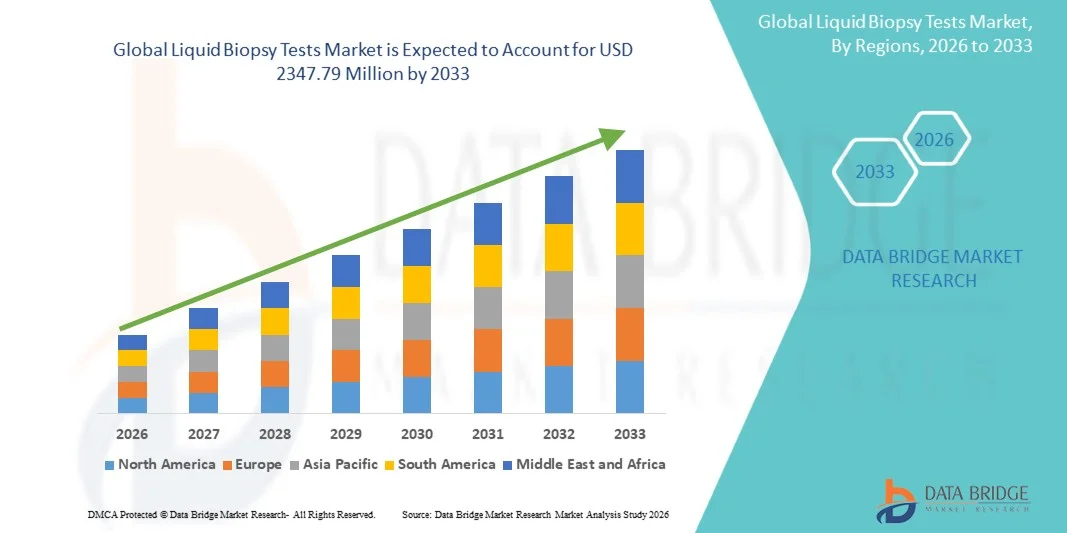
- Selon l'analyse de la recherche sur le marché de Data Bridge La taille du marché mondial des tests de biopsie liquide a été évaluée à673,2 millions de dollars en 2025et devrait atteindre2347,79 millions de dollars en 2033, à unTCAC de 16,90 %pendant la période de prévision
- La croissance du marché est largement alimentée par l'adoption croissante de techniques de diagnostic minimalement invasives, la prévalence croissante du cancer et la demande croissante de médicaments personnalisés et de dépistage précoce des maladies.
- De plus, la sensibilisation accrue des fournisseurs de soins de santé et des patients aux avantages des tests de biopsie liquide – comme la surveillance des maladies en temps réel, la détection précoce de la récidive tumorale et la réduction du besoin de biopsies tissulaires envahissantes – accélère l'adoption des solutions de tests de biopsie liquide, ce qui stimule considérablement la croissance de l'industrie.
Taille du marché et prévisions
- Valeur marchande mondiale (2025): USD 673.2 Millions
- Valeur marchande prévue (2033) : 2347,79 millions de dollars
- Prévisions CAGR (2026-2033): 16,90%
Quels sont les principaux débouchés du marché des tests de biopsie liquide
- Les tests de biopsie liquide, qui offrent des solutions diagnostiques minimalement invasives pour détecter et surveiller le cancer et d'autres maladies génétiques, sont des composantes de plus en plus vitales des soins de santé modernes en raison de leur capacité à fournir des renseignements en temps réel, à permettre la détection précoce et à réduire le besoin de biopsies tissulaires traditionnelles.
- La demande croissante de tests de biopsie liquide est principalement alimentée par la prévalence croissante du cancer, l'adoption croissante de médicaments personnalisés et la sensibilisation des fournisseurs de soins de santé et des patients aux avantages des outils de diagnostic non invasifs
- L'Amérique du Nord a dominé le marché des tests de biopsie liquide avec la plus grande part de revenus de 46 % en 2025, soutenue par des infrastructures de soins de santé de pointe, une forte adoption de la médecine de précision, une forte activité de recherche clinique et l'augmentation des investissements des principaux acteurs du marché. Les États-Unis dominent la région avec une forte croissance des tests de biopsie liquide dans les centres d'oncologie, les hôpitaux et les laboratoires de diagnostic
- L'Asie-Pacifique devrait être la région qui connaîtra la croissance la plus rapide sur le marché des tests de biopsie liquide au cours de la période de prévision, et devrait augmenter de 11 %, passant de 2026 à 2033, en raison de l'augmentation de l'incidence du cancer, de l'amélioration des infrastructures de soins de santé, de la sensibilisation accrue aux diagnostics avancés et de l'expansion des initiatives de recherche médicale dans des pays comme la Chine, l'Inde, le Japon et la Corée du Sud.
- Le segment des tests de l'ADN des tumeurs circulantes (ADNct) a dominé la plus grande part du marché de 45,8 % en 2025, en raison de sa grande sensibilité, de sa nature non invasive et de son utilité clinique avérée pour détecter des mutations actionnables pour une thérapie personnalisée.
Portée etEssais de biopsie liquide Segmentation du marché
Attributs |
Essais de biopsie liquide Principales perspectives du marché |
|
Segments couverts |
|
|
Pays couverts |
Amérique du Nord
Europe
Asie-Pacifique
Moyen-Orient et Afrique
Amérique du Sud
|
|
Principaux acteurs du marché |
|
|
Possibilités de marché |
|
|
Infos sur la valeur ajoutée |
En plus des renseignements sur les scénarios de marché comme la valeur marchande, le taux de croissance, la segmentation, la couverture géographique et les principaux intervenants, les rapports de marché établis par Data Bridge Market Research comprennent également une analyse approfondie des experts, l'épidémiologie des patients, l'analyse des pipelines, l'analyse des prix et le cadre réglementaire. |
Quelle est la tendance clé du marché des tests de biopsie liquide
(en milliers de dollars)L'adoption croissante de techniques de diagnostic du cancer invasives(en milliers de dollars)
- Une tendance clé sur le marché mondial des tests de biopsie liquide est l'adoption croissante de techniques de diagnostic minimalement invasives, qui permettent la détection précoce du cancer, la surveillance des maladies et l'évaluation de la réponse au traitement sans la nécessité de biopsies tissulaires traditionnelles.
- Par exemple, en 2024, Guardant Health a lancé son test de biopsie liquide Guardant360, permettant aux cliniciens de détecter de multiples mutations actionnables à partir d'un seul échantillon de sang, mettant en évidence le passage à un diagnostic minimal invasif.
- Les tests de biopsie liquide fournissent des informations moléculaires rapides et précises provenant d'un simple échantillon de sang, réduisant ainsi l'inconfort et le risque du patient par rapport aux biopsies chirurgicales.
- Les progrès dans le séquençage de la prochaine génération (NGS), le PCR numérique et les microfluidiques permettent une détection très sensible et précise de l'ADN tumoral circulant (ADNct), des exosomes et des cellules tumorales circulantes (CTC)
- La tendance est encore alimentée par la préférence croissante des patients pour des interventions moins invasives et des séjours hospitaliers plus courts
- Les hôpitaux et les centres d'oncologie intègrent de plus en plus les tests de biopsie liquide dans les flux de travail standard pour compléter les résultats de l'imagerie et de la biopsie tissulaire. Les entreprises pharmaceutiques tirent parti des technologies de biopsie liquide dans les essais cliniques pour l'identification des biomarqueurs et la surveillance thérapeutique
- L'augmentation de la disponibilité de trousses de diagnostic pour les thérapies ciblées entraîne l'adoption parmi les cliniciens. Les économies émergentes adoptent rapidement la biopsie liquide en raison de l'expansion des centres d'oncologie et de l'amélioration des infrastructures de soins de santé
- Les innovations technologiques telles que les panneaux multigènes et les lectures numériques améliorent la fiabilité et la vitesse des tests
Essais de biopsie liquide Dynamique du marché
Chauffeur
L'augmentation de la prévalence du cancer et le besoin de médecine personnalisée
- La charge mondiale croissante du cancer est l'un des principaux moteurs du marché des tests de biopsie liquide, car les cliniciens ont besoin de solutions diagnostiques précises, rapides et non invasives pour la détection et la surveillance précoces.
- Par exemple, en mars 2025, Roche a annoncé l'expansion de son test de mutation Cobas EGFR, une solution de biopsie liquide qui aide à sélectionner des patients pour des thérapies ciblées, illustrant la demande croissante de médicaments personnalisés
- L'adoption croissante d'approches de médecine personnalisée et de précision propulse la demande, car les biopsies liquides peuvent guider la sélection de thérapies ciblées et surveiller la réponse au traitement
- Les entreprises pharmaceutiques utilisent de plus en plus les biopsies liquides pour la mise au point de médicaments à base de biomarqueurs, la surveillance des essais cliniques et les diagnostics complémentaires, ce qui favorise l'expansion du marché.
- L'expansion de l'infrastructure de soins de santé dans les marchés émergents, associée à un meilleur accès aux diagnostics avancés, alimente l'adoption. Les initiatives gouvernementales visant à promouvoir les programmes de dépistage précoce du cancer, le soutien au remboursement et les campagnes de dépistage en oncologie renforcent la croissance du marché
- Les progrès technologiques dans le séquençage à haut débit, la PCR numérique et la bioinformatique améliorent la précision des tests, la fiabilité et le temps d'exécution. La sensibilisation des cliniciens et leur préférence pour des procédures moins invasives favorisent l'adoption de la biopsie liquide par rapport aux biopsies traditionnelles
- Les investissements en recherche et développement des principaux acteurs du marché dans les nouveaux panneaux de biopsie liquide favorisent l'innovation et l'adoption. La disponibilité de tests multix pour plusieurs types de cancer dans un seul essai augmente l'utilité clinique et la demande du marché
- La préférence des patients pour des procédures peu invasives contribue à l'augmentation des taux d'adoption. Les collaborations entre laboratoires de diagnostic, hôpitaux et entreprises de biotechnologie facilitent la pénétration du marché
Restriction/Défi
(en milliers de dollars)Questions de coût élevé et de normalisation technique(en milliers de dollars)
- Le coût élevé des tests de biopsie liquide par rapport aux méthodes de diagnostic classiques pose un défi à l'adoption généralisée, en particulier dans les régions sensibles aux prix et en développement.
- Par exemple, en 2023, une étude publiée dansL'oncologie de Lanceta souligné que le coût moyen des panneaux de biopsie liquide multigènes dépasse 1 000 USD par test, ce qui limite l'accessibilité et l'adoption par les cliniciens dans de nombreuses régions
- De plus, l'absence de normalisation dans la collecte, le traitement et l'interprétation des données des échantillons peut entraîner une variabilité des résultats, ce qui entraîne une hésitation chez les cliniciens. Les différences de sensibilité à la détection et de spécificité des tests entre les fournisseurs peuvent réduire la confiance dans les résultats des tests.
- Les obstacles à la réglementation et au remboursement dans certaines régions retardent l'expansion du marché et accroissent la complexité opérationnelle des fabricants. La disponibilité de personnel qualifié et de laboratoires certifiés est limitée dans les économies émergentes, ce qui limite l'adoption.
- Les besoins d'investissement élevés pour la mise en place de plates-formes de séquençage avancées dans les hôpitaux et les centres de recherche constituent un obstacle. Des études de validation clinique sont nécessaires pour assurer l'exactitude des tests et la conformité réglementaire, ralentir le déploiement du marché
- Certains patients et cliniciens demeurent sceptiques quant à la fiabilité des résultats de la biopsie liquide par rapport à la biopsie tissulaire, affectant l'absorption. Les limitations techniques dans la détection des mutations à faible abondance dans les cancers précoces posent des défis
- Les entreprises s'attaquent à ces contraintes en offrant des solutions rentables, en améliorant la sensibilité aux essais et en offrant formation et soutien aux laboratoires
Comment le marché des tests de biopsie liquide est-il segmenté
Le marché est segmenté en fonction du type, de la technologie, de l'application et de l'utilisateur final.
• Par type
Sur la base du type, le marché des tests de biopsie liquide est segmenté en tests de cellules tumorales circulantes (CTC), tests d'ADN des tumeurs circulantes (ADNct), tests à base d'exosome, tests à base d'ARN micro, et autres. LesDNA des tumeurs circulantes (ADNct)Le segment des tests a dominé la plus grande part du marché de 45,8 % en 2025, en raison de sa grande sensibilité, de sa nature non invasive et de son utilité clinique éprouvée pour détecter des mutations actionnables pour une thérapie personnalisée. Les tests d'ADNct sont largement utilisés en oncologie pour la sélection du traitement, la surveillance des maladies et la détection des récidives. Le segment bénéficie d'une large adoption dans les laboratoires hospitaliers et les centres de diagnostic commerciaux en raison de résultats fiables, d'une large couverture du cancer et de l'intégration aux plateformes de séquençage de prochaine génération (NGS). Les cliniciens préfèrent souvent l'ADNct pour la surveillance de la réponse thérapeutique et de la maladie résiduelle minimale (MMR). Les progrès technologiques continus dans la sensibilité aux essais, la détection du multiplex et la bioinformatique renforcent le leadership du marché de l'ADNc. La prévalence croissante du cancer dans le monde et la demande de médecine de précision soutiennent davantage la croissance du segment. Les acteurs du marché offrent de plus en plus des panels d'ADNc rentables, ce qui accroît l'accessibilité dans les régions développées et émergentes. Les collaborations stratégiques entre les entreprises de diagnostic et les centres d'oncologie facilitent l'adoption rapide. De plus, la disponibilité de tests d'ADNct approuvés par la FDA a amélioré la confiance clinique. Sensibiliser davantage les patients et les professionnels de la santé à l'adoption d'options moins invasives. Dans l'ensemble, les tests d'ADNc sont considérés comme la norme aurifère pour le profilage moléculaire à base de biopsie liquide, ce qui maintient la position dominante dans les revenus et les préférences cliniques.
On prévoit que le segment des tests sur les cellules tumorales circulantes (CTC) sera témoin du TCAC le plus rapide de 22,4 % entre 2026 et 2033, en raison de leur utilisation croissante dans la détection précoce du cancer, le pronostic et la surveillance métastatique. Les tests CTC permettent de suivre en temps réel la dynamique tumorale et de fournir des informations sur l'hétérogénéité tumorale, ce qui les rend très précieux pour la planification thérapeutique personnalisée. L'augmentation de la recherche clinique sur les nouvelles méthodes d'enrichissement et de détection de la CCT favorise l'adoption. La sensibilisation aux diagnostics non invasifs chez les patients et les oncologues accélère la demande. Les technologies de la CCT sont intégrées aux essais cliniques pour surveiller l'efficacité thérapeutique et les mécanismes de résistance. Les nouvelles applications de la surveillance de la réponse en immunothérapie stimulent davantage la croissance du marché. Les partenariats stratégiques et les investissements en R-D permettent aux plateformes novatrices de la CCT de faire preuve d'une plus grande sensibilité et de réduire le volume d'échantillons requis. L'expansion de laboratoires de diagnostic axés sur l'oncologie en Amérique du Nord, en Europe et en Asie-Pacifique contribue à une pénétration rapide du marché. Les initiatives gouvernementales et l'aide au remboursement dans certaines régions encouragent une adoption plus large. L'amélioration continue de la précision, de la reproductibilité et de la rentabilité des tests assure une acceptation généralisée des cliniciens. Les tests CTC complètent les tests d'ADNct, créant une approche synergique dans les diagnostics de biopsie liquide. La trajectoire de croissance est renforcée par l'augmentation des programmes de dépistage en oncologie et des collaborations en recherche universitaire. Dans l'ensemble, on s'attend à ce que les tests de la CCT connaissent la croissance la plus rapide en raison de la pertinence clinique croissante et des progrès technologiques.
• Par demande
Sur la base de l'application, le marché des tests de biopsie liquide est segmenté en c, surveillance du traitement, détection précoce et dépistage, évaluation pronostique et médecine personnalisée. Le segment du diagnostic du cancer a représenté la plus grande part du marché en 2025, soit 42,6 %, sous l'effet de l'augmentation du fardeau mondial du cancer et du besoin urgent d'outils de diagnostic précis et peu invasifs. Les cliniciens comptent de plus en plus sur des tests de biopsie liquide pour détecter les mutations actionnables, surveiller la progression de la maladie et compléter les résultats de la biopsie tissulaire. L'adoption de tests d'ADNct et de CTC pour diverses tumeurs solides, y compris les cancers du poumon, des cancers colorectaux, du sein et de la prostate, renforce le leadership du segment du marché. Le segment bénéficie des progrès technologiques, tels que les panneaux multiplex et le séquençage à haut débit, qui permettent la détection simultanée de plusieurs biomarqueurs. Les collaborations croissantes entre les hôpitaux, les centres de recherche et les entreprises de diagnostic favorisent l'adoption généralisée. La préférence des patients pour des procédures moins invasives renforce encore la demande. Les initiatives gouvernementales et non gouvernementales favorisant la détection précoce du cancer créent des conditions favorables au marché. Les investissements croissants dans la R-D en oncologie, conjugués à l'augmentation des infrastructures de soins de santé dans les économies émergentes, stimulent davantage la croissance. Les applications de diagnostic du cancer sont prioritaires dans les régions développées en raison du soutien au remboursement et de l'adoption clinique. Les publications universitaires et les lignes directrices cliniques appuient de plus en plus la biopsie liquide pour le diagnostic, renforçant ainsi la crédibilité. Dans l'ensemble, le segment conserve sa position dominante en raison de sa pertinence clinique critique, de son adoption technologique et de sa grande applicabilité à tous les types de cancer.
Le segment de la surveillance du traitement devrait connaître le TCAC le plus rapide (23,1 %) de 2026 à 2033, alimenté par le besoin croissant d'évaluer en temps réel l'efficacité thérapeutique et la détection précoce de la résistance aux médicaments. Les tests de biopsie liquide permettent aux cliniciens de suivre la dynamique tumorale de façon non invasive, ce qui permet des ajustements thérapeutiques sans biopsies tissulaires répétées. L'utilisation croissante de thérapies et d'immunothérapies ciblées nécessite une surveillance continue, ce qui stimule la demande. Les progrès technologiques dans la quantification de l'ADNc et la caractérisation de la CCT améliorent la précision et la fiabilité. Les entreprises pharmaceutiques intègrent de plus en plus la biopsie liquide dans les essais cliniques pour surveiller les résultats du traitement. L'expansion des laboratoires de diagnostic moléculaire hospitaliers en Amérique du Nord, en Europe et en Asie-Pacifique accélère l'adoption. La sensibilisation accrue des patients aux bienfaits du traitement personnalisé contribue à la croissance du marché. Les collaborations croissantes entre les entreprises de biotechnologie et les centres d'oncologie soutiennent l'innovation dans les essais de surveillance. Les économies émergentes adoptent une surveillance des traitements pour optimiser les ressources limitées en soins de santé. L'amélioration des politiques de remboursement dans les régions développées favorise une utilisation clinique plus large. La recherche continue sur les biomarqueurs prédictifs renforce la crédibilité du segment. Dans l'ensemble, les applications de surveillance du traitement sont celles qui connaissent la croissance la plus rapide en raison de la nécessité clinique, du progrès technologique et du passage à des soins oncologiques personnalisés.
Essais de biopsie liquide Analyse régionale du marché
- L'Amérique du Nord a dominé le marché des tests de biopsie liquide avec la plus grande part des revenus de 46 % en 2025.
- Appuyé par des infrastructures de soins de santé avancées
- Haute adoption de la médecine de précision, forte activité de recherche clinique et augmentation des investissements des principaux acteurs du marché
Essais de biopsie liquide aux États-Unis Aperçu du marché
Le marché américain des tests de biopsie liquide a enregistré la plus grande part de revenus en Amérique du Nord en 2025, grâce à une forte croissance des tests de biopsie liquide dans les centres d'oncologie, les hôpitaux et les laboratoires de diagnostic. L'expansion du marché est alimentée par les progrès technologiques dans la détection de l'ADN tumoral circulant (ADNct) et des cellules tumorales circulantes (CTC), ainsi que par l'augmentation des applications dans la détection précoce du cancer, la surveillance de la réponse au traitement et l'évaluation minimale des maladies résiduelles. Le pays bénéficie d'un solide soutien réglementaire, d'investissements croissants dans la médecine de précision et de collaborations croissantes entre les entreprises de diagnostic et les instituts de recherche, ce qui renforce encore la croissance du marché.
Europe Essais de biopsie liquide Aperçu du marché
Le marché européen des tests de biopsie liquide devrait se développer à un TCAC important au cours de la période de prévision, en raison de la prévalence croissante du cancer, de l'adoption de médicaments de précision et de politiques de soins de santé favorisant les tests diagnostiques précoces. Les collaborations entre les entreprises de diagnostic et les instituts de recherche, ainsi que l'expansion des laboratoires cliniques offrant des solutions de tests moléculaires de pointe, stimulent davantage la croissance.
Royaume-Uni Essais de biopsie liquide Aperçu du marché
Le marché britannique des tests de biopsie liquide devrait croître à un TCAC remarquable, alimenté par l'incidence croissante du cancer, l'adoption croissante de méthodes de diagnostic non invasives et l'augmentation des investissements dans la recherche clinique. Le pays dispose d'infrastructures de santé robustes et met l'accent sur la détection précoce et le traitement personnalisé, ce qui continue de favoriser l'adoption de technologies de biopsie liquide.
Allemagne Essais de biopsie liquide Aperçu du marché
Le marché allemand des tests de biopsie liquide devrait se développer régulièrement, avec l'appui d'un système de santé bien établi, d'une forte activité de recherche clinique et de l'adoption croissante de plateformes de diagnostic moléculaire avancées. La demande de diagnostics de cancers peu invasifs et de surveillance en temps réel de la progression de la maladie renforce encore la croissance du marché.
Essais de biopsie liquide en Asie-Pacifique Aperçu du marché
On s'attend à ce que le marché des tests de biopsie liquide en Asie-Pacifique soit la région qui connaît la croissance la plus rapide sur le marché des tests de biopsie liquide au cours de la période de prévision, ce qui devrait augmenter de 11 %, passant de 2026 à 2033. La croissance est attribuable à l'augmentation de l'incidence du cancer, à l'amélioration des infrastructures de soins de santé, à la sensibilisation accrue aux diagnostics avancés et à l'expansion des initiatives de recherche médicale dans des pays comme la Chine, l'Inde, le Japon et la Corée du Sud. Les initiatives gouvernementales soutenant la médecine de précision, l'adoption croissante de plates-formes de séquençage de la prochaine génération (NGS) et l'expansion des centres de diagnostic en oncologie sont des facteurs clés de croissance.
Japon Essais de biopsie liquide Aperçu du marché
Le marché japonais des tests de biopsie liquide prend de l'ampleur en raison de la forte prévalence du cancer dans le pays, du système de santé technologiquement avancé et de l'utilisation croissante de tests diagnostiques non invasifs. Les investissements continus en R-D et l'adoption d'outils de diagnostic moléculaire de pointe appuient davantage la croissance du marché, particulièrement en oncologie et en médecine personnalisée.
Chine Tests de biopsie liquide Aperçu du marché
En 2025, le marché chinois des tests de biopsie liquide a représenté la plus grande part du marché en Asie-Pacifique, en raison de l'augmentation de la prévalence du cancer, de l'expansion des infrastructures de soins de santé, des initiatives gouvernementales visant à promouvoir la détection précoce du cancer et de l'adoption croissante de technologies de diagnostic moléculaire. La présence d'entreprises de diagnostic nationales offrant des solutions rentables et des progrès technologiques rapides dans les plates-formes de biopsie liquide sont des facteurs clés de l'expansion du marché.
Part de marché des tests de biopsie liquide
L'industrie des tests de biopsie liquide est principalement dirigée par des entreprises bien établies, notamment :
- Santé des gardiens(États-Unis)
- Roche (Suisse)
- Illumina(États-Unis)
- Sciences exactes (États-Unis)
- Thermo Fisher Scientifique(États-Unis)
- Fondation Médecine (États-Unis)
- Société Sysmex (Japon)
- Natera (États-Unis)
- F. Hoffmann-La Roche (Suisse)
- Sophia Genetics (Suisse)
- Cancer Genetics, Inc. (États-Unis)
- Singlera Genomics (Chine)
- Diagnostic du génome personnel (É.-U.)
- Freenome (États-Unis)
- ArcherDX (États-Unis)
- Chronix Biomedical (Allemagne)
- Santé des gardiens (États-Unis)
- Laboratoires Bio-Rad (États-Unis)
- Brûlure de la biotechnologie des roches (Chine)
Les derniers développements du marché mondial des tests de biopsie liquide
- En juillet 2024, Guardant Health, Inc. a annoncé le lancement d'une importante mise à niveau de son test de biopsie liquide Guardant360 leader du marché, comprenant un panel élargi de 739 gènes qui permet une évaluation plus large des biomarqueurs et une meilleure sensibilité pour la caractérisation avancée du cancer, renforçant ainsi sa position dans les diagnostics oncologiques de précision.
- En octobre 2024, Guardant Health a reçu l'approbation de la FDA des États-Unis pour son test de biopsie liquide de 360 CDx comme compagnon de diagnostic pour identifier les mutations EGFR dans le cancer du poumon non à petites cellules (NSCLC), marquant l'une des premières approbations de la FDA pour un diagnostic de biopsie liquide à base de NGS dans une indication de tumeur solide
- En mai 2024, Mercy BioAnalytics, Inc. a reçu de la FDA des États-Unis la désignation de l'appareil Breakthrough pour son test de dépistage du cancer de Mercy Halo Ovarian — une biopsie liquide extracellulaire à base de vésicules conçue pour la détection précoce du cancer chez les femmes ménopausées asymptomatiques — mettant l'accent sur le soutien réglementaire à des diagnostics innovants non invasifs
- En août 2024, Labcorp a annoncé qu'elle avait reçu l'autorisation de mise sur le marché de De Novo de la FDA américaine pour PGDx elio plasma focus Dx, le premier test de biopsie liquide en kit autorisé par la FDA pour les tumeurs pan-solides, permettant aux cliniciens d'identifier l'admissibilité thérapeutique ciblée pour plusieurs types de cancer
- En mars 2025, Belay Diagnostics s'est associé à GenomOncology pour intégrer GO Pathology Workbench dans sa biopsie liquide.
- En mai 2025, le National Health Service (NHS) d'Angleterre a lancé un test d'ADNc à base de biopsie liquide, un outil de diagnostic de première ligne pour les personnes soupçonnées de souffrir d'un cancer du poumon ou d'un cancer du sein avancé, fournissant un profil génomique non invasif pour guider une thérapie personnalisée et réduire le besoin de biopsies de tissus invasifs.
SKU-
Accédez en ligne au rapport sur le premier cloud mondial de veille économique

- Tableau de bord d'analyse de données interactif
- Tableau de bord d'analyse d'entreprise pour les opportunités à fort potentiel de croissance
- Accès d'analyste de recherche pour la personnalisation et les requêtes
- Analyse de la concurrence avec tableau de bord interactif
- Dernières actualités, mises à jour et analyse des tendances
- Exploitez la puissance de l'analyse comparative pour un suivi complet de la concurrence
Méthodologie de recherche
La collecte de données et l'analyse de l'année de base sont effectuées à l'aide de modules de collecte de données avec des échantillons de grande taille. L'étape consiste à obtenir des informations sur le marché ou des données connexes via diverses sources et stratégies. Elle comprend l'examen et la planification à l'avance de toutes les données acquises dans le passé. Elle englobe également l'examen des incohérences d'informations observées dans différentes sources d'informations. Les données de marché sont analysées et estimées à l'aide de modèles statistiques et cohérents de marché. De plus, l'analyse des parts de marché et l'analyse des tendances clés sont les principaux facteurs de succès du rapport de marché. Pour en savoir plus, veuillez demander un appel d'analyste ou déposer votre demande.
La méthodologie de recherche clé utilisée par l'équipe de recherche DBMR est la triangulation des données qui implique l'exploration de données, l'analyse de l'impact des variables de données sur le marché et la validation primaire (expert du secteur). Les modèles de données incluent la grille de positionnement des fournisseurs, l'analyse de la chronologie du marché, l'aperçu et le guide du marché, la grille de positionnement des entreprises, l'analyse des brevets, l'analyse des prix, l'analyse des parts de marché des entreprises, les normes de mesure, l'analyse globale par rapport à l'analyse régionale et des parts des fournisseurs. Pour en savoir plus sur la méthodologie de recherche, envoyez une demande pour parler à nos experts du secteur.
Personnalisation disponible
Data Bridge Market Research est un leader de la recherche formative avancée. Nous sommes fiers de fournir à nos clients existants et nouveaux des données et des analyses qui correspondent à leurs objectifs. Le rapport peut être personnalisé pour inclure une analyse des tendances des prix des marques cibles, une compréhension du marché pour d'autres pays (demandez la liste des pays), des données sur les résultats des essais cliniques, une revue de la littérature, une analyse du marché des produits remis à neuf et de la base de produits. L'analyse du marché des concurrents cibles peut être analysée à partir d'une analyse basée sur la technologie jusqu'à des stratégies de portefeuille de marché. Nous pouvons ajouter autant de concurrents que vous le souhaitez, dans le format et le style de données que vous recherchez. Notre équipe d'analystes peut également vous fournir des données sous forme de fichiers Excel bruts, de tableaux croisés dynamiques (Fact book) ou peut vous aider à créer des présentations à partir des ensembles de données disponibles dans le rapport.











