



Segmentation du marché mondial des jus biologiques, par type (fruits (pomme, orange, raisins, ananas, etc.), légumes (betteraves, etc.), et mélanges), type d'emballage (bouteilles, dessins animés, etc.) Canal de distribution (marchés et supermarchés, magasins d'agrément, etc.) et non commerciaux) - Tendances et prévisions de l'industrie jusqu'en 2033
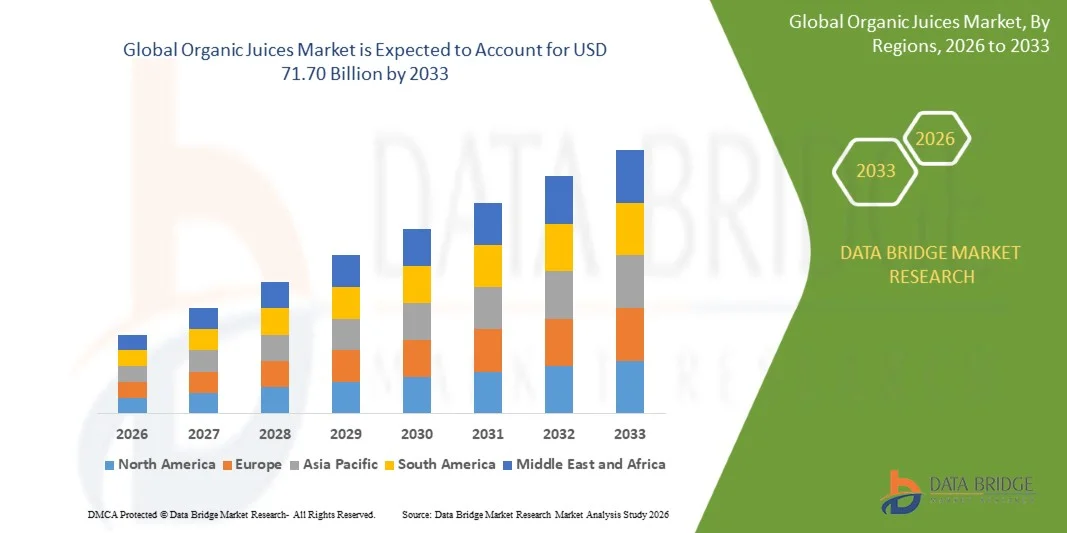
Quelle est la taille du marché mondial des jus biologiques et le taux de croissance?
- La taille du marché mondial des jus biologiques a été évaluée à24,68 milliards de dollars en 2025et devrait atteindre71,70 milliards de dollars en 2033, à unTCAC de 14,26 %pendant la période de prévision
- La croissance du marché est principalement attribuable à l'augmentation de la préférence des consommateurs pour les boissons sous étiquette propre, à la sensibilisation accrue à la santé et au bien-être, à la demande croissante de boissons sans produits chimiques et sans conservateurs, à l'adoption croissante de pratiques d'agriculture biologique et à la forte croissance de la consommation de jus fonctionnels et pressés par le froid dans tous les secteurs du commerce de détail et des services alimentaires.
Quels sont les principaux débouchés du marché des jus biologiques?
- L'augmentation de la consommation de boissons naturelles, végétales et riches en nutriments, ainsi que l'augmentation de la disponibilité de jus biologiques par les supermarchés, les magasins spécialisés et les plateformes en ligne créent des possibilités de croissance importantes pour le marché des jus biologiques
- Toutefois, les coûts de production élevés, la disponibilité limitée de matières premières certifiées biologiques, la durée de conservation plus courte et la sensibilité aux prix dans les régions en développement devraient constituer des obstacles majeurs à la croissance du marché au cours de la période de prévision.
- L'Amérique du Nord a dominé le marché des jus biologiques avec une part de revenus de 42,05 % en 2025, sous l'impulsion d'une forte sensibilisation des consommateurs aux boissons biologiques et à l'étiquetage propre, d'un fort pouvoir d'achat et d'une disponibilité généralisée de jus biologiques certifiés aux États-Unis et au Canada.
- L'Asie-Pacifique devrait enregistrer le TCAC le plus rapide de 6,9 % entre 2026 et 2033, en raison de l'urbanisation rapide, de la hausse des revenus disponibles et de la sensibilisation accrue à la santé et au bien-être en Chine, au Japon, en Inde, en Corée du Sud et en Asie du Sud-Est.
- Le segment des jus biologiques à base de fruits a dominé le marché avec une part estimée d'environ 52,4 % en 2025, soutenue par une forte préférence des consommateurs pour les saveurs familières, la douceur naturelle et la disponibilité généralisée de fruits biologiques
Portée du rapport et segmentation du marché des jus biologiques
| Attributs | Jus biologiques Principales perspectives du marché |
| Segments couverts |
|
| Pays couverts | Amérique du Nord
Europe
Asie-Pacifique
Moyen-Orient et Afrique
Amérique du Sud
|
| Principaux acteurs du marché |
|
| Possibilités de marché |
|
| Infos sur la valeur ajoutée | En plus des renseignements sur les scénarios du marché tels que la valeur du marché, le taux de croissance, la segmentation, la couverture géographique et les principaux intervenants, les rapports de marché établis par Data Bridge Market Research comprennent également une analyse approfondie des experts, une analyse des prix, une analyse des parts de marque, une enquête auprès des consommateurs, une analyse démographique, une analyse de la chaîne d'approvisionnement, une analyse de la chaîne de valeur, une vue d'ensemble des matières premières et des consommables, des critères de sélection des fournisseurs, une analyse PESTLE, une analyse Porter et un cadre réglementaire. |
Quelle est la tendance clé sur le marché des jus biologiques?
(en milliers de dollars)Vers des jus biologiques propres, fonctionnels et à pression froide(en milliers de dollars)
- Le marché des jus biologiques est témoin d'une forte adoption de préparations de jus pressées à froid, peu transformées et sans conservateur, motivées par la préférence croissante des consommateurs pour des boissons propres et naturelles
- Les fabricants se concentrent de plus en plus sur les jus organiques fonctionnels enrichis en probiotiques, vitamines, antioxydants, adaptogènes et superfruits pour soutenir l'immunité, la digestion et le bien-être général.
- La demande croissante de boissons biologiques pratiques, prêtes à boire et de première qualité accélère l'innovation des produits dans les secteurs de la vente au détail, des services alimentaires et de la distribution en ligne
- Par exemple, des entreprises comme Naked Juice, Suja Juice, Tropicana, Simply Orange et Lakewood Organic ont élargi leurs portefeuilles de produits biologiques avec des variantes de jus pressés à froid, à faible teneur en sucre et fonctionnels
- Sensibiliser les consommateurs à la réduction du sucre, aux ingrédients non OGM et à l'approvisionnement durable pousse les marques vers un étiquetage transparent et des certifications biologiques
- Alors que les modes de vie soucieux de la santé continuent d'augmenter à l'échelle mondiale, les jus biologiques demeureront un segment clé de la croissance de l'industrie des boissons fonctionnelles et haut de gamme.
Quels sont les principaux moteurs du marché des jus biologiques?
- Une préférence croissante des consommateurs pour les boissons biologiques, naturelles et sans produits chimiques en raison de la sensibilisation croissante à la santé et des maladies liées au mode de vie
- Par exemple, en 2024-2025, plusieurs marques mondiales ont introduit des jus de fruits biologiques à faible teneur en sucre, sans addition et fonctionnels pour répondre aux attentes changeantes des consommateurs.
- La demande croissante de boissons à base de plantes, de légumes et d'étiquettes propres aux États-Unis, en Europe et en Asie-Pacifique soutient l'expansion du marché
- La croissance des plates-formes modernes de vente au détail, de commerce électronique et des canaux directs vers les consommateurs a amélioré l'accessibilité des produits et la visibilité de la marque
- La hausse des revenus disponibles et la volonté de payer une prime pour les boissons certifiées biologiques et d'origine durable augmentent la valeur marchande
- Soutenu par l'innovation dans les technologies de transformation et des investissements importants dans l'agriculture biologique, le marché des jus biologiques devrait connaître une croissance soutenue à long terme
Quel est le facteur de contestation de la croissance du marché des jus biologiques?
- Coûts élevés de production et de matières premières associés à l'agriculture biologique, à la certification et à la transformation sous pression à froid
- Ainsi, entre 2024 et 2025, les fluctuations de l'offre de fruits biologiques et l'augmentation des coûts logistiques ont eu des répercussions sur les prix de plusieurs fabricants de jus biologiques.
- Une durée de conservation plus courte des jus biologiques par rapport aux boissons conventionnelles accroît l'entreposage, le transport et le gaspillage
- La disponibilité limitée de matières premières biologiques certifiées sur les marchés émergents limite la production à grande échelle
- La concurrence intense des boissons fonctionnelles, des smoothies, des boissons végétales et de l'eau aromatisée crée une pression sur les prix
- Pour relever ces défis, les entreprises mettent l'accent sur l'optimisation de la chaîne d'approvisionnement, l'approvisionnement durable, les technologies d'extension de la durée de conservation et la diversification du portefeuille pour renforcer l'adoption mondiale des jus biologiques.
Comment le marché des jus biologiques est-il segmenté?
Le marché est segmenté sur la base detype, légumes, type d'emballage et canal de distribution.
• Par type
Sur la base du type, le marché des jus biologiques est segmenté en Fruits (Apple, Orange, Raisins, Ananas, etc.), Légumes (Beetroot, etc.) et Mélanges. Le segment des jus biologiques à base de fruits a dominé le marché avec une part estimée d'environ 52,4 % en 2025, soutenue par une forte préférence des consommateurs pour les saveurs familières, la douceur naturelle et la disponibilité généralisée de fruits biologiques. Les jus de pomme et d'orange restent les plus consommés en raison de leur goût, de leurs bienfaits nutritionnels et de leur aptitude à la consommation quotidienne dans tous les groupes d'âge.
Le segment des mélanges devrait enregistrer le TCAC le plus rapide de 2026 à 2033, en raison de la demande croissante de boissons fonctionnelles qui combinent fruits et légumes pour améliorer la nutrition, les bienfaits de la désintoxication et la teneur en sucre réduite. L'intérêt croissant des consommateurs pour les boissons qui stimulent l'immunité, les boissons riches en antioxydants et les boissons axées sur le bien-être accélère l'innovation dans les préparations de jus organiques mélangés.
• Par légumes
Basé sur les légumes, le marché des jus biologiques est segmenté en Beetroot et autres. Le segment de Beetroot a dominé le marché avec une part d'environ 46,8 % en 2025, en raison de sa valeur nutritive élevée, de sa riche teneur en nitrates et de sa forte association avec la santé cardiaque, l'amélioration de l'endurance et la désintoxication. Le jus de betterave est largement adopté par les amateurs de fitness et les consommateurs soucieux de la santé, en particulier en Europe et en Amérique du Nord.
Le segment des autres légumes devrait croître au TCAC le plus rapide au cours de la période de prévision, en raison de l'utilisation croissante des jus de carottes, d'épinards, de céleri, de concombre et de chou. Une prise de conscience accrue de la nutrition végétale, de la santé digestive et des boissons à faible teneur en calories encourage les consommateurs à explorer diverses options de jus de légumes. Les innovations de produits axées sur l'amélioration des profils de goût et des formulations mélangées favorisent davantage la croissance dans ce segment.
• Par type d'emballage
Sur la base du type d'emballage, le marché des jus biologiques est segmenté en bouteilles, cartons et autres. Le segment des bouteilles a dominé le marché avec une part de près de 58,6 % en 2025, principalement en raison de la commodité, de la portabilité, de la resealabilité et de la forte préférence des consommateurs pour les emballages en verre et en PET de qualité supérieure. Les bouteilles sont largement utilisées pour les jus biologiques pressés à froid et prêts à boire dans les circuits de vente au détail et de restauration.
Le segment des Cartons devrait croître à la vitesse la plus rapide du TCAC de 2026 à 2033, grâce à la demande croissante de solutions d'emballage durables, légères et écologiques. L'adoption croissante d'emballages en carton aseptique pour une durée de conservation prolongée, la réduction des besoins en réfrigération et l'amélioration de l'efficacité du transport sont à l'origine de la croissance, en particulier dans les marchés émergents et la distribution de masse.
• Par canal de distribution
Basé sur le canal de distribution, le marché des jus biologiques est segmenté en magasins (Hypermarkets & Supermarkets, Convenience Stores, et autres) et non-Store-Based. Le segment des magasins a dominé le marché avec une part d'environ 64,2 % en 2025, en raison de la forte dépendance des consommateurs à l'égard du commerce de détail physique pour la comparaison de produits, la confiance de la marque et la disponibilité immédiate. Les hypermarchés et les supermarchés jouent un rôle clé dans l'offre d'une grande variété de marques et de saveurs de jus biologiques.
On prévoit que le segment des produits autres que les produits de base connaîtra la croissance la plus rapide au cours de la période de prévision, alimentée par l'expansion rapide des plateformes de commerce électronique, des modèles de distribution directe aux consommateurs et des services d'épicerie en ligne. La pénétration croissante des smartphones, l'adoption de paiements numériques et la préférence pour la livraison par porte accélèrent les ventes en ligne de jus biologiques, en particulier chez les consommateurs urbains et plus jeunes.
Quelle région détient la plus grande part du marché des jus biologiques?
- L'Amérique du Nord a dominé le marché des jus biologiques avec une part de revenus de 42,05 % en 2025, sous l'effet d'une forte sensibilisation des consommateurs à l'égard des boissons biologiques et certifiées, d'un fort pouvoir d'achat et d'une disponibilité généralisée de produits de jus biologiques certifiés aux États-Unis et au Canada. La préférence croissante pour les jus pressés à froid, non OGM et sans conservateurs continue de soutenir la croissance du marché dans tous les secteurs de la vente au détail et des services alimentaires
- Les principales entreprises nord-américaines se concentrent sur l'innovation des produits, les préparations fonctionnelles de jus, l'emballage durable et l'approvisionnement élargi en fruits biologiques, renforçant l'avantage concurrentiel de la région
- Des cadres de certification biologique bien établis, de solides réseaux de distribution et une forte demande de boissons axées sur la santé renforcent encore le leadership du marché nord-américain
Aperçu du marché américain des jus biologiques
Les États-Unis sont le plus important contributeur en Amérique du Nord, appuyé par une forte demande de boissons biologiques de qualité supérieure, une prise de conscience accrue de la santé et l'adoption croissante de régimes à base de plantes. L'augmentation de la consommation de jus de fruits et de légumes biologiques parmi les milléniaux et les consommateurs axés sur la condition physique, ainsi que l'expansion rapide du commerce électronique et de la logistique de la chaîne du froid, continuent de stimuler la croissance du marché.
Aperçu du marché canadien des jus biologiques
Le Canada contribue grandement à la croissance régionale, en raison de la demande croissante de boissons naturelles et d'origine durable. Le solide soutien du gouvernement à l'agriculture biologique, la pénétration croissante des produits biologiques dans les supermarchés et la préférence croissante pour les jus à faible teneur en sucre et fonctionnels favorisent l'expansion constante du marché dans tout le pays.
Marché des jus biologiques d'Asie-Pacifique
L'Asie-Pacifique devrait enregistrer le TCAC le plus rapide de 6,9 % entre 2026 et 2033, en raison de l'urbanisation rapide, de l'augmentation des revenus disponibles et de la sensibilisation à la santé et au bien-être en Chine, au Japon, en Inde, en Corée du Sud et en Asie du Sud-Est. La demande croissante de boissons biologiques sans conservateurs et l'expansion de l'infrastructure moderne de vente au détail accélèrent l'adoption du marché dans toute la région.
Chine Bio Jus Aperçu du marché
La Chine est le principal contributeur de l'Asie-Pacifique, soutenue par une classe moyenne en expansion rapide, des préoccupations croissantes concernant la sécurité alimentaire et une demande croissante de produits biologiques certifiés. La forte capacité de production nationale, les importations croissantes de fruits biologiques et l'expansion des marques de boissons haut de gamme stimulent la croissance du marché.
Le marché japonais des jus biologiques
Le Japon affiche une croissance soutenue, tirée par l'accent mis par les consommateurs sur la qualité, la nutrition et les bienfaits fonctionnels pour la santé. La demande de jus de légumes biologiques, de boissons de désintoxication et de boissons à faible teneur en calories, ainsi que les préférences en matière d'emballage, continuent de soutenir l'expansion du marché.
Le marché indien des jus biologiques
L'Inde devient un marché à forte croissance, alimenté par une sensibilisation accrue à la santé, une demande croissante de boissons naturelles et l'expansion des initiatives d'agriculture biologique. La popularité croissante des jus biologiques à base de fruits et l'amélioration de l'infrastructure de la chaîne du froid accélèrent l'adoption.
Corée du Sud Jus biologiques Aperçu du marché
La Corée du Sud contribue notamment en raison de la forte demande de boissons fonctionnelles et de haute qualité. L'accent mis de plus en plus sur les produits d'étiquetage propre, la prévention des maladies du mode de vie et les mélanges de jus innovants favorise une croissance soutenue du marché.
Quelles sont les meilleures entreprises du marché des jus biologiques?
L'industrie des jus biologiques est principalement dirigée par des entreprises bien établies, notamment :
- Jus nus (États-Unis)
- Suja Juice (États-Unis)
- Bolthouse Farms (États-Unis)
- Odwalla (États-Unis)
- V8 (États-Unis)
- Simplement orange (États-Unis)
- Tropicana (États-Unis)
- Famille R.W. Knudsen (États-Unis)
- Lakewood Organic (États-Unis)
Quelles sont les évolutions récentes du marché mondial des jus biologiques?
- En septembre 2025, Suja Juice (États-Unis) a annoncé un partenariat avec une grande chaîne d'épicerie pour étendre son réseau de distribution dans le Midwest, permettant à la marque d'atteindre de nouveaux clients qui privilégient les jus biologiques et pressés à froid, et renforçant sa visibilité sur le marché pour une croissance soutenue des ventes
- En août 2025, Naked Juice (É.-U.) a lancé une nouvelle gamme de smoothies biologiques destinés aux milléniaux soucieux de la santé, en diversifiant son portefeuille de produits tout en répondant à la tendance des boissons pratiques et nutritives, améliorant ainsi la présence de la marque et son positionnement concurrentiel sur le marché.
- En juillet 2025, Bolthouse Farms (États-Unis) a lancé une initiative de développement durable visant à réduire son empreinte carbone de 30 % au cours des cinq prochaines années, reflétant la préférence croissante des consommateurs pour des marques respectueuses de l'environnement et renforçant son leadership dans la production durable de jus biologiques.
- En janvier 2024, Suja Organic (É.-U.) a lancé une nouvelle gamme de préparations à boire Suja Organic Protein Shakes avec 16 grammes de protéines végétales de riz, de pois et de chanvre, enrichies de vitamines essentielles, de lait d'amande, de crème de noix de coco et de fibres d'Acacia, fournissant une alimentation pratique et augmentant la présence de la marque dans le segment des boissons protéiques
- En mai 2023, Topo Chico (É.-U.) a lancé une gamme d'eaux pétillantes aromatisées aux fruits, infusées d'extraits d'herbes, dont la chaux à la menthe, la myrtille à l'hibiscus et la mandarine au gingembre, qui s'adressent aux consommateurs à la recherche de boissons rafraîchissantes et fonctionnelles tout en élargissant le portefeuille de produits innovants de la marque.
SKU-
Accédez en ligne au rapport sur le premier cloud mondial de veille économique

- Tableau de bord d'analyse de données interactif
- Tableau de bord d'analyse d'entreprise pour les opportunités à fort potentiel de croissance
- Accès d'analyste de recherche pour la personnalisation et les requêtes
- Analyse de la concurrence avec tableau de bord interactif
- Dernières actualités, mises à jour et analyse des tendances
- Exploitez la puissance de l'analyse comparative pour un suivi complet de la concurrence
Méthodologie de recherche
La collecte de données et l'analyse de l'année de base sont effectuées à l'aide de modules de collecte de données avec des échantillons de grande taille. L'étape consiste à obtenir des informations sur le marché ou des données connexes via diverses sources et stratégies. Elle comprend l'examen et la planification à l'avance de toutes les données acquises dans le passé. Elle englobe également l'examen des incohérences d'informations observées dans différentes sources d'informations. Les données de marché sont analysées et estimées à l'aide de modèles statistiques et cohérents de marché. De plus, l'analyse des parts de marché et l'analyse des tendances clés sont les principaux facteurs de succès du rapport de marché. Pour en savoir plus, veuillez demander un appel d'analyste ou déposer votre demande.
La méthodologie de recherche clé utilisée par l'équipe de recherche DBMR est la triangulation des données qui implique l'exploration de données, l'analyse de l'impact des variables de données sur le marché et la validation primaire (expert du secteur). Les modèles de données incluent la grille de positionnement des fournisseurs, l'analyse de la chronologie du marché, l'aperçu et le guide du marché, la grille de positionnement des entreprises, l'analyse des brevets, l'analyse des prix, l'analyse des parts de marché des entreprises, les normes de mesure, l'analyse globale par rapport à l'analyse régionale et des parts des fournisseurs. Pour en savoir plus sur la méthodologie de recherche, envoyez une demande pour parler à nos experts du secteur.
Personnalisation disponible
Data Bridge Market Research est un leader de la recherche formative avancée. Nous sommes fiers de fournir à nos clients existants et nouveaux des données et des analyses qui correspondent à leurs objectifs. Le rapport peut être personnalisé pour inclure une analyse des tendances des prix des marques cibles, une compréhension du marché pour d'autres pays (demandez la liste des pays), des données sur les résultats des essais cliniques, une revue de la littérature, une analyse du marché des produits remis à neuf et de la base de produits. L'analyse du marché des concurrents cibles peut être analysée à partir d'une analyse basée sur la technologie jusqu'à des stratégies de portefeuille de marché. Nous pouvons ajouter autant de concurrents que vous le souhaitez, dans le format et le style de données que vous recherchez. Notre équipe d'analystes peut également vous fournir des données sous forme de fichiers Excel bruts, de tableaux croisés dynamiques (Fact book) ou peut vous aider à créer des présentations à partir des ensembles de données disponibles dans le rapport.











