



Global Organic Maple Syrup Market Segmentation, By Raw Material (Black Maple, Sugar Maple, Red Maple, and Others), Grade (Grade A, Processing Grade, and Substandard), Application (Food and Beverages, Bakery and Confectionery, Flavor Enhancer, Dairy and Frozen Desserts, and Others), Distribution Channel (Business to Business and Business to Consumer)- Industry Trends and Forecast to 2033
Quelle est la taille et le taux de croissance du marché du sirop d'érable biologique
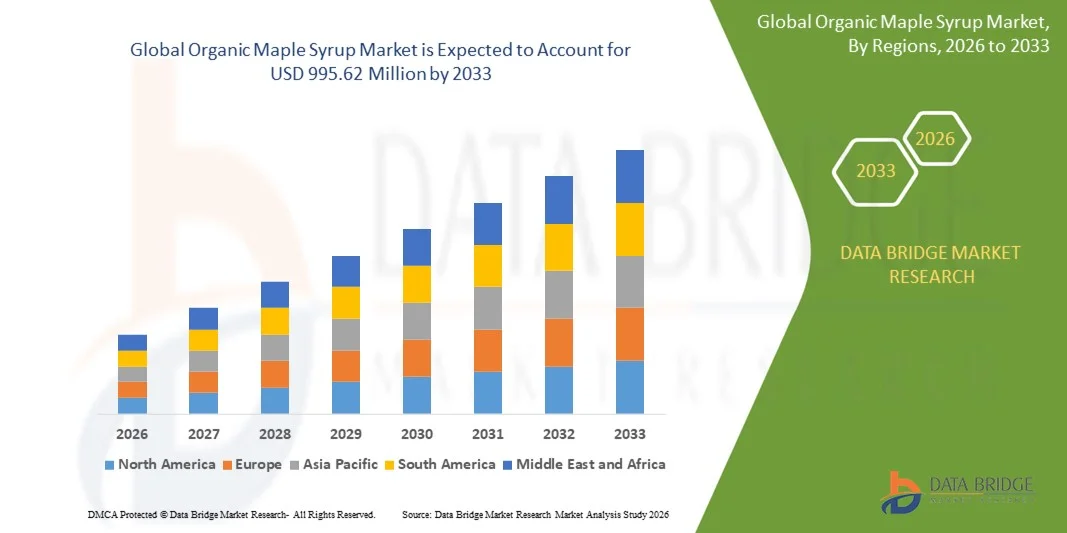
- La taille du marché mondial du sirop d'érable biologique a été évaluée à566,62 millions de dollars en 2025et devrait atteindre995,62 millions de dollars en 2033, à unTCAC de 7,30 %pendant la période de prévision
- La croissance du marché est largement alimentée par la préférence croissante des consommateurs pour les édulcorants naturels et biologiques, la prise de conscience croissante de la santé et la demande croissante de produits alimentaires propres
- L'adoption croissante de sirop d'érable biologique dans les boissons, les produits de boulangerie et les confiseries favorise l'expansion du marché.
Quels sont les principaux débouchés du marché du sirop d'érable biologique
- Le marché se caractérise par une forte demande d'édulcorants de qualité supérieure et naturels en raison de leurs avantages pour la santé et de l'attrait d'un étiquetage propre
- Les fabricants se concentrent sur l'innovation des produits, l'approvisionnement durable et les certifications biologiques pour renforcer leur position sur le marché
- L'Amérique du Nord a dominé le marché du sirop d'érable biologique avec la plus grande part des revenus de 38,5 % en 2025, en raison de l'augmentation de la préférence des consommateurs pour les édulcorants naturels et biologiques, de la prise de conscience accrue de la santé et des marchés bien établis des aliments biologiques.
- La région Asie-Pacifique devrait connaître le taux de croissance le plus élevé du monde.sirop d'érable biologiquemarché, entraîné par l'urbanisation rapide, l'augmentation de la population de la classe moyenne, l'adoption croissante de régimes de type occidental et la sensibilisation aux édulcorants naturels et biologiques
- Le segment de l'érable à sucre détenait la plus grande part du marché en 2025, en raison de sa teneur élevée en sucre, de son riche profil de saveur et de sa disponibilité généralisée en Amérique du Nord. Sucre Les sirops à base d'érable sont préférés pour les applications culinaires et les boissons, ce qui en fait un choix dominant parmi les consommateurs et les fabricants
Portée du rapport et segmentation du marché du sirop d'érable biologique
|
Attributs |
Sirop d'érable biologique Principales perspectives du marché |
|
Segments couverts |
|
|
Pays couverts |
Amérique du Nord
Europe
Asie-Pacifique
Moyen-Orient et Afrique
Amérique du Sud
|
|
Principaux acteurs du marché |
•B&G Foods, Inc.(États-Unis) |
|
Possibilités de marché |
|
|
Infos sur la valeur ajoutée |
En plus des renseignements sur les scénarios du marché tels que la valeur du marché, le taux de croissance, la segmentation, la couverture géographique et les principaux intervenants, les rapports de marché établis par Data Bridge Market Research comprennent également une analyse approfondie des experts, une analyse des prix, une analyse des parts de marque, une enquête auprès des consommateurs, une analyse démographique, une analyse de la chaîne d'approvisionnement, une analyse de la chaîne de valeur, une vue d'ensemble des matières premières et des consommables, des critères de sélection des fournisseurs, une analyse PESTLE, une analyse Porter et un cadre réglementaire. |
Quelle est la tendance clé sur le marché du sirop d'érable biologique
Demande croissante d'édulcorants naturels et biologiques
- La préférence croissante des consommateurs pour les édulcorants naturels et peu transformés façonne de façon significative le marché du sirop d'érable biologique. Les consommateurs recherchent activement des solutions de rechange plus saines au sucre raffiné, et le sirop d'érable biologique gagne en popularité en raison de son origine naturelle, de son positionnement sur une étiquette propre et de ses avantages fonctionnels comme les antioxydants et les minéraux. Cette tendance pousse les fabricants à innover avec de nouvelles formulations de produits et des mélanges qui répondent aux goûts changeants des consommateurs
- La sensibilisation croissante à la santé, au bien-être et à la consommation durable a accéléré l'adoption du sirop d'érable biologique dans la boulangerie, la confiserie, les boissons et les aliments pour le petit déjeuner. Les consommateurs soucieux de la santé et soucieux de l'environnement optent pour des produits fabriqués avec des édulcorants naturels, ce qui incite les marques à se concentrer sur les pratiques d'approvisionnement durable et les certifications biologiques
- Les tendances en matière d'étiquetage propre et de durabilité influent sur les décisions d'achat, les marques mettant l'accent sur la transparence de l'approvisionnement, la production écologique et les étiquettes de certification. Cela aide les entreprises à différencier les produits sur un marché concurrentiel et à renforcer la confiance des consommateurs tout en favorisant l'étiquetage biologique et éco-certifié
- Par exemple, en 2024, Coombs Family Farms aux États-Unis et Escumanac Maple Products au Canada ont élargi leur portefeuille de produits pour inclure le sirop d'érable biologique dans les sirops aromatisés et les produits pour petits déjeuners biologiques. Ils lancent des canaux ciblés de vente au détail, de spécialité et en ligne, mettant en évidence les sources d'approvisionnement naturelles et respectueuses de l'environnement afin d'accroître la fidélité de la marque et l'engagement des consommateurs
- La croissance soutenue du marché dépend de la poursuite de la R-D, de la rentabilité de la production et du maintien de normes de qualité. Les fabricants se concentrent également sur l'amélioration de la fiabilité de la chaîne d'approvisionnement, des emballages innovants et de la production à grande échelle pour répondre à la demande mondiale croissante
Dynamique du marché du sirop d'érable biologique
Chauffeur
La préférence croissante des consommateurs pour les édulcorants naturels et biologiques
- La sensibilisation à la santé et la demande de substituts naturels au sucre raffiné sont les principaux moteurs du marché du sirop d'érable biologique. Les fabricants répondent en offrant des options de sirop biologique et d'étiquetage propre pour attirer les consommateurs axés sur la santé et se conformer aux normes de réglementation et de certification
- L'expansion des applications dans les boulangeries, les confiseries, les boissons et les produits pour le petit déjeuner stimule la croissance du marché. Le sirop d'érable biologique améliore la saveur, la texture et l'attrait nutritionnel tout en soutenant le positionnement naturel des produits, ce qui permet aux fabricants de répondre aux attentes des consommateurs en matière d'offre haut de gamme et saine
- Les marques Foodservice et de détail font activement la promotion du sirop d'érable biologique grâce à l'innovation des produits, aux campagnes de marketing et aux certifications de durabilité. Ces initiatives sont soutenues par la préférence mondiale croissante pour des produits axés sur la santé et respectueux de l'environnement et encouragent les partenariats entre fournisseurs et marques
- Par exemple, en 2023, Maple Joe au Canada et Coombs Family Farms aux États-Unis ont signalé une utilisation accrue du sirop d'érable biologique dans les applications de boulangerie et de boissons, en réponse à la demande accrue des consommateurs d'édulcorants naturels, non OGM et biologiques. Les campagnes de marketing ont mis l'accent sur la durabilité et la traçabilité pour renforcer la confiance des consommateurs et la loyauté de la marque.
- L'expansion du marché dépend de l'optimisation des coûts, de l'approvisionnement durable et des processus de production évolutifs. Les investissements dans des chaînes d'approvisionnement efficaces, des certifications biologiques et des technologies de transformation de pointe seront essentiels pour répondre à la demande croissante et maintenir un avantage concurrentiel
Restriction/Défi
Coût plus élevé et sensibilisation limitée par rapport aux édulcorants conventionnels
- Le coût plus élevé du sirop d'érable biologique par rapport au sucre raffiné et aux sirops conventionnels est un défi clé, limitant l'adoption chez les consommateurs et les fabricants sensibles aux prix. La complexité de la transformation, les exigences de certification et les fluctuations de l'offre de matières premières contribuent à la hausse des prix
- La sensibilisation des consommateurs et des fabricants aux avantages du sirop d'érable biologique demeure inégale dans les régions en développement où la demande d'étiquettes propres se fait jour. Une compréhension limitée des avantages fonctionnels et nutritionnels peut limiter la pénétration du marché
- Les défis de la chaîne d'approvisionnement et de la distribution affectent également la croissance du marché, car le sirop d'érable biologique exige l'approvisionnement de fermes certifiées biologiques et le respect de normes de qualité strictes. Le stockage, le transport et la durée de conservation plus courte des produits naturels augmentent les coûts opérationnels
- Par exemple, en 2024, les petits distributeurs de l'Asie du Sud-Est ont signalé une absorption plus lente du sirop d'érable biologique en raison de la hausse des prix et de la sensibilisation limitée des consommateurs. Les exigences en matière d'entreposage et de conformité à la certification constituaient des obstacles supplémentaires, limitant parfois l'espace disponible au détail pour les produits biologiques de qualité supérieure.
- Pour surmonter ces défis, il faut une production rentable, des réseaux de distribution élargis et des initiatives éducatives ciblées pour les consommateurs et les fabricants. La collaboration avec les détaillants, les exploitants de services alimentaires et les organismes de certification, ainsi que des formulations novatrices et durables, sera essentielle à la croissance à long terme du marché.
Comment le marché du sirop d'érable biologique est-il segmenté
Le marché est segmenté sur la base de la matière première, grade, application et canal de distribution
- Par matière première
Sur la base de la matière première, le marché du sirop d'érable biologique est segmenté en érable noir, érable sucre, érable rouge et autres. Le segment de l'érable à sucre détenait la plus grande part du marché en 2025, en raison de sa teneur élevée en sucre, de son riche profil de saveur et de sa disponibilité généralisée en Amérique du Nord. Sucre Les sirops à base d'érable sont préférés pour les applications culinaires et les boissons, ce qui en fait un choix dominant parmi les consommateurs et les fabricants.
Le segment de l'érable noir devrait connaître le taux de croissance le plus rapide entre 2026 et 2033, en raison de l'intérêt croissant des consommateurs pour les profils de saveurs uniques et les produits artisanaux. Le sirop d'érable noir gagne en popularité dans les applications d'aliments et de boissons haut de gamme, particulièrement chez les consommateurs soucieux de la santé et gourmands.
- Par grade
Selon la catégorie, le marché du sirop d'érable biologique est segmenté en grade A, grade de transformation et niveau inférieur. Le segment de catégorie A détenait la plus grande part du marché en 2025, en raison de sa qualité supérieure, de sa couleur attrayante et de sa forte préférence pour la consommation directe de boissons, de boulangeries et de confiseries. Les consommateurs préfèrent le sirop de catégorie A pour sa saveur uniforme, sa pureté élevée et sa certification biologique, ce qui en fait un choix privilégié dans les produits de qualité supérieure et axés sur la santé. Les fabricants utilisent également le sirop de grade A pour améliorer le positionnement de la marque et répondre à la demande croissante d'édulcorants naturels.
Le segment des classes de transformation devrait connaître le taux de croissance le plus rapide entre 2026 et 2033, en raison de l'augmentation de la demande de sirop à grand volume dans les applications industrielles de transformation et de fabrication des aliments. Son accessibilité et sa polyvalence le rendent idéal pour le mélange, l'arôme et la production à grande échelle dans les industries de la boulangerie, de la confiserie et des boissons. L'augmentation des investissements dans la production industrielle de sirop d'érable biologique favorise l'évolutivité et l'adoption dans l'ensemble des services alimentaires et des produits emballés.
- Par demande
Sur la base de la demande, le marché du sirop d'érable biologique est segmenté en aliments et boissons, boulangerie et confiserie, enhancer des saveurs, produits laitiers et desserts congelés, et autres. Le segment des aliments et boissons détenait la plus grande part du marché en 2025, en raison de l'adoption croissante d'édulcorants biologiques dans les thés, cafés, smoothies et autres boissons naturelles. La tendance à la hausse des boissons saines et des boissons fonctionnelles a encore stimulé l'utilisation du sirop d'érable biologique comme alternative naturelle au sucre.
Le segment de la boulangerie et de la confiserie devrait connaître le taux de croissance le plus rapide de 2026 à 2033, alimenté par la hausse de la demande de produits de boulangerie, de chocolats et de confiseries haut de gamme fabriqués avec des ingrédients naturels et biologiques. Les consommateurs recherchent de plus en plus des produits aux saveurs authentiques et des ingrédients propres, ce qui incite les fabricants de boulangeries et de confiseries à innover avec des recettes à base de sirop d'érable biologique. Les produits saisonniers et artisanaux contribuent également à une plus grande adoption dans ce segment.
- Par canal de distribution
Sur la base du canal de distribution, le marché du sirop d'érable biologique est segmenté en Business to Business (B2B) et Business to Consumer (B2C). Le segment B2C détenait la plus grande part du marché en 2025, en raison de la pénétration croissante du commerce électronique, de la disponibilité au détail et de la commercialisation directe au consommateur du sirop d'érable biologique. La préférence croissante des consommateurs pour les modèles d'achat en ligne et de livraison par abonnement permet un accès pratique aux produits de sirop d'érable bio de qualité supérieure et spécialisée.
Le segment B2B devrait connaître le taux de croissance le plus rapide de 2026 à 2033, appuyé par l'utilisation croissante de sirop d'érable biologique dans les industries de la transformation des aliments, de la boulangerie, de la fabrication de boissons et de l'hôtellerie. Les partenariats avec les restaurants, les hôtels et les boulangeries commerciales augmentent la portée du marché, tandis que les contrats d'approvisionnement en vrac et la fabrication sous marque privée stimulent la croissance de ce canal.
Quelle région détient la plus grande part du marché du sirop d'érable biologique
- L'Amérique du Nord a dominé le marché du sirop d'érable biologique avec la plus grande part des revenus de 38,5 % en 2025, en raison de l'augmentation de la préférence des consommateurs pour les édulcorants naturels et biologiques, de la prise de conscience accrue de la santé et des marchés bien établis des aliments biologiques.
- Les consommateurs de la région accordent une grande valeur à la pureté, aux certifications d'étiquette propre et à l'approvisionnement en sirop d'érable biologique pour les boissons, les produits de boulangerie et les confiseries.
- Cette adoption généralisée s'appuie également sur des revenus disponibles élevés, une prise de conscience croissante des ingrédients fonctionnels et naturels et la tendance croissante à intégrer le sirop d'érable biologique dans les régimes alimentaires quotidiens et les produits alimentaires de première qualité.
Aperçu du marché américain du sirop d'érable biologique
Le marché américain du sirop d'érable biologique a enregistré la plus grande part de revenus en 2025 en Amérique du Nord, alimentée par la demande croissante d'édulcorants propres et à base végétale. Les consommateurs optent de plus en plus pour le sirop d'érable biologique comme alternative naturelle au sucre raffiné dans les boissons, les produits de boulangerie et les collations. La sensibilisation accrue à la santé, conjuguée à la disponibilité de produits biologiques de qualité supérieure et certifiés dans tous les circuits de vente au détail et de commerce électronique, stimule davantage la croissance du marché. En outre, l'accent mis sur l'approvisionnement durable et les pratiques de production respectueuses de l'environnement renforce la confiance des consommateurs et leur adoption.
Perspectives du marché du sirop d'érable biologique Europe
Le marché européen du sirop d'érable biologique devrait connaître le taux de croissance le plus rapide de 2026 à 2033, principalement en raison de l'augmentation de la demande d'édulcorants naturels, de la prise de conscience accrue de la santé et de l'expansion de l'industrie des aliments biologiques. Les consommateurs recherchent du sirop d'érable biologique pour les applications de boulangerie, de confiserie et de boissons fonctionnelles. L'accent mis par la région sur les ingrédients d'étiquetage propre, conjugué à des cadres réglementaires et à des normes de certification favorables, favorise l'adoption du marché dans les secteurs du commerce de détail et des services alimentaires.
Aperçu du marché britannique du sirop d'érable biologique
Le marché du sirop d'érable biologique du Royaume-Uni devrait connaître le taux de croissance le plus rapide de 2026 à 2033, en raison de l'intérêt croissant pour les produits alimentaires biologiques et de qualité supérieure, de la sensibilisation accrue aux avantages pour la santé et de l'adoption croissante de produits de cuisine à domicile et de boulangerie commerciale. On s'attend à ce que les circuits de vente au détail et de commerce électronique bien établis du Royaume-Uni, ainsi qu'une forte tendance à l'utilisation de produits à base végétale et à étiquetage propre, continuent de soutenir la croissance du marché.
Aperçu du marché du sirop d'érable biologique en Allemagne
Le marché allemand du sirop d'érable biologique devrait connaître le taux de croissance le plus rapide entre 2026 et 2033, alimenté par une sensibilisation accrue des consommateurs aux édulcorants naturels et aux choix alimentaires axés sur la santé. L'Allemagne met l'accent sur la durabilité, la production écologique et les certifications biologiques. L'intégration du sirop d'érable biologique dans les produits alimentaires de première qualité et fonctionnels gagne également en traction, en adéquation avec les préférences des consommateurs locaux pour des ingrédients de haute qualité et d'origine responsable.
Aperçu du marché du sirop d'érable biologique Asie-Pacifique
Le marché du sirop d'érable biologique en Asie-Pacifique devrait connaître le taux de croissance le plus rapide de 2026 à 2033, en raison de l'augmentation des revenus disponibles, de l'urbanisation et de l'adoption croissante de régimes alimentaires de style occidental. Des pays comme la Chine, le Japon et l'Inde manifestent un intérêt croissant pour les édulcorants biologiques et naturels, en particulier pour les applications de boulangerie, de boissons et de confiseries. Les initiatives gouvernementales de sensibilisation à la santé, conjuguées à l'augmentation de la disponibilité par le biais des circuits de vente au détail et en ligne, accélèrent l'adoption du marché.
Aperçu du marché japonais du sirop d'érable biologique
Le marché japonais du sirop d'érable biologique devrait connaître le taux de croissance le plus rapide entre 2026 et 2033, en raison de la population du pays soucieuse de la santé, de la demande d'ingrédients naturels et de la popularité croissante des aliments biologiques et fonctionnels. Les consommateurs japonais préfèrent le sirop d'érable biologique pour les boissons, les desserts et les produits de boulangerie. L'intégration du sirop d'érable biologique dans des formulations pratiques et prêtes à l'emploi favorise l'adoption.
Aperçu du marché chinois du sirop d'érable biologique
En 2025, le marché chinois du sirop d'érable biologique représentait la plus grande part des revenus du marché en Asie-Pacifique, attribuable à une sensibilisation accrue à la santé, à une classe moyenne croissante et à une consommation accrue d'édulcorants naturels. Le sirop d'érable biologique gagne en popularité dans les produits de boulangerie, de boisson et de confiserie. L'expansion des circuits de vente au détail et de commerce électronique, ainsi que la présence de marques biologiques nationales et importées, contribuent à la croissance du marché.
Part de marché du sirop d'érable biologique
L'industrie du sirop d'érable biologique est principalement dirigée par des entreprises bien établies, notamment :
•B&G Foods, Inc.(États-Unis)
•KRAFT Aliments(États-Unis)
•La société J.M. Smucker(États-Unis)
•Amoretti S.p.A.(Italie)
• DaVinci Gourmet (États-Unis)
• Les Industries Bernard (Canada)
• Bascom Maple Farms, Inc. (États-Unis)
• TURKEY HILL SUPARBUSH LTD. (Canada)
• Citadelle (France)
• Fermes familiales Coombs (États-Unis)
• Escuminac Maple Products (Canada)
• Maple Joe (Canada)
• Fermes Maple Grove du Vermont (États-Unis)
• Producteurs nord-américains de sirop d'érable (Canada)
• Cascadian Farm (États-Unis)
SKU-
Accédez en ligne au rapport sur le premier cloud mondial de veille économique

- Tableau de bord d'analyse de données interactif
- Tableau de bord d'analyse d'entreprise pour les opportunités à fort potentiel de croissance
- Accès d'analyste de recherche pour la personnalisation et les requêtes
- Analyse de la concurrence avec tableau de bord interactif
- Dernières actualités, mises à jour et analyse des tendances
- Exploitez la puissance de l'analyse comparative pour un suivi complet de la concurrence
Méthodologie de recherche
La collecte de données et l'analyse de l'année de base sont effectuées à l'aide de modules de collecte de données avec des échantillons de grande taille. L'étape consiste à obtenir des informations sur le marché ou des données connexes via diverses sources et stratégies. Elle comprend l'examen et la planification à l'avance de toutes les données acquises dans le passé. Elle englobe également l'examen des incohérences d'informations observées dans différentes sources d'informations. Les données de marché sont analysées et estimées à l'aide de modèles statistiques et cohérents de marché. De plus, l'analyse des parts de marché et l'analyse des tendances clés sont les principaux facteurs de succès du rapport de marché. Pour en savoir plus, veuillez demander un appel d'analyste ou déposer votre demande.
La méthodologie de recherche clé utilisée par l'équipe de recherche DBMR est la triangulation des données qui implique l'exploration de données, l'analyse de l'impact des variables de données sur le marché et la validation primaire (expert du secteur). Les modèles de données incluent la grille de positionnement des fournisseurs, l'analyse de la chronologie du marché, l'aperçu et le guide du marché, la grille de positionnement des entreprises, l'analyse des brevets, l'analyse des prix, l'analyse des parts de marché des entreprises, les normes de mesure, l'analyse globale par rapport à l'analyse régionale et des parts des fournisseurs. Pour en savoir plus sur la méthodologie de recherche, envoyez une demande pour parler à nos experts du secteur.
Personnalisation disponible
Data Bridge Market Research est un leader de la recherche formative avancée. Nous sommes fiers de fournir à nos clients existants et nouveaux des données et des analyses qui correspondent à leurs objectifs. Le rapport peut être personnalisé pour inclure une analyse des tendances des prix des marques cibles, une compréhension du marché pour d'autres pays (demandez la liste des pays), des données sur les résultats des essais cliniques, une revue de la littérature, une analyse du marché des produits remis à neuf et de la base de produits. L'analyse du marché des concurrents cibles peut être analysée à partir d'une analyse basée sur la technologie jusqu'à des stratégies de portefeuille de marché. Nous pouvons ajouter autant de concurrents que vous le souhaitez, dans le format et le style de données que vous recherchez. Notre équipe d'analystes peut également vous fournir des données sous forme de fichiers Excel bruts, de tableaux croisés dynamiques (Fact book) ou peut vous aider à créer des présentations à partir des ensembles de données disponibles dans le rapport.











