



Marché mondial des systèmes de gestion ferroviaire, par service (conseil, intégration et déploiement de systèmes, support et maintenance), mode de déploiement (cloud, sur site), taille de l'organisation (PME, grandes entreprises). Tendances et prévisions du secteur jusqu'en 2032.
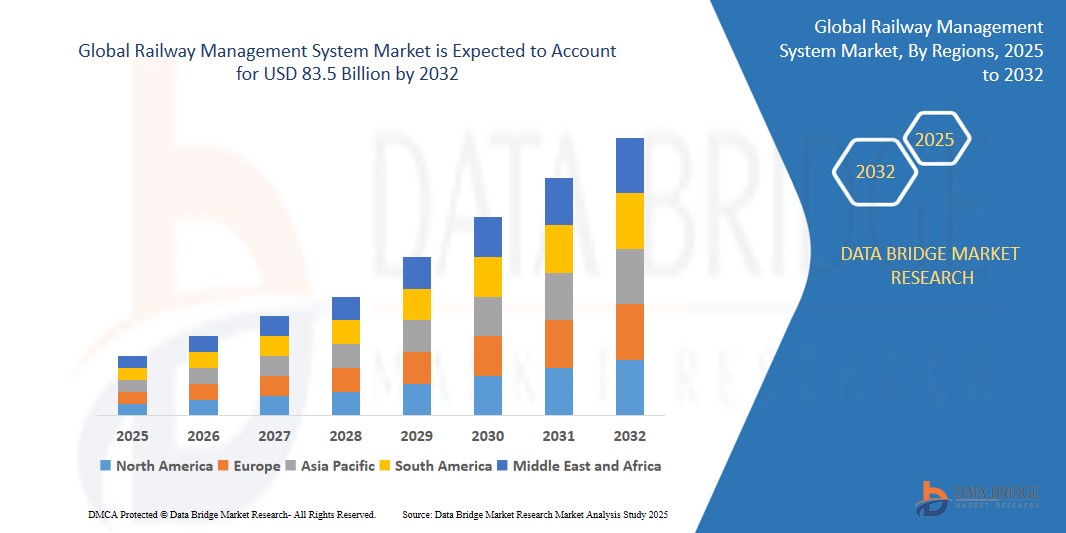
Taille du marché des systèmes de gestion ferroviaire
- La taille du marché mondial des systèmes de gestion ferroviaire était évaluée à environ 46,7 milliards USD en 2024 et devrait atteindre 83,5 milliards USD d'ici 2032, avec un TCAC de 7,3 % au cours de la période de prévision.
- Cette croissance est portée par des facteurs tels que l'augmentation des investissements dans la modernisation des infrastructures ferroviaires, le besoin croissant d'une exploitation ferroviaire efficace et l'intégration des technologies numériques comme l'IoT, le big data et l'IA. De plus, la demande de gestion du trafic en temps réel, de maintenance prédictive et d'amélioration de l'expérience des voyageurs favorise l'adoption des systèmes de gestion ferroviaire à l'échelle mondiale.
Analyse du marché des systèmes de gestion ferroviaire
- Le système de gestion ferroviaire est intégré à plusieurs types de systèmes manuels et automatiques qui incluent différents types d'instruments et de services qui aident à gérer le secteur ferroviaire rapidement et sainement.
- Les nouvelles technologies de l'information et de la communication sont utilisées dans toutes les opérations et constituent un facteur crucial pour accélérer la croissance du marché. L'augmentation de la participation des entités privées dans les marchés ferroviaires gérés par le gouvernement et l'augmentation de la préférence pour les tarifs bas et le transport multimodal sont les principaux facteurs, entre autres, qui stimulent le marché des systèmes de gestion ferroviaire.
- L’Amérique du Nord domine le marché des systèmes de gestion ferroviaire en raison de l’augmentation des développements technologiques et des infrastructures de pointe dans cette région.
- L'Asie-Pacifique est la région attendue en termes de croissance du marché des systèmes de gestion ferroviaire en raison de l'augmentation de la participation des entités privées dans les marchés ferroviaires gérés par le gouvernement et de la hausse de la préférence pour les tarifs bas et le transport multimodal dans cette région.
- En 2025, le segment Cloud devrait dominer le marché des systèmes de gestion ferroviaire, avec une part de marché de 39,12 %. Ce leadership s'explique par la demande croissante de solutions flexibles, évolutives et performantes pour l'exploitation ferroviaire, notamment pour la surveillance en temps réel, la maintenance prédictive et la prise de décision basée sur les données. L'intégration des technologies IoT et IA renforce encore la domination du segment Cloud, permettant aux opérateurs ferroviaires d'optimiser la gestion des actifs, la planification et l'efficacité opérationnelle globale.
Portée du rapport et segmentation du marché des systèmes de gestion ferroviaire
|
Attributs |
Informations clés sur le marché des systèmes de gestion ferroviaire |
|
Segments couverts |
|
|
Countries Covered |
North America
Europe
Asia-Pacific
Middle East and Africa
South America
|
|
Key Market Players |
|
|
Market Opportunities |
|
|
Value Added Data Infosets |
In addition to the insights on market scenarios such as market value, growth rate, segmentation, geographical coverage, and major players, the market reports curated by the Data Bridge Market Research also include import export analysis, production capacity overview, production consumption analysis, price trend analysis, climate change scenario, supply chain analysis, value chain analysis, raw material/consumables overview, vendor selection criteria, PESTLE Analysis, Porter Analysis, and regulatory framework. |
Railway Management System Market Trends
“Smart, automated railway operations gain traction”
- The Railway Management System market is witnessing a rapid shift toward automation and intelligent rail operations, driven by the increasing need for efficiency, safety, and sustainability in transportation. Modern systems now integrate IoT sensors, AI-powered analytics, and cloud-based platforms to enable real-time monitoring, predictive maintenance, and smart traffic control.
- These innovations help railway operators reduce delays, optimize routes, manage energy consumption, and improve asset utilization. The rise of digital railways and integration with smart city infrastructure is further enhancing performance, especially in urban and high-speed rail networks.
- For instance, on January 2025, the Railway Management System industry is expected to benefit significantly from advancements in Generative AI, leading to greater demand for edge computing and hybrid AI systems. This ensures more efficient deployment across centralized and decentralized railway operations, supporting real-time decisions and scalable network management.
- Governments and railway operators are also actively investing in smart rail systems to meet stringent safety standards and carbon neutrality goals. As a result, intelligent railway management solutions are becoming the standard across both developed and emerging transportation markets
Railway Management System Market Dynamics
Driver
“Meat demand boosts system adoption”
- The growing demand for efficient, safe, and reliable transportation is a key driver for the Railway Management System market. As urbanization increases, particularly in Asia-Pacific, Europe, and Latin America, governments and private operators are investing in smarter railway systems to address growing passenger volumes and freight needs.
- To meet this demand, railway operators are adopting automated Railway Management Systems to optimize train schedules, improve safety, enhance passenger experience, and reduce operational costs. These systems enable real-time monitoring, predictive maintenance, and dynamic route management.
- Additionally, the push for sustainable and eco-friendly transportation is driving the adoption of energy-efficient solutions in railway networks, such as automated energy management systems and green train technologies.
- For instance, On April 2025, Siemens Mobility announced its collaboration with Swiss Federal Railways (SBB) to implement an AI-driven Railway Management System designed to improve punctuality, reduce fuel consumption, and minimize delays in the Swiss railway network. The system uses predictive analytics to identify potential disruptions and optimize train operations in real-time.
- As the demand for faster and more reliable rail services increases, the need for advanced, automated railway systems will further accelerate market growth.
Opportunity
“Emerging markets fuel growth potential”
- Emerging economies present a lucrative growth opportunity for railway system providers, as regions like Asia, Africa, and Latin America invest in modernizing their rail infrastructure to enhance connectivity and improve transportation efficiency.
- Governments are promoting the adoption of smart railway solutions through subsidies, grants, and policy initiatives, while private investments in rail infrastructure and technology are increasing. Smaller and mid-sized countries are gradually transitioning from outdated manual systems to automated railway management systems to improve operational efficiency, safety, and passenger experience.
- Companies that offer cost-effective, scalable solutions tailored to the unique needs of emerging markets can capitalize on this growing demand for modernization and innovation in the rail industry.
- For instance, On April 2025, Hitachi Rail announced a partnership with the Kenyan government to deploy an advanced railway management system to enhance the Mombasa-Nairobi line. This project aims to improve train scheduling, reduce delays, and optimize maintenance across the network, boosting efficiency in East Africa’s growing transportation sector.
- The integration of smart technologies in railways, along with a rise in demand for high-speed and sustainable transport, is unlocking new opportunities for the growth of the railway management system market.
Restraint/Challenge
“High costs hinder widespread adoption”
- Despite their benefits, the high upfront costs associated with advanced railway management systems remain a significant barrier to widespread adoption, especially for small to medium-sized rail operators in developing economies. The cost of infrastructure upgrades, software, and ongoing maintenance can be prohibitive.
- Additionally, the complexity of integrating these systems with existing rail networks requires specialized expertise, which may not be readily available in certain regions. The challenge of retrofit operations to modernize older rail systems can also be both costly and disruptive.
- While the long-term savings from improved operational efficiency, reduced downtime, and better resource management justify the investment, the initial financial burden and lack of accessible financing options slow down the market penetration.
- For instance, On March 2025, Alstom reported that its implementation of an advanced signaling system for a major rail operator in India faced delays due to financial constraints and the integration challenges with the country's existing infrastructure. The company highlighted that some operators are opting for more affordable, incremental solutions due to the high initial capital investment required for full automation.
- Railway operators must prioritize modular, affordable solutions and collaborate with governments or financial institutions to offer financing models that make advanced technologies more accessible to a wider range of stakeholders
Railway Management System Market Scope
The market is segmented on the basis product, technology, application.
|
Segmentation |
Sub-Segmentation |
|
By Service |
|
|
By Deployment Mode |
|
|
By Organization Size |
|
In 2025, the Cloud segment is projected to dominate the market with a largest share in by Deployment segment
In 2025, the Cloud segment is projected to dominate the Railway Management System market, holding the largest share of 39.12%. This leadership is driven by the growing demand for flexible, scalable, and efficient solutions in railway operations, particularly for real-time monitoring, predictive maintenance, and data-driven decision-making. The integration of IoT and AI technologies is further boosting the cloud segment’s dominance, as it enables railway operators to enhance asset management, optimize scheduling, and improve overall operational efficiency
The System Integration and Deployment is expected to account for the largest share during the forecast period in Railway Management System market
In 2025, the System Integration and Deployment segment is expected to account for the second-largest share of 34.87% in the Railway Management System market. This growth is propelled by the increasing need for automation and the adoption of smart technologies in railway systems. The demand for seamless integration of systems such as train scheduling, maintenance management, and ticketing is driving the widespread adoption of system integration and deployment services. These solutions help optimize operations, improve system interoperability, and reduce operational costs for railway operators.
Railway Management System Market Regional Analysis
“North America Holds the Largest Share in the Railway Management System Market”
- North America dominates the Railway Management System Market, driven by the widespread adoption of advanced technologies, a strong presence of leading railway system providers, and growing demand for efficient, energy-saving systems in rail networks.
- The U.S. is projected to dominate the market, driven by continued investments in upgrading rail infrastructure, including the integration of AI, predictive maintenance, and IoT technologies. These innovations enhance operational efficiency, reduce costs, and improve safety across both passenger and freight rail systems.
- Canada is also witnessing growth in the railway management sector, with investments in the modernization of rail networks and increased focus on sustainability and reducing emissions. The adoption of digital technologies such as real-time monitoring and intelligent transport systems (ITS) is helping to improve performance across the continent.
“Asia Pacific is Projected to Register the Highest CAGR in the Railway Management System Market”
- The Asia-Pacific region is expected to register the highest growth rate in the Railway Management System Market, fueled by large-scale infrastructure projects, rapid urbanization, and increasing government focus on modernizing and expanding railway networks across countries such as India, China, and Japan.
- China is anticipated to lead the market in this region due to its ambitious high-speed rail expansion plans, while countries like India and Japan are investing heavily in advanced signaling systems, real-time monitoring technologies, and automation to enhance railway operations.
- The demand for intelligent rail systems to support the growing passenger and freight traffic in these countries is expected to further boost the growth of this market.
Railway Management System Market Share
The market competitive landscape provides details by competitor. Details included are company overview, company financials, revenue generated, market potential, investment in research and development, new market initiatives, global presence, production sites and facilities, production capacities, company strengths and weaknesses, product launch, product width and breadth, application dominance. The above data points provided are only related to the companies' focus related to market.
The Major Market Leaders Operating in the Market Are:
- Hitachi, Ltd. (Japan)
- Bombardier (Canada)
- Huawei Technologies Co., Ltd. (China)
- INDRA SISTEMAS, S.A. (Spain)
- Atos SE (France)
- Toshiba India Pvt. Ltd. (India)
- Tech Mahindra Limited (India)
- Nokia (Finland)
- OptaSense (United Kingdom)
- IBM Corporation (U.S.)
- GENERAL ELECTRIC (U.S.)
- GAO Group Inc. (Canada)
- EKE-Electronics Ltd (Finland)
- Sierra Wireless (Canada)
- EUROTECH (Italy)
- Trimble Inc. (U.S.)
- Frequentis AG (Austria)
- Siemens (Germany)
- Thales Group (France)
- DXC Technology Company (U.S.)
- ABB (Switzerland)
- Amadeus IT Group SA (Spain)
- Alstom (France)
- Cisco Systems, Inc. (U.S.)
Latest Developments in Global Railway Management System Market
- On April, 2025, the Shure MoveMic 88+ Receiver Kit is now available for $449 on Amazon and B&H Photo-Video. This portable audio equipment offers high-quality sound for recording on the go. Featuring customizable settings through the MOTIV app, it’s ideal for mobile recording, though not a replacement for higher-end microphones. It includes a mic, receiver, mounts, and cables.
- On April, 2025, Ultra-Wideband (UWB) technology, known for its precise ranging capabilities, is gaining traction in smartphones like Apple iOS and Samsung Galaxy. UWB is used in devices like AirTags and SmartTags for tracking. Audiophiles are hopeful for UWB’s use in wireless streaming, as Samsung files a patent for UWB wireless headphones, promising lossless music streaming without dongles or attachments.
- On April, 2025, UltraProlink launched the Air-Tunes Duo, a Bluetooth transmitter and adapter that adds Railway Management System capability to devices with a 3.5mm audio jack. It allows dual audio streaming, supports wired headphones, and offers up to 15 hours of battery life. Available for ₹1,841, it is designed for users seeking wireless freedom with existing high-end headphones or earbuds.
- On December, 2024, Sennheiser launched the Profile Wireless microphone system in India, aimed at content creators. The system offers dual-channel 2.4GHz wireless audio, with up to 245 meters range, 15-hour battery life, and 30 hours of onboard recording. Priced at ₹29,900, it supports multiple configurations and includes backup recording features for enhanced audio quality during production.
SKU-
Accédez en ligne au rapport sur le premier cloud mondial de veille économique

- Tableau de bord d'analyse de données interactif
- Tableau de bord d'analyse d'entreprise pour les opportunités à fort potentiel de croissance
- Accès d'analyste de recherche pour la personnalisation et les requêtes
- Analyse de la concurrence avec tableau de bord interactif
- Dernières actualités, mises à jour et analyse des tendances
- Exploitez la puissance de l'analyse comparative pour un suivi complet de la concurrence
Méthodologie de recherche
La collecte de données et l'analyse de l'année de base sont effectuées à l'aide de modules de collecte de données avec des échantillons de grande taille. L'étape consiste à obtenir des informations sur le marché ou des données connexes via diverses sources et stratégies. Elle comprend l'examen et la planification à l'avance de toutes les données acquises dans le passé. Elle englobe également l'examen des incohérences d'informations observées dans différentes sources d'informations. Les données de marché sont analysées et estimées à l'aide de modèles statistiques et cohérents de marché. De plus, l'analyse des parts de marché et l'analyse des tendances clés sont les principaux facteurs de succès du rapport de marché. Pour en savoir plus, veuillez demander un appel d'analyste ou déposer votre demande.
La méthodologie de recherche clé utilisée par l'équipe de recherche DBMR est la triangulation des données qui implique l'exploration de données, l'analyse de l'impact des variables de données sur le marché et la validation primaire (expert du secteur). Les modèles de données incluent la grille de positionnement des fournisseurs, l'analyse de la chronologie du marché, l'aperçu et le guide du marché, la grille de positionnement des entreprises, l'analyse des brevets, l'analyse des prix, l'analyse des parts de marché des entreprises, les normes de mesure, l'analyse globale par rapport à l'analyse régionale et des parts des fournisseurs. Pour en savoir plus sur la méthodologie de recherche, envoyez une demande pour parler à nos experts du secteur.
Personnalisation disponible
Data Bridge Market Research est un leader de la recherche formative avancée. Nous sommes fiers de fournir à nos clients existants et nouveaux des données et des analyses qui correspondent à leurs objectifs. Le rapport peut être personnalisé pour inclure une analyse des tendances des prix des marques cibles, une compréhension du marché pour d'autres pays (demandez la liste des pays), des données sur les résultats des essais cliniques, une revue de la littérature, une analyse du marché des produits remis à neuf et de la base de produits. L'analyse du marché des concurrents cibles peut être analysée à partir d'une analyse basée sur la technologie jusqu'à des stratégies de portefeuille de marché. Nous pouvons ajouter autant de concurrents que vous le souhaitez, dans le format et le style de données que vous recherchez. Notre équipe d'analystes peut également vous fournir des données sous forme de fichiers Excel bruts, de tableaux croisés dynamiques (Fact book) ou peut vous aider à créer des présentations à partir des ensembles de données disponibles dans le rapport.











