Segmentation du marché mondial des médicaments contre les maladies métaboliques héréditaires rares, par classe thérapeutique (médicaments de remplacement enzymatique, thérapie génique, médicaments de réduction du substrat, petites molécules, oligonucléotides et protéines), voie d'administration (parentérale, orale et intrathécale), développement clinique (médicaments commercialisés, essais cliniques de phase III, essais cliniques de phase I-II et candidats précliniques), indication (maladies de surcharge lysosomale, troubles du cycle de l'urée, troubles du métabolisme des acides aminés, acidémies organiques, maladies mitochondriales, maladies peroxysomales et autres maladies métaboliques héréditaires rares) - Tendances du secteur et prévisions jusqu'en 2033
Quel est le rare trouble métabolique hérité Taille du marché et taux de croissance
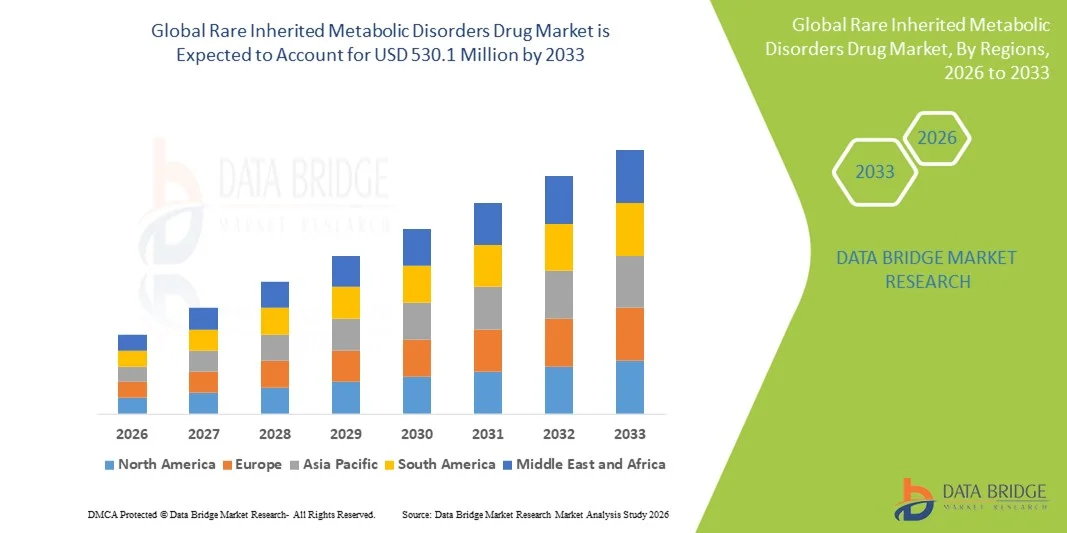
- Selon Data Bridge études de marché Analyse la taille du marché des médicaments a été évaluée à217,8 millions de dollars en 2025et devrait atteindre530,1 millions de dollars en 2033, à unTCAC de 11,80 %pendant la période de prévision
- La croissance du marché est en grande partie alimentée par l'augmentation des taux de diagnostic, les progrès dans les thérapies de précision et un solide soutien réglementaire aux médicaments orphelins, qui continuent de stimuler l'innovation dans le remplacement des enzymes, les petites molécules, les ARN et les nouveaux médicaments.thérapie géniquetraitements
- De plus, la demande croissante de thérapies efficaces et modifiant les maladies chez les patients pédiatriques et adultes renforce l'adoption, car les systèmes de santé privilégient les interventions précoces et améliorent les résultats à long terme. Ces facteurs convergents accélèrent l'adoption de médicaments IMD ciblés, ce qui stimule considérablement la croissance de l'industrie.
Taille du marché et prévisions
- Valeur marchande mondiale (2025):217,8 millions de dollars
- Valeur marchande prévue (2033) :530,1 millions de dollars
- Prévisions CAGR (2026-2033):11.80%
Quels sont les principaux débouchés pour les troubles métaboliques héréditaires rares
- Les médicaments ciblant les troubles métaboliques héréditaires rares, y compris les médicaments de substitution enzymatiques, les médicaments de thérapie génique, les médicaments de réduction des substrats, les médicaments à petites molécules, les médicaments à oligonucléotides et les médicaments à base de protéines, deviennent des piliers thérapeutiques essentiels pour plusieurs MTI rares, car ils améliorent la correction métabolique, ralentissent la progression des maladies et améliorent les résultats à long terme des patients chez les enfants et les adultes
- La demande croissante est alimentée par les progrès de la médecine génétique, l'expansion des programmes de dépistage des nouveau-nés, l'amélioration de la précision du diagnostic et la priorité accordée à la R-D sur les médicaments orphelins, qui, ensemble, stimulent les pipelines de développement et accélèrent la traduction clinique entre les voies d'administration parentérale, orale et intrathécale.
- L'Amérique du Nord a dominé le marché avec la plus grande part des revenus de 42,9 % en 2025, appuyée par une solide infrastructure pour la gestion des maladies métaboliques, une forte utilisation des thérapies de remplacement enzymatiques commercialisées, l'adoption rapide des technologies de thérapie génique et un pipeline actif couvrant la période commercialisée, la phase III, la phase I–II et les candidats à la DMI préclinique.
- On s'attend à ce que l'Asie-Pacifique soit la région qui connaît la croissance la plus rapide au cours de la période de prévision en raison de l'augmentation des dépenses de soins de santé, de la prise de conscience croissante des troubles du cycle de l'urée, des acides aminés et des mitochondries, et de l'élargissement de l'accès aux médicaments oraux à petites molécules et aux thérapies parentérales complexes.
- Le segment des troubles du stockage lysosomique a dominé le marché avec une part de marché de 45,2 % en 2025, en raison de la forte prévalence des DTS dans l'ensemble des DIM, de la grande disponibilité de médicaments de remplacement enzymatiques et de la poursuite des investissements dans les thérapies à base de substrat, de gènes et de protéines adaptées aux sous-types de DTS
Portée du rapport et troubles métaboliques héréditaires rares Segmentation du marché des médicaments
|
Attributs |
Rares troubles métaboliques héréditaires |
|
Segments couverts |
|
|
Pays couverts |
Amérique du Nord
Europe
Asie-Pacifique
Moyen-Orient et Afrique
Amérique du Sud
|
|
Principaux acteurs du marché |
|
|
Possibilités de marché |
|
|
Infos sur la valeur ajoutée |
|
Quelle est la tendance clé du marché des médicaments pour les troubles métaboliques héréditaires rares
Accélération des thérapies génétiques et moléculaires pour la modification des maladies à long terme
- Une tendance significative et accélérée sur le marché mondial des médicaments pour troubles métaboliques héréditaires rares est l'avancement rapide de la thérapie génique, de la thérapie oligonucléotidique et des thérapies protéiques de la prochaine génération, qui permettent une correction métabolique plus ciblée et une modification des maladies à long terme dans plusieurs catégories de DIM
- Par exemple, des plates-formes de thérapie génique basées sur l'AAV sont en cours de développement pour des conditions telles que la carence en CTO etMaladie pulmonairedémontrer une expression enzymatique durable et un bénéfice thérapeutique potentiel à dose unique, remodelant les attentes en matière de gestion à long terme
- La découverte de médicaments à l'aide de l'IA permet de mieux comprendre les erreurs de pliage des enzymes, les perturbations des voies métaboliques et les corrélations génotype-phénotypes, ce qui favorise une sélection plus précise des candidats aux médicaments.
- L'intégration transparente des diagnostics génétiques, l'élargissement du dépistage des nouveau-nés et la sélection des traitements guidés par les biomarqueurs permettent une intervention thérapeutique antérieure, permettant aux médecins de jumeler les patients avec les thérapies parentérales, orales ou intrathécales les plus appropriées.
- Cette évolution vers des thérapies plus personnalisées et spécifiques aux mécanismes modifie fondamentalement les pipelines cliniques, incitant les entreprises à élargir leurs portefeuilles de médicaments de thérapie génique, de médicaments de substitution enzymatiques et d'oligonucléotides ciblant les phénotypes métaboliques rares
- La demande de thérapies avancées qui offrent une correction métabolique plus profonde et des résultats fonctionnels améliorés augmente rapidement, les patients et les systèmes de santé privilégiant de plus en plus les traitements modifiant la maladie par rapport à la prise en charge symptomatique traditionnelle
Rares troubles métaboliques héréditaires Dynamique du marché des médicaments
Chauffeur
Besoin croissant porté par l'augmentation des taux de diagnostic et des progrès en médecine génétique
- Le diagnostic mondial croissant de MTI rares appuyé par un dépistage élargi des nouveau-nés, des tests génomiques plus larges et une sensibilisation accrue des cliniciens stimulent de façon significative la demande de médicaments spécialisés dans les segments de remplacement des enzymes, de thérapie génique et de petites molécules.
- Par exemple, en 2025, plusieurs entreprises biopharmaceutiques ont avancé des programmes de la phase III sur les troubles métaboliques en utilisant des approches basées sur les AAV et les ARNm, accélérant la dynamique du marché pour les traitements modifiant la maladie
- Comme un plus grand nombre de patients sont diagnostiqués plus tôt et présentent des profils moléculaires plus clairs, l'adoption de médicaments ciblés offrant une reconstitution enzymatique, une correction de la voie métabolique ou une réduction du substrat augmente rapidement dans les milieux cliniques.
- De plus, l'accent de plus en plus mis sur la médecine de précision et le succès clinique des cadres de développement des médicaments orphelins font des thérapies IMD un élément central des pipelines de maladies rares à l'échelle mondiale.
- La commodité des diverses voies d'administration, y compris les ERT parentérales, les petites molécules orales et les thérapies intrathécales pour les affections neurométaboliques, continue de renforcer l'adoption dans les centres métaboliques pédiatriques et adultes, avec une plus grande accessibilité au traitement favorisant la croissance globale du marché
- L'expansion des registres des patients, l'amélioration de l'infrastructure de consultation génétique et l'augmentation des investissements dans le développement des médicaments de la DMI contribuent encore à la forte et soutenue demande du marché à long terme
Restriction/Défi
Les coûts élevés du traitement et les voies réglementaires connexes constituent des obstacles majeurs
- Les préoccupations entourant le coût extrêmement élevé des thérapies de remplacement enzymatiques, des thérapies géniques et d'autres produits biologiques de pointe posent un défi important à la pénétration du marché, en particulier dans les régions où l'infrastructure de remboursement est limitée.
- Par exemple, des discussions très médiatisées sur le prix des thérapies géniques ponctuelles pour les troubles métaboliques ont soulevé des questions entre les payeurs et les organismes de santé concernant l'accessibilité et la durabilité à long terme
- Il est essentiel de répondre à ces préoccupations financières au moyen d'une tarification fondée sur la valeur, d'un remboursement lié aux résultats et d'une couverture d'assurance plus large pour appuyer l'accès des patients, car de nombreuses thérapies de la DIM dépassent le seuil d'accessibilité pour la plupart des familles sans soutien structuré.
- De plus, des exigences réglementaires strictes pour la validation clinique, y compris un suivi à long terme de l'innocuité des thérapies géniques et des normes complexes de CMC pour les produits biologiques, prolongent les délais de développement et accroissent les défis globaux de fabrication
- Alors que les initiatives réglementaires aux États-Unis et en Europe soutiennent le développement de médicaments orphelins, la complexité de la production d'enzymes de haute pureté, de vecteurs viraux et d'oligonucléotides spécialisés continue d'entraver l'évolutivité, en particulier pour les petites biotechnologies entrant dans l'espace IMD
- Il sera essentiel de surmonter ces difficultés en améliorant les technologies de fabrication, en coordonnant les modèles de remboursement et en harmonisant la réglementation mondiale pour permettre une adoption plus large et une expansion soutenue du marché.
Comment le marché pharmaceutique des troubles métaboliques héréditaires rares est-il segmenté
Le marché est segmenté en fonction de la classe de médicaments, de la voie d'administration, du stade de développement clinique et de l'indication.
- Par catégorie de drogues
Sur la base de la classe de médicaments, le marché est segmenté en médicaments de substitution enzymatiques, en médicaments de thérapie génique, en médicaments de réduction des substrats, en médicaments à petites molécules, en oligonucléotides et en médicaments protéiques. Le segment des médicaments de remplacement enzymatiques a dominé le marché en 2025, appuyé par son utilisation clinique de longue date pour les troubles du stockage lysosomique et par de solides cadres de remboursement sur les principaux marchés. Ces thérapies demeurent l'approche de première ligne pour des conditions telles que la maladie de Pompe, la maladie de Fabry et la maladie de Gaucher en raison de leur capacité avérée à reconstituer les enzymes déficientes et la progression lente de la maladie. Leur adoption constante dans les centres métaboliques pédiatriques et adultes renforce leur position de leader dans les rares IMD. Une grande familiarité des cliniciens, des schémas posologiques normalisés et des indications élargies renforcent encore la dominance du segment. Les fabricants continuent d'investir dans des formulations améliorées, des variantes de demi-vie prolongées et des enzymes recombinantes de nouvelle génération pour maintenir la pertinence sur le marché.
Le segment des médicaments de thérapie génique devrait connaître le taux de croissance le plus rapide de 2026 à 2033, en raison de la transition vers une correction métabolique à long terme ou potentiellement curative par le biais de plates-formes d'AAV, de lentiviral et d'édition de gènes. Les programmes de thérapie génique sont en expansion rapide pour les troubles du cycle de l'urée, les troubles mitochondriaux et les troubles graves de stockage lysosomique avec un besoin élevé non satisfait. L'augmentation du soutien réglementaire, des désignations de percées et des résultats cliniques à maturité stimulent fortement cette catégorie. Les investissements croissants des innovateurs en biotechnologie et les partenariats stratégiques avec les CDMO accélèrent l'évolutivité de la fabrication. Comme les thérapies durables à dose unique obtiennent une validation clinique, on s'attend à ce que l'adoption augmente à l'échelle mondiale.
- Par voie d'administration
Sur la base de la voie d'administration, le marché est segmenté en voie parentérale, orale et intrathécale. Le segment parentéral a dominé le marché avec la plus grande part des revenus en 2025, principalement en raison de la prévalence des thérapies de remplacement enzymatiques et des thérapies protéiques nécessitant une administration intraveineuse ou sous-cutanée. L'administration parentérale continue d'être la norme pour les produits biologiques de poids moléculaire élevé utilisés dans les DSL, les troubles mitochondriaux et les acidémies organiques. Les centres cliniques du monde entier sont bien équipés pour les thérapies à base de perfusion, faisant de cette voie la plus adoptée. La disponibilité croissante de modèles de perfusion à domicile et de formulations à action prolongée appuie davantage sa domination. Les voies parentérales assurent une biodisponibilité élevée et une exposition systémique constante, ce qui les rend indispensables pour les IMD sévères.
On s'attend à ce que le segment intrathécal enregistre le taux de croissance le plus rapide en 2026-2033, alimenté par le développement croissant de thérapies de troubles métaboliques ciblées par le SNC. De nombreux IMD rares impliquent des manifestations neurologiques, et l'administration intrathécale permet un accès direct au système nerveux central où l'administration systémique est moins efficace. Les progrès dans l'administration par cathéter et les vecteurs conçus pour la pénétration du SNC soutiennent l'adoption. Les entreprises poursuivent de plus en plus des thérapies géniques intrathécales, des oligonucléotides et des enzymes pour les indications neurométaboliques. La hausse de l'activité clinique et l'amélioration de la sécurité procédurale accélèrent la croissance.
- Par stade de développement clinique
Sur la base de l'évolution clinique, le marché est segmenté en médicaments commercialisés, en clinique en phase terminale (phase III), en clinique en phase initiale (phase I–II) et en candidats précliniques. Le segment commercialisé a dominé le marché en 2025, en raison de la présence de médicaments de remplacement enzymatiques de longue date, de l'établissement de traitements à petites molécules et de la commercialisation initiale de certaines thérapies génétiques. Les produits commercialisés demeurent la principale source de revenus en raison de la confiance des médecins, des résultats à long terme prouvés et de la couverture générale des remboursements. Les produits établis pour la maladie de Gaucher, la maladie de Fabry, le déficit en CTI et d'autres IMD continuent de générer une forte demande clinique. La gestion continue du cycle de vie, l'élargissement des étiquettes et l'amélioration des formulations renforcent encore leur part de premier plan. La disponibilité de cadres structurés de surveillance des patients renforce également l'adoption de thérapies commercialisées.
On prévoit que le segment des candidats précliniques connaîtra la croissance la plus rapide de 2026 à 2033, ce qui reflète l'augmentation des nouveaux pipelines de découverte de médicaments métaboliques. L'innovation préclinique se développe rapidement sur les voies d'édition des gènes, de réduction des substrats, des plates-formes d'oligonucléotides et des protéinothérapies conçues. Les investissements croissants des startups et des sociétés pharmaceutiques en biotechnologie créent une solide base de pipelines. La disponibilité de modèles de maladies avancés, de dépistage à haut débit et de cartographie des voies métaboliques utilisant l'IA accélère les premiers progrès. À mesure qu'un plus grand nombre de candidats passeront des études de découverte aux études sur l'IND, on s'attend à ce que le segment augmente de façon dynamique.
- Par indication
Sur la base de l'indication, le marché est segmenté en troubles du stockage lysosomique, troubles du cycle de l'urée, troubles métaboliques des acides aminés, acidémies organiques, troubles mitochondriaux, troubles peroxysomaux et autres MTI rares. Le segment des troubles du stockage lysosomique a dominé le marché en 2025 avec une part de marché de 45,2 %, en raison de la forte prévalence des TSD dans le paysage IMD et de la forte disponibilité des thérapies de remplacement des enzymes et de réduction des substrats. Les TSL comme la maladie de Gaucher, de Fabry et de Pompe représentent une grande partie des maladies métaboliques rares traitées dans le monde. Les voies diagnostiques établies, les registres robustes des patients et les pipelines multiproduits continuent de soutenir une forte demande. Le développement continu des ERT de la prochaine génération, des TRS oraux et des thérapies génétiques émergentes renforce encore le leadership de ce segment. L'investissement important dans les produits pharmaceutiques et l'activité des essais cliniques mondiaux maintiennent une domination à long terme.
Le segment des troubles mitochondriaux devrait connaître la croissance la plus rapide entre 2026 et 2033, en raison de l'intensification de la recherche sur la dysfonction mitochondriale et de l'émergence de stratégies novatrices de substitution de petites molécules, de thérapie génique et de protéines. Les technologies de diagnostic améliorées augmentent les taux de détection, en particulier chez les nourrissons et les jeunes enfants. Les entreprises mettent au point des thérapies ciblées qui traitent du stress oxydatif, des défauts du métabolisme énergétique et des anomalies de l'ADN mitochondrial. Un soutien réglementaire croissant pour les indications d'orphelins à besoins élevés accélère l'avancement des pipelines. Comme les nouveaux traitements mitochondriaux atteignent des étapes cliniques, l'adoption devrait augmenter fortement.
Quelle région détient la plus grande part du marché des médicaments pour les troubles métaboliques héréditaires rares
- L'Amérique du Nord a dominé le marché avec la plus grande part des revenus de 42,9 % en 2025, appuyée par une solide infrastructure pour la gestion des maladies métaboliques, une forte utilisation des thérapies de remplacement enzymatiques commercialisées, l'adoption rapide des technologies de thérapie génique et un pipeline actif couvrant la période commercialisée, la phase III, la phase I–II et les candidats à la DMI préclinique.
- Les patients et les fournisseurs de soins de santé de la région apprécient de plus en plus le diagnostic précoce, les options de traitement avancées et les programmes complets de gestion des soins, qui comprennent l'accès à des thérapies parentérales, orales et intrathécales adaptées au stockage lysosomique, aux acides aminés et aux troubles mitochondriaux.
- Cette adoption généralisée est en outre appuyée par des politiques de remboursement favorables, des programmes bien établis de dépistage des nouveau-nés et une activité élevée de R-D, qui facilitent collectivement l'adoption plus rapide sur le marché des médicaments commercialisés ainsi que des candidats cliniques en fin de traitement et en début de traitement
Troubles métaboliques rares hérités des États-Unis
Le marché américain a enregistré la plus grande part de revenus de 40 % en 2025 en Amérique du Nord, grâce à l'infrastructure de soins de santé de pointe, au diagnostic précoce grâce au dépistage élargi des nouveau-nés et à l'adoption élevée d'enzymes de remplacement, de thérapie génique et de médicaments à petites molécules. Les patients et les fournisseurs de soins privilégient de plus en plus l'accès à des thérapies de précision qui traitent des défauts métaboliques sous-jacents. L'utilisation croissante d'options de traitement par voie parentérale, orale et intrathécale, combinée à des pipelines cliniques actifs et à de solides cadres de remboursement, favorise l'expansion du marché. De plus, l'intégration des tests génomiques et des plateformes numériques de santé pour la surveillance des patients contribue de façon significative à la croissance du marché.
Europe Rares troubles métaboliques
Le marché européen devrait se développer à un TCAC important au cours de la période de prévision, principalement sous l'impulsion d'initiatives gouvernementales soutenant les thérapies pour maladies rares, de réglementations strictes en matière de soins de santé et de la nécessité croissante de traitements avancés pour les troubles lysosomiques, mitochondriaux et du cycle de l'urée. L'urbanisation croissante, l'augmentation des capacités diagnostiques et la disponibilité de thérapies commercialisées et de thérapies en pipeline favorisent l'adoption. Les systèmes de santé européens mettent l'accent sur l'intervention précoce et l'accès aux thérapies de remplacement des enzymes et aux petites molécules, contribuant ainsi à la croissance des hôpitaux, des cliniques spécialisées et des centres de recherche.
R.-U. Troubles métaboliques héréditaires rares Aperçu du marché des médicaments
Le marché du Royaume-Uni devrait croître à un TCAC remarquable au cours de la période de prévision, alimenté par la sensibilisation accrue aux troubles métaboliques héréditaires, le soutien gouvernemental à l'accès aux médicaments orphelins et l'adoption croissante de thérapies de pointe, y compris les médicaments de thérapie génique. Les préoccupations concernant le diagnostic précoce et la gestion des maladies à long terme encouragent les cliniciens et les patients à adopter des thérapies ciblées sur la précision. Les infrastructures de soins de santé bien développées du pays et la forte activité de recherche et d'essais cliniques continuent de stimuler la croissance du marché.
Allemagne Rares troubles métaboliques
Le marché allemand devrait se développer à un TCAC considérable au cours de la période de prévision, en raison d'une prise de conscience croissante des troubles métaboliques, d'une solide infrastructure de soins de santé et de l'adoption de thérapies technologiquement avancées comme le remplacement des enzymes, la thérapie génique et les médicaments à base d'oligonucléotides. Les soins de santé allemands mettent l'accent sur le traitement axé sur le patient et l'intervention thérapeutique précoce, qui soutient la demande de thérapies parentérales et orales. L'intégration de plates-formes de traitement innovantes aux lignes directrices cliniques et aux systèmes de gestion des patients favorise une croissance régulière.
Asie-Pacifique Rares troubles métaboliques héréditaires Aperçu du marché des médicaments
Le marché Asie-Pacifique est sur le point de croître le plus rapidement possible pendant la période de prévision, alimenté par l'augmentation des dépenses de soins de santé, l'augmentation des taux de diagnostic et la prise de conscience croissante des maladies métaboliques héréditaires rares dans des pays comme la Chine, le Japon et l'Inde. L'expansion des cliniques spécialisées, l'appui du gouvernement aux médicaments orphelins et l'augmentation de la disponibilité de substituts enzymatiques et de thérapies à petites molécules favorisent l'adoption. Le développement des capacités de fabrication pharmaceutique de la région et l'amélioration de l'accessibilité des thérapies accélèrent encore la croissance du marché.
Japon Rares troubles métaboliques héréditaires Aperçu du marché des médicaments
Le marché japonais prend de l'ampleur en raison des normes de santé élevées du pays, des diagnostics génomiques avancés et de la demande de gestion à long terme des troubles métaboliques. L'adoption d'enzymes de remplacement et de thérapies géniques augmente parallèlement à l'intégration croissante de la surveillance clinique et des plateformes numériques de santé. En outre, la population vieillissante du Japon et l'accent mis sur l'intervention précoce pour les patients pédiatriques et adultes devraient stimuler la demande de traitements ciblés de précision dans les hôpitaux et les centres de soins spécialisés.
Inde Rares troubles métaboliques héréditaires Aperçu du marché des médicaments
En 2025, le marché indien a représenté la plus grande part des revenus en Asie et dans le Pacifique, attribuable à une sensibilisation accrue aux soins de santé, à l'expansion de l'infrastructure diagnostique et à l'adoption croissante de médicaments de remplacement enzymatique, de médicaments à faiblemolécule et de nouveaux médicaments de thérapie génique. L'Inde représente l'un des plus grands marchés émergents de thérapies pour maladies rares, avec une demande croissante dans les hôpitaux, les cliniques spécialisées et les centres de soins urbains. Les initiatives gouvernementales concernant les maladies rares, l'expansion des pharmacies spécialisées et la disponibilité d'options thérapeutiques rentables sont des facteurs clés de la croissance du marché.
Quelles sont les meilleures entreprises du marché des médicaments pour les troubles métaboliques héréditaires rares
L'industrie des médicaments est principalement dirigée par des entreprises bien établies, notamment :
- Sanofi (France)
- Takeda Pharmaceutical Company Limited (Japon)
- BioMarin (États-Unis)
- Amicus Therapeutics, Inc. (États-Unis)
- Pfizer Inc. (États-Unis)
- Johnson & Johnson Services, Inc. (États-Unis)
- Alexion Pharmaceuticals, Inc. (États-Unis)
- Ultragenyx Pharmaceutical Inc. (États-Unis)
- Protalix BioTherapeutics, Inc. (États-Unis)
- Avrobio, Inc. (États-Unis)
- Sigilon Therapeutics, Inc. (États-Unis)
- Orphazyme A/S (Danemark)
- JCR Pharmaceuticals Co., Ltd. (Japon)
- REGENXBIO Inc. (États-Unis)
- Homologie Medicines, Inc. (États-Unis)
- Abeona Therapeutics, Inc. (États-Unis)
- LYSOGÈNE (France)
- Société Allievex (États-Unis)
- Bellicum Pharmaceuticals (États-Unis)
- Denali Therapeutics Inc. (États-Unis)
Quelles sont les évolutions récentes du marché mondial des troubles métaboliques rares
- En juillet 2025, la FDA a approuvé Sephience un médicament oral de PTC Therapeutics pour les patients atteints de Phénylcétonurie (PKU), élargissant les options thérapeutiques pour les troubles métaboliques des acides aminés au-delà des régimes restrictifs
- En mai 2025, une thérapie génique personnalisée utilisant le CRISPR a traité avec succès un nourrisson diagnostiqué avec une déficience en CPS1 (un trouble rare du cycle de l'urée), ce qui représente une étape importante en tant que première thérapie génomique sur mesure pour une maladie métabolique.
- En avril 2025, Glycomine a recueilli 115 millions de dollars dans le cadre d'un cycle de financement de la série C pour promouvoir sa thérapie expérimentale principale (GLM101) pour une forme de troubles congénitaux de la glycosylation (CDG), stimulant l'investissement en faveur du développement de médicaments métaboliques désordonnés
- En novembre 2024, la thérapie génique de Kebilidi (eladocagene exuparvovec‐tneq) a été approuvée par la Food and Drug Administration (FDA) des États-Unis pour le traitement de la carence en L-amino acide carboxylase (déficit en AADC), marquant la première thérapie génique approuvée par la FDA pour cette affection.
- En septembre 2024, la FDA a approuvé Miplyffa (arimocomol) le premier traitement approuvé pour la maladie de Niemann‐Pick de type C (NPC) offrant un traitement tant attendu pour les symptômes neurologiques et métaboliques associés à ce rare trouble de stockage lysosomique
SKU-
Accédez en ligne au rapport sur le premier cloud mondial de veille économique
- Tableau de bord d'analyse de données interactif
- Tableau de bord d'analyse d'entreprise pour les opportunités à fort potentiel de croissance
- Accès d'analyste de recherche pour la personnalisation et les requêtes
- Analyse de la concurrence avec tableau de bord interactif
- Dernières actualités, mises à jour et analyse des tendances
- Exploitez la puissance de l'analyse comparative pour un suivi complet de la concurrence
Méthodologie de recherche
La collecte de données et l'analyse de l'année de base sont effectuées à l'aide de modules de collecte de données avec des échantillons de grande taille. L'étape consiste à obtenir des informations sur le marché ou des données connexes via diverses sources et stratégies. Elle comprend l'examen et la planification à l'avance de toutes les données acquises dans le passé. Elle englobe également l'examen des incohérences d'informations observées dans différentes sources d'informations. Les données de marché sont analysées et estimées à l'aide de modèles statistiques et cohérents de marché. De plus, l'analyse des parts de marché et l'analyse des tendances clés sont les principaux facteurs de succès du rapport de marché. Pour en savoir plus, veuillez demander un appel d'analyste ou déposer votre demande.
La méthodologie de recherche clé utilisée par l'équipe de recherche DBMR est la triangulation des données qui implique l'exploration de données, l'analyse de l'impact des variables de données sur le marché et la validation primaire (expert du secteur). Les modèles de données incluent la grille de positionnement des fournisseurs, l'analyse de la chronologie du marché, l'aperçu et le guide du marché, la grille de positionnement des entreprises, l'analyse des brevets, l'analyse des prix, l'analyse des parts de marché des entreprises, les normes de mesure, l'analyse globale par rapport à l'analyse régionale et des parts des fournisseurs. Pour en savoir plus sur la méthodologie de recherche, envoyez une demande pour parler à nos experts du secteur.
Personnalisation disponible
Data Bridge Market Research est un leader de la recherche formative avancée. Nous sommes fiers de fournir à nos clients existants et nouveaux des données et des analyses qui correspondent à leurs objectifs. Le rapport peut être personnalisé pour inclure une analyse des tendances des prix des marques cibles, une compréhension du marché pour d'autres pays (demandez la liste des pays), des données sur les résultats des essais cliniques, une revue de la littérature, une analyse du marché des produits remis à neuf et de la base de produits. L'analyse du marché des concurrents cibles peut être analysée à partir d'une analyse basée sur la technologie jusqu'à des stratégies de portefeuille de marché. Nous pouvons ajouter autant de concurrents que vous le souhaitez, dans le format et le style de données que vous recherchez. Notre équipe d'analystes peut également vous fournir des données sous forme de fichiers Excel bruts, de tableaux croisés dynamiques (Fact book) ou peut vous aider à créer des présentations à partir des ensembles de données disponibles dans le rapport.