


Segmentation du marché mondial des tissus thermochromiques, par substrat (coton, polyester, nylon, mélanges synthétiques et autres), type (tissu teint et tissu imprimé), utilisation finale (vêtements de mode, vêtements de sport et de loisirs, textiles de maison, industrie et autres) - Tendances du secteur et prévisions jusqu'en 2033
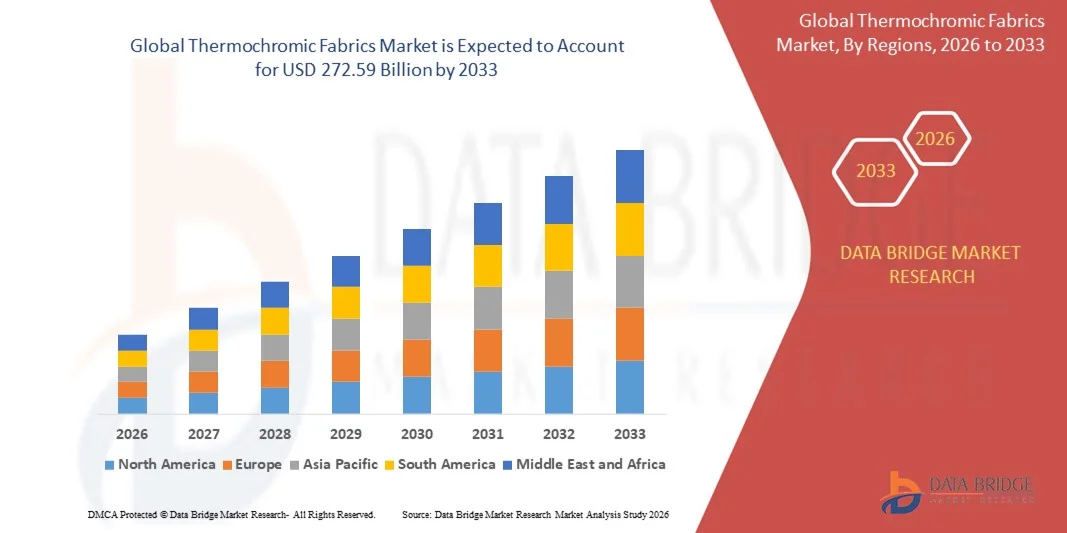
Taille du marché des tissus thermochromiques
- Le marché mondial des tissus thermochromiques était évalué à 168,47 milliards de dollars américains en 2025 et devrait atteindre 272,59 milliards de dollars américains d'ici 2033 , avec un TCAC de 6,20 % au cours de la période de prévision.
- La croissance du marché est largement alimentée par la demande croissante de textiles intelligents dans les secteurs de la mode, des vêtements de sport et de la santé, où les propriétés de changement de couleur améliorent la fonctionnalité et l'esthétique.
- L'intérêt croissant des consommateurs pour les vêtements interactifs et personnalisables stimule leur adoption, notamment dans les segments de la mode et du style de vie.
Analyse du marché des tissus thermochromiques
- Le marché connaît d'importantes innovations dans des applications telles que les vêtements thermosensibles, les vêtements de sport adaptatifs et les dispositifs de surveillance de la santé portables, favorisant ainsi une adoption plus large.
- Les collaborations stratégiques et les lancements de produits des principaux fabricants de textiles et de tissus intelligents accélèrent l'expansion du marché, tandis que les tendances régionales de la mode et les besoins industriels continuent de façonner la demande.
- L'Amérique du Nord a dominé le marché des tissus thermochromiques en 2025, avec une part de revenus de 38,75 %, grâce à l'adoption croissante des textiles intelligents et adaptatifs dans les secteurs de l'habillement, des vêtements de sport et de l'ameublement.
- La région Asie-Pacifique devrait connaître le taux de croissance le plus élevé sur le marché mondial des tissus thermochromiques , grâce à l'augmentation des revenus disponibles, au développement des secteurs de la mode et des vêtements de sport, à l'adoption croissante des technologies portables et aux initiatives gouvernementales soutenant l'innovation textile.
- Le segment du polyester a représenté la plus grande part de marché en termes de revenus en 2025, grâce à sa durabilité, sa flexibilité et sa grande compatibilité avec les colorants thermochromiques. Les tissus en polyester sont largement utilisés dans les vêtements de sport, les vêtements techniques et les applications industrielles en raison de leur résistance, de leur tenue des couleurs et de leur capacité à supporter des lavages répétés tout en conservant leurs propriétés thermochromiques.
Portée du rapport et segmentation du marché des tissus thermochromiques
|
Attributs |
Tissus thermochromes : Principales informations sur le marché |
|
Segments couverts |
|
|
Pays couverts |
Amérique du Nord
Europe
Asie-Pacifique
Moyen-Orient et Afrique
Amérique du Sud
|
|
Acteurs clés du marché |
|
|
Opportunités de marché |
|
|
Ensembles d'informations de données à valeur ajoutée |
Outre les informations sur les scénarios de marché tels que la valeur du marché, le taux de croissance, la segmentation, la couverture géographique et les principaux acteurs, les rapports de marché élaborés par Data Bridge Market Research comprennent également une analyse des importations et des exportations, un aperçu de la capacité de production, une analyse de la consommation de production, une analyse des tendances des prix, un scénario de changement climatique, une analyse de la chaîne d'approvisionnement, une analyse de la chaîne de valeur, un aperçu des matières premières/consommables, les critères de sélection des fournisseurs, une analyse PESTLE, une analyse de Porter et le cadre réglementaire. |
Tendances du marché des tissus thermochromiques
L'essor des textiles intelligents et interactifs
- Le marché mondial des textiles thermochromes connaît une forte évolution vers des textiles intelligents et interactifs qui changent de couleur en fonction des variations de température. Ces textiles innovants transforment les secteurs de l'habillement, de l'automobile et de l'ameublement en offrant une esthétique fonctionnelle et une expérience utilisateur améliorée, permettant ainsi aux fabricants de proposer des produits différenciés à forte valeur ajoutée. La demande croissante des consommateurs pour des textiles innovants et fonctionnels accélère encore leur adoption, les créateurs intégrant ces textiles dans des applications aussi bien dans la mode que dans le domaine technique.
- La demande croissante en technologies portables, applications médicales et vêtements thermosensibles accélère l'adoption des tissus thermochromiques. Ces tissus permettent un retour d'information en temps réel sur les conditions environnementales et la température corporelle, ce qui les rend particulièrement utiles dans les vêtements de sport, les textiles médicaux et les vêtements de sécurité. L'essor des vêtements intelligents dans les secteurs du fitness, des activités de plein air et des équipements de protection stimule également l'innovation industrielle et la pénétration du marché.
- La polyvalence, la durabilité et les propriétés personnalisables des tissus thermochromiques les rendent attractifs pour des applications à la fois fonctionnelles et esthétiques. Les fabricants bénéficient ainsi de la possibilité de concevoir des produits adaptatifs répondant à l'évolution des besoins des consommateurs, tout en renforçant l'image de marque. Par ailleurs, les partenariats entre producteurs textiles et fournisseurs de technologies favorisent le développement de traitements et de revêtements textiles avancés qui améliorent la performance et la longévité des produits.
- For instance, in 2023, several sportswear brands in Europe and North America introduced temperature-responsive activewear, which improved user comfort, enhanced visual appeal, and supported sustainable clothing innovations by reducing the need for additional layers. Early adopters reported higher consumer engagement and repeat purchases, highlighting the commercial potential of interactive textiles
- While thermochromic fabrics are redefining textile applications, their market growth depends on ongoing innovation, cost-effective production techniques, and widespread consumer awareness. Producers must focus on R&D and scalable manufacturing to fully capitalize on growing demand. Emerging trends, such as integration with IoT-enabled clothing and multi-functional textiles, are expected to create new revenue streams and market segments
Thermochromic Fabrics Market Dynamics
Driver
Rising Demand For Functional And Innovative Textiles
- The growing interest in functional textiles is driving manufacturers to adopt thermochromic fabrics in apparel, home textiles, and industrial applications. These fabrics offer both aesthetic and functional benefits, making them increasingly preferred across consumer and commercial markets. The rise of experiential fashion and smart interiors is further fueling innovation, encouraging brands to differentiate through technology-enabled textile solutions
- Consumers and designers are increasingly valuing adaptive, interactive, and personalized clothing, which has led to a surge in product development and adoption of smart fabrics. This trend is supported by the rise of experiential fashion and performance-oriented textiles. Enhanced consumer awareness of eco-friendly and versatile fabrics is also boosting demand for thermochromic solutions across multiple regions
- Government initiatives and collaborations between textile manufacturers and research institutes are strengthening innovation in smart fabrics. From funding R&D to creating standards for functional textiles, supportive frameworks are helping companies bring advanced thermochromic solutions to market. These collaborations are also facilitating faster commercialization and knowledge transfer, reducing development cycles and improving product quality
- For instance, in 2022, several European textile research centers partnered with apparel brands to develop color-changing fabrics for sports and medical applications, enhancing product differentiation and consumer engagement. Such collaborations have also helped companies navigate regulatory approvals and quality compliance more efficiently
- While innovation and institutional support are driving market growth, scalability, cost management, and material durability remain critical to achieving widespread adoption. Addressing challenges related to batch consistency, color stability, and long-term fabric performance will be essential for capturing a broader customer base
Restraint/Challenge
High Cost Of Advanced Thermochromic Materials And Production Limitations
- The high cost of thermochromic dyes, pigments, and specialized manufacturing processes limits adoption, particularly among small and mid-sized textile producers. Expensive production setups and quality control measures add to the overall cost, restricting widespread use. These costs can also limit experimentation with new designs, slowing product innovation and market diversification
- Limited availability of raw materials and complex integration into conventional textile production lines create operational challenges, slowing down large-scale commercialization. Smaller manufacturers may struggle to meet performance and durability standards. Supply chain disruptions, especially for specialized chemicals, can further impede timely delivery and affect production planning
- Market penetration is also affected by consumer awareness and education regarding the benefits of thermochromic fabrics. Without understanding their functional and aesthetic advantages, buyers may prefer conventional textiles, reducing demand in certain regions. Marketing and education efforts are therefore crucial for creating value perception and driving adoption in new markets
- For instance, in 2023, several textile manufacturers in Asia reported delays in scaling production of color-changing fabrics due to high material costs and equipment constraints, limiting the range of products offered to end-users. These delays also impacted partnerships with apparel brands seeking timely product launches
- While technological advances continue to evolve, addressing production costs, material availability, and process optimization will be essential for unlocking the long-term potential of the thermochromic fabrics market. Investments in automation, alternative pigments, and lean manufacturing techniques are expected to mitigate these challenges and enhance market competitiveness
Thermochromic Fabrics Market Scope
The market is segmented on the basis of substrate, type, and end use.
- By Substrate
On the basis of substrate, the thermochromic fabrics market is segmented into cotton, polyester, nylon, synthetic blends, and others. The polyester segment held the largest market revenue share in 2025, driven by its durability, flexibility, and high compatibility with thermochromic dyes. Polyester fabrics are widely used in sportswear, activewear, and industrial applications due to their strength, color retention, and ability to withstand repeated washing while maintaining thermochromic functionality.
The cotton segment is expected to witness the fastest growth rate from 2026 to 2033, driven by its comfort, breathability, and sustainability attributes. Cotton-based thermochromic fabrics are particularly popular in fashion apparel and home textiles, where consumer preference for natural, eco-friendly materials is rising, supporting adoption in both casual and premium clothing segments.
- By Type
Le marché est segmenté, selon le type de tissu, en tissus teints et tissus imprimés. En 2025, le segment des tissus teints détenait la part de marché la plus importante grâce à leurs propriétés de changement de couleur uniformes, leur adaptabilité à une production à grande échelle et leur facilité d'intégration aux procédés de fabrication textile traditionnels. Les tissus thermochromiques teints sont privilégiés dans le prêt-à-porter et les vêtements techniques pour leur rendu visuel constant et leur durabilité.
Le segment des tissus imprimés devrait connaître la croissance la plus rapide entre 2026 et 2033, grâce à sa capacité à créer des motifs complexes, des designs personnalisés et une esthétique multifonctionnelle. Les tissus thermochromiques imprimés sont de plus en plus utilisés dans les vêtements de sport, le linge de maison et les objets publicitaires, où des designs créatifs et interactifs renforcent l'engagement des consommateurs.
- Par utilisation finale
En fonction de l'utilisation finale, le marché est segmenté en vêtements de mode, vêtements de sport et de loisirs, textiles de maison, produits industriels et autres. Le segment des vêtements de mode a généré la plus grande part de revenus en 2025, porté par la demande croissante de vêtements originaux, interactifs et de créateurs utilisant des tissus à couleurs changeantes.
Le segment des vêtements de sport et de loisirs devrait connaître la croissance la plus rapide entre 2026 et 2033, porté par la préférence des consommateurs pour des vêtements fonctionnels fournissant des informations en temps réel sur la température et les conditions environnementales. Les tissus thermochromiques de ce segment améliorent la performance, le confort et le style, ce qui explique leur popularité croissante auprès des amateurs de fitness et des athlètes professionnels.
Analyse régionale du marché des tissus thermochromiques
- L'Amérique du Nord a dominé le marché des tissus thermochromiques en 2025, avec une part de revenus de 38,75 %, grâce à l'adoption croissante des textiles intelligents et adaptatifs dans les secteurs de l'habillement, des vêtements de sport et de l'ameublement.
- Les consommateurs de la région recherchent de plus en plus des tissus fonctionnels qui offrent à la fois un attrait esthétique et des performances thermorégulatrices.
- Cette adoption est également favorisée par des revenus disponibles élevés, des infrastructures de fabrication textile avancées et une forte sensibilisation aux technologies textiles innovantes, faisant des tissus thermochromiques un choix privilégié tant pour les consommateurs que pour les entreprises.
Aperçu du marché américain des tissus thermochromiques
Le marché américain des textiles thermochromiques a généré la plus grande part de revenus en Amérique du Nord en 2025, porté par l'essor des vêtements intelligents, des technologies portables et des textiles thermosensibles. Les fabricants investissent de plus en plus dans la recherche et le développement afin de produire des textiles adaptatifs pour la mode, le sport et le secteur médical. La préférence croissante des consommateurs pour des vêtements personnalisés et fonctionnels, conjuguée aux collaborations entre les marques textiles et les instituts de recherche, contribue significativement à la croissance de ce marché.
Aperçu du marché européen des tissus thermochromiques
Le marché européen des textiles thermochromiques devrait connaître la croissance la plus rapide entre 2026 et 2033, principalement tirée par la demande croissante de textiles innovants dans les secteurs de la mode, du sport et de la décoration intérieure. L'accent mis en Europe sur le développement durable et l'adoption des technologies textiles favorise l'intégration des textiles intelligents. Les consommateurs européens sont également attirés par les vêtements interactifs et performants, et les textiles thermochromiques sont intégrés aussi bien aux nouveaux produits qu'aux innovations de la mode.
Analyse du marché britannique des tissus thermochromiques
Le marché britannique des textiles thermochromiques devrait connaître une croissance rapide entre 2026 et 2033, portée par l'essor de la mode expérientielle et des vêtements fonctionnels. L'intérêt croissant des consommateurs pour les vêtements adaptatifs qui réagissent aux variations de température corporelle et environnementale stimule la demande. Le secteur de la mode britannique, déjà bien établi, associé à un intérêt grandissant pour les technologies portables, devrait continuer à favoriser l'adoption de ces textiles par le marché.
Analyse du marché allemand des tissus thermochromiques
Le marché allemand des textiles thermochromiques devrait connaître une forte croissance entre 2026 et 2033, portée par la recherche textile de pointe, d'importantes capacités de production et une demande croissante de textiles innovants et respectueux de l'environnement. L'accent mis par l'Allemagne sur une production textile durable et intelligente favorise l'adoption des textiles thermochromiques dans les secteurs de la mode, des vêtements de sport et des textiles techniques. Leur intégration dans le linge de maison et les vêtements de protection gagne également du terrain, répondant ainsi aux attentes des consommateurs locaux en matière de qualité et de fonctionnalité.
Analyse du marché des tissus thermochromiques en Asie-Pacifique
Le marché des textiles thermochromiques en Asie-Pacifique devrait connaître la croissance la plus rapide entre 2026 et 2033, portée par l'urbanisation galopante, la hausse des revenus disponibles et les progrès technologiques dans des pays comme la Chine, le Japon et l'Inde. L'intérêt croissant de la région pour les technologies portables, les vêtements techniques et les textiles domotiques intelligents favorise l'adoption des textiles thermochromiques. Par ailleurs, l'Asie-Pacifique étant un pôle majeur de production pour l'innovation textile, l'accessibilité et l'abordabilité des textiles thermochromiques s'étendent à un public de consommateurs toujours plus large.
Analyse du marché japonais des tissus thermochromiques
Le marché japonais des textiles thermochromiques devrait connaître une croissance significative entre 2026 et 2033, portée par une population férue de technologie, une forte adoption des textiles innovants et une demande croissante pour une mode fonctionnelle. Les consommateurs japonais privilégient le confort, la performance et les vêtements interactifs, incitant les fabricants à intégrer les technologies thermochromiques dans l'habillement et le linge de maison. Par ailleurs, le vieillissement de la population stimule la demande de textiles adaptatifs faciles à utiliser dans les secteurs de la santé et du vêtement du quotidien.
Analyse du marché chinois des tissus thermochromiques
En 2025, le marché chinois des textiles thermochromiques représentait la plus grande part de revenus de la région Asie-Pacifique, grâce à une urbanisation rapide, à l'essor de la classe moyenne et à de solides capacités de production. La Chine s'impose comme un marché clé pour les textiles fonctionnels et intelligents, avec des applications dans les secteurs de la mode, des vêtements de sport et des textiles industriels. Les initiatives gouvernementales soutenant l'innovation dans les technologies textiles, conjuguées à la disponibilité de textiles thermochromiques abordables, sont des facteurs déterminants de la croissance de ce marché.
Part de marché des tissus thermochromiques
L'industrie des tissus thermochromiques est principalement dominée par des entreprises bien établies, notamment :
• Archroma (Suisse)
• Huntsman Corporation (États-Unis)
• Clariant (Suisse)
• DyStar Group (Allemagne)
• Mitsui Chemicals, Inc. (Japon)
• Huntsman Textile Effects (États-Unis)
• CHT Group (Allemagne)
• Jinshan Chemical (Chine)
• Kiri Industries (Inde)
• Dystar India Pvt. Ltd. (Inde)
SKU-
Accédez en ligne au rapport sur le premier cloud mondial de veille économique

- Tableau de bord d'analyse de données interactif
- Tableau de bord d'analyse d'entreprise pour les opportunités à fort potentiel de croissance
- Accès d'analyste de recherche pour la personnalisation et les requêtes
- Analyse de la concurrence avec tableau de bord interactif
- Dernières actualités, mises à jour et analyse des tendances
- Exploitez la puissance de l'analyse comparative pour un suivi complet de la concurrence
Méthodologie de recherche
La collecte de données et l'analyse de l'année de base sont effectuées à l'aide de modules de collecte de données avec des échantillons de grande taille. L'étape consiste à obtenir des informations sur le marché ou des données connexes via diverses sources et stratégies. Elle comprend l'examen et la planification à l'avance de toutes les données acquises dans le passé. Elle englobe également l'examen des incohérences d'informations observées dans différentes sources d'informations. Les données de marché sont analysées et estimées à l'aide de modèles statistiques et cohérents de marché. De plus, l'analyse des parts de marché et l'analyse des tendances clés sont les principaux facteurs de succès du rapport de marché. Pour en savoir plus, veuillez demander un appel d'analyste ou déposer votre demande.
La méthodologie de recherche clé utilisée par l'équipe de recherche DBMR est la triangulation des données qui implique l'exploration de données, l'analyse de l'impact des variables de données sur le marché et la validation primaire (expert du secteur). Les modèles de données incluent la grille de positionnement des fournisseurs, l'analyse de la chronologie du marché, l'aperçu et le guide du marché, la grille de positionnement des entreprises, l'analyse des brevets, l'analyse des prix, l'analyse des parts de marché des entreprises, les normes de mesure, l'analyse globale par rapport à l'analyse régionale et des parts des fournisseurs. Pour en savoir plus sur la méthodologie de recherche, envoyez une demande pour parler à nos experts du secteur.
Personnalisation disponible
Data Bridge Market Research est un leader de la recherche formative avancée. Nous sommes fiers de fournir à nos clients existants et nouveaux des données et des analyses qui correspondent à leurs objectifs. Le rapport peut être personnalisé pour inclure une analyse des tendances des prix des marques cibles, une compréhension du marché pour d'autres pays (demandez la liste des pays), des données sur les résultats des essais cliniques, une revue de la littérature, une analyse du marché des produits remis à neuf et de la base de produits. L'analyse du marché des concurrents cibles peut être analysée à partir d'une analyse basée sur la technologie jusqu'à des stratégies de portefeuille de marché. Nous pouvons ajouter autant de concurrents que vous le souhaitez, dans le format et le style de données que vous recherchez. Notre équipe d'analystes peut également vous fournir des données sous forme de fichiers Excel bruts, de tableaux croisés dynamiques (Fact book) ou peut vous aider à créer des présentations à partir des ensembles de données disponibles dans le rapport.











