



Global Vaccine Production Market Segmentation, By Classification (Adult Vaccine Production, and Pediatric Vaccine Production), Disease Type (Hepatitis B, Malaria, Yellow Fever, Typhoid, Rabies, HIV, Cancer, Influenza, West Nile, Japanese Encephalitis, Pneumococcal, Rotavirus, DTP, Polio, Varicella, Meningococcal, Measles, Mumps, and Rubella, and Tuberculosis) - Industry Trends and Forecast to 2032
Quelle est la profondeur de la production de vaccins sur le marché et le taux de croissance
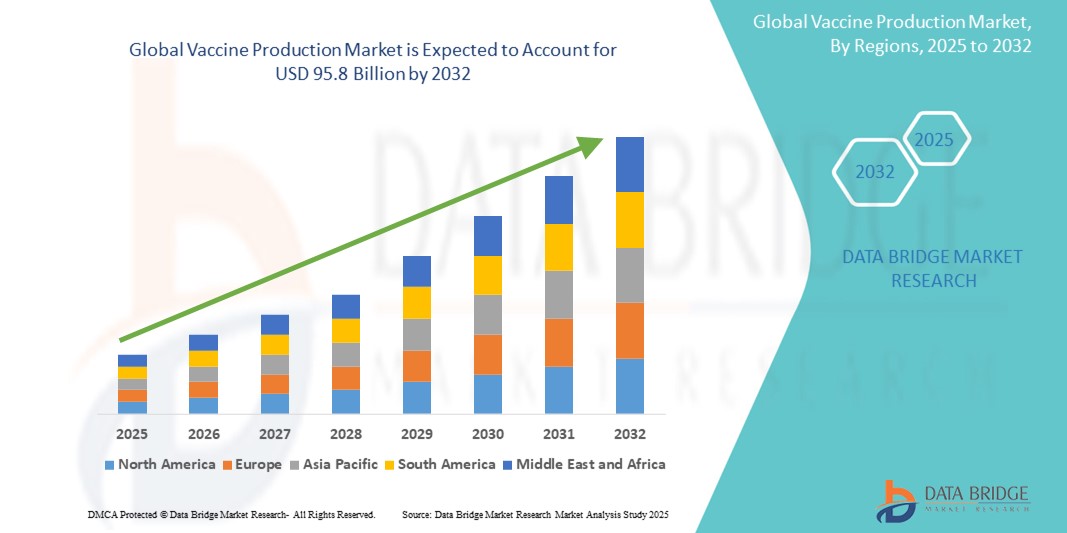
- Selon Data Bridge Market Research Analyse, la taille du marché mondial de la production de vaccins a été évaluée à54,77 milliards de dollars en 2024et devrait atteindre95,88 milliards de dollars en 2032, à unTCAC de 7,25 %pendant la période de prévision
- Le marché de la production de vaccins connaît une croissance importante, principalement en raison des progrès technologiques rapides et de la demande mondiale croissante de solutions de vaccination efficaces. Cette expansion conduit à une plus grande numérisation tout au long de la chaîne de valeur des vaccins, de la recherche-développement à la fabrication et à la distribution
- De plus, une prise de conscience croissante de la santé mondiale et l'impératif de réagir rapidement aux maladies infectieuses émergentes établissent des solutions de production de vaccins de pointe comme norme moderne de préparation à la santé publique. Ces facteurs convergents accélèrent l'adoption de solutions innovantes de production de vaccins, ce qui stimule considérablement la croissance de l'industrie.
Taille du marché et prévisions
Valeur marchande mondiale (2024):54,77 milliards de dollars
Valeur marchande prévue (2032) :95,88 milliards de dollars
Prévisions CAGR (2025-2032):7.25%
Quels sont les principaux débouchés pour la production de vaccins
- Le marché de la production de vaccins connaît une croissance importante, en raison de l'augmentation de la demande mondiale de solutions de vaccination efficaces et de progrès technologiques rapides, ce qui entraîne une numérisation accrue de l'ensemble de la chaîne de valeur des vaccins, de la recherche-développement à la fabrication et à la distribution. Cette expansion souligne le rôle crucial des vaccins dans la santé publique moderne et la prévention des maladies
- La demande croissante de solutions de production de vaccins est principalement alimentée par l'augmentation de la prévalence des maladies infectieuses, les préoccupations accrues en matière de sécurité sanitaire mondiale et l'importance croissante accordée aux soins de santé préventifs. De plus, des percées importantes dans les technologies de vaccination, comme l'ARNm et les plates-formes de vecteurs viraux, accélèrent les capacités de développement et de production, établissant des solutions de production de vaccins de pointe comme norme moderne pour la préparation en santé publique.
- L'Amérique du Nord a dominé le marché de la production de vaccins, avec la plus grande part des revenus de 43 % en 2024. Cette domination est attribuée à l'adoption rapide et forte de technologies de soins de santé de pointe, à des revenus disponibles élevés et à la présence robuste d'acteurs clés de l'industrie, y compris les grandes entreprises pharmaceutiques et de biotechnologie
- L'Asie-Pacifique devrait être la région qui connaît la croissance la plus rapide, avec un TCAC de 12,4 % sur le marché de la production de vaccins au cours de la période de prévision. Cette croissance est en grande partie attribuable à l'urbanisation croissante, à l'augmentation des revenus disponibles, à l'expansion des infrastructures de soins de santé et à l'importance croissante accordée aux initiatives de santé publique et aux programmes d'immunisation dans des pays comme la Chine et l'Inde, qui deviennent également d'importants centres de production de vaccins.
- Le segment de la production de vaccins pour adultes a dominé le marché de la production de vaccins avec une part de marché de 58,3 % en 2024, en raison de l'augmentation de la demande de vaccins ciblant des populations adultes comme la grippe, le pneumocoque et le zona.
Portée du rapport et segmentation du marché de la production de vaccins
|
Attributs |
Clé de la production de vaccinsPerspectives du marché |
|
Segments couverts |
|
|
Pays couverts |
Amérique du Nord
Europe
Asie-Pacifique
Moyen-Orient et Afrique
Amérique du Sud
|
|
Principaux acteurs du marché |
|
|
Possibilités de marché |
|
|
Infos sur la valeur ajoutée |
En plus des renseignements sur les scénarios du marché tels que la valeur du marché, le taux de croissance, la segmentation, la couverture géographique et les principaux intervenants, les rapports de marché établis par Data Bridge Market Research comprennent également une analyse approfondie des experts, une analyse des prix, une analyse des parts de marque, une enquête auprès des consommateurs, une analyse démographique, une analyse de la chaîne d'approvisionnement, une analyse de la chaîne de valeur, une vue d'ensemble des matières premières et des consommables, des critères de sélection des fournisseurs, une analyse PESTLE, une analyse Porter et un cadre réglementaire. |
Quelle est la tendance clé du marché de la production de vaccins
Dynamique du marché de la production vaccinale : évolution du paysage et impératifs stratégiques
- Une tendance importante et accélérée sur le marché mondial de la production de vaccins est l'évolution continue des plateformes de fabrication et l'accent croissant mis sur les capacités de réponse rapide. Ce progrès dans les technologies de production accroît fondamentalement la rapidité et l'ampleur de la mise au point et de la fabrication de nouveaux vaccins, ce qui a une incidence critique sur la préparation à la santé publique mondiale.
- Par exemple, le développement et le déploiement rapides de plateformes de vaccins contre l'ARNm au cours des récentes crises mondiales de santé ont démontré leur capacité à accélérer la disponibilité des vaccins. De même, les progrès dans les technologies des vecteurs viraux et des protéines recombinantes contribuent à une gamme variée de candidats au vaccin, offrant des solutions polyvalentes pour diverses maladies infectieuses.
- L'intégration de technologies de biotraitement de pointe, telles que les systèmes à usage unique et la fabrication continue, permet d'améliorer la flexibilité et de réduire les risques de contamination dans la production de vaccins. Par exemple, certains fabricants de pointe utilisent des bioréacteurs avancés et des systèmes de purification pour optimiser le rendement et assurer des sorties vaccinales de haute qualité. En outre, l'adoption d'unités de fabrication modulaires offre la facilité de déploiement et d'évolutivité rapides, permettant une production décentralisée et une distribution mondiale plus rapide
- L'intégration harmonieuse des processus de recherche, de développement et de fabrication facilite le contrôle centralisé de divers aspects de la chaîne de valeur des vaccins. Grâce à une approche unifiée, les intervenants peuvent gérer les pipelines de R-D en plus des essais cliniques, des présentations réglementaires et de la production à grande échelle, créant ainsi un écosystème plus efficace et plus réceptif.
- Cette tendance vers des systèmes de production de vaccins plus agiles, efficaces et interconnectés remodele fondamentalement les attentes mondiales en matière de prévention des maladies et d'intervention en cas de pandémie. Par conséquent, des entreprises comme BioNTech et Moderna investissent continuellement dans des technologies de plate-forme innovantes pour améliorer leur capacité de production et leur rapidité.
- La demande de solutions de production de vaccins qui offrent une évolutivité et des capacités de déploiement rapides continue de croître rapidement dans les pays développés comme dans les pays en développement, les gouvernements et les organismes de santé privilégiant de plus en plus la préparation et les stratégies d'immunisation globales
Dynamique du marché de la production de vaccins
Chauffeur
Besoin de croissance en raison de l'augmentation des menaces pour la santé mondiale et des progrès technologiques
- La prévalence croissante des maladies infectieuses, associée à l'accélération des progrès biotechnologiques, est un facteur important de la demande accrue de vaccins. Il s'agit notamment de l'émergence de nouveaux agents pathogènes et de la réémergence des anciens, nécessitant une innovation continue dans le développement et la fabrication de vaccins.
- Par exemple, les efforts de préparation mondiaux en cours après la COVID-19 ont permis d'investir de façon substantielle dans la préparation aux pandémies, notamment en développant les capacités de fabrication de vaccins dans le monde entier. De telles initiatives stratégiques de la part des gouvernements et des entreprises pharmaceutiques devraient stimuler la croissance de l'industrie de la production de vaccins au cours de la période de prévision.
- À mesure que les nations prennent conscience des menaces potentielles pour la santé publique et cherchent à mieux protéger leurs populations, les technologies de pointe de production de vaccins offrent des caractéristiques telles que l'évolutivité rapide, diverses options de plateforme et une efficacité accrue, offrant une amélioration convaincante par rapport aux méthodes de fabrication traditionnelles et plus lentes.
- De plus, l'accent de plus en plus mis sur les soins de santé préventifs et le désir d'un accès équitable aux vaccins qui sauvent la vie font de la production robuste de vaccins une composante intégrante des stratégies nationales de santé, offrant une intégration transparente avec les initiatives de santé publique et les plans d'intervention d'urgence.
- La facilité des cycles de développement plus rapides, la capacité de produire rapidement de grandes quantités de vaccins et le potentiel des technologies de plate-forme pour s'adapter aux nouvelles variantes sont des facteurs clés qui propulsent l'expansion de la production de vaccins sur les marchés établis et émergents. La tendance à la distribution des modèles de fabrication et la disponibilité croissante d'options de biotraitement sophistiquées contribuent davantage à la croissance du marché.
Restriction/Défi
Informations concernant les complexités manufacturières et les investissements initiaux élevés
- Les préoccupations concernant l'immense complexité et les dépenses d'investissement initiales élevées nécessaires à la mise en place et à la mise à l'échelle des installations de fabrication de vaccins posent un défi important à une plus grande pénétration du marché. Étant donné que la production de vaccins repose sur des équipements hautement spécialisés, un contrôle rigoureux de la qualité et des processus biologiques sophistiqués, elle est vulnérable aux défis techniques et aux dépenses financières importantes, ce qui soulève des inquiétudes parmi les investisseurs potentiels et les nouveaux arrivants.
- Par exemple, des rapports très médiatisés faisant état de retards ou d'échecs dans la fabrication au cours de l'expansion des nouveaux vaccins candidats ont fait hésiter certains intervenants à s'engager à investir à grande échelle et à risque dans de nouvelles capacités de production.
- S'attaquer à ces complexités de fabrication grâce à une optimisation robuste des processus, au transfert de technologie et à des partenariats de collaboration est crucial pour renforcer la confiance et garantir des chaînes d'approvisionnement fiables. Les entreprises telles que Lonza et Catalent mettent l'accent sur leurs capacités avancées CDMO (Contract Development and Manufacturing Organization) et leurs protocoles d'assurance qualité dans leur marketing pour rassurer les clients potentiels
- De plus, le coût initial relativement élevé de certaines installations de production de vaccins de pointe et de la main-d'oeuvre spécialisée requise peut constituer un obstacle à l'entrée des petites entreprises de biotechnologie ou des régions en développement, en particulier lorsque le financement public est limité. Bien que les capacités de remplissage et de finition de base puissent être plus accessibles, des caractéristiques de premier ordre comme le traitement intégré en amont et en aval pour les nouvelles plateformes sont souvent assorties d'un prix plus élevé.
- Bien que les gouvernements et les organisations internationales fournissent un financement important, la prime perçue pour les technologies de pointe de fabrication biologique et les longs délais de construction des installations peuvent encore entraver l'expansion généralisée, en particulier pour ceux qui n'ont pas immédiatement accès à des capitaux ou à des compétences considérables.
Comment la profondeur du marché de la production de vaccins est-elle segmentée
Le marché est segmenté en fonction de la classification et du type de maladie.
- Par classement
Sur la base de la classification, le marché de la production de vaccins est segmenté en production de vaccins pour adultes et de vaccins pédiatriques. En 2024, le segment de la production de vaccins pour adultes représentait la plus grande part des revenus du marché, soit 58,3 %, en raison de l'augmentation de la demande de vaccins ciblant les populations adultes comme la grippe, le pneumocoque et les bardeaux. L'augmentation de la population vieillissante à l'échelle mondiale et la sensibilisation croissante aux programmes d'immunisation des adultes contribuent grandement à la domination de ce segment.
Le segment de la production de vaccins pédiatriques devrait connaître le TCAC le plus rapide de 10,7% entre 2025 et 2032. Des facteurs tels que les calendriers obligatoires d'immunisation, les programmes de vaccination pour enfants dirigés par le gouvernement et la sensibilisation accrue à la prévention des maladies infantiles propulsent cette croissance.
- Par type de maladie
Sur la base du type de maladie, le marché de la production de vaccins est segmenté en hépatite B, paludisme, fièvre jaune, typhoïde, rage, VIH, cancer, grippe, Nil occidental, encéphalite japonaise, pneumocoque, rotavirus, DTP, polio, varicelle, méningocoque, rougeole, oreillons et rubéole (MRM) et tuberculose. En 2024, le segment de la grippe détenait la plus grande part de revenus du marché, soit 18,9 %, en raison de la demande saisonnière, des initiatives mondiales de vaccination et de l'évolution continue des souches de grippe nécessitant des vaccins mis à jour. Les campagnes annuelles de vaccination contre la grippe menées dans les pays développés et les pays émergents appuient encore davantage la forte performance du segment.
Le segment vaccinal contre le cancer devrait connaître le TCAC le plus rapide de 12,4 % entre 2025 et 2032, grâce aux progrès de la médecine personnalisée, aux investissements croissants en immunothérapie et à l'augmentation des essais cliniques ciblant le VPH et d'autres antigènes liés au cancer. La prévalence croissante du cancer dans le monde et le passage à l'oncologie préventive sont des facteurs de croissance majeurs.
Quelle région détient la plus grande part du marché de la production de vaccins
- L'Amérique du Nord a dominé le marché de la production de vaccins avec la plus grande part des revenus de 43 % en 2024, en raison de l'investissement accru dans l'infrastructure de fabrication de vaccins, de solides activités de R-D et d'un solide soutien gouvernemental aux programmes d'immunisation.
- La région bénéficie de capacités biopharmaceutiques avancées et de cadres réglementaires favorables, ce qui en fait un pôle de développement et de production de vaccins
- En outre, la présence de grandes sociétés pharmaceutiques et la sensibilisation croissante à la prévention des maladies contribuent de manière significative à la croissance du marché régional.
Aperçu du marché américain de la production de vaccins
Le marché américain de la production de vaccins a enregistré la plus grande part de 78,9 % en 2024 sur le marché nord-américain de la production de vaccins, appuyé par des taux élevés de consommation de vaccins, l'augmentation des partenariats public-privé et un financement substantiel pour l'innovation en matière de vaccins. Le pays mène la mise au point et la production de vaccins avancés contre des maladies telles que la grippe, le VPH et le COVID-19. L'adoption de nouvelles plateformes telles que l'ARNm et l'accroissement des efforts de stockage pour la préparation aux pandémies propulsent davantage le marché américain.
Aperçu du marché européen de la production de vaccins
Le marché européen de la production de vaccins devrait augmenter de 8,3 % entre 2025 et 2032, en raison de normes réglementaires rigoureuses, d'initiatives de vaccination menées par le gouvernement et d'investissements accrus dans les infrastructures de santé publique. L'urbanisation et la nécessité de prévenir les maladies dans les zones densément peuplées stimulent la demande de fabrication de vaccins à grande échelle. En outre, l'Europe met l'accent sur la production localisée pour assurer la résilience et l'autonomie de la chaîne d'approvisionnement lors des futures pandémies.
Aperçu du marché britannique de la production de vaccins
Le marché de la production de vaccins au Royaume-Uni devrait augmenter de 7,9 % entre 2025 et 2032, en raison de l'importance accordée à l'innovation dans le domaine des sciences de la vie, des investissements post-Brexit dans la production nationale de vaccins et d'un programme national d'immunisation proactif. Les collaborations stratégiques avec les sociétés pharmaceutiques et les établissements universitaires mondiaux, ainsi que l'augmentation de la demande de vaccins pédiatriques et de vaccins pour les voyages, alimentent l'expansion du marché.
Allemagne Production de vaccins Aperçu du marché
Le marché allemand de la production de vaccins devrait augmenter de 8,1 % entre 2025 et 2032, grâce à un solide soutien gouvernemental à l'innovation en biotechnologie, à l'adoption numérique de la santé et à la demande croissante de solutions durables de production de vaccins. Le pays met l'accent sur les pratiques de fabrication de haute qualité et l'automatisation intégrée dans les installations pharmaceutiques améliore la production de vaccins et la compétitivité mondiale.
Aperçu du marché de la production de vaccins en Asie-Pacifique
Le marché de la production de vaccins en Asie-Pacifique est sur le point d'enregistrer le TCAC le plus rapide de 12,4% entre 2025 et 2032, en raison de l'urbanisation rapide, de l'expansion des infrastructures de soins de santé et de l'augmentation de la demande de vaccins abordables dans des pays comme la Chine, l'Inde et le Japon. Les initiatives gouvernementales visant à promouvoir la vaccination, les incitations à la production locale et l'augmentation des exportations de vaccins vers les pays en développement appuient la croissance du marché. La région devient également un lieu stratégique pour la fabrication sous contrat et les essais cliniques.
Aperçu du marché japonais de la production de vaccins
Le marché japonais de la production de vaccins se développe en raison de son secteur de la biotechnologie de pointe et de son solide système national de santé. Le pays accorde une grande priorité à la préparation aux pandémies et au vieillissement de la population, ce qui stimule l'innovation dans la formulation des vaccins. Le marché devrait croître à un TCAC de 9,2 % de 2025 à 2032, grâce à l'intégration de plateformes de santé numériques et à l'augmentation du financement de la R-D dans les vaccins contre le cancer et les maladies infectieuses.
Chine Production de vaccins Aperçu du marché
En 2024, le marché chinois de la production de vaccins a représenté la plus grande part des revenus de l'Asie-Pacifique, attribuable à sa population massive, à un solide soutien gouvernemental et à l'accroissement des capacités biopharmaceutiques. Le marché devrait connaître une croissance de 16,1 % entre 2025 et 2032, alimentée par une adoption technologique rapide, des campagnes de vaccination menées par le gouvernement et des investissements dans la production nationale et les exportations mondiales de vaccins.
Quelles sont les plus grandes entreprises du marché de la production de vaccins
L'industrie de la production de vaccins est principalement dirigée par des entreprises bien établies, notamment :
- Sanofi(France)
- Valneva SE(France)
- CSL(Australie)
- GSK plc(Royaume-Uni)
- Produits biologiques de masse(États-Unis)
- Johnson & Johnson Services, Inc. (États-Unis)
- AstraZeneca (Royaume-Uni)
- Pfizer Inc. (États-Unis)
- Merck KGaA (Allemagne)
- Novartis AG (Suisse)
- BAXTER (États-Unis)
- Teva Pharmaceutical Industries Ltd. (Israël)
- IDT Biologika (États-Unis)
- Thermo Fisher Scientific Inc. (États-Unis)
- Lonza (Suisse)
- Boehringer Ingelheim International GmbH (Allemagne)
- Catalent, Inc (États-Unis)
- Laboratoires Charles River (États-Unis)
Quels sont les derniers développements en profondeur du marché de la production de vaccins
- En août 2023, Pfizer Inc. (États-Unis) a reçu l'approbation de la FDA des États-Unis en ce qui concerne ABRYSVO, son vaccin bivalent contre la préfusion du VRS F (RSVpreF), pour la prévention des maladies des voies respiratoires inférieures (LRTD) et de la TLR sévère causée par le VRS chez les nourrissons de la naissance jusqu'à l'âge de six mois par la vaccination active des personnes enceintes de 32 à 36 semaines d'âge gestationnel. Cette approbation importante a marqué une nouvelle ère en matière de vaccination maternelle et devrait contribuer au segment des vaccins pour adultes, qui représentait une part prédominante du marché des vaccins en 2023.
- En mai 2023, GSK plc (Royaume-Uni) a reçu l'approbation de la FDA des États-Unis pour Alexvy (vaccin respiratoire du virus syncytial, adjuvant) pour la prévention des maladies des voies respiratoires inférieures (LRTD) causées par le virus respiratoire syncytial (RSV) chez des personnes âgées de 60 ans et plus. Il s'agit du premier vaccin contre le VRS approuvé pour les personnes âgées, qui répond à un besoin médical majeur non satisfait et qui a une incidence importante sur le marché du vaccin pour adultes.
- En octobre 2023, Lonza (Suisse) a annoncé une collaboration élargie avec Vaxcyte pour la fabrication commerciale mondiale de vaccins conjugués à large spectre. Cela souligne le rôle de Lonza en tant que CDMO clé (Contract Development and Manufacturing Organization) sur le marché des vaccins, soutenant la production de vaccins essentiels. Le segment du marché des CDMO connaît une croissance, car davantage d'entreprises sous-traitent la fabrication complexe
- En janvier 2023, Sanofi (France), dans le cadre de ses efforts de R-D en cours, a continué de faire progresser son réseau de vaccins. Bien que les lancements de produits spécifiques avec des pourcentages en janvier 2023 ne soient pas largement signalés pour l'aspect « production de vaccins », l'engagement de Sanofi à l'égard de l'innovation vaccinale demeure fort, avec des développements dans des domaines comme la grippe et le VRS. Par exemple, Sanofi, en collaboration avec AstraZeneca, plus tard en 2023 (et accéléré en 2024 pour la saison 2025) a considérablement augmenté la capacité de production de Beyfortus (nirsevimab), un vaccin contre le VRS pour les nourrissons, soulignant leur engagement à répondre à la demande croissante dans les domaines clés de la maladie
SKU-
Accédez en ligne au rapport sur le premier cloud mondial de veille économique

- Tableau de bord d'analyse de données interactif
- Tableau de bord d'analyse d'entreprise pour les opportunités à fort potentiel de croissance
- Accès d'analyste de recherche pour la personnalisation et les requêtes
- Analyse de la concurrence avec tableau de bord interactif
- Dernières actualités, mises à jour et analyse des tendances
- Exploitez la puissance de l'analyse comparative pour un suivi complet de la concurrence
Méthodologie de recherche
La collecte de données et l'analyse de l'année de base sont effectuées à l'aide de modules de collecte de données avec des échantillons de grande taille. L'étape consiste à obtenir des informations sur le marché ou des données connexes via diverses sources et stratégies. Elle comprend l'examen et la planification à l'avance de toutes les données acquises dans le passé. Elle englobe également l'examen des incohérences d'informations observées dans différentes sources d'informations. Les données de marché sont analysées et estimées à l'aide de modèles statistiques et cohérents de marché. De plus, l'analyse des parts de marché et l'analyse des tendances clés sont les principaux facteurs de succès du rapport de marché. Pour en savoir plus, veuillez demander un appel d'analyste ou déposer votre demande.
La méthodologie de recherche clé utilisée par l'équipe de recherche DBMR est la triangulation des données qui implique l'exploration de données, l'analyse de l'impact des variables de données sur le marché et la validation primaire (expert du secteur). Les modèles de données incluent la grille de positionnement des fournisseurs, l'analyse de la chronologie du marché, l'aperçu et le guide du marché, la grille de positionnement des entreprises, l'analyse des brevets, l'analyse des prix, l'analyse des parts de marché des entreprises, les normes de mesure, l'analyse globale par rapport à l'analyse régionale et des parts des fournisseurs. Pour en savoir plus sur la méthodologie de recherche, envoyez une demande pour parler à nos experts du secteur.
Personnalisation disponible
Data Bridge Market Research est un leader de la recherche formative avancée. Nous sommes fiers de fournir à nos clients existants et nouveaux des données et des analyses qui correspondent à leurs objectifs. Le rapport peut être personnalisé pour inclure une analyse des tendances des prix des marques cibles, une compréhension du marché pour d'autres pays (demandez la liste des pays), des données sur les résultats des essais cliniques, une revue de la littérature, une analyse du marché des produits remis à neuf et de la base de produits. L'analyse du marché des concurrents cibles peut être analysée à partir d'une analyse basée sur la technologie jusqu'à des stratégies de portefeuille de marché. Nous pouvons ajouter autant de concurrents que vous le souhaitez, dans le format et le style de données que vous recherchez. Notre équipe d'analystes peut également vous fournir des données sous forme de fichiers Excel bruts, de tableaux croisés dynamiques (Fact book) ou peut vous aider à créer des présentations à partir des ensembles de données disponibles dans le rapport.











