


Global Waterborne Silicone Market Segmentation, By Type (Emulsions, Dispersions, Gels, and Others), Application (Paints and Coatings, Adhesives and Sealants, Personal Care, and Others), End Use (Construction, Automotive, Healthcare, Consumer Goods, Industrial, and Others) - Industry Trends and Forecast to 2032
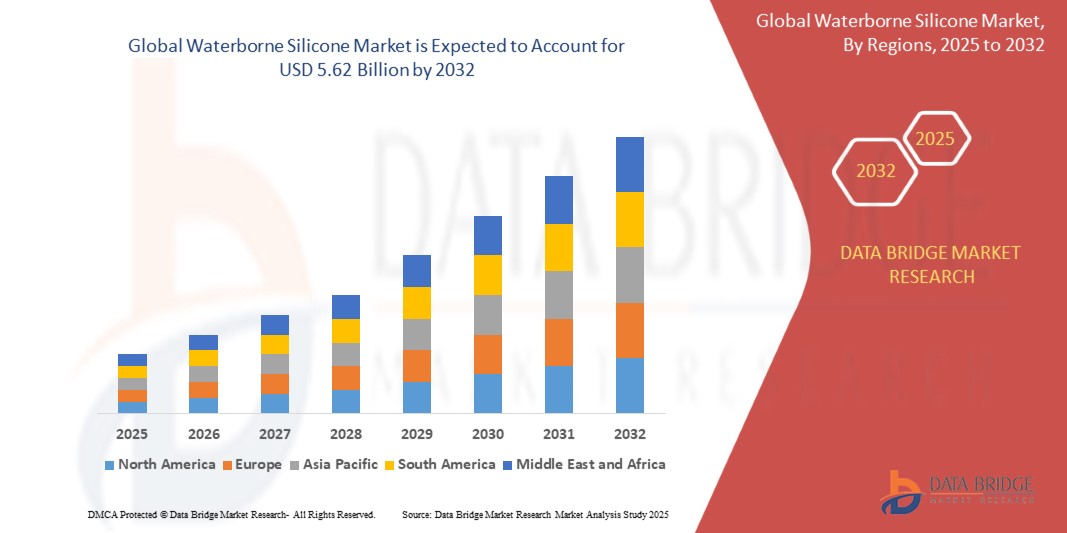
Waterborne Silicone Market Size
- The global waterborne silicone market was valued at USD 3.27 billion in 2024 and is expected to reach USD 5.62 billion by 2032
- During the forecast period of 2025 to 2032 the market is likely to grow at a CAGR of 7.50%, primarily driven by growing demand for eco-friendly and sustainable materials
- This growth is driven by the stringent environmental regulations restricting VOC emissions, and the increasing adoption of water-based formulations across industries
Waterborne Silicone Market Analysis
- Waterborne silicone has gained widespread acceptance due to its eco-friendly composition, low VOC emissions, and superior performance, driving demand across industries such as paints and coatings, adhesives and sealants, personal care, and construction. Its ability to enhance durability, improve environmental sustainability, and comply with stringent regulations has reinforced its significance in modern industrial applications
- The market is primarily driven by increasing environmental regulations, growing preference for sustainable materials, and advancements in silicone-based formulations. In addition, ongoing R&D in emulsions, dispersions, and gel-based waterborne silicones is further accelerating industry growth
- For instance, in North America and Europe, the demand for waterborne silicone has surged due to stricter VOC emission norms, rising adoption of green coatings, and innovations in high-performance silicone-based sealants
- Globally, waterborne silicone continues to play a critical role in industrial sustainability, with innovations such as silicone nano-coatings, high-temperature-resistant emulsions, and bio-based silicone formulations driving long-term market expansion and eco-friendly product development
Report Scope and Waterborne Silicone Market Segmentation
|
Attributes |
Waterborne Silicone Key Market Insights |
|
Segments Covered |
|
|
Countries Covered |
North America
Europe
Asia-Pacific
Middle East and Africa
South America
|
|
Key Market Players |
|
|
Market Opportunities |
|
|
Value Added Data Infosets |
In addition to the insights on market scenarios such as market value, growth rate, segmentation, geographical coverage, and major players, the market reports curated by the Data Bridge Market Research also include in-depth expert analysis, pricing analysis, brand share analysis, consumer survey, demography analysis, supply chain analysis, value chain analysis, raw material/consumables overview, vendor selection criteria, PESTLE Analysis, Porter Analysis, and regulatory framework |
Waterborne Silicone Market Trends
“Rising Adoption of Waterborne Silicone in High-Performance Coatings”
- The increasing demand for eco-friendly coatings in industries such as construction, automotive, and industrial manufacturing is driving the adoption of waterborne silicone due to its low VOC emissions, excellent durability, and superior adhesion properties
- Regulatory pressures promoting sustainable formulations and the ban on solvent-based coatings in various regions are accelerating the shift toward waterborne silicone-based paints, sealants, and protective coatings
- Innovations in nano-silicone emulsions, self-healing coatings, and thermal-resistant silicone dispersions are further expanding the application scope of waterborne silicone in specialized industries
For instance,
➢ In March 2024, AkzoNobel introduced a new range of waterborne silicone coatings for industrial applications, enhancing corrosion resistance and weatherability
➢ In October 2023, Sherwin-Williams launched a low-VOC waterborne silicone protective coating targeting automotive and aerospace applications
➢ In July 2023, BASF expanded its production capacity for waterborne silicone emulsions to cater to rising global demand for high-performance, sustainable coatings
- As industries prioritize sustainability and regulatory compliance, waterborne silicone will continue to gain traction in coatings, offering enhanced performance, reduced environmental impact, and long-term cost savings.
Waterborne Silicone Market Dynamics
Driver
“Increasing Utilization of Waterborne Silicone in Automotive Coatings”
- The demand for high-performance, eco-friendly coatings in the automotive sector is driving the adoption of waterborne silicone, offering superior durability, chemical resistance, and reduced VOC emissions
- Automotive manufacturers and paint suppliers are shifting toward silicone-based waterborne coatings to enhance scratch resistance, hydrophobicity, and weatherproofing in vehicle exteriors and interiors
- Stringent environmental regulations limiting the use of solvent-based paints and promoting low-VOC coatings are accelerating the transition toward waterborne silicone formulations
For instance,
- In March 2024, PPG Industries introduced a new waterborne silicone-based automotive clear coat, enhancing UV resistance and longevity
- In October 2023, Axalta Coating Systems expanded its waterborne silicone coatings portfolio, catering to the growing demand for sustainable automotive finishes
- In July 2023, BASF collaborated with major automakers to develop high-performance waterborne silicone coatings, ensuring compliance with global emission standards
- As the automotive industry prioritizes sustainability and advanced coating technologies, waterborne silicone will continue to gain traction, offering enhanced vehicle protection, reduced environmental impact, and improved regulatory compliance.
Opportunity
“Expanding Role of Waterborne Silicone in Next-Generation Electronics”
- The increasing demand for advanced electronic materials is creating new opportunities for waterborne silicone, which offers superior thermal stability, flexibility, and environmental resistance for next-generation electronic components
- Waterborne silicone coatings and encapsulants are being widely adopted in semiconductors, printed circuit boards (PCBs), and flexible electronics, ensuring enhanced durability and performance in harsh conditions
- Leading electronics manufacturers and material scientists are investing in waterborne silicone-based innovations, driven by the need for miniaturization, high-performance materials, and eco-friendly production processes
For instance,
- In March 2024, Samsung Electronics integrated waterborne silicone-based coatings into its flexible display technology, improving scratch resistance and longevity
- In November 2023, Dow introduced a new waterborne silicone encapsulant for high-power LED applications, enhancing efficiency and thermal stability
- In September 2023, TSMC announced research collaborations focused on waterborne silicone dielectric materials, supporting next-generation semiconductor advancements
- As electronics innovation continues to evolve, waterborne silicone will play a vital role in improving device performance, sustainability, and reliability, reinforcing its position in the fast-growing electronics materials market
Restraint/Challenge
“Regulatory Uncertainty Hindering Waterborne Silicone Market Growth”
- Evolving environmental policies and inconsistent regulatory frameworks across regions are creating uncertainties for waterborne silicone producers, impacting long-term investment decisions and market expansion
- Delays in government approvals, shifting subsidy structures, and complex compliance requirements are slowing down the adoption of waterborne silicone-based solutions across key industries such as automotive, construction, and electronics
- Stringent emission targets and chemical safety regulations are increasing the cost of compliance for manufacturers and suppliers, limiting new product development and innovation in waterborne silicone applications
For instance,
- In October 2023, the European Chemicals Agency (ECHA) tightened regulations on volatile organic compound (VOC) emissions, impacting waterborne silicone formulations in the coatings and adhesives sector
- As regulatory landscapes continue to evolve, industry stakeholders must navigate compliance challenges, advocate for clearer guidelines, and invest in sustainable innovation to ensure the long-term viability of waterborne silicone technologies
Waterborne Silicone Market Scope
The market is segmented on the basis of type, application, and end use.
|
Segmentation |
Sub-Segmentation |
|
By Type |
|
|
By Application |
|
|
By End Use |
|
Waterborne Silicone Market Regional Analysis
“Asia-Pacific is the Dominant Region in the Waterborne Silicone Market”
Rapid industrialization, expanding construction activities, and increasing demand for eco-friendly materials are driving the widespread adoption of waterborne silicone in the region
- Countries such as China, Japan, and India are leading in waterborne silicone production and consumption, supported by stringent environmental regulations and rising investments in sustainable materials
- The presence of major manufacturers, coupled with advancements in silicone-based formulations for coatings, adhesives, and personal care applications, strengthens Asia-Pacific's market leadership
- With increasing environmental awareness and regulatory support, Asia-Pacific will continue to dominate the Waterborne Silicone market, driving sustainable innovation and industry expansion
“North America is projected to register the Highest Growth Rate”
- Increasing demand for sustainable materials, stringent environmental regulations, and advancements in silicone-based technologies are driving the rapid expansion of the waterborne silicone market in the region
- Countries such as the U.S. and Canada are investing heavily in eco-friendly coatings, adhesives, and industrial applications, supported by government policies promoting low-VOC and high-performance silicone solutions
- The growing adoption of waterborne silicone in construction, automotive, and healthcare sectors, along with expanding research into next-generation silicone formulations, is further propelling market growth
- As North America continues to focus on sustainability and innovation, the region is expected to lead in waterborne silicone market growth, setting new benchmarks for performance, safety, and environmental impact
Waterborne Silicone Market Share
The market competitive landscape provides details by competitor. Details included are company overview, company financials, revenue generated, market potential, investment in research and development, new market initiatives, global presence, production sites and facilities, production capacities, company strengths and weaknesses, product launch, product width and breadth, application dominance. The above data points provided are only related to the companies' focus related to market.
The Major Market Leaders Operating in the Market Are:
- Dow (U.S.)
- Momentive Performance Materials (U.S.)
- Elkem ASA (Norway)
- Wacker Chemie AG (Germany)
- Siltech Corporation (Canada)
- DyStar Singapore Pte Ltd (Singapore)
- Evonik Industries AG (Germany)
- Huaian Kaiyue Tech. Dev. Co., Ltd. (China)
- Spartan Chemical Company, Inc. (U.S.)
- Shin-Etsu Chemical Co., Ltd. (Japan)
- BRB International (Netherlands)
- 3M (U.S.)
- BASF (Germany)
- Rogers Corporation (U.S.)
- Saint-Gobain (France)
- AMBER CHEMICALS (U.K.)
- Ashland Inc (U.S.)
- China National Bluestar (Group) Co., Ltd. (China)
- Bostik (France)
Latest Developments in Global Waterborne Silicone Market
- In June 2024, SioResin introduced a new water-based, high-temperature graphene silicone resin coating, utilizing its SiO-715 silicone resin emulsion. This advanced coating offers high-temperature resistance, thermal conductivity, and a water-based formulation, making it ideal for industrial pipelines, heating vessels, and domestic heating applications
- In March 2024, Shin-Etsu Chemical Co., Ltd. developed the first emulsifier-free, water-based silicone resin, known as the KRW-6000 Series. This innovative resin provides superior film properties, rapid curing through heating, and exceptional durability while eliminating organic solvents, reducing VOC emissions, and lowering greenhouse gas emissions due to its low-temperature curing capabilities
- In September 2023, Dow introduced a new range of silicone release coatings, launching the SYL-OFF SL 184 Coating. This product features fast curing, reduced mist formation at high line speeds, and highly stable release properties, making it an efficient solution for industrial applications
- In March 2023, LubeLife announced the launch of a water-based gel lubricant free from parabens, silicone, oil, hormones, and gluten. As the leading personal lubricant brand on Amazon with over 88,000 five-star ratings, LubeLife expanded its water-based product line with this new offering, catering to consumer demand for safe and high-quality lubricants
SKU-
Accédez en ligne au rapport sur le premier cloud mondial de veille économique

- Tableau de bord d'analyse de données interactif
- Tableau de bord d'analyse d'entreprise pour les opportunités à fort potentiel de croissance
- Accès d'analyste de recherche pour la personnalisation et les requêtes
- Analyse de la concurrence avec tableau de bord interactif
- Dernières actualités, mises à jour et analyse des tendances
- Exploitez la puissance de l'analyse comparative pour un suivi complet de la concurrence
Méthodologie de recherche
La collecte de données et l'analyse de l'année de base sont effectuées à l'aide de modules de collecte de données avec des échantillons de grande taille. L'étape consiste à obtenir des informations sur le marché ou des données connexes via diverses sources et stratégies. Elle comprend l'examen et la planification à l'avance de toutes les données acquises dans le passé. Elle englobe également l'examen des incohérences d'informations observées dans différentes sources d'informations. Les données de marché sont analysées et estimées à l'aide de modèles statistiques et cohérents de marché. De plus, l'analyse des parts de marché et l'analyse des tendances clés sont les principaux facteurs de succès du rapport de marché. Pour en savoir plus, veuillez demander un appel d'analyste ou déposer votre demande.
La méthodologie de recherche clé utilisée par l'équipe de recherche DBMR est la triangulation des données qui implique l'exploration de données, l'analyse de l'impact des variables de données sur le marché et la validation primaire (expert du secteur). Les modèles de données incluent la grille de positionnement des fournisseurs, l'analyse de la chronologie du marché, l'aperçu et le guide du marché, la grille de positionnement des entreprises, l'analyse des brevets, l'analyse des prix, l'analyse des parts de marché des entreprises, les normes de mesure, l'analyse globale par rapport à l'analyse régionale et des parts des fournisseurs. Pour en savoir plus sur la méthodologie de recherche, envoyez une demande pour parler à nos experts du secteur.
Personnalisation disponible
Data Bridge Market Research est un leader de la recherche formative avancée. Nous sommes fiers de fournir à nos clients existants et nouveaux des données et des analyses qui correspondent à leurs objectifs. Le rapport peut être personnalisé pour inclure une analyse des tendances des prix des marques cibles, une compréhension du marché pour d'autres pays (demandez la liste des pays), des données sur les résultats des essais cliniques, une revue de la littérature, une analyse du marché des produits remis à neuf et de la base de produits. L'analyse du marché des concurrents cibles peut être analysée à partir d'une analyse basée sur la technologie jusqu'à des stratégies de portefeuille de marché. Nous pouvons ajouter autant de concurrents que vous le souhaitez, dans le format et le style de données que vous recherchez. Notre équipe d'analystes peut également vous fournir des données sous forme de fichiers Excel bruts, de tableaux croisés dynamiques (Fact book) ou peut vous aider à créer des présentations à partir des ensembles de données disponibles dans le rapport.











