



North America Internet of Things (IoT) Healthcare Market By Component (Devices, Software, Services), Deployment (Cloud, On-Premises), Organization Size (Large Enterprises, Small and Medium Enterprises), Application (Telemedicine, Patient Monitoring, Connected Imaging, Clinical Operations, Others), and Country - Industry Trends and Forecast to 2032
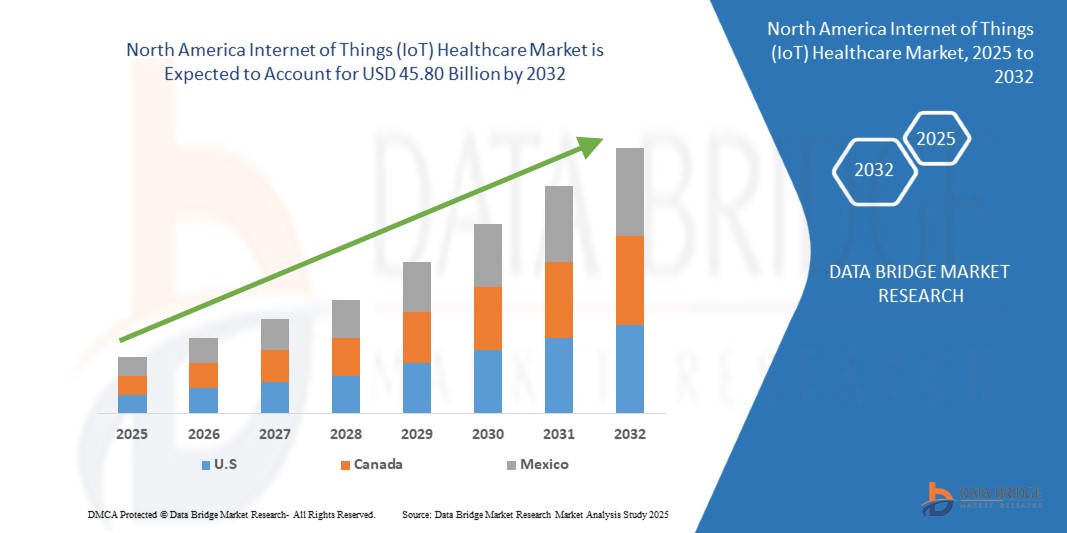
North America Internet of Things (IoT) Healthcare Market Size
- The north america internet of things (IoT) healthcare market size was valued at USD 12.50 billion in 2024 and is expected to reach USD 45.80 billion by 2032, at a CAGR of 17.6% during the forecast period
- This significant growth is driven by the increasing adoption of IoT-enabled medical devices, the rising demand for remote patient monitoring, and the integration of AI and cloud-based solutions to enhance healthcare delivery.
North America Internet of Things (IoT) Healthcare Market Analysis
IoT Healthcare solutions utilize connected devices, AI, and cloud platforms to enable real-time patient monitoring, streamline clinical operations, and improve healthcare outcomes through data-driven insights.
- The market is propelled by the growing prevalence of chronic diseases, advancements in wearable health technologies, and the need for cost-effective healthcare solutions in hospitals and clinics.
- The U.S. dominates the market due to its advanced healthcare infrastructure, high adoption of IoT technologies, and the presence of key players like Medtronic, Philips, and GE Healthcare.
- Canada is expected to exhibit steady growth, fueled by government investments in digital health and increasing adoption of telemedicine solutions.
- The patient monitoring segment is expected to hold a significant market share of approximately 31.53% in 2025, driven by the demand for real-time health data and remote care solutions.
Report Scope and Internet of things (IoT) healthcare Market Segmentation
|
Attributes |
Internet of things (IoT) healthcare Key Market Insights |
|
Segments Covered |
|
|
Countries Covered |
North America
|
|
Key Market Players |
|
|
Market Opportunities |
|
|
Value Added Data Infosets |
In addition to the insights on market scenarios such as market value, growth rate, segmentation, geographical coverage, and major players, the market reports curated by the Data Bridge Market Research also include import export analysis, production capacity overview, production consumption analysis, price trend analysis, climate change scenario, supply chain analysis, value chain analysis, raw material/consumables overview, vendor selection criteria, PESTLE Analysis, Porter Analysis, and regulatory framework. |
North America Internet of Things (IoT) Healthcare Market Trends
“Adoption of IoT and AI-Driven Healthcare Solutions”
- IoT-enabled devices, such as wearables and smart sensors, provide real-time patient data, enabling proactive care and reducing hospital readmissions.
- AI-driven analytics predict patient health risks by analyzing data from IoT devices, improving diagnostics and personalizing treatment plans.
For instance, in September 2024, Philips partnered with AWS to enhance its HealthSuite platform, integrating AI-powered analytics for remote patient monitoring in hospitals.
- These solutions improve clinical decision-making, driving adoption in telemedicine and patient monitoring applications.
- The trend supports scalability, allowing healthcare providers to manage patient data across distributed facilities efficiently.
North America Internet of Things (IoT) Healthcare Market Dynamics
Driver
“Rising Demand for Remote Patient Monitoring and Chronic Disease Management”
- IoT-enabled remote monitoring solutions allow healthcare providers to track patient health in real time, reducing the need for in-person visits and improving chronic disease management.
- The growing aging population and increasing prevalence of chronic conditions, such as diabetes and cardiovascular diseases, drive demand for IoT healthcare solutions.
For instance, a 2023 HIMSS report noted that 65% of U.S. hospitals adopted IoT-based monitoring to reduce patient readmissions by 25%.
- These solutions align with value-based care models, enhancing patient outcomes and reducing healthcare costs.
Opportunity
“Expansion of Cloud-Based Internet of things (IoT) healthcare in SMEs”
- Cloud-based IoT platforms offer small and medium-sized healthcare facilities affordable tools to monitor patients remotely and streamline operations.
- These solutions enable SMEs to improve patient care, reduce operational costs, and compete with larger healthcare providers.
For instance, in June 2024, Cerner launched a cloud-native IoT platform for SMEs, featuring remote monitoring and AI-driven analytics.
- The increasing adoption of digital health in rural and underserved areas fuels SME demand for cloud-based solutions.
- The flexibility of cloud platforms supports SMEs’ growth, creating significant market opportunities.
Restraint/Challenge
“Data Privacy Concerns and Interoperability Challenges”
- Storing sensitive patient data on cloud platforms raises concerns about cyberattacks and compliance with regulations like HIPAA and GDPR.
- Integrating IoT healthcare solutions with legacy hospital systems is complex, increasing deployment costs and timelines
For instance, a 2023 Gartner report highlighted that 50% of healthcare providers faced interoperability issues when deploying IoT-based tools.
- The lack of standardized protocols across IoT devices complicates seamless integration, hindering adoption.
- Addressing security through robust encryption and compliance measures is critical to maintaining trust in IoT healthcare solutions.
Internet of things (IoT) healthcare Market Scope
The market is segmented based on component, deployment, organization size, and application.
|
Segmentation |
Sub-Segmentation |
|
By Component |
|
|
By Deployment |
|
|
By Organization Size |
|
|
By Application |
|
In 2025, the patient monitoring segment is projected to dominate the application segment
The patient monitoring segment is expected to hold a market share of approximately 31.53% in 2025, driven by the need for real-time health data and remote care solutions.
The cloud deployment segment is expected to account for the largest share during the forecast period in the deployment market
In 2025, the cloud deployment segment is projected to account for a market share of 62.82%, driven by its scalability, cost-effectiveness, and ability to support distributed healthcare needs.
“The U.S. Holds the Largest Share in the North America IoT Healthcare Market”
- The U.S. dominates the market due to its advanced healthcare IT infrastructure, widespread adoption of IoT-enabled devices, and the presence of leading vendors like Medtronic, Philips, and GE Healthcare.
- The region benefits from significant investments in AI-driven health analytics and a strong focus on telemedicine and digital health initiatives.
- High penetration of wearable devices and government support for healthcare digitization further drive market growth.
“Canada is Projected to Register a Significant CAGR in the North America IoT Healthcare Market”
- Canada is expected to grow steadily, driven by government initiatives promoting digital health, increasing adoption of telemedicine, and investments in smart healthcare infrastructure.
- The country’s focus on improving healthcare access in remote areas accelerates the adoption of IoT solutions.
- The expanding role of wearables and remote monitoring in chronic disease management further supports market growth.
North America Internet of Things (IoT) Healthcare Market Share
The market competitive landscape provides details by competitor. Details included are company overview, company financials, revenue generated, market potential, investment in research and development, new market initiatives, global presence, production sites and facilities, production capacities, company strengths and weaknesses, product launch, product width and breadth, application dominance. The above data points provided are only related to the companies' focus related to market.
The Major Market Leaders Operating in the Market Are:
- Medtronic plc (U.S.)
- Koninklijke Philips N.V. (Netherlands)
- GE Healthcare (U.S.)
- Cisco Systems, Inc
- IBM Corporation (U.S.)
- Cerner Corporation (U.S.)
- Siemens Healthineers AG (Germany)
- Qualcomm Life, Inc. (U.S.)
- Honeywell International Inc. (U.S.)
- Microsoft Corporation (U.S.)
Latest Developments in North America Internet of Things (IoT) Healthcare Market
- In April 2023, Medtronic launched an enhanced version of its Guardian Connect system, integrating AI-driven predictive analytics for continuous glucose monitoring. This update enabled real-time data sharing with healthcare providers, targeting diabetes management and improving patient outcomes.
- In August 2023, Philips introduced an upgraded HealthSuite platform, a cloud-based solution for IoT healthcare, featuring enhanced connectivity for wearable devices and real-time patient monitoring. The platform supported telemedicine and integration with hospital systems, targeting improved clinical efficiency.
- In February 2024, GE Healthcare released an IoT-enabled version of its Versana ultrasound system, incorporating AI-driven diagnostics and remote monitoring capabilities. This launch focused on enabling connected imaging for smaller clinics, driving adoption in outpatient care.
- In July 2024, Cerner launched a cloud-native IoT platform tailored for SMEs, offering remote patient monitoring, predictive analytics, and integration with Microsoft Azure. The solution aimed to simplify digital health adoption for smaller healthcare providers, addressing demand in rural areas.
SKU-
Accédez en ligne au rapport sur le premier cloud mondial de veille économique

- Tableau de bord d'analyse de données interactif
- Tableau de bord d'analyse d'entreprise pour les opportunités à fort potentiel de croissance
- Accès d'analyste de recherche pour la personnalisation et les requêtes
- Analyse de la concurrence avec tableau de bord interactif
- Dernières actualités, mises à jour et analyse des tendances
- Exploitez la puissance de l'analyse comparative pour un suivi complet de la concurrence
Méthodologie de recherche
La collecte de données et l'analyse de l'année de base sont effectuées à l'aide de modules de collecte de données avec des échantillons de grande taille. L'étape consiste à obtenir des informations sur le marché ou des données connexes via diverses sources et stratégies. Elle comprend l'examen et la planification à l'avance de toutes les données acquises dans le passé. Elle englobe également l'examen des incohérences d'informations observées dans différentes sources d'informations. Les données de marché sont analysées et estimées à l'aide de modèles statistiques et cohérents de marché. De plus, l'analyse des parts de marché et l'analyse des tendances clés sont les principaux facteurs de succès du rapport de marché. Pour en savoir plus, veuillez demander un appel d'analyste ou déposer votre demande.
La méthodologie de recherche clé utilisée par l'équipe de recherche DBMR est la triangulation des données qui implique l'exploration de données, l'analyse de l'impact des variables de données sur le marché et la validation primaire (expert du secteur). Les modèles de données incluent la grille de positionnement des fournisseurs, l'analyse de la chronologie du marché, l'aperçu et le guide du marché, la grille de positionnement des entreprises, l'analyse des brevets, l'analyse des prix, l'analyse des parts de marché des entreprises, les normes de mesure, l'analyse globale par rapport à l'analyse régionale et des parts des fournisseurs. Pour en savoir plus sur la méthodologie de recherche, envoyez une demande pour parler à nos experts du secteur.
Personnalisation disponible
Data Bridge Market Research est un leader de la recherche formative avancée. Nous sommes fiers de fournir à nos clients existants et nouveaux des données et des analyses qui correspondent à leurs objectifs. Le rapport peut être personnalisé pour inclure une analyse des tendances des prix des marques cibles, une compréhension du marché pour d'autres pays (demandez la liste des pays), des données sur les résultats des essais cliniques, une revue de la littérature, une analyse du marché des produits remis à neuf et de la base de produits. L'analyse du marché des concurrents cibles peut être analysée à partir d'une analyse basée sur la technologie jusqu'à des stratégies de portefeuille de marché. Nous pouvons ajouter autant de concurrents que vous le souhaitez, dans le format et le style de données que vous recherchez. Notre équipe d'analystes peut également vous fournir des données sous forme de fichiers Excel bruts, de tableaux croisés dynamiques (Fact book) ou peut vous aider à créer des présentations à partir des ensembles de données disponibles dans le rapport.











