



North America Smoked Cheese Market Segmentation, By Type (Naturally Smoked Cheese and Processed Smoked Cheese), Product Type (Mozzarella, Parmesan, Cheddar, Cream Cheese, Ricotta, and Others), Form (Blocks, Cubes, Slice, Spread, and Others), Flavors (Original and Flavored), Category (Hard Cheese and Soft Cheese), Source (Cattle Milk, Goat Milk, Sheep Milk, and Others), Application (Food & Beverage Industries, Food Service Sector, and Households), Distribution Channel (Direct and Indirect) - Industry Trends and Forecast to 2033
What is the North America Smoked Cheese Market Size and Growth Rate?
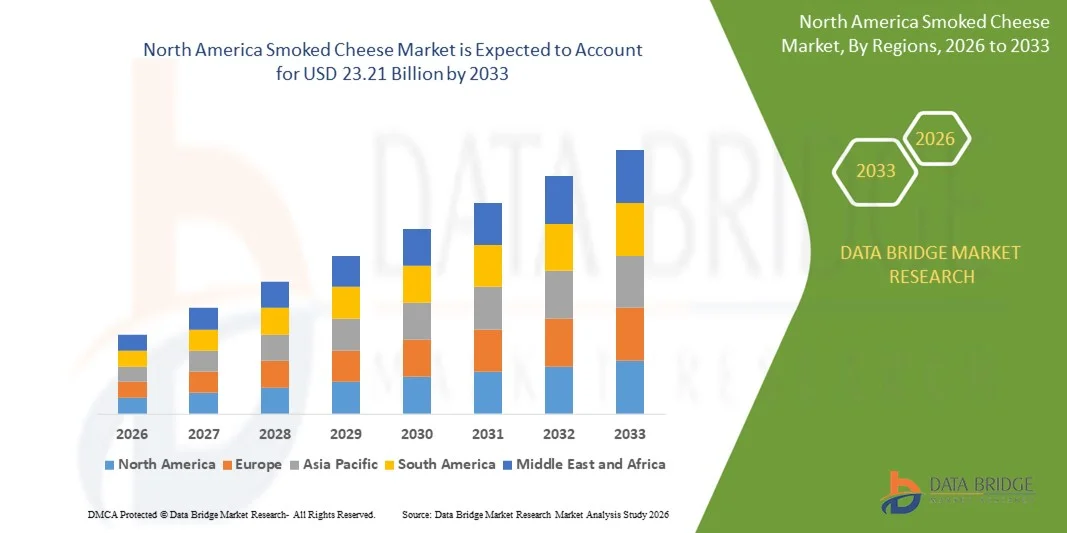
- The North America smoked cheese market size was valued at USD 15.00 billion in 2025 and is expected to reach USD 23.21 billion by 2033, at a CAGR of 5.00% during the forecast period
- The availability of various flavors in smoked cheese increases the demand among consumers which is expected to drive the growth of the smoked cheese market. The increasing awareness and changing consumer’s preference towards organic foods is expected to act as restraint for the growth of the smoked cheese market
What are the Major Takeaways of Smoked Cheese Market?
- The rising technical innovations in the food processing market and increasing consumption of smoke flavored food products in the region will create an opportunity for the growth of the smoked cheese market
- The manufacturers are dealing with the situation and trying to add more nutrients with unique taste in smoked cheese products is expected to act as a challenge for the growth of the smoked cheese market
- U.S. dominated the global smoked cheese market with an estimated 45.3% revenue share in 2025, driven by high dairy consumption, strong foodservice growth, expanding quick-service restaurants (QSRs), and widespread adoption of cheese in home cooking and convenience foods across key economies
- Mexico is projected to register the fastest CAGR of 8.92% from 2026 to 2033 in the North American Smoked Cheese market, fueled by growing urban populations, increasing QSR penetration, and rising consumption of pizzas, sandwiches, and bakery products
- The Naturally Smoked Cheese segment dominated the market with an estimated 61.4% share in 2025, driven by rising consumer preference for authentic flavors, traditional smoking methods, and clean-label dairy products
Report Scope and Smoked Cheese Market Segmentation
|
Attributes |
Smoked Cheese Key Market Insights |
|
Segments Covered |
|
|
Countries Covered |
North America
|
|
Key Market Players |
|
|
Market Opportunities |
|
|
Value Added Data Infosets |
In addition to the insights on market scenarios such as market value, growth rate, segmentation, geographical coverage, and major players, the market reports curated by the Data Bridge Market Research also include in-depth expert analysis, pricing analysis, brand share analysis, consumer survey, demography analysis, supply chain analysis, value chain analysis, raw material/consumables overview, vendor selection criteria, PESTLE Analysis, Porter Analysis, and regulatory framework. |
What is the Key Trend in the Smoked Cheese Market?
Growing Shift Toward Premium, Artisanal, and Naturally Smoked Cheese Varieties
- The smoked cheese market is witnessing increasing demand for premium, naturally smoked cheeses made using traditional smoking techniques with hardwoods such as hickory, applewood, and oak to enhance flavor authenticity
- Manufacturers are introducing artisanal, organic, and clean-label smoked cheeses with minimal additives, natural ingredients, and distinctive regional flavor profiles to meet evolving consumer preferences
- Rising consumer interest in gourmet foods, premium snacking, and specialty dairy products is accelerating the adoption of smoked cheeses across retail and foodservice channels
- For instance, companies such as Arla Foods, Saputo, Sargento, Leprino Foods, and Dairygold are expanding their smoked cheese portfolios, including smoked cheddar, gouda, mozzarella, and specialty blends
- Increasing popularity of cheese-based snacks, charcuterie boards, and restaurant-style home dining across the U.S., North America, and parts of North America is driving market expansion
- As consumers seek bold flavors and premium dairy experiences, Smoked Cheese will remain a key segment within the specialty cheese market
What are the Key Drivers of Smoked Cheese Market?
- Rising consumer demand for flavor-enhanced dairy products and premium cheese varieties is significantly boosting smoked cheese consumption
- For instance, during 2024–2025, leading producers such as Saputo, Arla Foods, and Sargento introduced new smoked cheese SKUs and packaging formats targeting retail and foodservice segments
- Growing popularity of ready-to-eat snacks, gourmet sandwiches, burgers, and fusion cuisines is increasing the use of smoked cheese in both household and commercial applications
- Expansion of modern retail, specialty cheese shops, and online grocery platforms is improving product availability and consumer access
- Increasing demand from foodservice operators, quick-service restaurants, and casual dining chains continues to strengthen market growth
- Supported by rising disposable incomes, evolving taste preferences, and innovation in dairy processing, the Smoked Cheese market is expected to witness steady long-term growth
Which Factor is Challenging the Growth of the Smoked Cheese Market?
- Higher production costs associated with natural smoking processes, premium milk sourcing, and extended aging periods limit price competitiveness
- During 2024–2025, fluctuations in raw milk prices, energy costs, and transportation expenses increased operational costs for smoked cheese manufacturers
- Shorter shelf life and strict cold-chain storage requirements can restrict distribution, particularly in emerging markets
- Limited consumer awareness in developing regions regarding smoked cheese varieties and usage occasions slows market penetration
- Competition from processed cheese, flavored cheese spreads, and plant-based cheese alternatives creates pricing and shelf-space pressure
- To overcome these challenges, producers are focusing on process optimization, innovative packaging, expanded distribution, and consumer education to support broader adoption of Smoked Cheese
How is the Smoked Cheese Market Segmented?
The market is segmented on the basis of type, product type, form, flavors, category, source, application, and distribution channel.
- By Type
On the basis of type, the smoked cheese market is segmented into Naturally Smoked Cheese and Processed Smoked Cheese. The Naturally Smoked Cheese segment dominated the market with an estimated 61.4% share in 2025, driven by rising consumer preference for authentic flavors, traditional smoking methods, and clean-label dairy products. Naturally smoked cheeses are produced using real wood smoke, offering superior aroma, texture, and premium positioning, making them popular across gourmet retail and foodservice channels.
The Processed Smoked Cheese segment is expected to grow at the fastest CAGR from 2026 to 2033, supported by its cost efficiency, longer shelf life, and consistent flavor profile. Increasing demand from quick-service restaurants, ready-to-eat foods, and mass-market retail is accelerating adoption. As affordability and convenience gain importance, processed smoked cheese will witness strong growth momentum.
- By Product Type
Based on product type, the market is segmented into Mozzarella, Parmesan, Cheddar, Cream Cheese, Ricotta, and Others. The Cheddar segment led the market with approximately 34.7% share in 2025, owing to its strong flavor retention after smoking, wide culinary versatility, and high usage in burgers, sandwiches, and snacks. Smoked cheddar remains a staple across retail and foodservice sectors globally.
The Mozzarella segment is projected to grow at the fastest CAGR from 2026 to 2033, driven by increasing demand from pizzas, baked dishes, and ready-to-cook meals. Growth in casual dining, frozen foods, and home cooking trends is supporting mozzarella consumption. Other varieties, including smoked parmesan and cream cheese, continue to gain traction in premium and specialty food segments.
- By Form
On the basis of form, the smoked cheese market is segmented into Blocks, Cubes, Slice, Spread, and Others. The Block segment dominated the market with a 39.6% share in 2025, as blocks offer better shelf stability, flexible portioning, and wide application across retail and foodservice operations. Smoked cheese blocks are commonly used for slicing, shredding, and food preparation.
The Slice segment is anticipated to grow at the fastest CAGR during 2026–2033, supported by rising demand from quick-service restaurants, sandwich chains, and convenience foods. Pre-sliced smoked cheese provides portion control, reduced preparation time, and consistent quality. Spreads and cubes are also witnessing growth due to increasing snacking habits and charcuterie board consumption.
- By Flavors
Based on flavor, the market is segmented into Original and Flavored smoked cheese. The Original flavor segment accounted for an estimated 58.9% share in 2025, driven by traditional taste preferences, wide culinary compatibility, and strong acceptance across all age groups. Original smoked cheese remains dominant in foodservice and home cooking applications.
The Flavored segment is expected to grow at the fastest CAGR from 2026 to 2033, fueled by innovation in herbs, spices, chili, garlic, and wood-infused flavor profiles. Growing consumer interest in bold and exotic flavors, especially among younger demographics, is driving experimentation. Premium positioning and limited-edition offerings further support flavored smoked cheese expansion globally.
- By Category
On the basis of category, the smoked cheese market is segmented into Hard Cheese and Soft Cheese. The Hard Cheese segment dominated the market with a 55.2% share in 2025, owing to its longer shelf life, intense smoked flavor retention, and widespread use in cooking and snacking applications. Smoked cheddar and parmesan largely contribute to this dominance.
The Soft Cheese segment is expected to register the fastest growth from 2026 to 2033, supported by rising consumption of smoked cream cheese and ricotta in spreads, dips, and gourmet recipes. Increasing popularity of breakfast foods, bakery fillings, and premium appetizers is driving demand for soft smoked cheese varieties.
- By Source
By source, the market is segmented into Cattle Milk, Goat Milk, Sheep Milk, and Others. The Cattle Milk segment held the largest share of around 72.8% in 2025, driven by abundant availability, cost efficiency, and high consumer familiarity. Most commercially produced smoked cheeses are derived from cow milk.
The Goat Milk segment is projected to grow at the fastest CAGR from 2026 to 2033, supported by rising demand for specialty, digestible, and premium dairy products. Increasing health awareness and preference for distinctive flavor profiles are boosting goat milk smoked cheese adoption, particularly in North America and North America.
- By Application
On the basis of application, the market is segmented into Food & Beverage Industries, Food Service Sector, and Households. The Food Service Sector dominated the market with a 41.3% share in 2025, driven by extensive use of smoked cheese in restaurants, cafés, fast-food outlets, and casual dining chains.
The Household segment is expected to grow at the fastest CAGR from 2026 to 2033, supported by rising home cooking trends, premium grocery purchases, and increasing availability of smoked cheese in retail outlets. Growth in e-commerce grocery platforms further strengthens household adoption.
- By Distribution Channel
Based on distribution channel, the market is segmented into Direct and Indirect channels. The Indirect channel dominated the market with an estimated 68.5% share in 2025, supported by supermarkets, hypermarkets, specialty stores, and online retail platforms offering wide product availability.
The Direct channel is expected to grow at the fastest CAGR from 2026 to 2033, driven by increasing sales through company-owned stores, foodservice contracts, and direct-to-consumer platforms. Improved cold-chain logistics and digital sales models are strengthening direct distribution growth.
Which Region Holds the Largest Share of the Smoked Cheese Market?
- U.S. dominated the global smoked cheese market with an estimated 45.3% revenue share in 2025, driven by high dairy consumption, strong foodservice growth, expanding quick-service restaurants (QSRs), and widespread adoption of cheese in home cooking and convenience foods across key economies
- Rising consumer preference for premium, artisanal, and flavored smoked cheese varieties, combined with growth in supermarkets, specialty stores, and online food retail, is significantly boosting smoked cheese demand across the region
- Advanced dairy processing technologies, strong domestic production, and continuous investment by multinational and regional cheese manufacturers reinforce North America’s leadership in the smoked cheese market
Canada Smoked Cheese Market Insight
In Canada, market growth is driven by rising urbanization, high dairy consumption, and increasing demand for convenience foods, including ready meals and packaged snacks. Smoked cheese is extensively used in bakery products, sandwiches, and gourmet cuisine. Expansion of supermarkets, specialty stores, and online retail channels, coupled with investment in modern dairy processing, supports higher adoption. Continuous focus on quality, flavor innovation, and food safety regulations ensures long-term market stability.
Mexico Smoked Cheese Market Insight
Mexico is projected to register the fastest CAGR of 8.92% from 2026 to 2033 in the North American Smoked Cheese market, fueled by growing urban populations, increasing QSR penetration, and rising consumption of pizzas, sandwiches, and bakery products. Expanding retail infrastructure, supermarkets, and cold-chain facilities support higher market penetration. Innovation in flavored, portion-controlled, and value-added smoked cheeses meets evolving consumer preferences. Rising disposable incomes and adoption of Western-style cuisines further accelerate regional market growth.
Which are the Top Companies in Smoked Cheese Market?
The smoked cheese industry is primarily led by well-established companies, including:
- Arla Foods amba (Denmark)
- Flanders Dairy Products (Belgium)
- Glanbia PLC (Ireland)
- Dairygold Co-Operative Society Ltd (Ireland)
- Gilman Cheese Corporation (U.S.)
- Crowley Cheese, LLC (U.S.)
- Saputo Inc. (Canada)
- Carr Valley Cheese (U.S.)
- Norseland Inc. (U.S.)
- Hilmar Cheese Company, Inc. (U.S.)
- Lioni Latticini, Inc. (U.S.)
- Sargento Foods Inc. (U.S.)
- Swaledale Cheese Company (U.K.)
- Leprino Foods Company (U.S.)
- Dewlay Cheesemakers (U.K.)
What are the Recent Developments in Global Smoked Cheese Market?
- In November 2025, flavour specialist ITS introduced a new range of natural, smoke-free smoked flavour solutions to help cheese manufacturers preserve authentic smoky taste profiles ahead of upcoming EU regulations restricting traditional smoke flavourings from July 2026, strengthening regulatory compliance while safeguarding product authenticity.
- In June 2025, Arla Foods and DMK Group approved a strategic merger to create North America’s largest dairy cooperative with combined annual revenues of approximately €19 billion, aimed at enhancing product innovation, operational scale, and competitive market positioning across global dairy markets
- In May 2025, The Laughing Cow expanded its spreadable cheese portfolio by launching Creamy Smoked Gouda wedges in the U.S., delivering a rich smoky flavour and 2 grams of protein per wedge, reinforcing the brand’s focus on premium taste innovation and consumer-driven product diversification
- In January 2025, Crowley Cheese marked its 200th anniversary by reintroducing limited-edition archival flavours including Caraway, Dill, and Salsa for the holiday season, leveraging heritage offerings to strengthen brand loyalty and consumer engagement
SKU-
Accédez en ligne au rapport sur le premier cloud mondial de veille économique

- Tableau de bord d'analyse de données interactif
- Tableau de bord d'analyse d'entreprise pour les opportunités à fort potentiel de croissance
- Accès d'analyste de recherche pour la personnalisation et les requêtes
- Analyse de la concurrence avec tableau de bord interactif
- Dernières actualités, mises à jour et analyse des tendances
- Exploitez la puissance de l'analyse comparative pour un suivi complet de la concurrence
Méthodologie de recherche
La collecte de données et l'analyse de l'année de base sont effectuées à l'aide de modules de collecte de données avec des échantillons de grande taille. L'étape consiste à obtenir des informations sur le marché ou des données connexes via diverses sources et stratégies. Elle comprend l'examen et la planification à l'avance de toutes les données acquises dans le passé. Elle englobe également l'examen des incohérences d'informations observées dans différentes sources d'informations. Les données de marché sont analysées et estimées à l'aide de modèles statistiques et cohérents de marché. De plus, l'analyse des parts de marché et l'analyse des tendances clés sont les principaux facteurs de succès du rapport de marché. Pour en savoir plus, veuillez demander un appel d'analyste ou déposer votre demande.
La méthodologie de recherche clé utilisée par l'équipe de recherche DBMR est la triangulation des données qui implique l'exploration de données, l'analyse de l'impact des variables de données sur le marché et la validation primaire (expert du secteur). Les modèles de données incluent la grille de positionnement des fournisseurs, l'analyse de la chronologie du marché, l'aperçu et le guide du marché, la grille de positionnement des entreprises, l'analyse des brevets, l'analyse des prix, l'analyse des parts de marché des entreprises, les normes de mesure, l'analyse globale par rapport à l'analyse régionale et des parts des fournisseurs. Pour en savoir plus sur la méthodologie de recherche, envoyez une demande pour parler à nos experts du secteur.
Personnalisation disponible
Data Bridge Market Research est un leader de la recherche formative avancée. Nous sommes fiers de fournir à nos clients existants et nouveaux des données et des analyses qui correspondent à leurs objectifs. Le rapport peut être personnalisé pour inclure une analyse des tendances des prix des marques cibles, une compréhension du marché pour d'autres pays (demandez la liste des pays), des données sur les résultats des essais cliniques, une revue de la littérature, une analyse du marché des produits remis à neuf et de la base de produits. L'analyse du marché des concurrents cibles peut être analysée à partir d'une analyse basée sur la technologie jusqu'à des stratégies de portefeuille de marché. Nous pouvons ajouter autant de concurrents que vous le souhaitez, dans le format et le style de données que vous recherchez. Notre équipe d'analystes peut également vous fournir des données sous forme de fichiers Excel bruts, de tableaux croisés dynamiques (Fact book) ou peut vous aider à créer des présentations à partir des ensembles de données disponibles dans le rapport.











