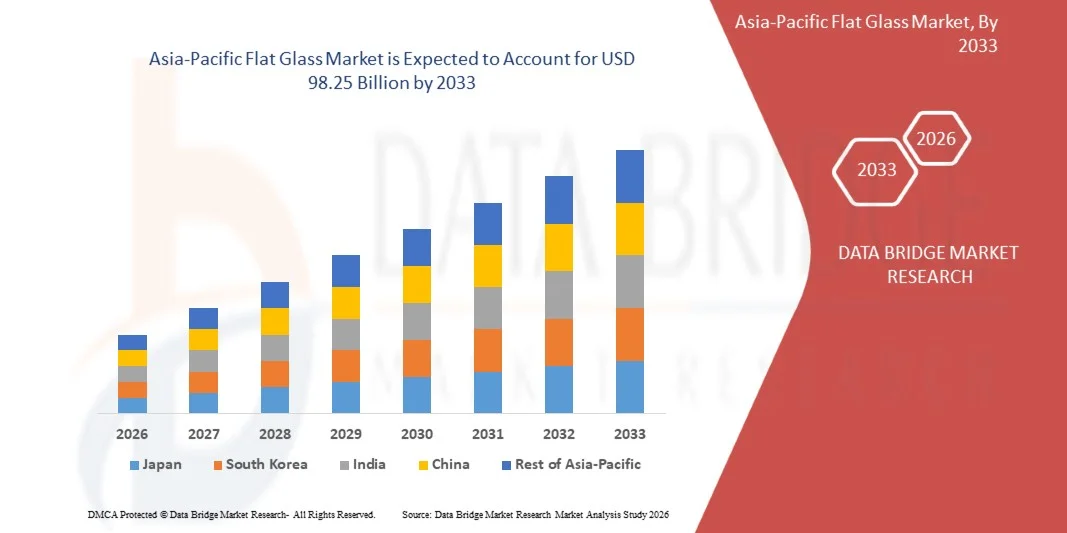
Asia
Market Size in USD Billion
CAGR :
%
USD
54.28 Billion
USD
98.25 Billion
2025
2033
| 2026 –2033 | |
| USD 54.28 Billion | |
| USD 98.25 Billion | |
|
|
|
|
Asia-Pacific Flat Glass Market Segmentation, By Type (Float Glass, Extra Clear Glass, Clear Glass, Cast Glass, Tinted Glass, Wired Glass, Special Flat Glass, Patterned Glass or Textured Glass, Blown Flat Glass, and Others), Function (UV Filter Glass, Heat Insulation Glass, Safety Glazing, Soundproofed Glazing, Self-Cleaning Glass, Ion Exchange Glass, and Others), Product (Coated and Uncoated), Application (Building and Construction, Automotive, Aerospace, Electronic Appliances, Solar Energy, Furniture, and Others) - Industry Trends and Forecast to 2033
Asia-Pacific Flat Glass Market Size
- The Asia-Pacific Flat Glass Market size was valued at USD 54.28 billion in 2025 and is expected to reach USD 98.25 billion by 2033, at a CAGR of 7.7% during the forecast period
- The market growth is largely driven by rapid expansion in building and construction activities along with rising demand for energy-efficient and sustainable infrastructure, increasing the use of flat glass across residential, commercial, and industrial projects
- Furthermore, growing adoption of flat glass in automotive, solar energy, and electronic applications due to its strength, transparency, and functional versatility is accelerating overall market demand, thereby supporting steady industry growth
Asia-Pacific Flat Glass Market Analysis
- Flat glass, widely used in windows, façades, automotive glazing, solar panels, and electronic displays, plays a critical role in modern construction and industrial manufacturing due to its durability, optical clarity, and adaptability to advanced processing
- The increasing emphasis on green buildings, lightweight vehicles, and renewable energy solutions is a key factor boosting flat glass consumption, supported by technological advancements in coating, insulation, and safety-enhancing glass products
- China dominated the Asia-Pacific Flat Glass Market in 2025, due to its extensive manufacturing capacity, strong domestic construction demand, and large-scale production of automotive and solar glass
- India is expected to be the fastest growing country in the Asia-Pacific Flat Glass Market during the forecast period due to rapid urbanization, large-scale infrastructure development, and expanding renewable energy installations
- Float glass segment dominated the market with a market share of 46.3% in 2025, due to its cost efficiency, uniform thickness, and widespread use across construction and automotive applications. Its smooth surface quality supports advanced processing such as coating, tempering, and laminating, which strengthens its demand in modern infrastructure projects. High production scalability and strong supply chains further support its dominance across residential and commercial buildings
Report Scope and Asia-Pacific Flat Glass Market Segmentation
|
Attributes |
Flat Glass Key Market Insights |
|
Segments Covered |
|
|
Countries Covered |
Asia-Pacific
|
|
Key Market Players |
|
|
Market Opportunities |
|
|
Value Added Data Infosets |
In addition to the insights on market scenarios such as market value, growth rate, segmentation, geographical coverage, and major players, the market reports curated by the Data Bridge Market Research also include import export analysis, production capacity overview, production consumption analysis, price trend analysis, climate change scenario, supply chain analysis, value chain analysis, raw material/consumables overview, vendor selection criteria, PESTLE Analysis, Porter Analysis, and regulatory framework. |
Asia-Pacific Flat Glass Market Trends
“Rising Adoption of Energy-Efficient and Low-Carbon Flat Glass”
- A key trend shaping the Asia-Pacific Flat Glass Market is the increasing adoption of energy-efficient and low-carbon glass solutions, driven by stricter environmental regulations and growing sustainability targets in construction and industrial sectors. Manufacturers are focusing on reducing carbon emissions across glass production while improving thermal insulation and solar control performance to meet green building standards
- For instance, AGC Glass Europe has introduced low-carbon float glass products with significantly reduced CO₂ emissions per square meter, supporting sustainable construction projects across Europe. These offerings help builders and architects comply with environmental certifications while maintaining performance and transparency requirements
- The construction sector is increasingly specifying low-emissivity and solar control flat glass for façades and windows to improve building energy efficiency and reduce heating and cooling costs. This trend is reinforcing the shift toward advanced coated glass solutions in residential and commercial developments
- Automotive manufacturers are also adopting energy-efficient flat glass to support lightweight vehicle designs and improve thermal comfort, contributing to better fuel efficiency and reduced emissions. This is strengthening cross-industry demand for value-added flat glass products
- Government initiatives promoting energy-efficient buildings and carbon neutrality targets are accelerating adoption across developed and emerging economies. This trend is positioning energy-efficient flat glass as a core material in sustainable infrastructure development
- Overall, the rising focus on low-carbon manufacturing and energy-saving applications is reshaping product innovation strategies and reinforcing long-term growth prospects for the Asia-Pacific Flat Glass Market
Asia-Pacific Flat Glass Market Dynamics
Driver
“Growing Construction and Infrastructure Development Worldwide”
- The expanding scale of construction and infrastructure development worldwide is a major driver for the Asia-Pacific Flat Glass Market, supported by rapid urbanization, population growth, and increased investment in residential and commercial projects. Flat glass is extensively used in windows, façades, partitions, and interior applications, making it a fundamental material in modern construction
- For instance, Saint-Gobain supplies a wide range of architectural flat glass products for large-scale commercial and residential projects across Europe, Asia, and North America. Its solutions support demand for durable, aesthetic, and energy-efficient building materials
- Government-backed infrastructure programs and smart city initiatives are increasing the use of flat glass in public buildings, transportation hubs, and commercial complexes. This is driving consistent demand for both basic and processed flat glass products
- Rising investments in high-rise buildings and modern office spaces are further boosting demand for advanced glazing solutions that enhance daylight utilization and occupant comfort. This supports increased consumption of coated and functional flat glass
- The growth of construction activities in emerging economies is expanding the customer base for flat glass manufacturers. This sustained expansion in infrastructure development continues to reinforce the market’s growth trajectory
Restraint/Challenge
“High Energy Consumption and Volatile Raw Material Costs”
- The Asia-Pacific Flat Glass Market faces significant challenges due to high energy consumption during glass melting and forming processes, which increases production costs and environmental impact. Glass manufacturing relies heavily on continuous high-temperature furnaces, making energy efficiency a critical concern
- For instance, companies such as SCHOTT AG operate energy-intensive manufacturing facilities that require substantial investments in fuel optimization and emission reduction technologies. Rising energy prices directly affect operational costs and profit margins
- Volatility in raw material prices, including soda ash, silica sand, and limestone, further adds to cost pressures across the supply chain. Fluctuations in availability and pricing create uncertainty for manufacturers and impact long-term planning
- Compliance with environmental regulations requires additional capital investment in cleaner technologies and emission control systems, increasing overall production expenses. Smaller manufacturers often face greater difficulty in absorbing these costs
- These combined challenges place pressure on manufacturers to balance sustainability goals with cost efficiency. Managing energy usage and raw material volatility remains a critical constraint affecting competitiveness and pricing stability in the Asia-Pacific Flat Glass Market
Asia-Pacific Flat Glass Market Scope
The market is segmented on the basis of type, function, product, and application.
• By Type
On the basis of type, the Asia-Pacific Flat Glass Market is segmented into float glass, extra clear glass, clear glass, cast glass, tinted glass, wired glass, special flat glass, patterned or textured glass, blown flat glass, and others. The float glass segment dominated the market with the largest revenue share of 46.3% in 2025, driven by its cost efficiency, uniform thickness, and widespread use across construction and automotive applications. Its smooth surface quality supports advanced processing such as coating, tempering, and laminating, which strengthens its demand in modern infrastructure projects. High production scalability and strong supply chains further support its dominance across residential and commercial buildings.
The extra clear glass segment is expected to witness the fastest growth from 2026 to 2033, fueled by rising demand from solar energy and premium architectural applications. Its low iron content enables higher light transmission, improving energy efficiency and aesthetic appeal. Increasing adoption in high-end façades, photovoltaic panels, and interior design solutions supports its rapid expansion.
• By Function
On the basis of function, the Asia-Pacific Flat Glass Market is segmented into UV filter glass, heat insulation glass, safety glazing, soundproofed glazing, self-cleaning glass, ion exchange glass, and others. Safety glazing held the dominant revenue share in 2025 due to strict building safety regulations and its extensive use in automotive windshields and high-rise buildings. Its ability to reduce injury risk through laminated and tempered structures makes it a standard requirement in many end-use sectors. Growing urbanization and infrastructure modernization further strengthen its market position.
Heat insulation glass is projected to register the fastest growth rate during the forecast period, driven by rising focus on energy-efficient buildings. Increasing awareness of thermal performance and reduced energy consumption boosts adoption in residential and commercial construction. Government incentives for green buildings also accelerate demand.
• By Product
On the basis of product, the market is segmented into coated and uncoated flat glass. The coated glass segment dominated the market in 2025, supported by strong demand for solar control, low-emissivity, and reflective properties in modern buildings. Coated glass improves thermal insulation and glare reduction, aligning with sustainability goals and energy regulations. Its widespread use in commercial façades and smart buildings reinforces its leading share.
The uncoated glass segment is anticipated to grow at the fastest pace from 2026 to 2033 due to its lower cost and expanding use in emerging markets. Rapid residential construction and basic glazing requirements support its rising adoption. Increasing infrastructure spending in developing economies further drives growth.
• By Application
On the basis of application, the Asia-Pacific Flat Glass Market is segmented into building and construction, automotive, aerospace, electronic appliances, solar energy, furniture, and others. Building and construction dominated the market revenue share in 2025, driven by large-scale urban development, commercial complexes, and residential housing projects. Flat glass is widely used in windows, doors, façades, and interior partitions, supporting consistent demand. Growth in smart cities and renovation activities also contributes to dominance.
The solar energy segment is expected to witness the fastest growth during the forecast period, fueled by expanding renewable energy installations worldwide. Flat glass plays a critical role in photovoltaic panels by enhancing durability and light transmission. Supportive government policies and declining solar project costs further accelerate adoption.
Asia-Pacific Flat Glass Market Regional Analysis
- China dominated the Asia-Pacific Flat Glass Market with the largest revenue share in 2025, driven by its extensive manufacturing capacity, strong domestic construction demand, and large-scale production of automotive and solar glass
- Robust government investment in infrastructure, rapid urbanization, and aggressive expansion of renewable energy projects reinforce China’s leadership in the regional Asia-Pacific Flat Glass Market
- The presence of major domestic manufacturers such as China Glass Holdings and Xinyi Glass, continuous capacity expansions, and strong integration with construction, automotive, and photovoltaic supply chains continue to consolidate China’s dominant position during the forecast period. Expanding exports and technological advancements in coated and low-carbon glass further strengthen market penetration across regional and global markets
Japan Asia-Pacific Flat Glass Market Insight
Japan is anticipated to grow steadily from 2026 to 2033, supported by its advanced manufacturing ecosystem and strong demand from the automotive and electronics industries. The country emphasizes high-quality, precision-engineered flat glass for applications requiring superior optical performance and durability. Rising adoption of energy-efficient and safety glazing in residential and commercial buildings supports consistent demand. Continuous R&D investments and technological innovation by Japanese manufacturers reinforce the market’s steady growth outlook. Japan’s focus on quality, performance, and advanced applications underpins its stable regional positioning.
India Asia-Pacific Flat Glass Market Insight
India is projected to register the fastest CAGR in the Asia-Pacific Flat Glass Market during 2026–2033, fueled by rapid urbanization, large-scale infrastructure development, and expanding renewable energy installations. Rising demand for affordable housing, commercial spaces, and automotive production is accelerating flat glass consumption. The growing emphasis on energy-efficient buildings and solar power generation is boosting demand for coated and extra clear flat glass. Expanding manufacturing capacity, supportive government initiatives, and increased participation of domestic and global players ensure India’s emergence as the fastest-growing market in the region.
Asia-Pacific Flat Glass Market Share
The flat glass industry is primarily led by well-established companies, including:
- Saint-Gobain Group (France)
- SCHOTT (Germany)
- Phoenicia (U.S.)
- CARDINAL GLASS INDUSTRIES, INC (U.S.)
- TAIWAN GLASS IND CORP. (Taiwan)
- Guardian Industries Holdings (U.S.)
- Nippon Sheet Glass Co., Ltd (Japan)
- AGC Inc. (Japan)
- Zibo Yuru Glass Company (China)
- KIBING GROUP (China)
- Swift Glass (U.S.)
- Qingdao REXI Industries Co., Ltd. (China)
- Vitro (Mexico)
- China Glass Holdings Limited (China)
- Qingdao Laurel Glass Technology Co.,Ltd (China)
- Specialty Glass Products (U.S.)
- Dongguan CSG Solar Glass Co., Ltd (China)
- Central Glass Co. Ltd (Japan)
- Sisecam (Turkey)
Latest Developments in Asia-Pacific Flat Glass Market
- In October 2023, Vitro disclosed an additional contract with First Solar, supplying high-tech glass front sheets for solar panels manufactured in North America. This agreement strengthens Vitro’s position in the rapidly expanding solar energy value chain, supported by strong regional demand for domestically produced photovoltaic components. Vitro’s USD 180 million investment in facility adaptation is aimed at scaling production capacity, improving process efficiency, and meeting stringent quality requirements under the contract. The project is expected to generate additional sales of approximately USD 1.3 billion over the next decade, reinforcing long-term revenue visibility. This contract complements the earlier USD 1.2 billion agreement and highlights Vitro’s strategic focus on renewable energy glass solutions
- In July 2023, Cardinal Glass Industries Inc. announced the consolidation and expansion of Cardinal CT Company’s Custom Tempering Operations in the Western U.S. The acquisition of the Dixon, California tempering facility enabled Cardinal to strengthen its regional manufacturing footprint and improve customer proximity. Following the acquisition, Cardinal CT completed a planned building expansion, optimized floor layouts, and installed advanced tempering equipment. These upgrades significantly increased production capacity, operational efficiency, and overall productivity. The initiative supports growing demand for custom-tempered glass in architectural and commercial applications across the western region
- In September 2022, AGC Glass Europe S.A., a subsidiary of AGC, revealed plans to create a float glass range with a significantly reduced carbon footprint. The initiative targets CO2 emissions of less than 7 kg per m2 for clear glass with 4 mm thickness, aligning with stringent European sustainability regulations. This development reflects AGC’s commitment to decarbonization and environmentally responsible manufacturing practices. The low-carbon float glass range is designed to support green building certifications and sustainable construction projects. The move also strengthens AGC’s competitive positioning among environmentally conscious customers
- In June 2022, Saint-Gobain introduced MIRASTAR REFLECT, a highly reflective glass featuring exceptional opacity and reflection properties. With only 0.1% light transmission and 55% light reflection, the product delivers strong visual performance for decorative and functional applications. Its durability in high-humidity conditions enhances suitability for interior architectural uses, including mirrored wall-fixed installations. The product addresses growing demand for premium aesthetic solutions in commercial and residential spaces. This launch reinforces Saint-Gobain’s innovation focus within value-added flat glass products
- In March 2021, SCHOTT AG presented innovative tempered glass solutions for home appliances at the Appliance & Electronics World Expo 2021 trade show. The showcased products highlighted advanced strength, thermal resistance, and design flexibility for modern household appliances. Participation in the trade show enhanced SCHOTT’s brand visibility among appliance manufacturers and industry stakeholders. The event provided a platform to demonstrate technical capabilities and application-specific benefits. This exposure supports future revenue growth through expanded customer engagement and increased adoption of SCHOTT’s tempered glass solutions
SKU-
世界初のマーケットインテリジェンスクラウドに関するレポートにオンラインでアクセスする

- インタラクティブなデータ分析ダッシュボード
- 成長の可能性が高い機会のための企業分析ダッシュボード
- カスタマイズとクエリのためのリサーチアナリストアクセス
- インタラクティブなダッシュボードによる競合分析
- 最新ニュース、更新情報、トレンド分析
- 包括的な競合追跡のためのベンチマーク分析のパワーを活用
調査方法
データ収集と基準年分析は、大規模なサンプル サイズのデータ収集モジュールを使用して行われます。この段階では、さまざまなソースと戦略を通じて市場情報または関連データを取得します。過去に取得したすべてのデータを事前に調査および計画することも含まれます。また、さまざまな情報ソース間で見られる情報の不一致の調査も含まれます。市場データは、市場統計モデルと一貫性モデルを使用して分析および推定されます。また、市場シェア分析と主要トレンド分析は、市場レポートの主要な成功要因です。詳細については、アナリストへの電話をリクエストするか、お問い合わせをドロップダウンしてください。
DBMR 調査チームが使用する主要な調査方法は、データ マイニング、データ変数が市場に与える影響の分析、および一次 (業界の専門家) 検証を含むデータ三角測量です。データ モデルには、ベンダー ポジショニング グリッド、市場タイムライン分析、市場概要とガイド、企業ポジショニング グリッド、特許分析、価格分析、企業市場シェア分析、測定基準、グローバルと地域、ベンダー シェア分析が含まれます。調査方法について詳しくは、お問い合わせフォームから当社の業界専門家にご相談ください。
カスタマイズ可能
Data Bridge Market Research は、高度な形成的調査のリーダーです。当社は、既存および新規のお客様に、お客様の目標に合致し、それに適したデータと分析を提供することに誇りを持っています。レポートは、対象ブランドの価格動向分析、追加国の市場理解 (国のリストをお問い合わせください)、臨床試験結果データ、文献レビュー、リファービッシュ市場および製品ベース分析を含めるようにカスタマイズできます。対象競合他社の市場分析は、技術ベースの分析から市場ポートフォリオ戦略まで分析できます。必要な競合他社のデータを、必要な形式とデータ スタイルでいくつでも追加できます。当社のアナリスト チームは、粗い生の Excel ファイル ピボット テーブル (ファクト ブック) でデータを提供したり、レポートで利用可能なデータ セットからプレゼンテーションを作成するお手伝いをしたりすることもできます。