



Asia-Pacific Laboratory Hoods and Enclosure Market Segmentation, By Product (Ventilated Balance Enclosures (VBEs), Biological Safety Cabinets, Laminar Flow Cabinets, Enclosures, Hoods, and Others), Modularity (Benchtop and Portable), Material (PVC, Stainless Steel, and Others), End User (Pharmaceutical Companies, Research Institutes, Academic Centers and Others)- Industry Trends and Forecast to 2033
Asia-Pacific Laboratory Hoods and Enclosure Market Size
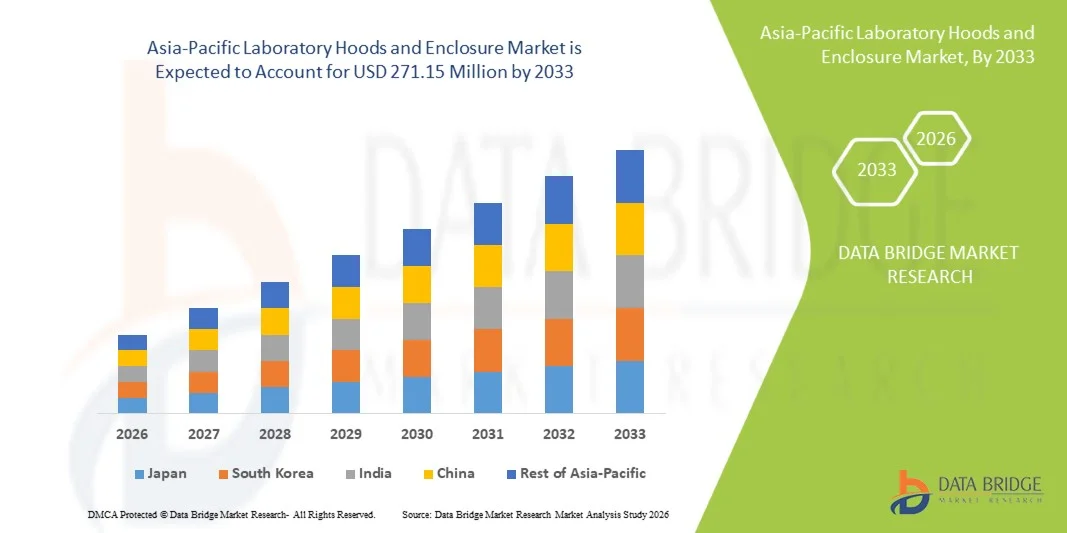
- The Asia-Pacific laboratory hoods and enclosure market size was valued at USD 135.09 million in 2025 and is expected to reach USD 271.15 million by 2033, at a CAGR of 9.1% during the forecast period
- The market growth is largely driven by the rapid expansion of pharmaceutical, biotechnology, academic research, and clinical laboratories across emerging and developed economies, supported by increased investments in R&D infrastructure and laboratory safety standard
- Furthermore, rising regulatory emphasis on occupational safety, growing awareness of hazardous material handling, and increasing adoption of advanced containment and ventilation technologies are positioning laboratory hoods and enclosures as essential safety equipment, thereby significantly boosting the market’s growth across the Asia-Pacific region
Asia-Pacific Laboratory Hoods and Enclosure Market Analysis
- Laboratory hoods and enclosures, designed to ensure personnel protection and controlled handling of chemical and biological hazards, are increasingly critical across pharmaceutical companies, research institutes, and academic centers as laboratory safety, contamination control, and regulatory compliance gain priority
- Demand for laboratory hoods and enclosures is largely driven by expanding pharmaceutical manufacturing, growth in biotechnology research, increasing government funding for life sciences, and stricter enforcement of laboratory safety standards across key Asia-Pacific countries
- China dominated the Asia-Pacific laboratory hoods and enclosure market with an estimated share of 36.2% in 2025, supported by its large pharmaceutical production base, rapid expansion of biotechnology and CRO facilities, and sustained government investment in laboratory infrastructure and research modernization
- India is expected to be the fastest-growing country during the forecast period driven by rising R&D expenditure, increasing number of pharmaceutical and biotech startups, and expansion of academic, clinical, and contract research laboratories
- Biological Safety Cabinets segment dominated the market with the largest share at 40.9% in 2025, driven by their extensive adoption in pharmaceutical companies, research institutes, and academic centers to meet stringent biosafety regulations and ensure safe handling of infectious and sensitive biological materials
Report Scope and Asia-Pacific Laboratory Hoods and Enclosure Market Segmentation
|
Attributes |
Asia-Pacific Laboratory Hoods and Enclosure Key Market Insights |
|
Segments Covered |
|
|
Countries Covered |
Asia-Pacific
|
|
Key Market Players |
|
|
Market Opportunities |
|
|
Value Added Data Infosets |
In addition to the insights on market scenarios such as market value, growth rate, segmentation, geographical coverage, and major players, the market reports curated by the Data Bridge Market Research also include in-depth expert analysis, patient epidemiology, pipeline analysis, pricing analysis, and regulatory framework |
Asia-Pacific Laboratory Hoods and Enclosure Market Trends
“Rising Adoption of Advanced Containment and Safety Technologies”
- A significant and accelerating trend in the Asia-Pacific laboratory hoods and enclosure market is the increasing adoption of advanced containment technologies, including enhanced airflow control, energy-efficient ventilation systems, and improved filtration mechanisms, aimed at ensuring higher safety and regulatory compliance in laboratory environments
- For instance, leading manufacturers are introducing biological safety cabinets and ventilated balance enclosures with HEPA/ULPA filtration and optimized airflow designs to meet stringent biosafety and chemical safety requirements in pharmaceutical and biotechnology laboratories
- Technological advancements in laboratory hoods and enclosures are enabling features such as real-time airflow monitoring, alarms for containment breaches, and improved ergonomic designs to enhance user safety and operational efficiency. For instance, some modern biological safety cabinets incorporate smart sensors to monitor airflow stability and alert users to unsafe operating conditions
- The integration of laboratory hoods and enclosures with modern laboratory infrastructure facilitates centralized monitoring of safety equipment alongside HVAC and environmental control systems, enabling laboratories to maintain consistent safety standards across multiple workstations
- This trend toward more efficient, intelligent, and regulation-compliant laboratory safety solutions is reshaping end-user expectations. Consequently, companies are focusing on developing next-generation laboratory hoods and enclosures that combine high containment performance with reduced energy consumption and space-efficient designs
- The demand for technologically advanced laboratory hoods and enclosures is growing steadily across pharmaceutical companies, research institutes, and academic centers, as laboratories increasingly prioritize safety, compliance, and operational efficiency
- Rising emphasis on sustainability is driving demand for low-energy, eco-friendly laboratory hoods with reduced exhaust requirements, supporting laboratories’ goals to lower operational costs and carbon footprints
Asia-Pacific Laboratory Hoods and Enclosure Market Dynamics
Driver
“Growing R&D Activity and Strengthening Laboratory Safety Regulations”
- The rapid expansion of pharmaceutical, biotechnology, and life sciences research activities across Asia-Pacific, coupled with the strengthening of laboratory safety regulations, is a major driver for the increasing demand for laboratory hoods and enclosures
- For instance, in recent years, government-backed initiatives in countries such as China and India have emphasized the modernization of research infrastructure and stricter enforcement of occupational safety standards, encouraging laboratories to upgrade containment and ventilation equipment
- As research involving hazardous chemicals, biological agents, and sensitive materials increases, laboratory hoods and enclosures provide essential protection through controlled airflow, containment, and contamination prevention, making them indispensable in modern laboratory settings
- Furthermore, the expansion of pharmaceutical manufacturing facilities, contract research organizations, and academic laboratories is driving the need for standardized and compliant laboratory safety equipment across new and existing facilities
- The growing focus on worker safety, regulatory audits, and accreditation requirements is compelling end users to invest in certified laboratory hoods and enclosures, thereby supporting sustained market growth across both public and private research sectors
- Rising incidence of infectious disease research and vaccine development activities is further driving demand for biological safety cabinets and specialized containment enclosures
- Increasing foreign direct investment in pharmaceutical manufacturing and CROs across Asia-Pacific countries is accelerating laboratory expansion and boosting equipment procurement
Restraint/Challenge
“High Installation Costs and Compliance Complexity”
- The relatively high initial cost of laboratory hoods and enclosures, including installation, ducting, and facility modifications, poses a significant challenge to market adoption, particularly for small laboratories and academic institutions with limited budgets
- For instance, advanced ducted hoods and biological safety cabinets often require specialized infrastructure and professional installation, increasing total ownership costs and limiting adoption in cost-sensitive markets
- Compliance with diverse and evolving safety standards and certification requirements across different Asia-Pacific countries adds complexity for manufacturers and end users, potentially delaying procurement and installation decisions
- In addition, the operational costs associated with energy consumption, routine maintenance, and filter replacement can be a concern for laboratories seeking to optimize long-term expenditures
- Overcoming these challenges through the development of cost-effective, modular designs, energy-efficient systems, and simplified compliance solutions will be crucial for manufacturers to expand adoption and ensure sustained growth in the Asia-Pacific laboratory hoods and enclosure market
- Limited technical expertise in smaller laboratories to properly operate and maintain advanced containment systems can restrict effective utilization
- Longer procurement and approval cycles in public and academic institutions can delay equipment upgrades and slow market penetration
Asia-Pacific Laboratory Hoods and Enclosure Market Scope
The market is segmented on the basis of product, modularity, material, and end user.
- By Product
On the basis of product, the Asia-Pacific laboratory hoods and enclosure market is segmented into ventilated balance enclosures (VBEs), biological safety cabinets, laminar flow cabinets, enclosures, hoods, and others. Biological Safety Cabinets dominated the market in 2025 with a market share of 40.9%, driven by their critical role in protecting personnel, samples, and the environment during handling of infectious agents and biological materials. Pharmaceutical companies, research institutes, and academic centers across China, Japan, and South Korea extensively rely on these cabinets to meet biosafety regulations. Their mandatory use in vaccine development, microbiology, and clinical research laboratories further supports dominance. Increasing infectious disease research and government-funded life science projects have strengthened demand. Compliance with international standards such as WHO and CDC guidelines also favors adoption. The availability of Class I, II, and III cabinets supports broad application coverage.
Ventilated Balance Enclosures (VBEs) are expected to be the fastest-growing segment from 2026 to 2033, fueled by rising analytical and weighing activities in pharmaceutical and chemical laboratories. VBEs provide localized containment while maintaining balance accuracy, making them ideal for handling powders and toxic substances. Growth in drug formulation and quality control laboratories across India and Southeast Asia is driving adoption. Their compact footprint and lower energy consumption compared to full-scale hoods increase appeal. Increasing regulatory focus on operator safety during weighing processes further accelerates growth.
- By Modularity
On the basis of modularity, the market is segmented into benchtop and portable laboratory hoods and enclosures. Benchtop systems dominated the market in 2025, supported by their widespread use in permanent laboratory setups within pharmaceutical manufacturing, CROs, and academic research facilities. These systems offer stable installation, higher containment efficiency, and compatibility with ducted ventilation infrastructure. Large-scale laboratories prefer benchtop units for continuous, high-volume operations. Their ability to support multiple applications, including chemical handling and biological research, strengthens dominance. Established laboratory designs across China and Japan favor fixed benchtop installations. Regulatory inspections also often mandate fixed containment solutions.
Portable laboratory hoods and enclosures are projected to witness the fastest growth during the forecast period, driven by the need for flexibility and space optimization. Rapid expansion of small laboratories, startups, and temporary research facilities is increasing demand. Portable units allow easy relocation and quick deployment without major infrastructure changes. Cost-effectiveness and reduced installation time further support adoption. Growing research activity in academic institutions and contract labs across India and ASEAN countries is accelerating growth.
- By Material
On the basis of material, the Asia-Pacific laboratory hoods and enclosure market is segmented into PVC, stainless steel, and others. Stainless steel dominated the market in 2025, owing to its superior durability, corrosion resistance, and ease of cleaning. Pharmaceutical and biotechnology laboratories prefer stainless steel due to its compatibility with sterile and cleanroom environments. Its ability to withstand harsh chemicals and frequent decontamination supports long-term use. Regulatory compliance requirements in GMP-certified facilities further drive demand. High adoption in biological safety cabinets and pharmaceutical enclosures strengthens market share. Stainless steel is also favored for its long service life and structural integrity.
PVC is expected to be the fastest-growing material segment from 2026 to 2033, driven by its cost-effectiveness and strong resistance to chemical corrosion. PVC-based hoods are increasingly adopted in academic and teaching laboratories with budget constraints. Lightweight properties make PVC suitable for portable and modular enclosures. Growth in educational infrastructure across India and Southeast Asia supports adoption. Increasing awareness of affordable laboratory safety solutions further fuels growth.
- By End User
On the basis of end user, the market is segmented into pharmaceutical companies, research institutes, academic centers, and others. Pharmaceutical companies dominated the market in 2025, supported by large-scale drug development, manufacturing, and quality control activities. Strict regulatory compliance requirements for worker safety and contamination control drive consistent investment in laboratory hoods and enclosures. Expansion of pharmaceutical manufacturing hubs in China and India significantly contributes to dominance. High utilization of biological safety cabinets and ducted hoods strengthens demand. Continuous R&D activities and capacity expansions further support market leadership.
Research institutes are expected to be the fastest-growing end-user segment during the forecast period, driven by increased government funding and international collaborations. Growth in public and private research facilities focusing on biotechnology, genomics, and infectious diseases is accelerating adoption. Establishment of new research centers across Asia-Pacific supports demand for advanced containment solutions. Rising emphasis on laboratory accreditation and safety compliance boosts procurement. Increasing collaboration with pharmaceutical companies further enhances growth potential.
Asia-Pacific Laboratory Hoods and Enclosure Market Regional Analysis
- China dominated the Asia-Pacific laboratory hoods and enclosure market with an estimated share of 36.2% in 2025, supported by its large pharmaceutical production base, rapid expansion of biotechnology and CRO facilities, and sustained government investment in laboratory infrastructure and research modernization
- End users in China place strong emphasis on laboratory safety, regulatory compliance, and effective containment of chemical and biological hazards, resulting in high adoption of biological safety cabinets, ventilated enclosures, and laboratory hoods across pharmaceutical companies and research institutes
- This widespread adoption is further supported by significant government investment in life sciences research, healthcare infrastructure development, and laboratory modernization initiatives, firmly establishing China as the leading market for laboratory hoods and enclosures in the Asia-Pacific region
The China Laboratory Hoods and Enclosure Market Insight
The China laboratory hoods and enclosure market captured the largest revenue share within Asia-Pacific in 2025, fueled by the country’s expansive pharmaceutical manufacturing base and rapid growth of biotechnology and contract research organizations. End users increasingly prioritize laboratory safety and regulatory compliance, driving strong demand for biological safety cabinets, ventilated enclosures, and laboratory hoods. The expansion of government-funded research institutes and large-scale healthcare infrastructure projects further supports market growth. Moreover, China’s focus on domestic drug development and biosafety preparedness is significantly contributing to sustained demand for advanced laboratory containment solutions.
Japan Laboratory Hoods and Enclosure Market Insight
The Japan laboratory hoods and enclosure market is experiencing steady growth due to the country’s strong focus on research excellence, technological innovation, and stringent safety standards. Japanese laboratories place high importance on precision, cleanliness, and contamination control, driving adoption of advanced biological safety cabinets and laminar flow systems. Growth in pharmaceutical R&D, regenerative medicine, and academic research is supporting demand. Furthermore, modernization of existing laboratory facilities and replacement of aging equipment are contributing to continued market expansion.
South Korea Laboratory Hoods and Enclosure Market Insight
The South Korea laboratory hoods and enclosure market is expanding steadily, supported by the country’s strong biotechnology, pharmaceutical, and semiconductor research ecosystem. Increasing investments in biomedical research, vaccine development, and advanced diagnostics are driving demand for high-performance laboratory hoods and biological safety cabinets. South Korea’s emphasis on regulatory compliance and laboratory accreditation is encouraging upgrades to modern containment systems. In addition, government-backed R&D initiatives and the growth of academic research centers are strengthening market growth.
India Laboratory Hoods and Enclosure Market Insight
The India laboratory hoods and enclosure market accounted for a significant revenue share in Asia-Pacific in 2025, supported by rapid expansion of pharmaceutical manufacturing, biotechnology startups, and academic research institutions. Increasing government initiatives promoting research, vaccine development, and healthcare infrastructure are driving demand for laboratory safety equipment. The growing number of CROs and testing laboratories is further accelerating adoption. In addition, rising awareness of laboratory safety standards and the availability of cost-effective containment solutions are key factors propelling market growth in India.
Asia-Pacific Laboratory Hoods and Enclosure Market Share
The Asia-Pacific Laboratory Hoods and Enclosure industry is primarily led by well-established companies, including:
- Thermo Fisher Scientific Inc., (U.S.)
- Esco Micro Pte. Ltd., (Singapore)
- Haier Biomedical, (China)
- NuAire, (U.S.)
- Labconco Corporation, (U.S.)
- Kewaunee International Group, (U.S.)
- BIOBASE GROUP, (China)
- Heal Force Bio-Meditech Holdings Ltd., (China)
- Guangdong Widinlsa International Co., Ltd., (China)
- Air Science USA LLC, (U.S.)
- Erlab, (France)
- Flow Sciences, Inc., (U.S.)
- The Baker Company, (U.S.)
- Germfree Laboratories, Inc., (U.S.)
- Yamato Scientific Co., Ltd., (Japan)
- Shimadzu Rika Corporation, (Japan)
- LabGuard India Pvt. Ltd., (India)
- TopAir Systems Ltd., (Israel)
- Telstar Life-Sciences, (Spain)
- Sentry Air Systems, Inc., (U.S.)
What are the Recent Developments in Asia-Pacific Laboratory Hoods and Enclosure Market?
- In November 2025, Haier Biomedical showcased nearly 20 cutting-edge smart laboratory and containment products, including biosafety cabinets, at the MEDICA 2025 global medical technology exhibition, emphasizing digital, IoT-enabled lab safety solutions
- In May 2025, Thermo Fisher Scientific launched the Thermo Scientific 1500 Series Class II, Type A2 Biological Safety Cabinet, featuring enhanced airflow precision and real-time safety alerts aimed at elevating lab safety and operational efficiency, marking a significant product advancement for high-containment laboratories
- In March 2023, Esco Lifesciences introduced the Labculture G4 Class II Biological Safety Cabinet, representing a major technological advance in airflow management and safety for high-containment labs and compliant research environment
- In March 2023, Labconco launched the ReVo Class II, Type A2 microbiological safety cabinet, a new product designed for improved containment and ease of use in research and clinical laboratories
- In April 2021, Tecniplast Group completed the acquisition of BioAir Spa, broadening its global product portfolio to include laminar flow units, industrial cabinets, and biosafety cabinets strengthening its presence in laboratory containment and safety equipment markets worldwide, including Asia
SKU-
世界初のマーケットインテリジェンスクラウドに関するレポートにオンラインでアクセスする

- インタラクティブなデータ分析ダッシュボード
- 成長の可能性が高い機会のための企業分析ダッシュボード
- カスタマイズとクエリのためのリサーチアナリストアクセス
- インタラクティブなダッシュボードによる競合分析
- 最新ニュース、更新情報、トレンド分析
- 包括的な競合追跡のためのベンチマーク分析のパワーを活用
調査方法
データ収集と基準年分析は、大規模なサンプル サイズのデータ収集モジュールを使用して行われます。この段階では、さまざまなソースと戦略を通じて市場情報または関連データを取得します。過去に取得したすべてのデータを事前に調査および計画することも含まれます。また、さまざまな情報ソース間で見られる情報の不一致の調査も含まれます。市場データは、市場統計モデルと一貫性モデルを使用して分析および推定されます。また、市場シェア分析と主要トレンド分析は、市場レポートの主要な成功要因です。詳細については、アナリストへの電話をリクエストするか、お問い合わせをドロップダウンしてください。
DBMR 調査チームが使用する主要な調査方法は、データ マイニング、データ変数が市場に与える影響の分析、および一次 (業界の専門家) 検証を含むデータ三角測量です。データ モデルには、ベンダー ポジショニング グリッド、市場タイムライン分析、市場概要とガイド、企業ポジショニング グリッド、特許分析、価格分析、企業市場シェア分析、測定基準、グローバルと地域、ベンダー シェア分析が含まれます。調査方法について詳しくは、お問い合わせフォームから当社の業界専門家にご相談ください。
カスタマイズ可能
Data Bridge Market Research は、高度な形成的調査のリーダーです。当社は、既存および新規のお客様に、お客様の目標に合致し、それに適したデータと分析を提供することに誇りを持っています。レポートは、対象ブランドの価格動向分析、追加国の市場理解 (国のリストをお問い合わせください)、臨床試験結果データ、文献レビュー、リファービッシュ市場および製品ベース分析を含めるようにカスタマイズできます。対象競合他社の市場分析は、技術ベースの分析から市場ポートフォリオ戦略まで分析できます。必要な競合他社のデータを、必要な形式とデータ スタイルでいくつでも追加できます。当社のアナリスト チームは、粗い生の Excel ファイル ピボット テーブル (ファクト ブック) でデータを提供したり、レポートで利用可能なデータ セットからプレゼンテーションを作成するお手伝いをしたりすることもできます。











